

1.5m Accuracy GPS Module That Changes What Builders Can Afford
The 1.5m Accuracy GPS Module Built for Professionals Who Can't Afford to Compromise
There is a gap in the GPS module market that most hardware developers have learned to silently accept. On one side, you have cheap commodity GNSS modules that deliver mediocre accuracy, slow fix rates, and unreliable multi-constellation support. On the other side, you have enterprise-grade precision navigation hardware with price tags that belong on a procurement invoice, not a maker workbench.
The MultiNav Pro+™ from RFOXiA exists to close that gap permanently.
This is a 1.5m accuracy GPS module engineered for drone builders, robotics engineers, precision agriculture developers, field researchers, and anyone who needs navigation data they can actually trust — at a price that doesn't require a grant application. At $49, the MultiNav Pro+ delivers specifications that were previously reserved for systems costing ten times as much.
This guide covers everything you need to know: what makes this module technically exceptional, how it compares to the alternatives, who it's built for, and why it belongs in your next project.
What Is the MultiNav Pro+?
The MultiNav Pro+ is RFOXiA's precision GNSS module, designed for integration into professional-grade hardware projects. It is built around the u-blox MIA-M10Q, one of the most advanced GNSS chipsets available for compact embedded applications. The result is a module that delivers accuracy, speed, and reliability that commodity alternatives simply cannot match.
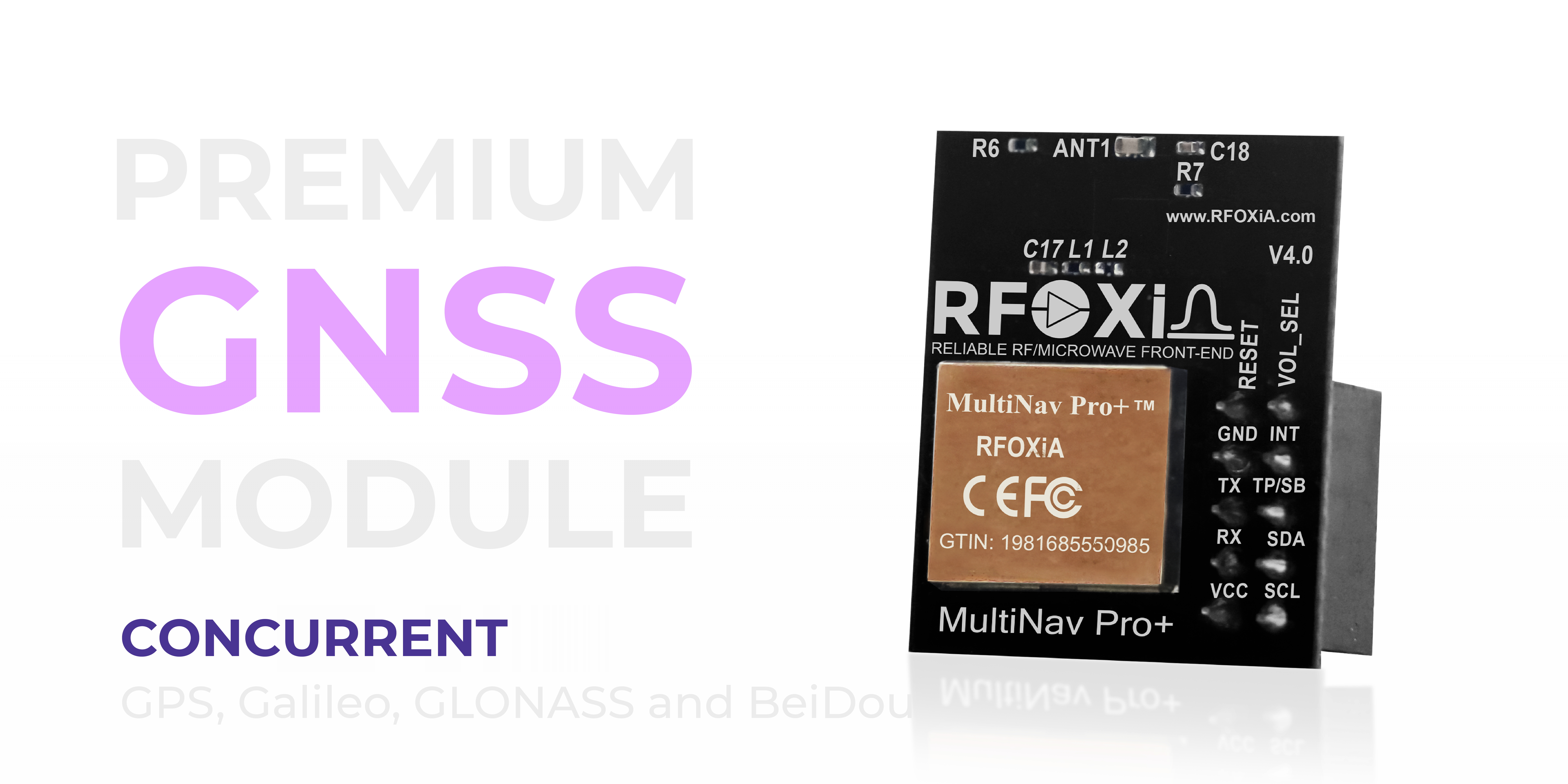
The MultiNav Pro+ is FCC certified, ready to ship, and supported by a complete software library compatible with Arduino IDE and other popular toolchains. It is a module designed by hardware engineers for hardware engineers — with the documentation, ecosystem integration, and build quality that serious projects demand.
Core Specifications at a Glance
Before diving into the technical depth, here is the complete specification summary:
- Accuracy: Less than 1.5 meters
- Fix Rate: 18Hz
- First Fix Time: 1 second (hot start)
- GNSS Systems: Concurrent GPS, Galileo, GLONASS, BeiDou
- Chipset: u-blox MIA-M10Q
- Antenna: Integrated high-gain chip antenna
- Interface: UART (TX/RX) and I2C (SCL/SDA)
- Operating Voltage: 1.8V and 3.3V
- Power Draw: 25–30mA
- Dimensions: 26mm × 22mm
- Certification: FCC certified
- Price: $49
Every one of these numbers matters. Let's break down why.
Why 1.5m Accuracy Changes Everything
When evaluating a 1.5m accuracy GPS module, it is worth understanding what that number actually means in practice — and why it represents such a significant leap over typical consumer-grade GNSS hardware.
Most commodity GPS modules used in maker projects advertise accuracy figures of 2.5 to 5 meters CEP (Circular Error Probable). That means half of all readings fall within a 2.5–5 meter radius of the true position. For applications like casual navigation or asset tracking where precision is secondary, this may be acceptable.
But consider what 5-meter accuracy means for a drone operating autonomously. A 5-meter position error is the difference between landing on a rooftop and landing on the edge — or not landing at all. In precision agriculture, a 5-meter error means herbicide applied to the wrong row, wasted input costs, and crop damage. In survey work, it means data that cannot be trusted.
The MultiNav Pro+'s sub-1.5m accuracy is not a marginal improvement. It is a fundamentally different class of precision. Combined with the 18Hz fix rate — which delivers 18 position updates per second — it enables tracking of fast-moving platforms like racing drones, robotic vehicles, and autonomous aircraft with the kind of temporal resolution that slow-updating modules cannot approach.

The 1-second first fix time is equally important for real-world deployment. Waiting 30–60 seconds for a GPS lock before a mission can begin is not just inconvenient — for time-sensitive applications, it can be a genuine operational constraint. The MultiNav Pro+ acquires a first fix in one second under hot start conditions, meaning your system is location-aware almost immediately after power-on.
Concurrent Multi-Constellation GNSS: Why It Matters
Not all GPS modules receive signals from all satellite systems simultaneously. Many low-cost modules are GPS-only, meaning they rely exclusively on the US GPS constellation of satellites. This creates real-world performance degradation in urban environments, forested areas, or any location where parts of the sky are obstructed.
The MultiNav Pro+ concurrently receives signals from four independent satellite networks:
GPS — The original US Department of Defense network. Global coverage, mature infrastructure.
Galileo — The European Space Agency's civilian constellation, known for high accuracy signals and strong performance in mid-latitude regions.
GLONASS — The Russian global navigation system. Adds satellite density particularly in high-latitude regions where GPS coverage thins.
BeiDou — China's satellite navigation system, now a mature global constellation with particular density across Asia.
By receiving from all four simultaneously, the MultiNav Pro+ always has more satellites in view than any single-constellation module. More satellites means better geometric dilution of precision (GDOP), which directly translates to better position accuracy. In challenging environments — urban canyons, mountain valleys, dense forests — this multi-constellation approach maintains accuracy where GPS-only modules degrade significantly.
Advanced RF Filtering Technology
Signal quality is not just about the chipset. A high-performance GNSS chip connected to poor RF front-end circuitry will still deliver mediocre results. RFOXiA's engineering background in RF technology is directly reflected in the MultiNav Pro+ design.
The module incorporates proprietary RF/microwave microstrip filter technology that minimizes interference before the signal reaches the chipset. This is particularly important in embedded applications where the GNSS module is deployed alongside other RF systems — radios, microcontrollers, switching power supplies — all of which generate electromagnetic noise that can degrade GPS signal quality.
The integrated high-gain chip antenna is designed to maximize signal reception within the compact 26mm × 22mm form factor. This is not a compromise antenna. It is an optimized design that delivers strong reception without requiring an external antenna, though external antenna support is available for applications where additional gain is needed.
Compact, Efficient, and Ready to Deploy
Hardware integration decisions are often constrained by size and power. The MultiNav Pro+ was designed with both constraints in mind.
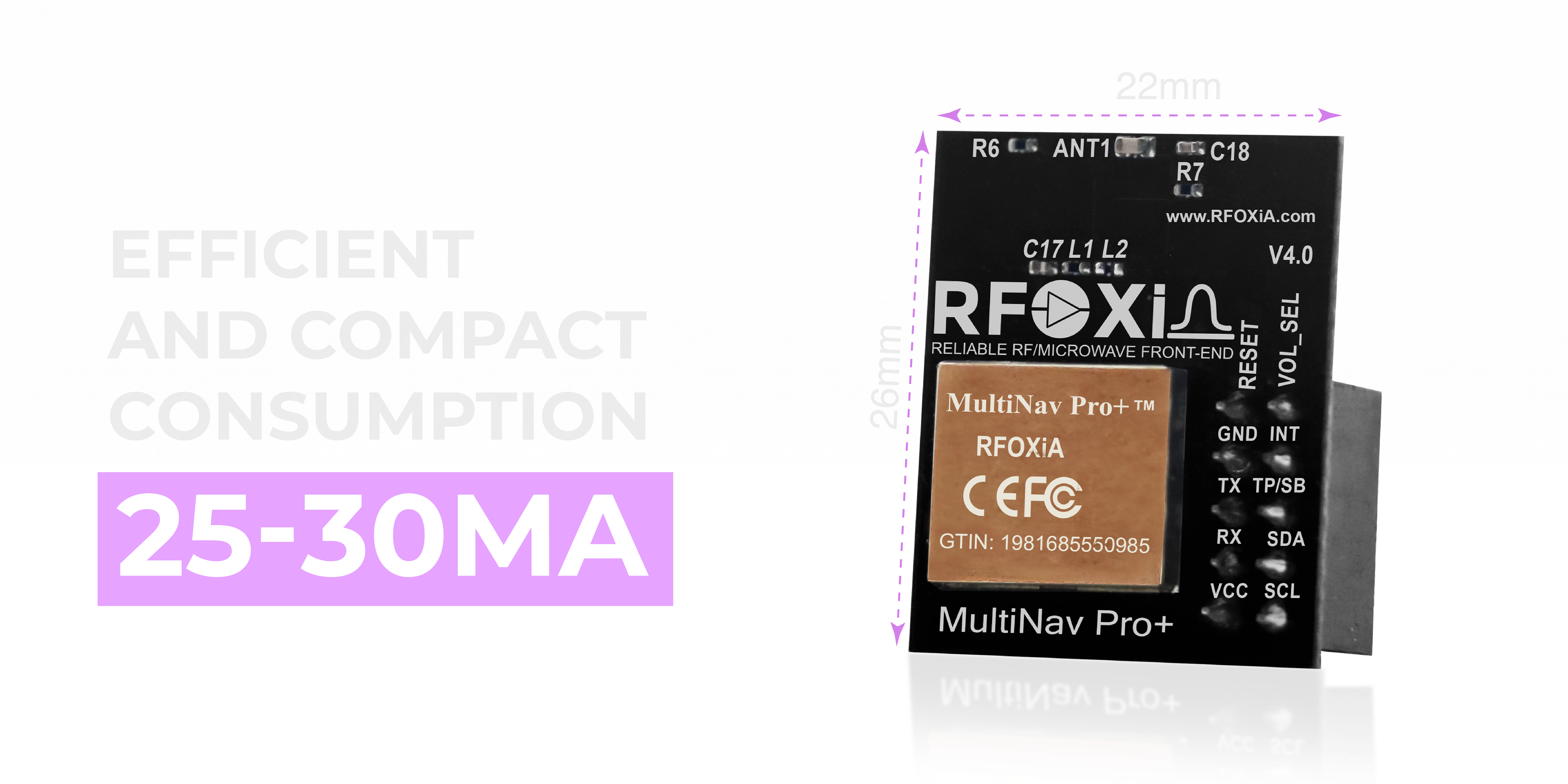
At 26mm × 22mm, the MultiNav Pro+ fits into tight PCB layouts without dominating board real estate. The 25–30mA power draw is modest for a full multi-constellation GNSS system, making it suitable for battery-powered field devices, UAV payloads, and portable IoT nodes where power budgets are carefully managed.
For developers working on wearable devices, miniaturized robotics, or compact sensor payloads, the combination of sub-1.5m accuracy and compact form factor in a single module is genuinely difficult to replicate at any price point.
Flexible Interface Options for Any Platform
One of the most practical aspects of the MultiNav Pro+ is its dual-interface design. Many GPS modules offer only a single communication interface, which can create integration headaches depending on which pins and protocols your microcontroller has available.
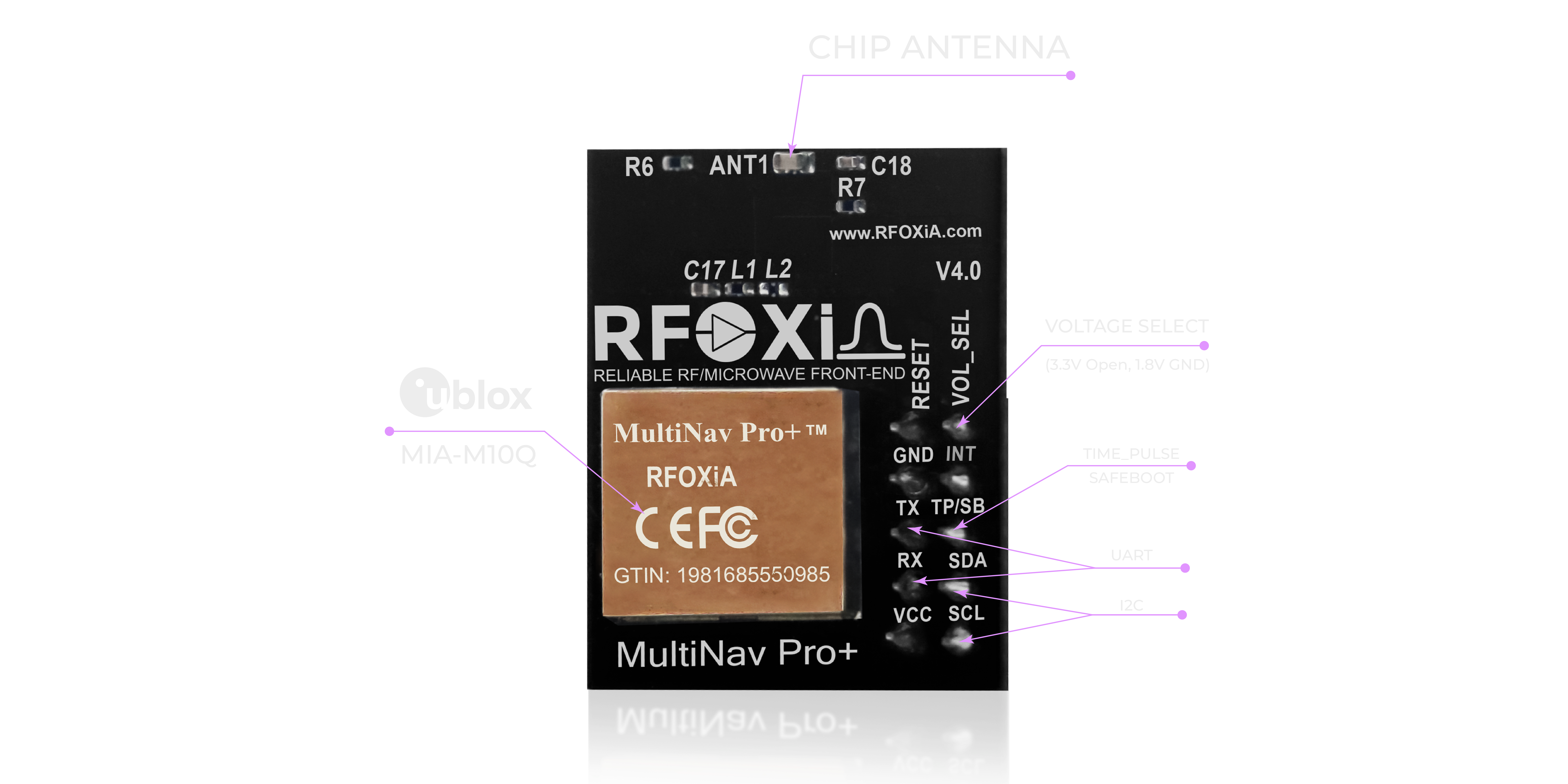
The MultiNav Pro+ supports:
UART (TX/RX) — The standard serial interface used by most GPS libraries across every major development platform. Compatible with Arduino, ESP32, STM32, Raspberry Pi, and virtually any microcontroller with a UART peripheral.
I2C (SCL/SDA) — Ideal for projects where you need to share a bus between multiple devices or where UART pins are already committed to other peripherals. I2C integration allows the GNSS module to coexist on the same bus with other sensors without requiring dedicated serial pins.
The module also supports both 1.8V and 3.3V operating voltages, making it compatible with modern low-voltage microcontrollers without requiring additional level shifting hardware in most configurations.
Who Is the MultiNav Pro+ Built For?
This is a professional-grade 1.5m accuracy GPS module, and its target users reflect that positioning.
Drone Builders and UAV Developers
Precision flight depends on precise position. Whether you are building an autonomous fixed-wing platform, a multirotor that needs to hold position in wind, or a racing drone with GPS return-to-home functionality, the MultiNav Pro+'s 18Hz fix rate and sub-1.5m accuracy provides the navigation foundation your autopilot needs. The fast first-fix time means shorter pre-flight initialization, and the multi-constellation support maintains lock even in challenging electromagnetic environments.
Precision Agriculture Engineers
Autonomous agricultural drones and ground vehicles require navigation accuracy measured in centimeters to meters, not dozens of meters. For variable-rate application systems, row-following algorithms, and field mapping applications, the MultiNav Pro+ delivers the accuracy tier that makes the data actionable.
Field Researchers and Scientists
Geotagged environmental data is only as valuable as the accuracy of the GPS coordinates attached to it. For researchers deploying sensor networks, conducting ecological surveys, or collecting field samples with GPS documentation, the MultiNav Pro+ provides the location precision that makes data publication-worthy.
IoT and Asset Tracking Developers
High-value asset tracking, fleet management, and logistics monitoring applications benefit directly from improved position accuracy. When the tracked item is in a dense urban environment or a GPS-challenged location, multi-constellation support makes the difference between reliable tracking and frustrating signal dropouts.
Robotics Engineers
Outdoor autonomous robots — ground vehicles, delivery platforms, inspection robots — need position feedback that is accurate enough to execute planned paths without significant deviation. Combined with onboard IMUs and the RFOXiA Sensors Module, the MultiNav Pro+ provides the outdoor positioning layer for serious robotics projects.
The RFOXiA Ecosystem Advantage
The MultiNav Pro+ is not just a standalone module. It is a component in a broader, deeply integrated ecosystem that sets RFOXiA apart from every other GNSS module vendor at this price point.
The RFOXiA Accurate GNSS Module is fully compatible with the RFOXiA Developer Bundle, which combines the BLE Module (5km ground-to-ground, 15–20km man-to-drone range), the Sensors Module (7 environmental sensors), and the Power/Program Kit (5-minute charge, 24-hour runtime) into a single integrated development platform.
When deployed together, the MultiNav Pro+ provides the precise location layer for a complete wireless sensing and communication system. Real-time GPS coordinates pair with environmental sensor data and transmit wirelessly over the BLE module — all displayed live on the RFOXiA Connect app on your phone. This is not a collection of loosely related modules. It is a purpose-designed stack.
For developers who want to go further, RFOXiA Club includes an AI Firmware Builder that generates production-ready firmware for your GNSS module integration in plain English — no months of library research required. Describe what you want your system to do, and the AI produces working code you can modify and deploy immediately.
The Data Network Opportunity
One aspect of the MultiNav Pro+ that no competing GNSS module can offer is its role in the RFOXiA data monetization network.
When deployed with the Sensors Module, GPS validation from the MultiNav Pro+ is a core verification requirement for data network participation. The system validates that your sensor node is genuinely deployed outdoors at a real geographic location — which is what makes the data valuable to enterprise buyers. GPS-verified sensor data commands premium pricing from agricultural companies, insurance firms, smart city operators, and research institutions that need granular, trustworthy environmental measurements.
Early network participants earn daily rewards for streaming verified environmental data, with rates influenced by location scarcity and data quality. Your hardware investment actively generates returns while deployed in the field.
Software Library and Development Support
Every MultiNav Pro+ ships with a ready software library that is compatible with Arduino IDE and other popular toolchains. You do not need to write register-level initialization code or parse raw NMEA sentences from scratch. The library handles module configuration, data parsing, and output formatting, letting you focus on building your application rather than integrating low-level hardware.
For teams working in more complex environments — ROS2 robotics stacks, custom RTOS firmware, or embedded Linux — the u-blox MIA-M10Q's well-documented protocol and the RFOXiA SDK provide the hooks needed for deep integration.
Full documentation, quick start guides, and community support are available through RFOXiA Club, where developers share projects, troubleshoot integrations, and access the AI firmware builder for accelerated development.
Pricing and Value Comparison
At $49, the MultiNav Pro+ occupies a pricing position that requires honest comparison to understand its value.
Commodity GPS modules at $5–15 deliver 2.5–5m accuracy, GPS-only or limited dual-constellation support, fix rates of 1–5Hz, and minimal documentation. They are adequate for casual applications but fall short for professional use.
Professional GNSS modules from survey-grade vendors delivering comparable accuracy start at $150–500+ for the module alone, without the ecosystem integration, software library, or application support that RFOXiA provides.
The MultiNav Pro+ at $49 is the point where professional-grade positioning becomes accessible to the maker, developer, and small team market. That is the core of what RFOXiA means by democratizing connectivity and computing power.
What's in the Box
Each MultiNav Pro+ package includes:
- MultiNav Pro+ GNSS Module
- Quick Start Guide for immediate setup
The software library is available via RFOXiA Club, and the Developer Bundle option includes additional modules for a complete integrated platform.
Final Assessment: Is the MultiNav Pro+ Right for Your Project?
If your project requires location data you can genuinely trust — not approximate, not good enough, but accurate within 1.5 meters with 18 updates per second — the MultiNav Pro+ is the most technically capable and cost-accessible solution available at this price point.
The combination of u-blox MIA-M10Q precision, concurrent four-constellation support, proprietary RF filtering, 1-second first fix, and deep integration with the RFOXiA ecosystem makes this a module that belongs in professional-grade builds.
For drone builders, robotics engineers, precision agriculture developers, field researchers, and IoT developers who have been compromising on GPS quality because professional-grade modules were priced out of reach — that compromise is over.
The RFOXiA Accurate GNSS Module is available now at $49 with FCC certification, ready-to-ship inventory, and full software and ecosystem support.
Frequently Asked Questions
Q: Does the MultiNav Pro+ work with Arduino? Yes. The included software library is compatible with Arduino IDE and works with any UART or I2C-capable Arduino board.
Q: Can I use the MultiNav Pro+ with an ESP32 or Raspberry Pi? Yes. The UART and I2C interfaces are compatible with ESP32, Raspberry Pi, STM32, and virtually any modern development platform.
Q: Does the module require an external antenna? No. The integrated high-gain chip antenna provides optimal performance for most applications. External antenna support is available for applications requiring additional gain in challenging environments.
Q: Is the MultiNav Pro+ compatible with the rest of the RFOXiA ecosystem? Yes. It is fully compatible with the BLE Module, Sensors Module, Power/Program Kit, and the RFOXiA Connect app. It is a core component of the Developer Bundle.
Q: How does 1.5m accuracy compare to a standard phone GPS? Modern smartphones typically achieve 3–5 meter accuracy under ideal conditions, and significantly worse in obstructed environments. The MultiNav Pro+'s sub-1.5m accuracy with multi-constellation support consistently outperforms smartphone GPS, particularly in challenging locations.
Ready to add professional-grade GNSS to your next project? Visit the RFOXiA Accurate GNSS Module product page and get yours today.
Written by: Moamen Mohamed LinkedIn