
Accurate GNSS Module: Why Precision Matters and How the MultiNav Pro+ Delivers It
The Accurate GNSS Module Built for Builders Who Can't Afford to Guess
Position accuracy is not a luxury — it is the foundation of every reliable autonomous system. Whether you are building a precision drone, a mobile robotics platform, an agricultural sensor node, or a field research instrument, the quality of your location data determines the quality of everything that follows. A module that drifts by 10 meters does not just produce bad data — it produces dangerous decisions.
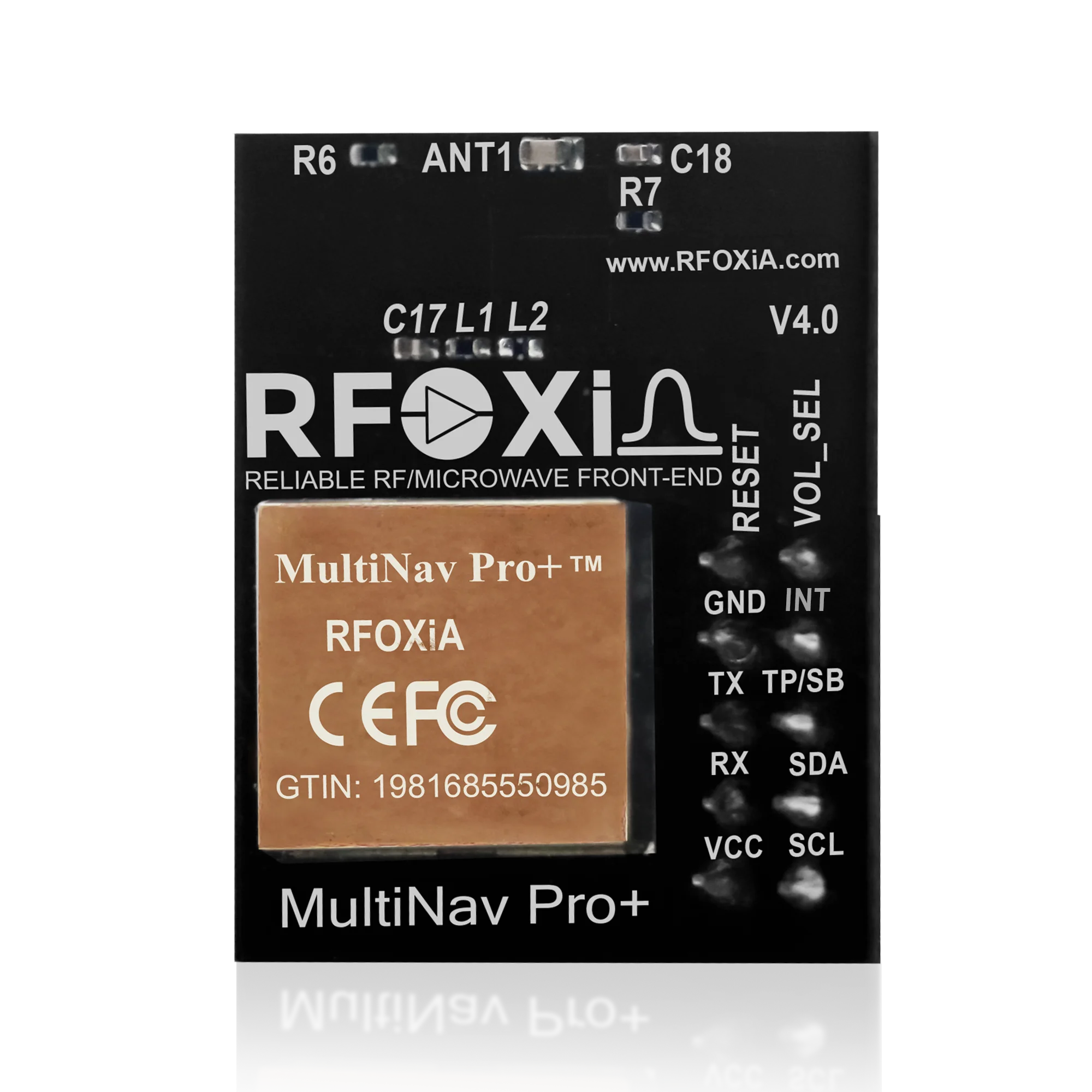
The MultiNav Pro+™ from RFOXiA is an accurate GNSS module engineered for developers, drone builders, researchers, and IoT engineers who demand real performance at a price that does not require a defense contract. With 1.5-meter accuracy, an 18Hz fix rate, concurrent multi-constellation support, and a compact 26mm x 22mm footprint, it is one of the most capable navigation modules available to the professional maker community.
This post breaks down what makes a GNSS module truly accurate, what separates the MultiNav Pro+ from the commodity market, and why fix rate matters just as much as positional accuracy when you are working with fast-moving platforms.
What "Accurate" Actually Means in GNSS
Most GPS modules marketed for consumer electronics or hobby use quote circular error probable (CEP) figures of 2.5 meters to 5 meters under ideal open-sky conditions. In practice, with urban interference, reflected signals, and atmospheric delay, that number frequently climbs to 8–15 meters. For photography drones operating in a park, that is acceptable. For precision agriculture, autonomous ground vehicles, or any application where a 10-meter position error translates to physical consequences, it is not.
True accuracy in GNSS comes from several layered factors:
- Receiver sensitivity — the ability to acquire and maintain lock on weak satellite signals
- Multi-constellation support — drawing from more satellites across more orbital planes reduces dilution of precision (DOP)
- Signal filtering — eliminating RF interference before it corrupts the position solution
- Fix rate — how many position updates per second the receiver generates, critical for tracking fast-moving objects
- Chipset quality — the core engine that processes all of the above
The MultiNav Pro+ addresses every one of these factors with hardware and firmware choices made specifically for demanding applications.
Inside the MultiNav Pro+: Hardware Built for Precision
The u-blox MIA-M10Q Chipset
At the heart of the MultiNav Pro+ is the u-blox MIA-M10Q, one of the most capable GNSS chips in the professional market for compact module design. u-blox is the gold standard in precision navigation silicon — their chipsets are found in survey-grade equipment, industrial automation systems, and commercial UAV platforms.
The MIA-M10Q brings ultra-low power consumption alongside exceptional receiver sensitivity, making it suitable for battery-powered deployments where you cannot afford to sacrifice either runtime or accuracy. This is not a rebranded consumer chip — it is professional navigation silicon in a maker-accessible form factor.
Concurrent Four-Constellation GNSS
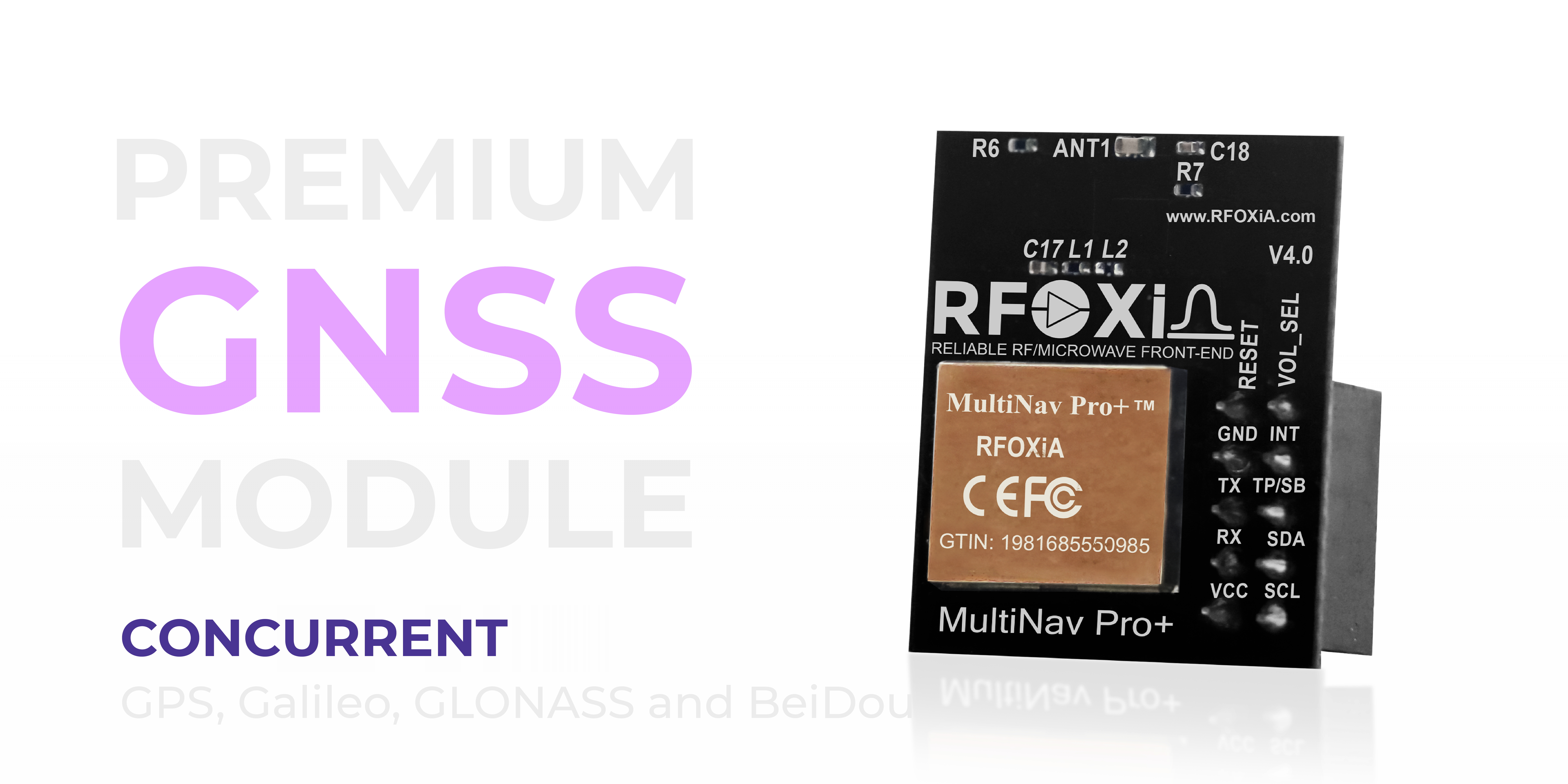
The MultiNav Pro+ simultaneously receives signals from GPS, Galileo, GLONASS, and BeiDou. This is significant for two reasons.
First, more satellites in view means better geometry. When your receiver is triangulating position from 20+ satellites across four independent constellation networks, the dilution of precision drops substantially. You get tighter position solutions even in partially obstructed environments — urban canyons, forest canopy, mountainous terrain.
Second, redundancy. If one constellation has degraded signal quality in your region at a given time, the others compensate. Concurrent multi-constellation support is not a marketing feature — it is an engineering requirement for any application that demands consistent sub-2-meter accuracy.
Proprietary RF Microstrip Filter Technology
RFOXiA's background is RF engineering, and that expertise is built directly into the MultiNav Pro+. The module incorporates advanced RF/microwave microstrip filter technology that attenuates interference before it reaches the receiver.
In real-world deployments — particularly on drones where ESCs, motors, video transmitters, and BLE modules all generate RF noise — this filtering makes a measurable difference in signal quality and position stability. You are not just buying a chipset. You are buying a complete RF system designed to perform in electrically noisy environments.
Integrated High-Gain Chip Antenna
The module uses an integrated chip antenna optimized for GNSS band reception. This eliminates the need for an external patch antenna in most applications, keeping your design compact and reducing the mechanical complexity of mounting. The antenna is tuned and characterized as part of the module — signal reception is validated, not assumed.
For applications where maximum performance is required in challenging environments, the module can also interface with external antenna options through appropriate circuit modifications.
18Hz Fix Rate: Why Speed Matters as Much as Accuracy
Most GNSS modules aimed at the maker market update position at 1Hz — one fix per second. Some higher-end modules push to 5Hz or 10Hz. The MultiNav Pro+ delivers 18 fixes per second.
For a static sensor node measuring air quality in a field, 1Hz is fine. But for any dynamic platform — a racing drone, an autonomous ground vehicle, a fixed-wing UAV executing a survey grid, a tracked wildlife tag — position update rate is critical.
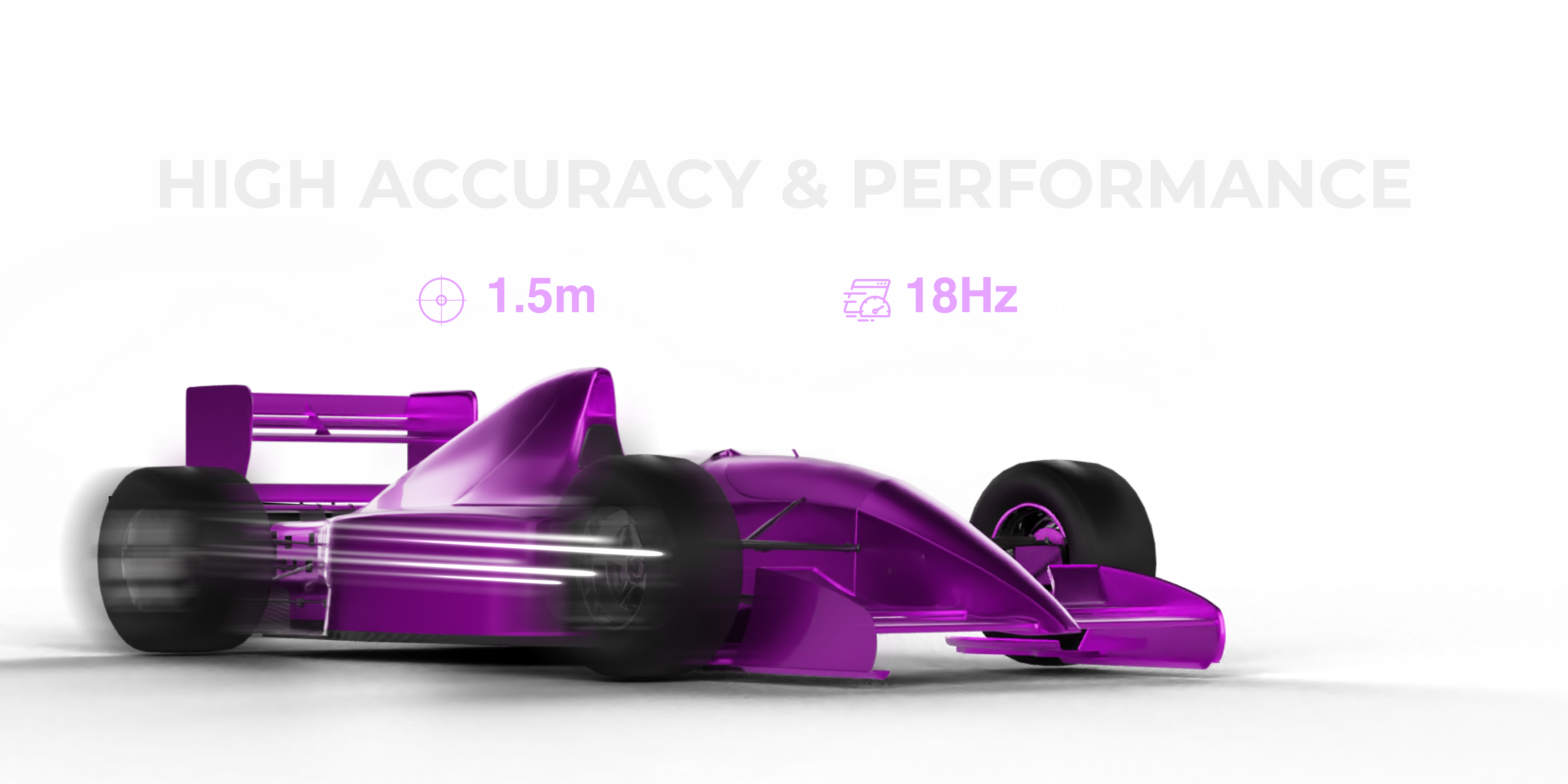
Consider a drone flying at 15 meters per second (a moderate cruising speed). At 1Hz, your control system receives a new position every 15 meters of travel. At 18Hz, it receives a new position every 0.83 meters. The difference between those two scenarios is the difference between smooth autonomous flight and a platform that cannot track its own trajectory.
The 18Hz fix rate of the MultiNav Pro+ makes it genuinely suitable for high-speed autonomous systems where most modules in its price class would fail to keep up.
First Fix in One Second
The module achieves first position fix in approximately one second under typical open-sky conditions with valid almanac data. Hot start performance is exceptional for field deployments where you power the system, check position, and move — survey workflows, rapid deployment scenarios, emergency response applications.
Integration and Developer Experience
An accurate GNSS module is only useful if you can actually build with it. RFOXiA has designed the MultiNav Pro+ with developer workflow in mind.
Dual Interface: UART and I2C
The module supports both UART and I2C communication interfaces. UART is the standard for high-speed data streaming to microcontrollers and single-board computers. I2C allows integration into multi-sensor bus architectures where you need to share a communication bus across multiple devices. Having both available gives you flexibility across different hardware platforms and project architectures.
Arduino-Compatible Software Library
The MultiNav Pro+ ships with a ready software library compatible with Arduino IDE and other common toolchains. For developers new to GNSS integration, this dramatically lowers the barrier to first working prototype. For experienced developers, it provides a clean starting point that can be adapted to any environment — FreeRTOS, bare metal, MicroPython, or custom embedded frameworks.
You can have your first position fix streaming to your terminal within minutes of receiving the module.
Compact 26mm x 22mm Form Factor
At 26mm by 22mm, the MultiNav Pro+ is compact enough to integrate into even size-constrained designs. It fits comfortably on a drone flight controller stack, inside a wearable data logger, or on a custom PCB alongside other sensors. The profile does not require compromise — you get professional-grade GNSS in a footprint that fits real-world hardware constraints.
The RFOXiA Ecosystem Advantage
The MultiNav Pro+ is designed to perform as a standalone module, but it reaches its full potential when integrated with the broader RFOXiA hardware ecosystem.
Paired with the BLE Module — which achieves 5km ground-to-ground range and up to 20km man-to-drone range — the GNSS module enables real-time GPS tracking on the RFOXiA Connect app. Your drone's position appears live on a map on your phone, streamed over a long-range Bluetooth link with no internet connection, no cloud dependency, and no subscription required.
Paired with the Sensors Module, which includes temperature, humidity, air pressure, air quality, accelerometer, gyroscope, and magnetometer, the GNSS module provides GPS-verified location tagging for every environmental data point. This is the foundation of the RFOXiA Data Network — a distributed sensor infrastructure where verified, GPS-tagged environmental data is aggregated and sold to enterprise buyers in agriculture, insurance, logistics, and smart city operations.
For developers who want to explore the complete system, the Developer Bundle — which includes the BLE Module, GNSS Module, Sensors Module, and Power/Program Kit — is the most efficient path to a fully capable wireless development platform. You can explore the full bundle and learn more about how the GNSS module integrates into the ecosystem at RFOXiA GNSS Module Info.
Who Is the MultiNav Pro+ Built For?
Drone Builders and FPV Pilots
If you are building an autonomous drone, a long-range FPV platform, or a UAV for aerial survey work, position accuracy and update rate are mission-critical. The MultiNav Pro+ gives you professional navigation capability without the cost overhead of industrial GPS systems.
Precision Agriculture
Micro-climate monitoring, soil sampling automation, and drone-based crop analysis all require reliable, accurate location data. The 1.5-meter accuracy of the MultiNav Pro+ is well within the requirements of most precision agriculture workflows.
Field Researchers and Environmental Scientists
Deploying sensor nodes in remote locations, tracking tagged wildlife, logging environmental data with GPS timestamps — all of these applications benefit from a module that acquires lock quickly, maintains it reliably, and delivers position data at a rate appropriate for dynamic measurements.
Robotics Engineers
For outdoor autonomous ground vehicles, the combination of high update rate and sub-2-meter accuracy provides the position foundation that autonomous navigation algorithms require. Integrate with the Sensors Module's IMU for sensor fusion and you have a navigation system capable of supporting serious outdoor robotics work.
IoT Developers Building for the Data Economy
As connected hardware moves from simple telemetry toward verifiable, monetizable data streams, GPS-tagged sensor data becomes significantly more valuable. The MultiNav Pro+ is the location verification layer that transforms raw sensor readings into trusted, location-confirmed data assets.
Specifications Summary
| Parameter | Specification |
|---|---|
| Accuracy | < 1.5 meters CEP |
| Fix Rate | Up to 18Hz |
| Time to First Fix | ~1 second (hot start) |
| Constellations | GPS, Galileo, GLONASS, BeiDou (concurrent) |
| Chipset | u-blox MIA-M10Q |
| Interface | UART, I2C |
| Antenna | Integrated high-gain chip antenna |
| Dimensions | 26mm x 22mm |
| Certification | FCC Certified |
| Price | $49 |
FCC Certification: Ready for Professional Deployment
The MultiNav Pro+ carries FCC certification — a requirement for any device that transmits or receives radio frequency signals in the United States. For professional developers, system integrators, and product builders, this is not optional. Deploying uncertified RF hardware in commercial products creates significant legal and product liability exposure.
FCC certification means the module has been tested to established emissions and interference standards. It is ready for integration into your product without triggering re-certification requirements in most standard integration scenarios. This is the same standard that distributors like DigiKey, Mouser, and professional procurement teams require before stocking or specifying a module.
Getting Started
The MultiNav Pro+ ships with the module itself and a Quick Start Guide that walks through initial setup, interface connection, library installation, and first fix acquisition. The module is in stock and ships directly from RFOXiA.
For developers interested in integrating the module into a larger wireless system, the RFOXiA Club platform provides access to documentation, firmware examples, the AI Firmware Builder tool that can generate production-ready firmware from a plain-language description of your application, and a developer community working with the same hardware.
New members receive a $10 welcome credit on signup — applicable toward any hardware purchase including the MultiNav Pro+.
Ready to add professional-grade location accuracy to your next project? Visit RFOXiA GNSS Module Info for full specifications, purchasing options, and ecosystem integration details.
Final Thoughts
The gap between consumer GNSS and professional navigation hardware has historically been measured in thousands of dollars. The MultiNav Pro+ closes that gap with a module that delivers sub-2-meter accuracy, 18Hz position updates, concurrent four-constellation support, and FCC certification — at $49.
For drone builders who need their autonomous systems to know exactly where they are. For researchers who need GPS-tagged data they can trust. For IoT developers building the location-aware connected hardware that the next decade of the data economy will run on — this is the accurate GNSS module built for that work.
Explore the full MultiNav Pro+ specification and order directly at RFOXiA GNSS Module Info.