
Air Quality Sensor Module Maker: The Complete Guide to Professional Multi-Sensor Integration
RFOXiA Integrated Sensors Module
Why Every Serious Air Quality Sensor Module Maker Needs More Than One Sensor
If you have spent any time building environmental monitoring systems, drone telemetry platforms, or IoT edge nodes, you already know the frustration. You find an air quality sensor that looks promising. You order it, wire it up, write the firmware, and then realize you also need temperature compensation for accurate readings. Then you need pressure data for altitude correction. Then your drone project demands motion sensing. Suddenly your compact build has become a rats nest of breakout boards, competing I2C addresses, and power rails that refuse to cooperate.
This is the core problem every air quality sensor module maker faces: environmental data is interconnected. Air quality readings drift with temperature. Pressure affects humidity calibration. Motion context determines whether a spike in particulate readings is real or caused by sensor vibration. Trying to solve these problems by stacking independent breakout boards is an engineering compromise that costs you board space, development time, and data reliability.
The better answer is a single, purpose-designed module that integrates all of these sensing modalities at the hardware level, with a clean communication interface that just works. That is exactly what the RFOXiA MultiNav Pro+ Sensors Module delivers.
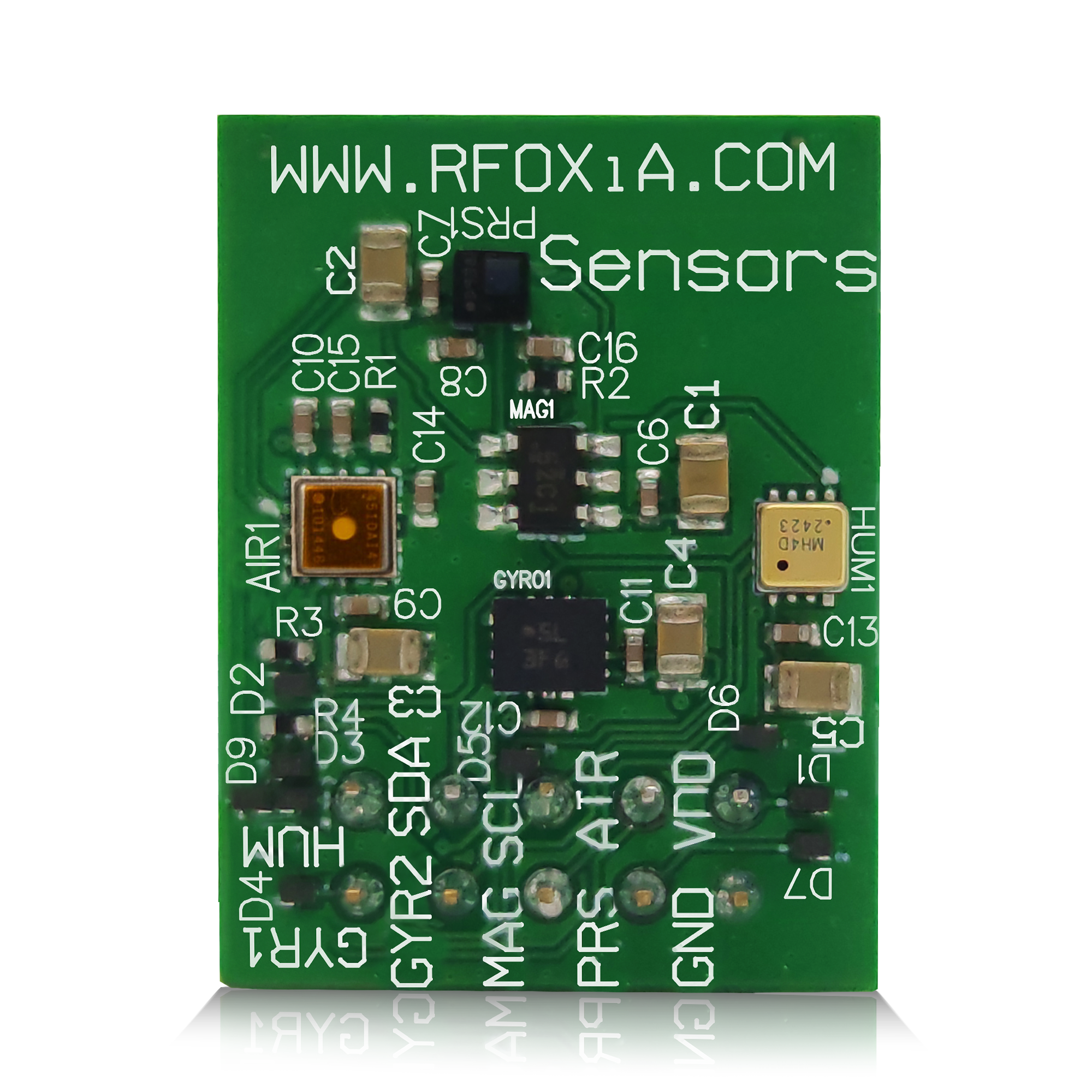
This guide breaks down everything you need to know about building professional sensor arrays into compact systems — what sensors matter, why integration beats standalone modules, and how the MultiNav Pro+ solves every major pain point for the modern maker and professional developer alike.
What Makes a Professional Sensor Module Different from a Hobbyist Breakout
Before diving into the hardware specifics, it is worth establishing what separates a professional sensor integration from a hobbyist-grade breakout board. The answer comes down to three things: component selection, system design, and real-world reliability.
Component Selection Matters Enormously
Not all sensors with the same name measure the same thing. An air quality sensor using a basic resistive MOX element behaves very differently from one using a calibrated electrochemical cell with on-chip signal processing. A gyroscope designed for consumer wearables performs very differently under the vibration loads of a multirotor drone compared to an industrial-grade MEMS device with advanced filtering.
Professional builds require professional silicon. Every sensor on the MultiNav Pro+ was selected from tier-one manufacturers with proven performance in demanding applications.
System-Level Design vs. Module-Level Design
A hobbyist breakout board takes one sensor IC and breaks out its pins. Done. A professional sensor module thinks about the entire system: power sequencing, decoupling, I2C address assignment, trace routing for signal integrity, thermal isolation between sensors that affect each other, and mechanical mounting in the context of real deployments.
The MultiNav Pro+ is 24mm by 18mm — not because that was the minimum achievable, but because that form factor was deliberately designed to fit within standard drone frame sensor bays, compact IoT enclosures, and wearable device housings without modification.
Real-World Reliability Under Load
Shipping a prototype that works on your bench is not the same as shipping a product that works reliably at altitude, in humidity, across temperature extremes, and under continuous vibration. Professional sensor integration accounts for these conditions at the design stage.
The Seven Sensors Inside the MultiNav Pro+ Sensors Module
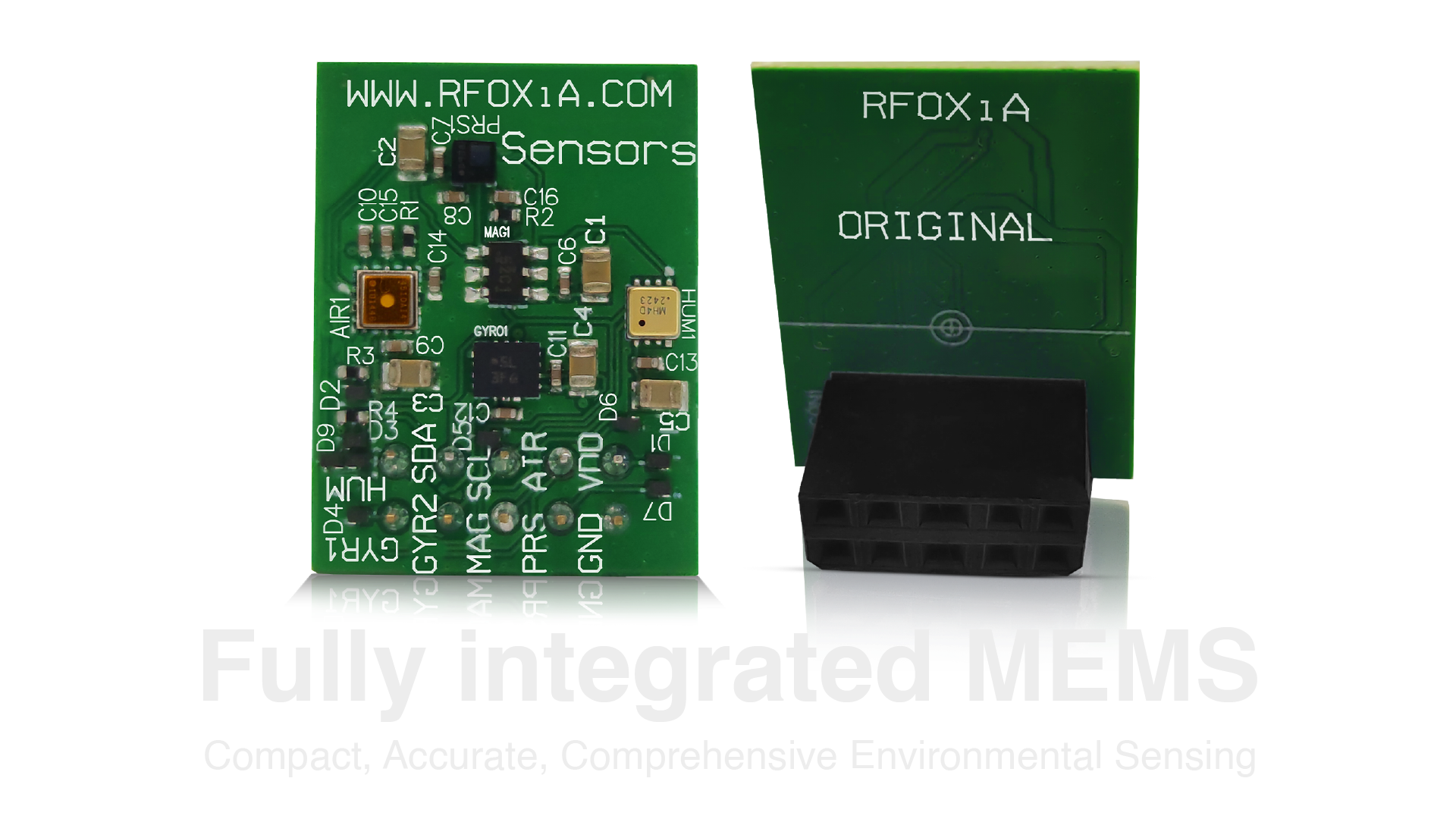
The MultiNav Pro+ integrates seven distinct sensing modalities into a single module. Here is a detailed look at each one and why it matters in practice.
1. Accelerometer — BMI270 from Bosch Sensortec
The BMI270 is one of the most respected MEMS inertial sensors in professional robotics and drone applications. It delivers full 6-axis motion data with extremely low noise and advanced built-in signal processing. For drone autopilot systems, the accelerometer data is fundamental — it feeds attitude estimation algorithms that keep your platform stable. For robotics, it provides the motion context that makes sensor fusion meaningful.
2. Gyroscope — BMI270 from Bosch Sensortec
Sharing the same IC as the accelerometer, the gyroscope in the MultiNav Pro+ benefits from tight integration. When your accelerometer and gyroscope share the same die, there is no synchronization latency between their outputs — critical for accurate complementary filtering and Kalman filter implementations in flight controllers and navigation systems.
3. Magnetometer — TMAG5273C1QDBVR from Texas Instruments
The Texas Instruments TMAG5273 is a 3-axis magnetic sensor designed for precision heading and compass applications. Unlike commodity magnetometer chips, the TMAG5273 offers excellent noise performance and temperature stability — meaning your compass heading does not drift as your drone climbs into colder air. It provides the third axis of orientation data that completes a full 9-DOF IMU when combined with the BMI270.
4. Air Pressure — LPS22HHTR from STMicroelectronics
ST's LPS22HH is a compact absolute pressure sensor with excellent noise characteristics and high output data rates. In drone applications, it serves as the barometric altimeter that supplements GNSS altitude data. In environmental monitoring, it provides the barometric pressure data required for weather correlation and altitude compensation of other sensor readings.
5. Temperature — MVH4003D from MEMSVision
Accurate temperature sensing is foundational to everything else. Air quality readings require temperature compensation. Humidity readings are meaningless without temperature context. The MVH4003D provides high-accuracy temperature data that both serves as a direct measurement output and improves the calibration quality of every other environmental sensor on the board.
6. Humidity — MVH4003D from MEMSVision
Sharing the same precision MEMS element as the temperature sensor, the humidity output from the MVH4003D provides calibrated relative humidity data with excellent long-term stability. This matters enormously for agricultural monitoring, HVAC control, and any application where humidity gradients are operationally significant.
7. Air Quality — ZMOD4510AI4R from RENESAS
This is where the MultiNav Pro+ truly separates itself from anything in the commodity maker market. The RENESAS ZMOD4510 is a professional-grade outdoor air quality sensor designed specifically for ozone and nitrogen dioxide detection — the pollutants most relevant to outdoor environmental monitoring, smart city applications, and precision agriculture. It features on-chip signal conditioning and delivers calibrated output that is directly usable without complex post-processing. For the serious air quality sensor module maker, this is not a hobbyist VOC sensor — it is a professional environmental measurement tool.
Sensor Chip Selection: Why These Components Were Chosen
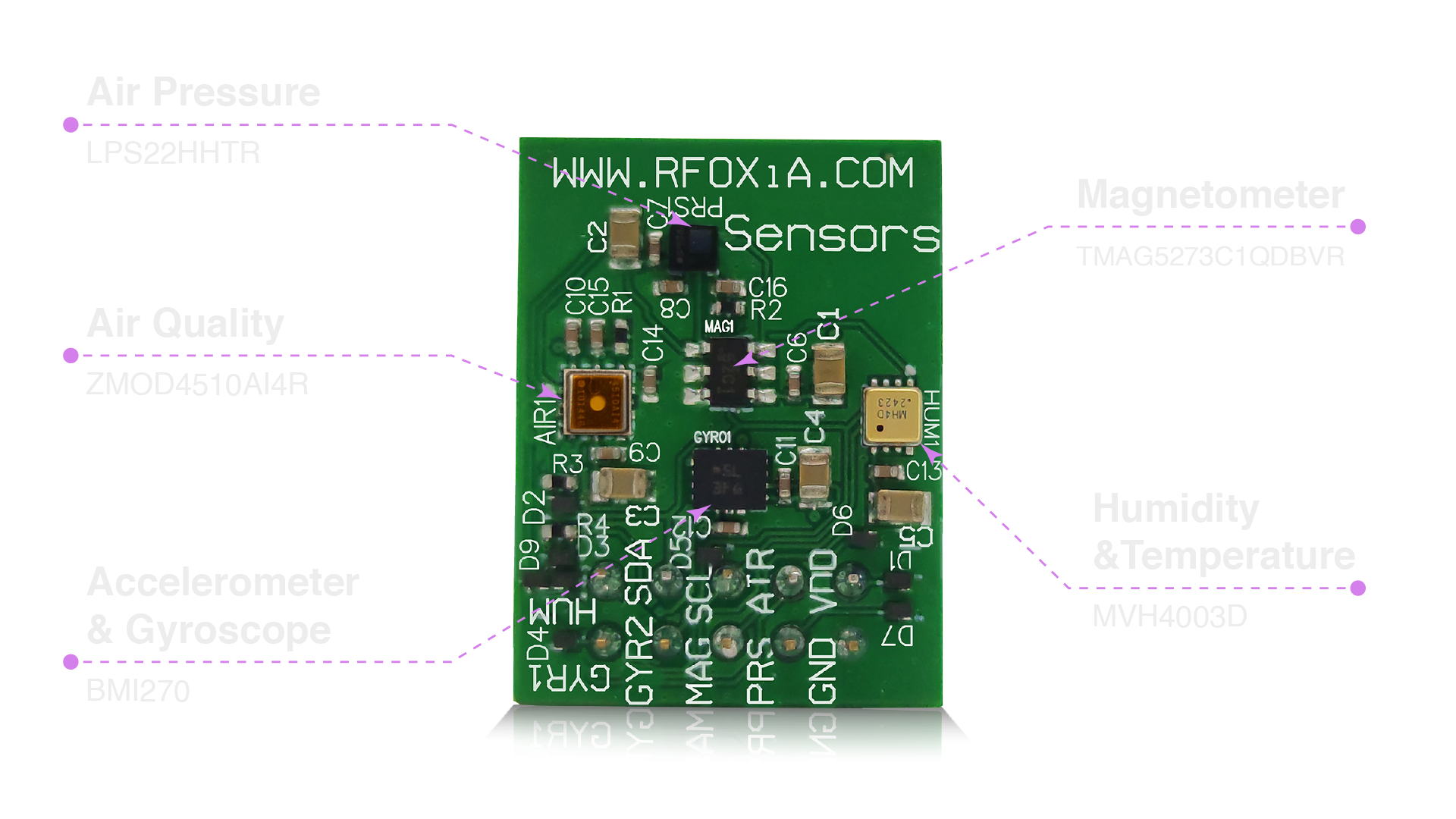
Every chip on this module was sourced from a tier-one semiconductor manufacturer. Bosch Sensortec's BMI270 is used in professional flight controllers and medical devices. STMicroelectronics' LPS22HH appears in industrial instrumentation. RENESAS' ZMOD4510 is designed for outdoor air quality networks operated by municipalities and research institutions. Texas Instruments' TMAG5273 meets automotive-grade temperature specifications.
These are not commodity parts chosen for cost. They are professional parts chosen for accuracy, stability, and long-term reliability — then integrated onto a single module priced at $39. That price-to-performance ratio is what makes RFOXiA uniquely positioned in the market.
I2C Integration: Why a Single Bus Matters
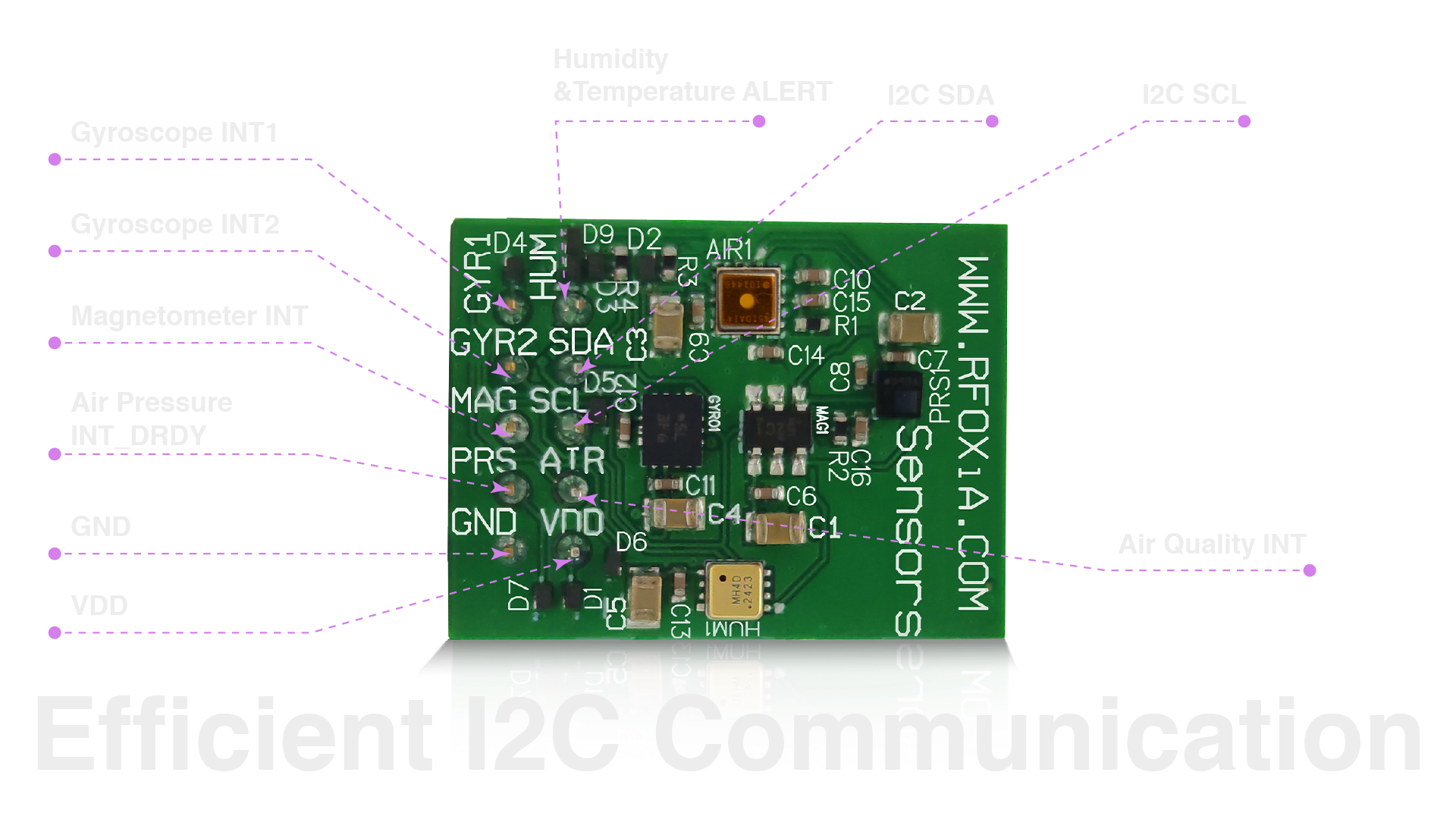
One of the most underappreciated engineering decisions in the MultiNav Pro+ design is the I2C bus architecture. All seven sensors share a single I2C bus, each with a dedicated, non-conflicting address. This means your host microcontroller needs exactly two signal pins — SDA and SCL — to access the complete sensor array.
What This Means in Practice
Simpler wiring. One connector to your host board. No SPI chip selects, no UART RX/TX pairs to manage, no competing bus protocols.
No address conflicts. A common failure mode when combining multiple breakout boards is I2C address collision. If two sensors share the same default address and neither offers hardware address configuration, you are stuck. The MultiNav Pro+ eliminates this problem by design — all seven sensor addresses are pre-configured to coexist cleanly.
Firmware simplicity. Your sensor polling loop iterates through seven known addresses on a single bus. Debugging is straightforward. Porting to a new host platform requires changing only your I2C driver abstraction, not seven separate driver integrations.
Lower GPIO usage. Especially valuable on resource-constrained microcontrollers like STM32 Cortex-M0 variants or RISC-V devices where every GPIO pin is doing meaningful work.
For any air quality sensor module maker working in embedded systems, the I2C integration alone justifies choosing the MultiNav Pro+ over a collection of individual breakouts.
Compact Form Factor: 24mm × 18mm
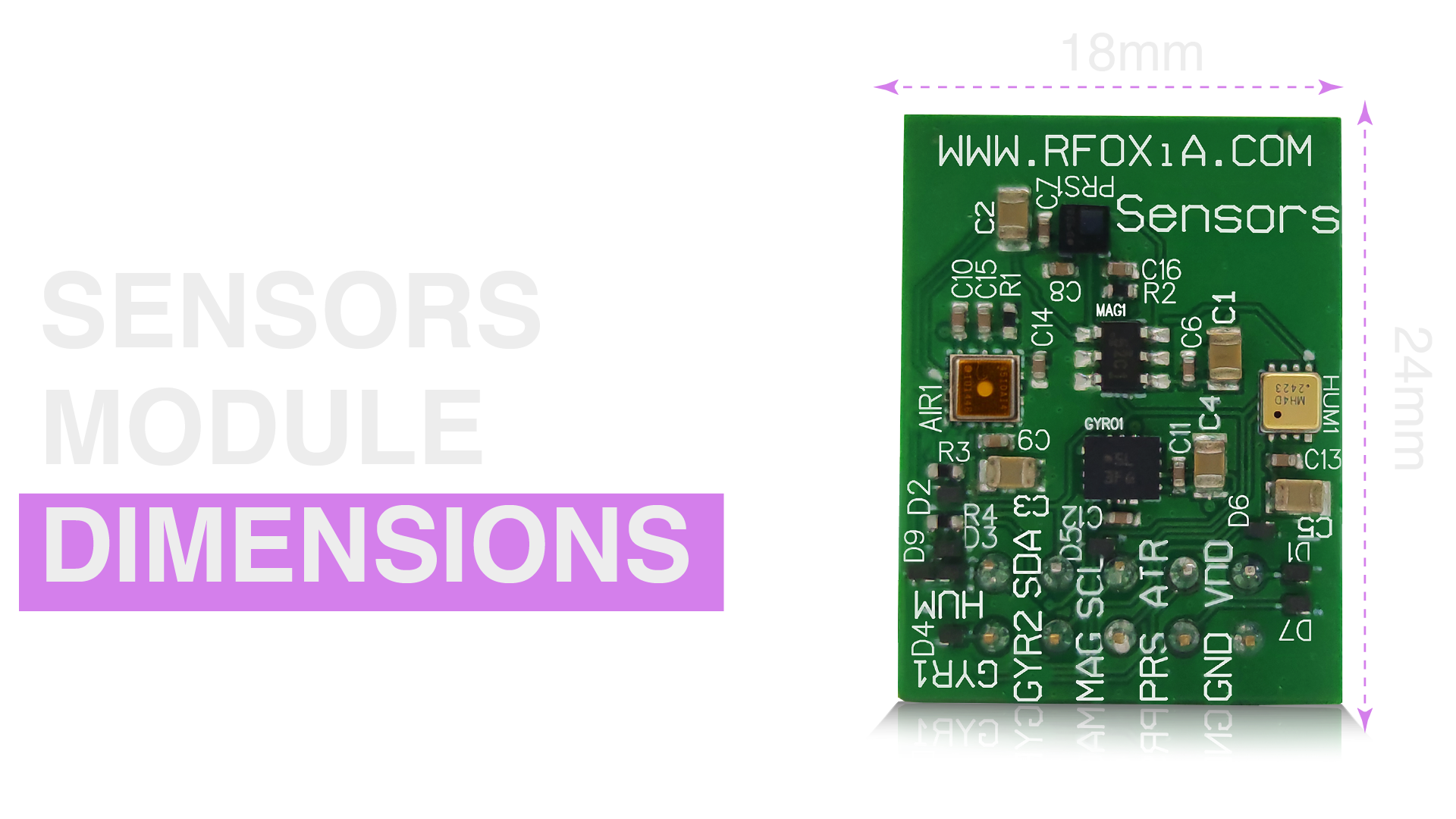
At 24mm by 18mm, the MultiNav Pro+ Sensors Module is smaller than a standard postage stamp. This is not an accident. The form factor was deliberately designed to fit within the physical constraints of the most space-demanding applications in the maker and professional market.
Drone Integration
Standard 20mm and 30.5mm mounting patterns on drone flight controller stacks accommodate the MultiNav Pro+ without modification. You can mount it directly to the stack, above the flight controller, without protruding beyond the frame's protected electronics bay in most 3-inch to 5-inch builds.
Wearable Devices
For biosensing, sports performance monitoring, and environmental exposure tracking worn on the body, 24mm by 18mm is genuinely compact enough to integrate into garment-embedded or wrist-mounted designs.
Compact IoT Nodes
When building distributed sensor networks — the kind that contribute to RFOXiA's data monetization network — you want the smallest possible node that still delivers complete data. The MultiNav Pro+ delivers all seven sensor streams in a footprint that fits inside a standard project enclosure with room for the host MCU and wireless module.
Real-Time Environmental Data: What You Can Do With It
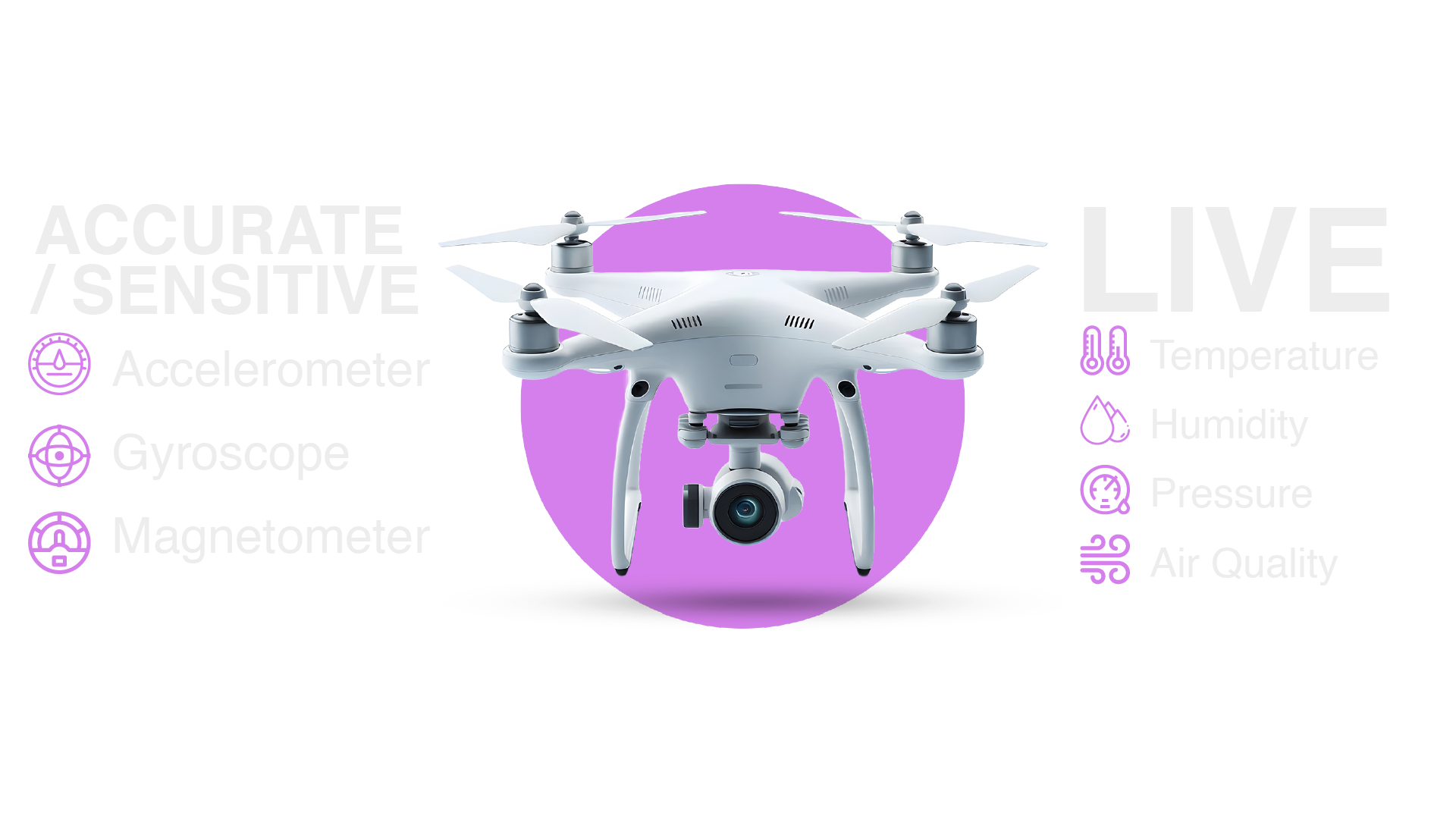
Raw sensor data is only as valuable as what you do with it. Here is a breakdown of the real-world applications that the MultiNav Pro+ Sensors Module enables.
Drone Telemetry and Autonomy
Combine the BMI270 accelerometer and gyroscope with the LPS22HH barometric altimeter for complete inertial-plus-barometric state estimation. Add the TMAG5273 magnetometer for heading lock. Stream all data in real time to the RFOXiA Connect app over the BLE module's 15–20km man-to-drone link, and you have a complete autonomous sensor platform for inspection, surveying, and search operations.
Environmental Research
Deploy nodes across a study area — rooftops, field stations, mobile platforms — and stream synchronized air quality, temperature, humidity, and pressure data to a central server. The second-level temporal resolution that RFOXiA's data network supports means you capture transient pollution events that 10-minute averaged public APIs miss entirely.
Agricultural Monitoring
Micro-climate variation within a single field can significantly affect crop health. Deploying MultiNav Pro+ nodes across a farm gives agronomists the spatial and temporal resolution needed to make precision irrigation, pest management, and harvest timing decisions based on real data, not interpolated estimates.
Smart City Infrastructure
Urban air quality monitoring at street level — not airport-adjacent weather station level — requires dense node deployment with reliable, calibrated sensors. The ZMOD4510 on the MultiNav Pro+ is specifically designed for this application. Municipalities deploying sensor networks for air quality compliance monitoring need exactly this kind of professional-grade, compact, affordable hardware.
Earn From Your Sensor Network
RFOXiA's data monetization network pays node operators daily rewards for verified environmental data contributions. Nodes with all five required data streams active — temperature, humidity, pressure, air quality, and GPS-validated outdoor location — earn up to $0.40 per day per node. Pioneer network members lock in higher base rates early. The MultiNav Pro+ paired with a GNSS module is the hardware stack that qualifies for the full reward tier.
Explore the full RFOXiA Integrated Sensors Module to see how it integrates with the broader ecosystem.
Application Domains: Where This Module Wins

The MultiNav Pro+ is not designed for one niche. Its combination of motion sensing and environmental sensing covers the broadest possible range of serious maker and professional applications.
| Application | Sensors Used | Benefit |
|---|---|---|
| Drone autopilot | Accel, Gyro, Mag, Pressure | Full attitude + altitude estimation |
| Air quality monitoring | Air Quality, Temp, Humidity, Pressure | Complete atmospheric data |
| Robotics navigation | Accel, Gyro, Mag | 9-DOF motion awareness |
| Precision agriculture | Temp, Humidity, Pressure, Air Quality | Micro-climate field mapping |
| Wearable health tech | Accel, Gyro, Temp, Humidity | Activity + environment correlation |
| Smart city nodes | Air Quality, Temp, Humidity, Pressure | Urban environmental compliance |
| Research instrumentation | All seven | Complete data set for analysis |
| Data network contribution | Temp, Humidity, Pressure, Air Quality | Qualifies for full RFOXiA reward tier |
How the MultiNav Pro+ Fits the RFOXiA Ecosystem
The Sensors Module does not exist in isolation. It is one component in a vertically integrated wireless development ecosystem that RFOXiA has built from the ground up.
Pair it with the BLE Module and your sensor data streams wirelessly at 2Mbps to a host device up to 5km away on the ground, or 15–20km in man-to-drone configurations. No cellular, no Wi-Fi infrastructure, no subscription.
Pair it with the GNSS Module and every sensor reading is GPS-tagged with 1.5-meter accuracy at 18Hz — fast enough to track sensor readings on a moving drone platform with precision.
Power it with the Power/Program Kit and your sensor node runs continuously for 24 hours on a 5-minute supercapacitor charge. For field deployment, that means one charge in the morning and continuous data collection through a full working day.
Control and monitor everything through the RFOXiA Connect app, which displays live sensor telemetry on your mobile device with no internet connection required.
Get your firmware built by AI through the RFOXiA Club AI Firmware Builder. Describe your sensor application in plain language, and receive production-ready firmware with full source code access. For any air quality sensor module maker who wants to move from concept to deployed hardware in days rather than months, this is a fundamental capability shift.
Technical Specifications Summary
| Parameter | Specification |
|---|---|
| Sensors | Accelerometer, Gyroscope, Magnetometer, Temperature, Humidity, Air Pressure, Air Quality |
| Accelerometer + Gyroscope | BMI270, Bosch Sensortec |
| Magnetometer | TMAG5273C1QDBVR, Texas Instruments |
| Air Pressure | LPS22HHTR, STMicroelectronics |
| Temperature + Humidity | MVH4003D, MEMSVision |
| Air Quality | ZMOD4510AI4R, RENESAS |
| Communication | I2C (single bus, dedicated addresses per sensor) |
| Module Size | 24mm × 18mm |
| Certification | FCC Certified |
| Price | $39 |
| Compatibility | Full RFOXiA ecosystem (BLE Module, GNSS Module, Power Kit, Connect App) |
Precision Motion and Environmental Sensing in One Package
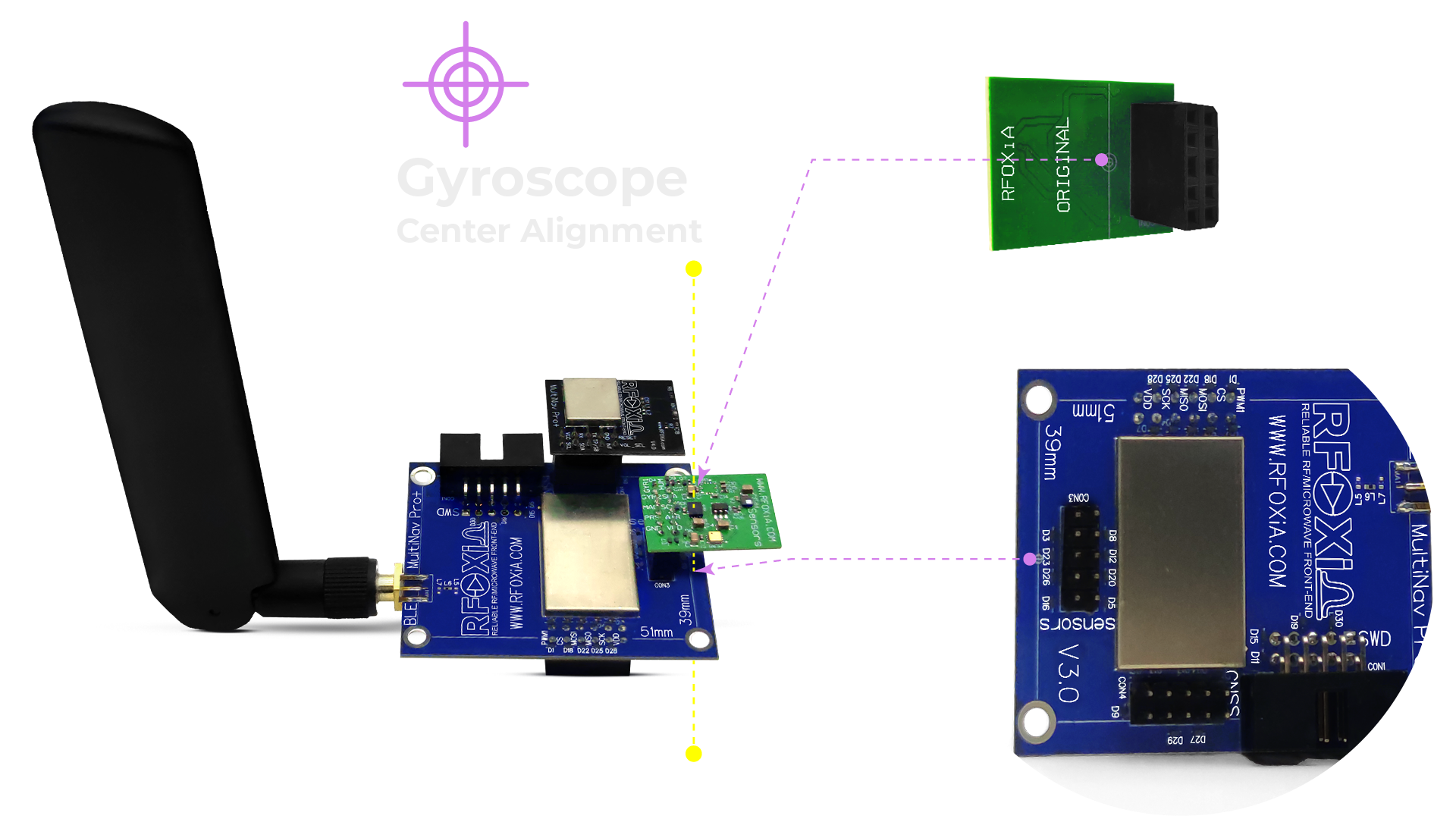
The true differentiator of the MultiNav Pro+ Sensors Module is the combination of motion sensing and environmental sensing in one package. These two sensing domains are usually purchased separately because they seem unrelated. But in practice, they are deeply connected.
A drone that monitors air quality needs both. A research platform that maps environmental conditions needs its data GPS-tagged and motion-context-aware to separate real events from sensor artifacts caused by vibration. A smart agriculture node that detects sudden humidity spikes needs to know whether the platform moved into a microclimate or whether a weather event is genuinely occurring.
Integrating both sensing domains at the hardware level is not just convenient. It produces better data.
Why $39 Changes the Equation
Professional sensor ICs from Bosch, Texas Instruments, STMicroelectronics, and RENESAS are not cheap components. The bill of materials for a module using these seven sensors from these manufacturers represents genuine engineering investment. Yet the MultiNav Pro+ is priced at $39.
This is possible because RFOXiA's manufacturing infrastructure — built through four Kickstarter campaigns and direct factory relationships in China — eliminates the distributor margin stack that drives up prices in the traditional electronics distribution chain. You are buying directly from the engineering team that designed the hardware.
For context: a comparable collection of individual breakout boards sourced from standard distributors would cost $80–150 and still require your own I2C integration work, address conflict resolution, and system-level validation. The MultiNav Pro+ does all of that at the hardware level and ships FCC certified at $39.
For any serious air quality sensor module maker evaluating the true cost of a custom sensor array, the math is straightforward.
Getting Started: Your First Sensor Node
Deploying your first MultiNav Pro+ sensor node takes minutes, not days. The module ships with I2C pinout documentation and is fully compatible with STM32, ESP32, Arduino, and Raspberry Pi host platforms. Sample firmware for all seven sensors is available in the RFOXiA Club Dev Hub.
For developers who want a zero-to-running experience:
- Connect SDA, SCL, VCC, and GND to your host MCU.
- Download the sample firmware from RFOXiA Club.
- Flash and run — all seven sensor addresses are pre-configured and immediately readable.
- Optionally use the AI Firmware Builder to generate custom firmware for your specific application.
- Pair with a BLE Module to stream data wirelessly to the RFOXiA Connect app.
The complete Developer Bundle — BLE Module, GNSS Module, Sensors Module, and Power/Program Kit — is available for $199 through the RFOXiA Club, and includes platform access, AI firmware tools, and the data monetization network enrollment.
Visit the RFOXiA Integrated Sensors Module page to order your module and access full technical documentation.
Final Thoughts: The Right Tool for the Serious Builder
The maker market has never lacked for cheap sensors. What it has always lacked is professional-grade sensor integration at maker-accessible prices — hardware designed with the rigor of industrial applications but priced for independent builders, researchers, and small teams.
The RFOXiA MultiNav Pro+ Sensors Module closes that gap. Seven professional sensors from tier-one manufacturers, integrated onto a 24mm × 18mm FCC-certified board, communicating through a clean I2C interface, priced at $39, and backed by a complete ecosystem of wireless hardware, AI firmware tools, mobile control, and a data monetization network.
For the air quality sensor module maker who is tired of compromising between capability and cost, this is the module you have been waiting for.
Get your MultiNav Pro+ Sensors Module and start building the sensor platform your projects deserve.
Written by: Moamen Mohamed LinkedIn