
Autonomous Landing GPS Module: Why Precision GNSS Is the Heart of Every Intelligent Drone System
The Autonomous Landing GPS Module That Engineers Have Been Waiting For
If you have ever watched a drone hover perfectly over a landing pad, touch down within centimeters of its target, and do it all without a single human input, you already understand why a high-performance autonomous landing GPS module is not optional — it is everything. Position accuracy at the moment of landing is the difference between a successful autonomous mission and a crash, a broken payload, or worse.
The problem for most engineers, drone builders, and IoT developers has always been the same: the GPS modules that deliver the precision you actually need cost a fortune, come locked inside proprietary ecosystems, or are designed for enterprise customers with enterprise budgets. Affordable consumer-grade modules simply cannot keep up with the demands of real autonomous flight.
That changes with the RFOXiA MultiNav Pro+™ GNSS Module — a professional-grade autonomous landing GPS module engineered for developers who refuse to compromise on accuracy, update rate, or integration flexibility.
What Makes a Great Autonomous Landing GPS Module?
Before diving into the MultiNav Pro+ specifications, it is worth establishing exactly what separates a capable autonomous landing GPS module from a generic location chip. Autonomous landing — whether on a drone delivery platform, a precision agriculture vehicle, or a research UAV — demands three non-negotiable characteristics:
1. Sub-2-Meter Positional Accuracy
Consumer GPS modules commonly advertise 3-5 meter accuracy under ideal conditions. In real-world environments with atmospheric interference, urban canyons, or dense tree canopy, that number degrades further. For autonomous landing, 5-meter error means your drone can land anywhere within a 10-meter diameter circle. That is not autonomy — that is guessing.
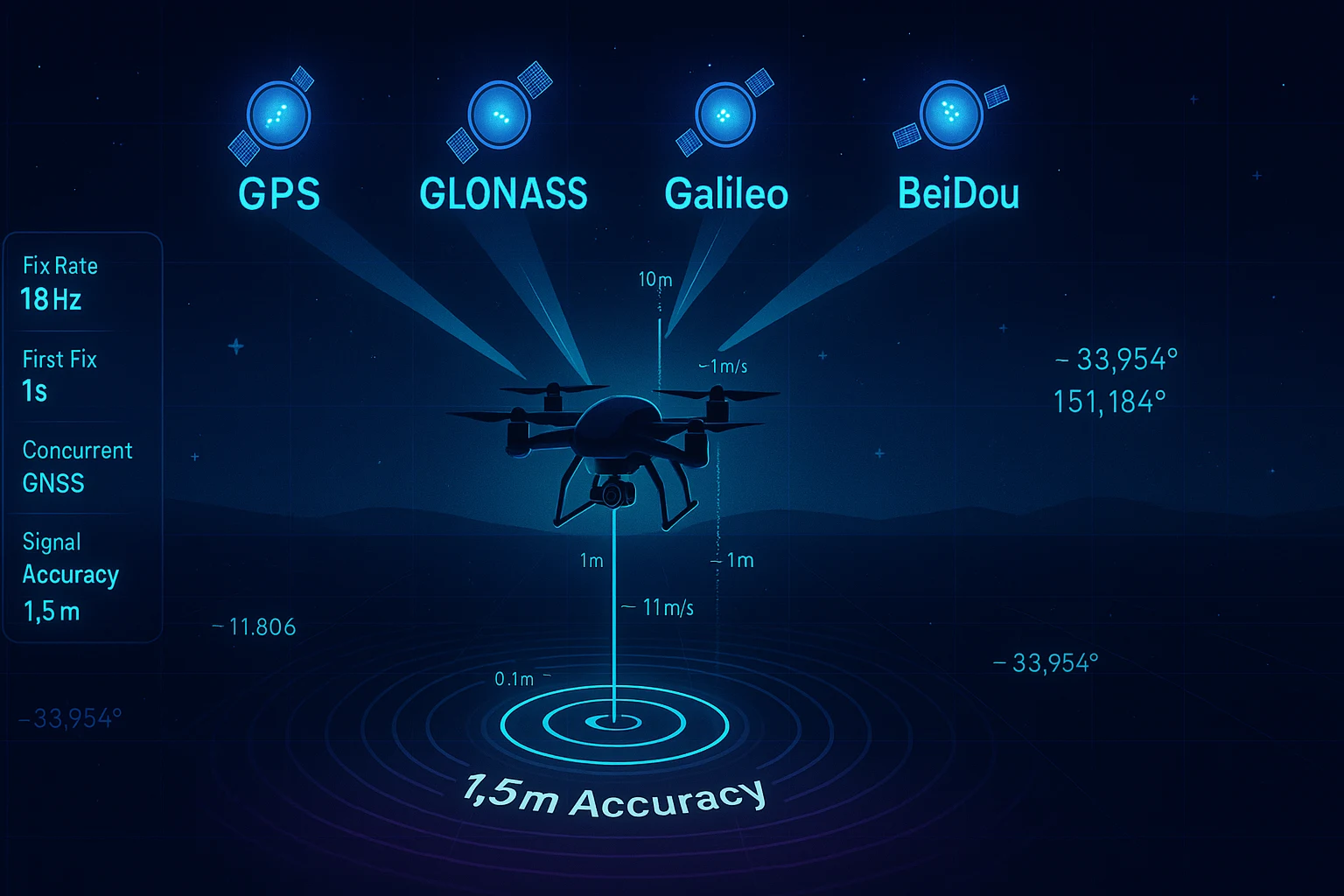
A true autonomous landing GPS module must achieve consistent sub-2-meter accuracy. The MultiNav Pro+ delivers less than 1.5 meters of positional accuracy, making it one of the most precise modules available at its price point.
2. High Fix Rate for Dynamic Platforms
Update rate matters enormously during the final meters of descent. A drone descending at 1 m/s with a 1Hz GPS update rate is effectively flying blind between updates. The GNSS receiver needs to refresh position data fast enough that the flight controller can make real-time corrections.
The MultiNav Pro+ delivers an 18Hz fix rate — eighteen position updates per second. For comparison, most hobbyist GPS modules operate at 1-10Hz. This is the update speed required for smooth, confident autonomous landing on moving or precision-marked landing pads.
3. First Fix Speed
Time to First Fix (TTFF) determines how quickly your platform can begin a mission. The MultiNav Pro+ achieves first fix in just 1 second under good sky visibility — dramatically reducing pre-flight initialization time for time-sensitive applications.
Introducing the MultiNav Pro+™: Professional GNSS Built for Autonomous Systems
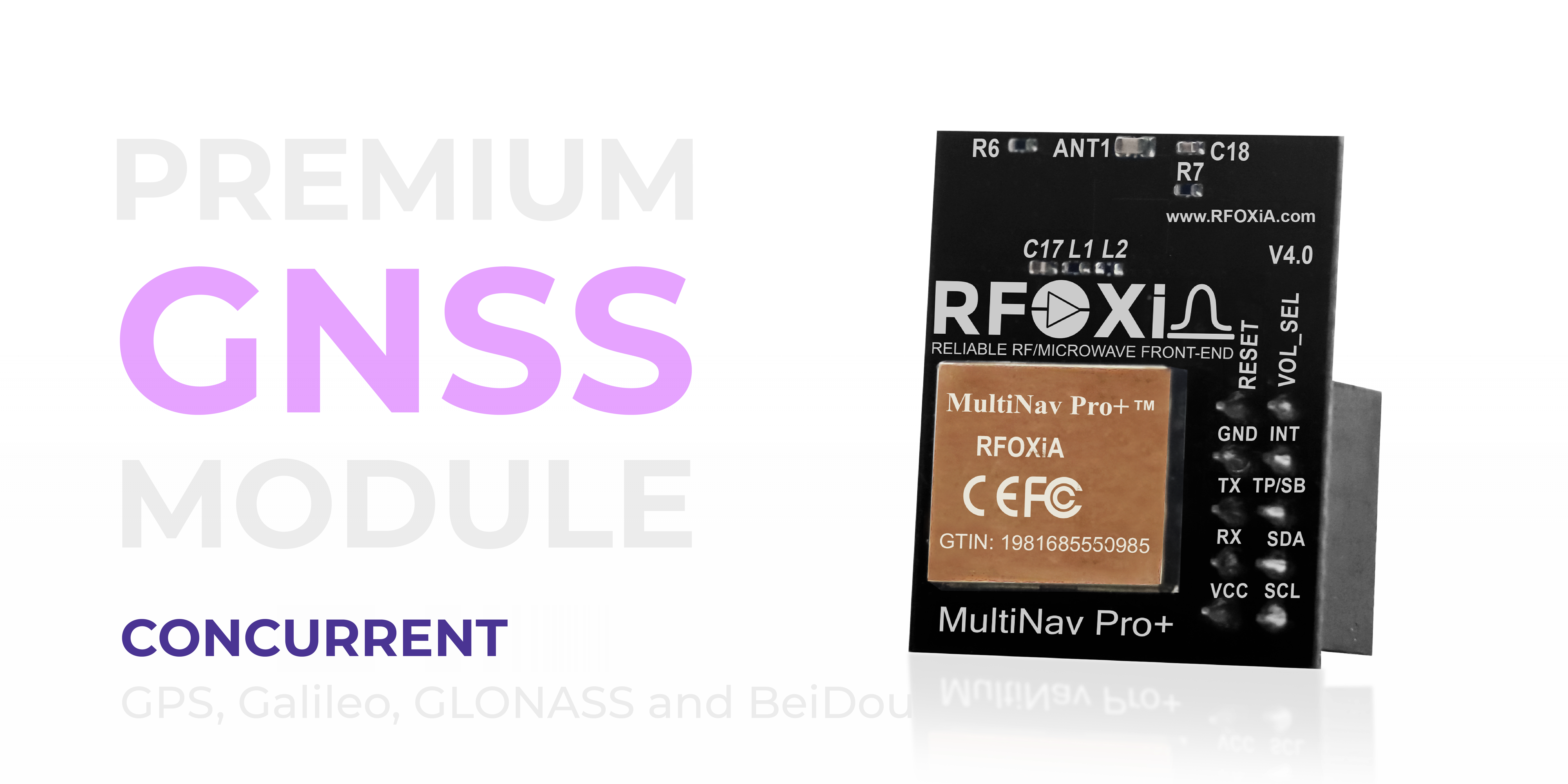
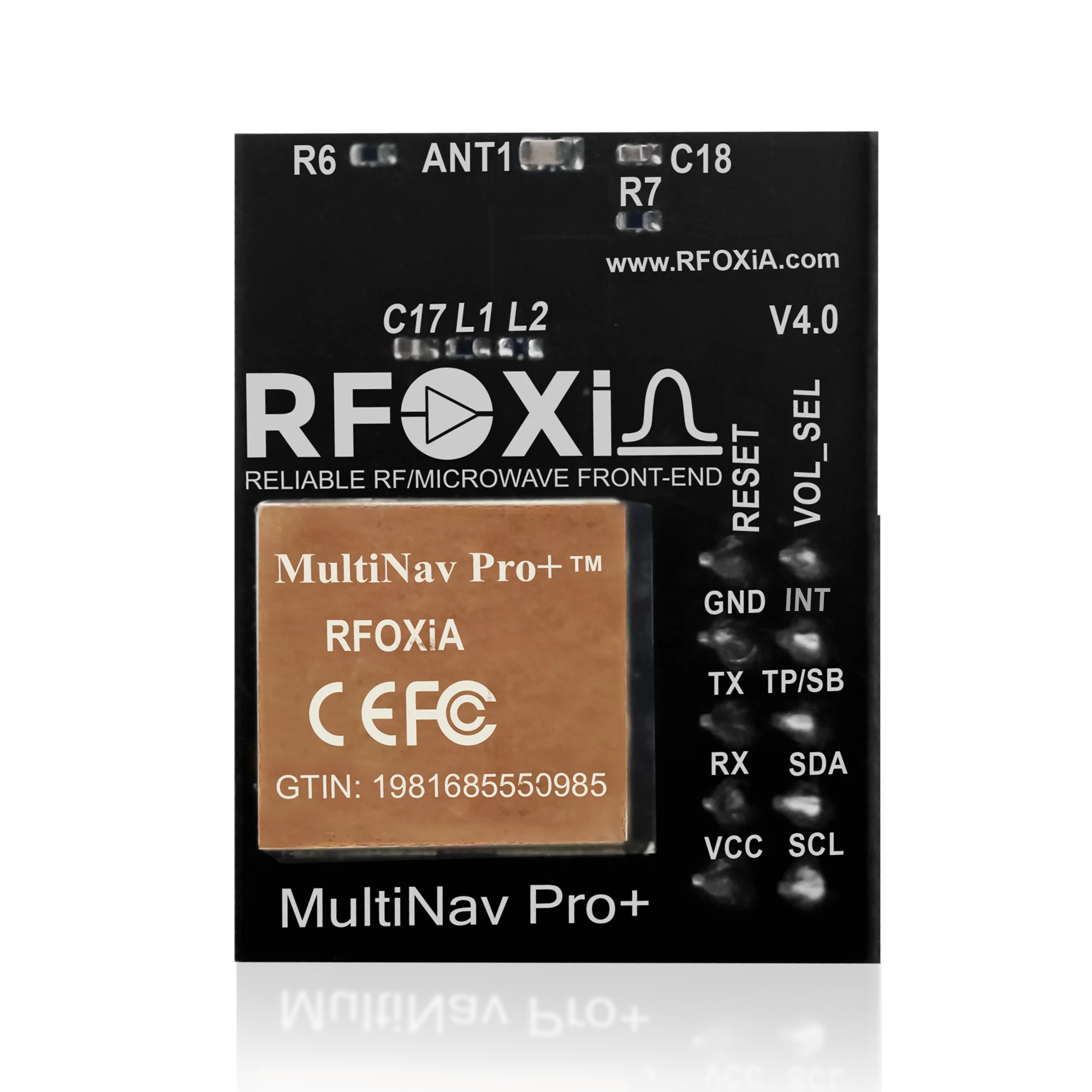
The MultiNav Pro+™ is RFOXiA's precision GNSS module, built on the u-blox MIA-M10Q — one of the most advanced compact GNSS chipsets available today. This is not a repackaged commodity GPS chip. The MIA-M10Q supports concurrent reception from four satellite constellations simultaneously, meaning your autonomous landing GPS module is always pulling position data from every available satellite overhead — not just the ones in a single network.
Supported constellations:
- GPS (United States)
- GLONASS (Russia)
- Galileo (European Union)
- BeiDou (China)
Concurrent four-constellation support means better satellite geometry, more satellites in view at any given time, and significantly improved accuracy and reliability — especially in challenging environments where a single-constellation receiver would struggle.
Full Specification Breakdown
| Specification | MultiNav Pro+™ Value |
|---|---|
| Positional Accuracy | < 1.5 meters |
| Fix Rate | Up to 18Hz |
| Time to First Fix | 1 second |
| GNSS Constellations | GPS, GLONASS, Galileo, BeiDou (concurrent) |
| GNSS Chip | u-blox MIA-M10Q |
| Power Consumption | 25-30mA |
| Module Dimensions | 26mm x 22mm |
| Antenna | Integrated high-gain chip antenna |
| Interfaces | UART (TX/RX) and I2C (SCL/SDA) |
| Operating Voltage | 1.8V and 3.3V |
| Signal Filtering | RF/microwave microstrip filter technology |
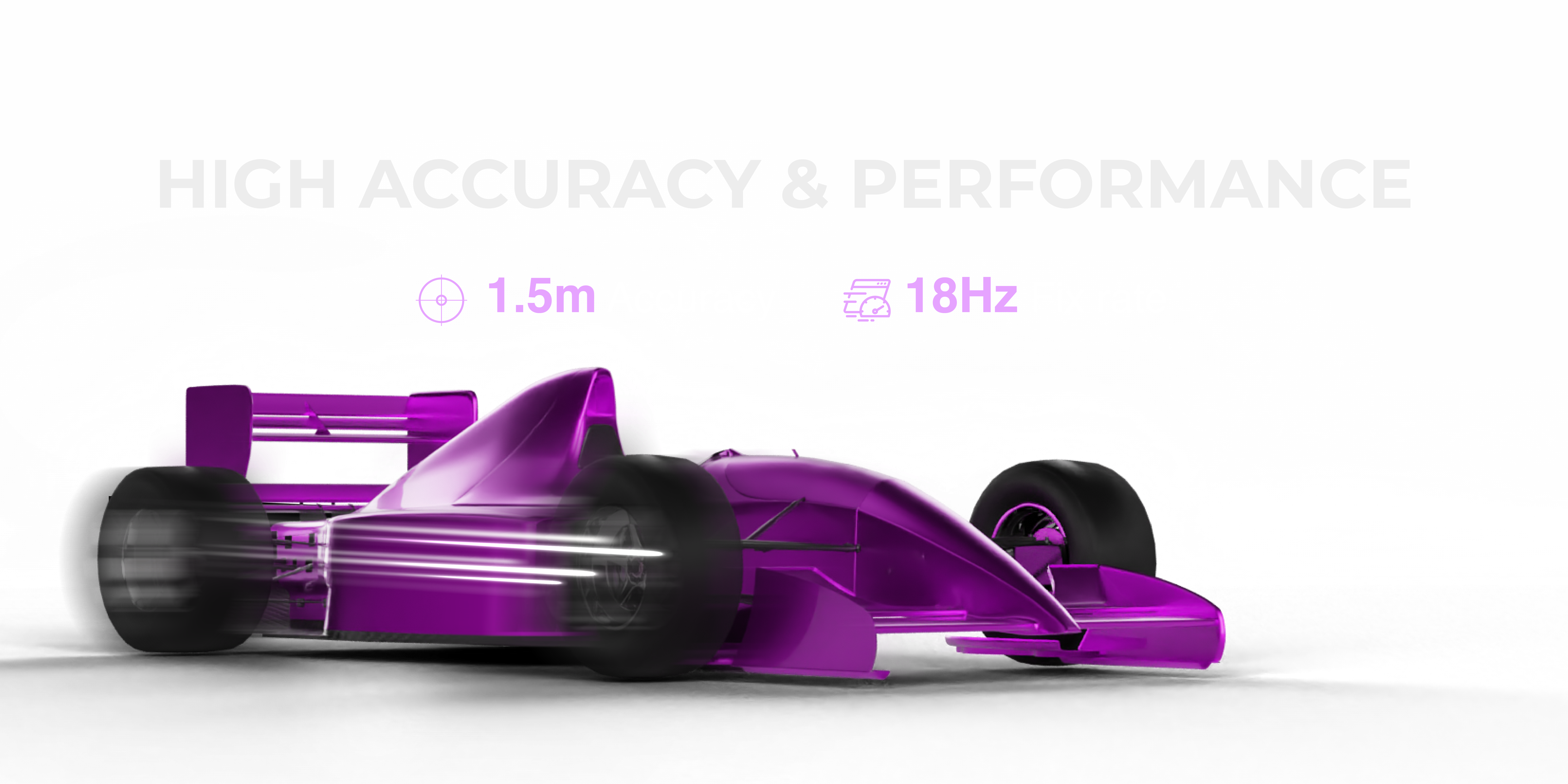
Every number in that table was chosen deliberately. The 18Hz fix rate enables real-time flight controller feedback. The 1.5-meter accuracy enables precision landing. The 25-30mA power draw means you are not compromising flight time to run your GNSS. The 26x22mm footprint means this fits on platforms where space is at an absolute premium.
Compact and Power-Efficient by Design
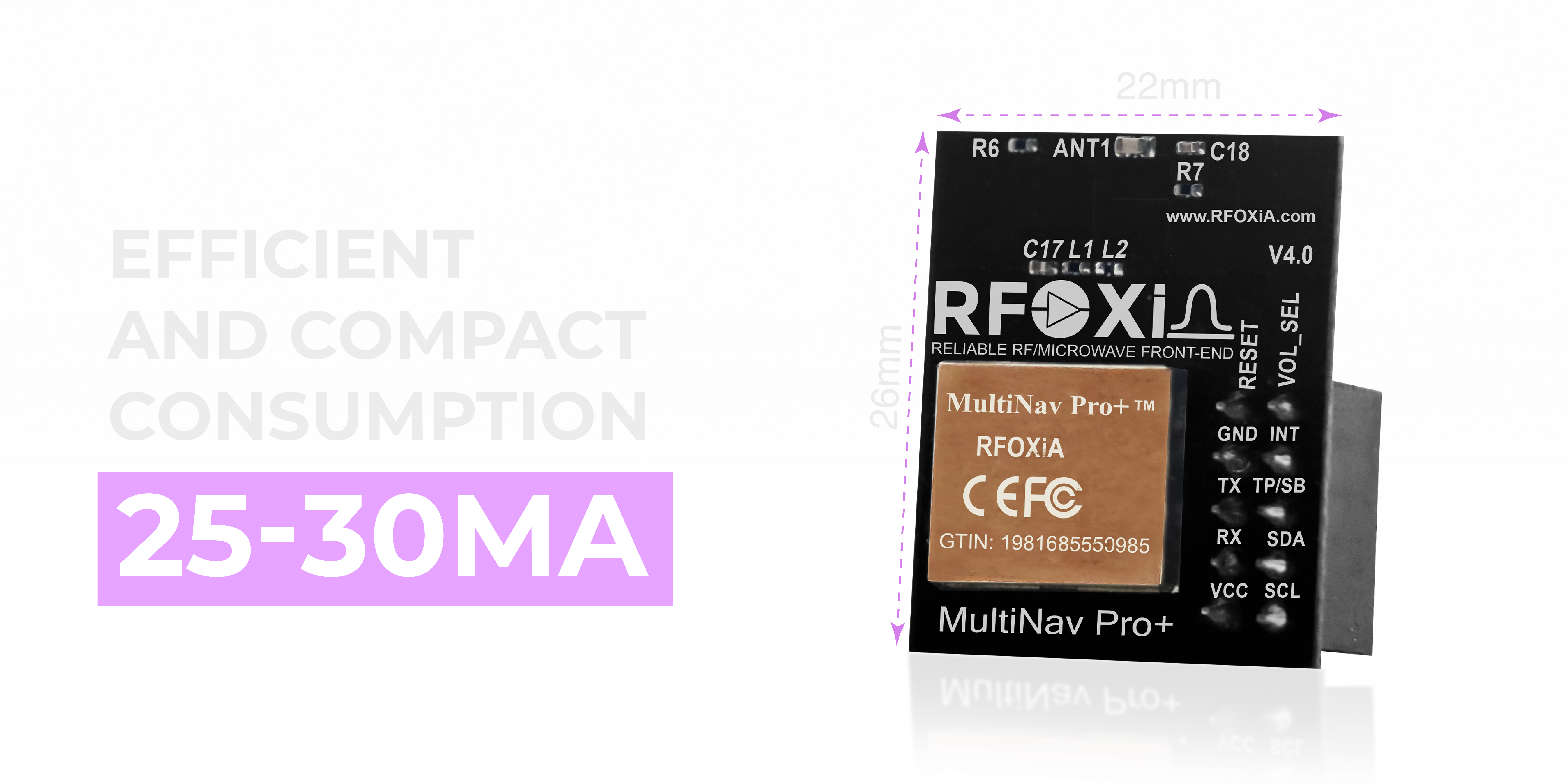
Size and power consumption are often overlooked in GNSS module comparisons, but for drone builders and embedded developers, they are critical constraints.
At 26mm x 22mm, the MultiNav Pro+ is compact enough to integrate into tight PCB layouts and small UAV frames without forcing a design compromise. Its 25-30mA operating current is efficient enough to run continuously through a long mission without meaningfully impacting battery endurance.
The integrated high-gain chip antenna is a deliberate design choice. Rather than requiring an external patch antenna (which adds weight, connector points, and potential failure modes), the MultiNav Pro+ integrates antenna performance directly into the module footprint — maintaining signal quality while eliminating complexity.
The module's proprietary RF/microwave microstrip filter technology further improves real-world signal quality by attenuating interference from onboard electronics — particularly important on drones where ESCs, motors, and high-current power systems generate significant RF noise that can degrade lesser GNSS receivers.
Flexible Interface Options for Any Platform
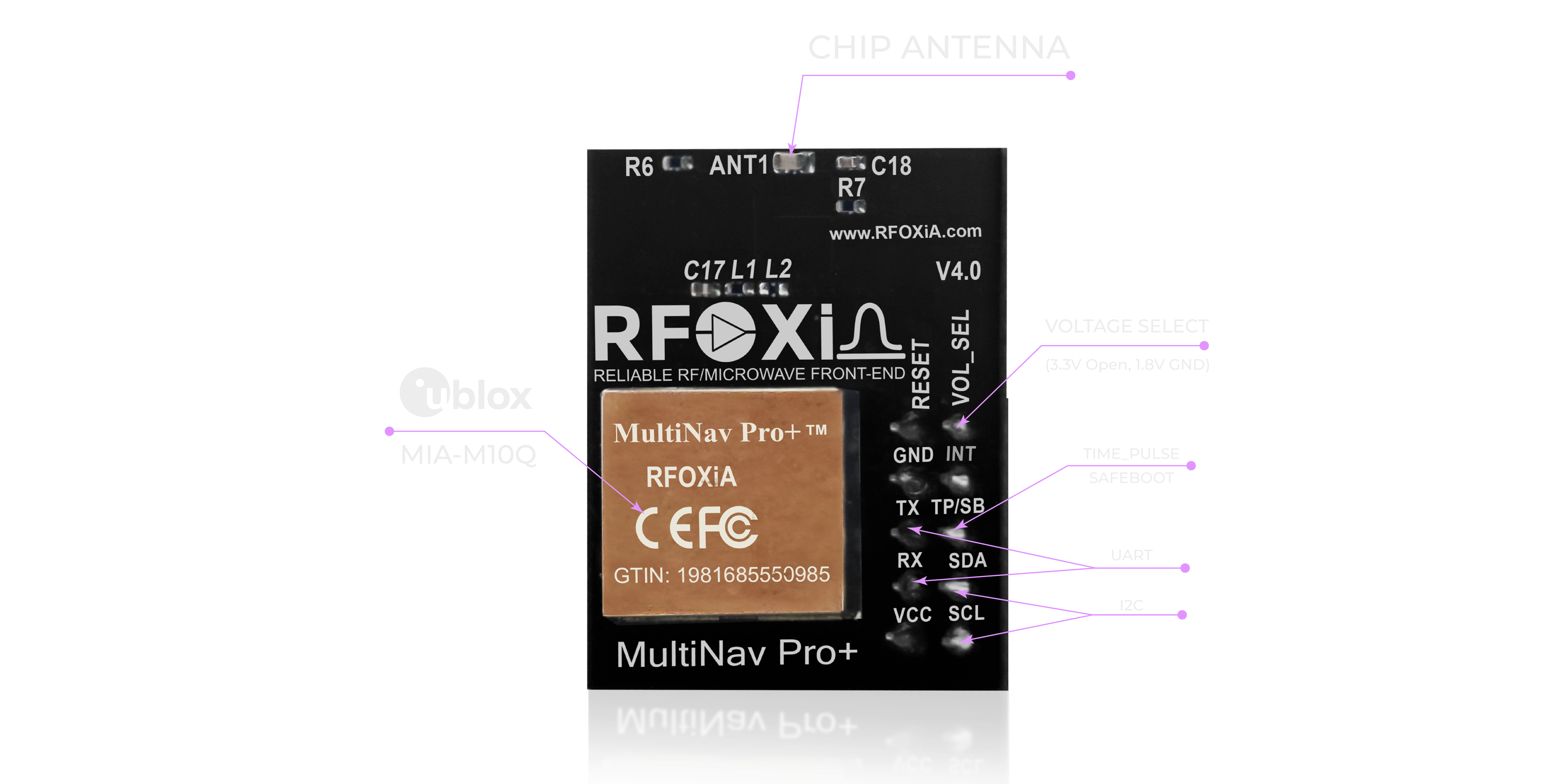
One of the quiet advantages of the MultiNav Pro+ is its interface flexibility. Many GNSS modules lock you into a single communication protocol, forcing you to design your system around the module's constraints. The MultiNav Pro+ supports both:
- UART (TX/RX) — the standard for flight controllers, ArduPilot, PX4, and most embedded microcontrollers
- I2C (SCL/SDA) — ideal for sensor fusion applications, microcontroller arrays, and systems where GPIO pins are limited
Combined with support for both 1.8V and 3.3V operating voltages, the MultiNav Pro+ integrates cleanly with modern STM32 platforms, ESP32, Raspberry Pi, Arduino-class boards, and professional flight controller stacks without voltage translation headaches.
This flexibility is particularly valuable for developers building custom autonomous systems where the GNSS module needs to communicate with multiple subsystems simultaneously.
Open-Source Driver: Start Building in Minutes
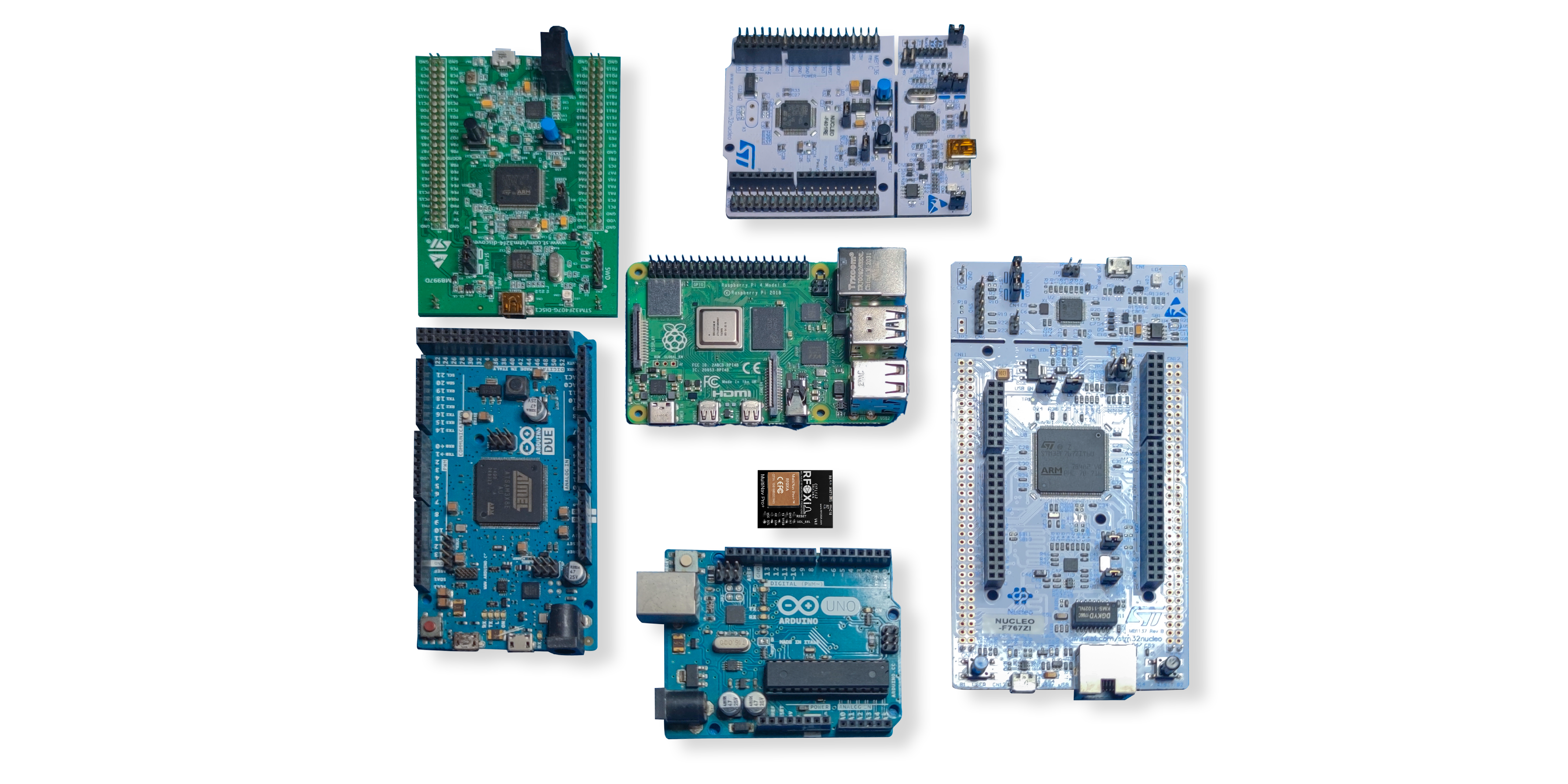
Hardware performance means nothing if integration takes weeks. RFOXiA ships the MultiNav Pro+ with a fully open-source C language driver library that handles NMEA protocol parsing out of the box.
The library is designed for immediate productivity:
- NMEA standard protocol commands — compatible with the industry-standard data format used across GNSS applications
- Arduino IDE compatible — import the library and have position data streaming in minutes
- Compatible with any C-based toolchain — STM32CubeIDE, PlatformIO, ESP-IDF, and custom embedded environments all work without modification
- Fully open source — read the code, modify it, extend it, contribute back. No black boxes.
For developers who want to push beyond the standard library, the open-source nature means full visibility into how position data is parsed, filtered, and formatted — enabling custom fusion algorithms, proprietary landing logic, and application-specific optimizations.
You can explore the open-source firmware approach RFOXiA takes across all its modules at the RFOXiA Accurate GNSS Module product page.
U-Center Software: Visualize, Configure, and Validate
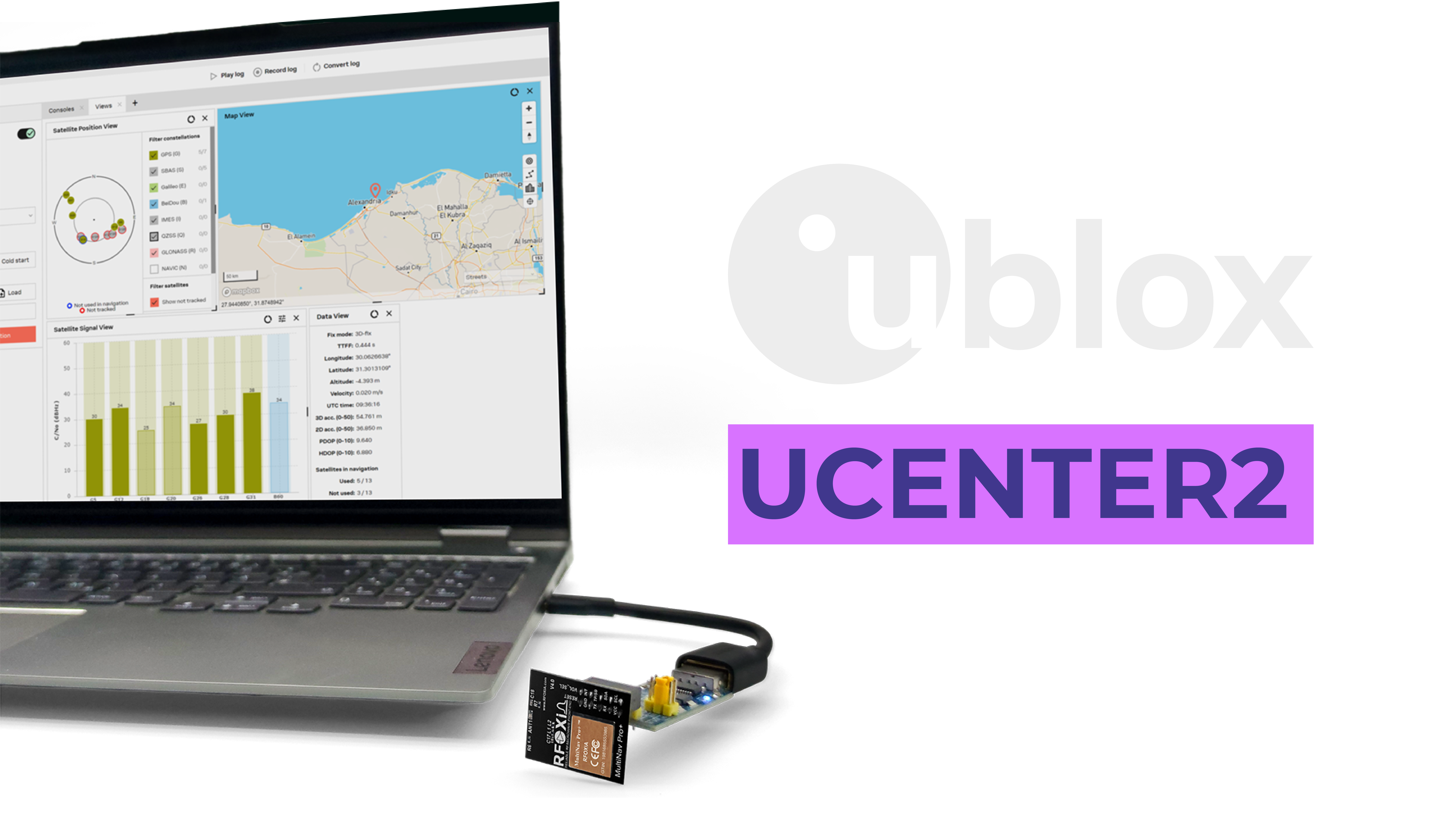
Because the MultiNav Pro+ is built on the u-blox MIA-M10Q, it is fully compatible with u-center — u-blox's professional GNSS evaluation and configuration software.
u-center gives you:
- Live satellite visualization — see exactly which satellites are in view, their signal strength, and their sky positions
- Real-time track logging — record movement paths for analysis, testing, and validation
- Module configuration — adjust fix rate, constellation selection, power mode, and output message types through a GUI
- Signal quality analysis — identify interference sources and verify performance in your deployment environment
- GNSS service evaluation — test advanced u-blox features and service integrations
For an autonomous landing GPS module application, u-center is an invaluable tool during development and testing. You can validate that your module is achieving expected accuracy, confirm satellite geometry at your test site, and fine-tune configuration before deploying on a live platform.
Use Cases: Where the MultiNav Pro+ Delivers

The MultiNav Pro+ was designed for professional applications across a wide range of domains. Here are the primary use cases where this autonomous landing GPS module performs at its best:
Autonomous Drone Systems
Precision landing, waypoint navigation, return-to-home, and geofencing all depend on sub-2-meter positional accuracy and high update rates. The 18Hz fix rate feeds flight controllers fast enough for smooth, stable autonomous operation. Whether you are building a delivery drone, inspection UAV, or agricultural sprayer, the MultiNav Pro+ delivers the GNSS performance the mission demands.
FPV and Racing Platforms
High update rate GNSS is increasingly used in FPV platforms for rescue mode, position hold, and telemetry logging. The 18Hz rate captures fast-moving position data that lower-rate modules simply miss.
Precision Agriculture
Automatic row navigation, field boundary mapping, and variable rate application all require consistent sub-2-meter positioning. The MultiNav Pro+ provides this performance at a fraction of the cost of dedicated agricultural GNSS receivers.
IoT Asset Tracking
Fleet management, logistics monitoring, and high-value asset tracking benefit from the MIA-M10Q's low power consumption and fast fix time — minimizing tracking latency while conserving device battery life.
Robotics and Ground Vehicles
Outdoor autonomous ground robots — from research platforms to agricultural rovers — need reliable outdoor positioning. The MultiNav Pro+ provides GNSS data that feeds into sensor fusion systems alongside IMUs and wheel encoders for robust localization.
Wearables and Field Research
Compact size and low power consumption make the MultiNav Pro+ suitable for wearable tracking devices and field research equipment where weight, size, and battery life are constrained.
Educational and Research Platforms
The open-source driver and u-center software compatibility make the MultiNav Pro+ an excellent teaching and research tool for universities and research institutions exploring GNSS, positioning algorithms, and autonomous systems.
The RFOXiA Ecosystem Advantage
The MultiNav Pro+ is more powerful when used as part of the complete RFOXiA hardware ecosystem. RFOXiA builds every module to work together:
- MultiNav Pro+ GNSS Module — precision position ($49)
- MultiNav Pro+ BLE Module — 5-20km long-range wireless communication ($59 for 2 units)
- Sensors Module — 7-sensor environmental monitoring ($39)
- Power/Program Kit — supercapacitor power with 5-minute charge and 24-hour runtime ($119)
- Developer Bundle — the complete ecosystem in one kit ($199)
When the GNSS module is paired with the RFOXiA BLE module, you get precision position data transmitted wirelessly over ranges up to 20km between ground and drone — enabling autonomous operation and real-time tracking far beyond what standard telemetry radios support. The RFOXiA Connect mobile app displays live GPS position on a real-time map, making the GNSS module immediately useful even before you build custom integration code.
For developers building data-collection platforms, the Sensors Module paired with the GNSS module enables GPS-verified environmental data collection — which also qualifies for RFOXiA's data monetization network, where verified sensor data earns daily rewards.
Explore the full ecosystem and grab the RFOXiA Accurate GNSS Module to start building your autonomous system today.
Why Developers Choose the MultiNav Pro+ Over Commodity GNSS Modules
The market is full of inexpensive GPS modules based on aging chipsets with limited constellation support, slow fix rates, and minimal ecosystem integration. Here is what separates the MultiNav Pro+ from the commodity field:
Accuracy advantage: Most $10-15 GPS modules deliver 3-5 meter accuracy. The MultiNav Pro+ delivers sub-1.5 meters. For an autonomous landing GPS module application, that gap is the difference between a successful autonomous mission and a crash landing.
Update rate advantage: Standard consumer modules commonly max out at 5-10Hz. The MultiNav Pro+ runs at 18Hz — nearly double the industry standard for professional-grade modules — delivering real-time position feedback that high-speed controllers demand.
Constellation advantage: Single or dual-constellation modules (typically GPS + GLONASS only) have fewer satellites available, particularly at mid-latitudes and in urban environments. Four-constellation concurrent support maximizes satellites in view at all times.
Integration advantage: Open-source drivers, u-center software compatibility, dual interface support (UART + I2C), and dual voltage support (1.8V + 3.3V) mean the MultiNav Pro+ integrates into virtually any development platform without custom adaptation work.
Ecosystem advantage: No other module at this price point connects to a complete long-range wireless communication system, a professional mobile control application, an AI firmware development platform, and a data monetization network.
Technical Integration Guide
Connecting via UART
Connect TX (module) to RX (microcontroller) and RX (module) to TX (microcontroller). Default baud rate is 9600 bps, configurable via u-center to 115200 bps for high-speed data transfer at 18Hz fix rates.
NMEA sentences output by default include:
- GNGGA — Global Position Fix with altitude and satellite count
- GNRMC — Recommended Minimum Specific GPS Data with speed and course
- GNGSV — Satellites in View
- GNGLL — Geographic Position
For autonomous landing applications, GNGGA provides the primary position data including fix quality indicator — allowing your controller to verify fix quality before initiating the landing sequence.
Connecting via I2C
I2C address is configurable. Connect SCL and SDA to your microcontroller's I2C bus. I2C mode is particularly useful when daisy-chaining multiple sensors on a single bus — common in compact drone builds where GPIO is limited.
Recommended Antenna Placement
For optimal autonomous landing GPS module performance, mount the MultiNav Pro+ with a clear sky view — away from carbon fiber structural members (which attenuate GNSS signals), metal shielding, and high-current power wiring. The integrated chip antenna performs best when the module faces skyward without obstruction.
Pricing and Availability
The MultiNav Pro+™ GNSS Module is priced at $49 — making it one of the most accessible professional-grade autonomous landing GPS modules available to independent developers, drone builders, and research teams.
This price includes:
- MultiNav Pro+™ GNSS Module
- Quick Start Guide
- Access to open-source C driver library
- RFOXiA Club membership with $10 welcome credit
FCC certification is complete. Inventory is available and ships immediately.
Conclusion: The Autonomous Landing GPS Module That Belongs in Every Serious Build
Autonomous systems are only as precise as the sensors that guide them. When your drone, robot, or autonomous vehicle needs to land, navigate, or position itself with confidence, the GNSS module you choose defines the ceiling of what your system can achieve.
The MultiNav Pro+™ GNSS Module delivers 1.5-meter accuracy, 18Hz update rate, 1-second first fix, and concurrent four-constellation support — all in a 26x22mm package that draws under 30mA. It integrates into any platform via UART or I2C, comes with an open-source driver library, and connects to the full RFOXiA developer ecosystem.
For developers who have been waiting for a professional-grade autonomous landing GPS module at a price that does not require an enterprise budget, the wait is over.
Get the RFOXiA Accurate GNSS Module and start building the autonomous systems you have always had in mind.
Written by: Moamen Mohamed LinkedIn