
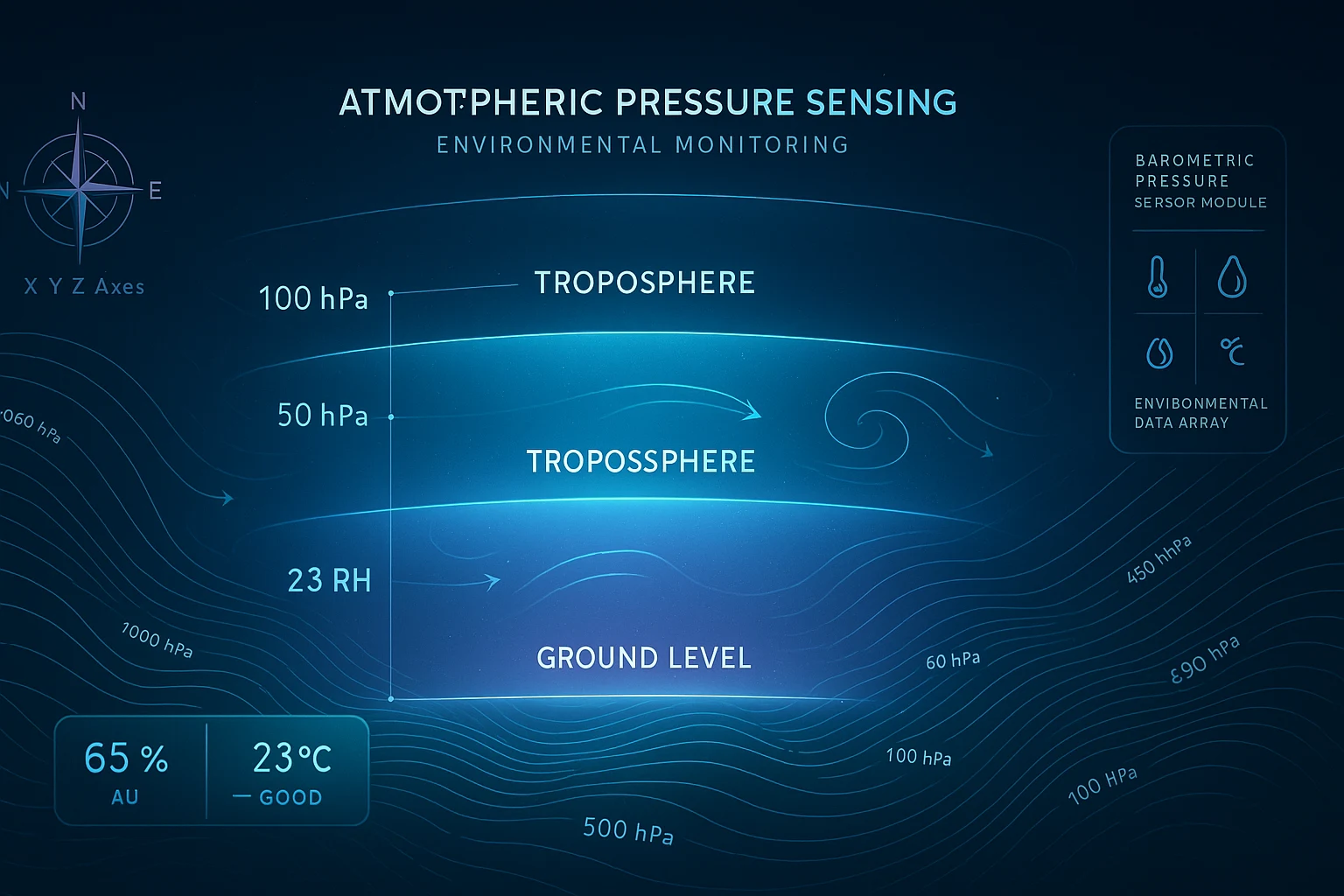
Barometric Pressure Sensor Module With 7 Integrated Sensors for Drones, Robotics, and IoT
RFOXiA Integrated Sensors Module
The Most Complete Barometric Pressure Sensor Module for Serious Developers
When you are building a drone, a field research node, an autonomous robot, or any professional IoT system, sensor integration is one of the most time-consuming and frustrating parts of the job. You need motion data. You need environmental data. You need altitude, orientation, air quality, and temperature — and most of the time you are sourcing five or six different breakout boards, wiring them up on a breadboard, fighting I2C address conflicts, and spending more time debugging your sensor stack than actually building the application you care about.
That is exactly the problem the MultiNav Pro+ Sensors Module from RFOXiA was designed to solve.
This is a single, compact, FCC-certified board that integrates seven professional-grade sensors — including a precision barometric pressure sensor module — into a 24mm × 18mm footprint. One board. One I2C line. Seven data streams. And it ships today.
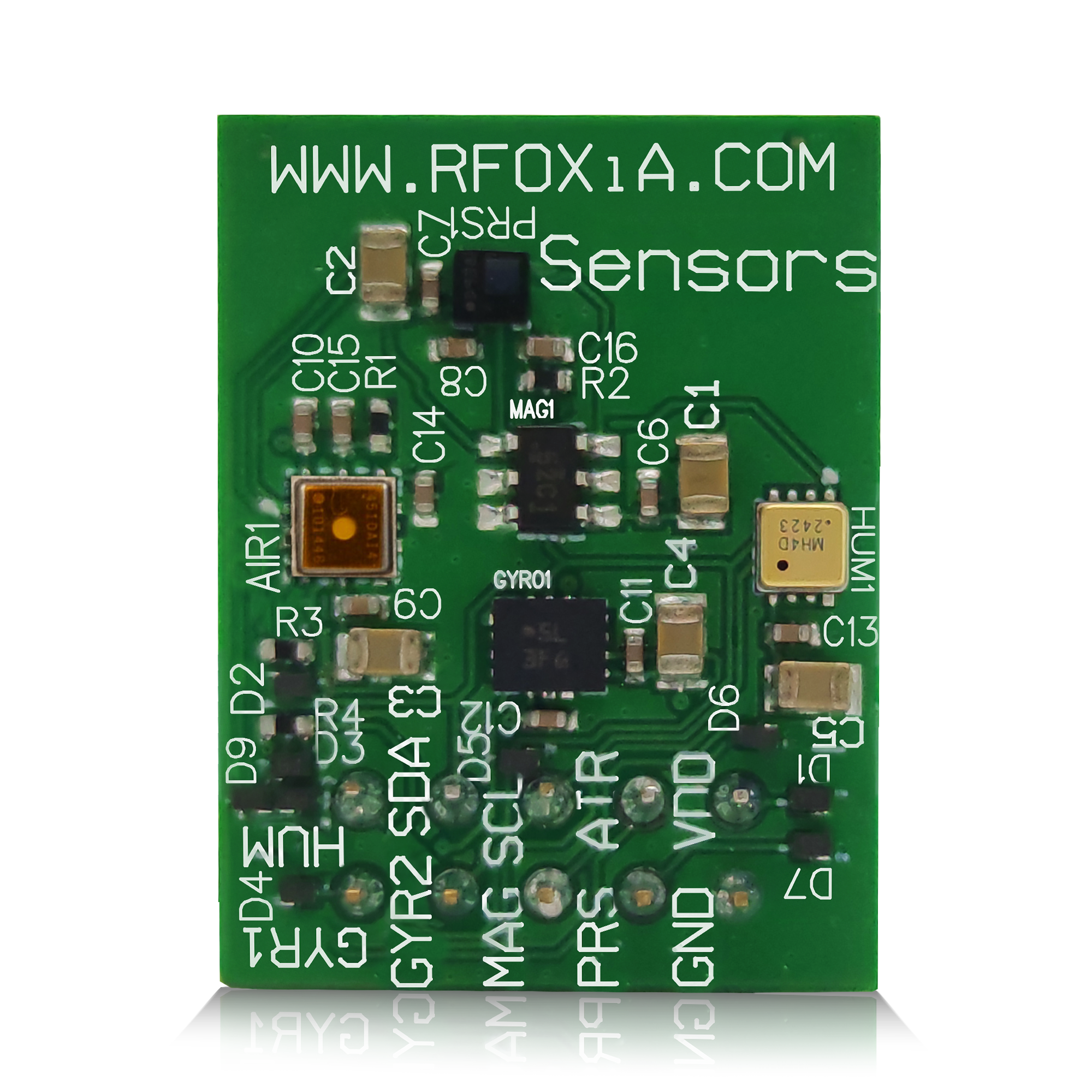
Let us break down exactly what is on this board, why each sensor matters, how the architecture is designed, and why this is the right choice for your next build.
What Is a Barometric Pressure Sensor Module and Why Does It Matter?
A barometric pressure sensor measures absolute atmospheric pressure, typically expressed in hectopascals (hPa) or millibars. At sea level, atmospheric pressure sits around 1013.25 hPa. As altitude increases, pressure drops — and this relationship is precise enough that modern flight controllers use barometric pressure readings as a primary altitude reference.
For drone applications, the barometric pressure sensor module is not optional. It is the foundation of altitude hold, return-to-home, and autonomous flight modes. Without accurate, high-speed pressure data, a drone cannot maintain stable hover — especially in dynamic outdoor conditions where wind, temperature changes, and turbulence create rapid pressure fluctuations.
Beyond drones, barometric pressure data is essential for:
- Weather station networks — local pressure readings are the core input for storm prediction and atmospheric modeling
- Environmental IoT nodes — pressure combined with temperature and humidity provides the full picture of atmospheric conditions
- Wearable altitude trackers — hiking computers, sports watches, and climbing gear all rely on barometric pressure for elevation tracking
- Indoor navigation — floor-level detection in multi-story buildings uses pressure differentials
- Agricultural monitoring — pressure trends correlate with incoming weather systems that affect crop management decisions
The MultiNav Pro+ includes the LPS22HHTR from STMicroelectronics as its barometric pressure sensor — a component trusted in professional aerospace and industrial applications for its low noise, high resolution, and fast output data rate.
All Seven Sensors: What Is on the Board
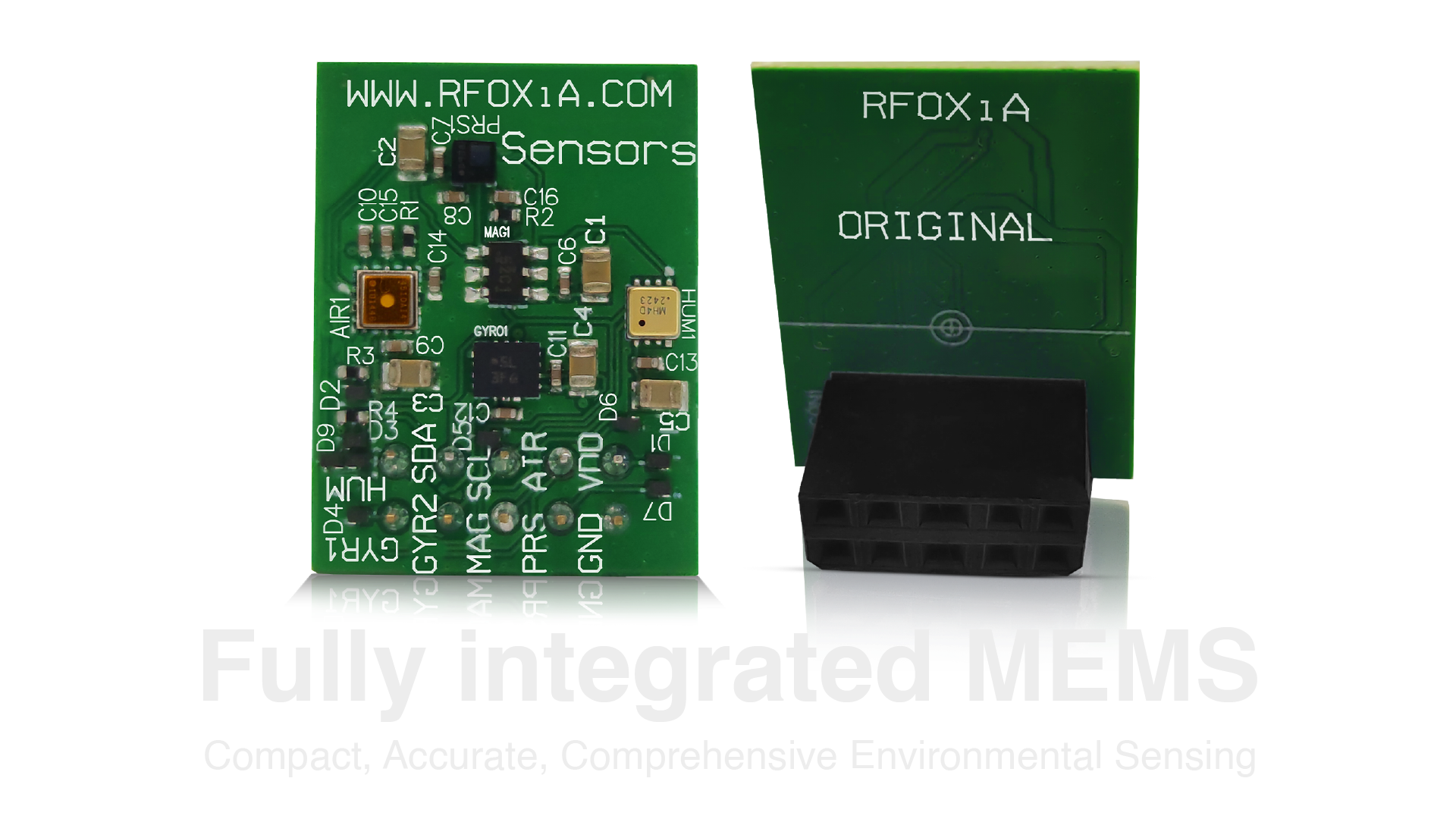
The MultiNav Pro+ Sensors Module is not just a barometric pressure sensor module. It is a complete environmental and motion sensing platform. Here is every sensor on the board:
Motion Sensors
Accelerometer and Gyroscope — BMI270 (Bosch Sensortec)
The BMI270 is one of the most respected IMU components in professional drone and robotics applications. It delivers low-noise, high-bandwidth acceleration and angular velocity data that is essential for attitude estimation, vibration analysis, gesture recognition, and stabilization systems. Bosch engineered this sensor specifically for wearable and drone-class applications, and its performance characteristics are reflected in the spec sheet and in real-world flight.
Magnetometer — TMAG5273C1QDBVR (Texas Instruments)
The TI TMAG5273 is a 3-axis Hall-effect magnetic field sensor designed for precise heading and compass applications. For any system that needs to know which direction it is pointing — a drone executing a waypoint mission, a robot navigating a warehouse, a handheld survey tool — accurate magnetometer data fused with gyroscope and accelerometer readings provides a stable heading reference even in GPS-denied environments.
Environmental Sensors
Barometric Pressure — LPS22HHTR (STMicroelectronics)
This is the barometric pressure sensor module component at the heart of the environmental sensing stack. The LPS22HHTR offers a pressure range of 260 to 1260 hPa, a relative accuracy of ±0.1 hPa, and an output data rate up to 200 Hz — meaning your system can track atmospheric pressure changes faster than virtually any environmental event can produce them. For altitude applications, this translates to sub-meter resolution when the sensor is properly calibrated against a reference.
Humidity and Temperature — MVH4003D (MEMSVision)
Temperature and humidity are the two most universally demanded environmental data points across IoT applications. The MVH4003D from MEMSVision delivers calibrated, factory-compensated readings with fast response time — critical for applications where the sensor is exposed to dynamic outdoor conditions rather than stable indoor environments.
Air Quality — ZMOD4510AI4R (Renesas)
Air quality monitoring is increasingly demanded across environmental research, smart city infrastructure, agricultural applications, and personal health devices. The ZMOD4510 from Renesas provides outdoor air quality index data based on ozone and nitrogen dioxide detection, with a sensor output specifically designed for real-world outdoor deployment. This is not a basic VOC sensor — it is a component engineered for the kind of outdoor data collection that RFOXiA's data monetization network is built on.
Precision Motion and Environmental Sensing in One Package
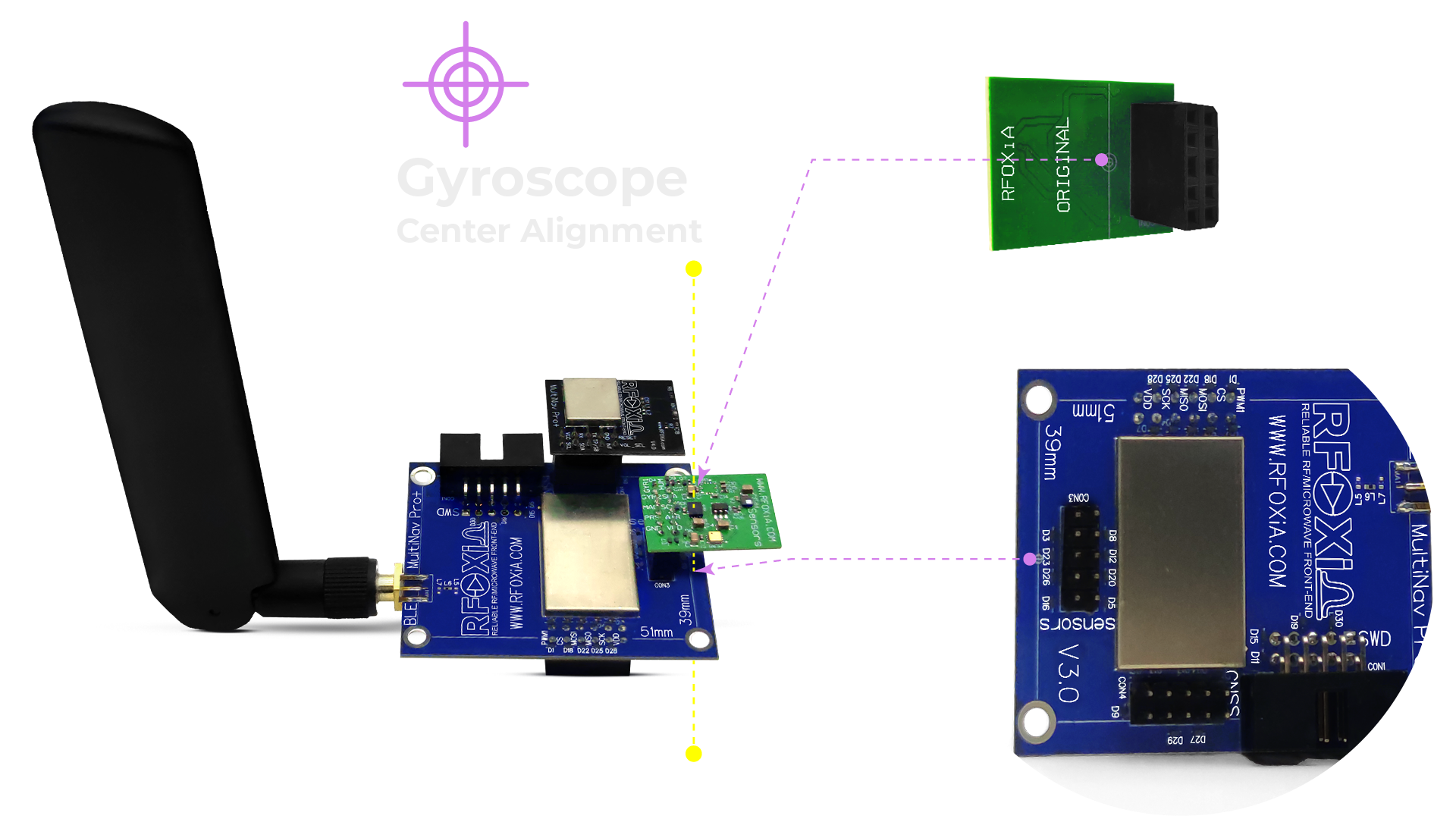
The combination of motion and environmental sensing on a single board is not just convenient — it is architecturally significant. In professional drone applications, motion data and environmental data are processed together in real time. Altitude hold fuses barometric pressure with accelerometer and gyroscope data. Heading lock fuses magnetometer with gyroscope. Environmental logging timestamps sensor readings with positional data.
When these sensors are on separate boards, you introduce latency, synchronization errors, and communication overhead. When they share a single board with synchronized output, the data is inherently aligned — which produces better fusion results and simpler firmware.
For field researchers and environmental monitoring applications, having motion sensors alongside environmental sensors means a single deployed node can capture both what is happening in the atmosphere and how the platform carrying the sensor is moving — enabling applications like turbulence detection, wind estimation, and platform-compensated environmental readings.
The Component Lineup: Industry-Leading Silicon
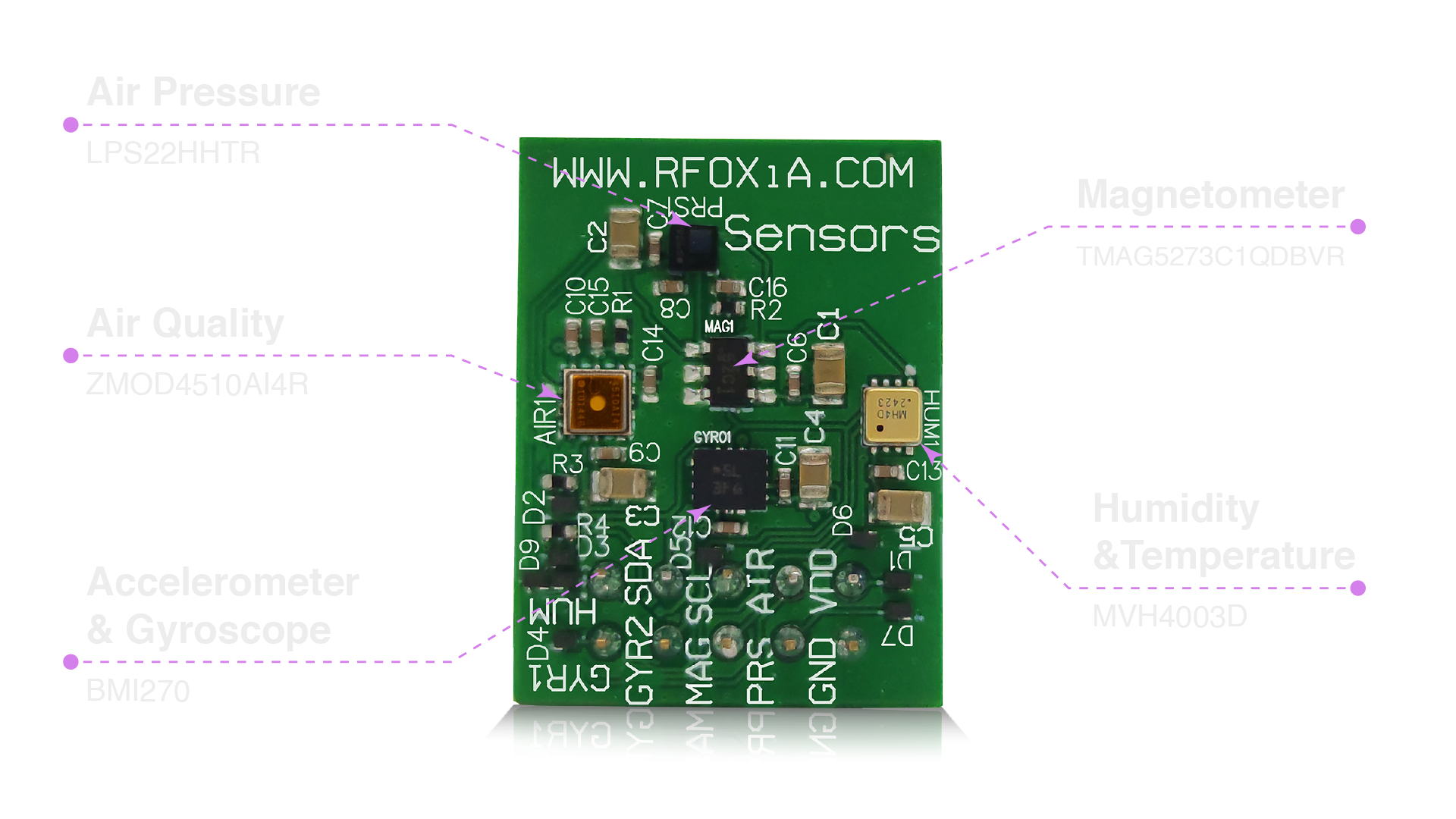
Every component on the MultiNav Pro+ Sensors Module was chosen from the product lines of major semiconductor companies — Bosch, Texas Instruments, STMicroelectronics, MEMSVision, and Renesas. This is not a module built around whatever sensors were cheapest or most available. It is a module built around sensors that professionals trust in production hardware.
This matters for several reasons:
- Datasheet reliability — major manufacturers provide comprehensive, accurate datasheets, application notes, and reference designs
- Long-term availability — components from Bosch, TI, and ST have long production lifecycles and stable supply chains
- Community support — popular components like the BMI270 have extensive open-source driver support in Arduino, Zephyr, FreeRTOS, and bare-metal environments
- Integration confidence — when you know exactly what silicon is on your board, you can trust your firmware to behave exactly as your datasheet analysis predicted
For the developer who is building a product rather than a prototype, component provenance matters. The MultiNav Pro+ is transparent about every chip on the board.
I2C Architecture: One Line, Seven Sensors, Zero Conflicts
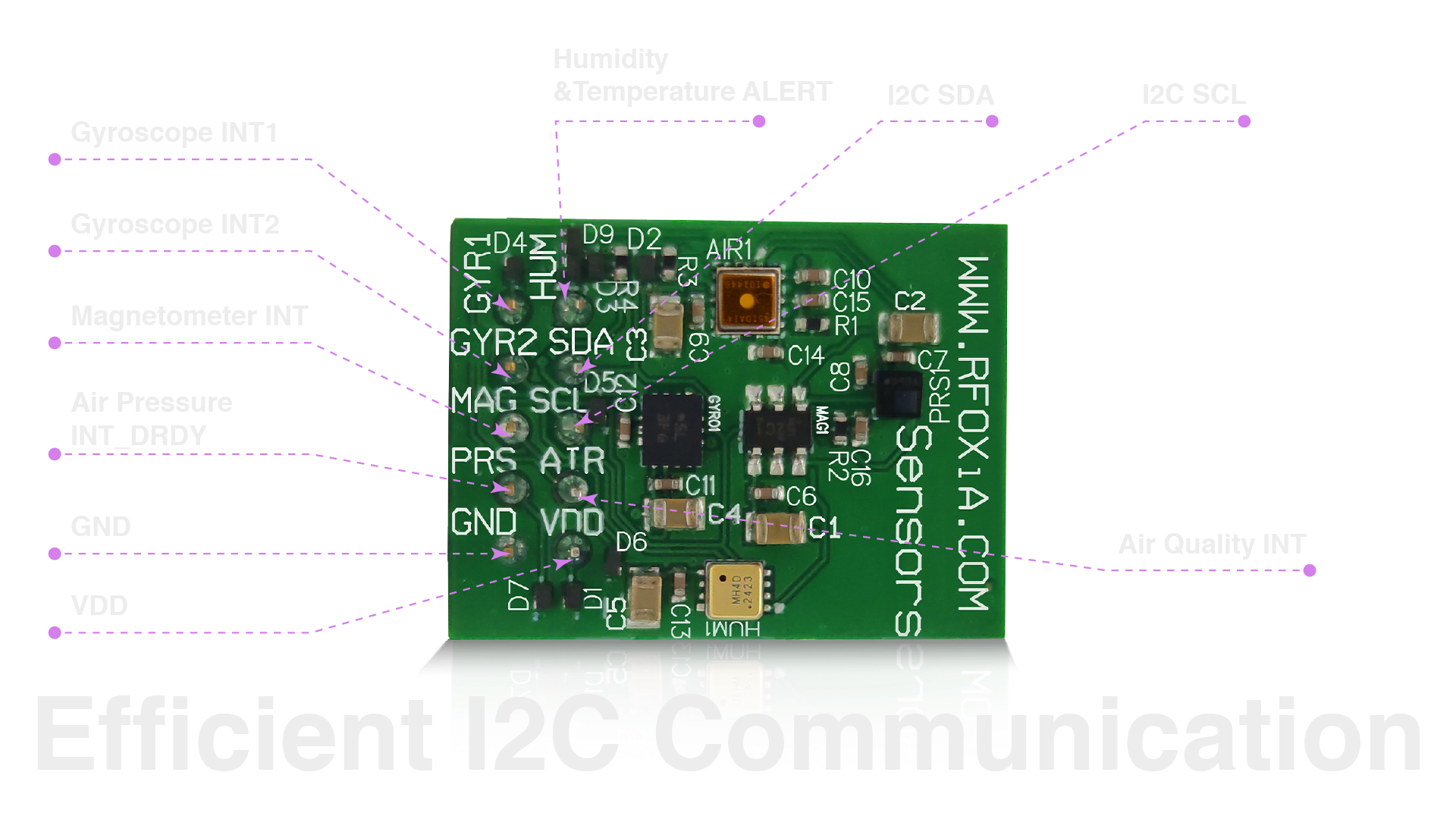
One of the most common pain points in multi-sensor projects is I2C address conflict. Many popular sensor ICs have fixed addresses or only one or two selectable addresses via hardware pins. When you stack five or six sensors on the same bus, you frequently end up with address collisions that require I2C multiplexers, additional logic, or complete redesigns.
The MultiNav Pro+ was designed from the ground up to avoid this problem. All seven sensors are assigned dedicated, non-conflicting I2C addresses, and the module exposes a single clean I2C interface to your host controller. Plug in, scan the bus, and all seven sensors are immediately addressable without any configuration overhead.
This clean I2C architecture also means:
- Simpler firmware — one bus initialization, standard read calls per sensor, no multiplexer logic
- Lower latency — direct addressing without switching overhead
- Better compatibility — works with any I2C master: STM32, ESP32, Arduino, Raspberry Pi, nRF52, and more
- Easier debugging — single bus means single scope probe point for logic analysis
For developers who have fought I2C address conflicts before, this design choice alone is worth a significant part of the $39 purchase price.
Compact Form Factor: 24mm × 18mm
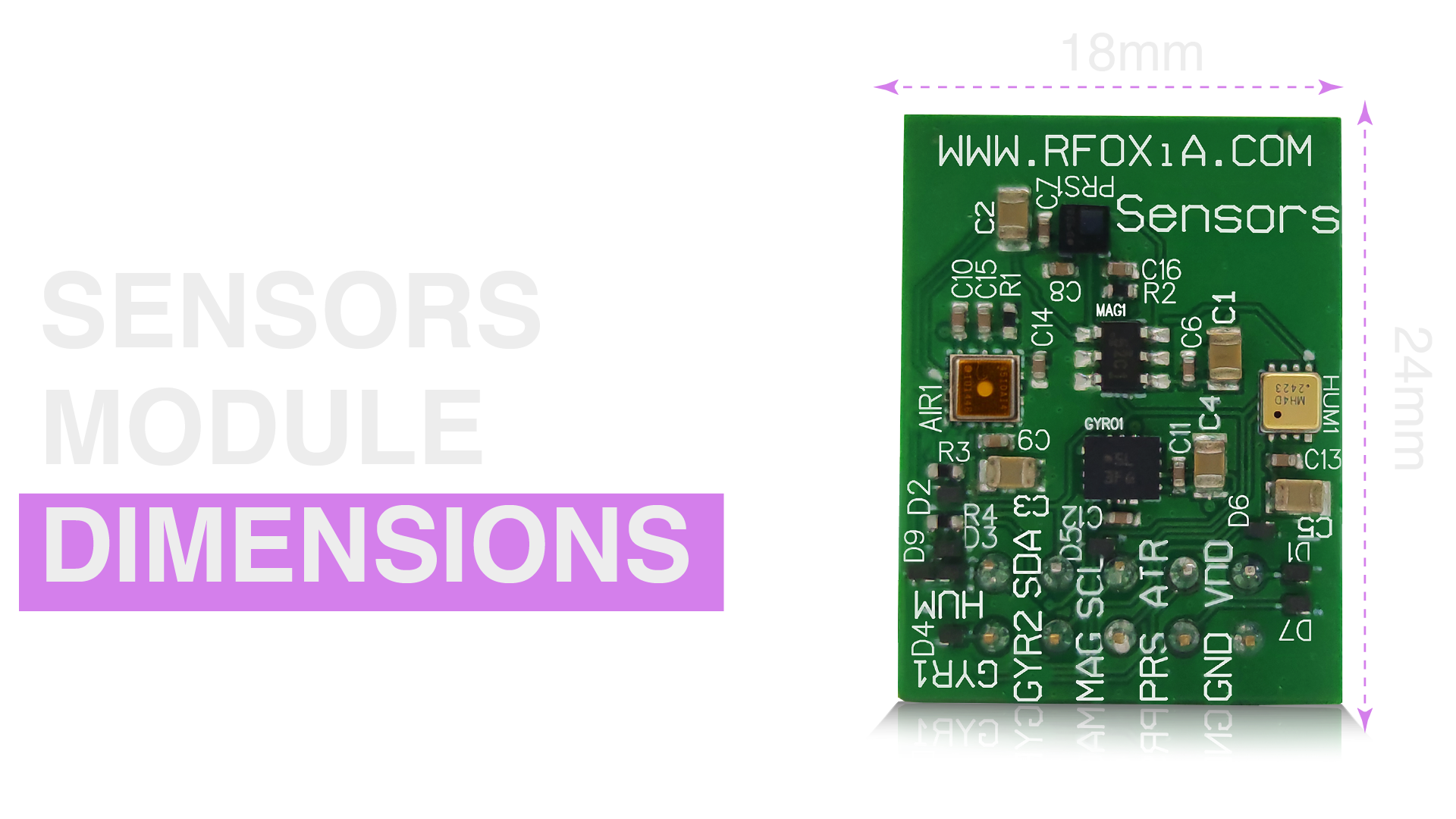
At 24mm × 18mm, the MultiNav Pro+ Sensors Module fits into form factors that most multi-sensor solutions cannot reach. A 250mm racing drone. A wearable device. A micro-UAV. An agricultural soil sensor probe. A compact environmental buoy.
For comparison, achieving equivalent sensor coverage with individual breakout boards would require a stack of five or six boards totaling anywhere from 150mm × 80mm to 200mm × 100mm of board area — before you account for the wiring harness connecting them. That is simply not viable in a drone application where every gram and every millimeter matters.
The compact design also reduces:
- Weight — one board instead of six means less total PCB material and fewer connectors
- Power consumption — single board, optimized power routing, no conversion losses across multiple VCC rails
- Vibration sensitivity — a single rigid board mounted at one point is mechanically simpler than a wiring harness connecting multiple boards
If you are building any application where size, weight, and integration density matter — and in most professional applications they do — the 24mm × 18mm footprint of the MultiNav Pro+ is a significant advantage.
Real-Time Environmental Data for Live Applications
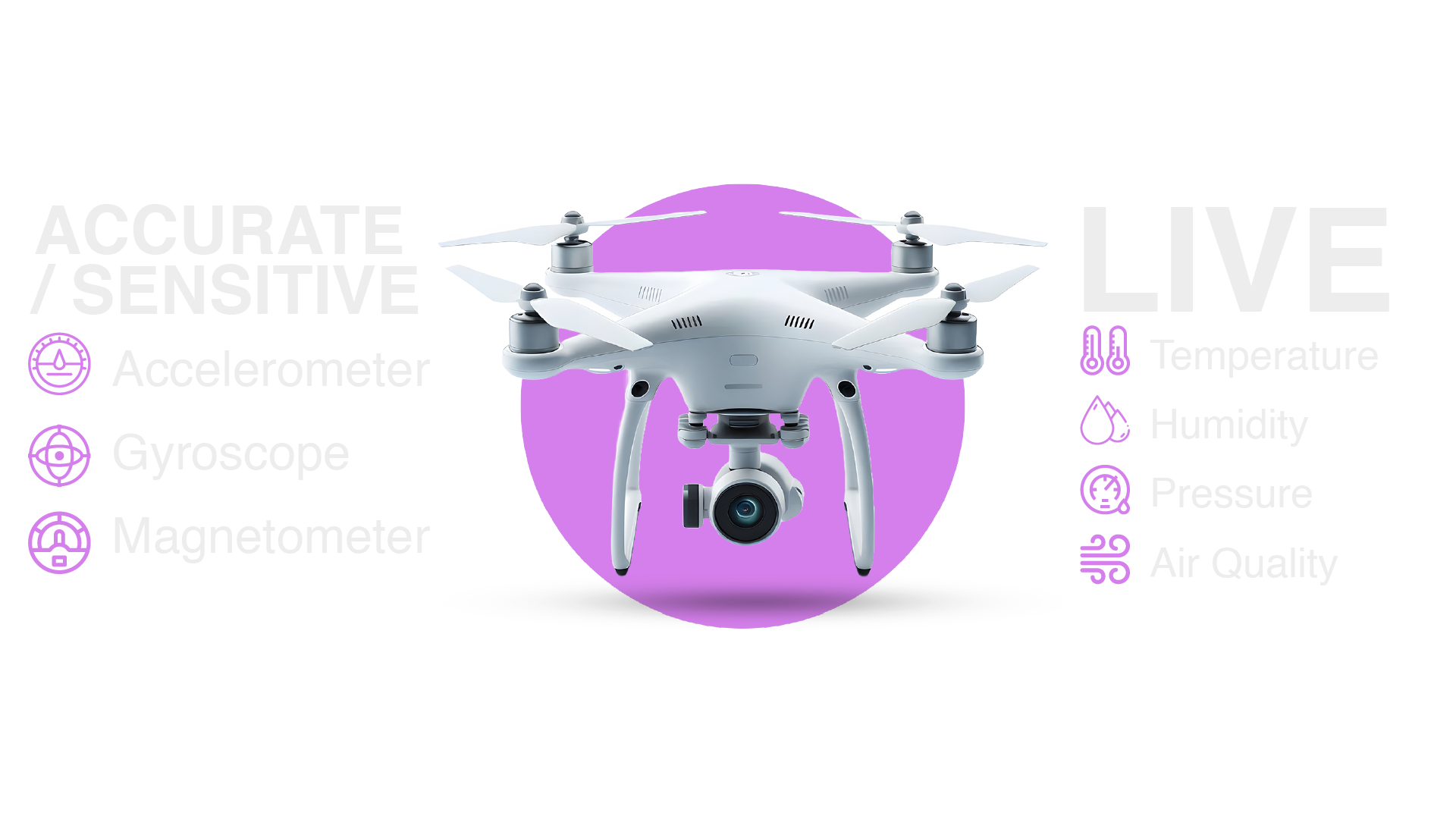
The MultiNav Pro+ is not just a logging module. All seven sensors deliver real-time output that your firmware can act on immediately. For control systems — flight controllers, robotics controllers, environmental automation systems — this real-time responsiveness is what separates useful sensor data from archived measurements.
When paired with the RFOXiA BLE Module (which achieves up to 20km man-to-drone range), the Sensors Module becomes a live remote sensing platform. Environmental data from the module streams wirelessly in real time to the RFOXiA Connect app on your phone — displayed on a live dashboard showing temperature, pressure, humidity, air quality, and motion data simultaneously.
This combination — compact barometric pressure sensor module with full environmental stack, high-speed wireless link, and mobile visualization — is something that previously required either expensive industrial sensor telemetry systems or a complex DIY integration of five separate components. The RFOXiA Integrated Sensors Module delivers it for $39.
Applications: Where the MultiNav Pro+ Sensors Module Belongs

The range of applications for a seven-sensor module combining motion and environmental sensing is genuinely broad. Here are the primary use cases where the MultiNav Pro+ delivers immediate value:
Drone and UAV Development
Every autonomous drone needs a barometric pressure sensor module for altitude hold, and most professional drones need motion sensing for stabilization and attitude estimation. Adding air quality, humidity, and temperature sensors to a drone enables aerial environmental surveys — applications that are increasingly demanded by agricultural operators, emergency responders, and environmental researchers. The MultiNav Pro+ puts all of this on a single 24mm × 18mm board.
Field Environmental Monitoring
Deployed outdoors as part of a fixed or mobile sensing node, the MultiNav Pro+ captures the complete local atmospheric picture: pressure, temperature, humidity, and air quality, with motion sensing available to detect tampering, vandalism, or structural movement of the deployment platform. Combined with the RFOXiA GNSS Module for GPS-verified location data, this becomes a hyper-local environmental data collection node that can participate in RFOXiA's data monetization network.
Robotics and Ground Vehicles
For ground robots, the IMU (accelerometer and gyroscope) enables dead reckoning navigation, tilt detection, and collision response. The magnetometer provides heading without GPS — critical for indoor navigation where GNSS signals are unavailable. The environmental sensors add situational awareness: a robot operating in a confined space can detect changes in air quality or temperature that might indicate fire, chemical release, or HVAC failure.
Wearable Devices and Personal Monitoring
The 24mm × 18mm form factor and I2C interface make the MultiNav Pro+ viable for integration into wearable devices. Fitness trackers, outdoor navigation devices, and health monitors all benefit from having motion, heading, altitude (via barometric pressure), and environmental data in a single compact package.
Smart Agriculture
Micro-climate data at the field level — not at the nearest weather station 30 kilometers away — is increasingly valuable for precision agriculture. Soil temperature, canopy humidity, local air pressure trends, and air quality readings (including ozone, which affects crop yields) are all captured by the MultiNav Pro+. Deployed across a field grid with wireless communication via the RFOXiA BLE Module, this creates a real-time micro-climate monitoring network.
Research and Education
For university labs, research teams, and advanced educational programs, the MultiNav Pro+ provides a professional-grade sensor platform at a price point that makes deployment of multiple nodes practical. Research applications include atmospheric science, drone aerodynamics studies, environmental impact assessment, and IoT systems research.
The RFOXiA Ecosystem Integration Advantage
The MultiNav Pro+ Sensors Module is not a standalone product. It is one module in a fully integrated wireless development ecosystem.
When combined with the rest of the RFOXiA product line, the Sensors Module becomes part of something much larger:
- + BLE Module — stream sensor data wirelessly at up to 20km range (man-to-drone) with no internet connection required
- + GNSS Module — add GPS-verified location data at 18Hz fix rate for precise spatial tagging of sensor readings
- + Power/Program Kit — power the entire module stack for 24 hours on a 5-minute supercapacitor charge, with integrated STLink programming
- + RFOXiA Connect App — visualize all sensor data live on your phone, including barometric pressure, air quality, temperature, humidity, and motion data
- + AI Firmware Builder — describe your sensor application in plain language and receive production-ready firmware — no months of development time required
- + Data Network — deploy your Sensors Module outdoors, stream verified environmental data, and earn daily rewards as your node contributes to RFOXiA's enterprise data network
This last point deserves emphasis. The Sensors Module is not just a development tool. It is a revenue-generating asset. Founding members who deploy verified outdoor nodes earn up to $0.40 per day in data network rewards — meaning a module that costs $39 can begin returning that investment within weeks of deployment.
The RFOXiA Integrated Sensors Module is the only $39 sensor board on the market that can also pay you back.
Technical Specifications Summary
| Specification | Detail |
|---|---|
| Form Factor | 24mm × 18mm |
| Communication | I2C (single bus, dedicated addresses) |
| Sensors | 7 total (see below) |
| Accelerometer / Gyroscope | BMI270 — Bosch Sensortec |
| Magnetometer | TMAG5273C1QDBVR — Texas Instruments |
| Barometric Pressure | LPS22HHTR — STMicroelectronics |
| Humidity / Temperature | MVH4003D — MEMSVision |
| Air Quality | ZMOD4510AI4R — Renesas |
| Certification | FCC Certified |
| Price | $39 |
| Ecosystem Compatibility | Full RFOXiA hardware and software ecosystem |
Why the LPS22HHTR Is the Right Barometric Pressure Sensor Module Component
Not all pressure sensors are equal. The LPS22HHTR from STMicroelectronics was selected for the MultiNav Pro+ because it hits the exact performance envelope required for professional applications at a component cost that keeps the module accessible.
Key characteristics of the LPS22HHTR:
- Pressure range: 260 to 1260 hPa — covers altitude from sea level to well above the operational ceiling of most commercial drones
- Absolute accuracy: ±1 hPa — sufficient for altitude reference with calibration
- Relative accuracy: ±0.1 hPa — the number that matters for altitude hold, where relative changes in pressure are what the flight controller is tracking
- Output data rate: Up to 200 Hz — fast enough for real-time flight control loops
- Current consumption: 3 μA in low-power mode — negligible impact on battery life
- Operating temperature: -40°C to +85°C — covers any real-world deployment environment
For a barometric pressure sensor module that will be deployed in drones flying in winter conditions, environmental nodes sitting outdoors in direct sun, or research equipment operating at altitude, these specifications are not academic — they are the reason the module performs reliably in conditions where cheaper sensors fail.
FCC Certification: Production-Ready From Day One
One of the most common barriers to moving from prototype to product in IoT and wireless development is regulatory certification. FCC certification can cost $10,000 to $30,000 and take months — making it economically inaccessible for most individual developers and small teams.
The MultiNav Pro+ Sensors Module is FCC certified. Every module in the RFOXiA product line carries FCC certification. This means:
- Legal deployment in the United States — you can deploy your sensor node in a commercial product, a research installation, or a public space without additional certification
- Distribution channel access — DigiKey, Mouser, and other professional distributors require FCC certification for electronics listings
- Customer confidence — for developers selling products to end users, having FCC-certified components in your BOM is a competitive advantage
At $39, the MultiNav Pro+ is the most affordable FCC-certified seven-sensor environmental and motion sensing module available.
Get the MultiNav Pro+ Sensors Module
The MultiNav Pro+ Sensors Module is available now, in stock, and ships from the United States. At $39, it is priced to be a practical component in your development budget — not a significant capital expenditure.
If you are building a drone, a robot, an environmental monitoring node, a wearable device, or any IoT system that needs barometric pressure data alongside motion and environmental sensing, this is the board that eliminates five separate sensor sourcing decisions and replaces them with a single, clean, I2C-addressable module.
For maximum capability, the MultiNav Pro+ is available as part of the Developer Bundle — which combines the Sensors Module with the long-range BLE Module (up to 20km drone range), the 18Hz GNSS Module, and the 24-hour supercapacitor Power/Program Kit in one integrated package at $199.
Visit the RFOXiA Integrated Sensors Module page to order yours, review full documentation, and explore integration guides for the most common host platforms.
Seven sensors. One board. One I2C line. $39. FCC certified. Ships today.
That is what the MultiNav Pro+ Sensors Module delivers — and there is nothing else on the market that comes close at this price point.
Written by: Moamen Mohamed LinkedIn