
Best GNSS Module Arduino 2026: MultiNav Pro+ Complete Review
The Best GNSS Module for Arduino in 2026 — Precision, Speed, and Open-Source Simplicity
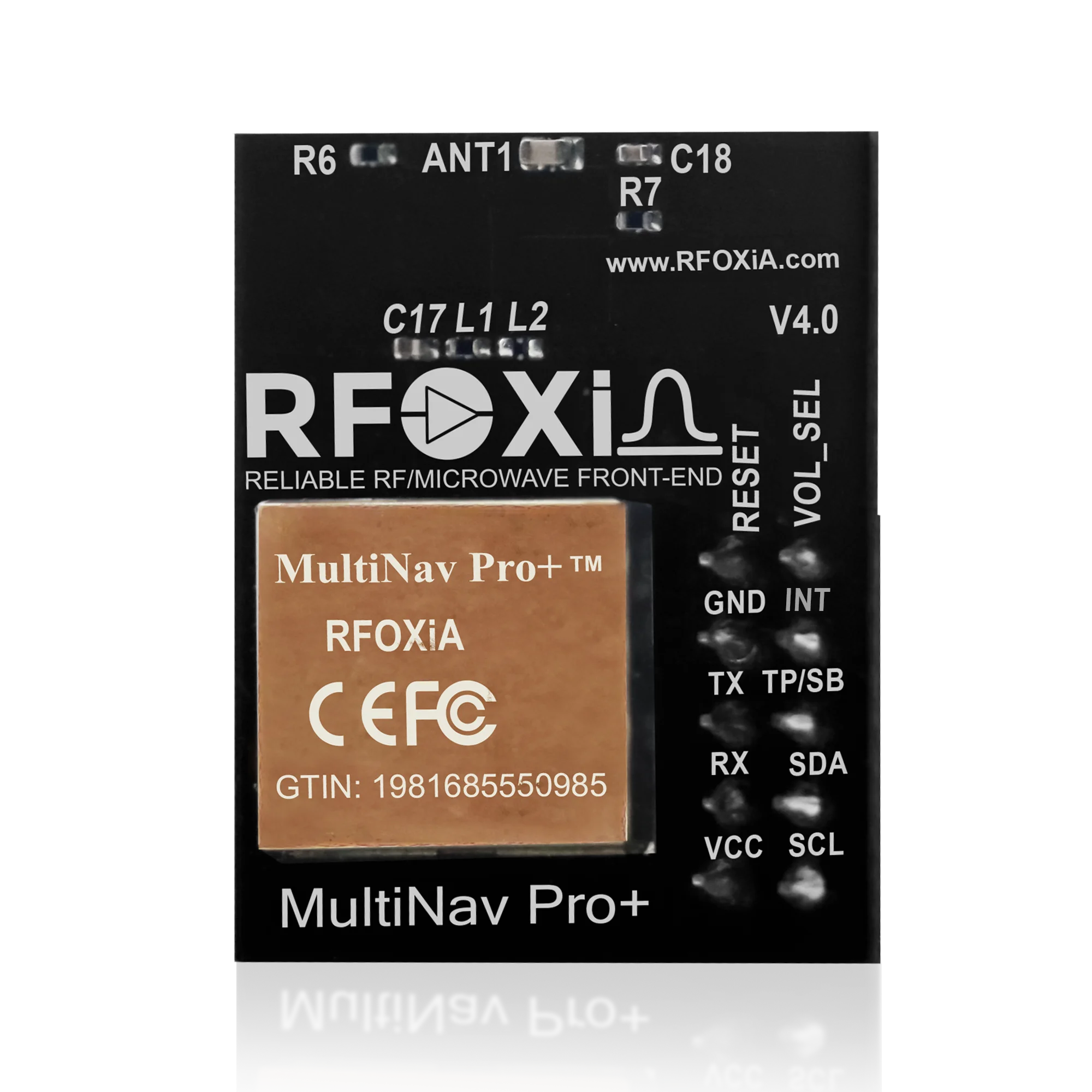
If you are searching for the best GNSS module Arduino 2026 has to offer, you have likely already discovered that the market is flooded with options ranging from cheap, inaccurate GPS breakouts to expensive survey-grade receivers that cost more than your entire project budget. The gap between those two extremes is exactly where the RFOXiA MultiNav Pro+™ lives — and it does so with specifications that genuinely change what is possible for makers, drone builders, robotics engineers, and IoT developers working with Arduino and compatible platforms.
This guide covers everything you need to know about the MultiNav Pro+: what it does, how it compares to the competition, how to integrate it with Arduino, and why it has become the go-to precision GNSS solution for serious hardware developers in 2026.
Why GNSS Module Choice Matters More Than You Think
Most developers underestimate the downstream impact of a poor GNSS module choice. A module with a 5-meter or 10-meter accuracy radius sounds acceptable until you realize it means your drone cannot reliably hold position, your tracking system cannot differentiate between adjacent parcels, and your survey data is essentially worthless for any professional application.
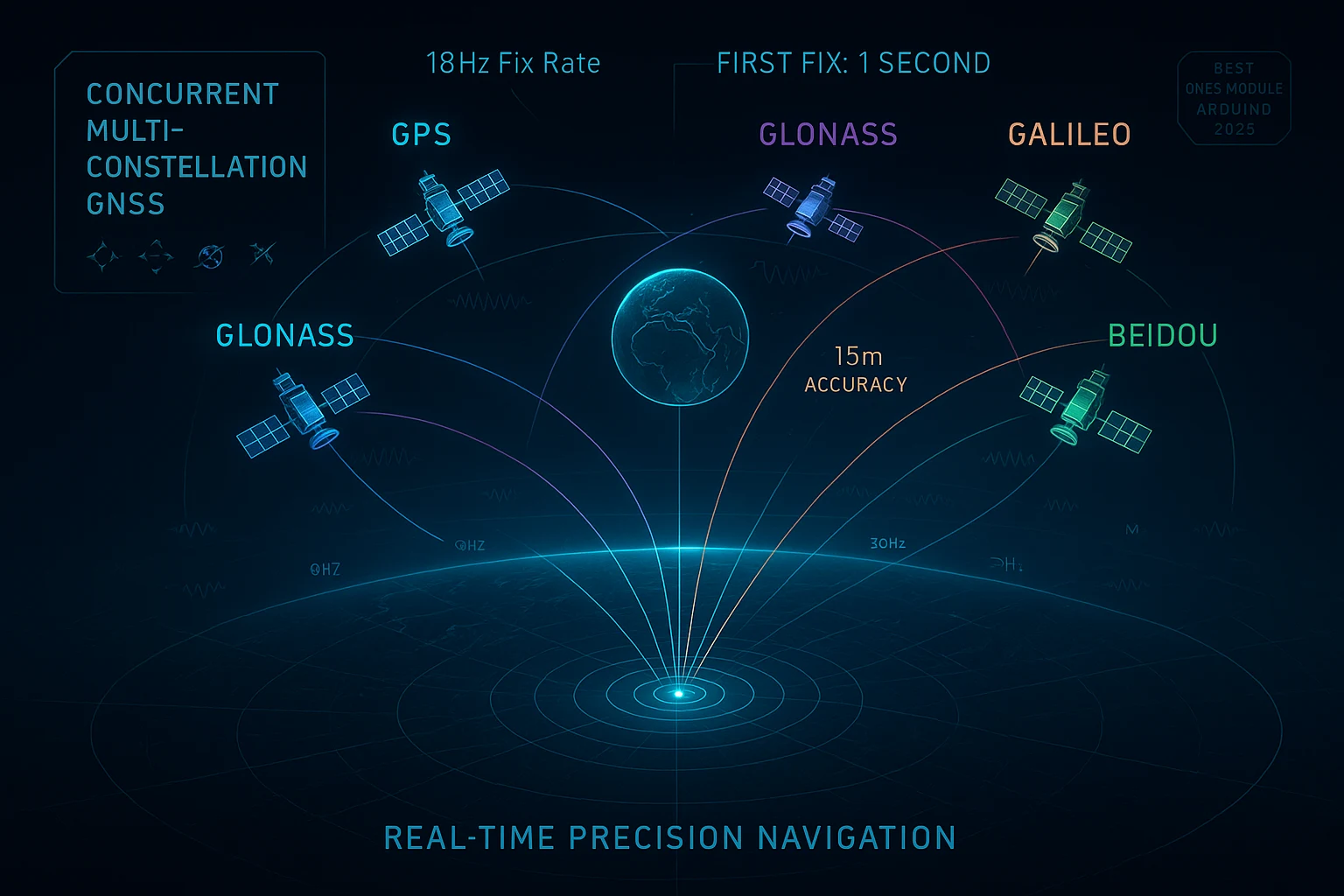
Fix rate matters just as much. A 1Hz fix rate — the standard on cheap modules — means your system receives one position update per second. For a drone flying at 60 km/h, that is 16.7 meters of travel between position updates. At 18Hz, the MultiNav Pro+ delivers a new position fix every 55 milliseconds. That is not an incremental improvement. It is a fundamentally different capability.
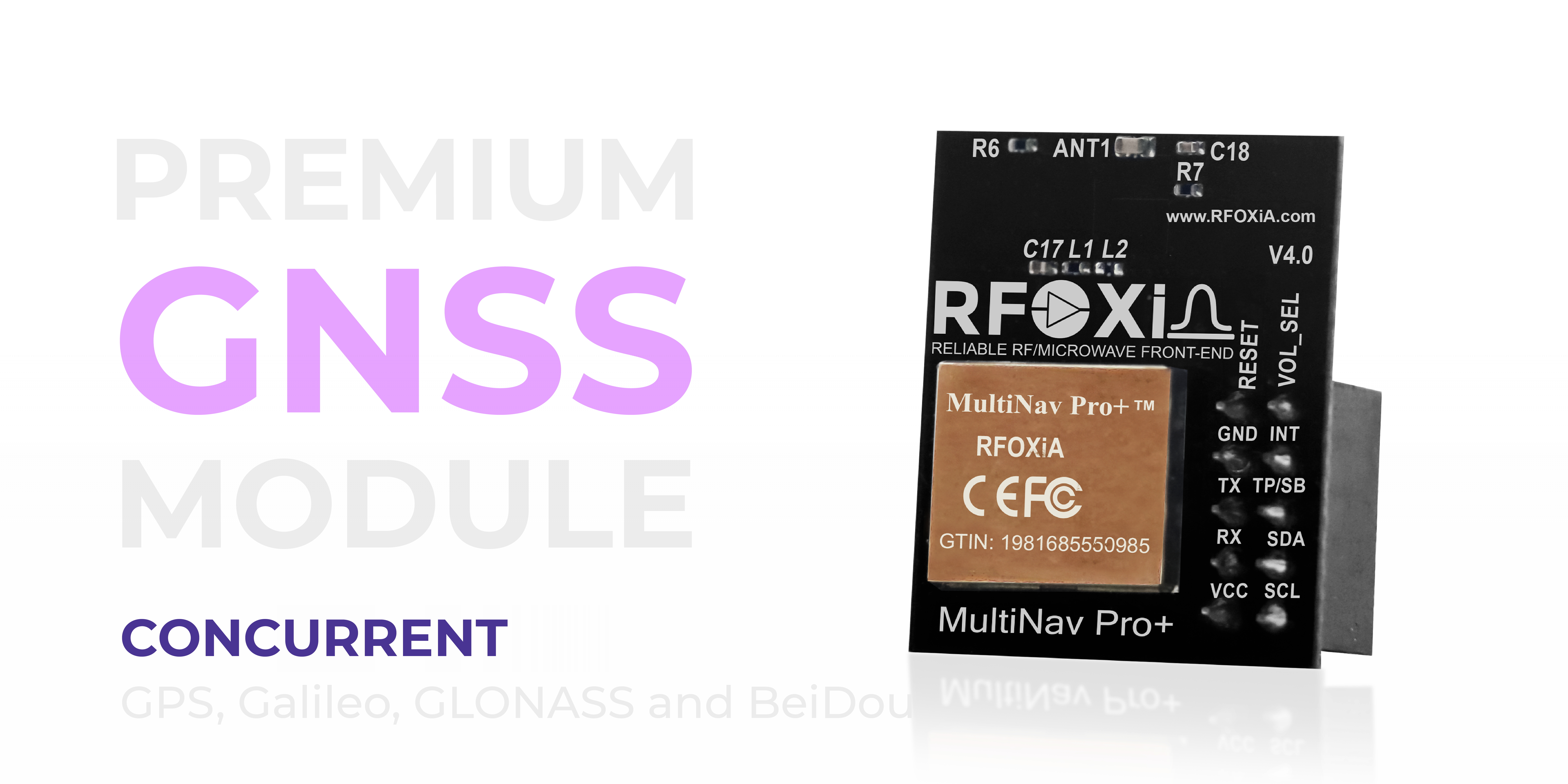
The MultiNav Pro+ is built around the u-blox MIA-M10Q — one of the most advanced GNSS chipsets available in a compact, maker-accessible form factor. It tracks GPS, Galileo, GLONASS, and BeiDou simultaneously, which means your module is always locked onto the maximum available satellites regardless of geography or sky conditions. The result is faster first fix times, more robust tracking in urban canyons and tree cover, and higher sustained accuracy across diverse environments.
MultiNav Pro+ Specifications — The Numbers That Matter
Before diving into integration and use cases, here are the core specifications that make the MultiNav Pro+ the best GNSS module for Arduino developers in 2026:
- Accuracy: Less than 1.5 meters CEP
- Fix Rate: Up to 18Hz
- First Fix: As fast as 1 second (hot start)
- Constellation Support: Concurrent GPS, Galileo, GLONASS, BeiDou
- Chipset: u-blox MIA-M10Q
- Antenna: Integrated high-gain chip antenna
- Interface: UART (TX/RX) and I2C (SCL/SDA)
- Operating Voltage: 1.8V and 3.3V
- Current Draw: 25–30mA
- Dimensions: 26mm × 22mm
- FCC Certified: Yes
- Price: $49

The 1.5-meter accuracy figure deserves emphasis. At this price point, sub-2-meter accuracy is exceptional. Competing modules in the same price range typically deliver 2.5–5 meters under ideal conditions, and considerably worse in real-world deployments. The MultiNav Pro+ achieves its accuracy through a combination of multi-constellation tracking, the advanced signal processing in the MIA-M10Q chipset, and RFOXiA's proprietary RF/microwave microstrip filter technology that minimizes interference at the antenna stage before it ever reaches the digital processing pipeline.
Compact, Efficient, and Built for Embedded Systems
One of the most common complaints from hardware developers integrating GNSS into embedded systems is power consumption. GNSS receivers are notoriously power-hungry, which creates real problems for battery-powered applications: trackers, wearables, remote sensors, and drone payloads.
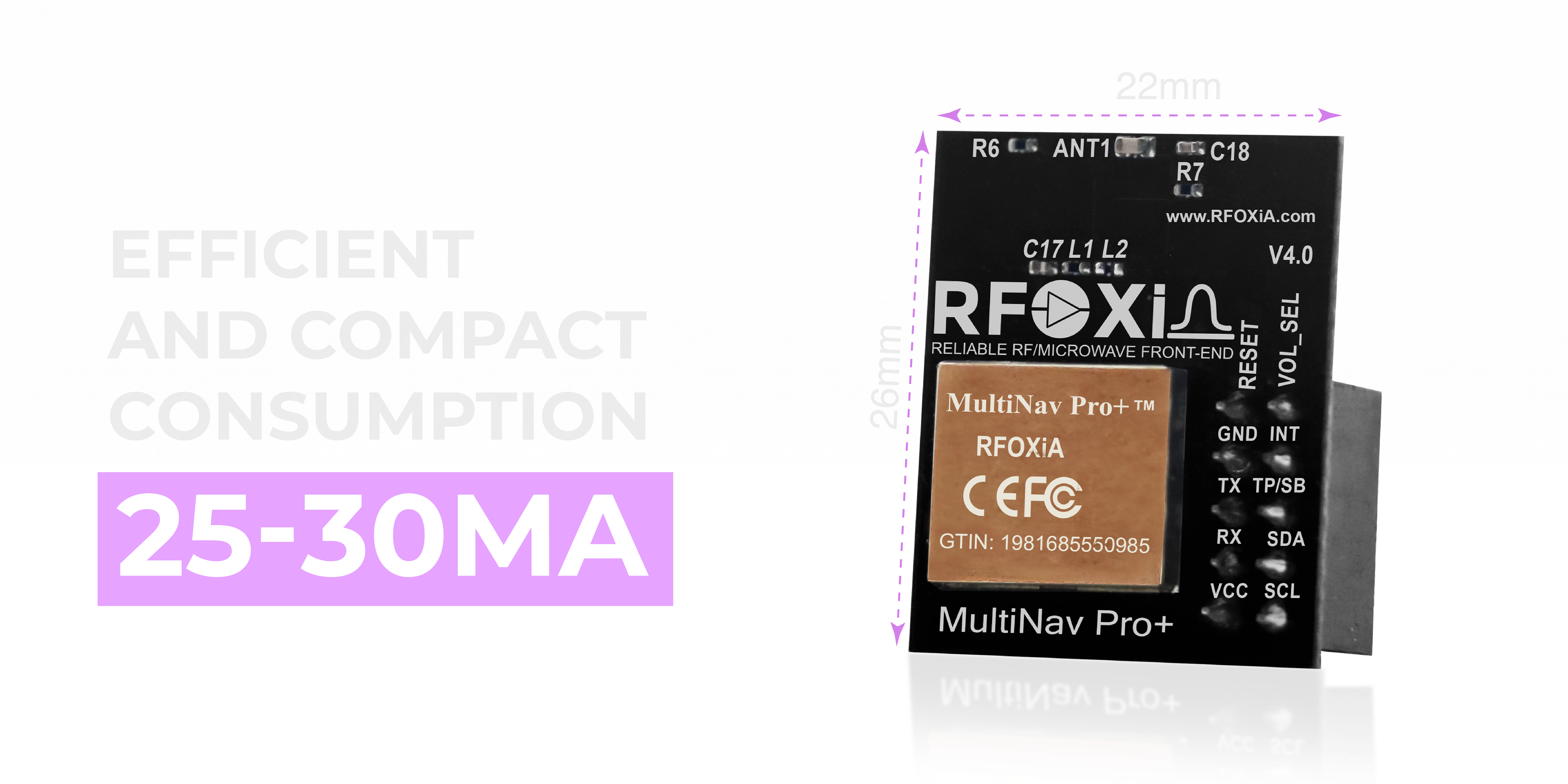
At 25–30mA operating current, the MultiNav Pro+ sits in the efficient range for a multi-constellation receiver. Combined with its compact 26mm × 22mm footprint, it integrates cleanly into tight PCB layouts, small enclosures, and weight-sensitive platforms without demanding a dedicated power management circuit. For drone applications where every gram and every milliamp-hour counts, this efficiency directly translates to longer flight times and lighter payload designs.
The module's dual voltage support (1.8V and 3.3V) adds additional flexibility. You can connect it directly to 3.3V microcontrollers like the Arduino MKR series, ESP32, or STM32 boards without level shifting, and it operates natively at 1.8V for ultra-low-power system designs.
Arduino Integration — UART and I2C Support
The MultiNav Pro+ supports both UART and I2C interfaces, giving Arduino developers maximum flexibility in how they connect and communicate with the module.
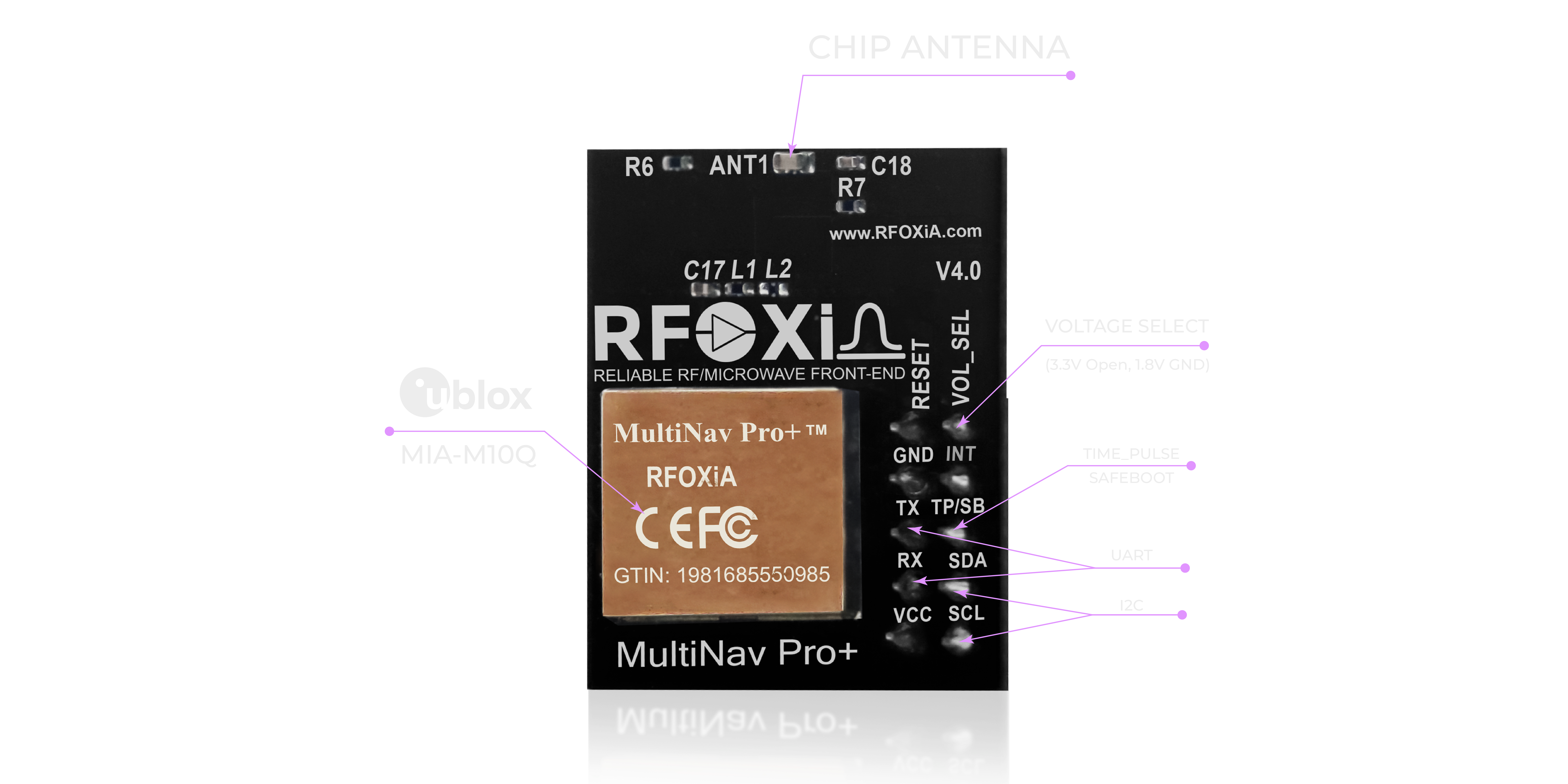
UART connection is the most common approach for Arduino projects. Connect the module's TX pin to your Arduino's RX pin and the module's RX to your Arduino's TX. The module communicates using standard NMEA 0183 sentences — the industry-standard protocol used by virtually all GNSS hardware — which means existing Arduino GPS parsing libraries work immediately with no modifications required.
I2C connection is useful when your project already uses UART for another peripheral (a cellular modem, radio module, or debug interface) and you want to preserve that serial bus for its intended purpose. On I2C, the MultiNav Pro+ connects via SCL and SDA to your Arduino's dedicated I2C pins, freeing your serial ports entirely.
Both interfaces are supported by the included open-source driver library, so you choose based on your project architecture rather than being constrained by the module.
Open-Source Driver — The Developer Experience Difference
Hardware specifications only tell half the story. The development experience — how quickly you go from unboxing to working code — determines whether a module is truly practical for a real project.
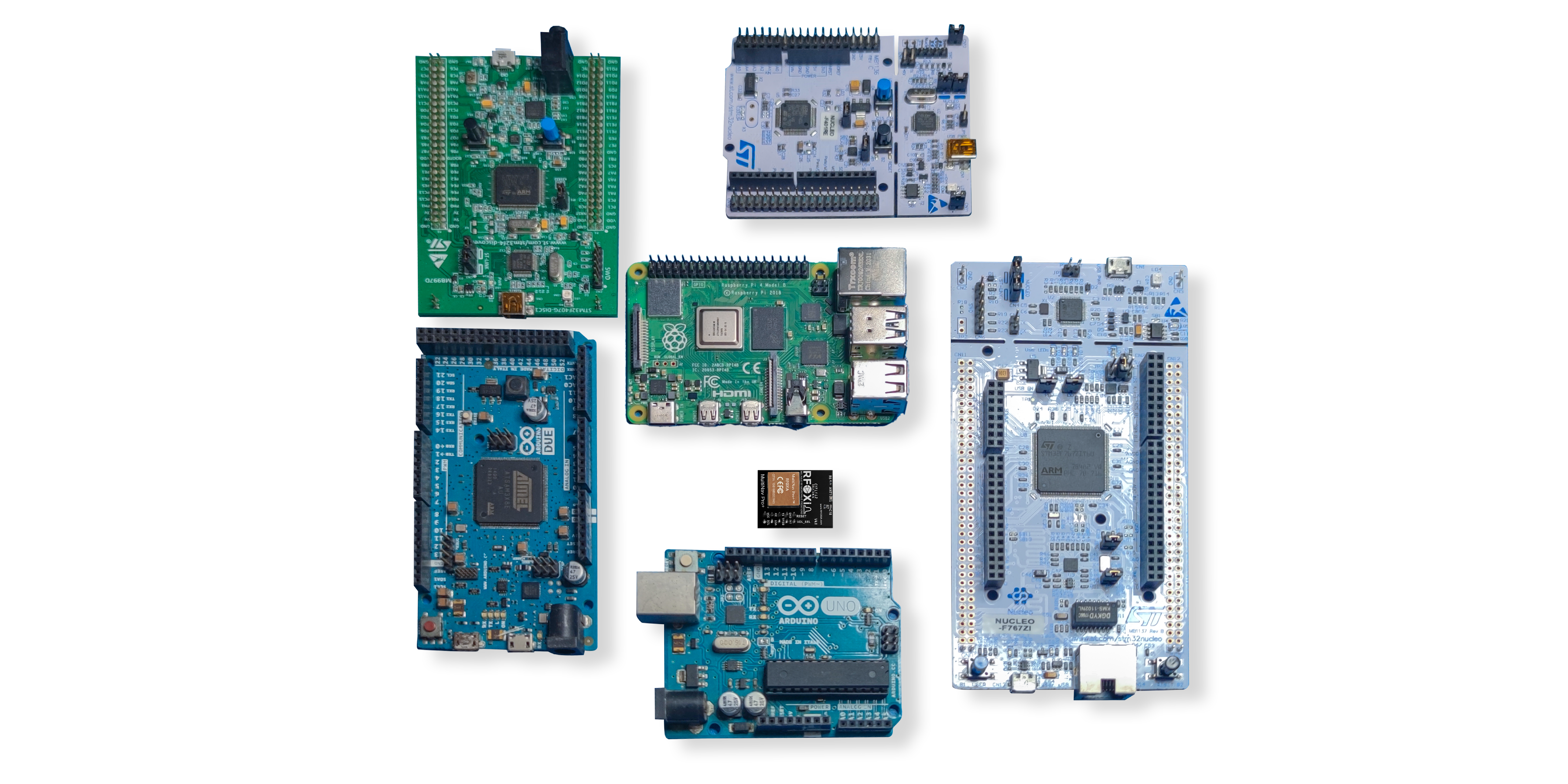
The MultiNav Pro+ ships with a fully open-source C language library that implements the complete NMEA standard protocol command set. The library is structured to import directly into Arduino IDE with zero configuration — add the library, include the header, initialize the module, and you have live GPS data flowing to your application in minutes rather than hours.
For developers working outside the Arduino ecosystem, the C library is clean, well-documented, and portable. It compiles without modification in PlatformIO, STM32CubeIDE, Zephyr RTOS environments, and any standard embedded C toolchain. This is not a locked-down proprietary SDK that forces you into a specific ecosystem. It is your code, fully open, fully customizable.
The full source is available for inspection, modification, and contribution. For developers building commercial products on top of the MultiNav Pro+, this open-source approach eliminates licensing concerns and gives you complete visibility into every function the library performs.
If you want to see the RFOXiA Accurate GNSS Module in action before committing, RFOXiA's GitHub repositories include worked examples covering basic position reading, high-rate logging, geofencing, and integration with the broader RFOXiA ecosystem including the BLE Module for long-range data relay.
u-Center Software — Visualization and Configuration
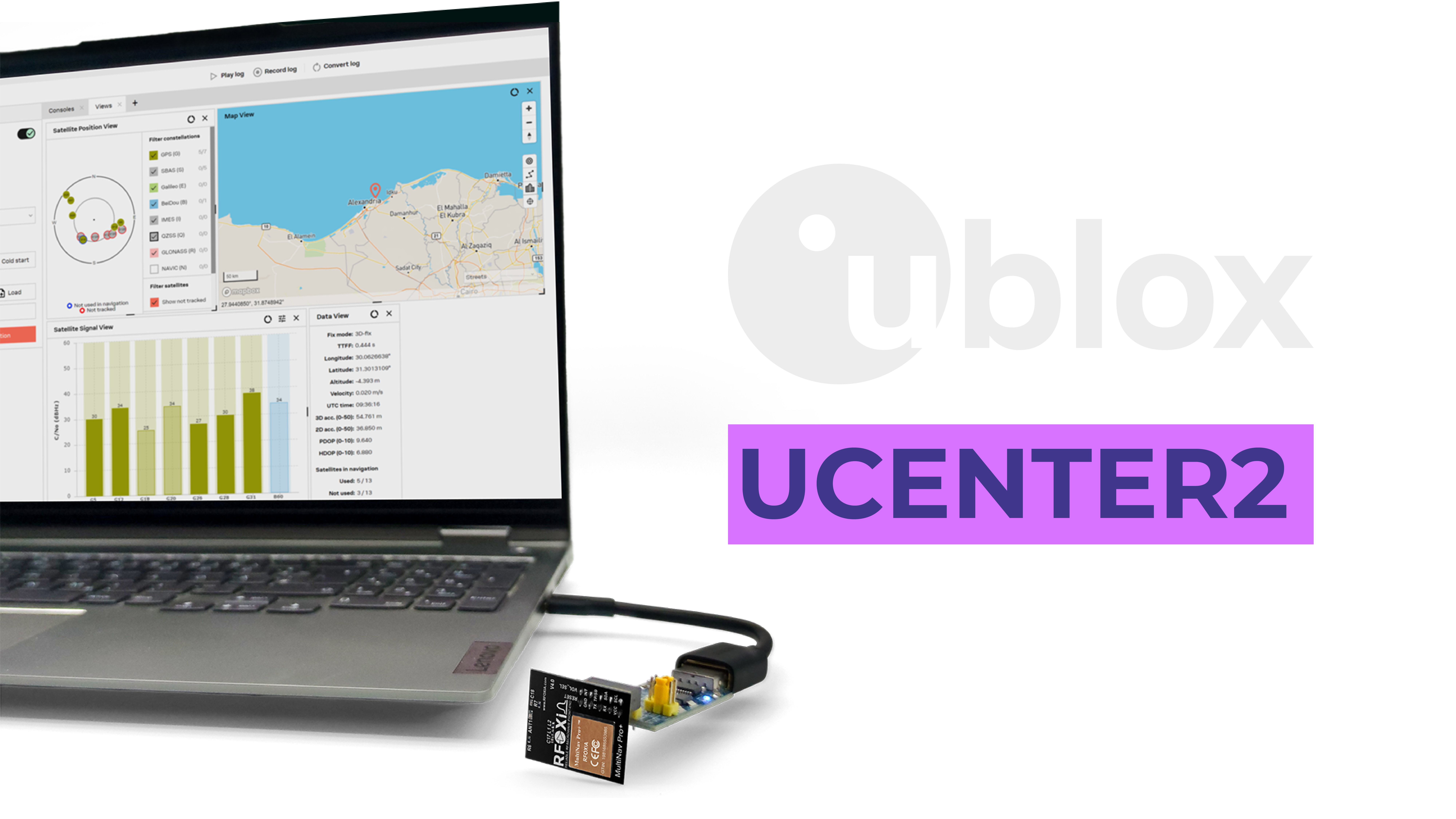
Because the MultiNav Pro+ is powered by the u-blox MIA-M10Q chipset, it is fully compatible with u-blox's u-center software — a professional-grade GNSS evaluation and configuration tool available free from u-blox.
u-center provides a graphical interface for visualizing satellite constellation geometry in real time, displaying signal strength per satellite, configuring output rates and message types, logging position data with timestamps, and evaluating accuracy under different sky conditions. For developers validating their integration or characterizing module performance before deployment, u-center is an invaluable tool that would otherwise require significant software development effort to replicate.
This compatibility is not accidental. RFOXiA chose the MIA-M10Q specifically because it represents the current state of the art in compact GNSS processing, and because the broader u-blox ecosystem of tools, documentation, and community knowledge benefits every developer who works with the module.
Use Cases — Where the MultiNav Pro+ Excels

The MultiNav Pro+ was designed to serve serious applications across a wide range of platforms. Here are the deployments where its specifications deliver the most meaningful advantage:
Autonomous Drones and FPV Platforms
The 18Hz fix rate is the critical specification for drone applications. Autonomous flight controllers need position updates fast enough to respond to wind gusts, execute precise waypoint transitions, and maintain stable hover without hunting. At 18Hz with sub-1.5m accuracy, the MultiNav Pro+ provides the data quality that transforms a drone from a toy into a precision tool. It integrates naturally into ArduPilot and PX4 flight stacks via UART with standard NMEA or UBX protocol configuration.
Asset and Vehicle Tracking
For real-time asset tracking — vehicles, equipment, personnel — the combination of fast fix rate and high accuracy means your tracking platform always knows where assets are, not where they were one second ago. The module's efficient power consumption extends battery life in always-on tracking deployments.
IoT Environmental Sensor Networks
When combined with RFOXiA's Sensors Module, the MultiNav Pro+ adds GPS-verified location to environmental data — temperature, humidity, air pressure, and air quality readings that are geographically anchored. This is the configuration used for contributing to RFOXiA's data monetization network, where GPS validation confirms outdoor deployment and geographic location for data buyers.
Precision Agriculture
Micro-climate data collection, soil sampling coordination, spray drone navigation, and crop monitoring all benefit from sub-2-meter positional accuracy. The MultiNav Pro+ delivers survey-grade performance at a price point accessible to agricultural technology developers and small-scale precision farming operations.
Robotics and Ground Vehicles
For outdoor mobile robots — lawn maintenance bots, logistics robots, exploration platforms — the fast fix rate and reliable multi-constellation lock provide the positional foundation for path planning, obstacle avoidance integration, and safe autonomous navigation.
Research and Education
Universities and research institutions working on GNSS applications, sensor fusion, Kalman filtering, or autonomous systems benefit from access to a professional-specification module at a price that does not require grant funding for hardware alone. The open-source driver and u-center compatibility make the MultiNav Pro+ an excellent teaching platform as well.
How the MultiNav Pro+ Compares to the Competition in 2026
The best GNSS module Arduino 2026 search returns a crowded field. Here is how the MultiNav Pro+ stacks up against the most common alternatives:
Generic NEO-6M/NEO-8M Modules ($8–$15) These are the modules most frequently recommended in beginner tutorials. Fix rate is typically 1–5Hz. Accuracy is 2.5–5 meters under ideal conditions. No concurrent multi-constellation support on the older NEO-6M. No open-source professional library. No FCC certification. Adequate for basic learning projects. Not adequate for any professional or safety-critical application.
Adafruit Ultimate GPS ($39.95) Based on the MediaTek MT3339 chipset. 10Hz fix rate. 1.8-meter accuracy. Single UART interface. A solid choice for maker projects, but limited to 66 channels versus the MIA-M10Q's superior multi-constellation architecture. No I2C support. No u-center compatibility.
SparkFun ZED-F9P RTK ($274.95) Survey-grade RTK with centimeter accuracy. Excellent hardware. Requires RTK correction data stream. Price excludes most embedded applications. Five times the cost of the MultiNav Pro+ for applications that do not require centimeter-level precision.
The MultiNav Pro+ occupies the performance tier between basic hobbyist modules and expensive RTK systems — which is exactly where the majority of real-world professional embedded applications live. For the developer who needs better than consumer GPS but does not need survey-grade RTK, there is no better option at this price point.
Integration with the RFOXiA Ecosystem
The MultiNav Pro+ is a capable standalone GNSS module, but it reaches its full potential as part of the RFOXiA hardware ecosystem. When paired with the RFOXiA BLE Module (5km ground-to-ground, 20km man-to-drone range), position data can be relayed wirelessly over distances that no standard Bluetooth implementation can approach.
The RFOXiA Connect app on Android and iOS receives live GPS position from the BLE Module and renders it as a real-time track on an integrated map display — all without any internet connection. For drone operators, field researchers, and search-and-rescue teams, this means live position awareness at ranges up to 20km with no cellular or Wi-Fi infrastructure required.
For developers who want the complete platform — BLE Module, GNSS Module, Sensors Module, and Power/Program Kit in a single integrated package — the Developer Bundle combines all four modules at a significant discount with immediate access to the AI Firmware Builder inside RFOXiA Club.
The RFOXiA Accurate GNSS Module is available individually at $49, or as part of the Developer Bundle for integrated ecosystem deployment.
Getting Started with the MultiNav Pro+ on Arduino
Here is the fastest path from unboxing to live GPS data on your Arduino project:
Step 1: Connect For UART: Connect module TX → Arduino RX, module RX → Arduino TX, VCC → 3.3V, GND → GND. For I2C: Connect SCL → Arduino SCL, SDA → Arduino SDA, VCC → 3.3V, GND → GND.
Step 2: Install the Library Download the open-source C library from the RFOXiA GitHub repository. In Arduino IDE: Sketch → Include Library → Add .ZIP Library. Select the downloaded library archive.
Step 3: Load the Example Sketch The library includes example sketches for basic position reading, high-rate logging, and geofencing. Open the BasicPosition example, select your board and port, and upload.
Step 4: Open Serial Monitor At 115200 baud, you will see live NMEA sentences parsed into latitude, longitude, altitude, speed, heading, fix quality, and satellite count — typically within 1 second of powering up if you have a recent almanac cached.
Step 5: Validate with u-center (Optional) Connect via USB-to-serial adapter and open u-center to visualize your satellite constellation, signal strengths, and position accuracy estimate. This step is especially valuable when validating antenna placement and enclosure design for your specific application.
FCC Certification — Why It Matters for Your Product
Every RFOXiA module, including the MultiNav Pro+, carries full FCC certification. For makers building personal projects, this may seem irrelevant. For anyone building a commercial product or deploying modules in a professional context, FCC certification is essential.
FCC-certified modules can be incorporated into final products without requiring the end product to undergo independent GNSS module testing — a significant cost and time saving in the certification process. Distributors including DigiKey and Mouser require FCC certification for listing. Enterprise customers and institutional buyers require it for procurement. If you are building something that will ship, scale, or be sold, starting with FCC-certified hardware is not optional.
Conclusion — The Best GNSS Module for Arduino in 2026
The search for the best GNSS module Arduino 2026 ends with hardware that delivers professional-grade specifications, developer-friendly integration, open-source software, and a price point that does not require a research budget to justify.
The MultiNav Pro+ delivers 1.5-meter accuracy and an 18Hz fix rate from a 26mm × 22mm module that connects directly to any Arduino via UART or I2C, ships with a fully open-source C library that works in Arduino IDE out of the box, and is backed by u-center compatibility, FCC certification, and RFOXiA's complete developer ecosystem.
Whether you are building an autonomous drone, a precision tracking system, an IoT sensor network, or a research platform, the MultiNav Pro+ gives you the GNSS foundation your project deserves — without paying survey-grade prices for capabilities that only surveyors need.
Ready to build with precision? Explore the RFOXiA Accurate GNSS Module and order yours today for $49 with FCC certification, open-source driver, and full RFOXiA ecosystem compatibility included.
Written by: Moamen Mohamed LinkedIn