
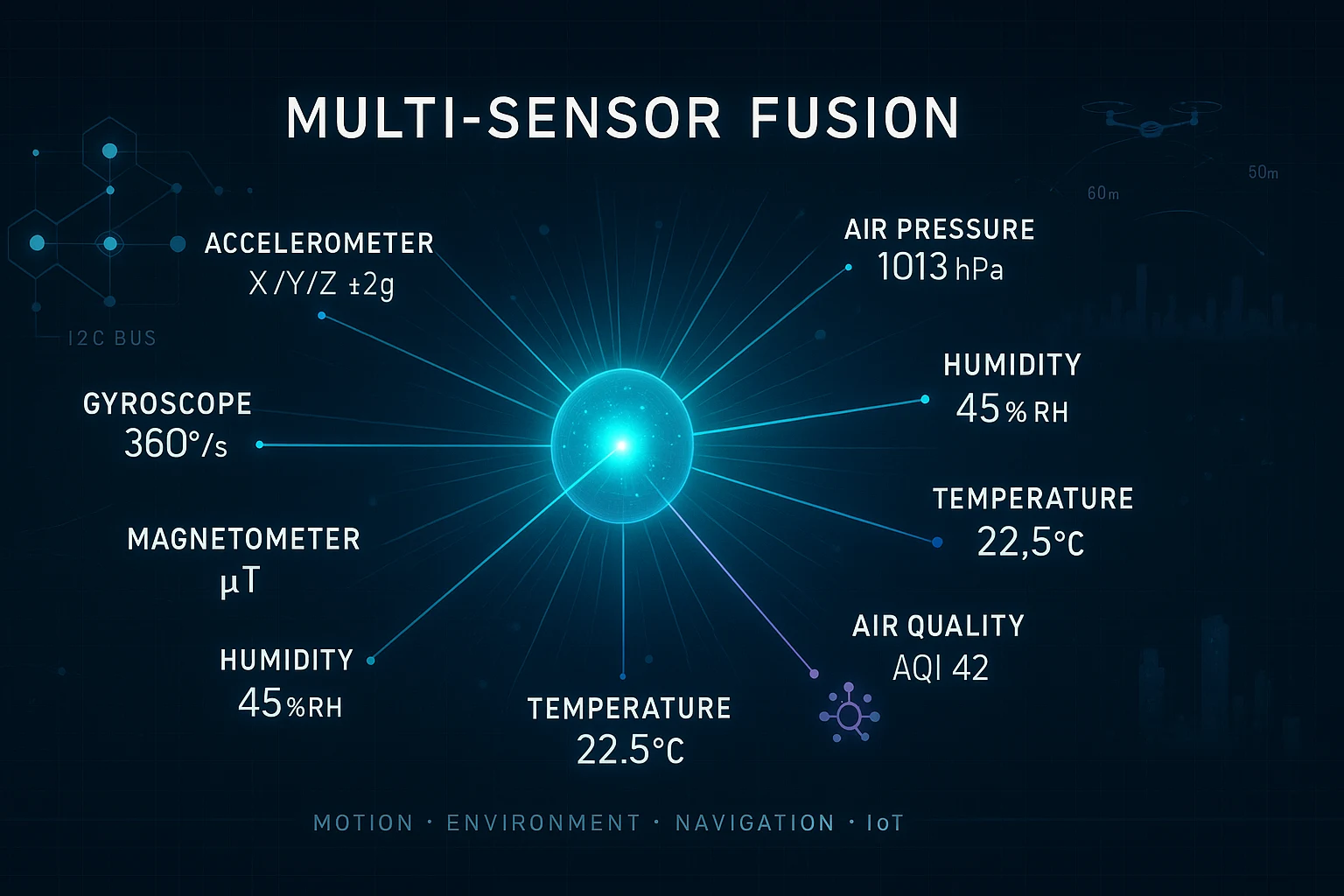
Best Multi Sensor Board Arduino Projects Have Been Waiting For
RFOXiA Integrated Sensors Module
The Best Multi Sensor Board Arduino Ecosystem Finally Has a Worthy Contender
If you have spent any time sourcing sensors for a serious project, you already know the frustration. You find a decent accelerometer, then hunt for a separate pressure sensor, then wire in a humidity module, then bolt on an air quality sensor, and before long your compact drone or wearable prototype looks like a rat's nest of breakout boards, each pulling its own I2C address from a shrinking pool, each adding weight and complexity you never budgeted for.
The search for the best multi sensor board Arduino developers can actually trust — one that is compact, professionally sourced, cleanly integrated, and ready for real deployment — ends with the RFOXiA MultiNav Pro+ Sensors Module.
This is not a hobbyist kit. It is a 24mm × 18mm production-grade sensing platform carrying seven industry-leading sensors from Bosch Sensortec, Texas Instruments, STMicroelectronics, MEMSVision, and RENESAS — all sharing a single I2C line, all FCC certified, and all supported by an AI firmware development environment and a live data monetization network that pays you back for every verified data session your module streams.
Let's dig into why this module earns its place at the top of every serious developer's shortlist.
Why Multi-Sensor Integration Is Harder Than It Looks
Before we talk about what the MultiNav Pro+ does right, it is worth understanding what most solutions get wrong.
The commodity approach to multi-sensor projects is to stack individual breakout boards. You buy an MPU-6050 for IMU data, an BME280 for environmental readings, a separate magnetometer, and maybe a gas sensor. Each board has its own voltage regulator, its own decoupling capacitors, and its own PCB footprint. The result works in a lab. It does not survive a drone crash, a field deployment in a rain event, or a wearable application where every gram counts.
The alternative — sourcing individual ICs and designing your own PCB — requires expertise in RF layout, power supply design, sensor placement to avoid thermal cross-contamination, and careful I2C address management. For a single engineer or a small team, this is months of work before you even write your first line of application firmware.
The MultiNav Pro+ solves both problems. RFOXiA handled the hardware engineering so you can focus on your application.
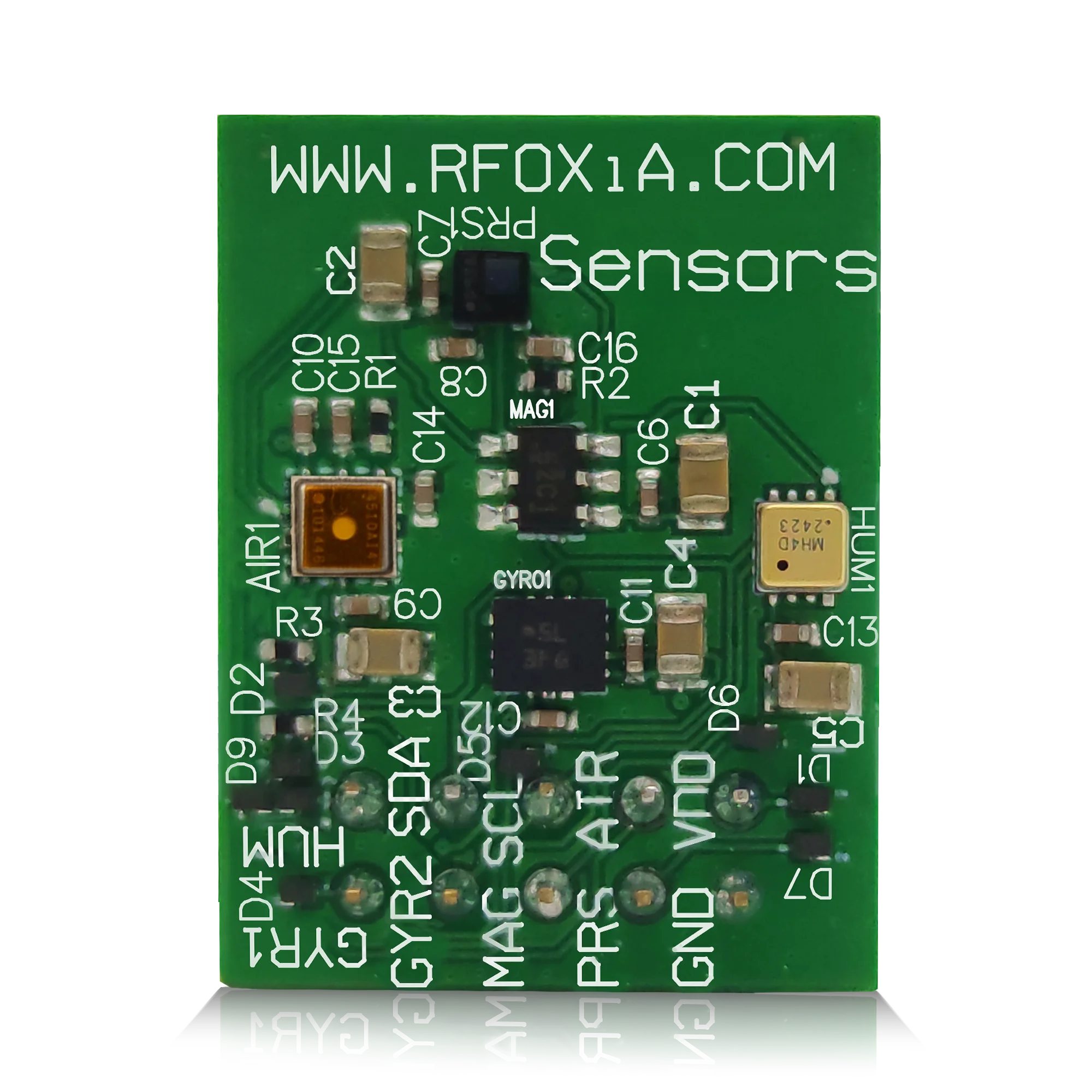
What Seven Sensors on One Board Actually Means
Seven sensors. One board. One I2C bus. Let that sink in for a moment.
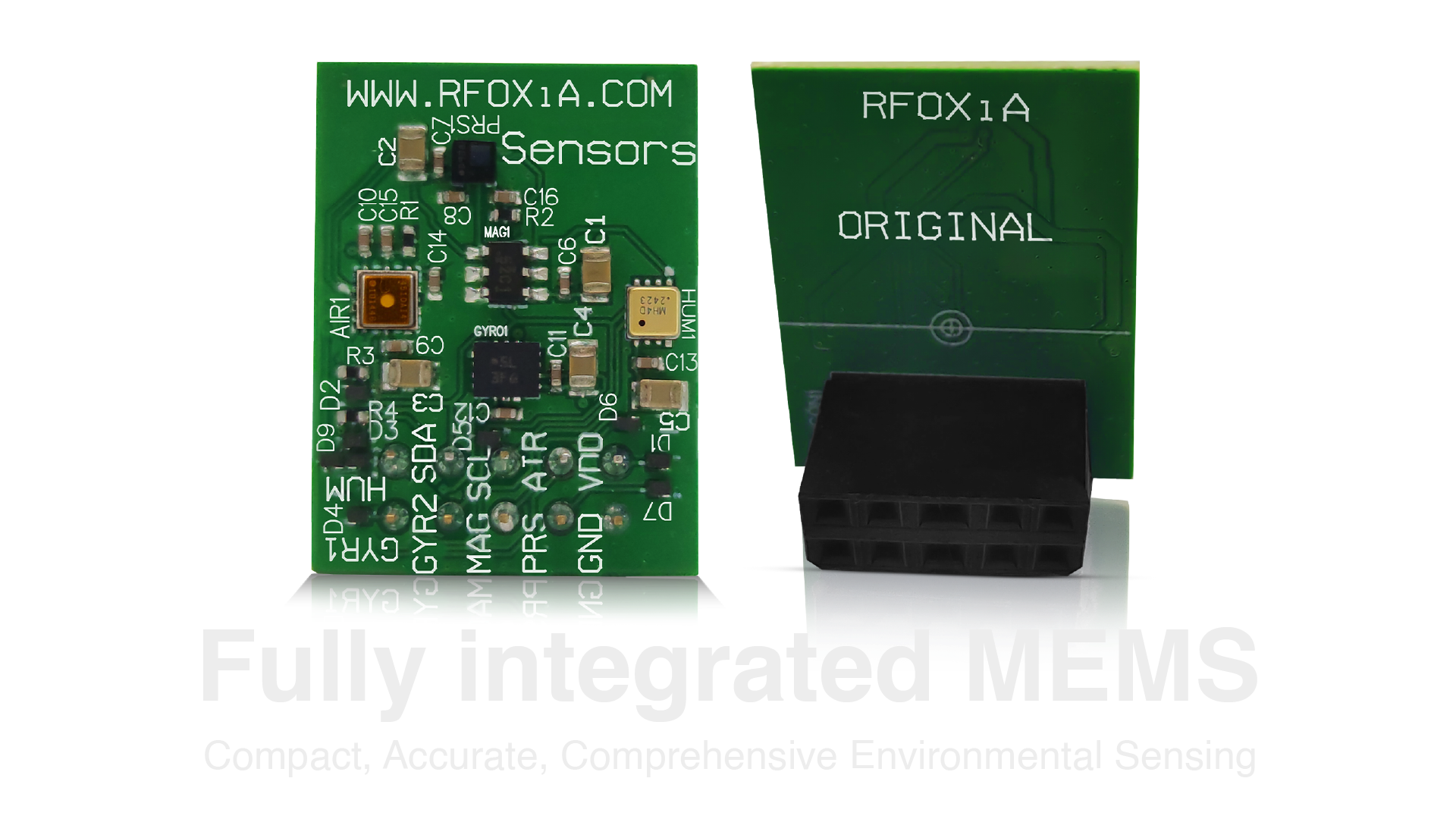
The MultiNav Pro+ Sensors Module delivers two distinct sensing categories in a single package:
Motion Sensing
- Accelerometer — detects linear acceleration across three axes
- Gyroscope — measures angular velocity for orientation and stabilization
- Magnetometer — provides absolute heading via Earth's magnetic field
Environmental Sensing
- Temperature — ambient air temperature with high accuracy
- Humidity — relative humidity for environmental context
- Air Pressure — barometric pressure enabling altitude estimation
- Air Quality — volatile organic compound and pollution detection
This combination is not arbitrary. It was designed to serve the exact applications where both motion context and environmental context matter simultaneously: drone flight controllers that need to know where they are AND what conditions they are flying in, agricultural monitoring nodes that need to report environmental data AND detect physical tampering or movement, and wearable health devices that need motion data AND environmental exposure readings in the same timestamp.
When you are evaluating the best multi sensor board Arduino projects can use across all these domains, the completeness of the sensor array is the first filter. The MultiNav Pro+ passes without compromise.
The Sensor ICs: No Compromises on Component Selection
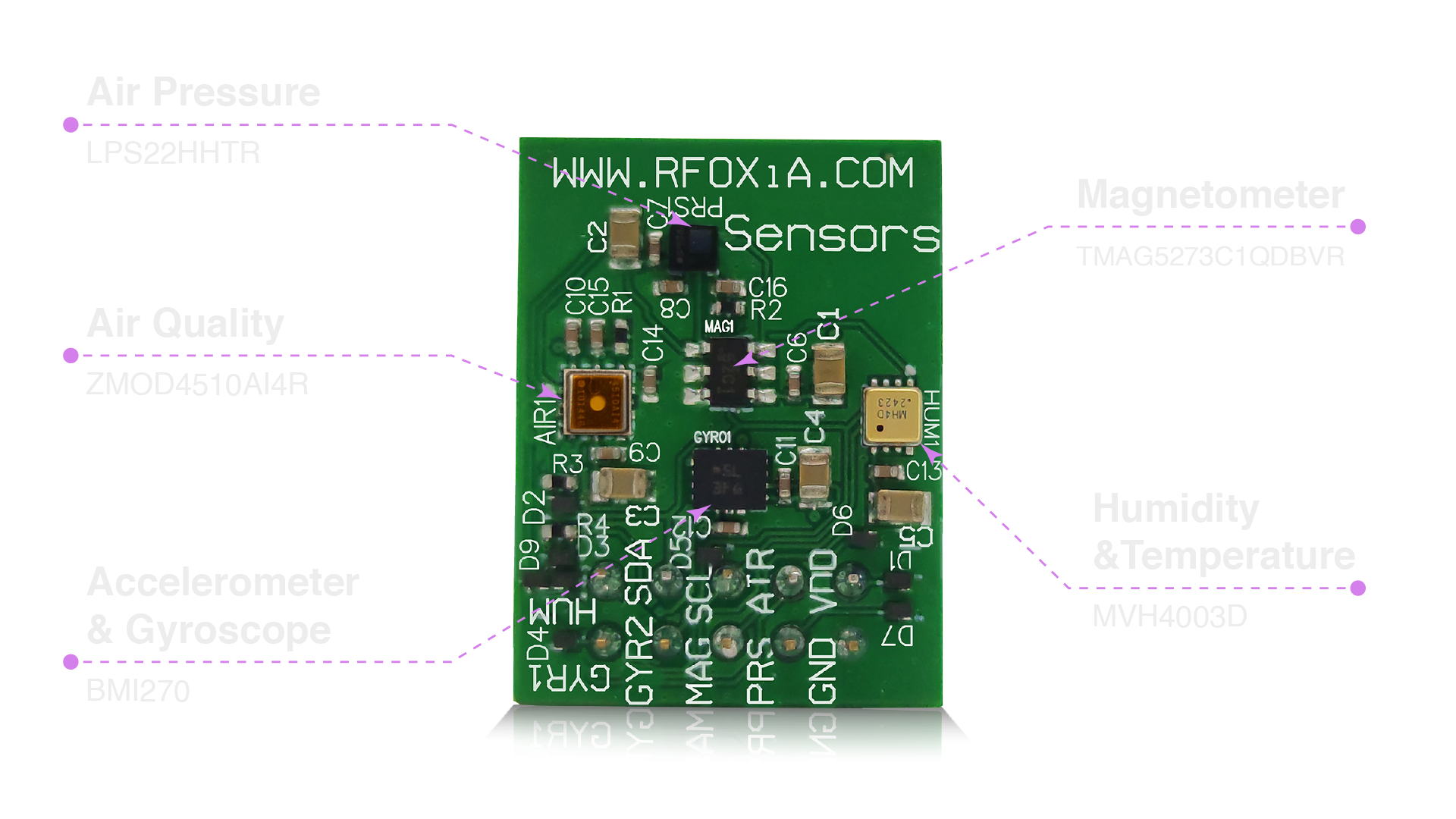
The difference between a professional sensor board and a hobbyist module often comes down to which ICs were selected and why. Here is a breakdown of every sensor inside the MultiNav Pro+:
BMI270 — Accelerometer and Gyroscope (Bosch Sensortec)
The BMI270 is Bosch Sensortec's flagship inertial measurement unit, designed specifically for wearable and drone applications requiring low power consumption without sacrificing performance. It features an integrated step counter, activity recognition, and a secondary I2C interface for auxiliary sensors. This is the same class of IMU found in professional fitness wearables and commercial drone flight controllers. You are not getting a generic MEMS IMU — you are getting one of the most capable motion sensors available in a small package.
TMAG5273C1QDBVR — Magnetometer (Texas Instruments)
Texas Instruments' TMAG5273 is a 3D Hall-effect sensor delivering high-precision magnetic field measurements across all three axes. Unlike many magnetometers that struggle with noise in the presence of power electronics, the TMAG5273 is designed for industrial-grade environments, making it highly suitable for drone and robotics applications where motors and ESCs generate significant electromagnetic interference.
LPS22HHTR — Air Pressure (STMicroelectronics)
STMicroelectronics' LPS22HH is a high-performance MEMS pressure sensor capable of absolute pressure measurements from 260 to 1260 hPa. At typical atmospheric pressure, this translates to altitude resolution in the range of centimeters — not meters — making it genuinely useful for drone altitude hold, weather station applications, and precision environmental logging.
MVH4003D — Humidity and Temperature (MEMSVision)
MEMSVision's MVH4003D delivers fast-response humidity and temperature readings using a capacitive sensing element. Fast response time matters enormously in mobile environmental sensing applications — if your sensor takes 30 seconds to settle after a temperature gradient, your drone telemetry data is worthless. The MVH4003D is selected specifically for its responsiveness in dynamic environments.
ZMOD4510AI4R — Air Quality (RENESAS)
RENESAS's ZMOD4510 is an outdoor air quality sensor specifically calibrated for ozone and nitrogen dioxide detection — the pollutants that matter most for smart city infrastructure, agricultural monitoring, and environmental research. This is not a generic VOC sensor repurposed for air quality marketing. It is a purpose-built outdoor sensing element with hardware-level signal processing. For developers building nodes that contribute to the RFOXiA data monetization network, this sensor is what unlocks verified air quality data rewards.
I2C Integration: The Architecture That Makes It All Work
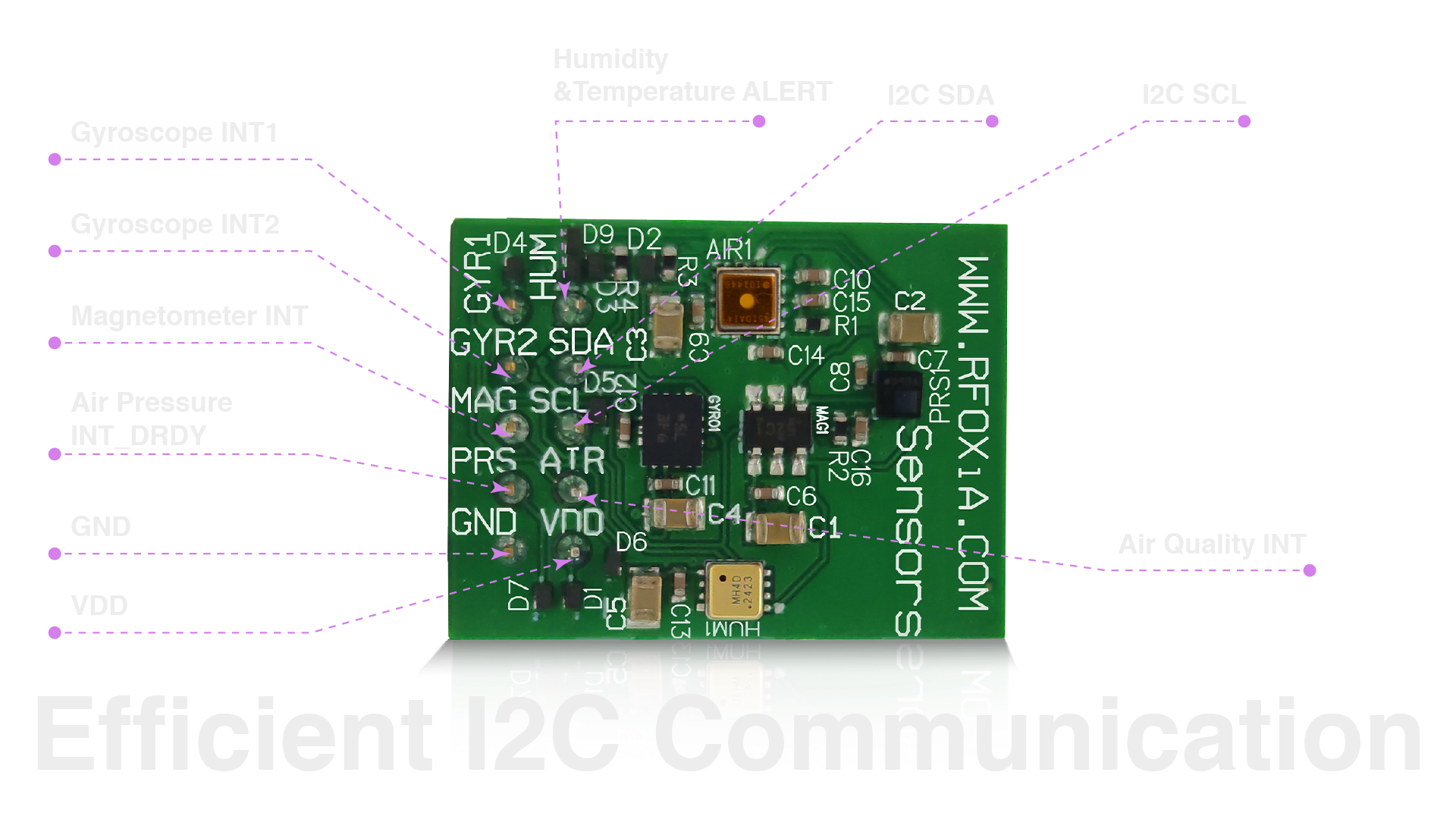
One of the most common failure points in multi-sensor designs is I2C address collision. Many popular sensor ICs share default addresses — the 0x68/0x69 space is notoriously overcrowded with IMUs, and 0x76/0x77 sees constant conflict among barometric pressure sensors.
RFOXiA's engineering team selected the seven sensor ICs on the MultiNav Pro+ specifically to avoid address conflicts, ensuring every sensor on the board has a unique dedicated I2C address. The result is a single four-wire connection from your microcontroller — power, ground, SDA, SCL — and all seven sensors are immediately accessible without any hardware modifications, address jumpers, or software workarounds.
For best multi sensor board Arduino integration, this means your Wire.begin() call and seven straightforward sensor library initializations are all you need. No multiplexers. No address conflicts. No hardware gymnastics.
The I2C architecture also means the MultiNav Pro+ integrates cleanly with virtually any modern microcontroller platform: Arduino Uno, Arduino Mega, Arduino Nano 33 BLE, ESP32, ESP8266, STM32, Raspberry Pi, and any other platform with I2C support. If you are working within the RFOXiA ecosystem using the BLE module, the integration is even more seamless — the full ecosystem is designed to work together from the ground up.
Compact Design: 24mm × 18mm for Real-World Deployments
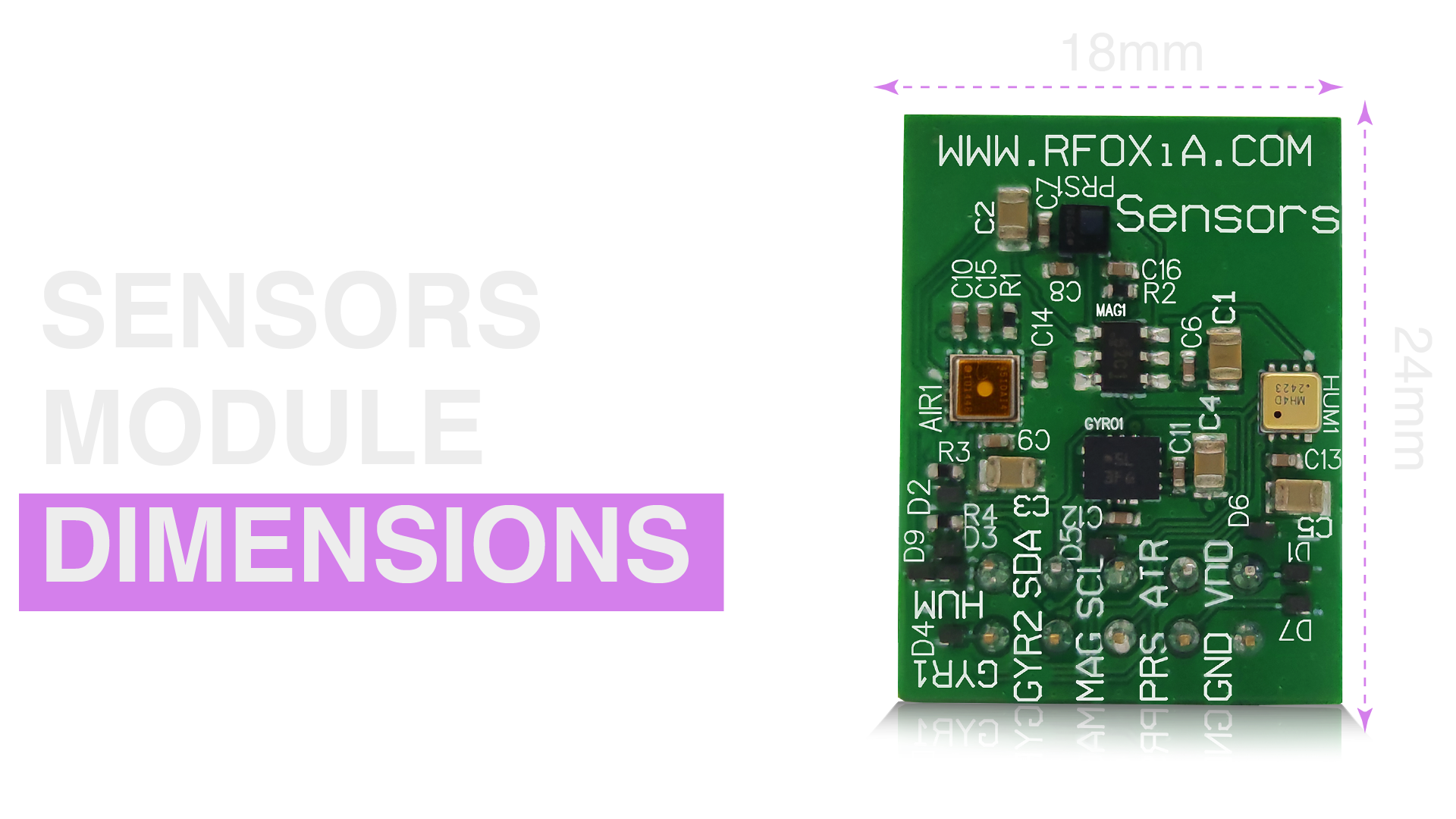
At 24mm × 18mm, the MultiNav Pro+ Sensors Module is genuinely small. For context, that footprint is roughly the size of a postage stamp. Seven professional-grade sensors from five tier-one manufacturers — in a postage stamp.
This matters enormously across the key application categories:
Drone applications: Every gram of payload on a drone costs flight time. A stacked set of breakout boards with their individual PCBs, regulators, and connectors can easily weigh 15-25 grams. The MultiNav Pro+'s single compact board keeps payload mass minimal, preserving battery life and handling characteristics.
Wearable devices: Wearable electronics are constrained by body geometry. A 24mm × 18mm module fits comfortably on a wristband, inside a helmet, or integrated into clothing-mounted sensor nodes — configurations that are physically impossible with stacked breakout boards.
Compact IoT nodes: Environmental monitoring deployments often need weatherproof enclosures. Smaller boards mean smaller enclosures, which means less cost, less wind loading, and easier installation in the field.
FPV and racing drones: Weight and space constraints in FPV builds are extreme. The MultiNav Pro+ delivers IMU and environmental sensing in a footprint that competes with standalone IMU breakouts — while adding four additional sensors.
Real-Time Environmental Data: What You Can Actually Build
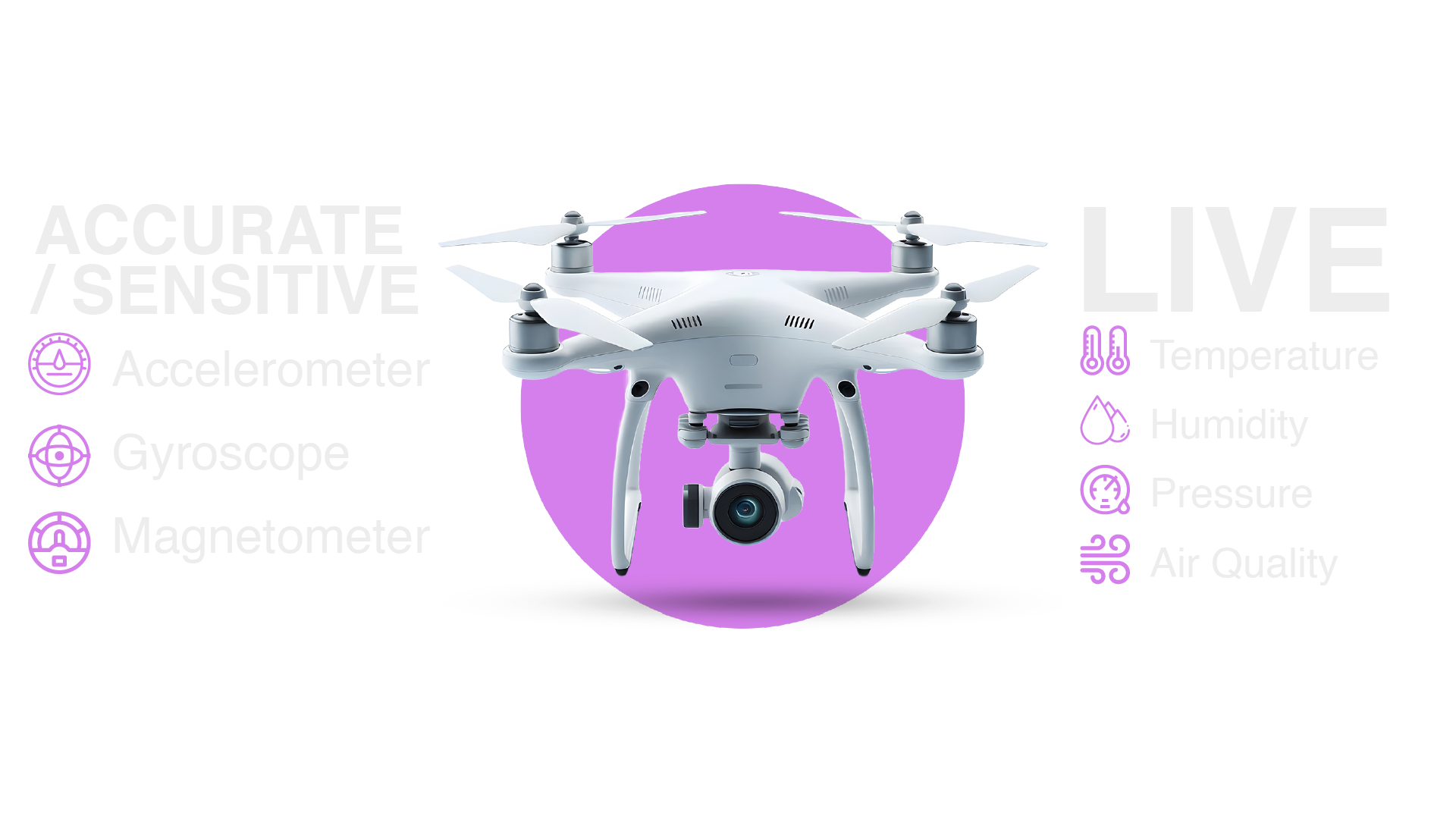
The MultiNav Pro+ enables real-time environmental data streaming that opens up application categories most developers have never been able to pursue affordably:
Precision agriculture: Soil microclimate monitoring with temperature, humidity, and air pressure at field resolution. Flight path optimization using barometric altitude hold during crop surveying missions. Air quality monitoring for pesticide drift detection.
Smart city infrastructure: Street-level air quality nodes that provide neighborhood-resolution pollution mapping. Motion-triggered environmental logging for intersection monitoring. Integration with city-wide data networks.
Search and rescue: Drones equipped with the MultiNav Pro+ can log atmospheric conditions during search operations, correlating air quality and pressure data with terrain features to build 3D environmental maps in real time.
Industrial IoT: Equipment health monitoring combining vibration detection (via accelerometer) with environmental context (temperature, humidity) enables predictive maintenance systems that understand both the machine state and the operating environment.
Environmental research: Deployable sensor networks for climate researchers, air quality studies, and microclimate analysis — at a fraction of the cost of traditional research-grade instruments.
Every one of these applications becomes dramatically simpler when you start with the RFOXiA Integrated Sensors Module rather than building from disparate components.
The Data Monetization Opportunity: Your Sensor Working While You Sleep
Here is the part that no other sensor board manufacturer offers, and it changes the economics of every deployment completely.
RFOXiA operates a live environmental data network. When you deploy your MultiNav Pro+ Sensors Module outdoors — verified by GPS through the companion GNSS module — and stream live data to the RFOXiA platform, you earn daily rewards for every verified complete data session.
The reward structure:
- Base rate: $0.08–$0.25 per day depending on your location's data scarcity
- Pioneer member rate: higher locked-in rate for early network contributors
- Scarcity bonus: nodes in data-sparse geographic areas earn premium rates
- Uptime bonus: consistent streaming earns higher daily rates
- Maximum verified potential: up to $0.40 per day for complete verified data
This is not theoretical future value. The data your sensor generates — temperature, humidity, air pressure, air quality, GPS-verified location — is exactly what agricultural technology companies, smart city operators, insurance firms, logistics companies, and research institutions cannot get from existing weather APIs. Public APIs provide data at 1-minute or 10-minute intervals from weather stations kilometers apart. The RFOXiA network provides second-level temporal resolution at street-level geographic resolution. That hyper-local, high-frequency data commands real enterprise pricing.
Your sensor earns. Your node contributes to a dataset that matters. And the longer you run it, the more the network grows, and the more valuable everyone's contributions become.
Endless Applications Across Every Domain

The MultiNav Pro+ was not designed for one application. It was designed for builders who do not yet know exactly what they will build — but know they need professional-grade sensing to build it well.
Current customer applications include:
- FPV drone telemetry systems with live sensor overlay
- Autonomous ground vehicle navigation with magnetic heading correction
- Agricultural field mapping drones combining IMU stabilization and environmental logging
- Wearable health monitoring prototypes
- Industrial equipment health monitoring nodes
- Smart home environmental stations with air quality alerting
- Research-grade atmospheric sensing networks
- Robotics competition platforms requiring precise motion feedback
Whether your next project is a 5-inch FPV quad, a precision agriculture drone, a wearable prototype, or a fixed IoT node contributing to the data network, the MultiNav Pro+ covers the sensing requirements without compromise.
For developers working within the full RFOXiA ecosystem — pairing the Sensors Module with the BLE Module for long-range wireless transmission, the GNSS Module for location verification, and the Power/Program Kit for field deployment — the combination creates a complete deployable sensor node capable of streaming live data over distances up to 5km ground-to-ground and 15-20km man-to-drone. No other ecosystem at anywhere near this price point offers this complete a solution.
If you are serious about finding the best multi sensor board Arduino and embedded developers can actually deploy — not just prototype — the MultiNav Pro+ is the answer. And it is available now, FCC certified, in stock, and ready to ship.
Explore the full specifications and order your MultiNav Pro+ Sensors Module today at the RFOXiA Integrated Sensors Module product page.
AI Firmware Development: From Description to Running Code
One of the most common barriers to using a sophisticated multi-sensor platform is firmware development time. Writing drivers for seven sensors, managing I2C transactions, implementing filtering algorithms for the IMU, handling data validation for environmental sensors — in a traditional development workflow, this is weeks of work.
RFOXiA eliminates this barrier entirely through the AI Firmware Builder integrated into the RFOXiA Club platform.
Describe your application in plain language. The AI generates complete, production-ready firmware with full source code. Not pseudocode. Not a template. Actual working firmware you can flash to your STM32 or compatible microcontroller and iterate from.
For developers who are already comfortable with embedded firmware, the AI Firmware Builder dramatically accelerates prototyping. For developers who are stronger on the application and system design side than the embedded firmware side, it removes the biggest obstacle between an idea and a working demo.
The platform is built using Claude (Anthropic) and GitHub Copilot, integrated directly into the RFOXiA Club Dev Hub. Every Club member has access. Membership starts free with a $10 welcome credit.
Technical Specifications Summary
| Specification | Detail |
|---|---|
| Board Dimensions | 24mm × 18mm |
| Accelerometer / Gyroscope | BMI270 (Bosch Sensortec) |
| Magnetometer | TMAG5273C1QDBVR (Texas Instruments) |
| Air Pressure | LPS22HHTR (STMicroelectronics) |
| Humidity and Temperature | MVH4003D (MEMSVision) |
| Air Quality | ZMOD4510AI4R (RENESAS) |
| Communication Interface | I2C (single bus, unique addresses per sensor) |
| Total Sensors | 7 |
| Certification | FCC Certified |
| Price | $39 |
| Compatibility | Arduino, ESP32, STM32, Raspberry Pi, any I2C host |
Why RFOXiA and Why Now
RFOXiA occupies a market position no other company currently owns: professional-grade wireless and sensing hardware at maker-accessible prices, supported by an AI firmware platform, a live data monetization network, and a mobile control application.
The MultiNav Pro+ Sensors Module at $39 delivers sensor hardware that would cost $80-120 if you sourced and assembled the same ICs individually — and that assumes you have the PCB design skills, manufacturing access, and testing infrastructure to do it correctly. You get a professionally engineered, FCC certified, immediately deployable sensor platform for less than the cost of a dinner for two.
For developers evaluating the best multi sensor board Arduino projects can use in 2025 and beyond — across drone development, robotics, environmental monitoring, wearables, or data network deployment — the MultiNav Pro+ is not one option among many. It is the option that makes every other option look like a compromise.
Ready to build something real? Visit the RFOXiA Integrated Sensors Module page to order your MultiNav Pro+ Sensors Module and join the RFOXiA Club for free to access AI firmware development, the data network, and a community of builders who are already using this hardware to build things that matter.
The MultiNav Pro+ Sensors Module is FCC certified and ships from RFOXiA's US inventory. Compatible with Arduino, ESP32, STM32, Raspberry Pi, and any microcontroller platform supporting I2C communication.
Written by: Moamen Mohamed LinkedIn