

Best Power Module Embedded 2026: MultiNav Pro+ Power/Program Kit
RFOXiA SuperCapacitor Battery and Programmer Kit
The Best Power Module Embedded 2026 — Why Supercapacitor Technology Is Changing Everything
Every embedded developer knows the feeling. You are deep in a field test, your firmware is finally behaving exactly the way you want, your BLE module is streaming data beautifully — and then the battery dies. Not a graceful shutdown. Just silence.
Power is not a glamorous problem. It doesn't trend on social media. Nobody posts about their power regulator on TikTok. But anyone who has done serious embedded development, drone engineering, field robotics, or IoT deployment knows that power is the problem that kills more projects than any firmware bug ever will.
In 2026, the embedded hardware ecosystem has matured dramatically — better wireless modules, faster processors, more precise GNSS receivers, richer sensor arrays. But power solutions have lagged behind. Most developers are still strapping lithium batteries to their rigs, managing charge cycles, dealing with degradation, and planning their field sessions around battery life measured in hours. If you need to swap batteries in a remote location, you lose time. If you are running a 24-hour environmental monitoring node, you need infrastructure. If you are doing rapid firmware iteration cycles, waiting 90 minutes for a charge is a productivity killer.
The RFOXiA SuperCapacitor Battery and Programmer Kit was built to solve all of these problems simultaneously, and it makes a serious claim to being the best power module embedded 2026 has produced — not just because of its specifications, but because of what those specifications mean for real-world embedded development workflows.
Let's break it down completely.
What Is the MultiNav Pro+ Power/Program Kit?
The MultiNav Pro+ Power/Program Kit is a dual-purpose embedded hardware accessory designed to complement the RFOXiA MultiNav Pro+ ecosystem. It combines two critical capabilities that embedded developers typically have to source separately:
- A professional supercapacitor-based power system capable of running a full MultiNav Pro+ module stack for an entire working day on a single five-minute charge.
- An integrated STLink programmer interface for direct firmware flashing and debugging of the MultiNav Pro+ BLE Module.
These two capabilities together — in one compact kit, at one accessible price — represent a meaningful leap forward in how embedded developers can structure their workflow. Whether you are building drones, deploying environmental monitoring nodes, prototyping field robotics, or doing rapid firmware development, this kit removes two of the biggest friction points in the embedded development cycle.
The Supercapacitor Advantage: Why This Is the Best Power Module Embedded 2026
To understand why supercapacitor technology matters here, it helps to understand what supercapacitors actually are and how they compare to lithium-based battery systems.
A lithium battery stores energy through electrochemical reactions. It can hold a lot of energy relative to its weight, but those chemical reactions impose constraints: charge slowly, degrade over hundreds of cycles, lose capacity in cold temperatures, and carry thermal runaway risk if abused.
A supercapacitor stores energy electrostatically — no chemical reaction involved. This means it can charge and discharge almost instantaneously, it does not degrade meaningfully over charge cycles (supercapacitors can sustain hundreds of thousands of cycles versus a few hundred for lithium cells), it performs well across temperature extremes, and it has no thermal runaway risk.
The tradeoff has historically been energy density — supercapacitors store less energy per kilogram than lithium batteries. But advances in supercapacitor technology have dramatically narrowed that gap, and for many embedded applications — particularly those where charge access is available but charge time is constrained — the supercapacitor approach is now clearly superior.
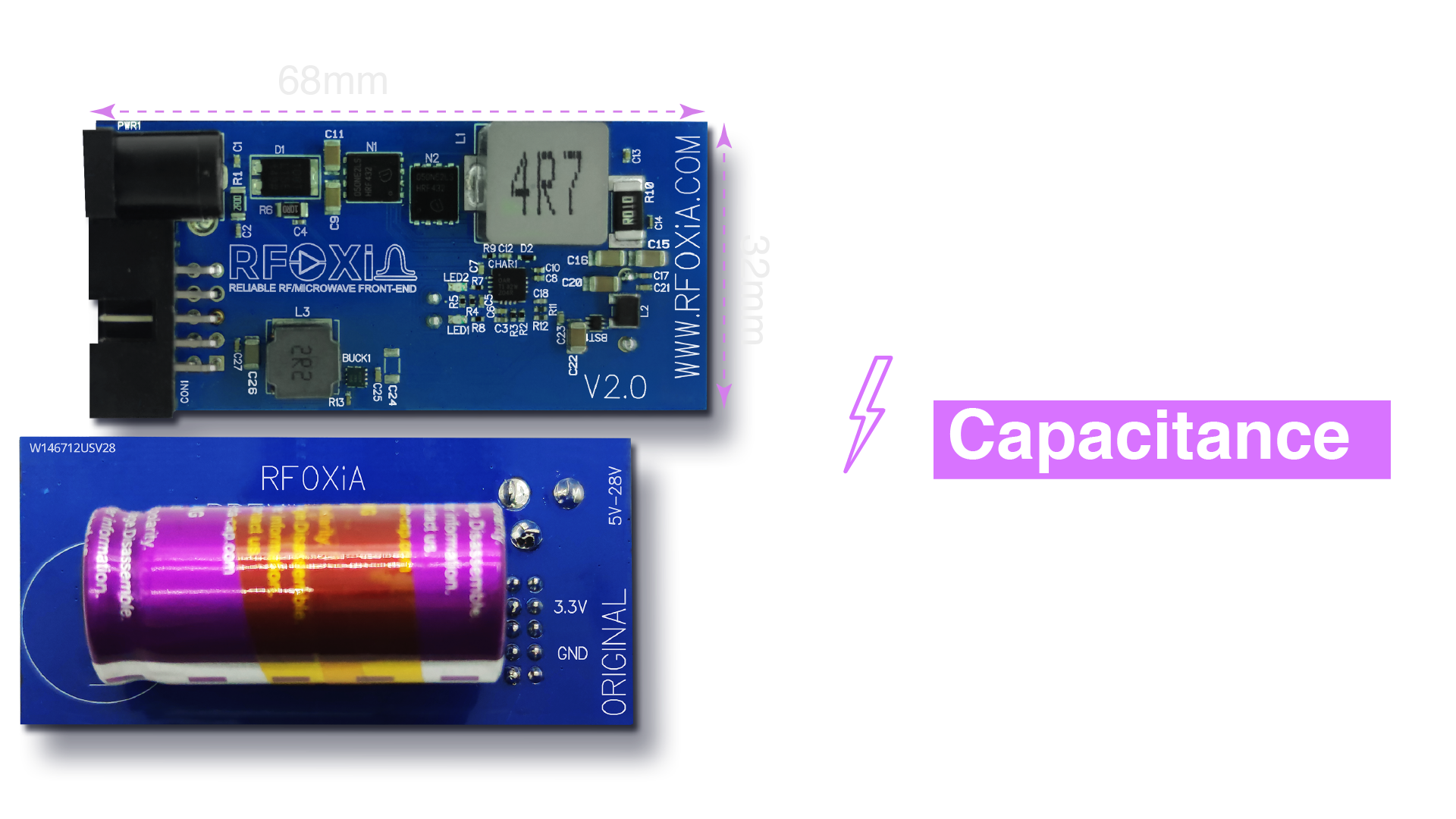
The MultiNav Pro+ Power/Program Kit uses an 1100 Farad supercapacitor system storing 8800 Joules of energy. To put that in concrete terms: 8800 Joules is enough to power the complete MultiNav Pro+ module stack — BLE Module, GNSS Module, and Sensors Module running simultaneously — for a full working day. And the system reaches full charge in under five minutes.
For a drone builder doing bench testing before a flight session, this means plugging in the kit while you run through your pre-flight checks, and by the time you are done, the power system is fully charged. For a field researcher deploying environmental monitoring nodes, it means a quick top-up charge at your vehicle before hiking to a deployment site. For a firmware developer iterating through build-flash-test cycles, it means never waiting for power.
This is what earns the MultiNav Pro+ Power/Program Kit the title of best power module embedded 2026: not a single impressive specification in isolation, but the combination of runtime, charge speed, and reliability that fundamentally changes how embedded development feels.
High-Power Charging: 12V 5A Input, 4V 10A to the Supercapacitor
The five-minute charge time is not an accident — it is the result of deliberate engineering in the charging subsystem. The included high-power adapter delivers 12V at 5A from the wall, which the kit's internal charging circuitry converts to 4V at 10A for the supercapacitor array. That is 40 watts of charging power flowing into the capacitor bank, which is why the charge time is measured in minutes rather than hours.
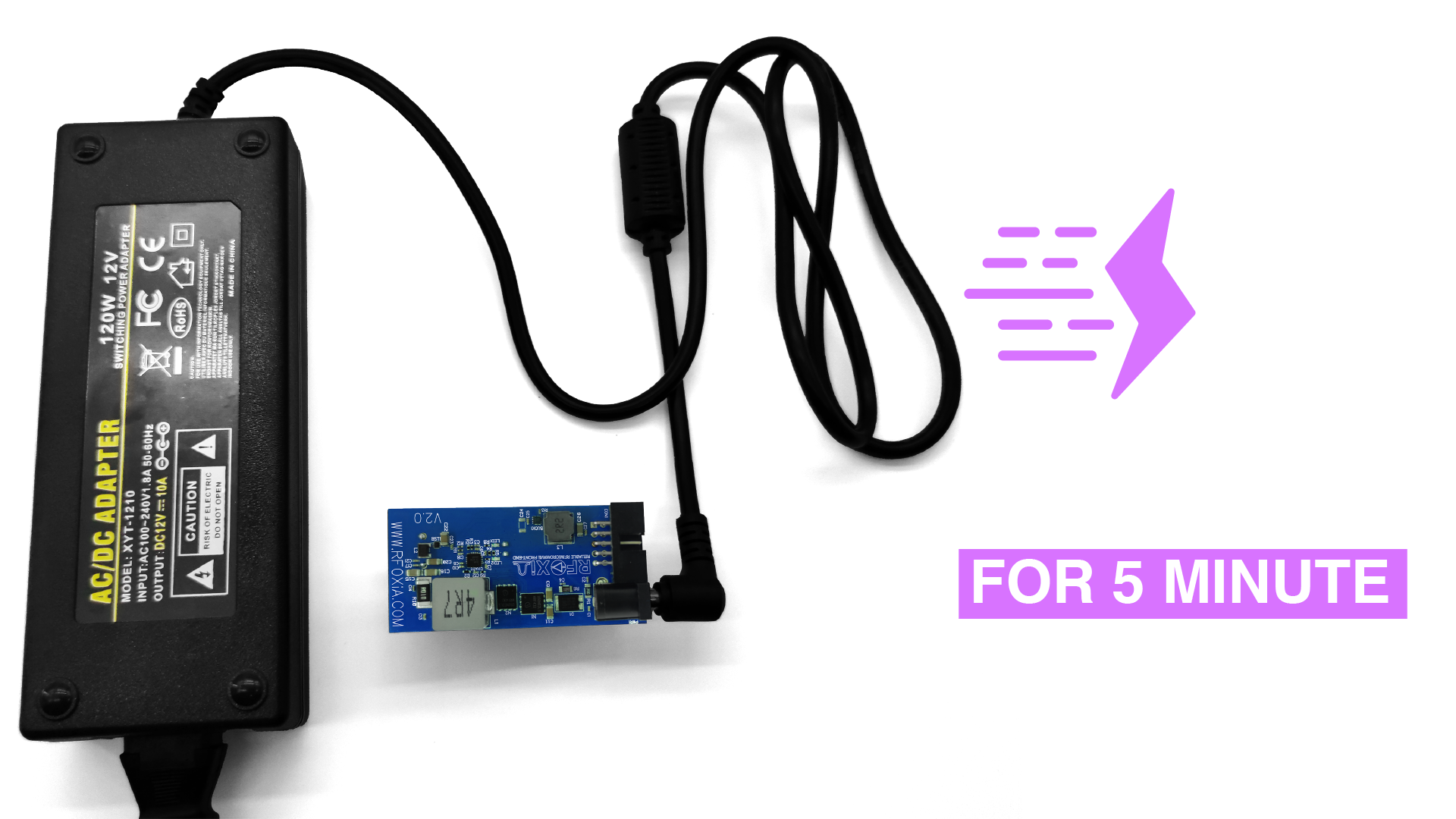
The adapter is included with the kit. There is no need to source a compatible charger, calculate current limits, or worry about whether your existing bench power supply will charge the system correctly. Plug in, wait five minutes, done.
For developers who work in environments where wall power is available periodically — a field vehicle, a base camp, a lab bench — this architecture is ideal. You charge the kit quickly during natural downtime in your workflow, and it powers your modules through the work periods. The cycle time is so short that you are never meaningfully constrained by power access.
All-Day Power for the Complete MultiNav Pro+ Module Stack
The power system is designed to run not just the BLE Module but the entire MultiNav Pro+ ecosystem simultaneously — including the GNSS Module and Sensors Module — for a full working day on a single charge.
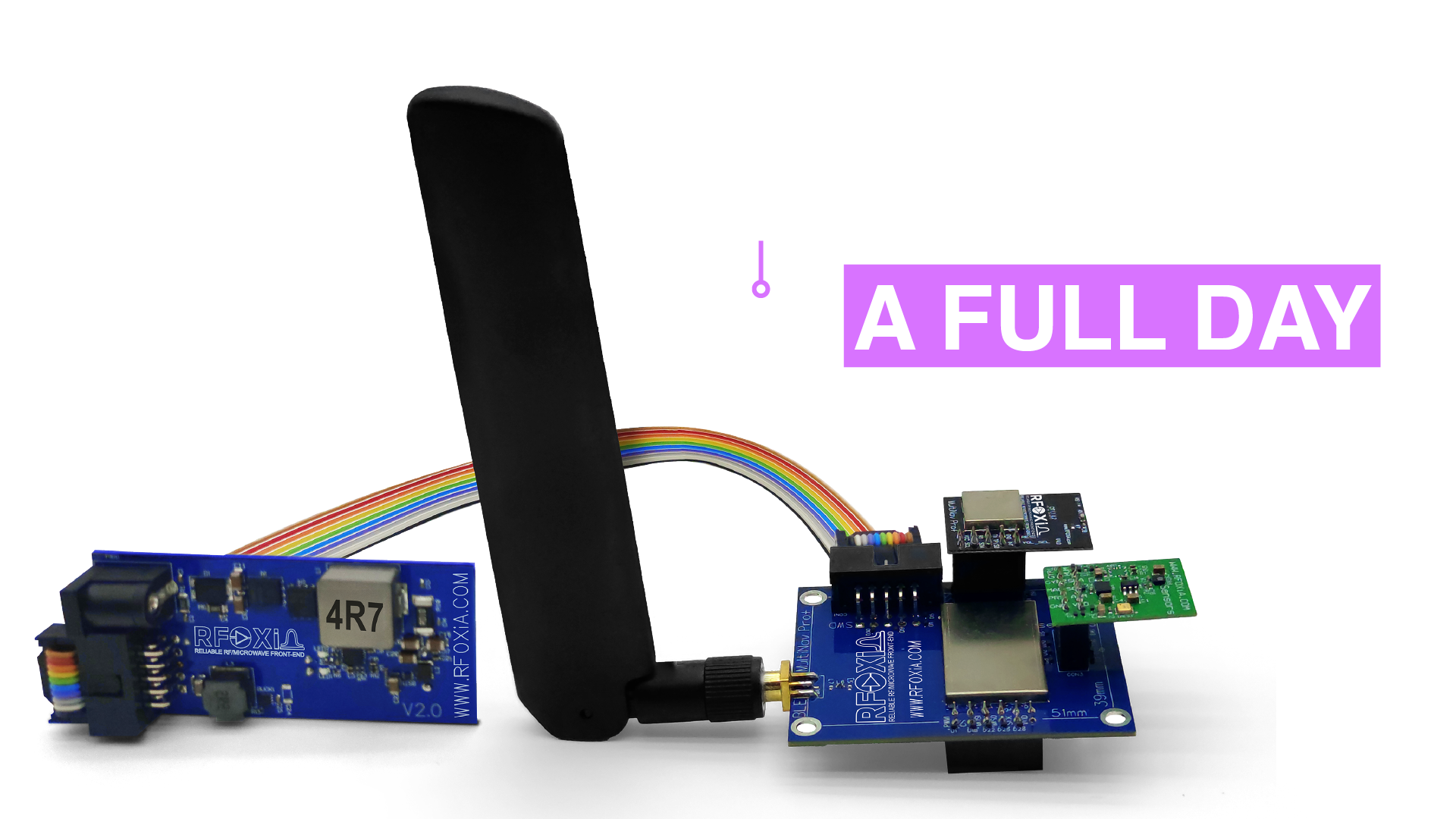
This matters because real embedded projects rarely run just one module. A drone navigation rig needs BLE communication and GNSS positioning. An environmental monitoring node needs the Sensors Module streaming air quality, temperature, humidity, pressure, and accelerometer data alongside GNSS validation. A field robotics platform needs control, positioning, and environmental sensing simultaneously.
The MultiNav Pro+ Power/Program Kit was designed with the full stack in mind, not just a single module. When RFOXiA specifies "full working day," that means the complete module ecosystem under realistic operating conditions — not a single low-power module in standby mode.
For developers deploying nodes in RFOXiA's data monetization network, this runtime characteristic is particularly important. A node that runs all day without intervention generates verified environmental data continuously, which translates to maximum daily reward earnings. Power interruptions cost data, and missed data costs earnings.
Integrated STLink Programmer: Development Without Friction
The second major capability of this kit is the integrated STLink programmer interface for the MultiNav Pro+ BLE Module.

For developers building custom firmware on the MultiNav Pro+ BLE Module — which is based on the STM32WB07 — the STLink interface is the standard tool for firmware flashing, debugging, and real-time inspection. Having it integrated into the power kit means one connected device handles both your power delivery and your programming interface.
This matters particularly for the RFOXiA AI Firmware Builder workflow. The AI Firmware Builder, integrated into RFOXiA Club, lets you describe your application in plain language and generates production-ready firmware with full source code. Once your firmware is generated, the next step is flashing it to the module. With the STLink programmer built into the Power/Program Kit, that step is immediate — no searching for a separate programmer, no wondering about pinout compatibility, no additional cables.
The development loop becomes: describe your firmware in natural language → AI generates source code → flash via integrated STLink → test on powered module → iterate. The Power/Program Kit makes that loop as tight as possible.
For developers who want to go deeper, the full MultiNav Pro+ BLE Module firmware repository is available on GitHub at github.com/RFOXiA/MultiNav-Pro-Long-Range-BLE-Module-Firmware-STM32WB07, giving you complete access to the firmware foundation to build on.
Complete Connectivity: Every Cable Included
One of the small frustrations that costs embedded developers real time is the cable problem. You have the right hardware, the right programmer, the right modules — and you are missing one specific ribbon cable or JST connector. The project stalls while you wait for a parts order.
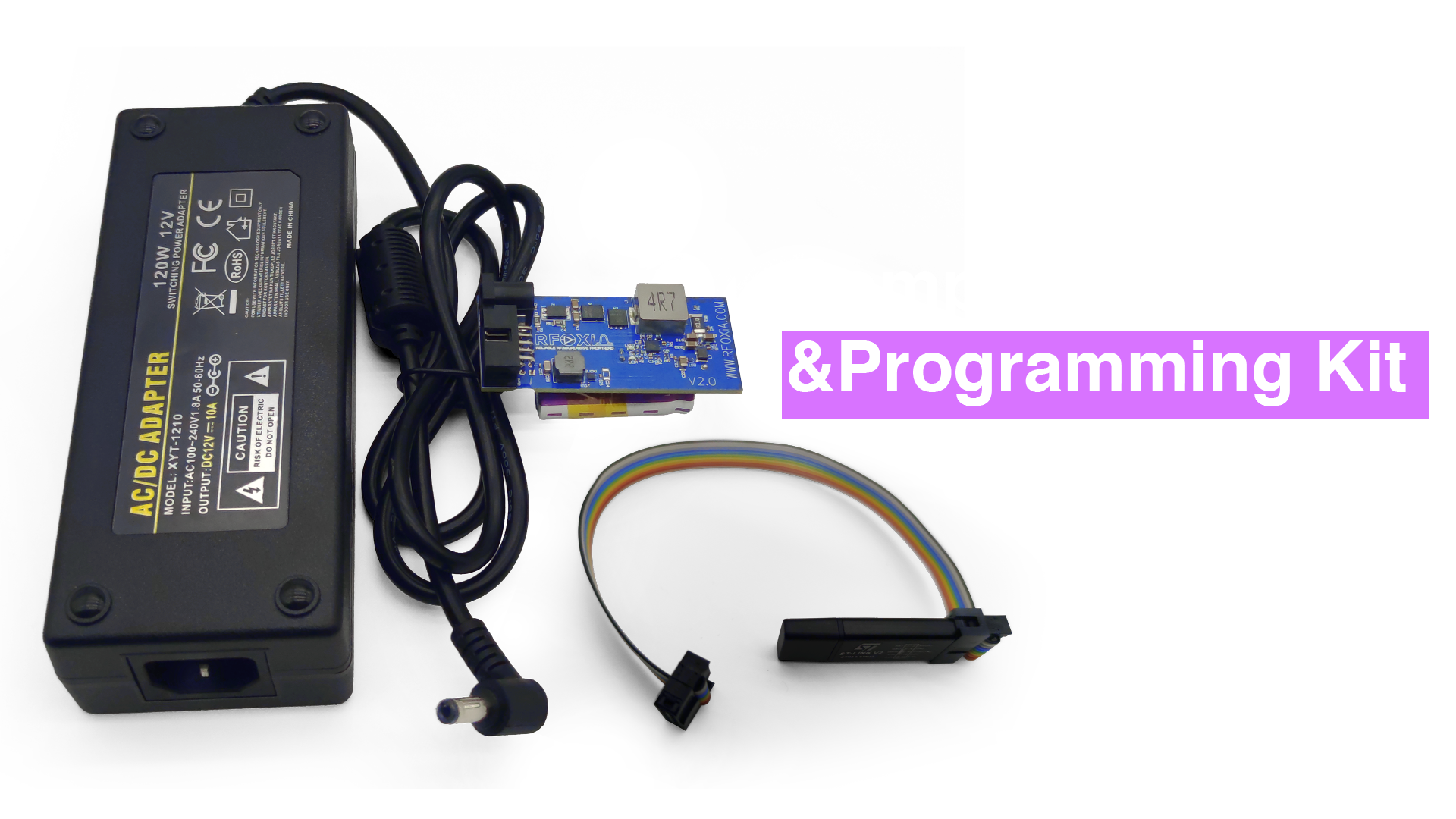
The MultiNav Pro+ Power/Program Kit includes every cable needed to connect the complete system:
- Flat ribbon cables to connect the BLE Module to the power module
- Flat ribbon cables to connect the STLink programmer to the BLE Module
- High-power charging adapter for the supercapacitor system
This is a fully self-contained kit. Unbox it, connect it, charge it for five minutes, and your complete MultiNav Pro+ stack is running. No additional sourcing required.
Who Should Be Using the MultiNav Pro+ Power/Program Kit?
The RFOXiA SuperCapacitor Battery and Programmer Kit was designed for a specific kind of developer: serious, time-conscious, working on real projects where power interruptions have real consequences.
Drone builders and FPV engineers — Running ground test sessions with your MultiNav Pro+ BLE Module for long-range control? The five-minute charge means you can top up between flight sessions without ever waiting for power. The full-day runtime means a day of bench testing never ends with a dead module.
Field researchers and environmental scientists — Deploying MultiNav Pro+ Sensors Modules for environmental data collection? The all-day runtime and robust supercapacitor reliability across temperature extremes makes this the right power solution for field deployment.
IoT and embedded firmware developers — Iterating through firmware builds using the AI Firmware Builder? The integrated STLink programmer and always-ready power system keeps your development loop fast and uninterrupted.
Data network contributors — Running MultiNav Pro+ nodes to contribute verified environmental data to the RFOXiA data network and earn daily rewards? Maximizing uptime directly maximizes earnings. The all-day runtime on five minutes of charging is the most efficient way to maximize node uptime.
Robotics engineers — Powering MultiNav Pro+ module stacks on mobile platforms? The compact, reliable supercapacitor system handles the vibration and temperature variation of robotic deployments better than lithium batteries.
Supercapacitor vs. Lithium Battery: A Direct Comparison
For developers still on the fence about supercapacitor technology, here is an honest side-by-side comparison for embedded use cases:
| Characteristic | Lithium Battery | MultiNav Pro+ Supercapacitor |
|---|---|---|
| Charge time | 60-120 minutes | < 5 minutes |
| Runtime (full stack) | 4-8 hours typical | Full working day |
| Cycle life | 300-500 cycles | 100,000+ cycles |
| Temperature performance | Degrades in cold | Stable across range |
| Thermal safety | Thermal runaway risk | No thermal runaway |
| Degradation over time | Capacity loss per cycle | Negligible degradation |
| Development downtime | High | Minimal |
For embedded applications where charge access is available periodically and runtime between charges is the critical variable, the supercapacitor system wins on every dimension that matters to a working developer.
Specifications Summary
- Supercapacitor Capacitance: 1100 Farads
- Stored Energy: 8800 Joules
- Charge Time: Under 5 minutes (full charge)
- Runtime: Full working day powering complete MultiNav Pro+ module stack
- Input Charging: 12V 5A (adapter included)
- Supercapacitor Charging Rate: 4V 10A
- Programmer Interface: STLink (compatible with MultiNav Pro+ BLE Module / STM32WB07)
- Included Cables: Flat ribbon cables for all module-to-power and module-to-programmer connections
- Certification: FCC certified
- Price: $119
The RFOXiA Ecosystem Context
The MultiNav Pro+ Power/Program Kit is designed as part of a complete ecosystem, not a standalone accessory. It pairs with:
- MultiNav Pro+ BLE Module — FCC-certified long-range Bluetooth module achieving 5km ground-to-ground, 15-20km man-to-drone, and 50km drone-to-drone range at 2Mbps data rate for $59 per pair.
- MultiNav Pro+ GNSS Module — 1.5-meter accuracy at 18Hz fix rate for precision positioning on fast-moving platforms.
- MultiNav Pro+ Sensors Module — Seven integrated sensors (temperature, humidity, pressure, air quality, accelerometer, gyroscope, magnetometer) for complete environmental monitoring.
- Developer Bundle — All four modules together, including the Power/Program Kit, at a bundled price.
When you plug the Power/Program Kit into your full Developer Bundle stack, you have a complete professional-grade wireless development platform — long-range communication, precision positioning, environmental sensing, professional power management, and integrated firmware programming — that is unmatched at any comparable price point in the embedded market.
And through the RFOXiA Club data network, that same hardware stack can contribute verified environmental data and earn daily rewards while it is deployed, turning your embedded hardware investment into a source of passive income.
Final Verdict: The Best Power Module Embedded 2026
The embedded hardware market in 2026 has no shortage of power solutions — from simple LiPo breakout boards to sophisticated battery management systems. What it lacks is a solution that simultaneously solves the charge-time problem, the runtime problem, the degradation problem, and the development-friction problem in a single integrated kit at a price accessible to individual developers.
The MultiNav Pro+ Power/Program Kit solves all four. Five-minute charge. All-day runtime. Supercapacitor durability with no meaningful degradation. Integrated STLink programmer that eliminates a separate tool from your development workflow. Every cable included. FCC certified. Ready to ship.
For developers building serious embedded projects on the MultiNav Pro+ platform, this is not an optional accessory — it is the power infrastructure your project deserves.
Get the RFOXiA SuperCapacitor Battery and Programmer Kit and stop letting power be the thing that limits your embedded development.
MultiNav Pro+ Power/Program Kit is available at rfoxia.com. FCC certified. Compatible with all MultiNav Pro+ modules. Ships from inventory.
Written by: Moamen Mohamed LinkedIn