
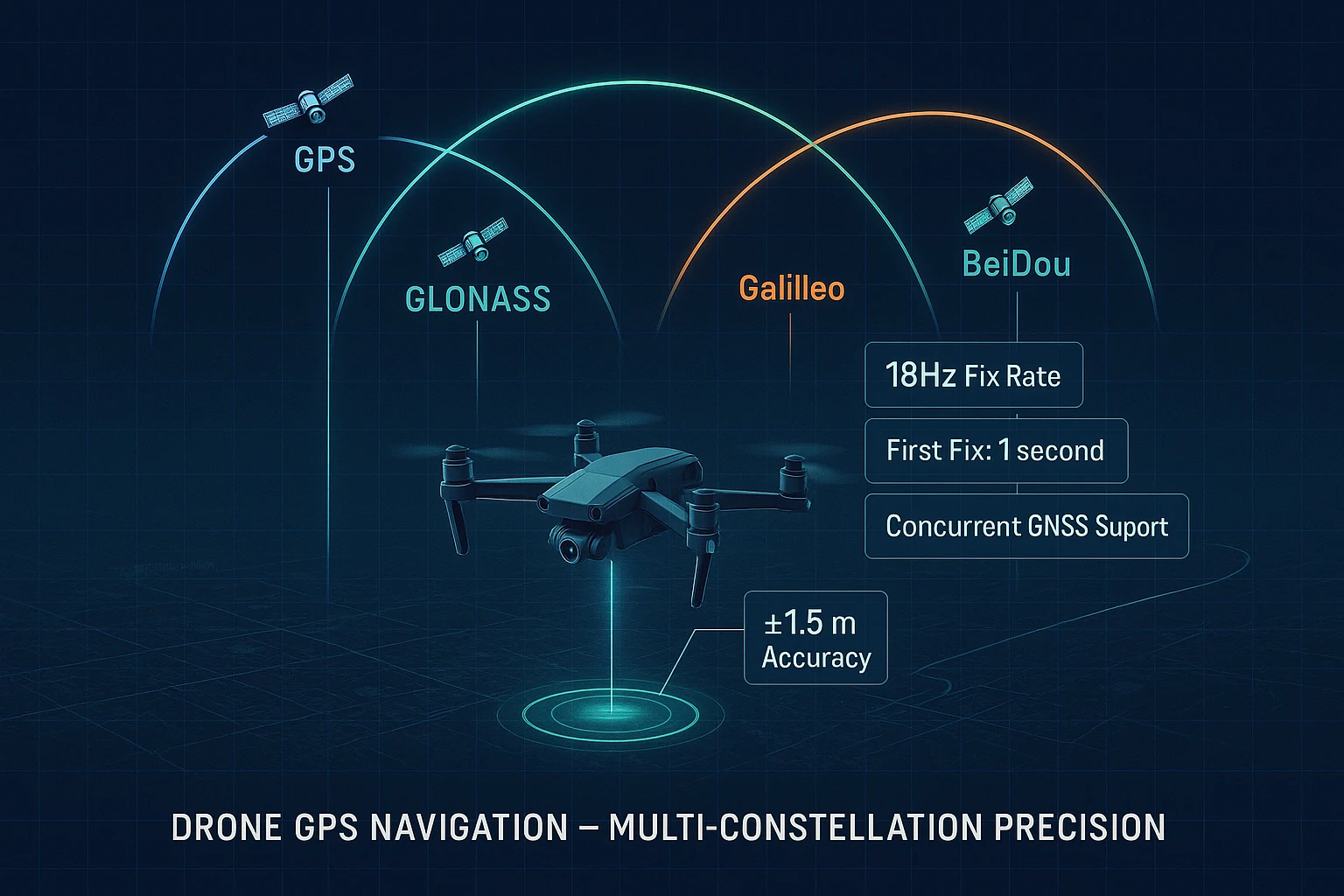
Drone GPS Module Redefined: Meet the MultiNav Pro+ Accurate GNSS Module
The Drone GPS Module Built for Builders Who Demand Precision
If you have ever lost a drone because your GPS locked on late, drifted three meters off course during a precision maneuver, or simply could not keep up with fast-moving flight dynamics, you already understand why the choice of drone GPS module matters more than almost any other component in your build.
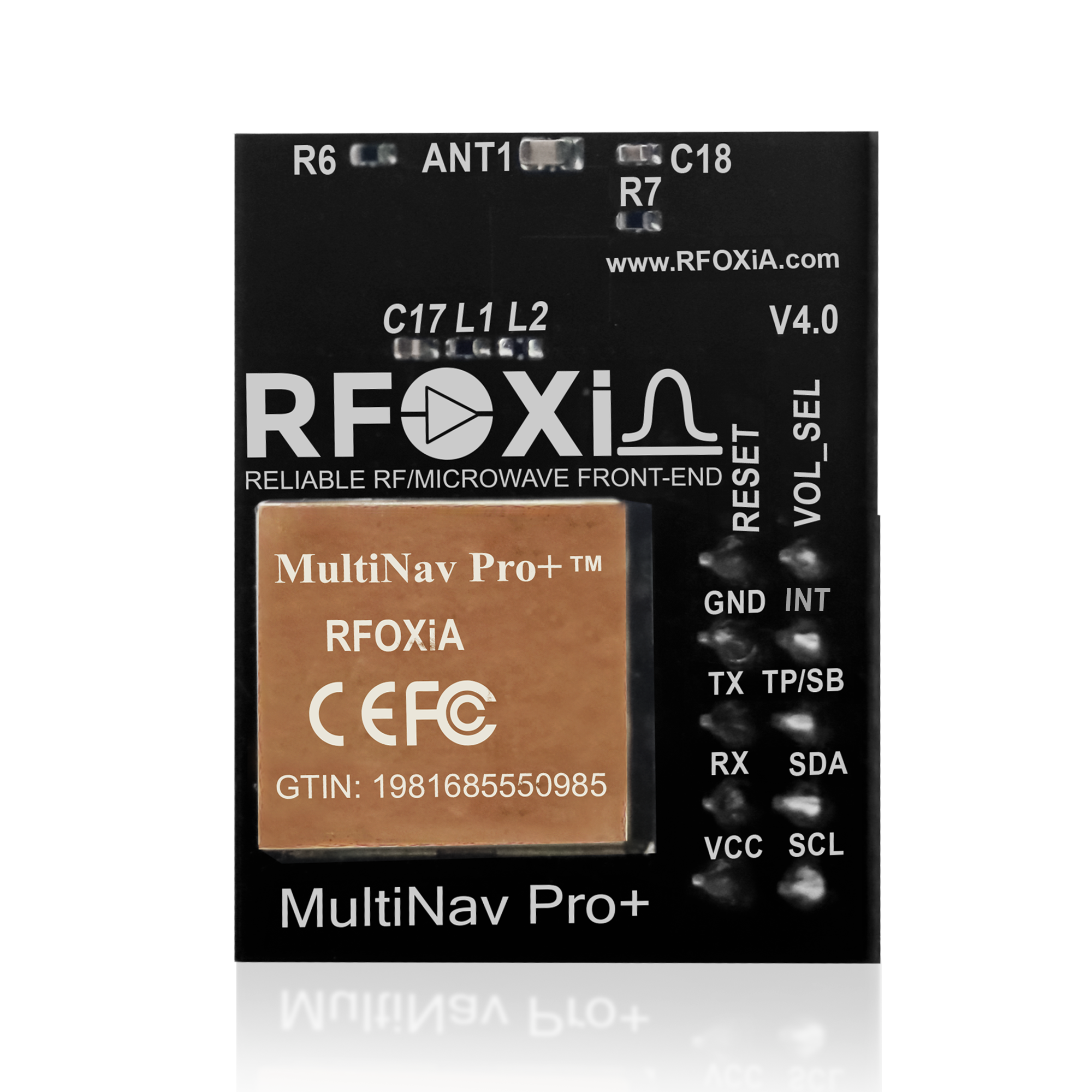
The MultiNav Pro+ Accurate GNSS Module from RFOXiA is not another commodity GPS breakout board. It is a purpose-engineered precision navigation solution built around the latest u-blox MIA-M10Q chipset, designed from the ground up for the demands of modern drones, autonomous robots, IoT deployments, and professional research platforms.
This post covers everything you need to know — the specs, the technology, the use cases, and why this module stands apart from every other drone GPS module on the market today.
Why Your Drone GPS Module Choice Defines Your Entire Build
GPS is the nervous system of any autonomous or semi-autonomous aerial system. A weak, slow, or imprecise GPS module creates a chain of downstream problems:
- Hold position drift — your drone wanders during hover
- Return-to-home inaccuracy — your aircraft lands meters away from launch, sometimes dangerously close to people or obstacles
- Slow initial lock — you wait on the ground while satellites are acquired, burning battery and patience
- Logging gaps — at low fix rates, fast-moving platforms generate incomplete or interpolated telemetry data
- Mission failure — waypoint missions require centimeter-to-meter precision, and commodity GPS cannot deliver it reliably
Every one of these problems is solved by choosing the right module from the start. The MultiNav Pro+ was engineered specifically to eliminate these failure modes.
MultiNav Pro+ Core Specifications
Before diving into the technology, here are the headline numbers:
| Specification | MultiNav Pro+ |
|---|---|
| Accuracy | Less than 1.5 meters |
| Fix Rate | Up to 18Hz |
| First Fix Time | 1 second (hot start) |
| GNSS Systems | GPS, Galileo, GLONASS, BeiDou — concurrent |
| Chipset | u-blox MIA-M10Q |
| Antenna | Integrated high-gain chip antenna |
| Interfaces | UART (TX/RX) and I2C (SCL/SDA) |
| Operating Voltage | 1.8V and 3.3V |
| Current Draw | 25–30mA |
| Dimensions | 26mm x 22mm |
| Certification | FCC certified |
| Price | $49 |
These are not marketing estimates. These are measured, real-world specifications backed by FCC certification and validated through field testing on live drone platforms.
The Technology Behind 1.5-Meter Accuracy
Concurrent Multi-Constellation GNSS
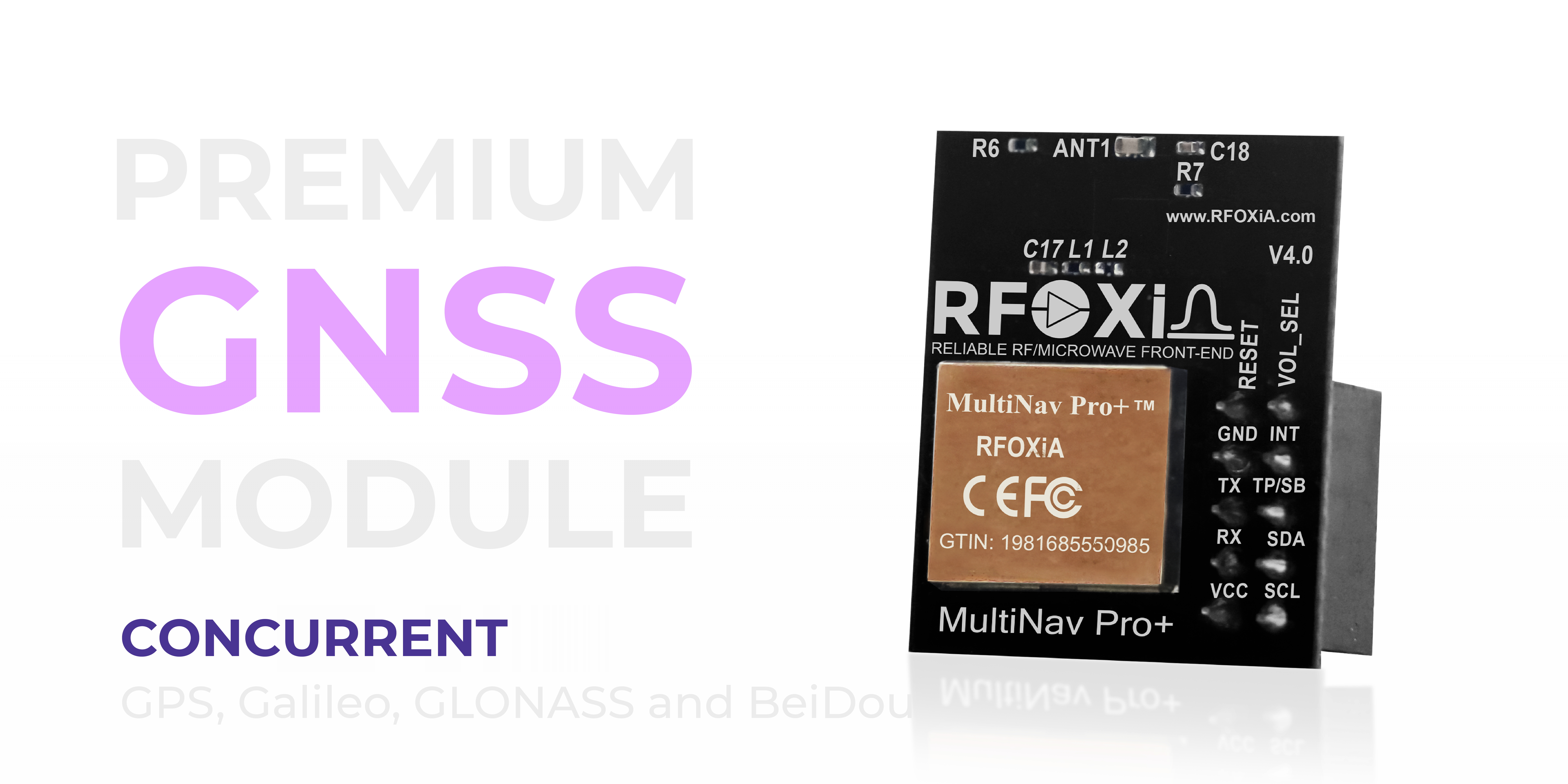
Most budget GPS modules connect to a single satellite constellation — typically GPS alone. This means your module is working with a subset of the available satellites overhead at any given moment. Fewer satellites means a weaker geometric fix, lower accuracy, and longer time to lock.
The MultiNav Pro+ connects to all four major global satellite systems simultaneously:
- GPS — the original US-operated system, global coverage
- Galileo — the European system, highest civilian accuracy specification
- GLONASS — the Russian system, excellent high-latitude coverage
- BeiDou — the Chinese system, dense coverage across Asia-Pacific with global expansion
By pulling from all four constellations at once, the MultiNav Pro+ has access to significantly more satellites overhead at any time. More satellites means better geometry (lower DOP — dilution of precision), faster lock, and more consistent sub-1.5-meter accuracy regardless of your location on Earth.
This is the foundation of why this drone GPS module outperforms every similarly-priced alternative.
18Hz Fix Rate — Built for Fast Platforms
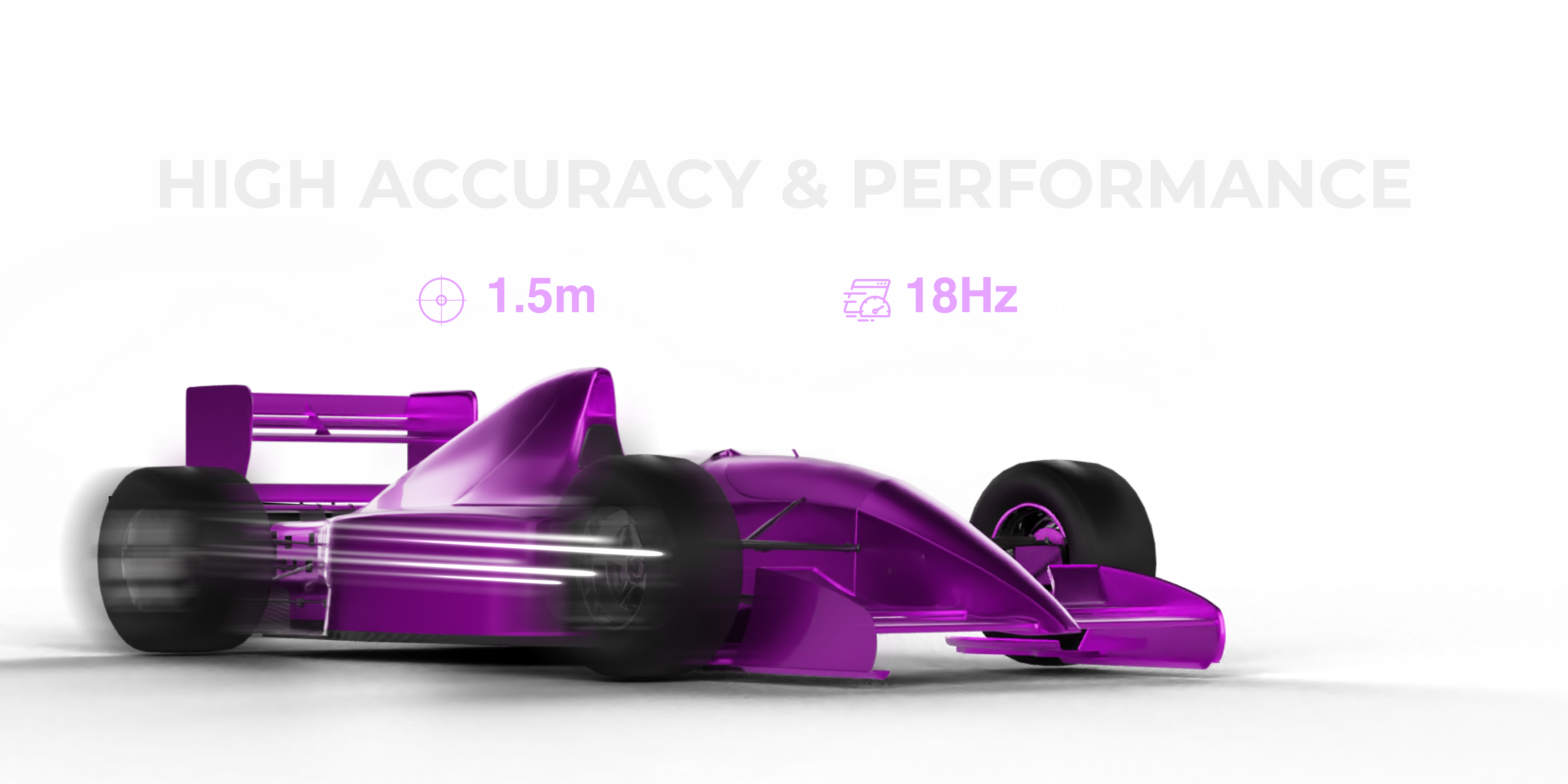
A standard GPS module updates at 1Hz — one position fix per second. For a stationary IoT sensor, that is acceptable. For a drone traveling at 60 km/h, it is completely inadequate.
At 60 km/h, a drone moves approximately 16.7 meters every second. A 1Hz GPS update means your flight controller is working with position data that is potentially 16 meters out of date. At 10Hz, that window closes to 1.7 meters. At 18Hz, you are getting a fresh position fix every 55 milliseconds — 1.1 meters of travel between updates at maximum speed.
This is why the 18Hz fix rate matters for drone applications specifically. It is not a spec chosen for marketing purposes. It is the threshold at which fast-platform position control becomes genuinely viable.
For racing drones, high-speed survey flights, and precision waypoint missions, the MultiNav Pro+ delivers the update rate that keeps your flight controller synchronized with reality.
u-blox MIA-M10Q Chipset
The heart of the MultiNav Pro+ is the latest-generation u-blox MIA-M10Q. u-blox is the gold standard in professional-grade GNSS silicon, used in everything from automotive navigation systems to industrial survey equipment. The MIA-M10Q is their most recent generation, designed specifically for:
- Ultra-low power multi-constellation reception
- Fast acquisition in challenging RF environments
- Reliable operation on dynamic platforms
- Tight integration with host microcontrollers
Choosing this chipset was a deliberate engineering decision. When you choose the MultiNav Pro+ as your drone GPS module, you are not getting a clone chip or a recycled design. You are getting current-generation silicon from the world's leading GNSS manufacturer, packaged into a hardware platform optimized for your use case.
RF Filtering Technology
One of the most overlooked aspects of GPS module performance is RF interference. Drones are electrically noisy environments — motor ESCs, video transmitters, FPV cameras, and other onboard electronics all generate RF noise that can corrupt GPS signals.
The MultiNav Pro+ incorporates advanced RF/microwave microstrip filter technology developed as part of RFOXiA's core RF engineering competency. This filtering architecture specifically targets the frequency bands used by noise sources common in drone builds, allowing the GNSS receiver to extract clean satellite signals even in the presence of significant onboard interference.
This is a detail that separates professional-grade modules from commodity breakout boards. The filter is not an afterthought — it is an engineered solution to a real-world deployment problem.
Compact, Efficient, Ready to Fly
Drone builders know that weight and power budget are non-negotiable constraints. Every gram on the airframe costs flight time. Every milliamp on the power rail is battery capacity that could be powering motors.
The MultiNav Pro+ was designed with this reality in mind:
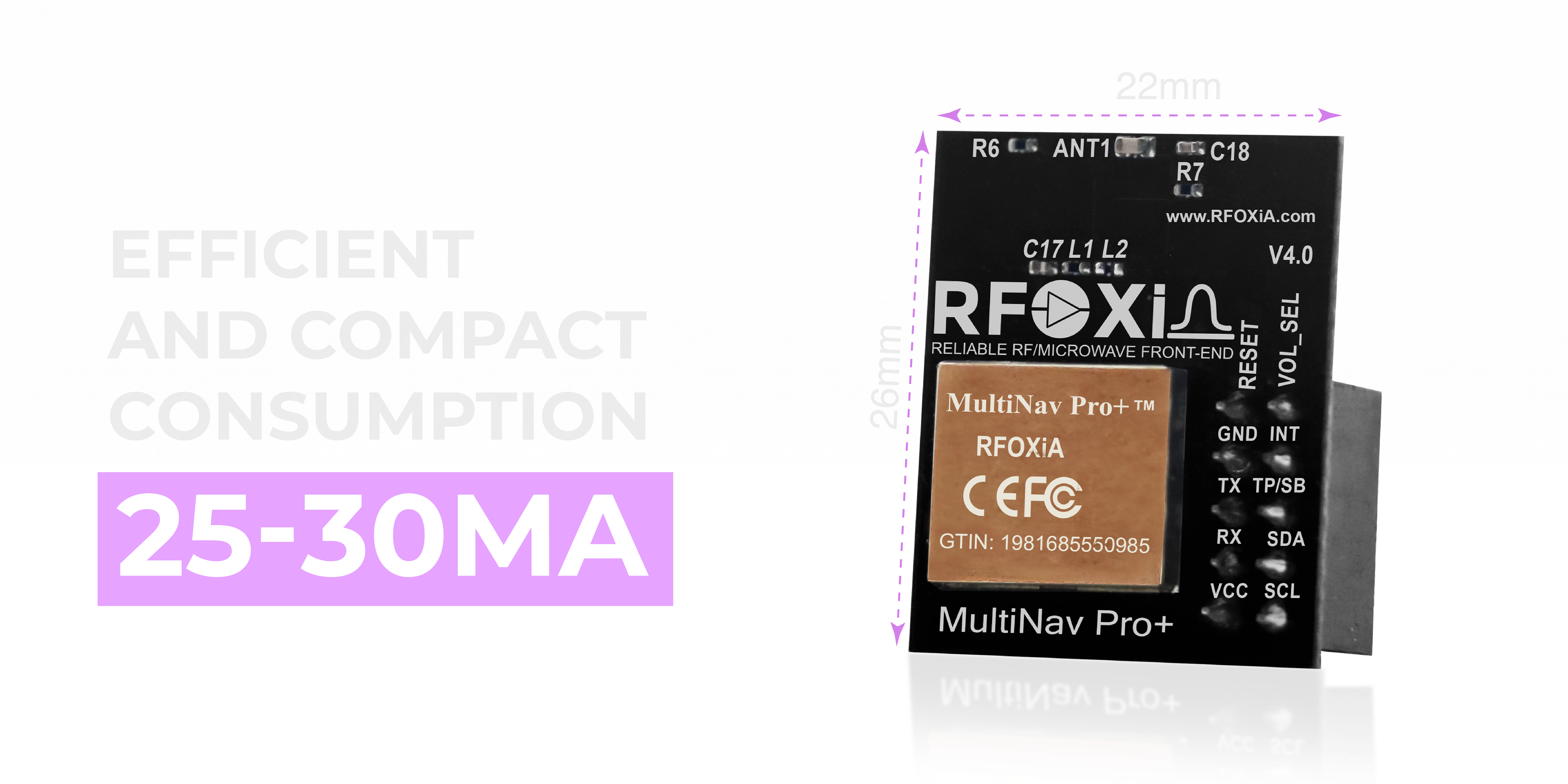
Size: 26mm x 22mm — one of the most compact multi-constellation GNSS modules available at this performance level. It integrates cleanly into any drone frame without compromising CG or requiring dedicated mounting hardware.
Current: 25–30mA — the entire multi-constellation receive chain, antenna, and output interface draws under 30 milliamps. In the context of a drone drawing 20A+ through its ESCs, the GPS module's power draw is completely negligible.
Voltage: 1.8V and 3.3V — direct compatibility with the most common logic levels in modern flight controllers and development boards. No level shifting required in most applications.
The integrated chip antenna eliminates the need for an external ceramic patch antenna and its associated cable, connector, and mounting hardware. This simplifies builds, reduces failure points, and keeps the module footprint minimal.
Connectivity and Integration
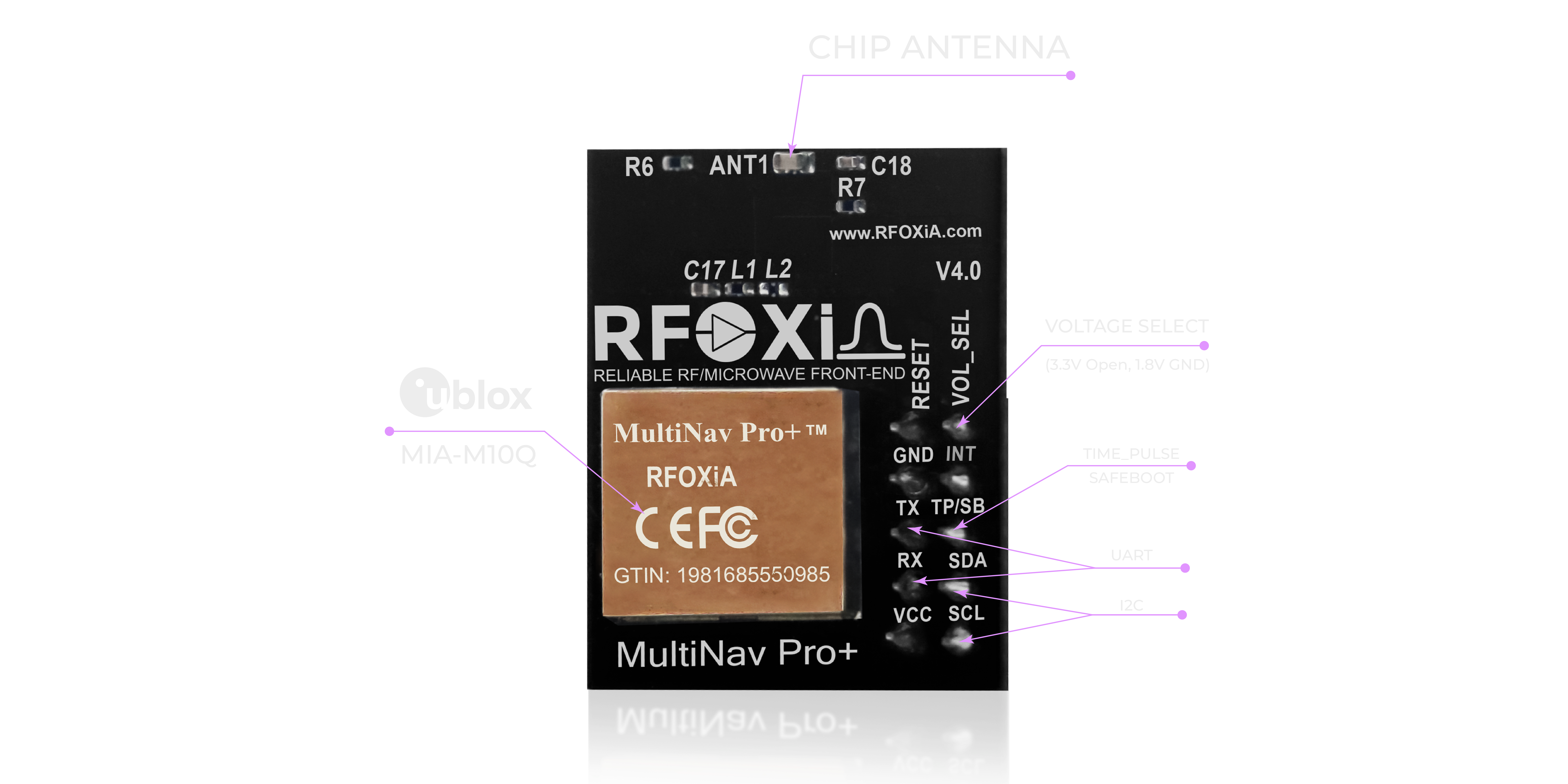
The MultiNav Pro+ supports two hardware interfaces, making it compatible with virtually every development platform and flight controller on the market:
UART Interface
The most common GPS integration path for flight controllers. Connect TX and RX to any available serial port on your FC, set the baud rate, and your navigation system is live. Compatible with ArduPilot, Betaflight (GPS rescue), iNAV, PX4, and every other major open-source flight control stack.
I2C Interface
For microcontroller-based builds where UART ports are at a premium, the I2C interface allows multiple devices to share a two-wire bus. Ideal for custom autopilot designs, Arduino and ESP32-based systems, and embedded research platforms.
Both interfaces are supported simultaneously in hardware — the interface you use is determined by your software configuration, not by physical jumpers or board revisions.
Open-Source Firmware and Developer-Friendly Ecosystem
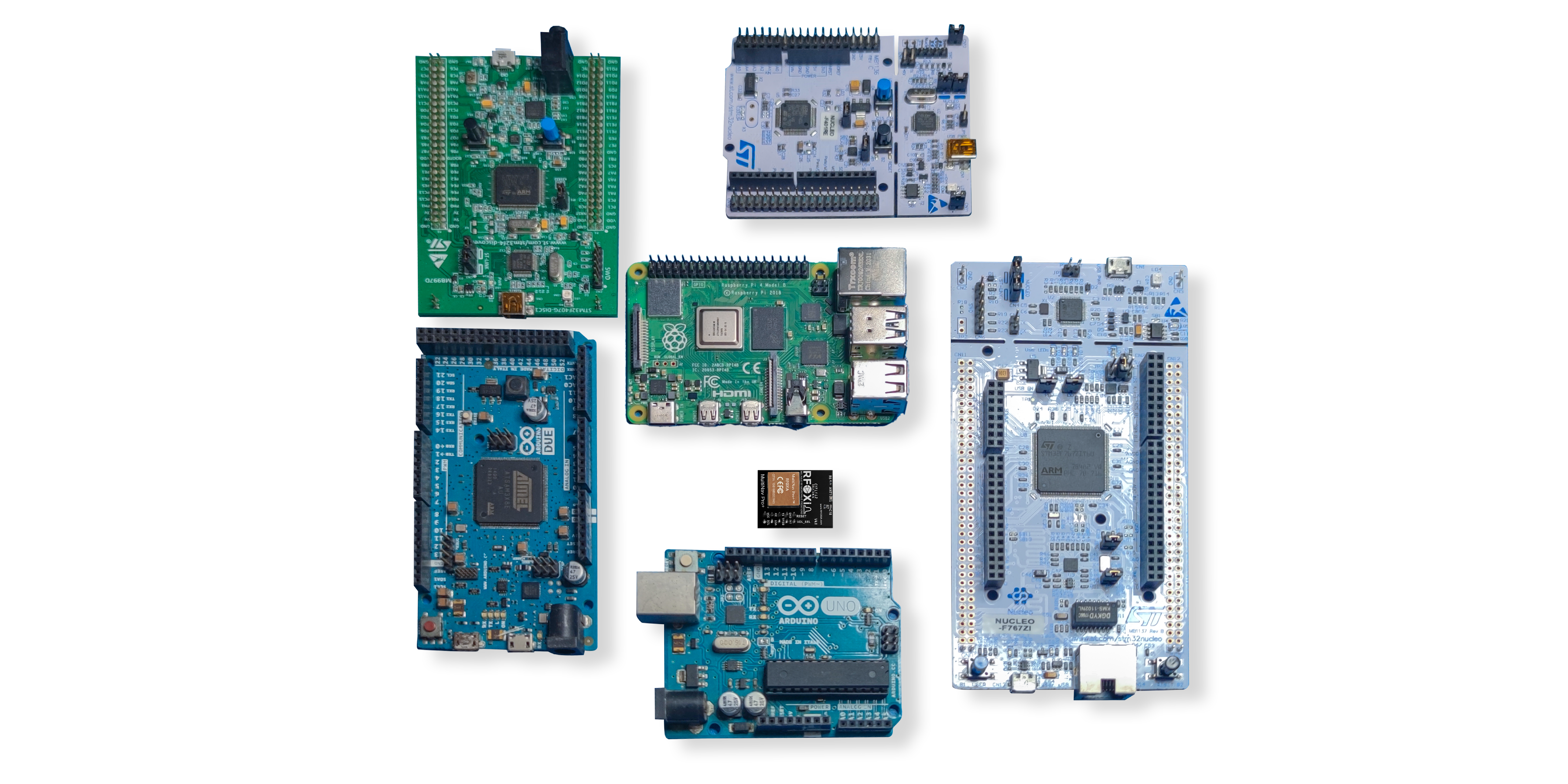
Professional hardware deserves professional software support. The MultiNav Pro+ ships with a fully open-source C language driver library that handles all the low-level GNSS communication protocol work so you can focus on your application.
The library:
- Implements the full NMEA standard protocol command set
- Parses all standard sentence types (GGA, RMC, VTG, GSA, GSV, and more)
- Provides clean, documented C functions for position, velocity, heading, and fix quality
- Imports directly into Arduino IDE with zero modification
- Works with any C/C++ toolchain — STM32 HAL, ESP-IDF, PlatformIO, and more
- Is available on GitHub for forking, contribution, and customization
This is not a proprietary black box. You own the integration layer. You can inspect it, modify it, and build on it without restriction.
For developers working within the broader RFOXiA ecosystem, the GNSS module pairs natively with the RFOXiA Accurate GNSS Module platform integration, enabling real-time GPS data streaming through the RFOXiA Connect app — live map tracking, position logging, and integration with the data monetization network.
u-Center Software Compatibility
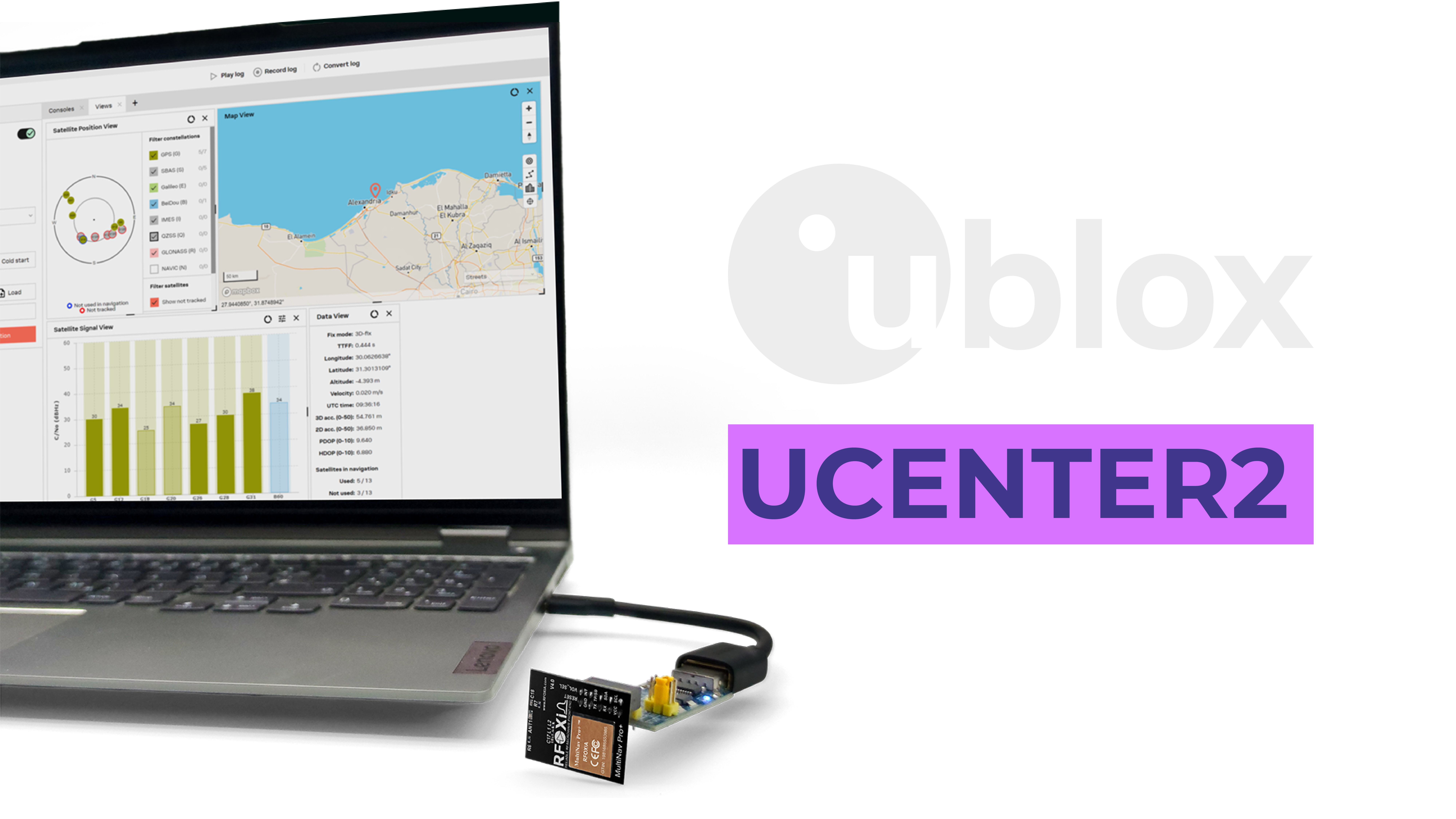
Because the MultiNav Pro+ is built on the u-blox MIA-M10Q, it is fully compatible with u-Center — u-blox's professional GNSS evaluation and configuration software. u-Center gives you:
- Real-time sky view showing every satellite visible and its signal strength
- Position, velocity, and heading visualization
- Full receiver configuration — fix rate, constellation selection, power mode, NMEA output configuration
- Data logging with post-processing capability
- Signal quality analysis tools used by professional GNSS integrators
This is a genuinely powerful tool that most manufacturers charge for or lock behind proprietary protocols. Because the MultiNav Pro+ uses u-blox silicon, you get full u-Center access for free — the same tool used by engineers designing automotive navigation systems and industrial survey equipment.
For a drone GPS module developer, u-Center makes the difference between guessing and knowing when it comes to antenna placement, interference mitigation, and performance optimization.
Use Cases: Where the MultiNav Pro+ Performs

The MultiNav Pro+ is the right drone GPS module for a wide range of professional applications:
Drone and UAV Applications
- FPV rescue and return-to-home — 1.5m accuracy means your drone returns to within arm's reach
- Autonomous waypoint missions — high fix rate and accuracy enable precision survey and inspection paths
- Agricultural spraying — consistent sub-2-meter accuracy across field grids
- Photogrammetry — accurate geotagging at the 18Hz capture rate matches high-speed imaging workflows
- Racing drones with GPS rescue — fast fix rate keeps rescue mode viable even at speed
IoT and Tracking
- Asset tracking — vehicles, equipment, and personnel with real-time position streaming
- Fleet management — high fix rate provides smooth track reconstruction for moving assets
- Smart city sensor nodes — GPS-verified outdoor deployment for environmental data networks
- Wildlife research — lightweight module suitable for deployment on larger wildlife tracking collars
Research and Development
- Robotics platforms — outdoor autonomous navigation for ground vehicles and research robots
- Wearable positioning — compact size and low power budget enable body-worn applications
- Data collection platforms — 18Hz logging captures high-resolution spatial data for academic research
- Embedded systems education — open-source driver and Arduino compatibility make this ideal for learning professional GNSS integration
Integration with the RFOXiA Ecosystem
The MultiNav Pro+ is designed as a standalone precision drone GPS module — but it becomes significantly more capable when integrated with the full RFOXiA hardware ecosystem.
Paired with the BLE Module (MultiNav Pro+ Long-Range BLE): Stream live GPS position data over 5km ground-to-ground or up to 15-20km to a drone, visualized in real time on the RFOXiA Connect app. The live map screen shows your aircraft's exact position as it updates at 18Hz — a genuinely cinematic experience when you see it for the first time.
Paired with the Sensors Module: Combine GPS location with environmental data — temperature, humidity, pressure, air quality — to create geo-tagged environmental datasets. This combination is the foundation of the RFOXiA data monetization network, where contributors earn daily rewards for streaming verified outdoor sensor data.
Paired with the Developer Bundle: The complete ecosystem in one package — BLE module, GNSS module, sensors module, and power kit — gives you everything needed to build, deploy, and operate a full wireless sensor platform. The GNSS module validates outdoor deployment and provides the location layer that makes the data network valuable to enterprise buyers.
For developers ready to build something serious, the RFOXiA Accurate GNSS Module is available individually at $49, or as part of the Developer Bundle.
Why FCC Certification Matters
In a market flooded with uncertified modules from unverified manufacturers, FCC certification is not a bureaucratic checkbox. It is the difference between a module that operates legally in the US market and one that does not.
FCC certification on the MultiNav Pro+ means:
- Verified RF emissions — the module does not generate interference that violates US radio regulations
- Retail channel eligibility — FCC-certified products can be stocked by major US distributors
- Legal deployment — your product built on this module inherits a key compliance foundation
- Quality assurance signal — the certification process validates that the hardware performs as designed
All four RFOXiA modules carry FCC certification. This is not common at this price point. It reflects the level of engineering investment that separates RFOXiA from commodity module vendors.
MultiNav Pro+ vs. Generic Drone GPS Modules
It is worth being direct about what you are comparing when you evaluate the MultiNav Pro+ against lower-cost alternatives.
| Feature | Generic GPS Module | MultiNav Pro+ |
|---|---|---|
| Accuracy | 2.5–5 meters typical | Less than 1.5 meters |
| Fix Rate | 1–5Hz | Up to 18Hz |
| Constellations | GPS only or dual | GPS + Galileo + GLONASS + BeiDou concurrent |
| Chipset | Unverified / legacy | u-blox MIA-M10Q (current gen) |
| RF Filtering | None | Advanced microstrip filter |
| Open-source driver | Rarely | Full C library on GitHub |
| u-Center compatible | No | Yes |
| FCC certified | No | Yes |
| Ecosystem integration | None | Full RFOXiA platform |
| Price | $8–25 | $49 |
The price delta between a generic module and the MultiNav Pro+ is roughly $25–40. For any serious build, that is a fraction of the cost of a motor, ESC, or frame — and it is the single component most responsible for whether your autonomous system performs as designed or fails in the field.
Getting Started
The MultiNav Pro+ is available now, FCC certified, and ships with a Quick Start Guide covering:
- Hardware connection diagrams for common platforms
- Software library installation for Arduino IDE
- First-fix verification procedure
- u-Center setup guide
- Integration with RFOXiA Connect for live map visualization
New users who join RFOXiA Club receive a $10 welcome credit toward their first hardware purchase.
Conclusion: The Drone GPS Module That Performs Like Professional Equipment
The MultiNav Pro+ Accurate GNSS Module exists because serious builders deserve professional-grade GPS performance without a professional-grade price tag. At $49, with 1.5-meter accuracy, 18Hz updates, concurrent four-constellation reception, u-blox silicon, open-source drivers, FCC certification, and full integration into the RFOXiA ecosystem, it occupies a position that no other module on the market can claim.
If you are building a drone, a robot, a research platform, or an IoT deployment where location accuracy and update rate genuinely matter, the choice of drone GPS module may be the most important specification decision in your build.
The MultiNav Pro+ is the answer to that decision.
Ready to upgrade your navigation? Visit the RFOXiA Accurate GNSS Module product page to order, explore the documentation, and join the RFOXiA developer community.
Written by: Moamen Mohamed LinkedIn