
Drone Sensor Module Telemetry: The Complete Guide to the MultiNav Pro+ Sensors Module
RFOXiA Integrated Sensors Module
The Best Drone Sensor Module Telemetry Platform Just Got Smaller, Smarter, and More Affordable
If you have spent any time building drones, autonomous robots, field IoT nodes, or environmental monitoring systems, you already know the pain. Sensor integration is messy. You source an accelerometer from one vendor, a magnetometer from another, an air quality module from a third, and by the time you wire them all up, manage their power rails, resolve I2C address conflicts, and write the firmware to poll each one independently, you have burned weeks of development time before your project has even moved an inch.
That is the exact problem the MultiNav Pro+ Sensors Module from RFOXiA was built to solve.
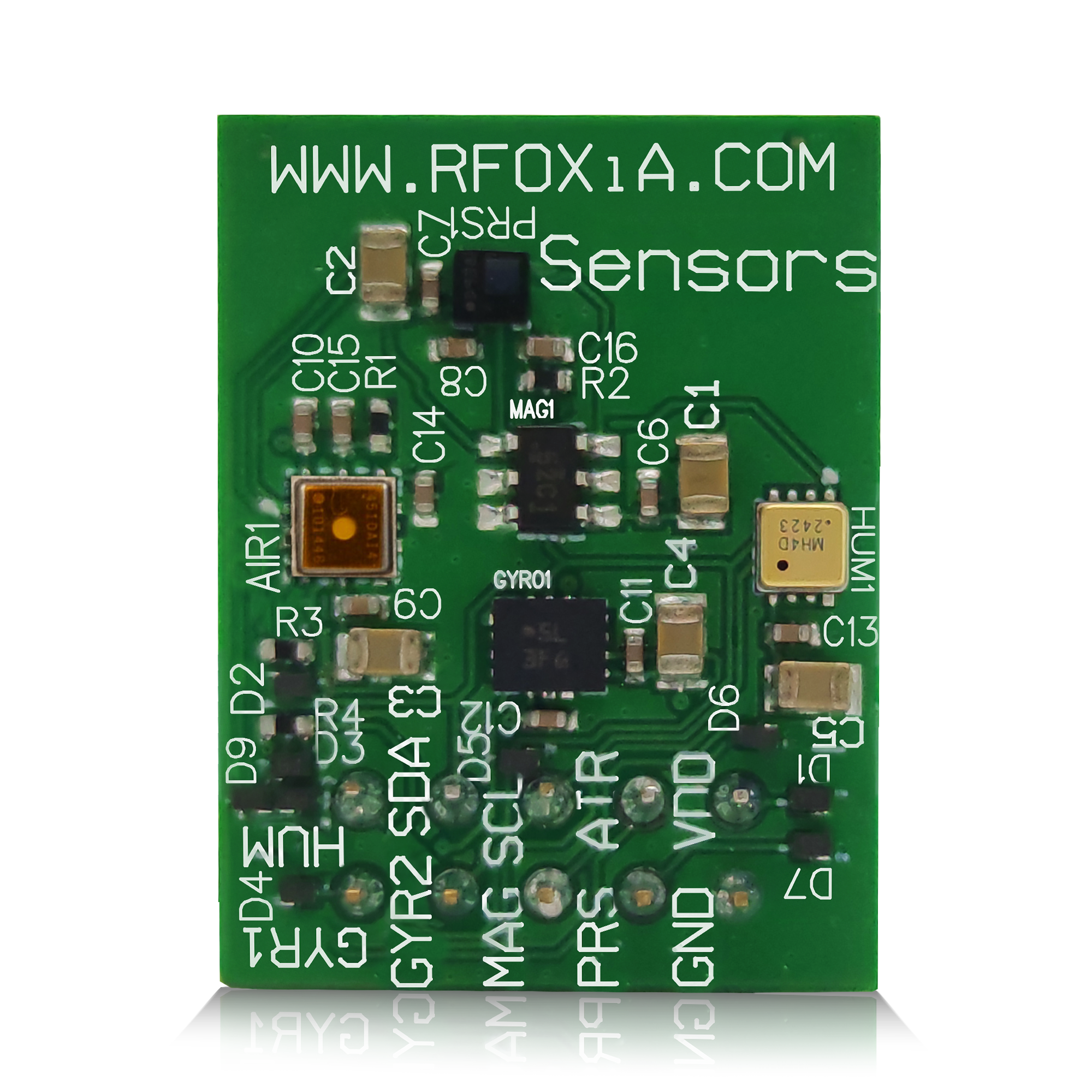
In a compact 24mm × 18mm footprint, this module delivers seven professional-grade sensors on a single board with a single I2C bus, FCC certification, and full ecosystem compatibility with the rest of the RFOXiA hardware platform. Whether you are building a drone that needs real-time motion data and environmental awareness simultaneously, a smart agriculture node that streams micro-climate readings to a data network, or a wearable that needs to understand its surroundings in real time, this is your answer.
This guide covers everything you need to know about the MultiNav Pro+ Sensors Module: what it includes, why each sensor was chosen, how it integrates with a broader drone sensor module telemetry stack, what applications it unlocks, and why this is one of the most technically ambitious sensor modules available at any price in this form factor.
What Is a Drone Sensor Module Telemetry System and Why Does It Matter?
Before diving into the hardware, it is worth defining the concept for those newer to the space.
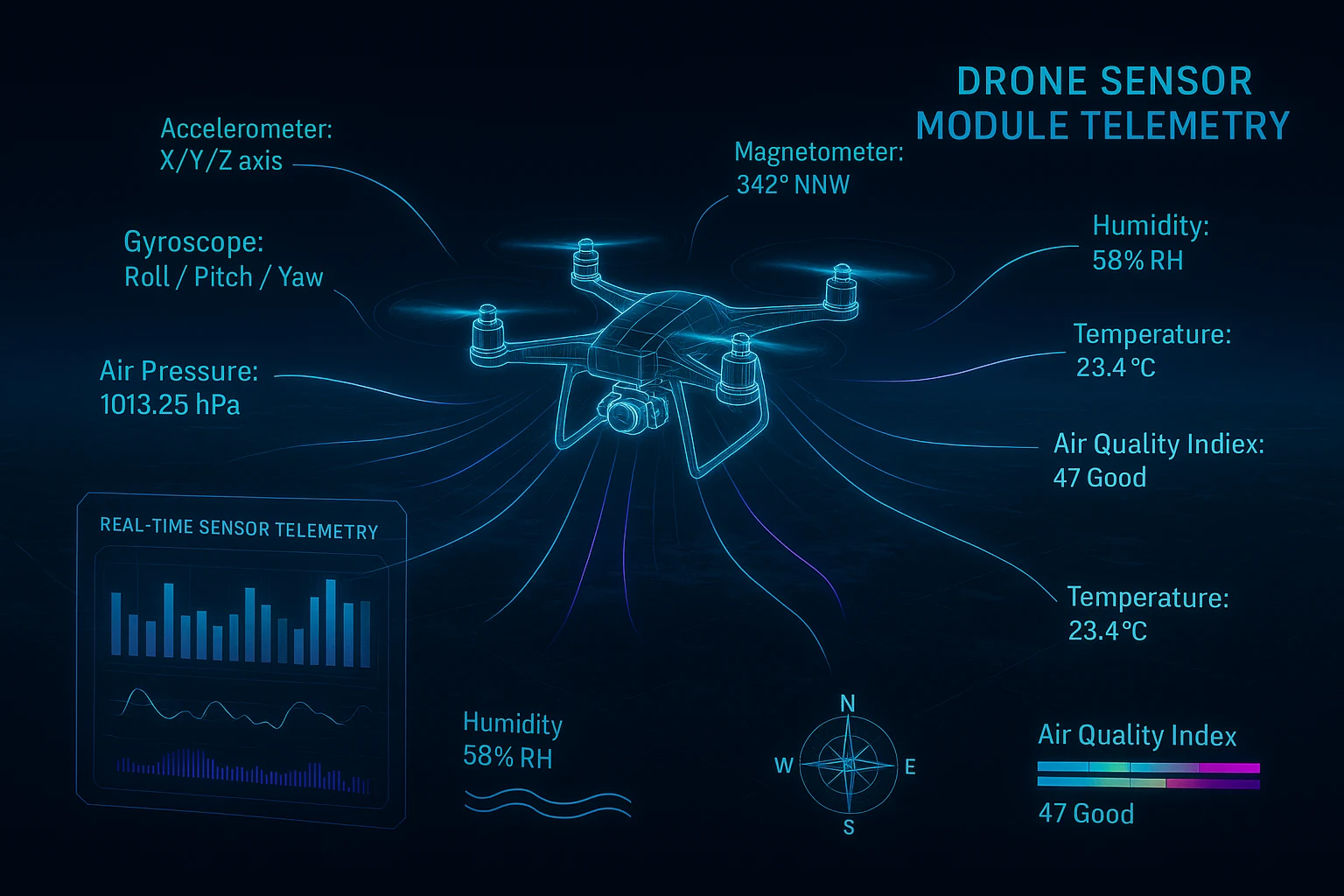
Drone sensor module telemetry refers to the real-time collection, transmission, and interpretation of sensor data from an airborne or ground-based platform. In modern drone development and IoT field deployments, telemetry is not just GPS coordinates. A fully instrumented platform captures motion state (orientation, acceleration, angular velocity), positional data (GPS, barometric altitude), and environmental context (temperature, humidity, air quality, atmospheric pressure) — all simultaneously, all timestamped, all streamed back to a base station or stored locally for post-mission analysis.
The challenge has always been integration. Sourcing seven individual sensor ICs, designing a PCB to host them all with proper decoupling, assigning non-conflicting I2C addresses, writing driver firmware for each, and validating the entire stack is a serious hardware engineering project. For large aerospace firms, that is a line item in a multi-million dollar program. For independent developers, drone builders, researchers, and startups, it has historically been a significant barrier.
The MultiNav Pro+ Sensors Module eliminates that barrier entirely.
Inside the Module: Seven Sensors, One Board
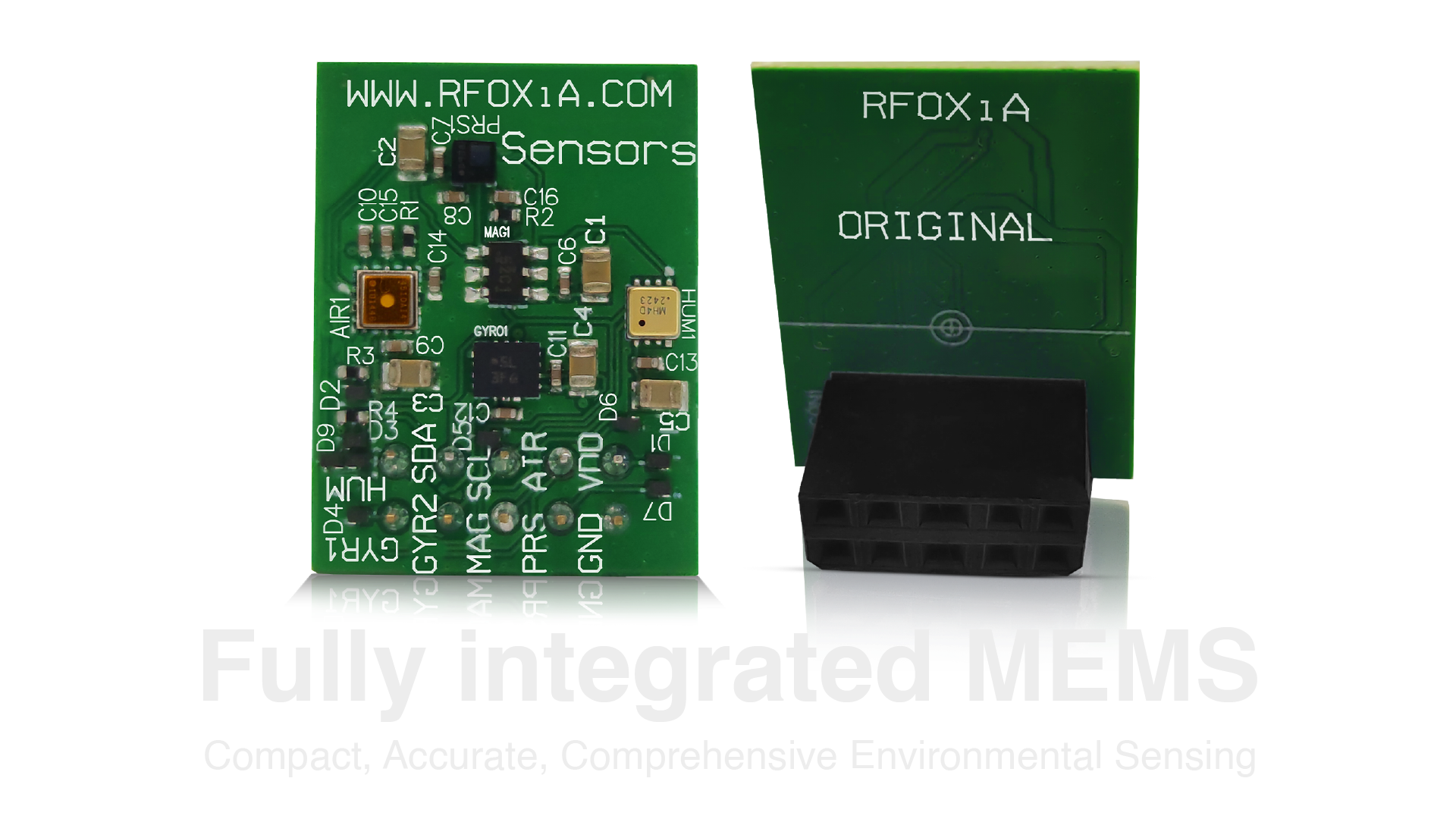
Let us break down exactly what is packed into this 24mm × 18mm board.
Motion Sensing: Accelerometer and Gyroscope — BMI270 from Bosch Sensortec
The BMI270 is not a budget accelerometer. It is the same class of inertial measurement unit used in professional drones and advanced robotics platforms. Bosch Sensortec built the BMI270 specifically for applications requiring ultra-low power consumption without sacrificing measurement performance. For drone sensor module telemetry use cases, this means you get high-resolution six-axis IMU data (three-axis acceleration, three-axis angular velocity) in a package that will not drain your flight battery.
The accelerometer captures linear acceleration across X, Y, and Z axes, essential for flight stabilization, impact detection, vibration analysis, and dead reckoning. The gyroscope captures rotational rate, the backbone of attitude estimation and heading hold in any autonomous flight system.
Navigation Sensing: Magnetometer — TMAG5273C1QDBVR from Texas Instruments
For true north heading and compass functionality, the module uses Texas Instruments' TMAG5273, a three-axis Hall-effect magnetometer with exceptional sensitivity and low-noise performance. In a drone sensor module telemetry context, the magnetometer provides the third pillar of a complete attitude and heading reference system (AHRS) when fused with the accelerometer and gyroscope data from the BMI270.
Magnetometer data is critical for any autonomous navigation application where GPS alone is insufficient — indoor environments, GPS-denied zones, precision landing, and heading-locked hover modes all rely on magnetometer fusion.
Environmental Sensing: Air Pressure — LPS22HHTR from STMicroelectronics
STMicroelectronics' LPS22HH is a high-accuracy MEMS pressure sensor capable of absolute pressure measurement in the 260 to 1260 hPa range. In drone and UAV applications, this directly enables barometric altitude estimation — a key redundancy to GPS altitude data and the primary altitude reference in GPS-denied conditions.
For ground-based IoT deployments, the LPS22HH contributes to the weather and micro-climate dataset that makes the RFOXiA data network commercially valuable. Micro-resolution atmospheric pressure data at street level is something traditional weather infrastructure simply cannot provide.
Environmental Sensing: Humidity and Temperature — MVH4003D from MEMSVision
The MVH4003D from MEMSVision provides calibrated relative humidity and temperature readings. Temperature and humidity are the two most universally demanded environmental data points across agricultural technology, HVAC monitoring, cold chain logistics, smart building management, and climate research.
For drone applications, temperature data is relevant to battery performance modeling, motor thermal management, and payload environmental monitoring. For fixed IoT node deployments contributing to the RFOXiA data network, these two sensors are the foundation of the micro-climate dataset.
Environmental Sensing: Air Quality — ZMOD4510AI4R from Renesas
This is where the MultiNav Pro+ Sensors Module goes significantly beyond what most competing sensor arrays offer. The ZMOD4510 from Renesas is a dedicated air quality sensor built on metal oxide semiconductor (MOX) technology, specifically designed for outdoor air quality index monitoring.
The ZMOD4510 detects ozone and nitrogen dioxide — the two primary photochemical pollutants in outdoor environments — and generates a calculated air quality index output. For environmental researchers, smart city operators, precision agriculture teams, and public health applications, having a calibrated outdoor air quality sensor co-located with temperature, humidity, and pressure data is enormously powerful.
No other module in this price class includes a calibrated outdoor air quality sensor alongside a full IMU and environmental stack.
Precision That Holds Up in the Field
Sensor specifications on paper are easy to manufacture. What matters in real deployment is whether the data holds up under operational conditions — vibration from drone motors, temperature swings between ground and altitude, electromagnetic interference from power systems.
Every sensor chosen for the MultiNav Pro+ represents a deliberate decision by RFOXiA's engineering team. The BMI270's vibration rejection performance is specifically documented for drone-class vibration environments by Bosch. The LPS22HH's hermetic MEMS packaging resists humidity intrusion that degrades cheaper pressure sensors. The ZMOD4510's design explicitly targets outdoor deployment, unlike generic gas sensors that saturate in open-air environments.
This is not a module assembled from the cheapest available ICs. It is a module assembled from the most appropriate ICs for professional drone and IoT telemetry applications.
The Sensor Lineup at a Glance
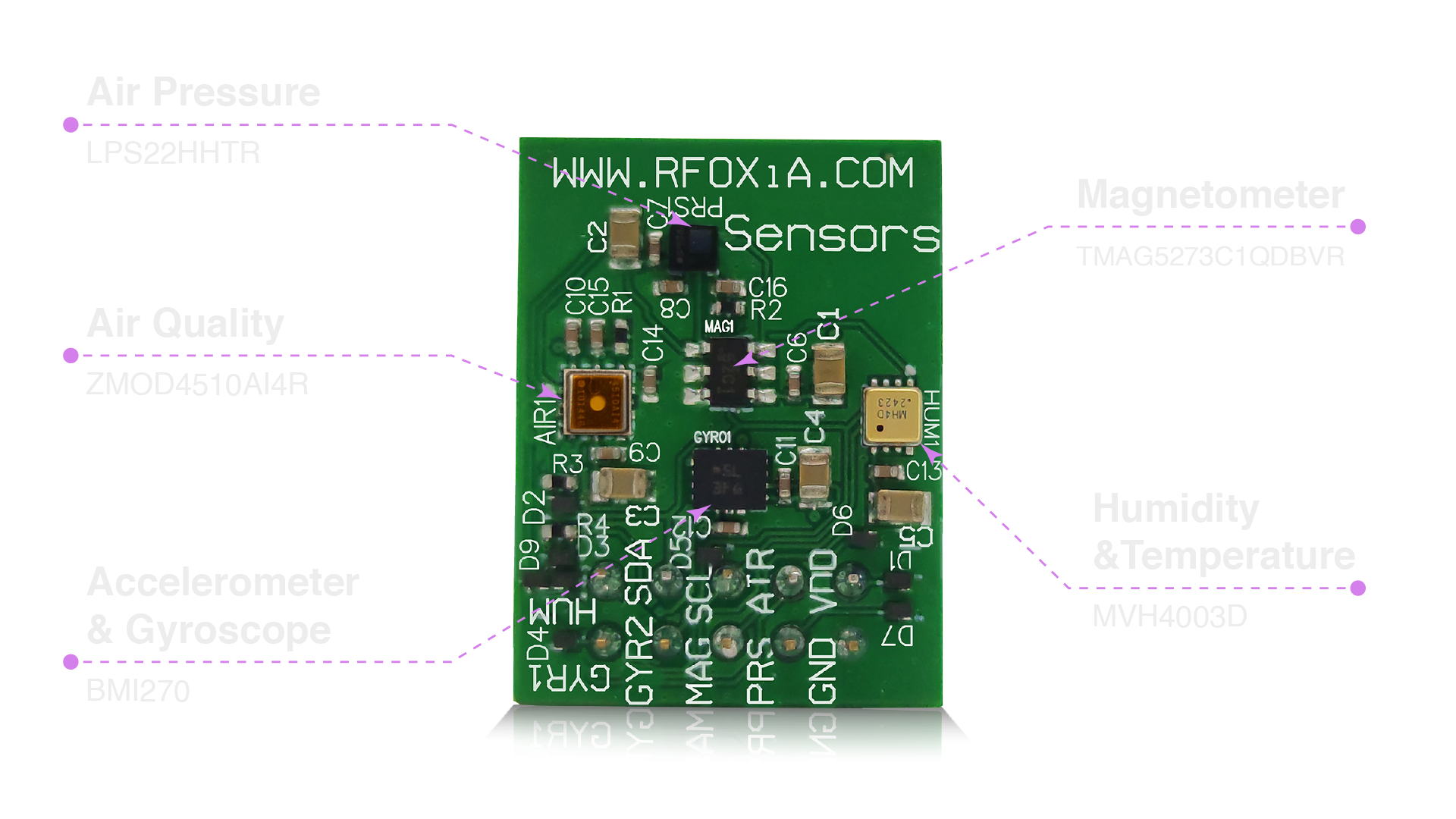
To summarize the full sensor lineup:
- Accelerometer & Gyroscope: BMI270 — Bosch Sensortec
- Magnetometer: TMAG5273C1QDBVR — Texas Instruments
- Air Pressure: LPS22HHTR — STMicroelectronics
- Humidity & Temperature: MVH4003D — MEMSVision
- Air Quality: ZMOD4510AI4R — Renesas
Seven data streams. Five industry-leading semiconductor manufacturers. One 24mm × 18mm board priced at $39.
Single I2C Bus: The Engineering Decision That Makes This Module Practical
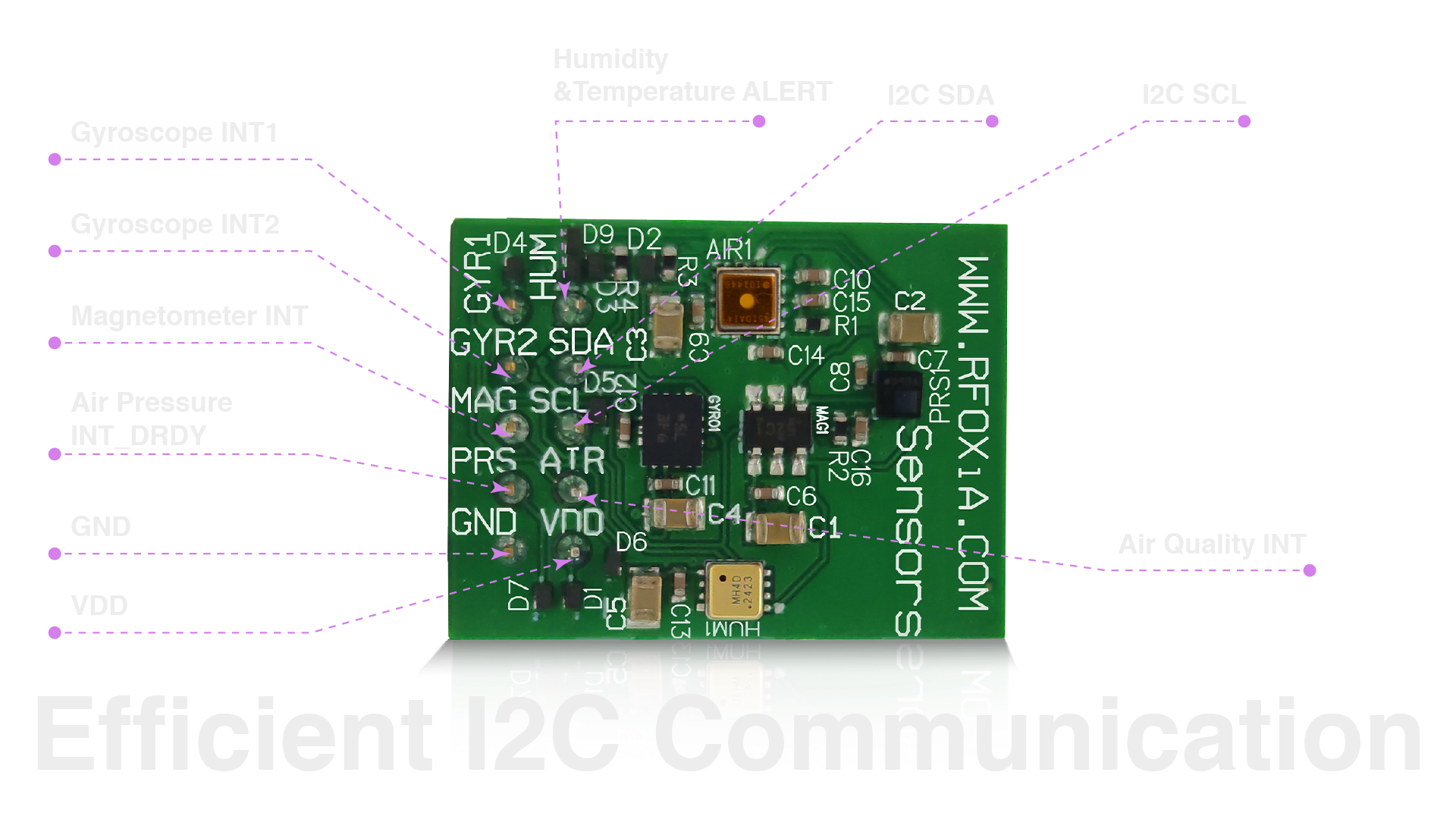
One of the most significant design decisions embedded in this module is the single I2C bus architecture. All seven sensors share one I2C line, each assigned a unique device address at the hardware level.
This matters more than it might appear at first. In a DIY multi-sensor build, I2C address conflicts are one of the most common integration headaches. Many popular sensor ICs share default addresses, requiring either address jumpers, software multiplexers, or dedicated I2C buses on your microcontroller — adding wiring complexity, software overhead, and potential failure points.
RFOXiA's hardware team resolved all of this in the PCB design phase. You connect two wires to your microcontroller — SDA and SCL — and all seven sensors are immediately addressable without any additional hardware or software multiplexing. Your firmware initializes each sensor by its unique address and starts polling. That is it.
For developers building drone sensor module telemetry systems under time pressure, this is the difference between a one-day integration and a one-week debugging session.
Compact by Design, Not by Compromise
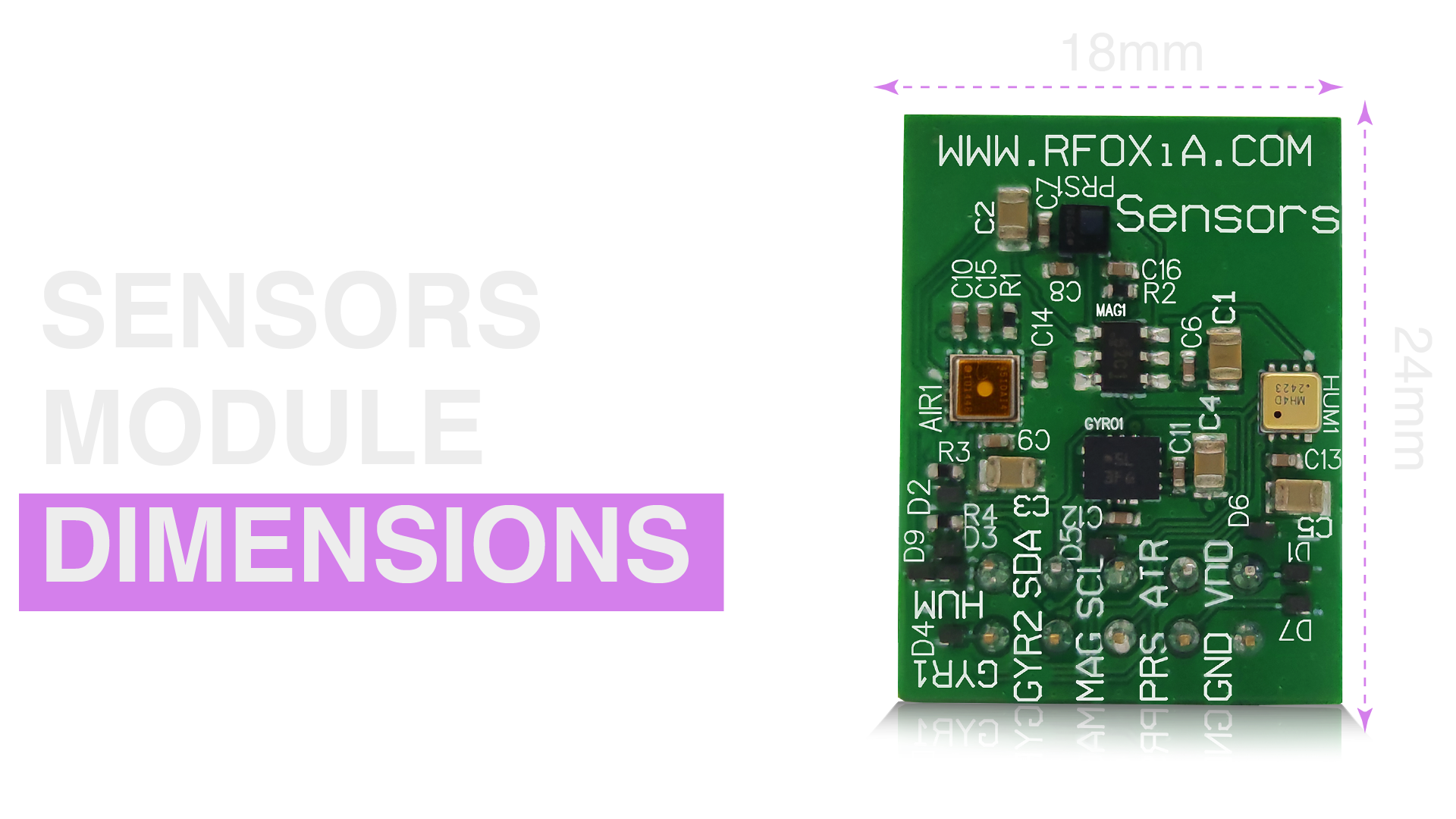
At 24mm × 18mm, the MultiNav Pro+ Sensors Module fits on platforms where space is genuinely constrained. A racing drone frame does not have room for a sensor breakout board the size of your palm. A field IoT node buried in an agricultural deployment needs to fit inside a weatherproof enclosure alongside a battery and communication module.
This form factor was chosen deliberately. Every millimeter of PCB real estate on a drone is weight, and weight is flight time. Every cubic centimeter inside a field enclosure is structural complexity. The MultiNav Pro+ delivers the full seven-sensor stack in a package small enough to mount on a mini quad or integrate into a wrist-worn device.
For comparison, sourcing and individually mounting the five sensor ICs on a custom PCB from scratch — even with a compact layout — would result in a board considerably larger than this due to the required decoupling networks, crystal oscillator footprints, and routing clearances around sensitive analog sections. RFOXiA has already solved that layout challenge, manufactured it, and FCC certified it.
Real-Time Environmental Data: What It Actually Means for Your Application
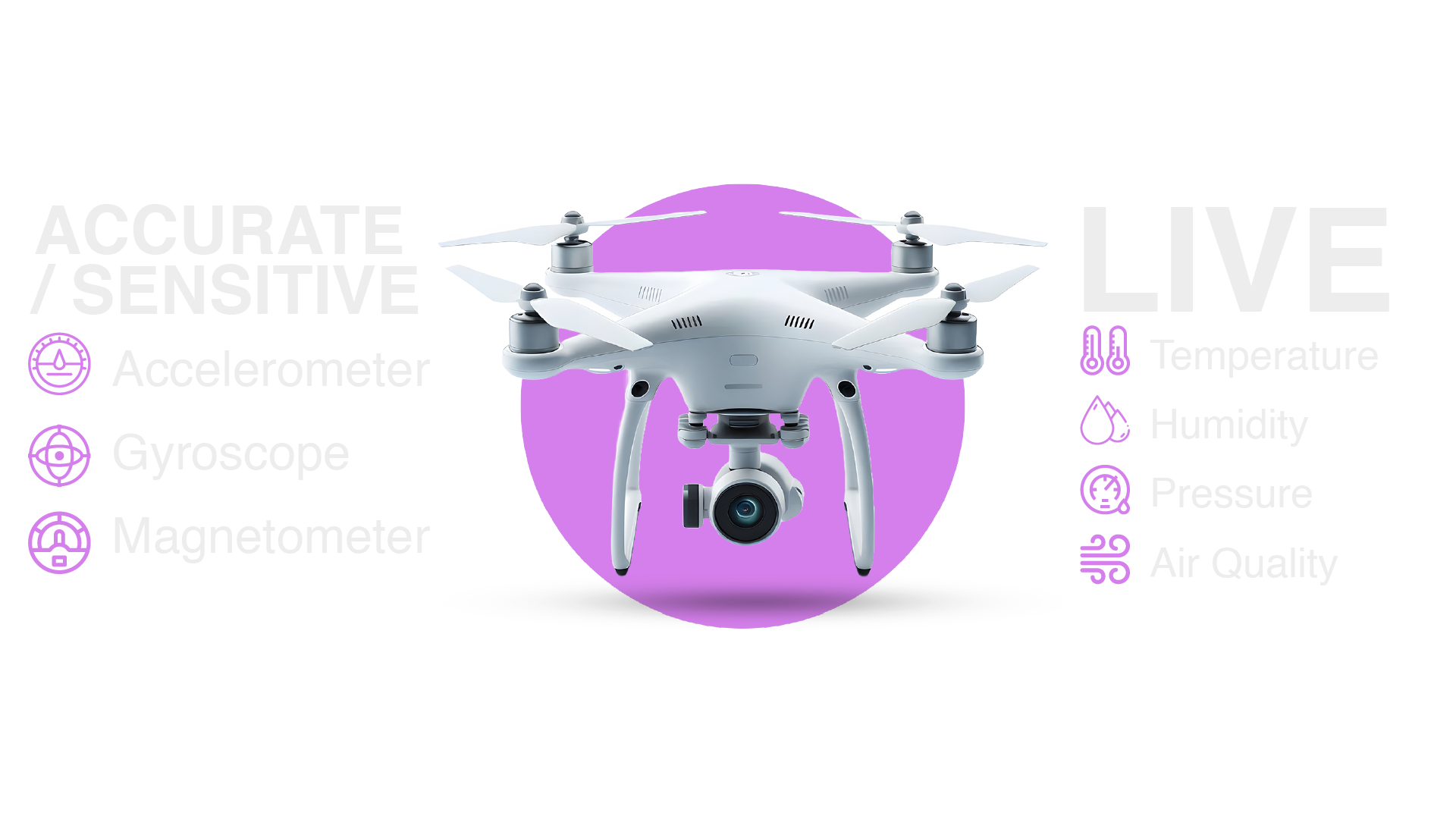
Real-time is not a marketing term here. The I2C polling rates supported by these sensors allow you to sample the full environmental and motion dataset at update rates fast enough to feed a real-time control loop or a live data visualization dashboard.
For drone applications, real-time motion data at high polling rates is non-negotiable. A flight controller that receives IMU data with even a 50ms lag will exhibit noticeably degraded stability. The BMI270 supports output data rates up to 1600Hz for the accelerometer and 6400Hz for the gyroscope — far in excess of what any drone flight controller loop requires, meaning you will never be waiting on sensor data.
For environmental monitoring, real-time matters in a different way. When a drone conducts an atmospheric survey, you want each GPS waypoint timestamped with a simultaneous environmental reading — not a 10-second-old buffered average. The MultiNav Pro+'s sensors provide the instantaneous readings your analysis pipeline needs.
For the RFOXiA Integrated Sensors Module deployed as a fixed data network node, real-time streaming means the RFOXiA data network receives second-resolution environmental data — a temporal resolution that commercial weather APIs simply cannot match, and one that creates genuine enterprise value for buyers who need sub-minute environmental data.
Applications: Where This Module Belongs

Let us walk through the primary application categories where the MultiNav Pro+ Sensors Module delivers the most value.
Professional and Racing Drones
For drone builders, this module is a complete telemetry sensor pack. Mount it on your airframe, connect it to your flight computer or companion computer, and you have full six-axis IMU, heading reference, and barometric altitude in one address. Add the environmental sensors and your drone simultaneously logs atmospheric data during every flight — enabling applications like atmospheric profiling, crop health correlation, and urban air quality mapping.
For FPV pilots and racing drone builders, the compact form factor means this can be integrated without any meaningful weight penalty. At 24mm × 18mm, it sits comfortably on a 30mm or 20mm stack.
Autonomous Ground Vehicles and Robotics
Any autonomous ground vehicle needs IMU data for dead reckoning, wheel slip detection, obstacle response, and pose estimation. The BMI270 and TMAG5273 combination provides the motion sensing backbone for a professional-quality robotics build. Add the environmental sensors and your robot can map air quality as it traverses an indoor or outdoor environment — relevant for warehouse inspection robots, search and rescue platforms, and agricultural field robots.
Environmental Research and Field Science
Researchers deploying field sensor networks need instruments they can trust. The sensor ICs inside the MultiNav Pro+ are the same calibration classes used in professional scientific instruments. A researcher deploying 20 nodes across a watershed or urban study area can use the MultiNav Pro+ with confidence that the temperature, humidity, pressure, and air quality data meets scientific analysis standards.
For distributed deployments, the single I2C interface and compact form factor mean nodes can be built quickly and cheaply without requiring custom PCB design skills.
Smart Agriculture and Precision Farming
Micro-climate variability across agricultural fields is one of the most commercially valuable and underserved data problems in modern agriculture. A field that is 500 meters wide may experience measurably different humidity and temperature profiles across its span, especially in sloped terrain or areas with varying soil moisture. Traditional weather stations at the field edge cannot capture this variation.
Deploying a network of MultiNav Pro+ sensor nodes across a large field, connected via the RFOXiA BLE module's 5km ground-to-ground range, enables genuinely hyper-local micro-climate monitoring at a hardware cost dramatically below traditional agricultural sensor infrastructure.
Wearable Technology and Human Performance Monitoring
The compact form factor and motion sensing capabilities make the MultiNav Pro+ viable in wearable development contexts. Athletes, first responders, industrial workers, and medical device developers can use this module as the sensing core of a wearable that simultaneously captures motion kinematics and ambient environmental exposure.
RFOXiA Data Network Node Deployment
For users who want their hardware to generate passive income, the MultiNav Pro+ is specifically designed to participate in the RFOXiA data network. Deploy the module outdoors, connect it to a RFOXiA system, and it begins streaming verified environmental data (temperature, humidity, pressure, air quality, with GPS validation) to the network. Verified contributors earn daily rewards based on location scarcity and data quality — up to $0.40 per day for complete verified data streams.
This transforms a $39 sensor module into infrastructure that pays for itself over time while contributing to a commercially valuable dataset purchased by agricultural technology companies, smart city operators, logistics firms, and climate researchers.
FCC Certification: Why It Matters for Your Project
The MultiNav Pro+ Sensors Module carries FCC certification, as do all RFOXiA modules. For developers building products for the US market, FCC certification on your component stack is not optional — it is a legal requirement for commercialization and a practical requirement for distribution through professional electronics channels.
Sourcing an FCC-certified sensor module eliminates one of the most costly and time-consuming steps in bringing a hardware product to market. You do not need to independently certify the sensors — the certification transfers to your system integration, dramatically reducing your time to market and regulatory compliance burden.
Integration with the RFOXiA Ecosystem
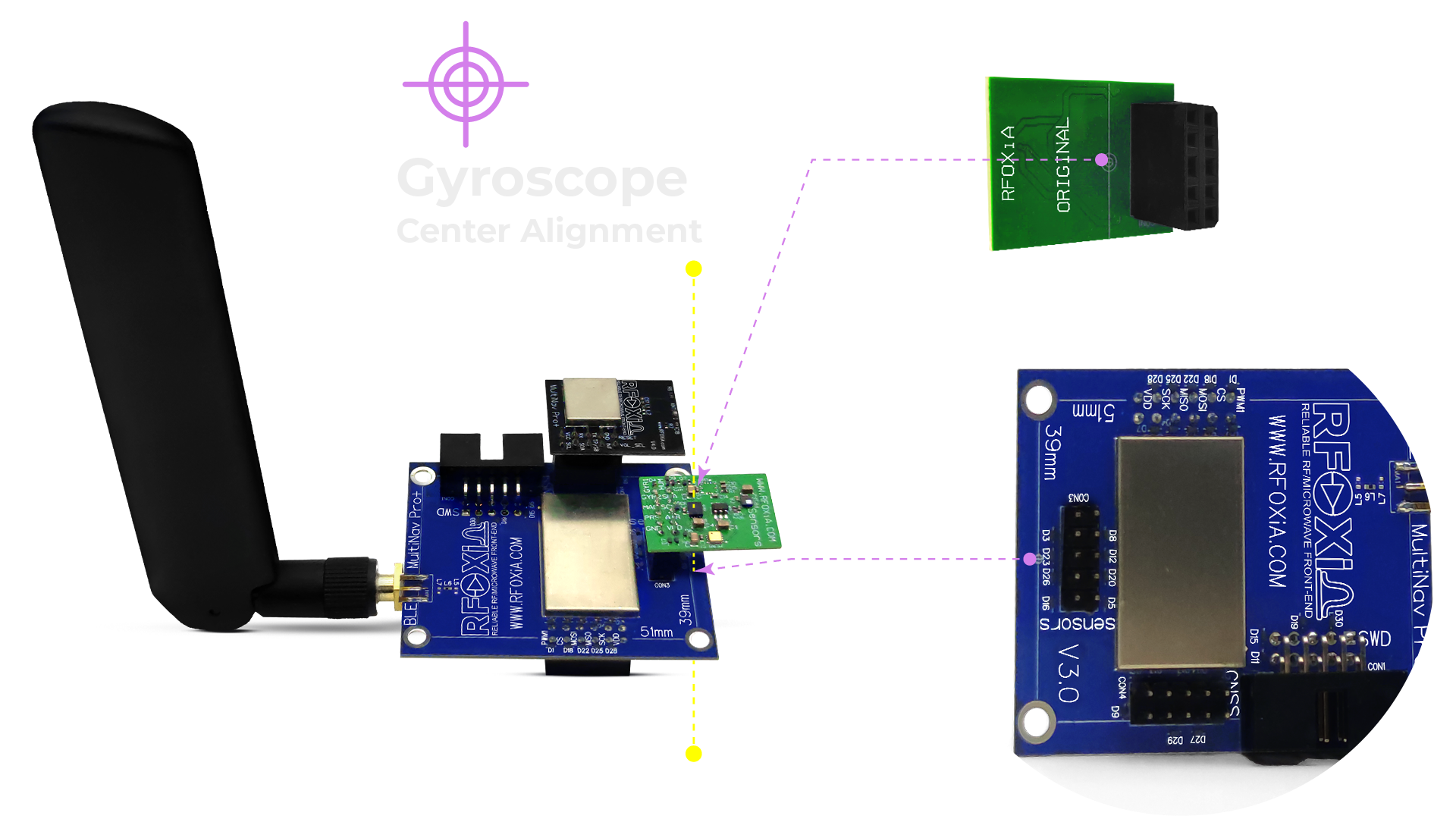
The MultiNav Pro+ Sensors Module is designed to work seamlessly within the broader RFOXiA hardware ecosystem. Pair it with the BLE Module for wireless data transmission up to 5km ground-to-ground (15-20km man-to-drone), the GNSS Module for GPS-validated position alongside your sensor readings, and the Power/Program Kit for a 24-hour runtime from a 5-minute charge using supercapacitor technology.
The complete Developer Bundle brings all four modules together for $199, representing the most complete professional wireless sensor development kit available at this price point.
Firmware development for the MultiNav Pro+ is further simplified through the RFOXiA Club AI Firmware Builder. Describe your application in plain language — "I need to read all seven sensors and transmit the data over BLE every 100 milliseconds" — and the AI generates complete, production-ready firmware with full source code. What would take a firmware engineer several days of driver development, debugging, and testing can be completed in under an hour.
For developers building complete drone sensor module telemetry systems, the combination of the MultiNav Pro+ Sensors Module, the BLE Module, and the AI Firmware Builder represents a complete development stack that removes nearly every traditional integration barrier.
Explore the full module and start your build at RFOXiA Integrated Sensors Module.
Technical Specifications Summary
| Parameter | Detail |
|---|---|
| Sensors included | Accelerometer, Gyroscope, Magnetometer, Temperature, Humidity, Air Pressure, Air Quality |
| IMU IC | BMI270 — Bosch Sensortec |
| Magnetometer IC | TMAG5273C1QDBVR — Texas Instruments |
| Pressure IC | LPS22HHTR — STMicroelectronics |
| Humidity/Temperature IC | MVH4003D — MEMSVision |
| Air Quality IC | ZMOD4510AI4R — Renesas |
| Communication | I2C (single bus, dedicated addresses) |
| Module dimensions | 24mm × 18mm |
| Certification | FCC certified |
| Price | $39 |
| Ecosystem compatibility | Full RFOXiA hardware ecosystem |
Why the MultiNav Pro+ Is the Right Drone Sensor Module Telemetry Solution
Let us be direct about what this module represents in the context of the current hardware market.
At $39, with FCC certification, seven professional-grade sensors from Bosch, Texas Instruments, STMicroelectronics, MEMSVision, and Renesas, a single I2C interface that eliminates integration complexity, and a 24mm × 18mm form factor that fits on any platform — there is no directly comparable product at this price point.
Alternatives in the market fall into two categories. Commodity sensor breakout boards from hobbyist electronics suppliers use lower-grade ICs, lack FCC certification, and require individual integration of multiple boards with all the wiring and address conflict challenges that entails. Professional instrument-grade environmental sensor systems from established test and measurement vendors cost hundreds to thousands of dollars and are designed for laboratory or industrial fixed installations, not drone integration or mobile IoT deployments.
The MultiNav Pro+ occupies the professional performance tier at a maker-accessible price — exactly the position RFOXiA was founded to hold across its entire product line.
For anyone serious about drone sensor module telemetry — whether you are a drone builder wanting complete situational awareness, a researcher building a distributed environmental monitoring network, a developer creating IoT infrastructure that participates in a data monetization network, or an engineer accelerating a hardware product to market — the MultiNav Pro+ Sensors Module is the fastest path from idea to deployed, streaming, data-generating hardware.
Get the MultiNav Pro+ Sensors Module
The MultiNav Pro+ Sensors Module is available now at $39 directly from RFOXiA.
Visit the RFOXiA Integrated Sensors Module product page to order, access technical documentation, explore firmware examples through the RFOXiA Club Dev Hub, and learn how to activate your module as a contributing node in the RFOXiA data network.
For the most complete development experience, consider the Developer Bundle — BLE Module, GNSS Module, Sensors Module, and Power/Program Kit together for $199 — the complete wireless sensor telemetry stack in one order.
All modules are FCC certified. All modules are in stock and ready to ship.
Written by: Moamen Mohamed LinkedIn