
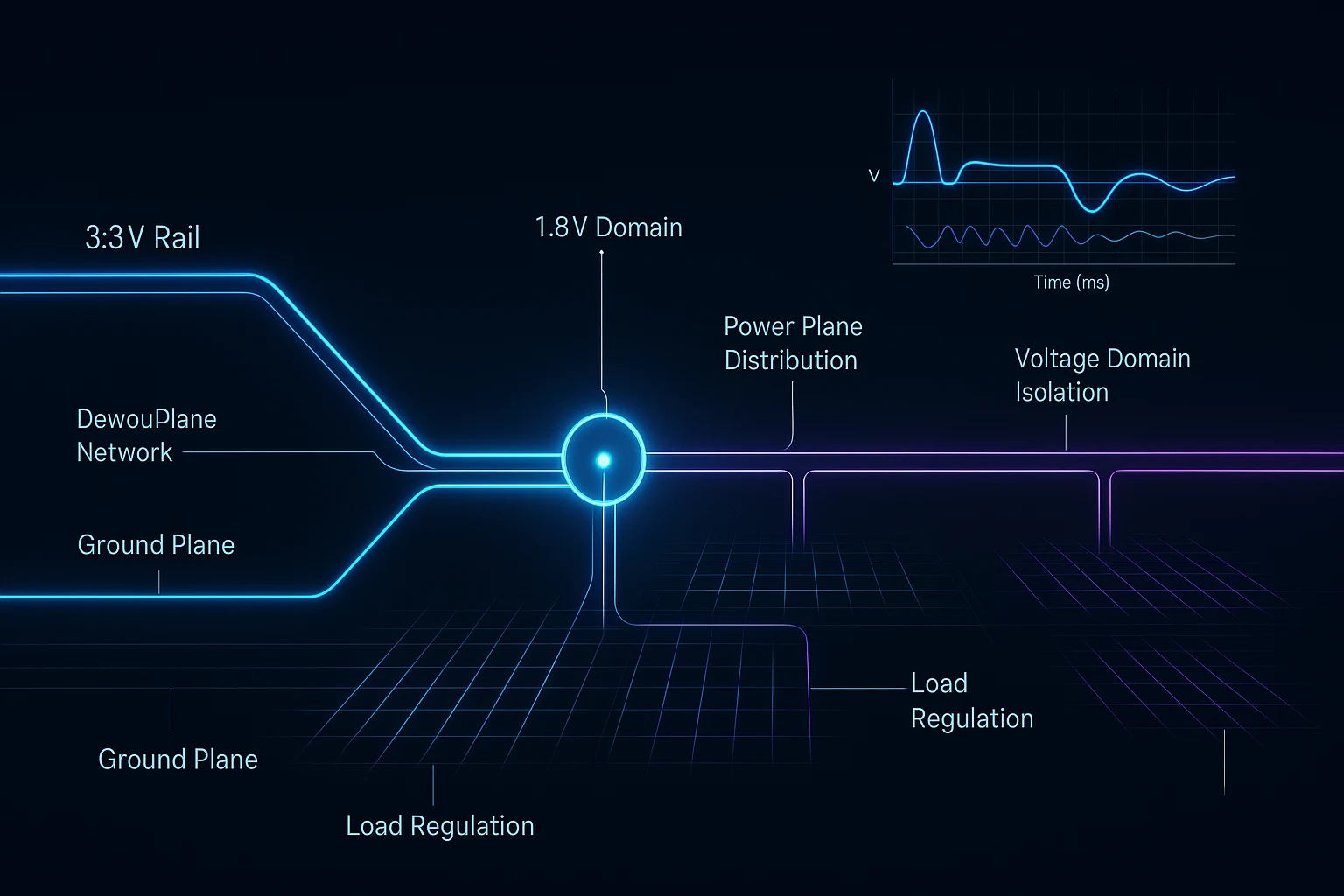
Embedded Power Rail Design: Why SuperCapacitors Are Changing the Game for Wireless Developers
RFOXiA SuperCapacitor Battery and Programmer Kit
Rethinking Embedded Power Rail Design From the Ground Up
If you have spent any time deploying wireless modules in the field — whether on drones, remote sensor stations, robotics platforms, or research installations — you already know that the power system is where most projects die. Not the firmware. Not the RF design. The power rail.
Batteries fail in the cold. They degrade over charge cycles. They take hours to recharge when you are in the middle of a field deployment. Voltage sag under load corrupts your data. And if you are running an STM32-based BLE module like the MultiNav Pro+, an unstable power rail is not just inconvenient — it causes firmware crashes, corrupted flash writes, and RF performance that drops off a cliff when your transmit amplifier demands a current spike the battery cannot deliver cleanly.
Professional embedded power rail design is not glamorous. But it is the difference between a wireless system that works reliably in the real world and one that works perfectly on your bench and fails the moment it matters.
RFOXiA has built a complete answer to this problem. The RFOXiA SuperCapacitor Battery and Programmer Kit is not a battery pack with a USB port. It is a purpose-engineered power delivery and development system built around supercapacitor technology — and it fundamentally changes what embedded power rail design looks like for the MultiNav Pro+ ecosystem.
The Core Problem With Conventional Battery-Based Power Rails
Before diving into what the Power/Program Kit does, it is worth being precise about why conventional lithium battery solutions fall short for serious wireless module deployments.
Voltage Droop Under Transient Load
The MultiNav Pro+ BLE Module uses an external RF amplifier to achieve its extraordinary range specs — up to 5km ground-to-ground, 15-20km man-to-drone, and 50km drone-to-drone. That amplifier draws current in bursts when transmitting. A lithium cell with any meaningful internal resistance will exhibit voltage droop during those bursts. Depending on your regulator design, that droop may never cause a visible problem — or it may intermittently crash your MCU, corrupt a transmission, or cause your GNSS module to lose lock at exactly the wrong moment.
Supercapacitors have internal resistance measured in milliohms. They can deliver hundreds of amps of peak current without measurable voltage sag. For an embedded power rail serving a multi-module wireless system with transient RF loads, this is not a marginal improvement — it is a categorical one.
Recharge Time in Field Deployments
A standard 18650 lithium cell takes 2-4 hours to recharge. A LiPo pack for a full-day deployment might take 6-8 hours. If you are doing field research, iterative drone testing, or running a sensor network with rotating node maintenance, that recharge window destroys your operational tempo.
The RFOXiA Power/Program Kit charges to full in under 5 minutes. Not approximately 5 minutes. Under 5 minutes, charged at 4V 10A from the included 12V 5A adapter. You swap out a depleted kit, plug it in while you review your data, and it is ready before you finish your coffee.
Charge Cycle Degradation
Lithium batteries degrade with every charge cycle. After 300-500 cycles, capacity drops meaningfully. Supercapacitors are rated for 500,000 to 1,000,000 charge cycles with negligible degradation. For a piece of field equipment that gets charged daily, this is not a footnote — it is a 1000x difference in operational lifespan.
Inside the RFOXiA Power/Program Kit: Engineering Breakdown
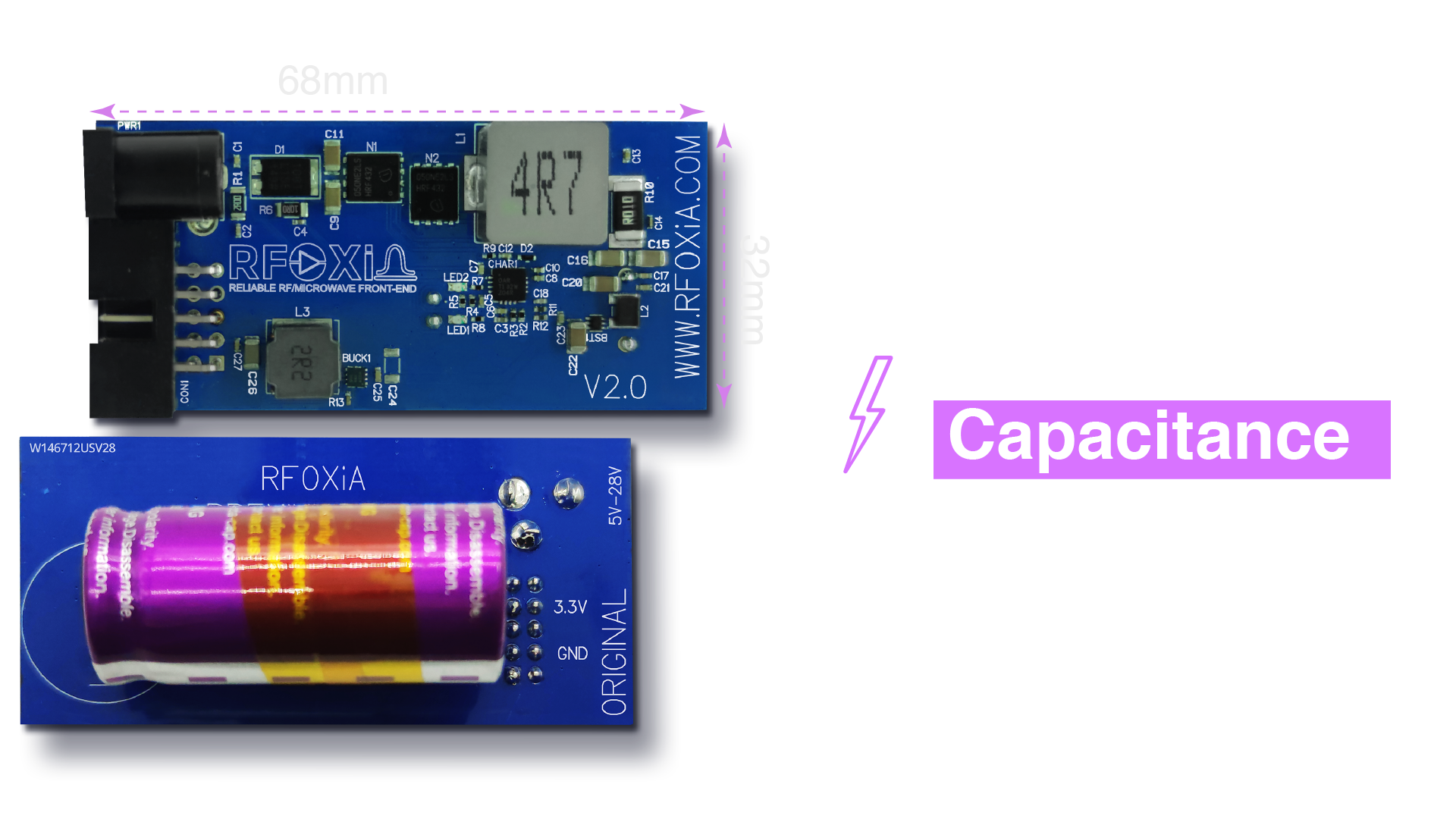
The 1100F SuperCapacitor System
At the heart of the kit is an 1100 Farad supercapacitor bank. This stores 8,800 Joules of energy — enough to power the complete MultiNav Pro+ module stack (BLE Module + GNSS Module + Sensors Module) for a full working day of continuous operation.
To put that in context: 8,800 Joules from a capacitor-based storage system means zero chemical reactions, zero thermal management concerns at normal operating temperatures, and a power delivery profile that remains consistent from the first minute to the last minute of discharge. Unlike a lithium cell that delivers diminishing voltage as it discharges, a properly regulated supercapacitor system with an appropriate boost or buck converter stage can maintain a perfectly stable embedded power rail voltage throughout the entire discharge curve.
This matters enormously for RF performance. Your transmit power, receiver sensitivity, and oscillator stability are all functions of supply voltage stability. A stable power rail is a stable wireless link.
Charge Rate and Adapter
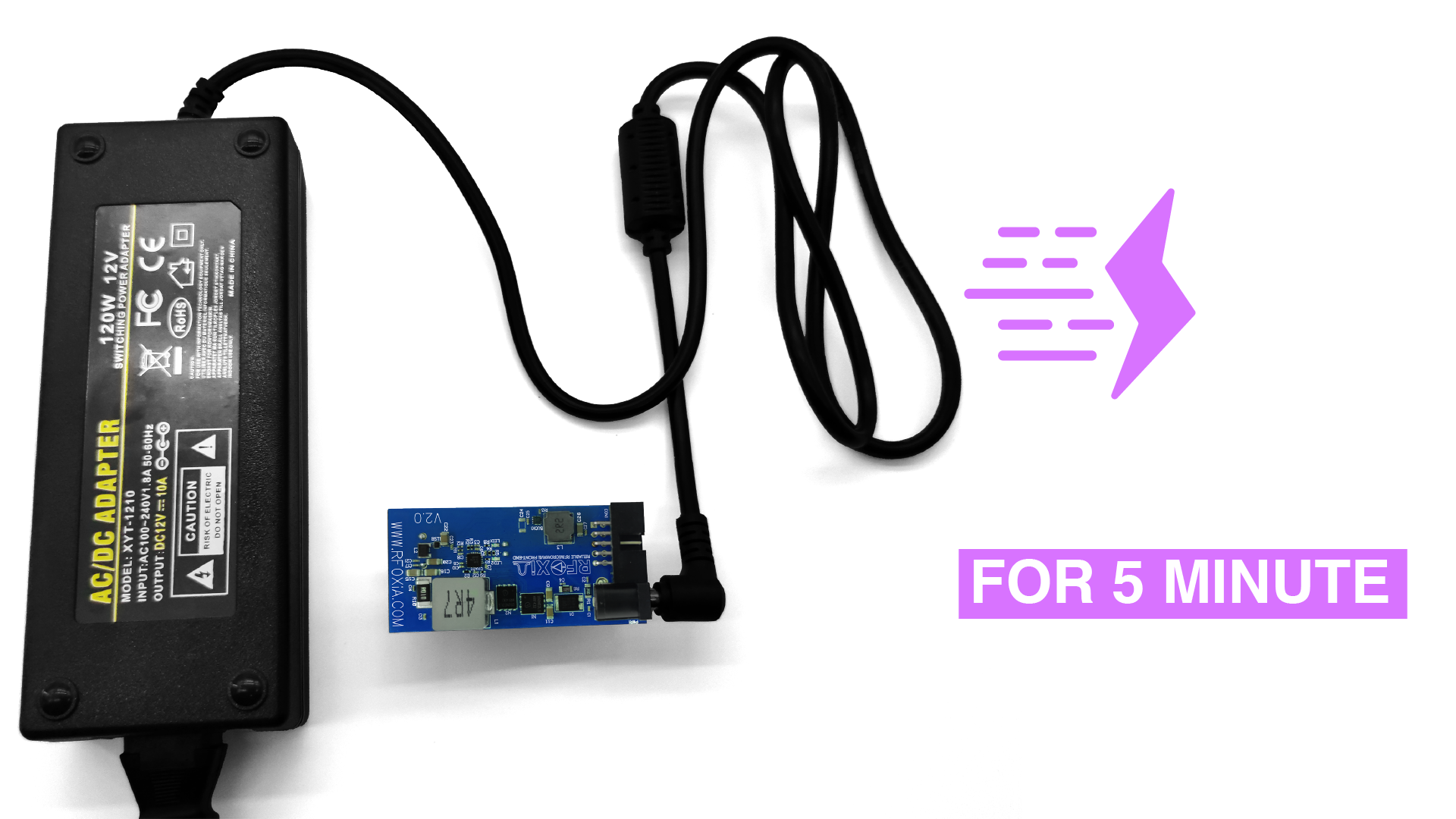
The included 12V 5A charging adapter delivers power to the supercapacitor bank at 4V 10A through a dedicated charge management circuit. This high-current charging path is what enables the sub-5-minute charge time.
For context on why this is significant: charging 8,800 Joules in 5 minutes requires a power delivery rate of approximately 29 watts sustained. The included adapter is sized precisely for this. This is not a USB-C trickle charge scenario — it is a purpose-built rapid energy delivery system.
From a practical embedded power rail design standpoint, this means the kit functions operationally more like a hot-swap power module than a battery. You charge it fast, you run it all day, you charge it again.
Full-Day Multi-Module Power Delivery
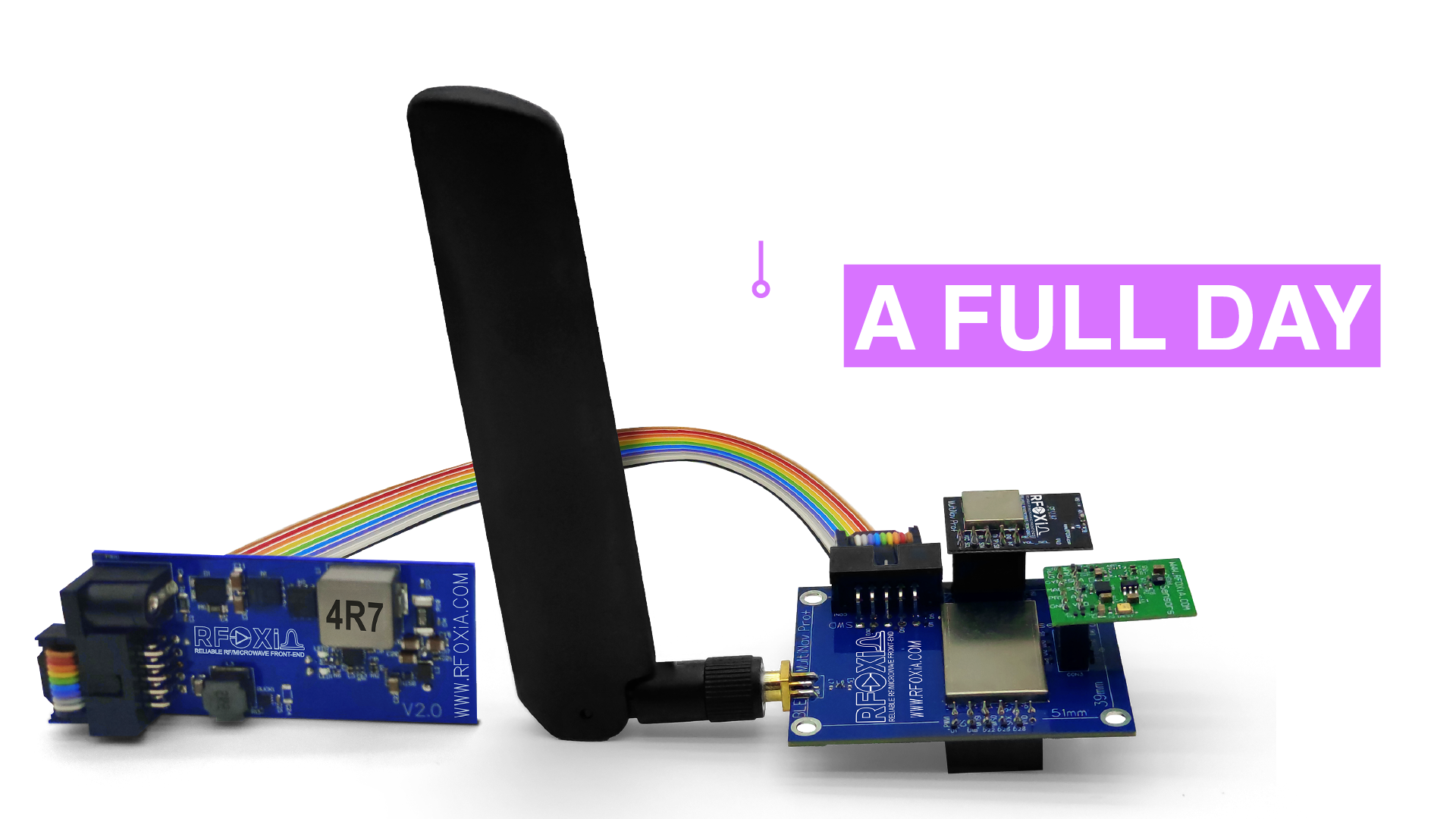
The Power/Program Kit is not sized for the BLE module alone. It is designed to power the complete MultiNav Pro+ ecosystem simultaneously:
- BLE Module — RF amplifier, STM32WB07 MCU, external antenna
- GNSS Module — 18Hz fix rate receiver, active antenna power
- Sensors Module — 7 active sensors: temperature, humidity, pressure, air quality, accelerometer, gyroscope, magnetometer
Running all four modules simultaneously represents a realistic peak current draw scenario. The 1100F bank handles this without compromise, delivering stable, clean power across all loads for a full operational day.
This is embedded power rail design at the system level — not just powering a single chip, but architecting a multi-board power distribution topology that keeps every module in spec simultaneously.
The STLink Programmer: Completing the Development Loop
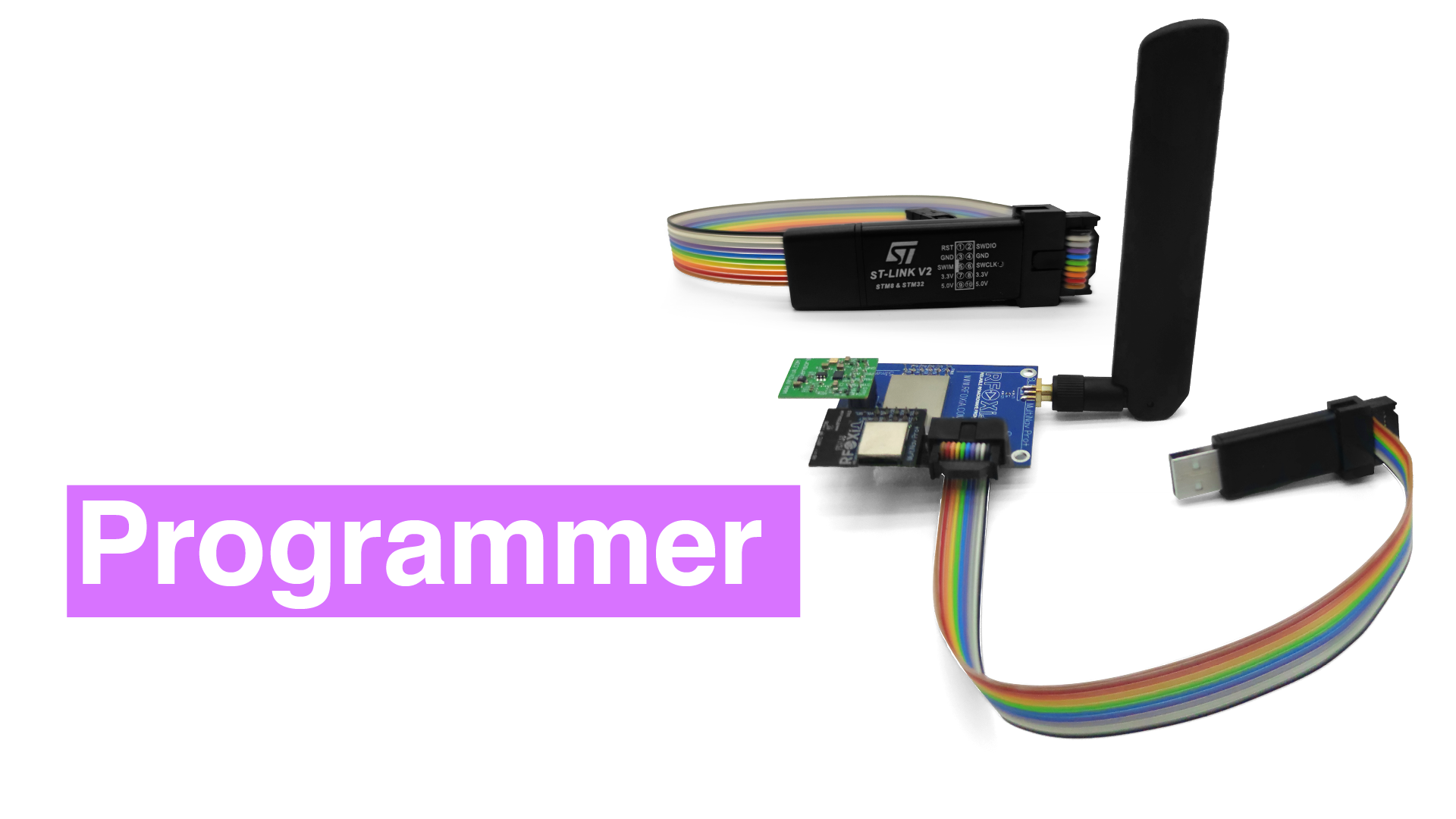
The second major component of the Power/Program Kit is the integrated STLink programmer — and this is what elevates the kit from a power solution to a complete development platform.
The MultiNav Pro+ BLE Module is built on the STM32WB07 microcontroller. Programming and debugging this MCU requires an STLink-compatible interface. Rather than requiring developers to source a separate ST-Link V2 or V3, wire it up correctly, and manage another piece of equipment, RFOXiA has integrated the programmer directly into the Power/Program Kit.
This has real implications for embedded development workflow:
Reliable Firmware Flashing
The STLink programmer provides a stable, hardware-level programming interface directly to the STM32WB07 flash memory. This means reliable firmware flashing without bootloader dependencies, and direct hardware debugging through SWD (Serial Wire Debug) for real-time variable inspection, breakpoint setting, and step-through execution.
For teams working with RFOXiA's AI Firmware Builder — which generates production-ready STM32WB07 firmware from plain-language descriptions — this means you can go from AI-generated code to running firmware on hardware in minutes.
Integrated Debug Access
SWD access through the STLink interface means you can run GDB or ST's CubeIDE debugger directly against the hardware. For RF systems, this is particularly valuable: you can inspect the radio state machine, verify BLE connection parameters, and confirm transmit power settings at the register level while the module is under realistic operating conditions.
Version Control Integration
With the firmware available at the RFOXiA GitHub repository, developers can clone, modify, and flash custom firmware builds directly through the integrated STLink interface. The programmer becomes the bridge between your development environment and your hardware — and with everything integrated into one kit, there are no compatibility surprises.
Complete Connectivity: The Cables That Matter
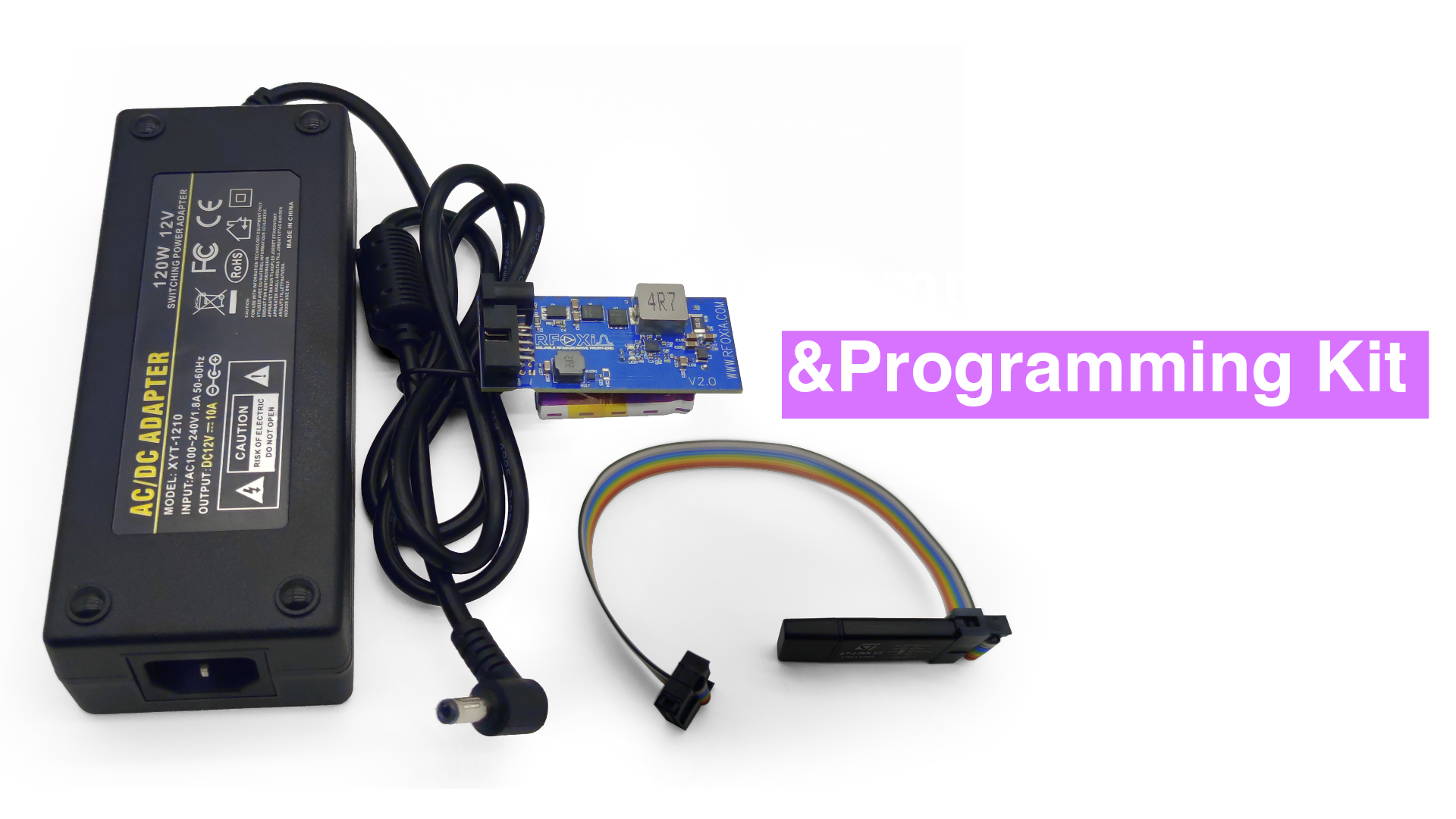
The Power/Program Kit ships with a complete cable set, including flat ribbon cables for module-to-module connections. This is worth mentioning not as a bullet point afterthought, but because cable quality and connector reliability are genuinely important in RF-adjacent embedded systems.
Flat ribbon cables for internal module connections reduce radiated emissions compared to bundled wire looms. They also enforce consistent routing, which matters when you are doing repeatable range tests or field deployments where mechanical consistency affects your data quality.
All cables for connecting the BLE module to the power module, and the STLink programmer to the BLE module, are included. You open the kit and your bench is ready. No sourcing, no compatibility guesswork.
Embedded Power Rail Design Principles: What This Kit Gets Right
Let us step back and look at what the Power/Program Kit represents from a pure embedded power rail design perspective — because the design decisions here reflect a coherent engineering philosophy.
1. Impedance-First Power Delivery
Designing around supercapacitors rather than lithium chemistry is fundamentally an impedance-first decision. The low ESR of the supercapacitor bank means the power rail can respond to fast transient loads — like the RF amplifier current spikes during BLE transmit events — without requiring large local bypass capacitors at every module to compensate for source impedance.
2. System-Level Thinking
The kit is sized for the complete module stack, not the minimum viable load. This is the correct approach for field equipment. Undersizing a power system to optimize the spec sheet and then having it fail under full load is a design failure. The 1100F bank and 8,800 Joule energy reserve is sized for all-day, all-module operation with margin.
3. Operational Continuity Over Raw Capacity
A conventional approach might use a large LiPo to maximize stored energy. The RFOXiA approach prioritizes operational continuity — the ability to recharge in 5 minutes means the system is effectively always available. This is a fundamentally different optimization target, and it is the right one for field-deployed embedded systems where uptime matters more than theoretical maximum runtime.
4. Unified Development and Deployment Platform
Integrating the STLink programmer with the power system is not just a convenience play. It reflects an understanding that development and deployment are not separate phases in the lifecycle of an embedded wireless product — they are continuous. Field firmware updates, in-situ debugging, and configuration changes are all part of operating a real embedded system at scale.
Who Needs the RFOXiA Power/Program Kit
This kit is built for developers and deployers who cannot afford power system failures:
Drone builders and FPV pilots using the MultiNav Pro+ BLE module for long-range telemetry and control need a power system that handles the transient loads of high-power RF transmission without rail collapse. They also need rapid recharge between flights.
Field researchers deploying sensor networks need days of reliable data collection. The integrated sensor module support means this kit powers your complete environmental monitoring stack — temperature, humidity, pressure, air quality, and IMU data — all day, every day.
IoT and embedded developers building custom applications on the STM32WB07 need a programmer that just works. The integrated STLink removes a variable from the development setup and keeps the focus on firmware, not toolchain.
Data network contributors running RFOXiA sensor nodes for the live data monetization network need reliable, continuous uptime. The supercapacitor system and rapid recharge cycle makes daily node maintenance operationally trivial.
Specifications Summary
| Parameter | Value |
|---|---|
| Supercapacitor Bank | 1100F |
| Stored Energy | 8,800 Joules |
| Charge Time | < 5 minutes |
| Charge Current | 4V @ 10A |
| Adapter Input | 12V 5A |
| Runtime (full module stack) | Full working day |
| Programmer Interface | STLink (SWD) |
| Compatible MCU | STM32WB07 (MultiNav Pro+ BLE Module) |
| Included Cables | Flat ribbon (module-to-power, programmer-to-module) |
| Price | $119 |
| FCC Certified | Yes |
Final Thoughts on Embedded Power Rail Design for Wireless Systems
Embedded power rail design is one of those disciplines that rarely gets the attention it deserves until something goes wrong. By then, you are debugging a field deployment, correlating mysterious firmware crashes with battery state-of-charge logs, and wishing you had made different decisions six months earlier.
The RFOXiA Power/Program Kit makes the right decision easy. Supercapacitor storage with milliohm-level source impedance, a 5-minute recharge cycle, day-long runtime across the full MultiNav Pro+ module stack, and an integrated STLink programmer — this is a cohesive, coherently engineered solution to a problem that matters.
If you are building anything serious with the MultiNav Pro+ ecosystem, this kit is not optional equipment. It is the foundation your embedded power rail design should be built on.
Explore the full specs and get the RFOXiA SuperCapacitor Battery and Programmer Kit for $119 — and build wireless systems that run as reliably as you designed them to.
Written by: Moamen Mohamed LinkedIn