
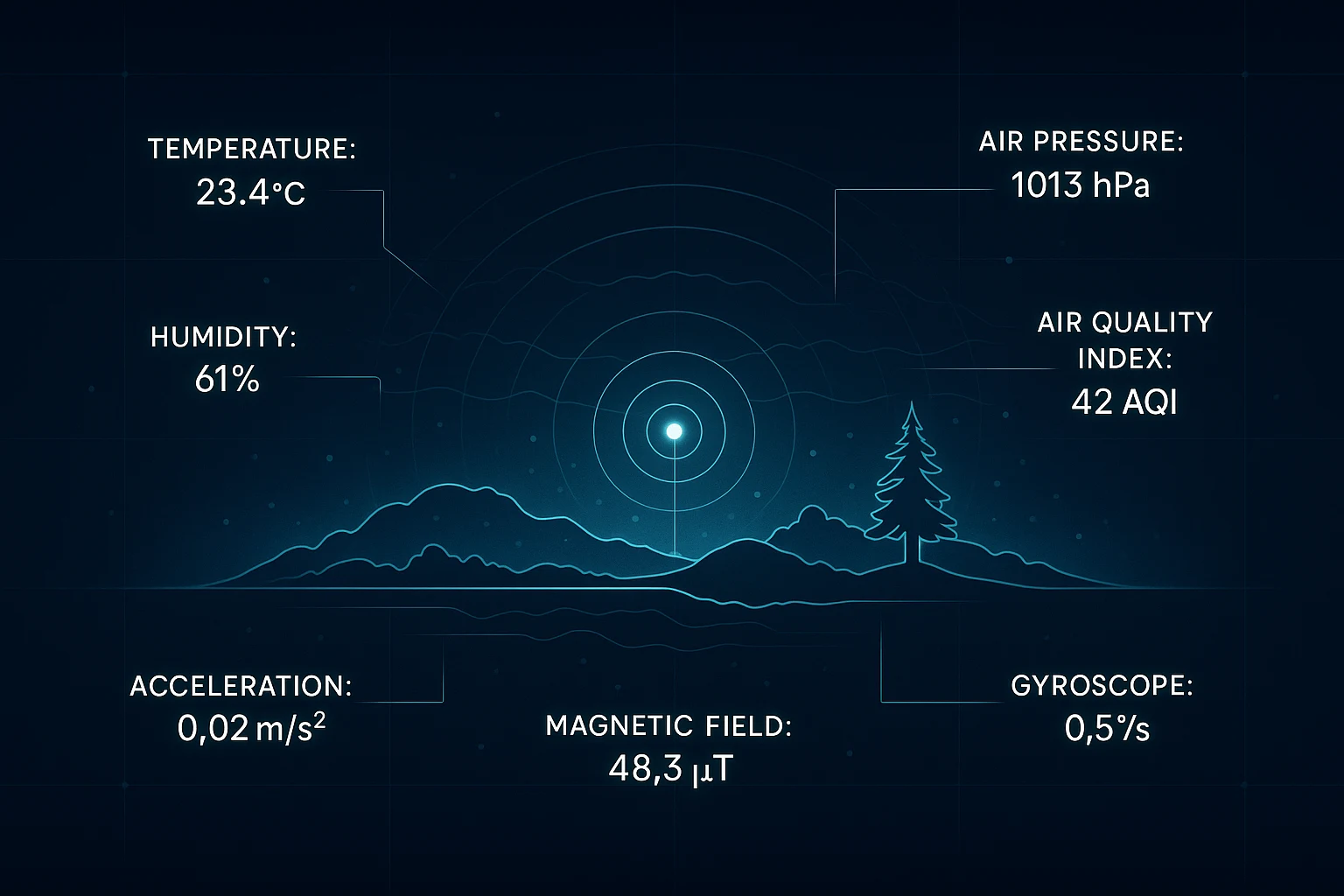
Environmental Data Logger Sensor: The Complete All-in-One Solution for Makers, Drone Builders, and IoT Engineers
RFOXiA Integrated Sensors Module
Why Your Next Project Needs a True Environmental Data Logger Sensor
If you have ever tried to build a serious drone telemetry system, a field research station, or an industrial IoT node, you already know the problem: getting accurate, real-time environmental data is hard. Not because the sensors do not exist, but because sourcing them individually, wiring them up without conflicts, and fitting them into a compact footprint is a nightmare that can eat weeks of your development time.
That is exactly the problem the MultiNav Pro+™ Sensors Module from RFOXiA was designed to solve.
This is not a hobbyist breakout board. This is a production-grade, FCC-certified environmental data logger sensor that packs seven professional sensors into a 24mm × 18mm form factor, communicates over a clean shared I2C bus, and integrates directly into the broader RFOXiA wireless ecosystem. Whether you are building a precision agriculture monitoring station, a research-grade UAV payload, a smart city air quality node, or a wearable environmental tracker, this module gives you everything you need in one compact, battle-tested package.
Let us break down exactly what is inside, why every design decision matters, and how this sensor module compares to everything else on the market.
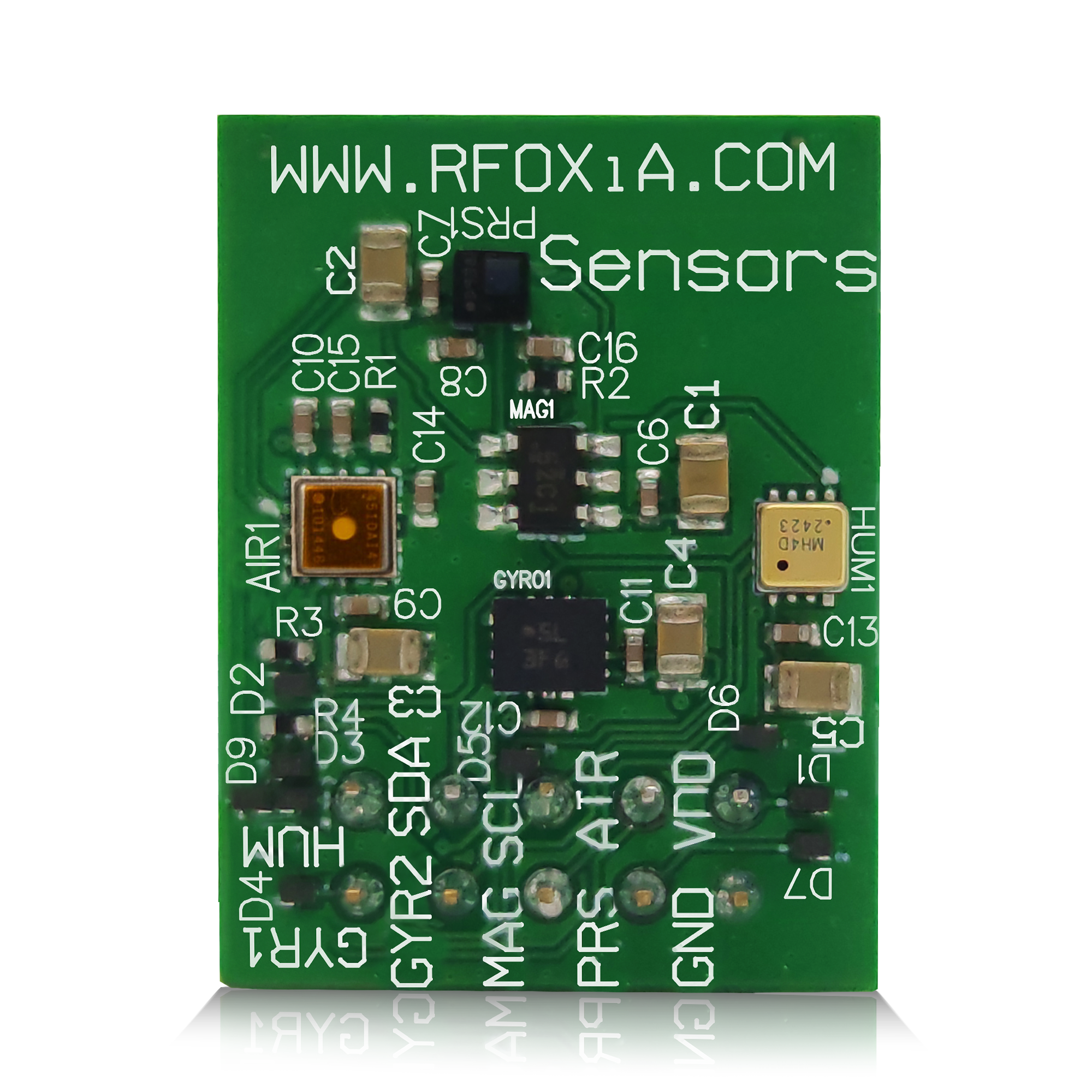
What Is the MultiNav Pro+™ Sensors Module?
The MultiNav Pro+™ Sensors Module is RFOXiA's all-in-one sensor array designed for developers who need both motion sensing and environmental monitoring in a single, compact, integrated package. It ships as part of the RFOXiA hardware ecosystem alongside the long-range BLE module, GNSS module, and supercapacitor power kit — but it is equally capable as a standalone sensor node.
At its core, this module solves a real integration problem. Most developers who need this combination of sensors end up sourcing five or six separate ICs, designing custom PCBs to route them, fighting I2C address conflicts, and debugging signal integrity issues under time pressure. The MultiNav Pro+™ eliminates all of that with a single, pre-integrated, pre-tested board that is ready to drop into your design immediately.
The Seven Sensors Inside — And Why Each One Was Chosen
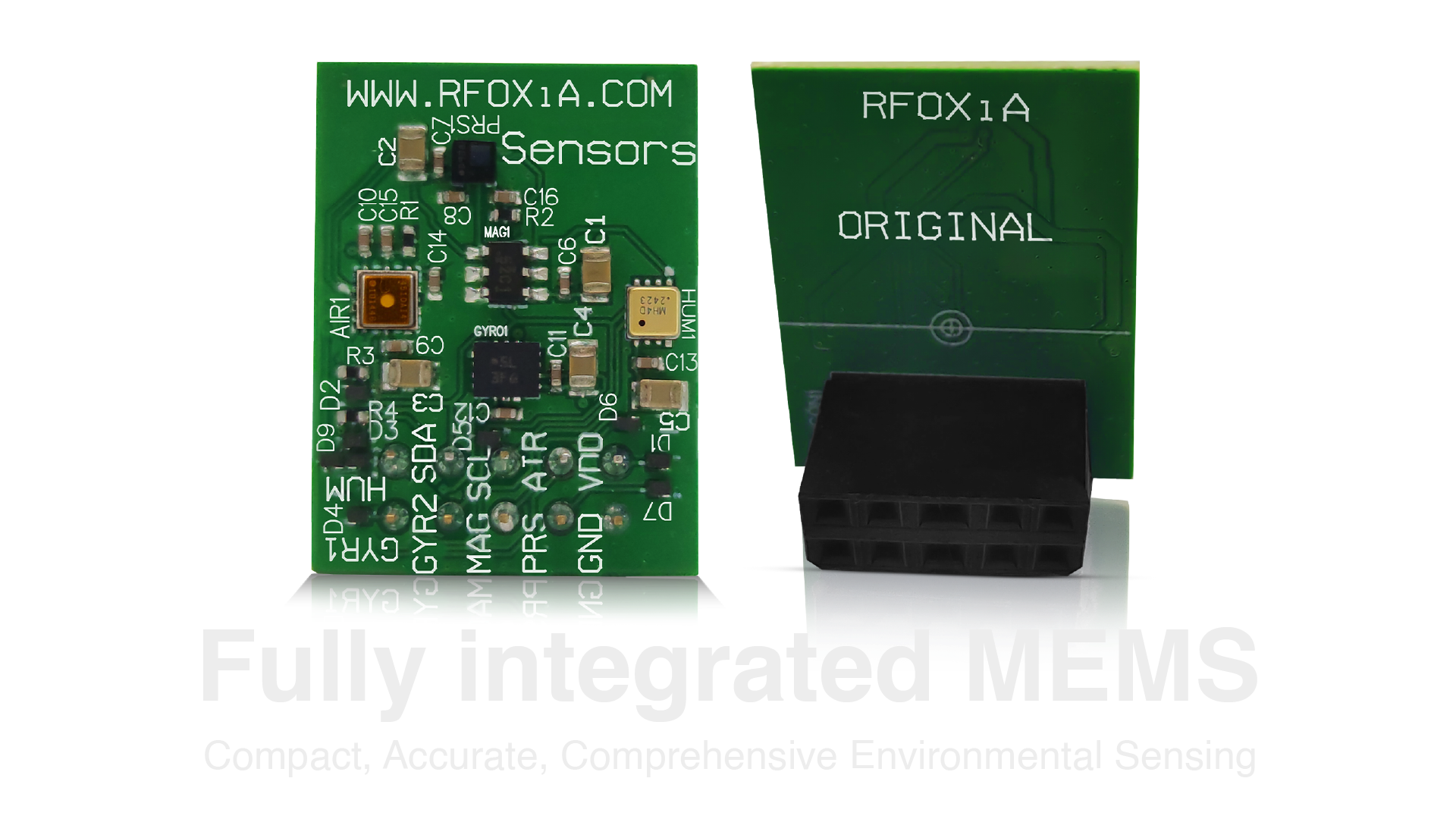
Every sensor on this board was selected deliberately. RFOXiA did not reach for the cheapest available part — the component choices reflect real engineering priorities around accuracy, power consumption, and long-term supply chain reliability.
1. Accelerometer and Gyroscope — BMI270 (Bosch Sensortec)
The BMI270 is one of the most respected IMUs in professional drone and robotics development. It is the inertial sensor used in premium flight controllers, not budget hardware. It delivers high-bandwidth motion data with low noise density, making it suitable for demanding stabilization, vibration analysis, and attitude estimation applications.
For drone builders, this matters enormously. A noisy IMU translates directly into unstable flight performance and poor PID tuning. The BMI270 gives you the clean, responsive data your flight control algorithms need.
2. Magnetometer — TMAG5273C1QDBVR (Texas Instruments)
Magnetometers are critical for heading estimation, but they are notoriously sensitive to PCB layout and external interference. The TMAG5273 from Texas Instruments offers a low-power, high-sensitivity 3D Hall-effect sensor with a compact footprint. Combined with the accelerometer and gyroscope, it enables full 9-DOF attitude estimation — the foundation for any serious navigation or orientation tracking system.
3. Air Pressure — LPS22HHTR (STMicroelectronics)
ST's LPS22HH is a piezoresistive absolute pressure sensor with a measurement range of 260 to 1260 hPa. At this precision level, it can be used not just for weather monitoring but for relative altitude estimation — a critical capability for drones operating without GPS lock, or for applications requiring barometric altitude holds.
4. Humidity and Temperature — MVH4003D (MEMSVision)
MEMSVision's MVH4003D delivers calibrated relative humidity and temperature readings from a single tiny MEMS die. Calibrated output simplifies firmware development and ensures consistency between modules, which is essential when you are deploying a network of environmental data logger sensor nodes and need comparable data across all of them.
5. Air Quality — ZMOD4510AI4R (RENESAS)
The RENESAS ZMOD4510 is a high-performance metal oxide semiconductor (MOS) gas sensor designed specifically for outdoor air quality monitoring. It detects ozone and nitrogen dioxide — two of the primary outdoor pollutants — with outstanding sensitivity. This is a professional-grade choice that goes far beyond the crude VOC sensors found in consumer devices, and it is exactly what you need if you are building a credible air quality monitoring station.
Precision Motion and Environmental Sensing: What This Means in Practice
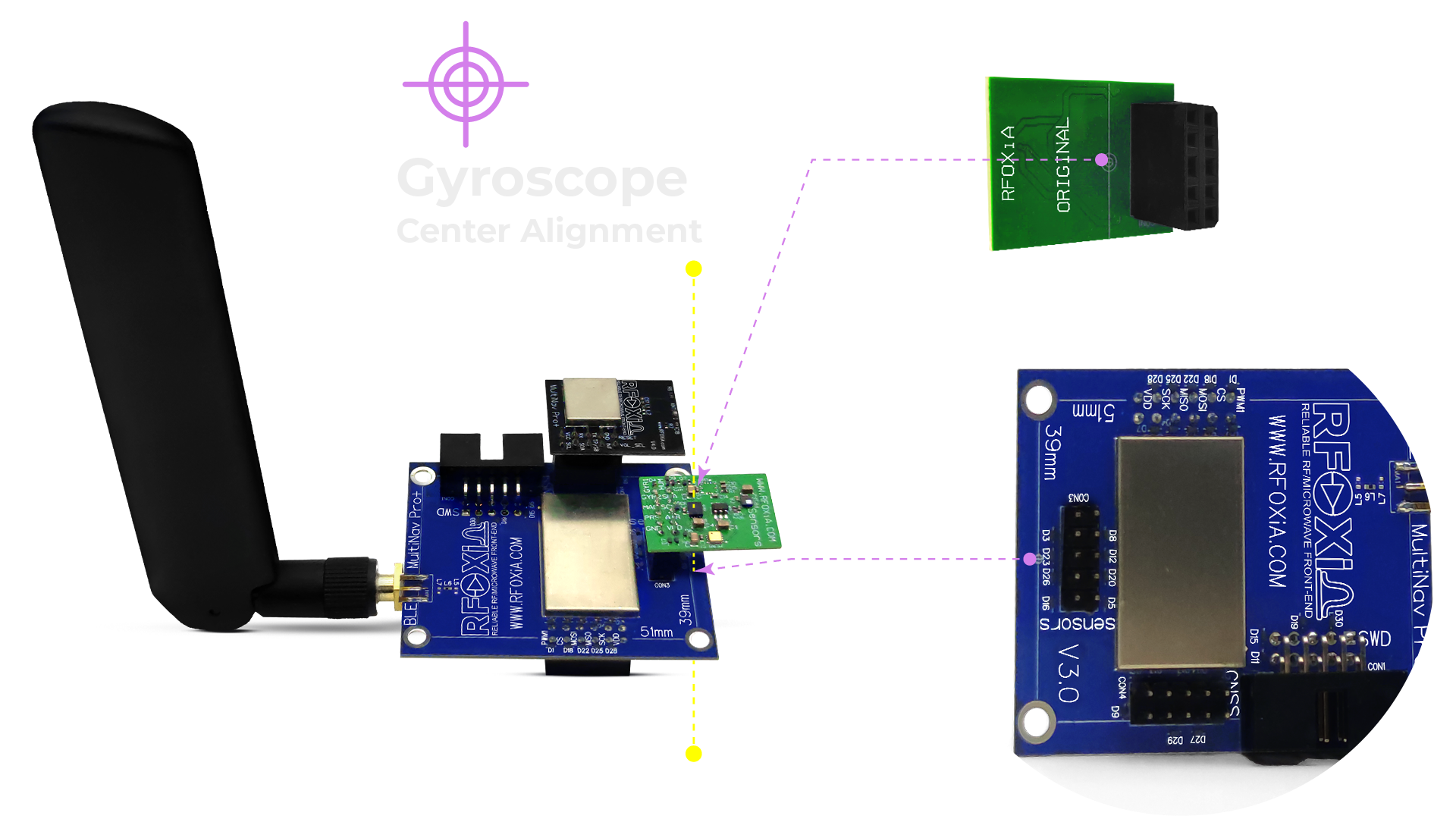
Having these sensors together on one board enables application categories that simply are not possible when sensors are separated across multiple modules.
Consider a professional atmospheric research drone. It needs:
- IMU data for flight stabilization
- Barometric pressure for altitude hold
- Temperature and humidity for atmospheric profiling
- Air quality for pollution mapping
- All of it timestamped and streamed in real time
With the MultiNav Pro+™ Sensors Module, every one of those data streams is available over a single I2C connection, at the exact same time, with no additional wiring complexity. The drone flies, the module logs, and you get a complete picture of both vehicle dynamics and atmospheric conditions simultaneously.
The same principle applies to ground-based research stations, industrial monitoring nodes, smart city infrastructure deployments, and precision agriculture setups. The combination of motion and environmental data in one package is uniquely powerful.
The Component Lineup: Professional Parts, Not Compromise Choices
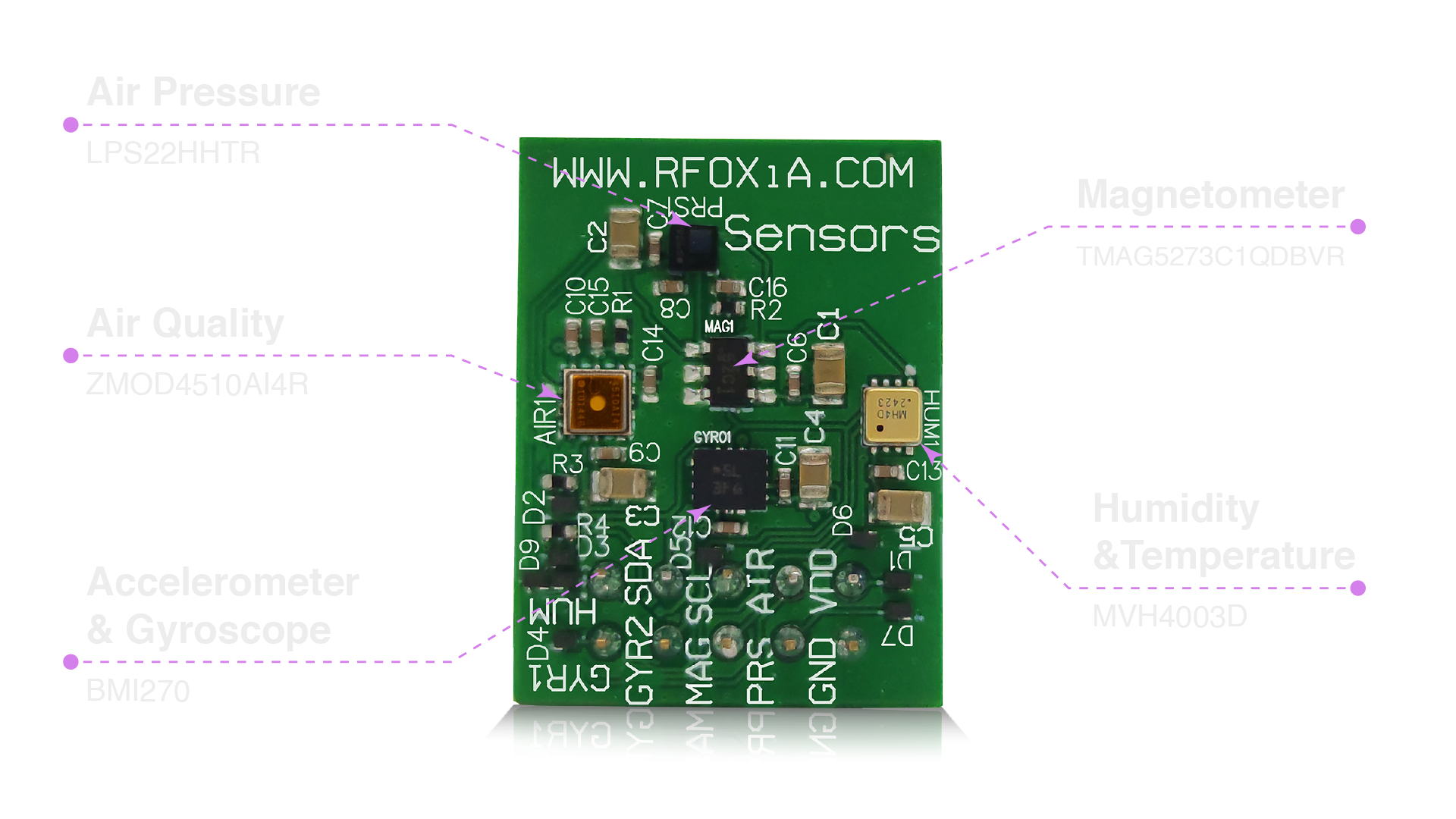
Here is the complete sensor component manifest for the MultiNav Pro+™:
| Function | IC | Manufacturer |
|---|---|---|
| Accelerometer + Gyroscope | BMI270 | Bosch Sensortec |
| Magnetometer | TMAG5273C1QDBVR | Texas Instruments |
| Air Pressure | LPS22HHTR | STMicroelectronics |
| Humidity + Temperature | MVH4003D | MEMSVision |
| Air Quality | ZMOD4510AI4R | RENESAS |
Every one of these is a name-brand, industrial-quality component from a tier-one semiconductor manufacturer. This is not a module built around generic Chinese clones or unmarked equivalents. When you are deploying this as part of a serious project or a commercial product, that provenance matters — both for reliability and for documentation purposes.
Efficient I2C Communication — One Bus, No Conflicts
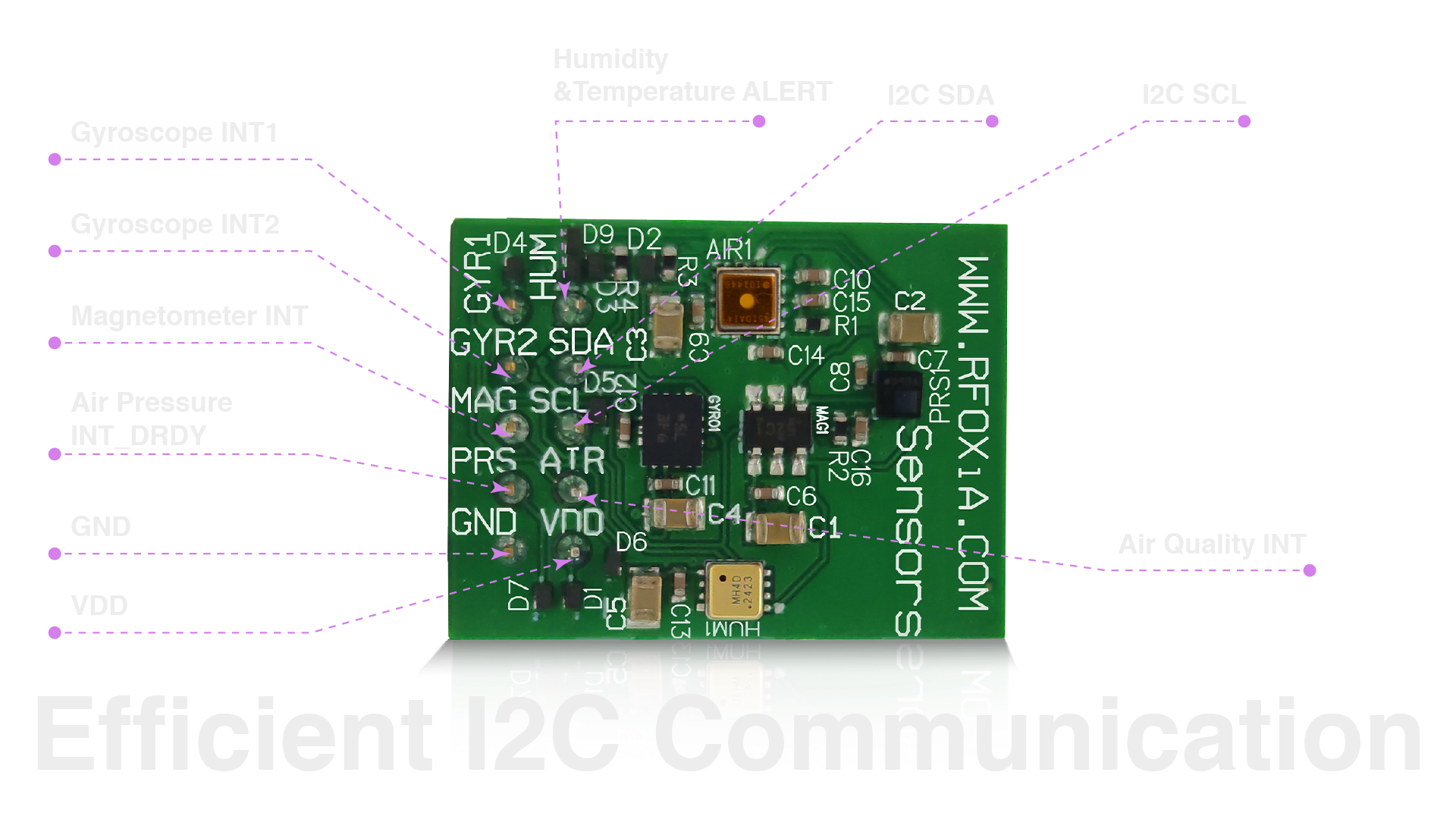
One of the most underappreciated engineering decisions in the MultiNav Pro+™ design is the I2C implementation.
When you try to put multiple sensors on a shared I2C bus yourself, address conflicts are the first problem you hit. Many popular sensors share default I2C addresses, requiring either hardware address configuration pins or software bus multiplexers — both of which add complexity, cost, and potential failure points.
In the MultiNav Pro+™, this has already been solved. All five sensor ICs have been assigned dedicated I2C addresses with no conflicts, the PCB routing has been optimized for signal integrity on a shared bus, and the result is a clean, simple interface: one SDA line, one SCL line, power, ground, and you have access to all seven sensor data streams.
For developers, this means your firmware development starts from a clean baseline. You do not need to debug I2C conflicts before you can write a single line of application code. You connect the module, initialize each sensor at its known address, and start reading data.
This is the kind of integration work that saves days of development time — and it is exactly the kind of detail that separates a professionally designed module from a collection of breakout boards bolted together.
Compact Design: 24mm × 18mm — Fits Anywhere
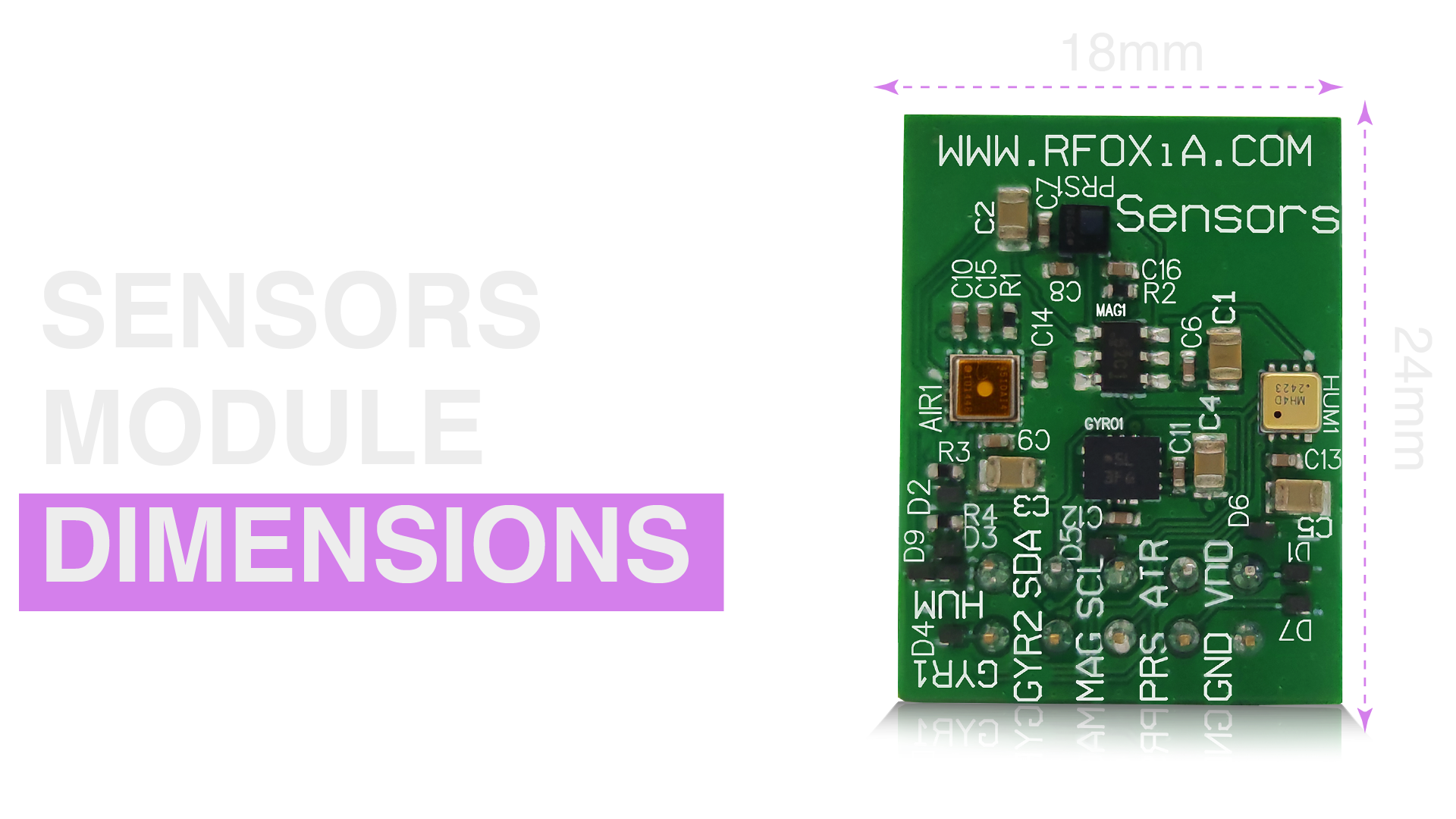
The MultiNav Pro+™ Sensors Module measures just 24mm × 18mm.
To put that in perspective: that is smaller than a standard postage stamp, and it contains a professional-grade 9-DOF IMU, barometric pressure sensor, humidity and temperature sensor, and outdoor-grade air quality sensor — all pre-integrated and pre-tested.
This form factor makes it viable for:
- Drone payloads where every gram and every cubic centimeter is accounted for
- Wearable environmental monitors that need to fit inside compact enclosures
- Compact IoT nodes deployed in urban infrastructure or agricultural fields
- Robotics platforms where board real estate is shared across many subsystems
- Research instruments where size and weight drive platform selection
The compact design was not achieved by compromising on sensor quality or PCB routing. It was achieved through careful component selection and professional-grade PCB layout — the same skills that go into every RFOXiA hardware design.
Real-Time Environmental Data: What You Can Actually Build
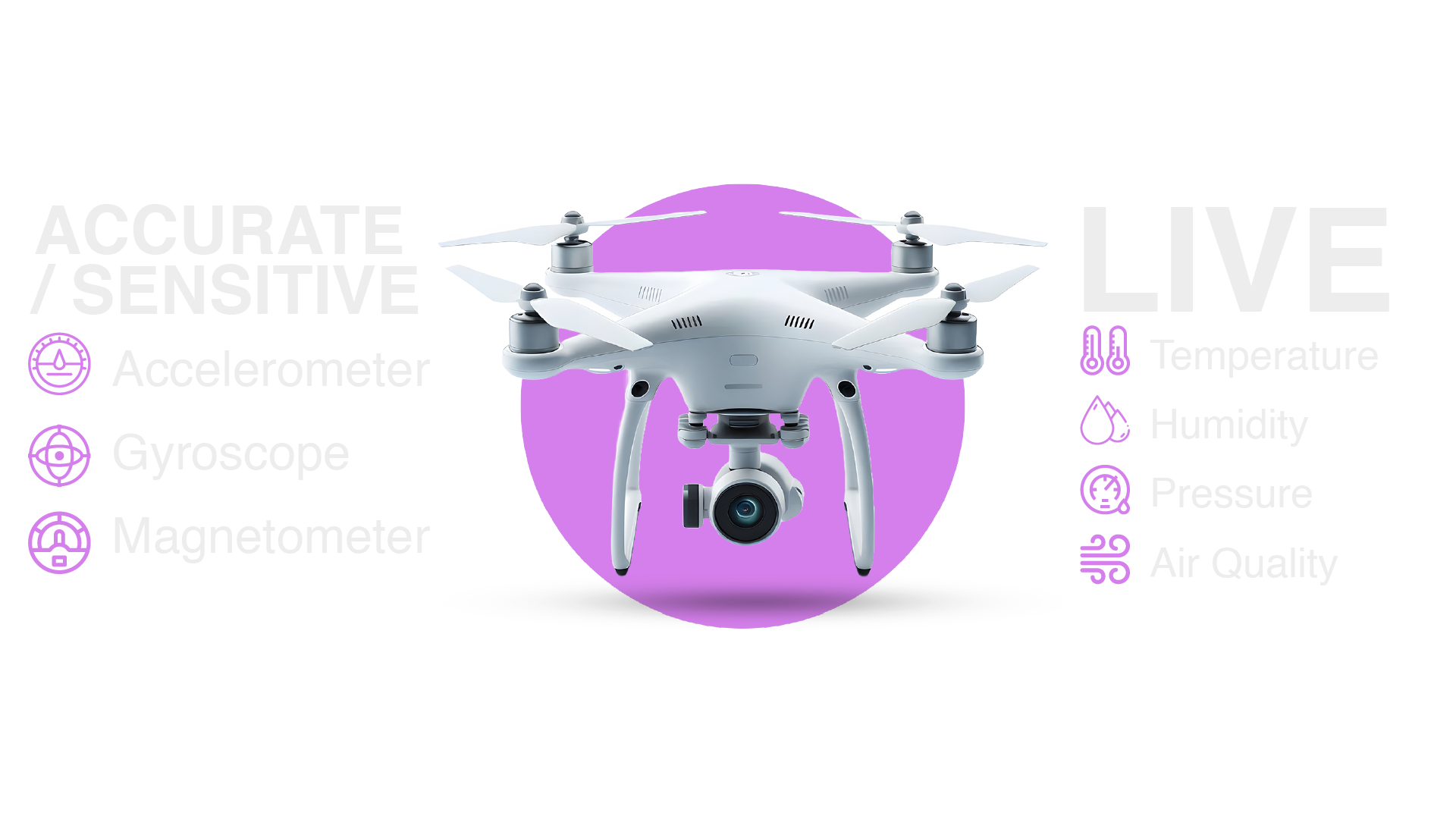
Real-time environmental data is not just a feature — it is the foundation of entire application categories. Here is a non-exhaustive look at what becomes possible when you have a capable environmental data logger sensor like the MultiNav Pro+™:
Atmospheric Research and UAV Profiling
Mount the module on a drone with the RFOXiA GNSS module and BLE module. As the drone climbs, log temperature, pressure, humidity, and air quality at GPS-tagged waypoints. Stream the data live to ground via the BLE module's 15-20km man-to-drone range. Build atmospheric profiles in real time that would otherwise require expensive radiosonde equipment.
Precision Agriculture Environmental Monitoring
Deploy multiple sensor nodes across a field. Each node logs micro-climate data — soil-level temperature gradients, localized humidity, air quality variations — and streams it to a central hub via the RFOXiA BLE mesh. Correlate environmental data with crop health and yield data over time.
Smart City Air Quality Networks
Deploy nodes on lampposts, rooftops, or building facades. The ZMOD4510 air quality sensor detects ozone and NO2 at street level, providing resolution that no weather station network can match. Feed the data into a city operations dashboard or into RFOXiA's data network for monetization.
Industrial Condition Monitoring
Track temperature, humidity, pressure, and air quality inside manufacturing environments. The 9-DOF IMU adds vibration monitoring and machine health diagnostics to the same data stream.
Emergency Response and Disaster Assessment
Deploy rapidly in post-disaster environments to assess air quality (smoke, chemical hazards), atmospheric conditions, and physical stability. The combination of environmental and motion sensing gives responders data that single-function sensors cannot provide.
Endless Applications: Built for the Projects That Push Boundaries

The MultiNav Pro+™ Sensors Module was designed with a simple philosophy: build one board that handles the sensing layer for almost any serious project, so developers can spend their time on what actually differentiates their work.
The applications RFOXiA customers are building with this module include:
- FPV and autonomous drone systems — real-time telemetry including attitude, altitude, temperature, and air quality streamed live to the operator
- Robotics platforms — environment-aware navigation using pressure-based altitude and IMU-based orientation
- Research instruments — portable, battery-powered field stations for academic and industrial research
- Smart agriculture nodes — micro-climate monitoring at crop canopy level
- Wearable environmental monitors — personal air quality and environmental exposure tracking
- RFOXiA Data Network nodes — contributing verified environmental data to the network and earning daily rewards
That last point deserves special mention. When you deploy the MultiNav Pro+™ Sensors Module outdoors as a verified data node on the RFOXiA network, your hardware starts generating passive income. The data network pays contributors daily rates of $0.08 to $0.40 per day depending on location scarcity and data quality. Your sensor works while you sleep.
How the Sensors Module Fits Into the RFOXiA Ecosystem
The MultiNav Pro+™ Sensors Module is designed to be used as part of the complete RFOXiA stack, but it does not require it. Here is how the pieces fit together:
Standalone: Connect via I2C to any microcontroller — STM32, ESP32, Arduino, Raspberry Pi. Read all seven sensor streams. Log locally or transmit via whatever wireless interface you prefer.
With the BLE Module: Stream all sensor data wirelessly over the 5km ground-to-ground (up to 20km man-to-drone) BLE link to the RFOXiA Connect app. See live sensor readings on your phone, GPS-tagged on a live map. No internet required.
With the GNSS Module: Add GPS-tagged location data to every sensor reading. Critical for mapping applications, research, and data network contribution.
With the Power/Program Kit: Power the complete sensor stack from a supercapacitor system that charges in 5 minutes and runs for 24 hours. Deploy in the field without worrying about battery management.
As a Developer Bundle: All four modules together, integrated and tested. The fastest path from idea to working prototype for any wireless sensing application.
For developers who want to get started with AI-assisted firmware development, the RFOXiA Club Dev Hub includes an AI Firmware Builder that generates production-ready firmware for the Sensors Module from plain-language descriptions. Describe what you want your sensor application to do, and the AI generates the I2C initialization sequences, sensor read loops, and data handling code automatically.
Explore the full RFOXiA Integrated Sensors Module details and start building your next environmental sensing project.
Specifications Summary
| Specification | Detail |
|---|---|
| Sensors | Accelerometer, Gyroscope, Magnetometer, Temperature, Humidity, Air Pressure, Air Quality |
| IMU IC | BMI270 (Bosch Sensortec) |
| Magnetometer IC | TMAG5273C1QDBVR (Texas Instruments) |
| Pressure IC | LPS22HHTR (STMicroelectronics) |
| Humidity + Temperature IC | MVH4003D (MEMSVision) |
| Air Quality IC | ZMOD4510AI4R (RENESAS) |
| Communication | I2C (shared bus, dedicated addresses per sensor) |
| Module Size | 24mm × 18mm |
| Certification | FCC Certified |
| Price | $39 |
| Ecosystem | Compatible with RFOXiA BLE Module, GNSS Module, Power Kit |
Why the MultiNav Pro+™ Is the Right Environmental Data Logger Sensor for Serious Projects
The market for environmental data logger sensor hardware is cluttered with two extremes: overpriced multi-thousand-dollar research instruments on one end, and under-specced hobbyist breakout boards on the other. The MultiNav Pro+™ Sensors Module occupies the productive middle ground: professional-grade component selection, genuine engineering quality, compact and deployable form factor, and a price point at $39 that makes it accessible to individual developers and small teams.
The FCC certification is not a minor detail. It means this module has been tested and approved for use in real products and commercial deployments in the United States. That certification alone represents months of testing and thousands of dollars in regulatory costs — and it comes included in the price.
The component choices — Bosch, Texas Instruments, STMicroelectronics, RENESAS — are not marketing choices. They are engineering choices made by someone who builds real hardware for real applications and knows that the sensor ICs in your module determine the quality of every data point your system ever produces.
And the integration into the RFOXiA ecosystem — the BLE module, the GNSS module, the power kit, the Connect app, the data network — means the MultiNav Pro+™ Sensors Module is not just a sensor board. It is the sensing layer of a complete wireless development platform that enables you to build, deploy, monitor, and monetize your projects in ways that no other hardware platform at this price point makes possible.
If you are building a serious environmental sensing application and you need a compact, capable, professionally designed environmental data logger sensor module, the MultiNav Pro+™ is the answer.
Ready to add it to your project? Visit the RFOXiA Integrated Sensors Module product page and get yours today — or explore the complete Developer Bundle to get the full ecosystem at once.
Frequently Asked Questions
Can I use the MultiNav Pro+™ Sensors Module without the rest of the RFOXiA ecosystem? Yes. The module communicates over standard I2C and can be connected to any I2C-capable microcontroller including STM32, ESP32, Arduino, and Raspberry Pi platforms. Firmware examples and documentation are available in the RFOXiA Club Dev Hub.
What is the I2C address for each sensor? Each sensor has a dedicated, pre-assigned I2C address with no conflicts. Full addressing documentation is available in the RFOXiA Club Resources section.
Is the module FCC certified? Yes. The MultiNav Pro+™ Sensors Module is FCC certified, making it suitable for integration into commercial products for the US market.
Can I use this module to contribute to the RFOXiA data network and earn rewards? Yes. When deployed outdoors with GPS verification (via the GNSS module), the Sensors Module can contribute verified environmental data to the RFOXiA data network and earn daily rewards of $0.08 to $0.40 depending on location and data quality.
What power supply does the module require? The module is designed to work with the RFOXiA Power/Program Kit, which provides supercapacitor-based power with a 5-minute charge time and 24-hour runtime. It can also be powered from any compatible 3.3V regulated supply.
Where can I get firmware examples for the BMI270 or ZMOD4510? Firmware examples, SDK documentation, and AI-assisted firmware generation are all available through the RFOXiA Club Dev Hub. The AI Firmware Builder can generate complete initialization and data-read code for all seven sensors from a plain-language description of your application.
For full specifications, purchase options, and ecosystem integration details, visit the RFOXiA Integrated Sensors Module product page at rfoxia.com.
Written by: Moamen Mohamed LinkedIn