
Fast Charging Circuit Embedded: The MultiNav Pro+ Power/Program Kit Redefines Developer Power
RFOXiA SuperCapacitor Battery and Programmer Kit
A Fast Charging Circuit Embedded for Real-World Hardware Development
Every serious hardware developer knows the feeling. You are mid-session, tracking live sensor data, testing your firmware, monitoring a drone flight path — and your power module dies. You lose your session, your data, and sometimes your hardware. The problem is not the work itself. The problem is power infrastructure that was never designed for professional-grade field use.
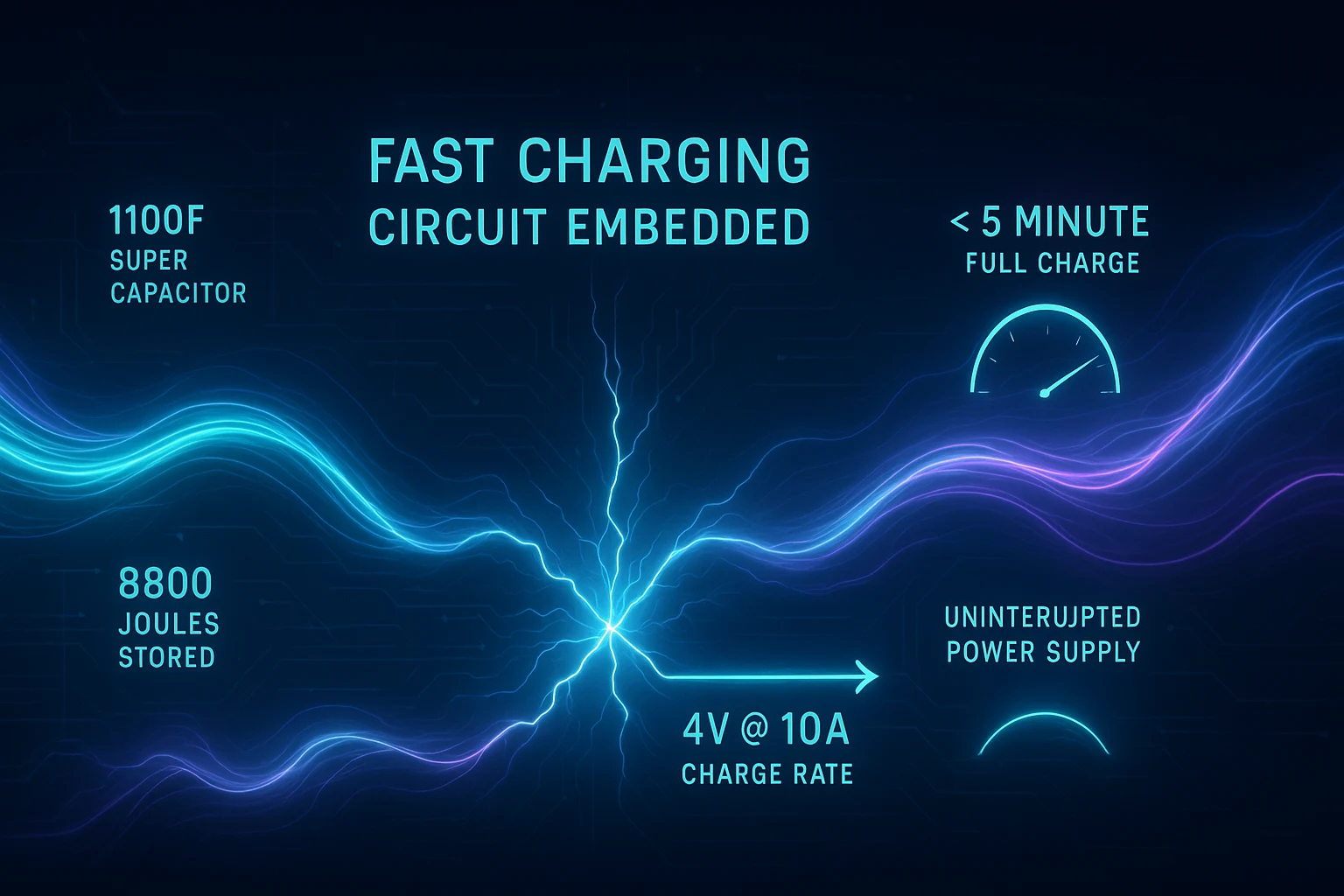
The RFOXiA SuperCapacitor Battery and Programmer Kit was built specifically to eliminate that problem. At its core is a fast charging circuit embedded directly into the supercapacitor power architecture — a design choice that allows the entire 1100F supercapacitor bank to reach full charge in under five minutes, then sustain continuous power delivery to your full MultiNav Pro+ module stack for an entire working day.
This is not incremental improvement over standard LiPo battery systems. This is a fundamentally different approach to embedded power management — and it changes what is possible in the field.
Why Supercapacitors Change Everything for Embedded Systems
Most hardware developers default to lithium polymer batteries because that is what is available. LiPo batteries are fine for consumer electronics. They are deeply problematic for professional embedded systems used in the field.
LiPo batteries degrade over hundreds of cycles. They become fire hazards if punctured, overcharged, or exposed to high temperatures. They require careful balancing and battery management circuits. And critically — they charge slowly. A typical LiPo battery powering a full IoT module stack will require one to three hours to recharge. That is time your deployment is offline.
Supercapacitors operate on a completely different electrochemical principle. They store energy electrostatically rather than chemically. This means:
- No degradation over cycles — supercapacitors maintain performance over hundreds of thousands of charge cycles
- No chemical fire risk — no flammable electrolyte chemistry
- Instantaneous charge acceptance — the capacitor accepts maximum charge current from the first second to the last
- True fast charging — when a fast charging circuit embedded at the right voltage and current levels drives a supercapacitor bank, full charge times measured in minutes — not hours — are achievable
The MultiNav Pro+ Power/Program Kit uses an 1100F supercapacitor system storing 8800 Joules of energy. That energy density, paired with the fast charging circuit embedded in the kit's charging architecture, creates a power system that recharges completely in under five minutes and runs your entire MultiNav Pro+ module stack continuously for a full working day.
Inside the Fast Charging Circuit Embedded Architecture
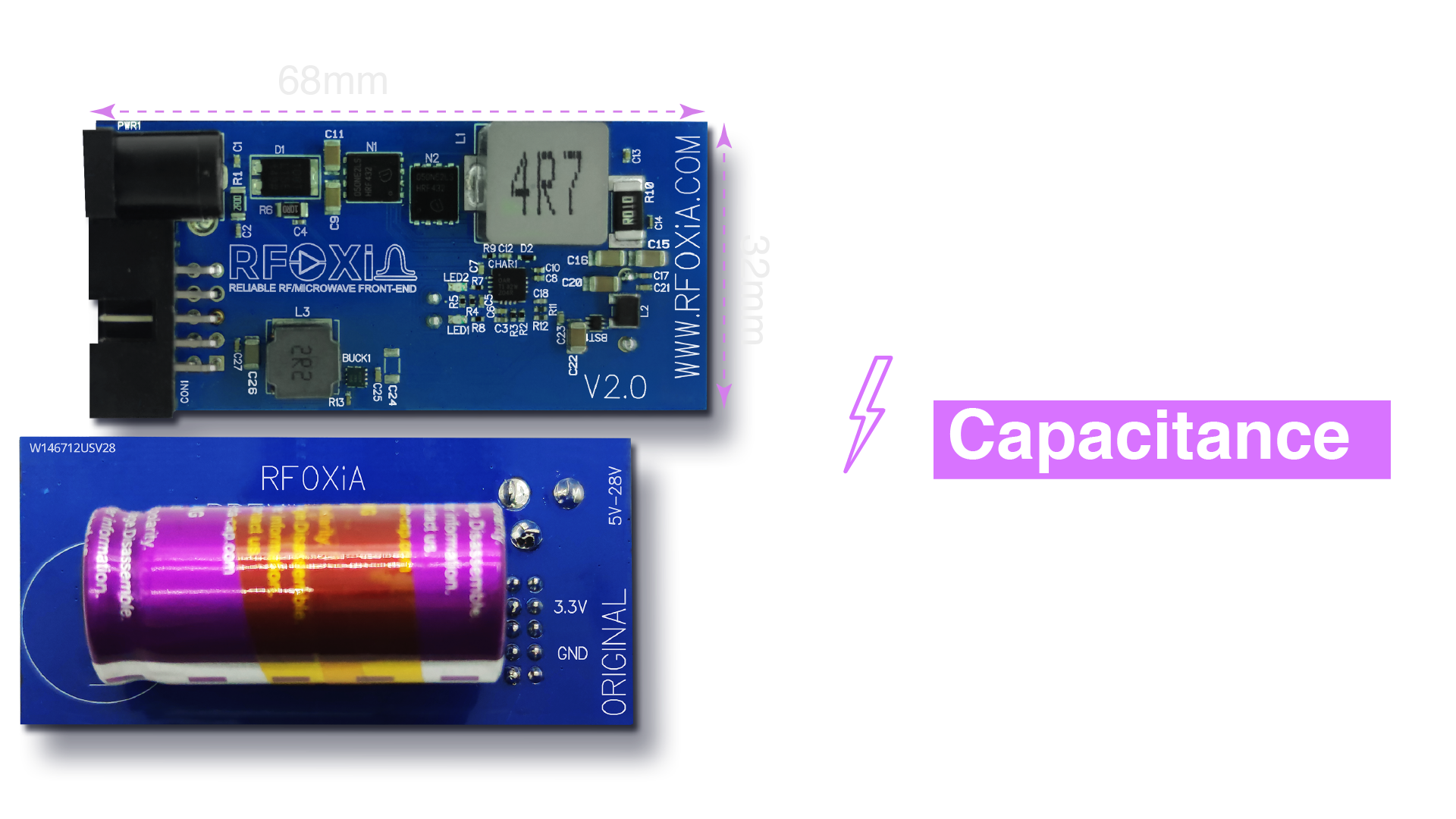
The 1100F supercapacitor bank is the energy storage foundation. But the fast charging circuit embedded between the input adapter and the supercapacitor bank is what makes the five-minute charge time possible.
Here is how the architecture works:
The included high-power charging adapter delivers 12V at 5A from the wall outlet. The embedded fast charging circuit steps this down and conditions it to deliver 4V at 10A directly into the supercapacitor bank. That is 40 watts of charging power delivered continuously into a storage system that can accept it all simultaneously — because supercapacitors, unlike batteries, do not require current tapering as they approach full charge.
A battery management circuit for a LiPo at the same capacity would need to taper current significantly in the final 20-30% of charge to prevent cell damage. The supercapacitor accepts full current until it is full. The fast charging circuit embedded in this kit is designed around that characteristic — it delivers maximum current throughout the entire charge cycle, then cuts off cleanly at full voltage.
The result: full charge in under five minutes from empty.
The High-Power Charging Adapter: Designed to Match the Circuit
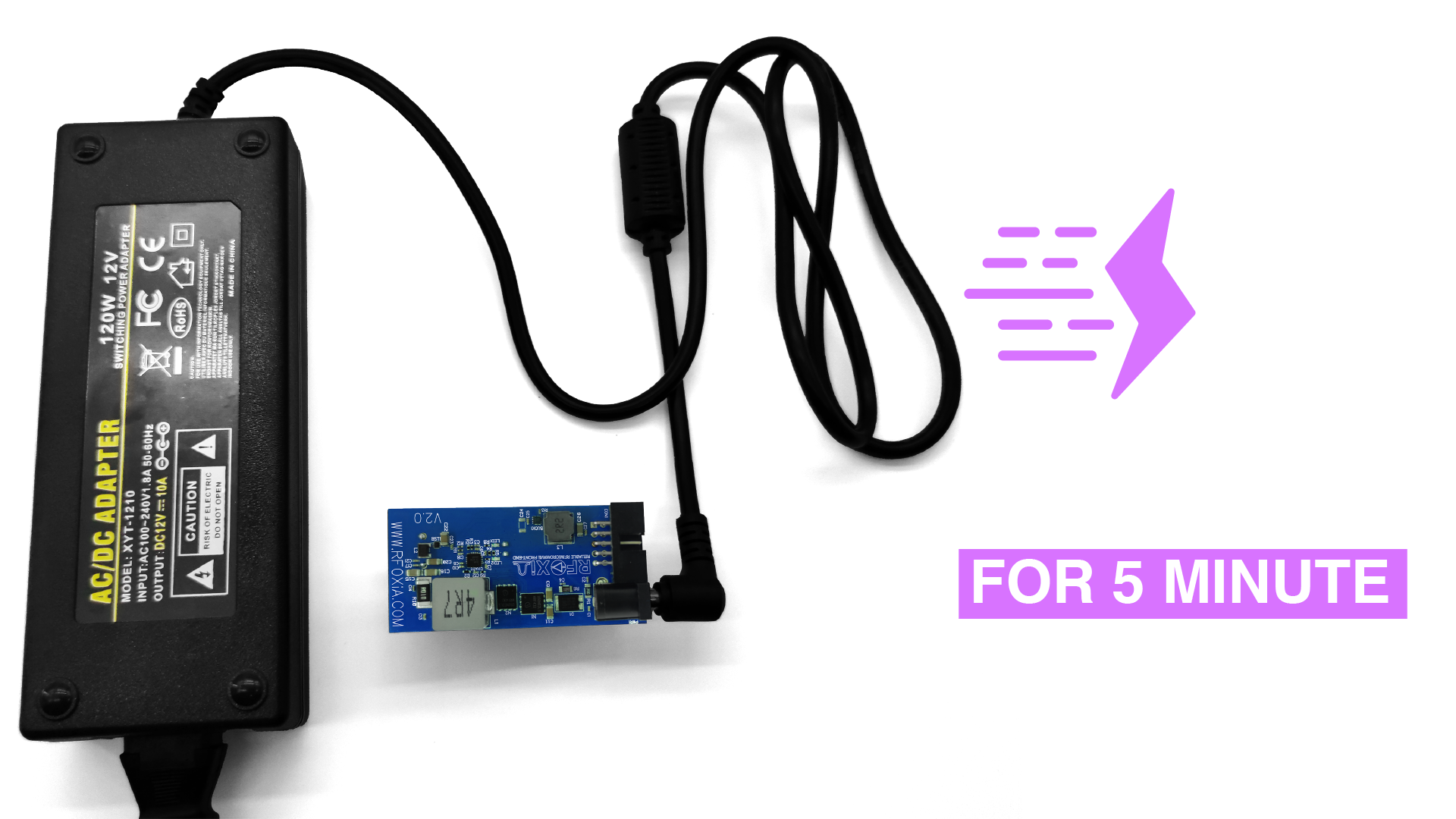
The included 12V 5A adapter is not a generic wall wart. It is specified to match the input requirements of the fast charging circuit embedded in the kit.
Generic 12V adapters often have poor regulation — their output voltage sags under load, their current delivery is inconsistent, and they generate substantial electrical noise. The charging circuit in the MultiNav Pro+ Power/Program Kit is designed around a stable, high-current input. The included adapter provides exactly that: clean 12V at 5A with sufficient headroom for the embedded circuit to condition efficiently down to the 4V 10A delivery the supercapacitor bank needs.
Using a mismatched adapter will not destroy the kit — the embedded circuit includes protection — but it will extend your charge time and potentially reduce the consistency of charge termination. The included adapter is part of the system design, not an afterthought.
For field deployments where wall power is unavailable, the input architecture also supports operation from high-current 12V DC sources — vehicle power systems, field battery packs, or solar charge controllers — as long as they can sustain the current demand during the five-minute charge window.
Full-Day Power for the Entire MultiNav Pro+ Module Stack
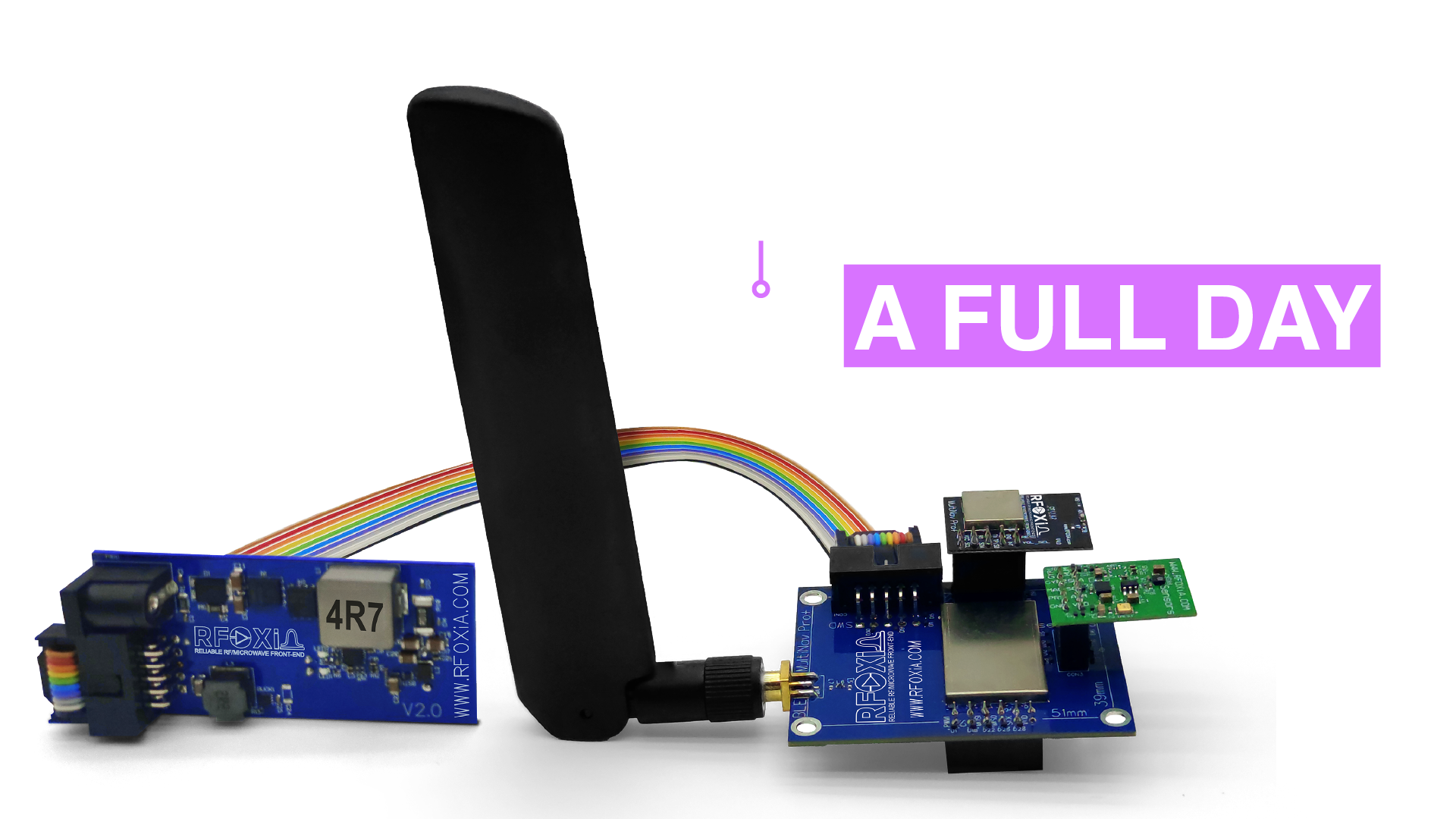
The MultiNav Pro+ ecosystem includes four modules: the BLE Module, the GNSS Module, the Sensors Module, and the Power/Program Kit itself. Running all three active modules simultaneously — continuous BLE transmission at long range, active GNSS fix at 18Hz, and all seven environmental sensors streaming — represents a meaningful power draw.
The 1100F supercapacitor bank storing 8800 Joules sustains that full load for a complete working day. For drone builders, that means an entire day of flight sessions without returning to wall power. For field researchers, it means deploying your node in the morning and not thinking about power again until you pack up at sunset. For IoT developers running extended test sessions, it means your hardware stays online through your entire work session.
This matters especially for the RFOXiA data network use case. To earn daily rewards for contributing sensor data, your node must maintain a verified, continuous data stream. Interruptions break the session verification. A power system that fails mid-day does not just inconvenience you — it ends your reward for that day. The 24-hour runtime eliminates that risk entirely.
STLink Programmer: Firmware Development Without the Friction

The power architecture is half the story. The other half is the integrated STLink programmer.
The MultiNav Pro+ BLE Module is built on the STM32WB07 — a professional-grade Bluetooth 5.4 SoC with a dedicated RF coprocessor architecture. Programming it requires an STLink interface. Most development setups treat the programmer as a separate purchase, a separate USB dongle, a separate cable nightmare.
The MultiNav Pro+ Power/Program Kit integrates the STLink programmer directly into the same board as the power management system. This means:
- One connection to your workstation handles both power delivery to the development stack and firmware programming to the BLE module
- No separate programmer to lose, charge, or cable-manage
- Debugging sessions can run alongside live power — you can flash new firmware, power-cycle the module, and observe live behavior without reconfiguring your bench
- The flat ribbon cable interface to the BLE module provides both power rails and programming signals through a single clean connection
For developers using the RFOXiA Club's AI Firmware Builder — which generates complete, production-ready STM32WB07 firmware from plain-language descriptions — having the STLink programmer integrated into your power kit means the path from AI-generated code to running hardware is as short as possible. Generate firmware in the browser, download to your machine, flash through the kit, observe live behavior. The full loop takes minutes.
Complete Connectivity Kit: No Hunting for Cables
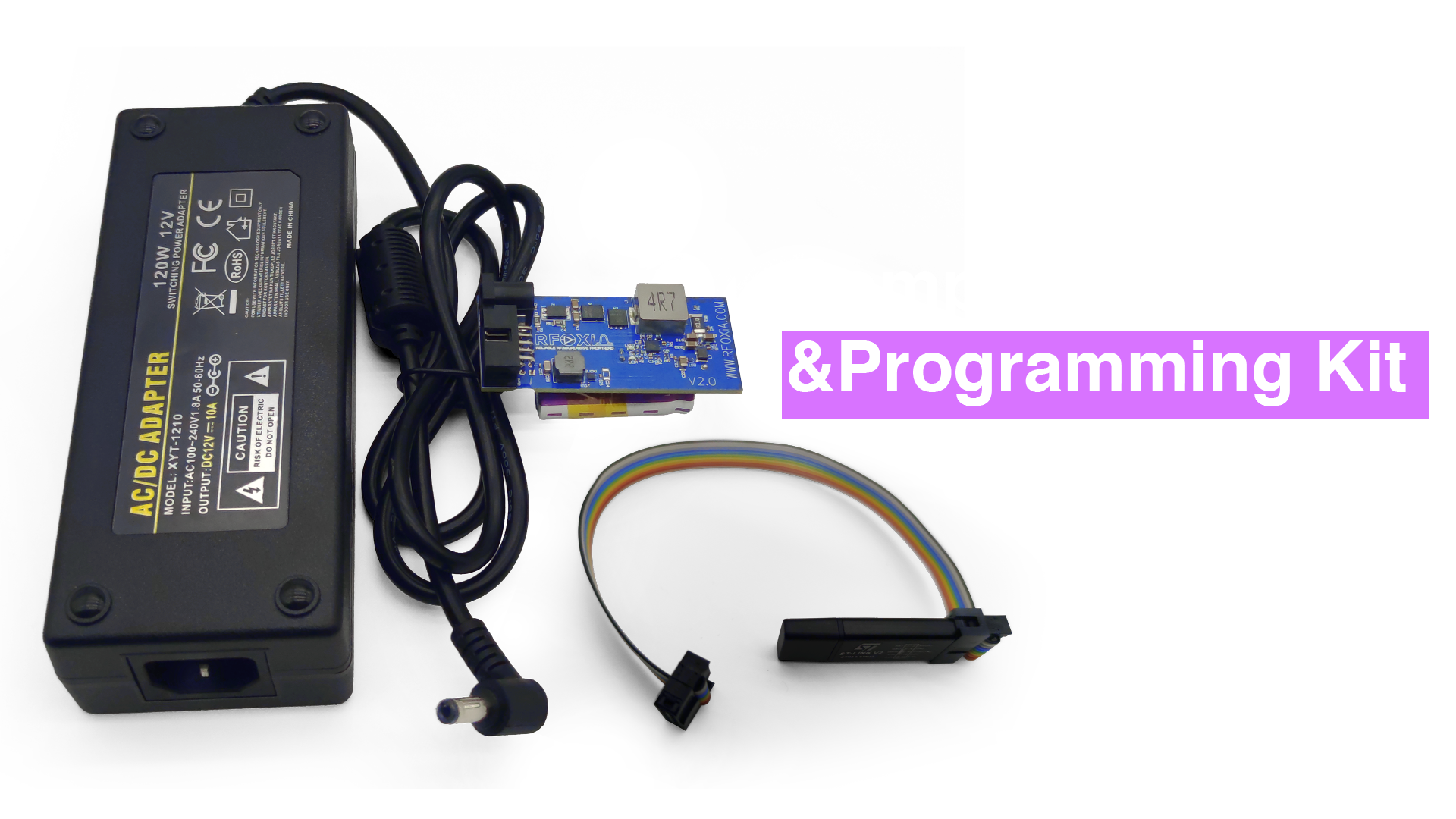
The MultiNav Pro+ Power/Program Kit ships with every cable required to connect your full module stack. This includes the flat ribbon cables that interface the BLE module with the power module and the programmer interface with the BLE module's programming header.
This is a deliberate design choice. Hardware development time lost to connector incompatibility, missing cables, and improvised wiring is a real and substantial tax on productivity. The Kit arrives ready to connect. Unbox, connect the ribbon cables, plug in the adapter, charge for five minutes, and you are operational.
For field deployments, the flat ribbon cable configuration keeps the module stack compact and mechanically stable — important when you are mounting modules on a drone airframe or securing them inside an enclosure for outdoor sensor deployment.
Who Needs the MultiNav Pro+ Power/Program Kit
The fast charging circuit embedded in this kit is engineered for specific use cases where standard battery solutions fail. If your work falls into any of these categories, the Power/Program Kit belongs in your setup.
Drone Builders and FPV Pilots
Field sessions mean distance from wall power. The five-minute charge time is short enough to complete at the field between flight sessions using a vehicle's 12V outlet. The 24-hour runtime means a single morning charge before you leave covers your entire day of flying.
Field Researchers and Environmental Monitors
Deploying sensor nodes in remote locations means your power system needs to either last until retrieval or recharge from field sources. The supercapacitor architecture handles both requirements — long runtime per charge and compatibility with solar or vehicle power recharge in the field.
IoT and Embedded Systems Developers
Extended test sessions on the bench benefit from a power system that does not require monitoring. The 24-hour runtime lets you run overnight automated tests without managing power. The integrated STLink programmer keeps your bench clean and your programming workflow uninterrupted.
Data Network Contributors
If you are contributing to the RFOXiA data network to earn daily sensor data rewards, uninterrupted power is not optional — it is the difference between a verified session and a broken one. The Power/Program Kit is the right power foundation for any node intended to contribute data consistently.
Technical Specifications Summary
| Specification | Value |
|---|---|
| Supercapacitor Capacity | 1100F |
| Energy Storage | 8800 Joules |
| Charge Time | Under 5 minutes |
| Runtime (Full Module Stack) | 24 hours |
| Charging Input | 12V 5A (included adapter) |
| Fast Charging Circuit Output | 4V at 10A |
| Programmer Interface | STLink (STM32WB07 compatible) |
| Cable Included | Flat ribbon cables — power and programming |
| FCC Certification | Yes |
How the Power/Program Kit Fits Into the RFOXiA Ecosystem
The MultiNav Pro+ Power/Program Kit is designed to operate as part of the complete RFOXiA development ecosystem — not as a standalone item. When combined with the BLE Module, GNSS Module, and Sensors Module in the Developer Bundle, you get a complete wireless development platform with professional power management and programming capability included.
The RFOXiA Club platform — where you manage your devices, run the AI Firmware Builder, monitor your data network earnings, and connect with the developer community — pairs directly with the hardware stack the Power/Program Kit enables. Every firmware workflow in the Club Dev Hub assumes you have an STLink interface available. The Kit is that interface, combined with power management that keeps your hardware running through your entire development session.
For developers who want to understand the full BLE module firmware architecture before customizing it, the open-source firmware repository is publicly available on GitHub. The STLink programmer in this Kit is your direct interface to that codebase — the bridge between the firmware you write and the hardware that runs it.
The Case for Supercapacitor Power in Professional Embedded Systems
The hardware development community has been slow to adopt supercapacitor-based power for portable embedded systems, largely because early supercapacitor technology had too low an energy density to be practical at reasonable form factors. That constraint has changed significantly with modern ultra-high-capacity supercapacitor cells.
At 1100F and 8800 Joules in a form factor designed to pair with a modular development stack, the MultiNav Pro+ Power/Program Kit demonstrates that supercapacitor power is now viable for professional embedded development applications. The fast charging circuit embedded in this kit is what makes the practical tradeoff compelling: you sacrifice some energy density compared to the highest-capacity LiPo alternatives, but you gain cycle life that effectively never ends, charge times measured in minutes rather than hours, and a power system that is chemically safe in any deployment environment.
For hardware developers who have been frustrated by the limitations of LiPo-based development power, this represents a genuinely different option — not just a marginally better version of the same approach.
Get the MultiNav Pro+ Power/Program Kit
The RFOXiA SuperCapacitor Battery and Programmer Kit is available now at $119, with inventory ready to ship. FCC certified. Compatible with the full MultiNav Pro+ module stack. Includes the high-power charging adapter, flat ribbon cables, and integrated STLink programmer.
If you are building the complete ecosystem, the Developer Bundle combines all four MultiNav Pro+ modules — BLE Module, GNSS Module, Sensors Module, and Power/Program Kit — at a bundled price with credits available through RFOXiA Club membership.
A fast charging circuit embedded in a professional supercapacitor power system. Twenty-four hours of runtime per charge. Five minutes from empty to full. This is what professional embedded power infrastructure looks like at a maker-accessible price point.
Stop managing your power. Start building.
Written by: Moamen Mohamed LinkedIn