
GNSS Antenna Module: The MultiNav Pro+™ Delivers 1.5m Accuracy for Drones, Robotics, and IoT
The Most Capable GNSS Antenna Module You Can Buy at This Price Point
Every serious hardware developer eventually faces the same problem: consumer-grade GPS modules are too slow, too inaccurate, and too flimsy for real-world applications. Industrial and survey-grade solutions exist — but they cost thousands of dollars and are designed for enterprise procurement teams, not builders.
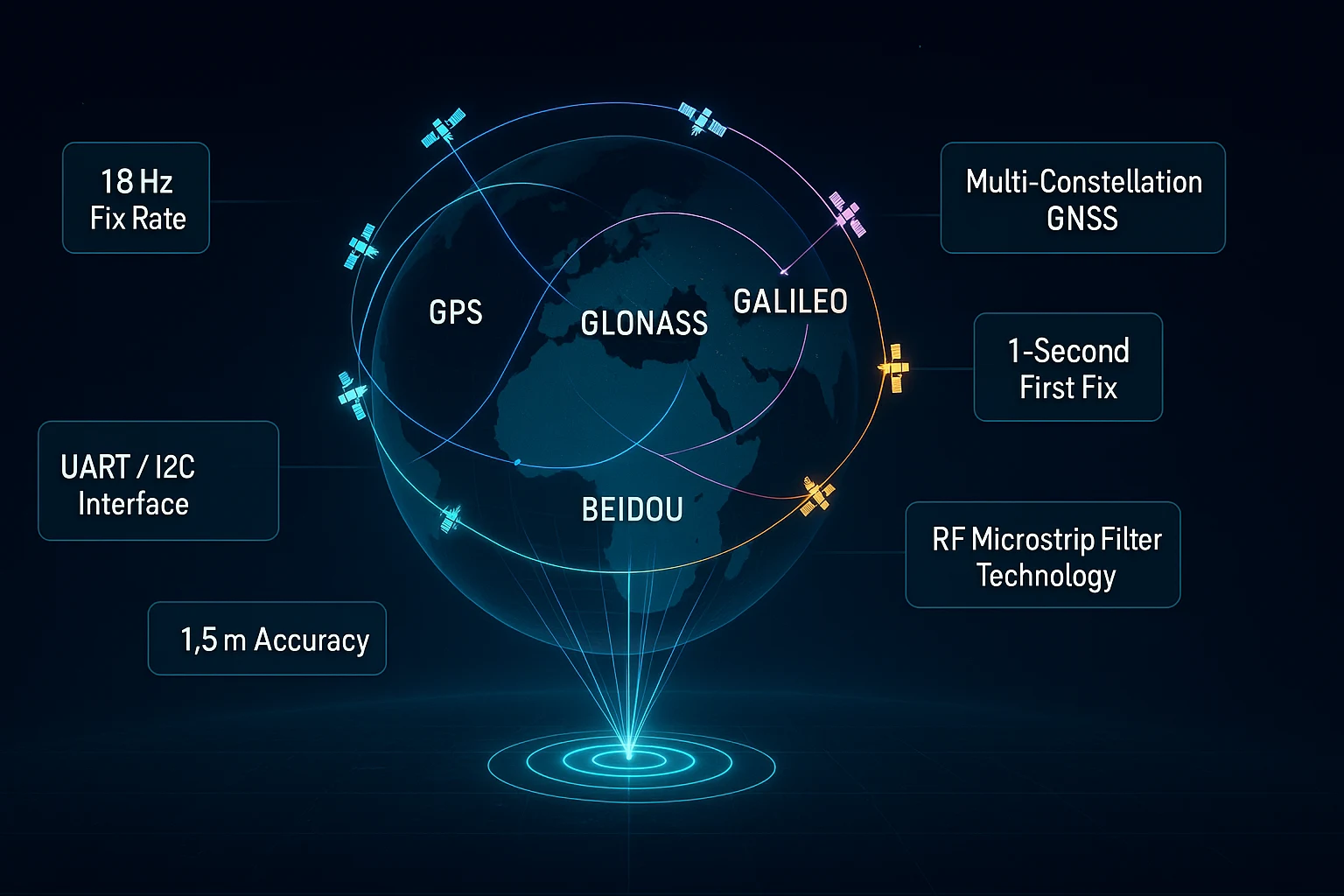
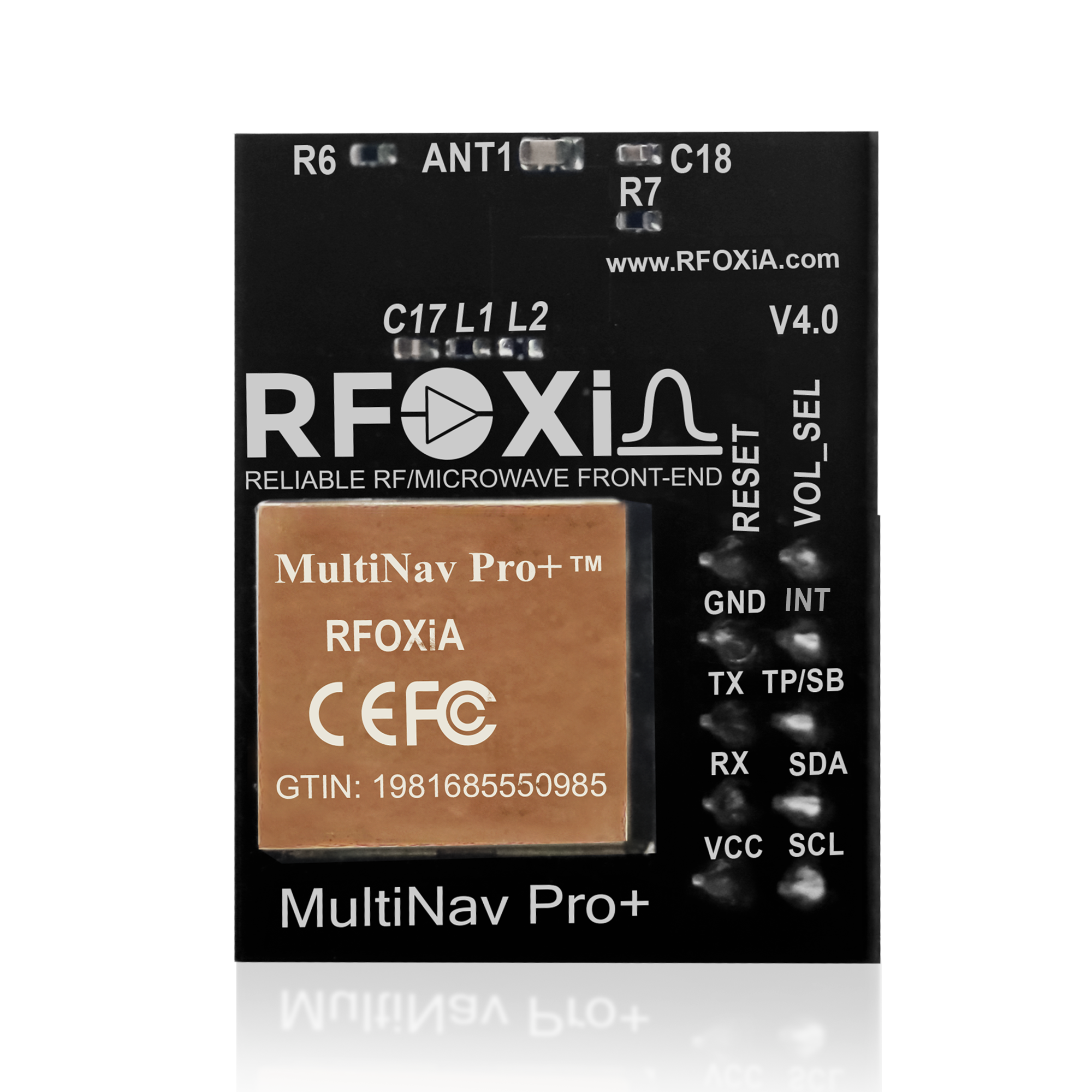
The MultiNav Pro+™ from RFOXiA fills that gap directly. It is a professional-grade GNSS antenna module built around the u-blox MIA-M10Q chipset, delivering 1.5-meter accuracy, an 18Hz fix rate, concurrent multi-constellation satellite acquisition, and a compact 26mm × 22mm form factor — all at a price point accessible to individual developers, drone builders, robotics engineers, and research teams.
This post covers everything you need to know about the MultiNav Pro+: its architecture, specifications, real-world applications, software ecosystem, and how it compares to what else is on the market.
What Makes a GNSS Antenna Module "Professional Grade"?
Before diving into specs, it's worth understanding what separates a professional GNSS antenna module from a hobby-grade GPS breakout board.
Most sub-$20 GPS modules you'll find on maker marketplaces share a common set of limitations:
- 1–5 Hz update rate — fast enough for a hiking app, far too slow for a drone traveling at 80 km/h
- 3–10 meter accuracy — acceptable for navigation, insufficient for precise landing, mapping, or formation flight
- Single constellation — typically GPS only, meaning fewer satellites in view and longer time-to-first-fix in challenging environments
- No filtering — susceptible to RF interference from motors, ESCs, and power electronics
- No open-source library — requires manual NMEA parsing or proprietary SDKs
A professional-grade GNSS antenna module solves all of these problems simultaneously. It provides high update rates for dynamic platforms, sub-2-meter accuracy for precision applications, multi-constellation redundancy for signal reliability, RF filtering for noisy environments, and a developer-friendly software ecosystem.
The MultiNav Pro+™ delivers every one of these qualities.
MultiNav Pro+™ Core Specifications
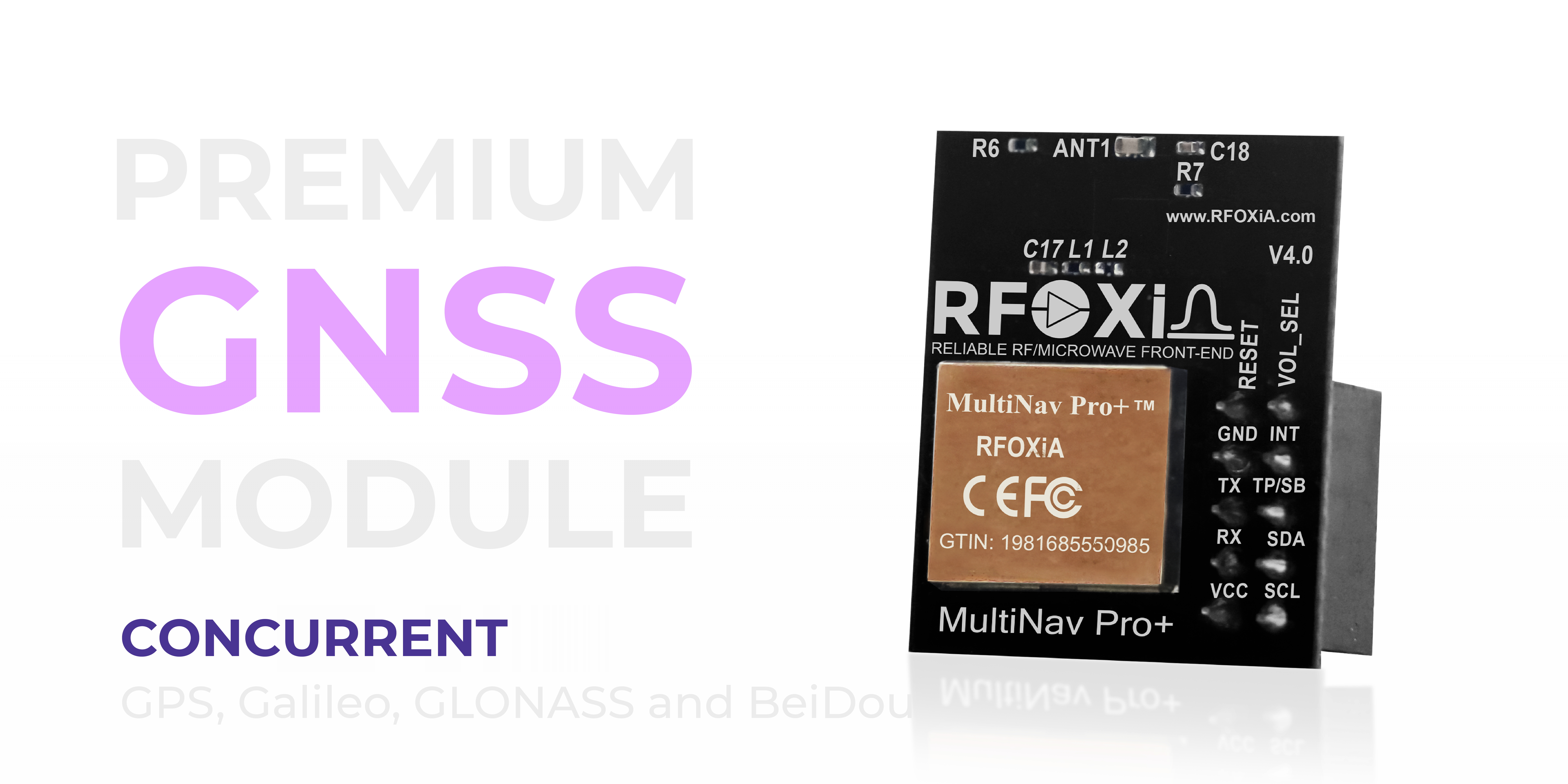
The MultiNav Pro+™ is powered by the u-blox MIA-M10Q — one of the most capable GNSS chipsets available for embedded applications. Here is what that translates to in practice:
| Specification | Value |
|---|---|
| Accuracy | < 1.5 meters CEP |
| Fix Rate | Up to 18 Hz |
| Time to First Fix | 1 second (hot start) |
| Satellite Systems | GPS, GLONASS, Galileo, BeiDou (concurrent) |
| Interface | UART (TX/RX) and I2C (SCL/SDA) |
| Operating Voltage | 1.8V and 3.3V |
| Current Consumption | 25–30 mA |
| Antenna | Integrated high-gain chip antenna |
| Dimensions | 26mm × 22mm |
| Certification | FCC certified |
Every specification in that table matters. Let's look at the critical ones in detail.
1.5-Meter Accuracy: Why It Changes What You Can Build
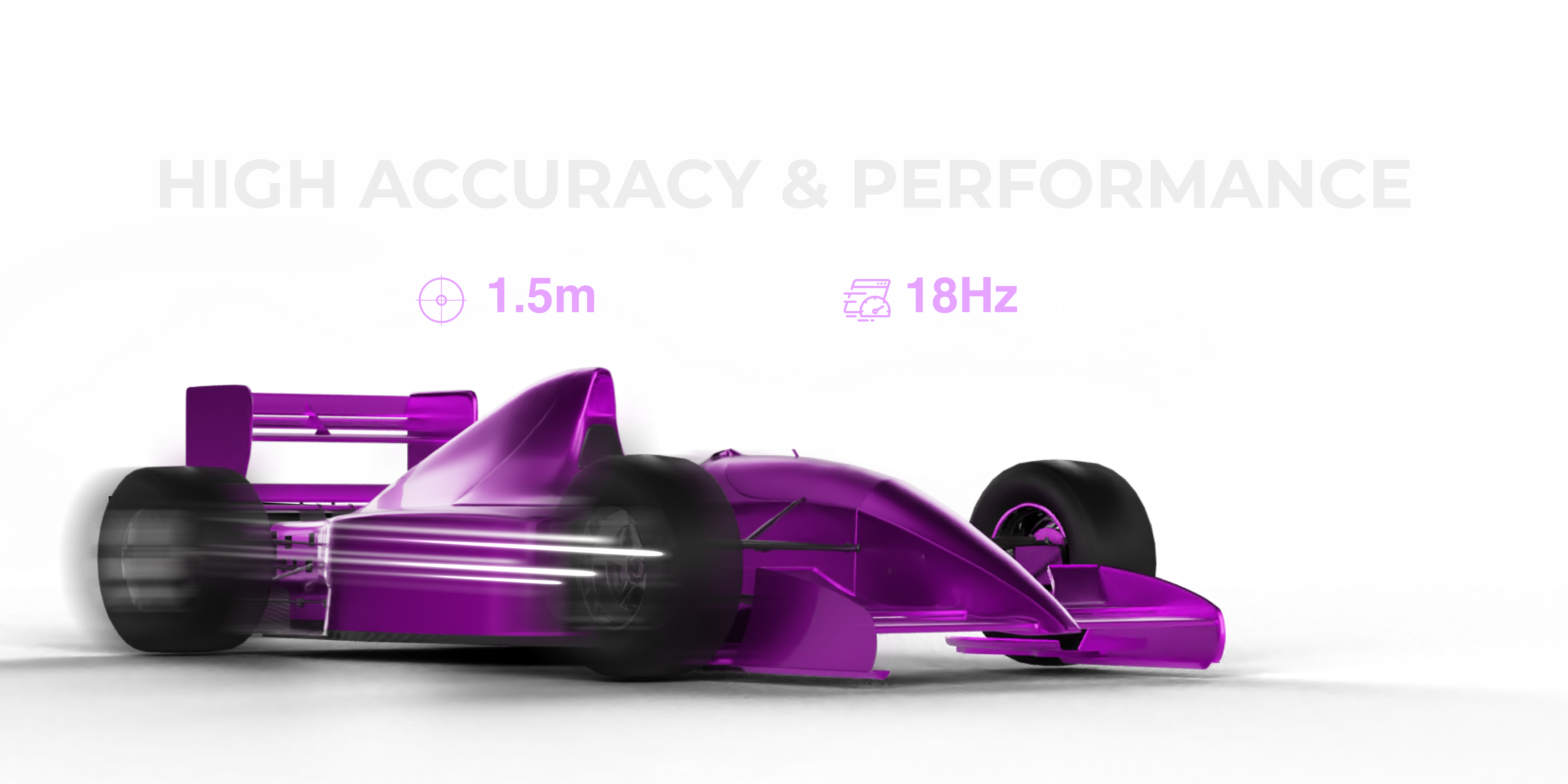
Accuracy at the sub-2-meter level unlocks applications that simply are not possible with consumer-grade modules:
Precision drone landing: Automated return-to-home and precision landing require knowing where "home" is to within a meter or two. At 5–10 meter accuracy, autonomous landing becomes dangerous. At 1.5 meters, it becomes reliable.
Agricultural row tracking: Precision agriculture applications require GPS accuracy tight enough to follow crop rows without overlap or gaps. Sub-2-meter accuracy is the minimum threshold for useful agricultural automation.
Search and rescue marking: When a first responder marks a location in the field, that coordinate needs to lead the next responder to within arm's reach — not within a city block.
Research-grade data collection: Environmental sensor nodes, wildlife tracking systems, and field research equipment all benefit from location data precise enough to be scientifically meaningful.
The MultiNav Pro+™ achieves this accuracy through the combination of the u-blox MIA-M10Q chipset, concurrent multi-constellation acquisition (more satellites in view means better geometric dilution of precision), and the proprietary RF/microwave microstrip filter technology that reduces signal noise before it reaches the receiver.
18Hz Fix Rate: Built for Fast-Moving Platforms
Fix rate is arguably more important than accuracy for dynamic applications. Here is why:
A standard 1 Hz GPS module updates its position once per second. A drone traveling at 20 m/s covers 20 meters between position updates. At 18 Hz, the same drone gets a fresh position every 55 milliseconds — covering just 1.1 meters between fixes. That is the difference between smooth, responsive control and laggy, dangerous behavior.
The 18Hz fix rate of the MultiNav Pro+™ makes it appropriate for:
- FPV racing drones where position is changing dozens of times per second
- High-speed tracking applications following vehicles or athletes
- Precision waypoint navigation where the autopilot needs constant position feedback to correct trajectory
- Real-time data logging where temporal resolution of position data matters for analysis
For any application where the platform is moving faster than walking pace, an 18Hz GNSS antenna module is not a luxury — it is a requirement.
Compact Design and Power Efficiency
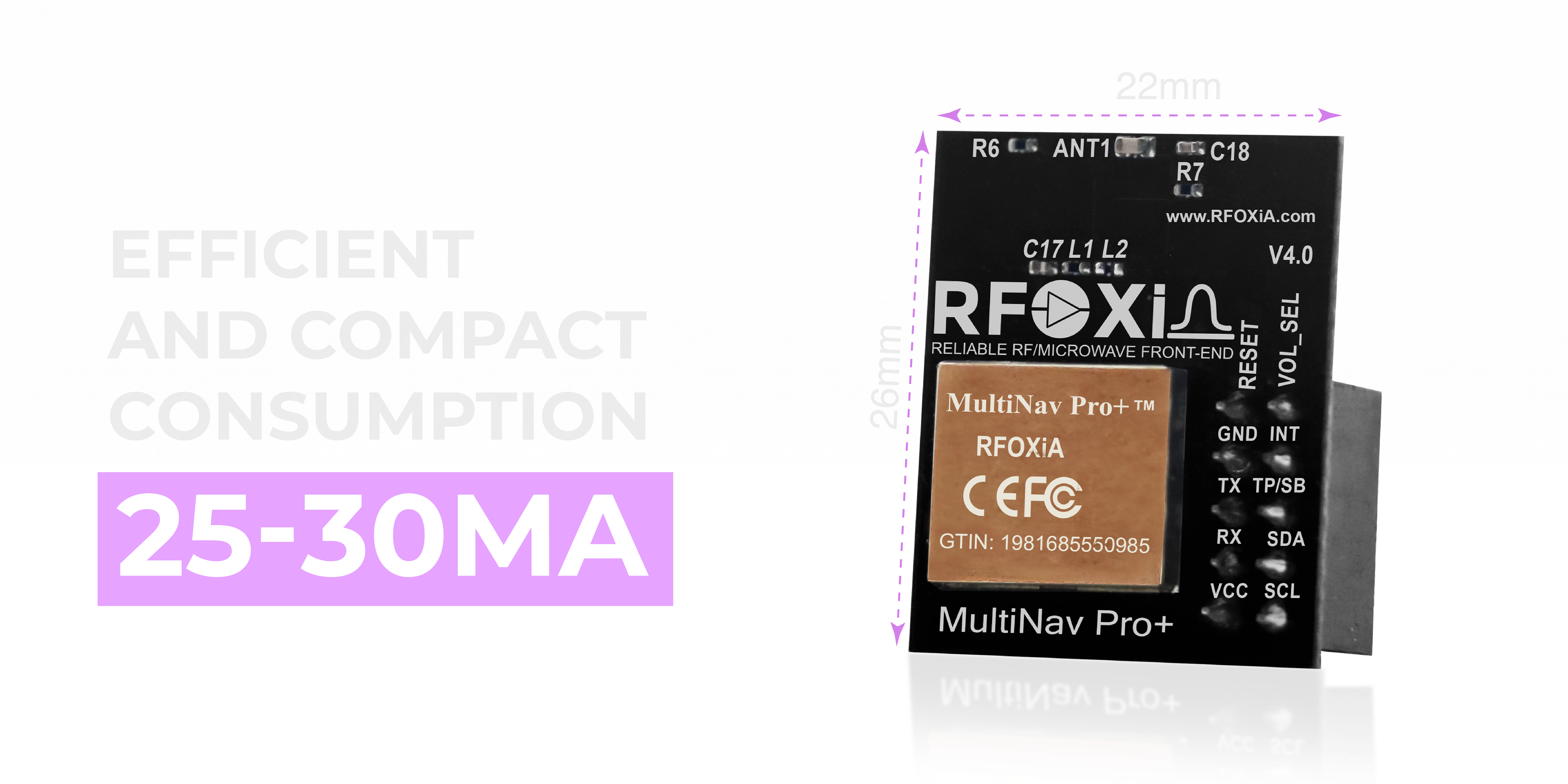
The MultiNav Pro+™ measures just 26mm × 22mm — smaller than a postage stamp. At 25–30mA current consumption, it draws less power than a typical LED indicator. These characteristics matter enormously in real deployments:
Weight-critical platforms: Racing drones and research UAVs count grams. A module this small and light adds negligible mass while delivering professional-grade location capability.
Battery-powered field devices: Sensor nodes, trackers, and portable instruments need to run for hours or days on battery. At 25–30mA, the MultiNav Pro+™ can operate continuously for 24+ hours on a modest LiPo without compromising other system power budgets.
Wearable and portable applications: The compact footprint makes it viable for integration into wearables, handheld instruments, and portable devices where board real estate is scarce.
The integrated high-gain chip antenna means there is no external antenna to route, mount, or damage. The entire GNSS antenna module — chipset, filter, and antenna — fits in that 26 × 22mm envelope.
Versatile Connectivity: UART and I2C
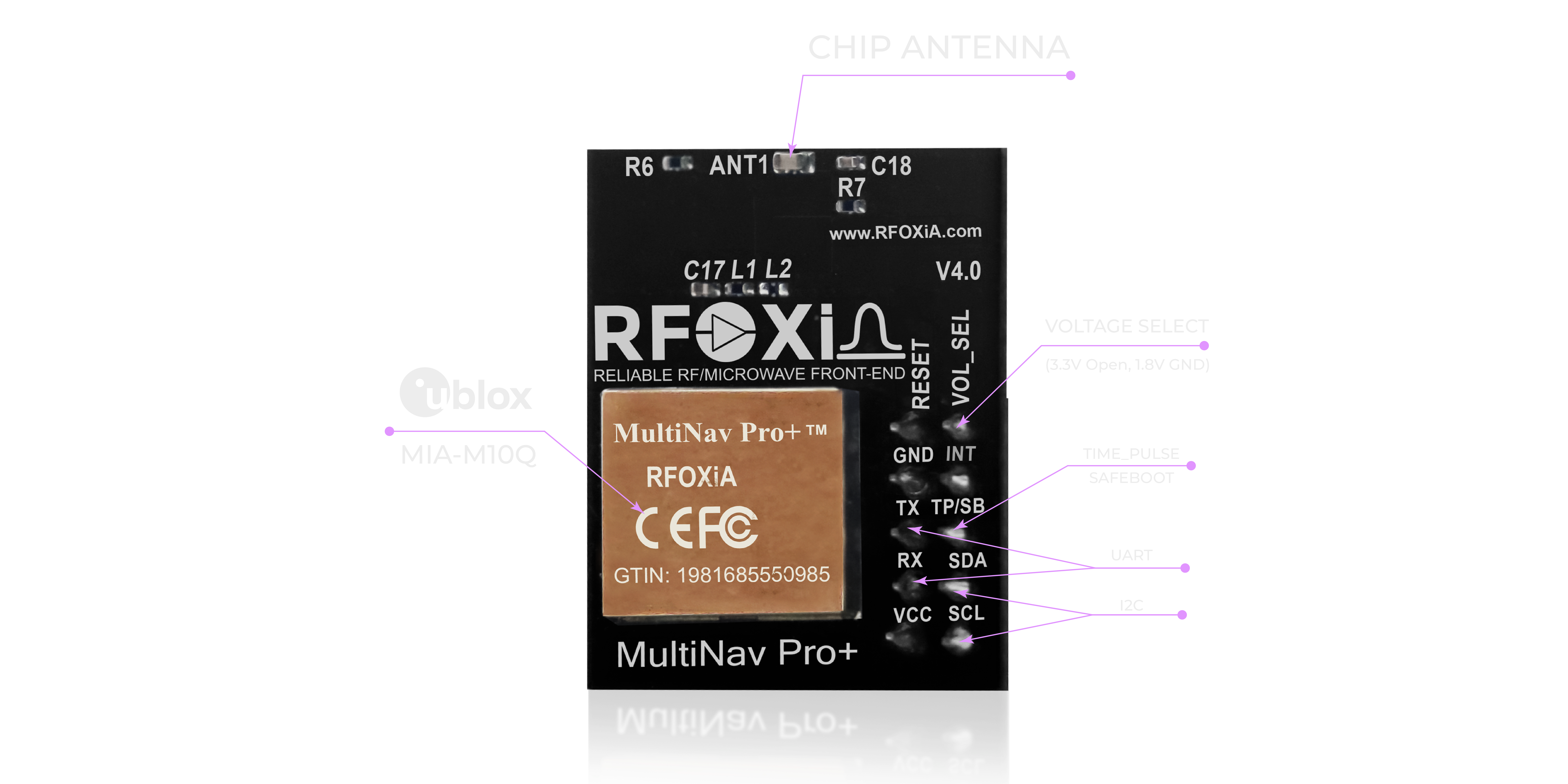
The MultiNav Pro+™ supports two industry-standard interfaces:
UART (TX/RX): The most common interface for GPS modules. Compatible with virtually every microcontroller, single-board computer, and flight controller. Works natively with Arduino, ESP32, STM32, Raspberry Pi, and ArduPilot/PX4 flight stacks.
I2C (SCL/SDA): Enables multi-device bus architectures where multiple sensors share the same two-wire interface. Particularly useful when UART ports are already occupied by other peripherals.
Dual voltage support (1.8V and 3.3V) means the module interfaces directly with both modern ultra-low-power microcontrollers running at 1.8V and the more common 3.3V systems — no level shifter required in most designs.
This flexibility is intentional. RFOXiA builds hardware that integrates with the tools developers already use, not hardware that demands a complete redesign of the existing system.
Open-Source Driver and Software Library
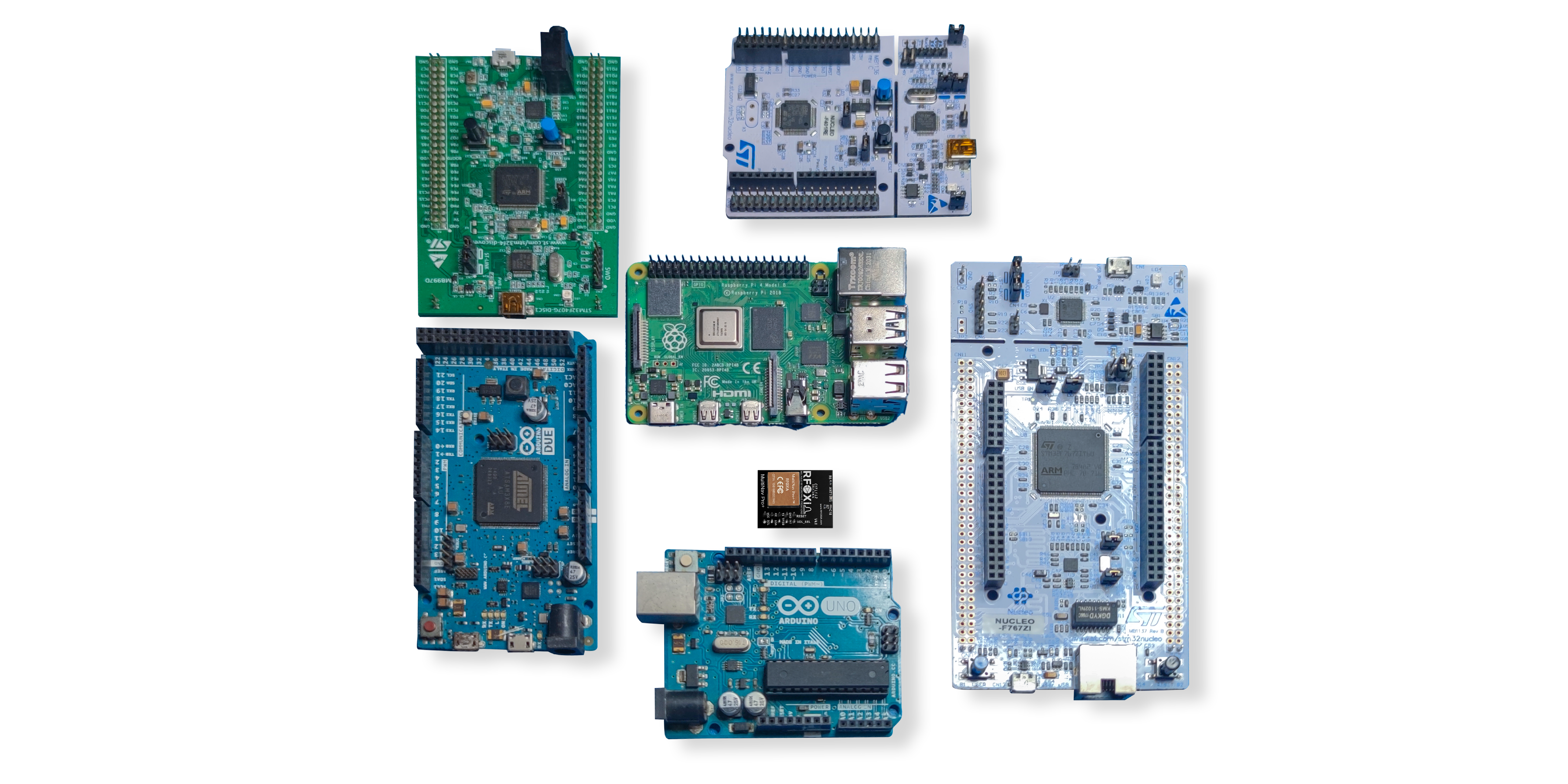
Hardware is only half the story. The MultiNav Pro+™ ships with a fully open-source C language driver library that implements the complete NMEA standard protocol command set.
What this means in practice:
- Arduino IDE compatible: Import the library with a single include statement and have working GNSS output in minutes
- Toolchain agnostic: The C library works with PlatformIO, STM32CubeIDE, ESP-IDF, and any other embedded development environment
- NMEA standard: All standard NMEA sentences are supported — GGA, RMC, VTG, GSA, GSV — meaning the module works with existing navigation software, mapping tools, and autopilot systems without modification
- Full source access: The library is open source. You can read it, modify it, extend it, and incorporate it into commercial projects
For developers working within the RFOXiA ecosystem, the RFOXiA Accurate GNSS Module integrates directly with the AI Firmware Builder in RFOXiA Club — describe your application in plain language, and the AI generates complete firmware that incorporates the GNSS module alongside the BLE module, sensors, and power management hardware.
U-Center Software for Evaluation and Configuration
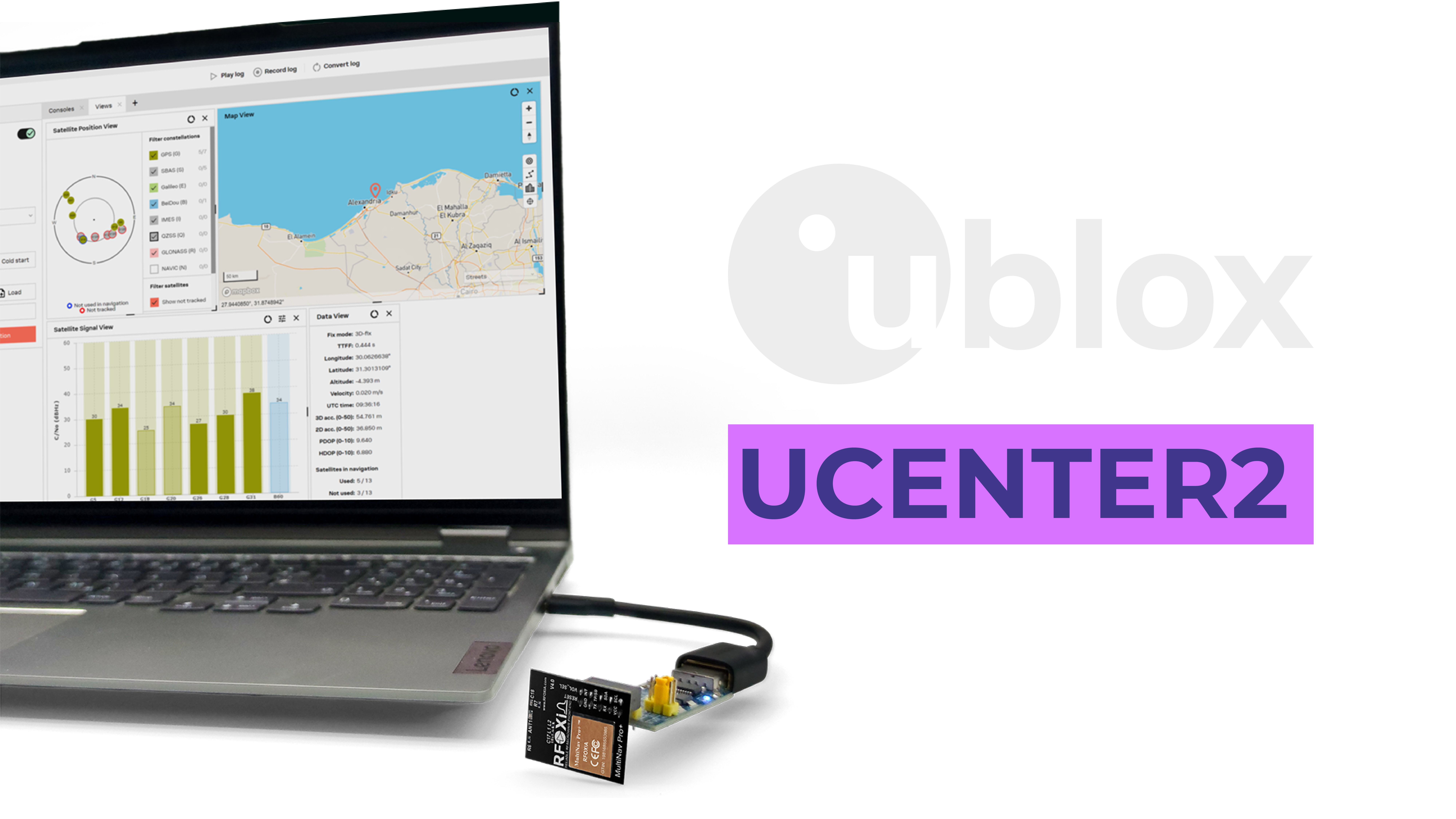
Because the MultiNav Pro+™ is built on the u-blox MIA-M10Q, it is fully compatible with u-center — u-blox's professional GNSS evaluation software.
u-center provides:
- Satellite sky view: Visualize every satellite in view, its elevation, azimuth, and signal strength in real time
- Position tracking: Watch your position update on a live map at full 18Hz resolution
- Configuration interface: Adjust constellations, fix rate, power modes, NMEA output sentences, and dozens of other parameters through a graphical interface — no command-line required
- Data logging: Record complete GNSS sessions for post-processing and analysis
- Signal quality metrics: Analyze carrier-to-noise ratio, HDOP, VDOP, and other quality indicators for environment characterization
For researchers, the combination of u-center for evaluation and the open-source library for production deployment makes the MultiNav Pro+™ the complete professional toolkit.
Applications: Where This GNSS Antenna Module Belongs

The MultiNav Pro+™ is appropriate for a wide range of professional and research applications:
Drone and UAV Applications
- Autonomous waypoint navigation requiring sub-2-meter position accuracy
- Precision landing and return-to-home on fixed-wing and multirotor platforms
- Drone swarm coordination requiring high-frequency position sharing
- Agricultural mapping and spray drones following crop row patterns
- Search and rescue UAVs marking target locations for ground teams
IoT and Environmental Monitoring
- GPS-verified sensor node deployment for the RFOXiA data network (GNSS validation confirms outdoor deployment, unlocking data rewards)
- Asset tracking for valuable equipment in field environments
- Wildlife monitoring collars and environmental sensor packages
- Weather station networks requiring precise geographic tagging of observations
Robotics and Ground Vehicles
- Outdoor mobile robot navigation in GPS-accessible environments
- Agricultural autonomous vehicles following field boundaries
- Survey robots collecting geo-referenced data
Research and Academia
- Field data collection requiring scientifically defensible location accuracy
- Atmospheric science payloads on weather balloons and research UAVs
- Marine research instruments requiring precise position logging
- Geodesy and geophysics field surveys
Wearables and Portable Devices
- Personal tracking devices for athletes, hikers, and field teams
- Lone worker safety devices requiring location reporting
- Portable environmental monitors with geo-referenced data
Multi-Constellation Reception: Why Concurrent Matters
Many GPS modules claim multi-constellation support but operate by switching between constellations sequentially rather than receiving them simultaneously. This matters because sequential acquisition means:
- Fewer satellites actively contributing to the position solution at any moment
- Longer time-to-first-fix in challenging environments
- Higher geometric dilution of precision (fewer satellites = less accurate position geometry)
- Weaker performance under partial sky obstruction (buildings, trees, terrain)
The MultiNav Pro+™ acquires GPS, GLONASS, Galileo, and BeiDou concurrently — all four major global navigation satellite systems simultaneously. In practice, this means:
- Up to 30+ satellites potentially visible in a clear sky view
- Faster first fix because the receiver is not waiting for a single constellation to acquire
- More redundancy against individual satellite signal loss
- Better accuracy in urban canyons and other partially obstructed environments where selective constellation geometry is critical
For applications in challenging RF environments — urban areas, dense vegetation, near infrastructure — concurrent multi-constellation reception is the difference between a reliable fix and a frustrating hunt for signal.
RF Filtering Technology: Protecting Signal Quality
Drones and robots are electrically noisy environments. Brushless motors, electronic speed controllers, switching power supplies, radio transmitters, and digital electronics all generate broadband RF noise that can degrade GNSS receiver sensitivity.
The MultiNav Pro+™ incorporates proprietary RF/microwave microstrip filter technology specifically designed to attenuate out-of-band interference before it reaches the GNSS receiver. This filtering is implemented at the PCB level — in the microstrip geometry of the antenna feed network — rather than as a discrete component that can fail or be bypassed.
The practical result: the MultiNav Pro+™ maintains lock and accuracy in environments where unfiltered modules lose fix entirely. For drone integration, this is not a minor feature — it is the reason the module works reliably mounted near a flight controller and power distribution board rather than requiring careful isolation and shielding.
Integration with the RFOXiA Ecosystem
The MultiNav Pro+™ is designed as part of the complete RFOXiA wireless development ecosystem. When combined with the other RFOXiA modules, the GNSS module enables capabilities that no individual component can provide alone:
With the BLE Module (MultiNav Pro+™ BLE): Real-time GPS position is transmitted over the long-range BLE link (up to 20km man-to-drone range) and displayed on the RFOXiA Connect app's live map. This creates a complete, internet-independent drone tracking and control system visible on your phone from kilometers away.
With the Sensors Module: Environmental data (temperature, humidity, pressure, air quality) is geo-tagged with the precise position from the GNSS module. This geo-referenced sensor data is the foundation of the RFOXiA data network — and the GPS validation is what confirms outdoor deployment for reward calculation.
With the Power/Program Kit: The supercapacitor-based power system provides 24 hours of runtime for the complete module stack on a 5-minute charge — including the GNSS module running at continuous 18Hz acquisition.
The RFOXiA Accurate GNSS Module is available individually for $49, or as part of the Developer Bundle alongside the BLE module, Sensors module, and Power/Program Kit.
FCC Certification: Ready for Commercial and Research Deployment
The MultiNav Pro+™ is FCC certified. For developers and organizations, this matters for several reasons:
- Legal compliance: FCC certification is required for intentional and unintentional radiators deployed in the United States. Using uncertified modules in a commercial product creates liability.
- Distributor qualification: Major electronics distributors (DigiKey, Mouser, Digi-International) require FCC certification for listed products. RFOXiA's certification enables legitimate retail distribution.
- Institutional procurement: Universities, government agencies, and corporate R&D departments have procurement policies that require certified components. FCC certification opens these markets.
- Peace of mind: Certification means the module has been tested and validated to meet interference and emissions standards — not just designed to meet them.
All four RFOXiA modules carry FCC certification. This is a deliberate strategic investment that separates RFOXiA from the majority of the import module market.
What's in the Box
Every MultiNav Pro+™ purchase includes:
- MultiNav Pro+™ GNSS Module — fully assembled, tested, and ready to use
- Quick Start Guide — step-by-step setup instructions for first fix in minutes
- Access to RFOXiA Club — documentation, open-source firmware library, AI Firmware Builder, and developer community
The open-source C library and u-center software are available for download immediately after purchase through the RFOXiA Club Resources section.
Who Should Use the MultiNav Pro+™?
The MultiNav Pro+™ is not the right module for every application. It is the right module when:
- Your platform moves faster than walking pace and needs position updates more than once per second
- Your application requires location accuracy of 2 meters or better
- You are integrating into a noisy RF environment (drone, robot, vehicle)
- You need a module that will pass FCC compliance review as part of a commercial product
- You want open-source firmware support without depending on a vendor's closed SDK
- You are building something that will eventually scale and need a module with a real manufacturer behind it
If you are building a Bluetooth drone controller, a precision agricultural robot, a research UAV, an environmental sensor network, or any location-aware embedded system that will be used professionally — this is your module.
Pricing and Availability
The MultiNav Pro+™ GNSS Module is priced at $49 and is available now with immediate fulfillment from existing inventory.
For developers building the complete wireless ecosystem, the Developer Bundle includes the GNSS module alongside the BLE module, Sensors module, and Power/Program Kit — and is available at a significant discount versus individual purchase pricing.
New RFOXiA Club members receive a $10 welcome credit on signup, applicable toward any hardware purchase including the MultiNav Pro+™.
Explore full specifications, documentation, and order directly through the RFOXiA Accurate GNSS Module product page.
Final Assessment
The MultiNav Pro+™ is the GNSS antenna module that the maker and professional developer community has needed for years — and has not had access to at an accessible price point.
Sub-2-meter accuracy. 18Hz update rate. Concurrent four-constellation acquisition. Integrated high-gain chip antenna. RF filtering for noisy environments. Open-source firmware. FCC certified. $49.
There is no other module on the market that combines this specification set at this price. The MultiNav Pro+™ exists because RFOXiA was built on the principle that professional-grade wireless and navigation technology belongs in the hands of every engineer, researcher, and builder — not just those with military procurement budgets.
If your project demands location data you can trust, at the update rate your platform requires, in the environments you actually operate in — this is the module you have been looking for.
Written by: Moamen Mohamed LinkedIn