
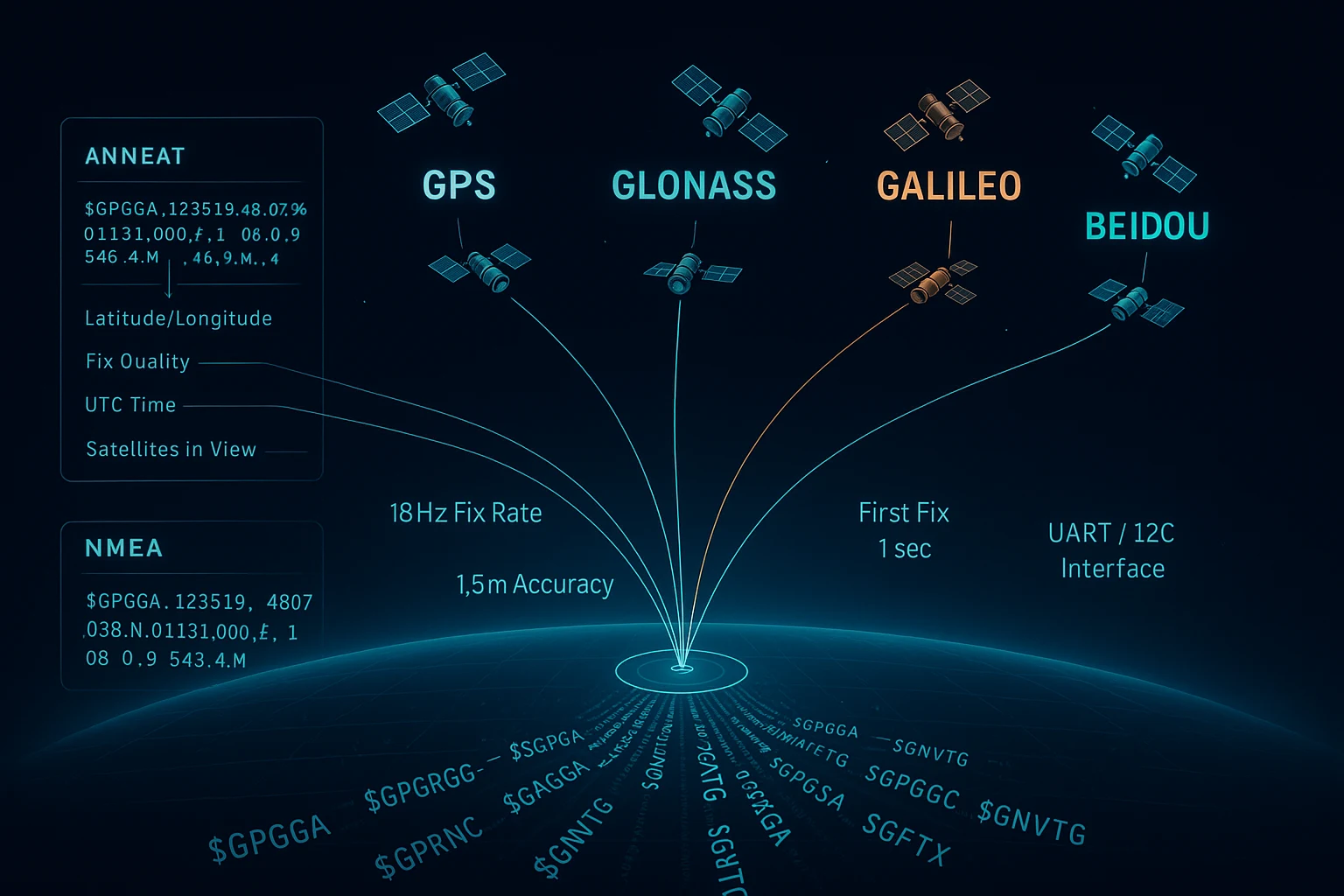
GNSS Module NMEA Output: The Complete Developer Guide to the MultiNav Pro+
Why Your Next Build Deserves a GNSS Module with Proper NMEA Output
If you have ever integrated a GPS or GNSS module into a project and struggled with slow fix times, inconsistent accuracy, or confusing data protocols, you already understand the frustration that most hardware developers face. Location-aware applications demand precision, speed, and reliability — and the module sitting at the heart of your system determines whether your build succeeds or fails in the field.
The GNSS module NMEA output is the universal language of satellite navigation. Every professional navigation system, drone autopilot, tracking device, and geospatial application reads NMEA sentences to extract position, velocity, time, and satellite status data. Choosing a GNSS module that delivers clean, fast, and accurate NMEA output is not just a technical decision — it is the foundation of your entire location system.
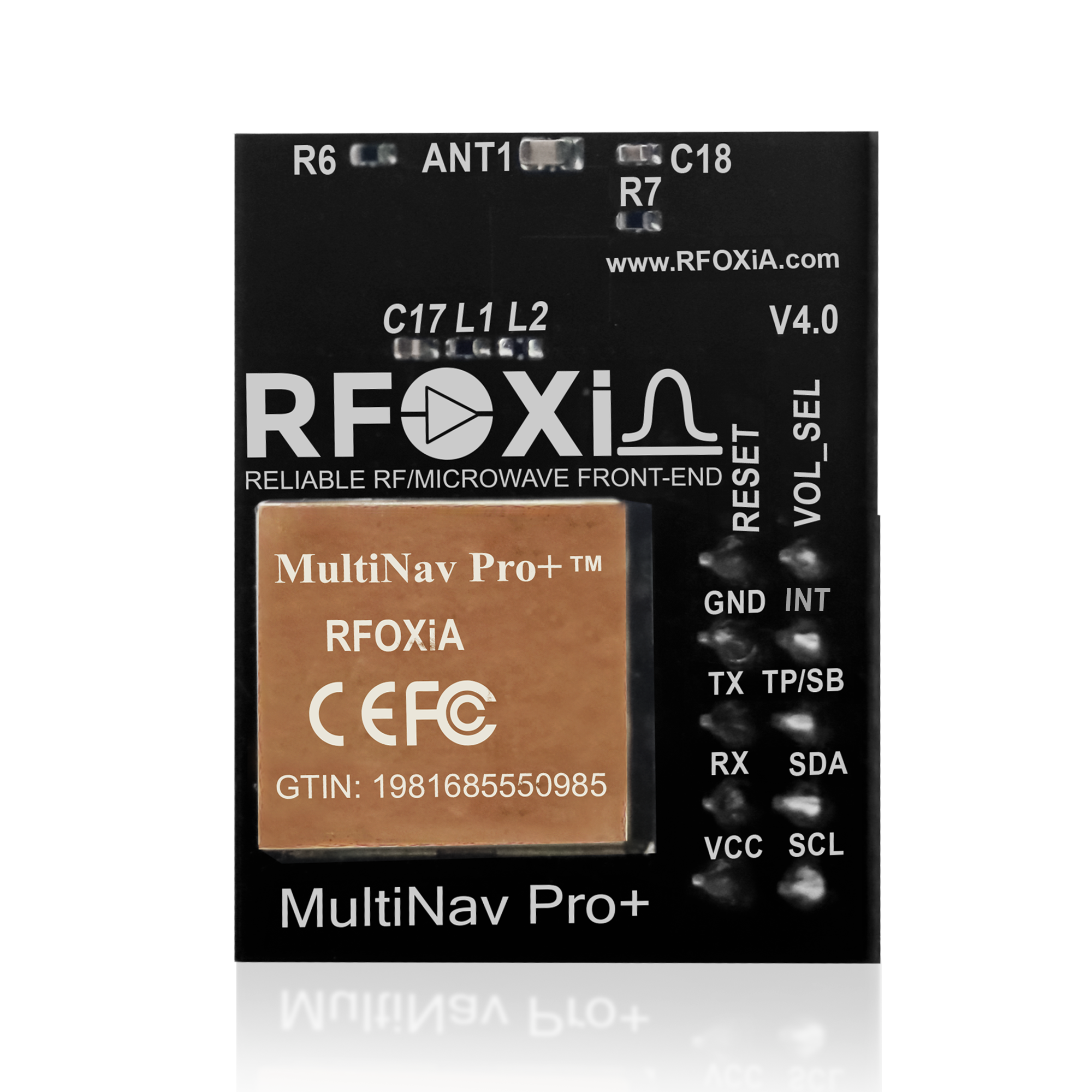
This guide walks you through everything you need to know about the RFOXiA MultiNav Pro+ GNSS module: its hardware architecture, NMEA output capabilities, interface options, integration workflow, and the real-world applications where it delivers outstanding results.
What Is NMEA Output and Why Does It Matter?
NMEA (National Marine Electronics Association) is the standard data protocol used by virtually every GNSS receiver on the market. When your GNSS module locks onto satellites and computes a position fix, it formats that data into structured ASCII sentences — the NMEA output — and transmits it over a serial interface to your host microcontroller or computer.
Common NMEA sentence types include:
- $GNGGA — Global Positioning Fix Data (latitude, longitude, altitude, fix quality, satellite count)
- $GNRMC — Recommended Minimum Navigation Information (position, velocity, date/time)
- $GNGSV — Satellites in View (number of visible satellites per constellation)
- $GNGLL — Geographic Position (latitude/longitude with timestamp)
- $GNVTG — Course Over Ground and Ground Speed
- $GNGSA — GPS DOP and Active Satellites
A clean, properly structured GNSS module NMEA output gives your application everything it needs to build navigation, tracking, geofencing, altitude monitoring, timing synchronization, and velocity estimation systems.
The critical variables in any NMEA-capable module are: how fast the output updates, how accurate the position data is, and how many satellite constellations are contributing to the fix. The MultiNav Pro+ sets a new standard in all three dimensions for developer-grade modules.
Introducing the MultiNav Pro+: Professional GNSS for Every Builder
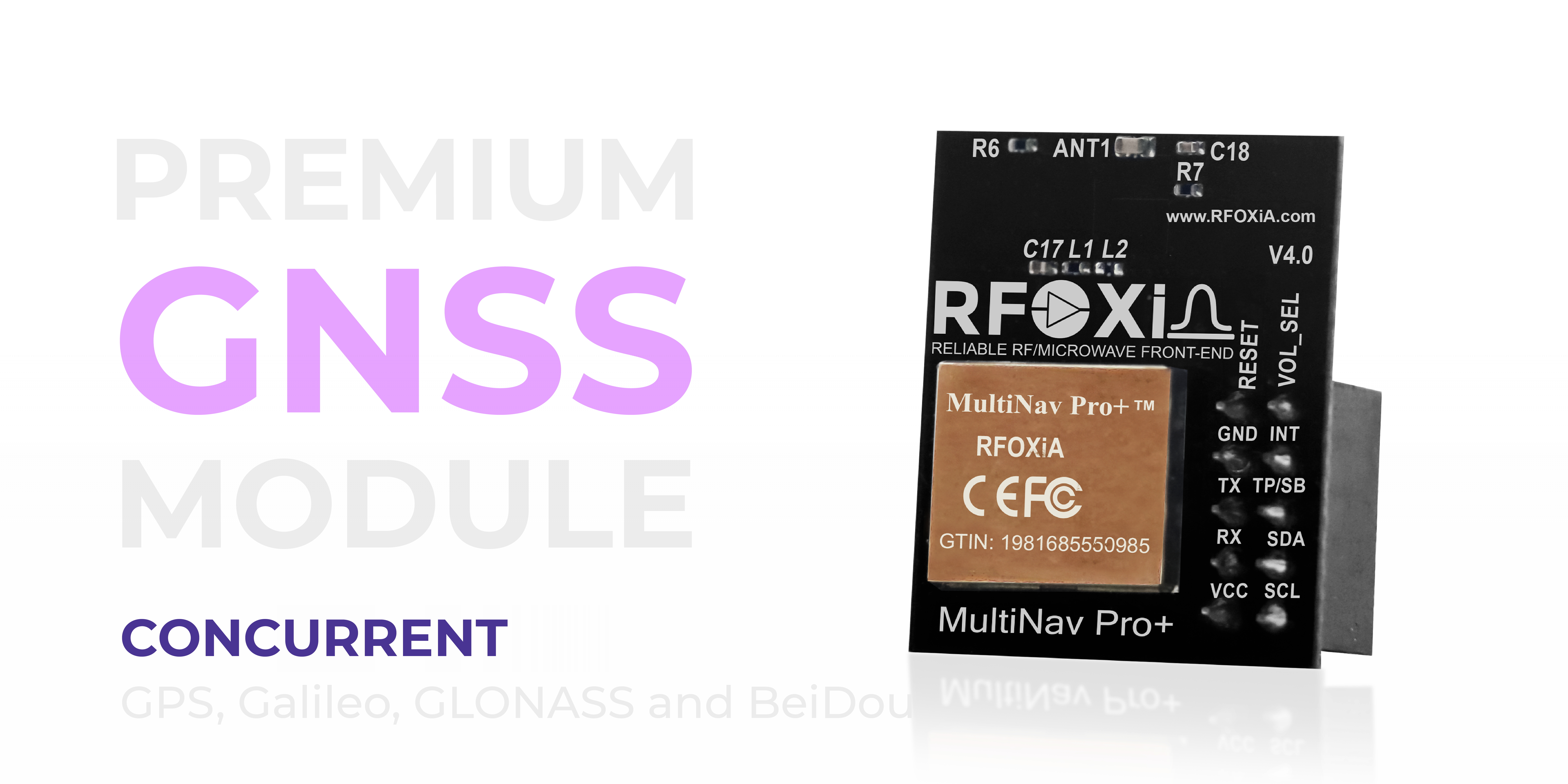
The RFOXiA MultiNav Pro+ is built around the u-blox MIA-M10Q, one of the most advanced low-power GNSS chips available for embedded development. The MIA-M10Q is engineered for concurrent multi-constellation operation, ultra-fast time-to-first-fix, and exceptional sensitivity — all in a power envelope that makes it ideal for battery-powered and drone-mounted applications.
RFOXiA has taken this silicon and wrapped it in a purpose-built module that is:
- Compact at 26mm × 22mm — small enough to fit in wearables, FPV drones, and embedded tracker hardware
- FCC certified — ready for commercial deployment and distribution channel qualification
- Open-source library ready — NMEA output parsed and delivered through a ready-to-use C library compatible with Arduino IDE and any modern toolchain
- Ecosystem-integrated — part of the complete RFOXiA hardware platform including the long-range BLE module, sensors module, power kit, and developer bundle
For drone builders, IoT engineers, researchers, and anyone who needs to know precisely where their hardware is at any moment, the MultiNav Pro+ delivers performance that previously required spending significantly more or accepting serious compromises.
Core Specifications: What the Numbers Actually Mean
1.5-Meter Accuracy — Real Precision for Real Applications
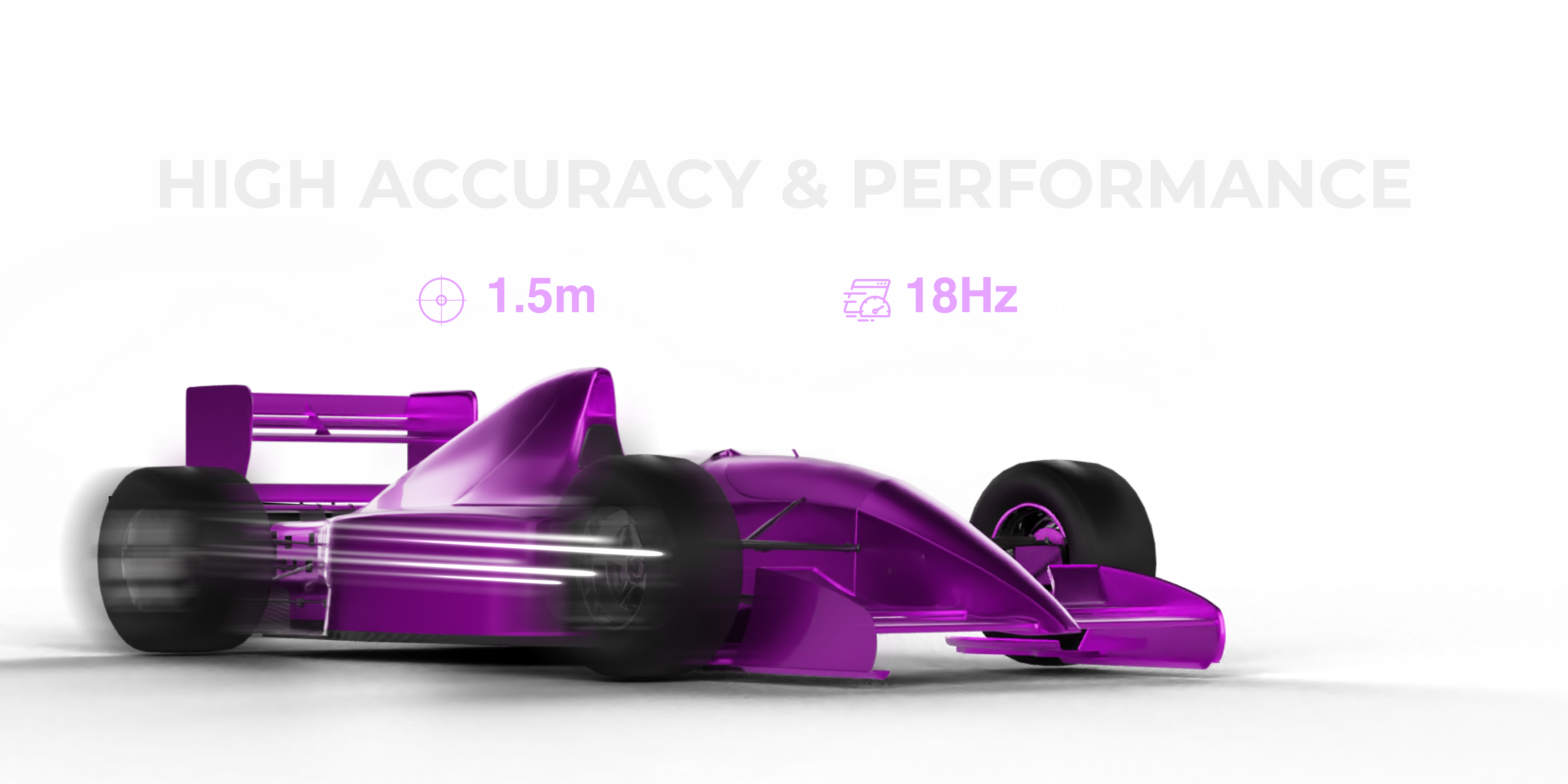
A 1.5-meter CEP (Circular Error Probable) means that 50% of reported positions fall within 1.5 meters of the actual location. For most developer applications — drone navigation, asset tracking, geofencing, precision agriculture, research data collection — this level of accuracy is more than sufficient and dramatically better than the 3-5 meter accuracy typical of consumer-grade GPS modules.
This accuracy is achieved through the concurrent multi-constellation architecture of the MIA-M10Q. When GPS, Galileo, GLONASS, and BeiDou are all contributing satellite signals simultaneously, the receiver has more geometric diversity to compute a tighter position solution. More satellites from more orbital planes means better dilution of precision (DOP) and a more confident fix.
The proprietary RF/microwave microstrip filter technology built into the MultiNav Pro+ further improves accuracy by attenuating out-of-band interference before it reaches the RF front end. In real-world urban and industrial environments where RF noise is significant, this filtering makes a measurable difference in fix quality and NMEA output consistency.
18Hz Fix Rate — Fast Enough for High-Speed Tracking
Most GNSS modules targeting the maker market operate at 1Hz — one position update per second. Some mid-range modules push to 5Hz or 10Hz. The MultiNav Pro+ delivers 18Hz, meaning your application receives a fresh position via the GNSS module NMEA output stream 18 times every second.
For a drone flying at 60 km/h, a 1Hz update means positional data is 16 meters stale between fixes. At 18Hz, that staleness drops to under one meter. For FPV racing, autonomous flight, precision landing, and any tracking application where the target is moving fast, 18Hz is not a luxury — it is a requirement.
First Fix in 1 Second
Time-to-first-fix (TTFF) is the delay between powering on your module and receiving a valid position in your NMEA output stream. The MultiNav Pro+ achieves a 1-second first fix under good sky conditions using hot start. This near-instant availability means your application can begin operating without waiting through the 30-60 second acquisition cycles common in lower-end modules.
Power Efficiency and Physical Design
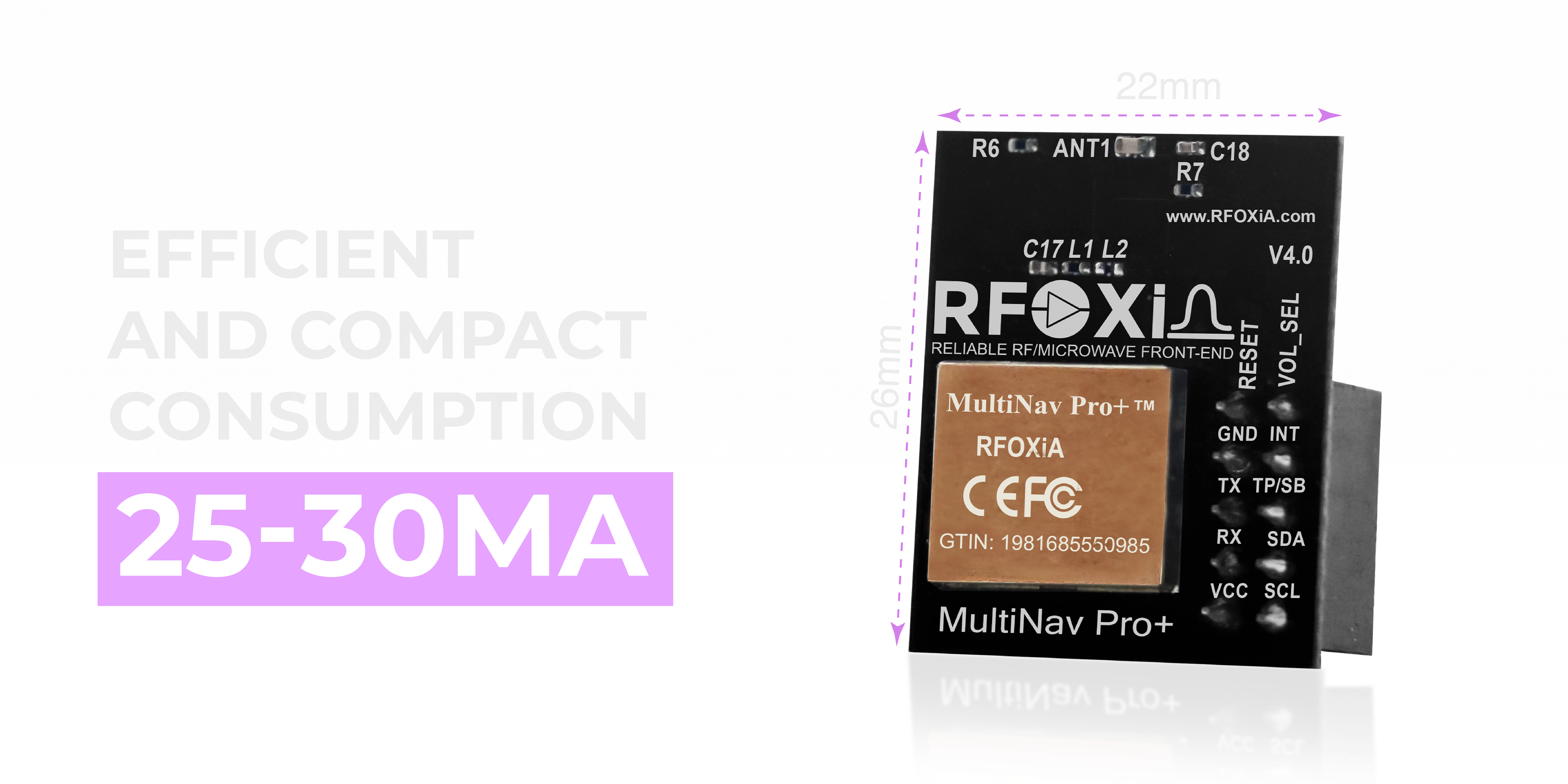
Running full multi-constellation tracking at 18Hz, the MultiNav Pro+ consumes just 25-30mA. For context, a typical 18650 lithium cell stores 3,000mAh — theoretically powering the module for 100+ hours of continuous operation. When paired with RFOXiA's supercapacitor-based Power/Program Kit, this power profile enables extended field deployments without battery management complexity.
The 26mm × 22mm footprint is a critical design consideration for space-constrained builds. Drone frames, wearable trackers, embedded agricultural sensors, and vehicle-mounted systems all benefit from a module that delivers professional performance without dominating the PCB. The integrated high-gain chip antenna eliminates the need for external antenna routing, keeping your BOM simple and your layout clean.
Voltage compatibility covers both 1.8V and 3.3V logic levels, making the MultiNav Pro+ drop-in compatible with virtually every modern microcontroller family including STM32, ESP32, Arduino, Raspberry Pi Pico, Nordic nRF series, and NXP i.MX RT.
Interface Options: UART and I2C for Maximum Flexibility
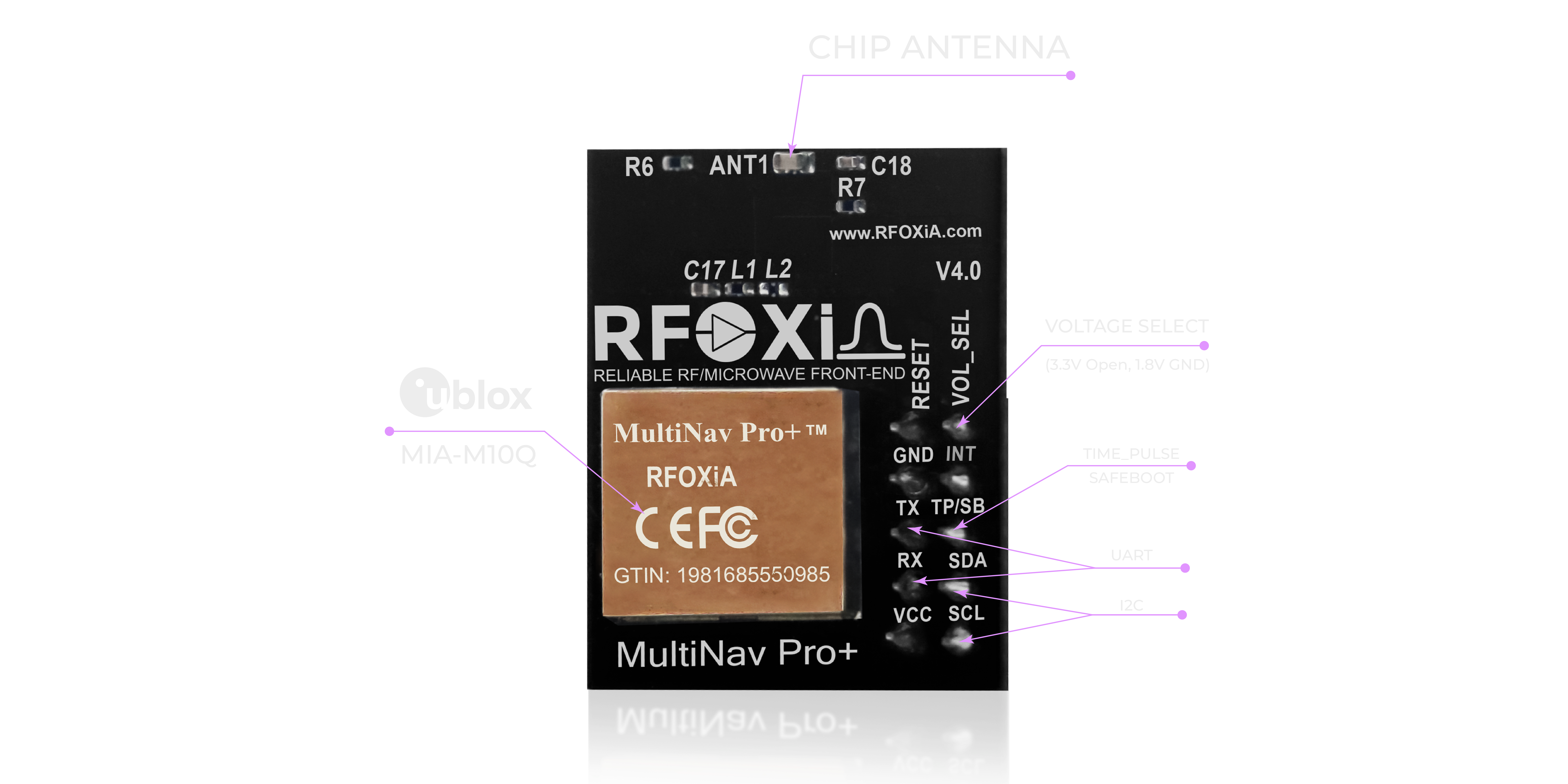
The MultiNav Pro+ supports two interface modes:
UART Interface (TX/RX)
UART is the classic interface for GNSS module NMEA output. Your module transmits NMEA sentences as ASCII text over the TX line at a configurable baud rate (default 9600, configurable to 115200+). Your microcontroller reads the serial stream, parses the NMEA sentences, and extracts position, velocity, and time data.
UART is ideal when:
- You want a simple, direct connection to a microcontroller UART peripheral
- You are streaming NMEA to a PC via USB-serial adapter for evaluation
- You are using the u-center software for configuration and visualization
- Your application needs minimal latency between fix and data availability
I2C Interface (SCL/SDA)
I2C allows the MultiNav Pro+ to share a two-wire bus with other sensors and peripherals, reducing pin count and simplifying wiring on crowded PCBs.
I2C is ideal when:
- Your microcontroller has limited UART peripherals
- You are building a multi-sensor node with other I2C devices (accelerometer, barometer, etc.)
- You want polled position reads rather than a continuous NMEA stream
- You are integrating with the RFOXiA Sensors Module on a shared bus
Both interfaces are fully supported by the included open-source library, with no additional configuration required to switch between them.
Open-Source NMEA Library: From Module to Application in Minutes
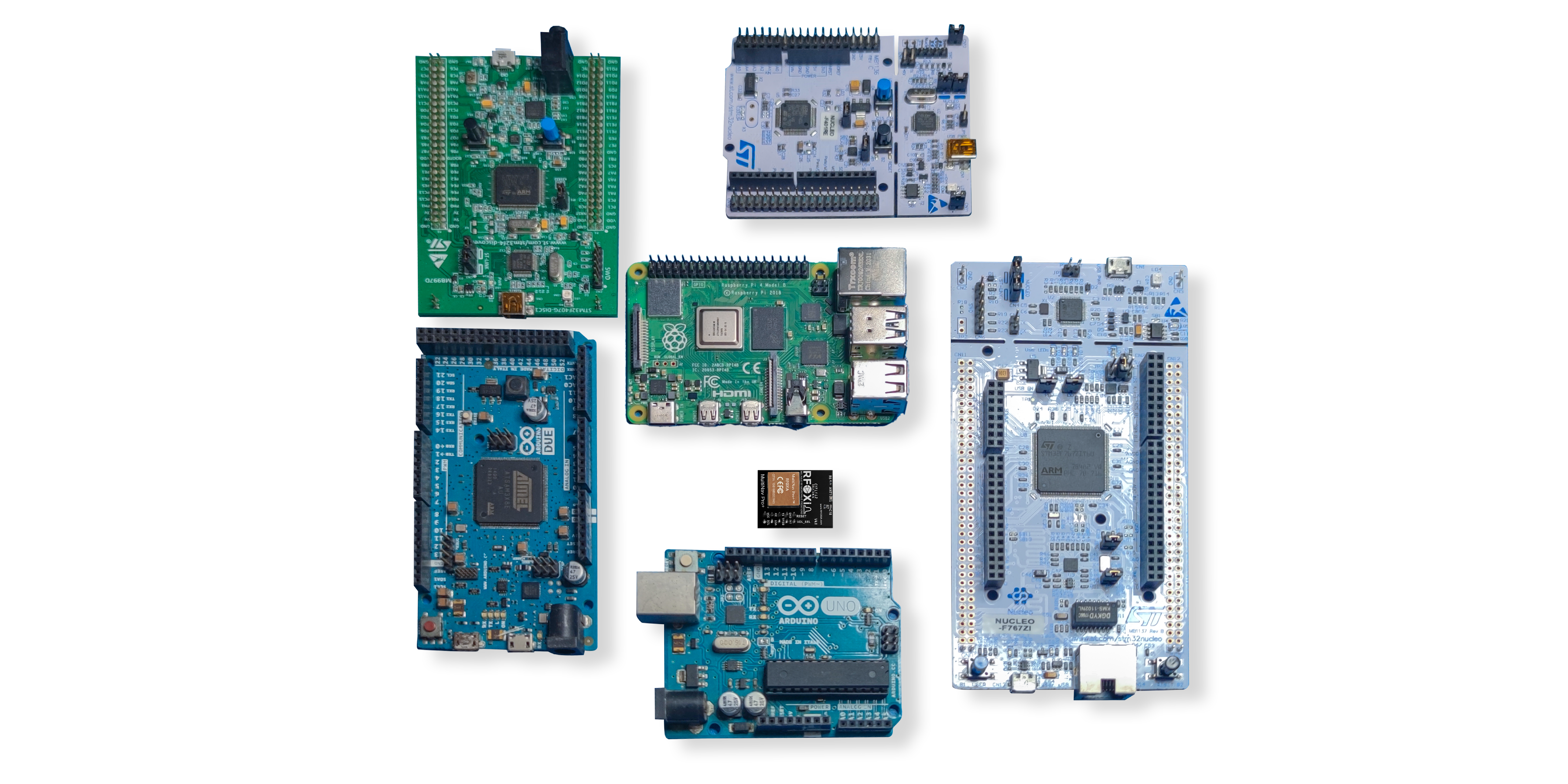
One of the most practical advantages of the MultiNav Pro+ is the fully open-source C language driver library that ships with every module. This library implements the complete NMEA standard protocol command set, giving you:
- Automatic parsing of all standard NMEA sentence types
- Structured data objects for latitude, longitude, altitude, speed, heading, fix quality, and satellite count
- Configuration commands to set update rate, enable/disable sentence types, and adjust power modes
- Compatible with Arduino IDE, PlatformIO, STM32CubeIDE, ESP-IDF, and virtually any C/C++ toolchain
Importing the library into Arduino IDE is a single ZIP import operation. From there, reading your GNSS module NMEA output data in your sketch requires just a few lines of initialization code. The library handles all the serial parsing, checksum verification, and data extraction automatically.
For developers who want to go deeper, the full source code is available for inspection, modification, and extension. If your application requires custom NMEA sentence types or proprietary u-blox UBX protocol commands, the library architecture makes extending it straightforward.
RFOXiA Club members also have access to the AI Firmware Builder — describe your GNSS application in plain language and receive production-ready firmware with full source code. What previously required days of NMEA parsing implementation now takes minutes. RFOXiA Accurate GNSS Module is the hardware that powers all of this.
U-Center Software: Professional Evaluation and Configuration
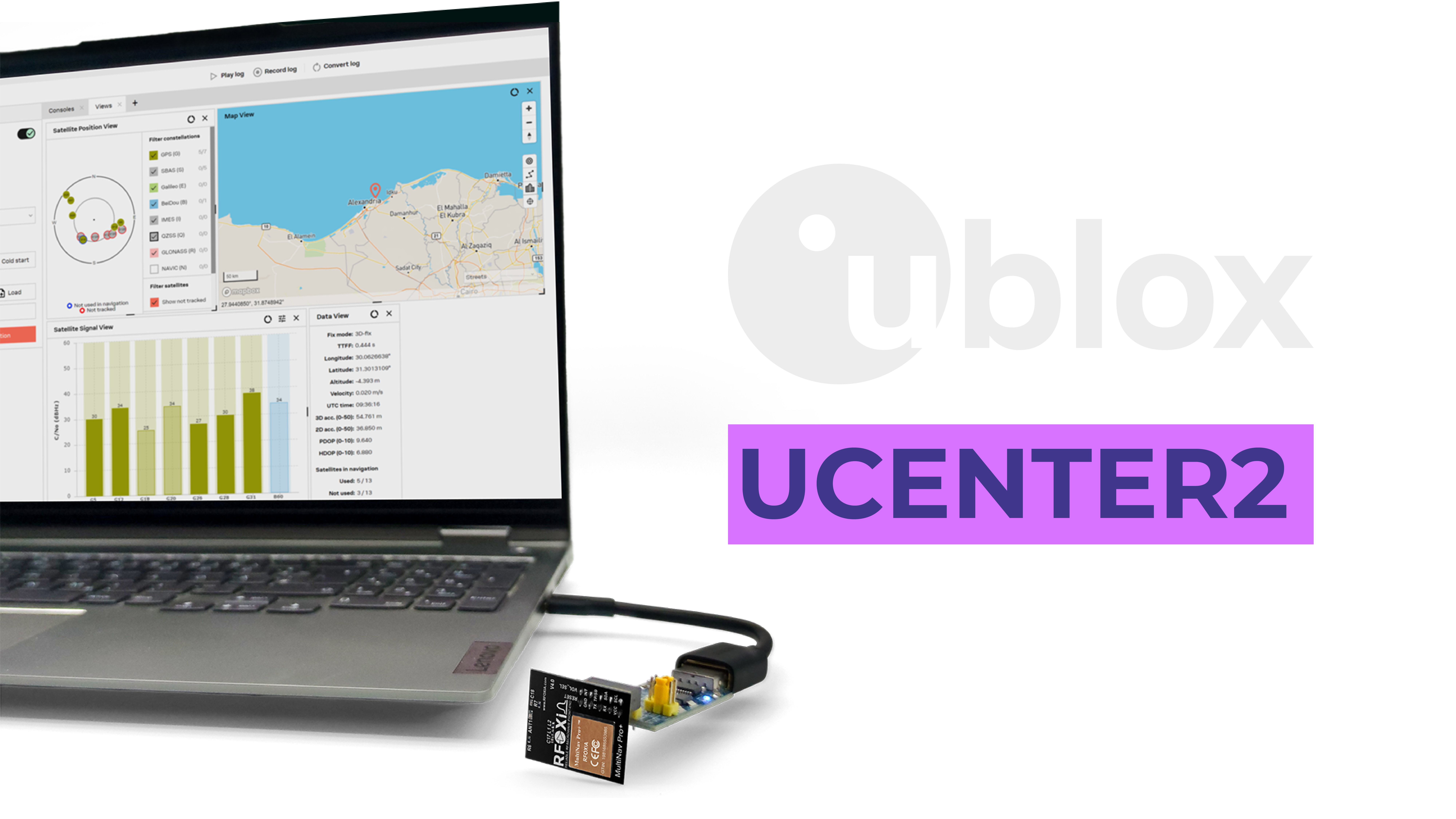
Because the MultiNav Pro+ is built on the u-blox MIA-M10Q, it is fully compatible with u-center — u-blox's professional GNSS evaluation and configuration software.
u-center gives you:
- Satellite visualization — see which satellites from each constellation are visible and their signal strength in real time
- Live map tracking — watch your position update on a map as you move
- Fix quality metrics — HDOP, VDOP, satellite count, fix mode (2D/3D)
- NMEA and UBX message configuration — enable, disable, and customize the output stream
- Update rate control — configure your GNSS module NMEA output frequency from 1Hz up to 18Hz
- Data logging — record full NMEA sessions to file for post-processing and analysis
- Firmware evaluation — assess module performance under different environmental conditions
For professional applications where you need to validate module performance before deployment, or tune the NMEA output configuration for a specific use case, u-center provides a complete toolset at no additional cost.
Real-World Applications Where MultiNav Pro+ Excels

The combination of 1.5-meter accuracy, 18Hz fix rate, multi-constellation support, and clean GNSS module NMEA output makes the MultiNav Pro+ the right choice across an unusually wide range of applications:
Drone Navigation and Autopilot
The 18Hz update rate is purpose-built for drone applications. Whether you are building a custom autopilot, adding GPS hold to an FPV quad, or developing a waypoint navigation system, the MultiNav Pro+ delivers the positional update speed that modern flight controllers require. Paired with the RFOXiA BLE module's 15-20km man-to-drone range, you have a complete position-aware long-range drone communication system.
IoT Asset Tracking
Battery-powered tracking devices need a GNSS module that acquires quickly and consumes minimal power between fixes. The 1-second first fix and 25-30mA operating current make the MultiNav Pro+ ideal for periodic-wake tracking architectures where the module powers on, acquires a fix, transmits the NMEA data, and powers off within seconds.
Wearables and Personal Navigation
The 26mm × 22mm footprint and 1.8V compatibility make the MultiNav Pro+ one of the most compact high-performance GNSS solutions available for wearable builds. Activity trackers, personal safety devices, sports performance monitors, and field research wearables all benefit from sub-2-meter accuracy in a minimal physical package.
Precision Agriculture
Micro-climate and soil condition monitoring systems need accurate GPS coordinates attached to every data point to enable spatial analysis. The MultiNav Pro+ provides the location anchoring for RFOXiA's Sensors Module data, enabling farmers and agronomists to build geo-referenced environmental datasets with 1.5-meter spatial resolution.
Research and Data Collection
University researchers, environmental scientists, and field data collectors rely on precise, timestamped location data. The GNSS module NMEA output from the MultiNav Pro+ provides both — GPS-synchronized timestamps accurate to sub-millisecond levels, and position accuracy sufficient for most field research protocols.
Automotive and Transportation
Vehicle tracking, fleet management, and transportation research applications benefit from the high update rate and multi-constellation coverage. Whether tracking delivery vehicles in dense urban canyons or monitoring test vehicles on a proving ground, the MultiNav Pro+ maintains fix quality where single-constellation modules struggle.
RFOXiA Data Network
Users who deploy the MultiNav Pro+ alongside the RFOXiA Sensors Module can contribute to the RFOXiA live data network — streaming GPS-verified environmental data and earning daily rewards. The GPS validation built into the data network's verification system specifically requires the kind of accurate, consistent NMEA output that the MultiNav Pro+ provides. It is one of the few GNSS modules at this price point where the accuracy and fix rate are sufficient to pass the network's data quality checks consistently.
Integration Walkthrough: From Unboxing to Live NMEA Data
Getting the MultiNav Pro+ outputting live NMEA data in your project follows a straightforward path:
Step 1: Connect the Hardware For UART operation, connect VCC to 3.3V (or 1.8V if your system requires it), GND to ground, TX to your microcontroller's RX pin, and RX to your microcontroller's TX pin. Four wires total.
Step 2: Import the Library Download the open-source C library from RFOXiA Club resources. In Arduino IDE, navigate to Sketch → Include Library → Add .ZIP Library and import the downloaded file. The library installs in seconds.
Step 3: Initialize the Module In your sketch, include the library header and call the initialization function with your serial port reference and desired baud rate. The library configures the module, sets the update rate, and begins streaming NMEA output automatically.
Step 4: Read Position Data Call the library's update function in your main loop. Structured position data — latitude, longitude, altitude, speed, heading, fix quality, satellite count — is available as clean numeric values ready for your application logic.
Step 5: Verify with u-center (Optional) Connect the module via USB-serial adapter to your PC and open u-center to visualize satellite acquisition, verify fix quality, and configure advanced options like power saving modes or custom NMEA sentence selection.
For developers who want even faster integration, RFOXiA Club's AI Firmware Builder can generate the complete initialization and data-reading code for your specific microcontroller and application in minutes. RFOXiA Accurate GNSS Module includes access to the full developer resource library with example projects for the most common use cases.
MultiNav Pro+ vs. Generic GNSS Modules: An Honest Comparison
When evaluating GNSS modules for your next project, the comparison that matters is not just price — it is the total development cost including integration time, the operational cost including battery replacement, and the accuracy cost including how close your application needs positions to be.
| Feature | Generic 1Hz GPS Module | MultiNav Pro+ |
|---|---|---|
| Fix Rate | 1Hz | 18Hz |
| Accuracy | 3-5m typical | 1.5m CEP |
| Constellations | GPS only | GPS + Galileo + GLONASS + BeiDou |
| First Fix Time | 30-60s cold start | 1s hot start |
| NMEA Library | Often none or poorly documented | Open-source, Arduino-ready, maintained |
| Evaluation Software | None | u-center professional suite |
| FCC Certification | Rarely | Yes |
| Interface Options | UART only | UART + I2C |
| Voltage Options | 3.3V typically | 1.8V and 3.3V |
For applications where any of the right-column specifications matter — and for most professional or commercial builds, many of them will — the MultiNav Pro+ is not an upgrade from a generic module. It is a fundamentally different class of hardware.
Package Contents and Getting Started
Every MultiNav Pro+ ships with:
- The MultiNav Pro+ GNSS module (26mm × 22mm)
- Quick Start Guide with pinout, wiring diagram, and first-use instructions
- Library download link and access to RFOXiA Club developer resources
The module is available individually at $49, and as part of the Developer Bundle ($199) which combines the MultiNav Pro+ with the RFOXiA long-range BLE module, 7-in-1 Sensors Module, and supercapacitor Power/Program Kit. The Developer Bundle is the fastest path to a complete wireless development ecosystem.
All RFOXiA modules are in-stock and ship from verified manufacturing partners. FCC certification documentation is available for download from RFOXiA Club for distribution, academic, and regulatory purposes.
Conclusion: The GNSS Module Your Project Actually Deserves
The MultiNav Pro+ represents what happens when professional-grade GNSS engineering meets a commitment to making that engineering accessible to every developer, researcher, and builder — not just those with enterprise hardware budgets.
With a GNSS module NMEA output refreshing at 18Hz, 1.5-meter positional accuracy, concurrent four-constellation coverage, open-source library support, and a compact form factor that fits anywhere, the MultiNav Pro+ eliminates the compromises that have historically forced developers to choose between capability and affordability.
Whether you are building your first GPS-enabled Arduino project or designing the navigation system for a commercial drone platform, the MultiNav Pro+ delivers the accuracy, speed, and developer experience to bring your application to life without months of low-level NMEA parsing work.
RFOXiA Accurate GNSS Module — explore the full specifications, order your module, and access the complete developer resource library from RFOXiA Club.
FCC certified. In stock. Ready to ship.
Written by: Moamen Mohamed LinkedIn