
GNSS Module Robotics: The MultiNav Pro+ Is Redefining Precision Navigation
Why Your Robotics Project Demands a True GNSS Module for Robotics
If you have ever tried to build a robot, autonomous vehicle, or drone with a generic GPS breakout board, you already know the pain. Positions jump by meters. Fix rates are painfully slow. Multi-path interference wrecks accuracy in anything but an open field. And when your robot is moving fast — a delivery bot threading a parking lot, an inspection drone tracing a pipeline, an agricultural rover following crop rows — a 10-meter position error is not a minor inconvenience. It is a mission failure.
The truth is that most affordable GPS modules were designed for static or slow-moving consumer applications. They were not built with robotics in mind. Robotics demands something fundamentally different: sub-meter positioning that updates fast enough to match mechanical motion, satellite redundancy that survives urban canyons and tree cover, and an interface clean enough to integrate without a firmware archaeology project.
This is exactly the gap the MultiNav Pro+ GNSS module from RFOXiA was designed to fill. It is a professional-grade GNSS module for robotics applications, priced so that every builder — not just well-funded research labs — can access precision navigation.
What Makes a GNSS Module Right for Robotics?
Before diving into the MultiNav Pro+ specifications, it is worth understanding what separates a robotics-grade GNSS module from a consumer-grade one. There are four critical criteria:
1. Positional Accuracy
Consumer GPS modules typically achieve 3–10 meters of accuracy under ideal conditions. For a person navigating to a coffee shop, that is fine. For a robot executing a precision maneuver, it means the system does not know which side of a doorway it is on. A robotics-grade GNSS module must achieve sub-2-meter accuracy as a baseline — and the MultiNav Pro+ delivers less than 1.5 meters consistently.
2. Fix Rate (Update Frequency)
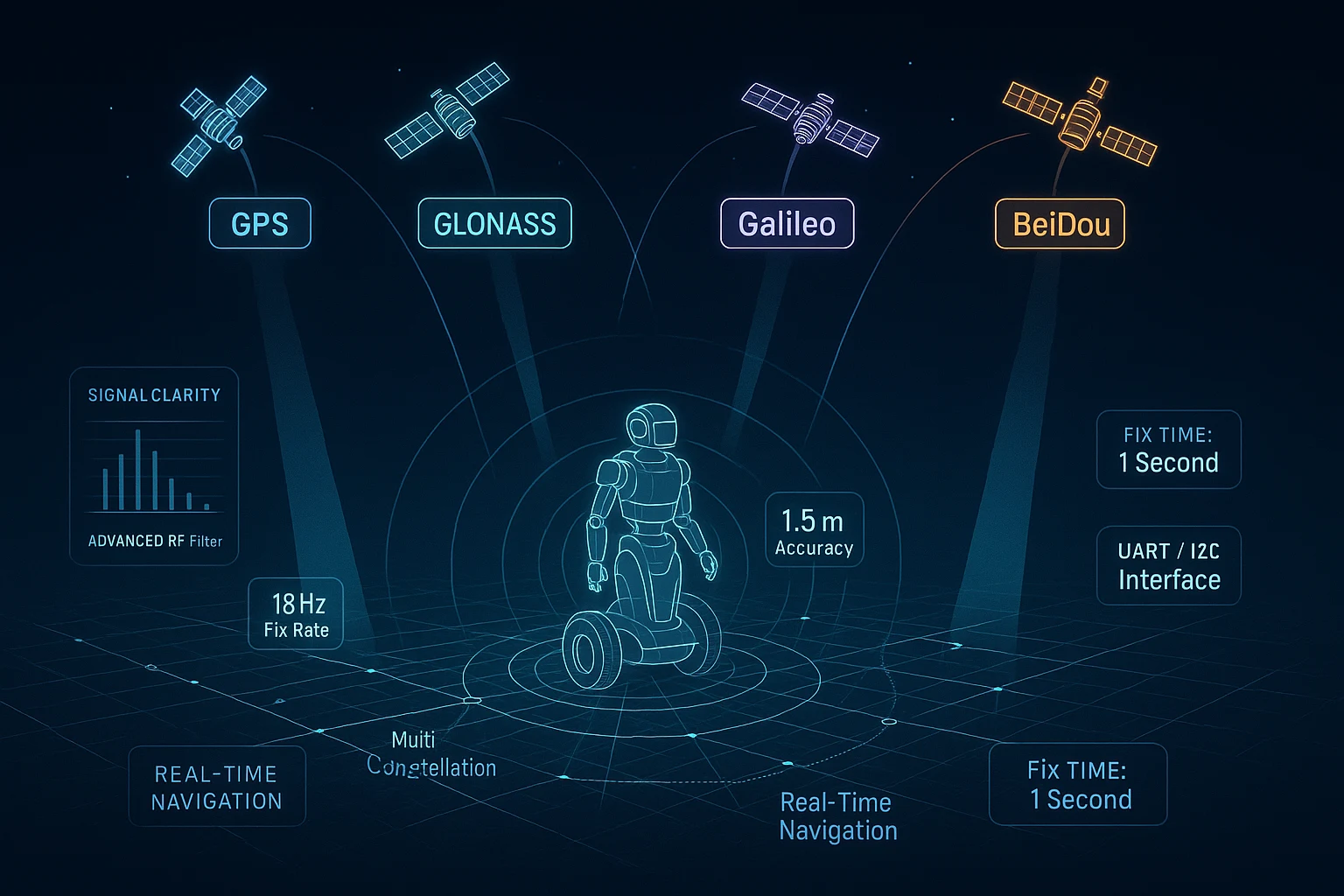
A standard GPS module updates at 1Hz — one position fix per second. At 5 meters per second (a brisk robot pace), that means 5 meters of movement between position updates. A GNSS module for robotics needs a high fix rate to stay synchronized with mechanical motion. The MultiNav Pro+ offers 18Hz — eighteen position updates per second — which is fast enough for smooth closed-loop control on most robotic platforms.
3. Multi-Constellation Support
Single-constellation GPS receivers (GPS only) can struggle in environments with limited sky view: between buildings, under trees, near metal structures. Multi-constellation receivers that pull signals from GPS, GLONASS, Galileo, and BeiDou simultaneously have far more satellites to work with, resulting in better accuracy and faster acquisition even in challenging environments.
4. Developer Integration
A module that requires days of firmware work to produce useful NMEA data is a liability in a project. Robotics developers need plug-and-play compatibility, clean library support, and flexibility to interface with the microcontrollers and single-board computers already in their stack.
The MultiNav Pro+ meets all four criteria — and it does so at $49, a price point that makes it genuinely accessible.
MultiNav Pro+: Technical Specifications Deep Dive
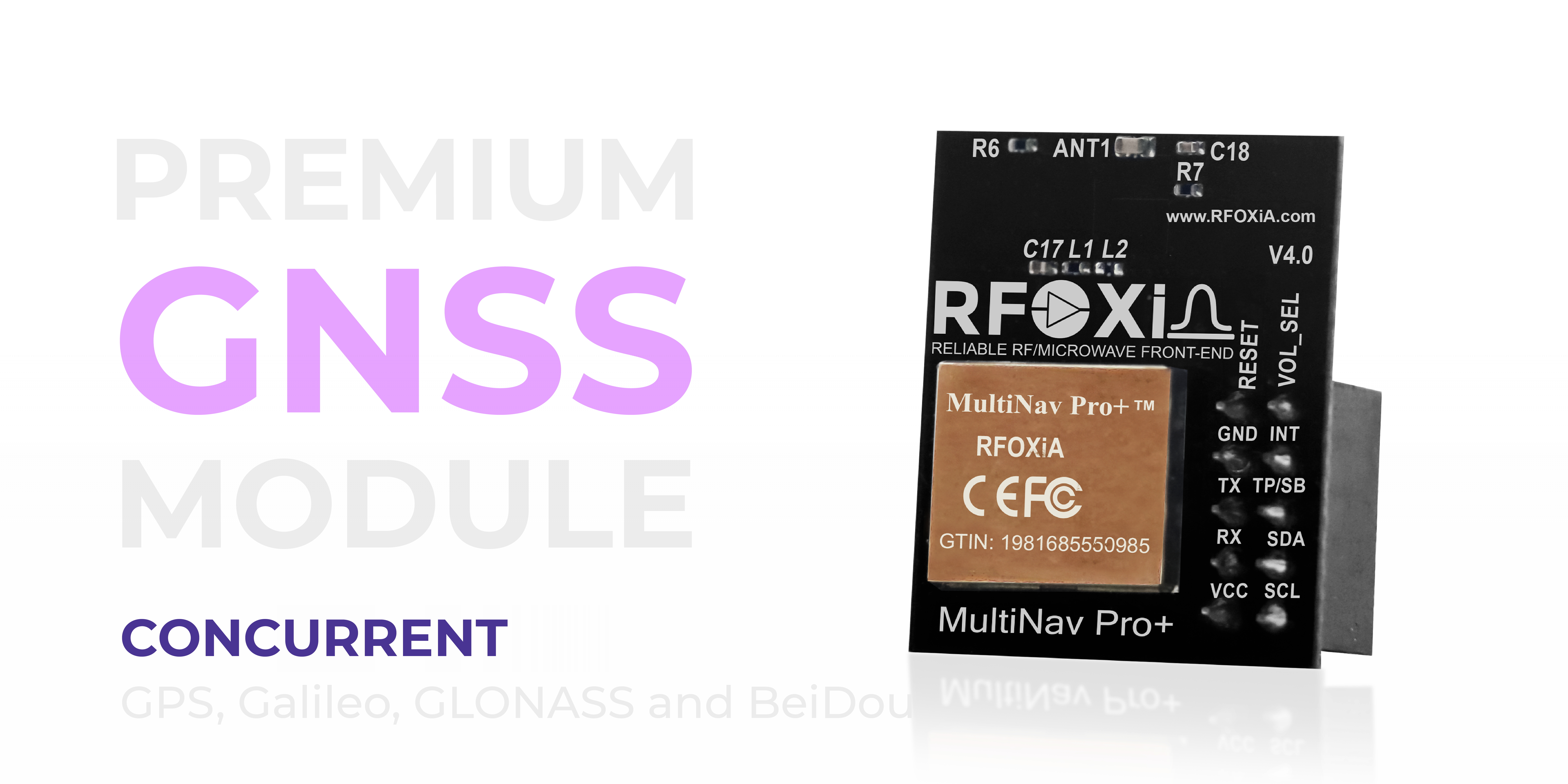
At the heart of the MultiNav Pro+ is the u-blox MIA-M10Q — one of the newest and most capable GNSS chips available to the commercial market. u-blox is the gold standard in professional GNSS silicon, trusted by industrial OEMs, automotive manufacturers, and aerospace integrators worldwide. By building on the MIA-M10Q, RFOXiA is delivering proven, enterprise-grade positioning technology inside a maker-accessible form factor.
Core Performance
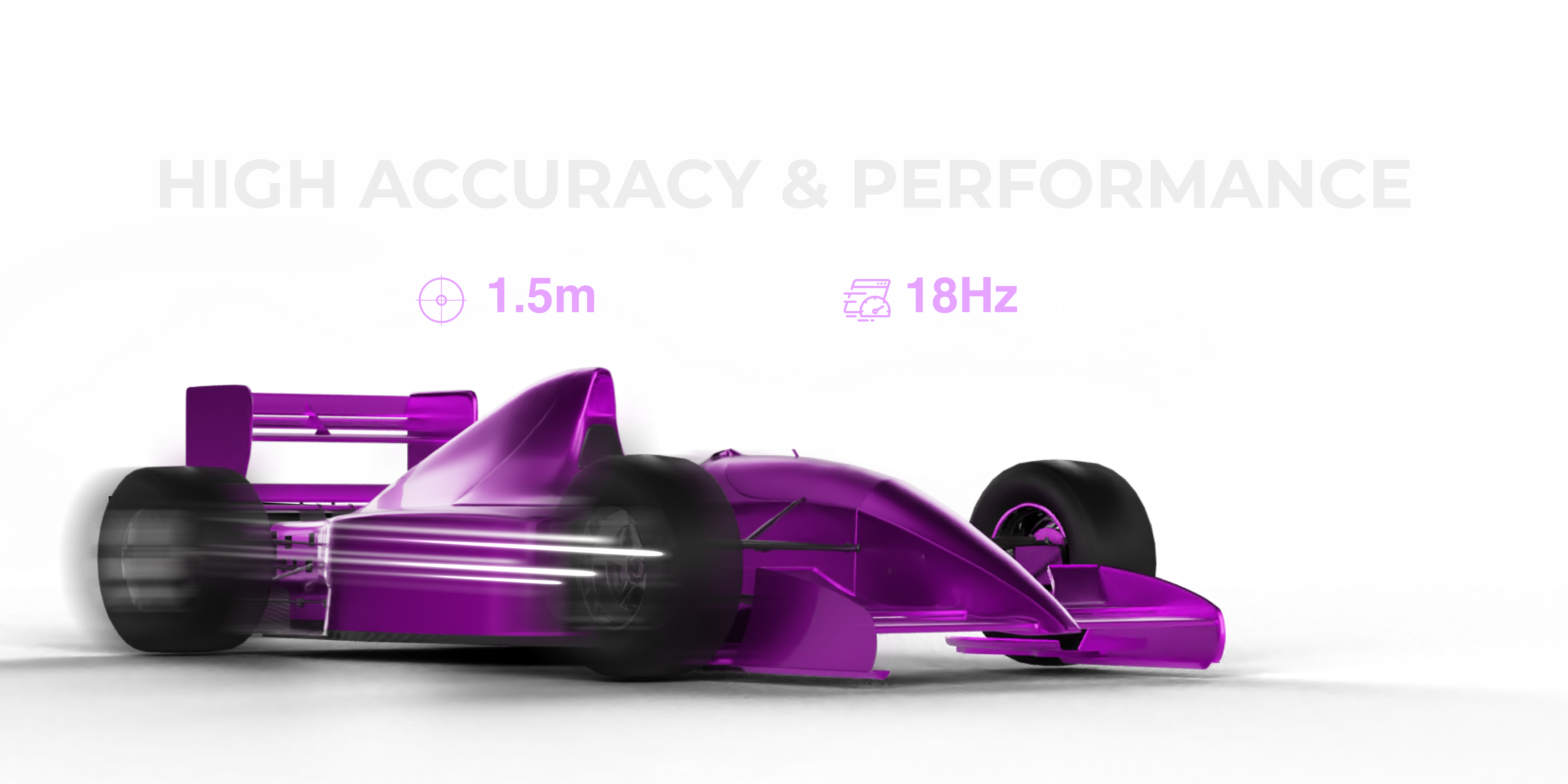
- Accuracy: Less than 1.5 meters CEP (Circular Error Probable) — exceptional for a chip-antenna module at this price
- Fix Rate: Up to 18Hz — fast enough for high-velocity platforms and real-time control loops
- Time to First Fix (TTFF): 1 second — robots do not wait around for a GPS lock
- Satellite Systems: Concurrent GPS, Galileo, GLONASS, and BeiDou — all four major constellations simultaneously
- Advanced RF Filtering: Proprietary RF/microwave microstrip filter technology minimizes interference and signal noise, delivering clean positioning data even near RF-dense electronics
The 1-second time to first fix deserves special attention. Many robotics deployments involve frequent power cycling — a robot that boots, executes a mission, and powers down. A module that needs 30–45 seconds to acquire a valid fix adds significant operational latency. One second changes the deployment math entirely.
Physical and Electrical Characteristics
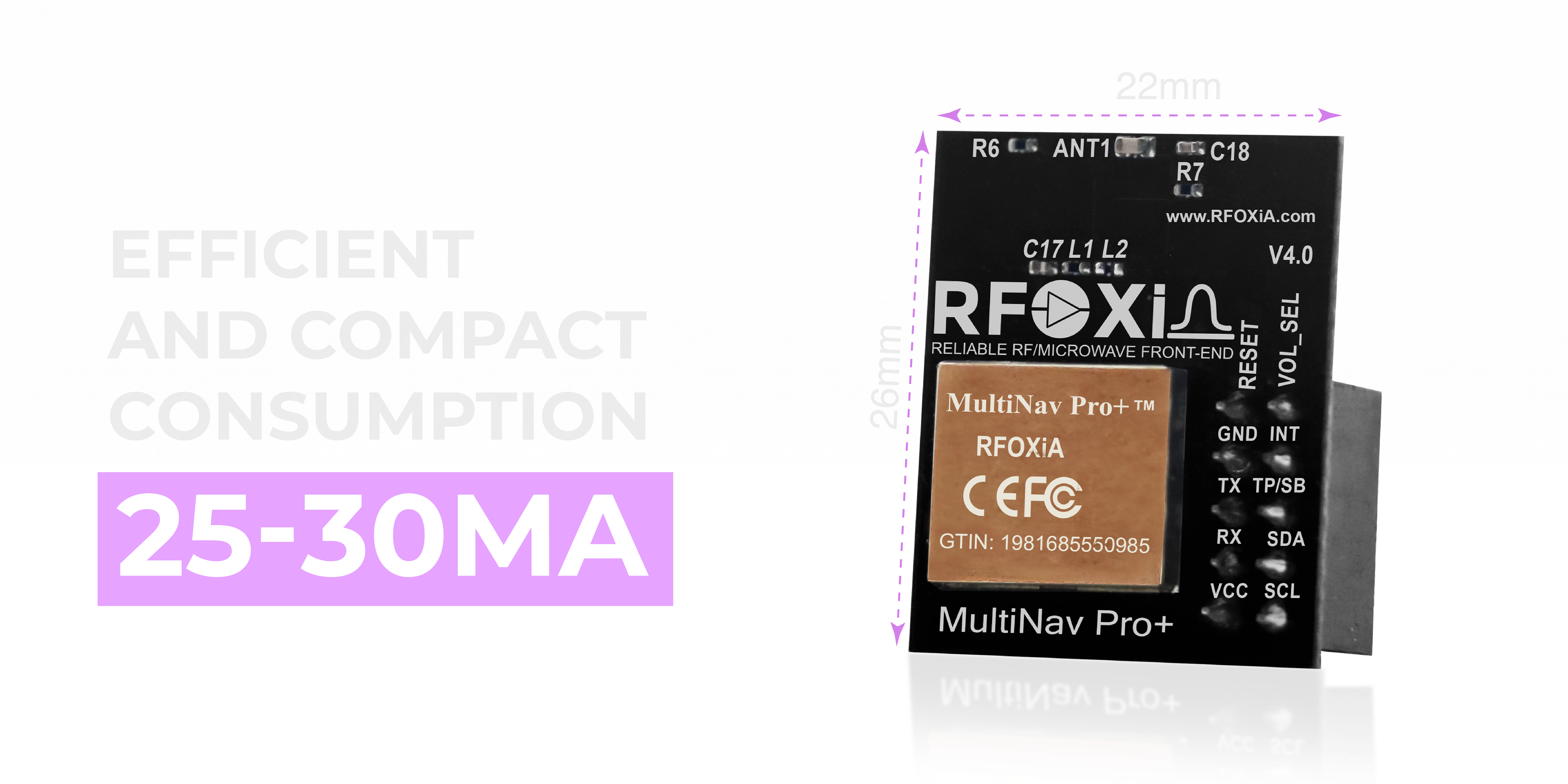
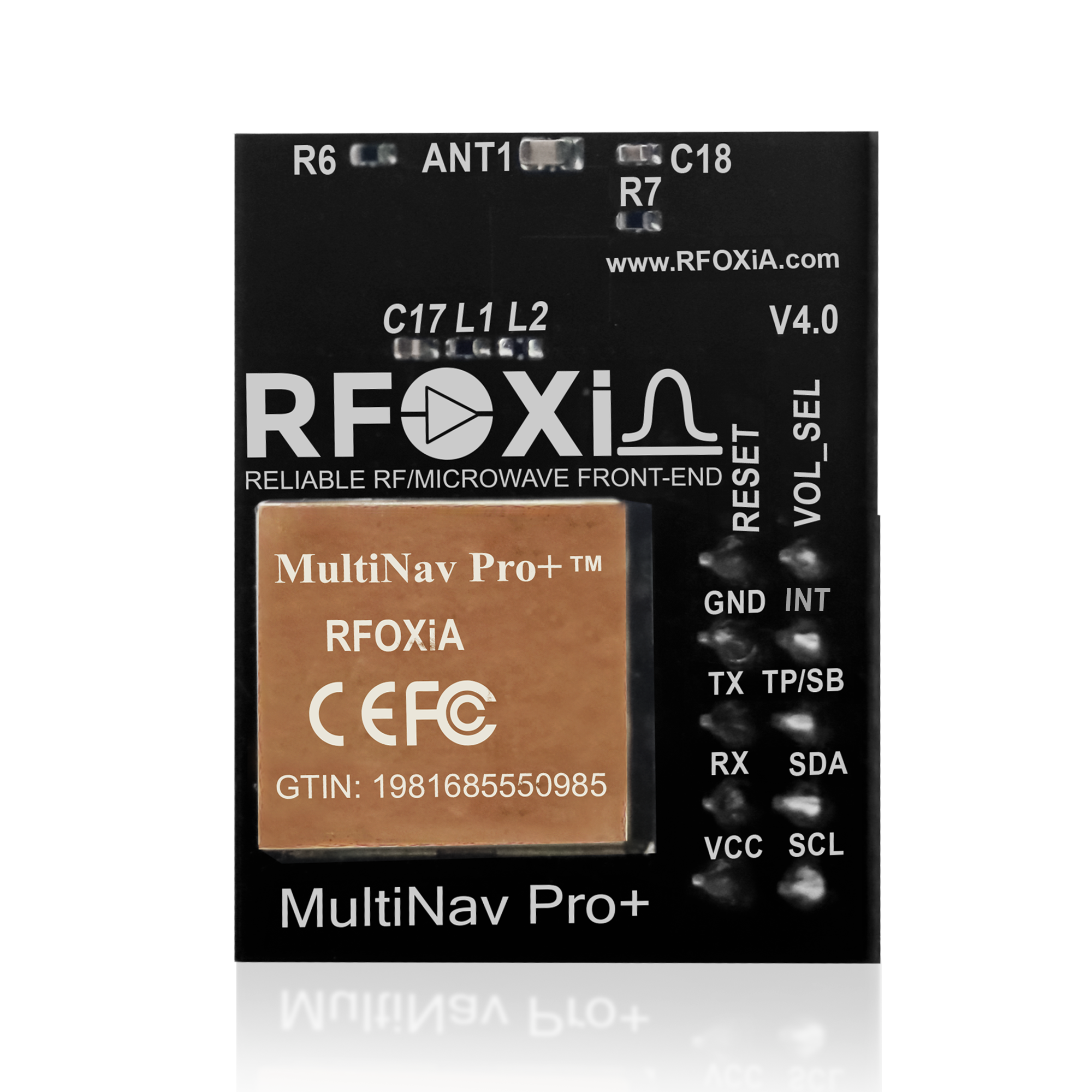
- Dimensions: 26mm x 22mm — compact enough to fit inside virtually any robot chassis or drone frame
- Power Consumption: 25–30mA — highly efficient for a multi-constellation receiver; compatible with battery-powered mobile platforms
- Integrated Chip Antenna: No external antenna required; optimal signal reception built into the module footprint
- Supply Voltage: 1.8V and 3.3V — compatible with a wide range of modern microcontrollers and SBCs
For drone builders specifically, the power and weight budget matters enormously. At 25–30mA and a form factor smaller than a postage stamp, the MultiNav Pro+ adds almost nothing to the payload equation while delivering professional positioning performance.
Interface and Connectivity
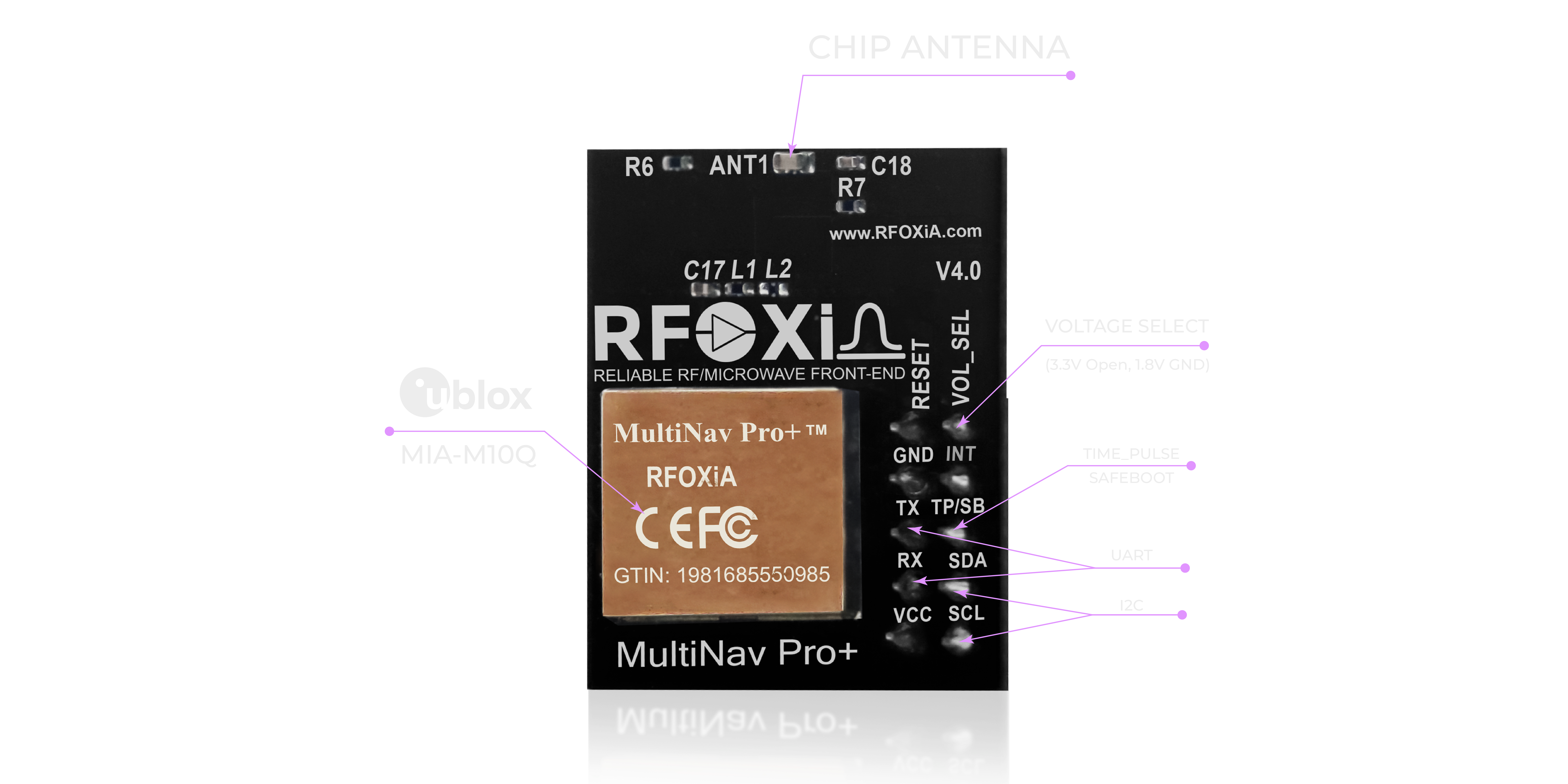
- UART: Standard TX/RX serial interface — compatible with virtually every microcontroller from Arduino to STM32 to ESP32
- I2C: SCL/SDA for environments where UART pins are already allocated
- Protocol: NMEA standard — the universal language of GNSS data, readable by every major robotics framework
Supporting both UART and I2C means the MultiNav Pro+ fits into your existing hardware design without forcing interface compromises. Whether you are running ROS on a Raspberry Pi, building a custom STM32 flight controller, or prototyping with Arduino, the module speaks your language.
Open Source Driver: No Black Box Navigation
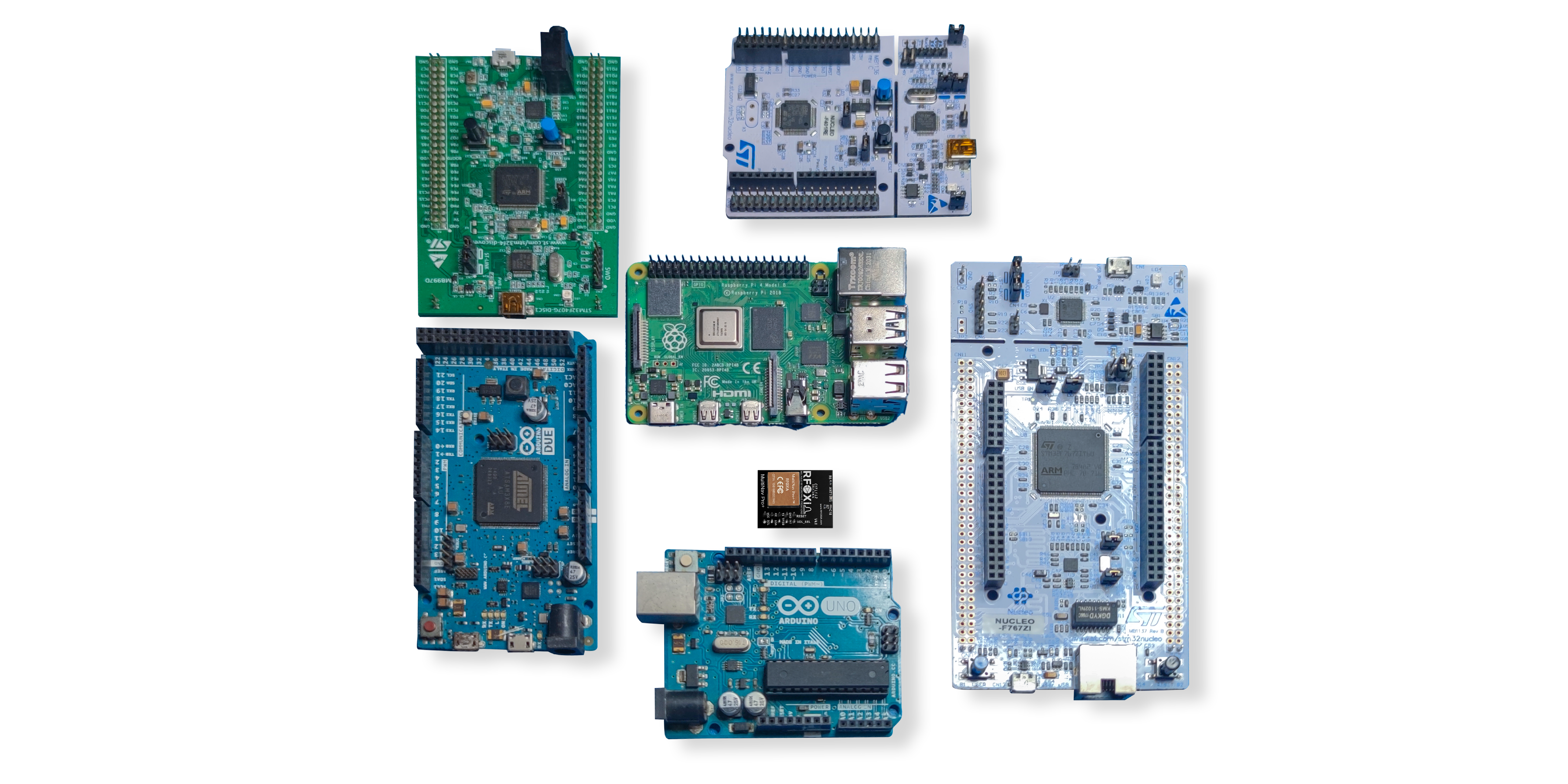
One of the most practical advantages of the MultiNav Pro+ for robotics developers is the fully open-source C language driver library. This is not a binary blob with a thin abstraction layer — it is complete source code implementing NMEA standard protocol commands, which means:
- You can read, modify, and extend the library to suit your application
- Integration into Arduino IDE is straightforward — import and run
- The same library works with any C-compatible toolchain: PlatformIO, STM32CubeIDE, ESP-IDF, Zephyr RTOS, and more
- You can contribute improvements back to the community
For robotics engineers who need custom parsing of specific NMEA sentences, who want to implement their own Kalman filter fusion, or who are integrating into a proprietary software stack, open-source firmware is not a nice-to-have — it is a requirement. The MultiNav Pro+ delivers it out of the box.
Explore the RFOXiA Accurate GNSS Module and its complete open-source resources on the RFOXiA platform.
U-Center Software: Visualize, Configure, Validate
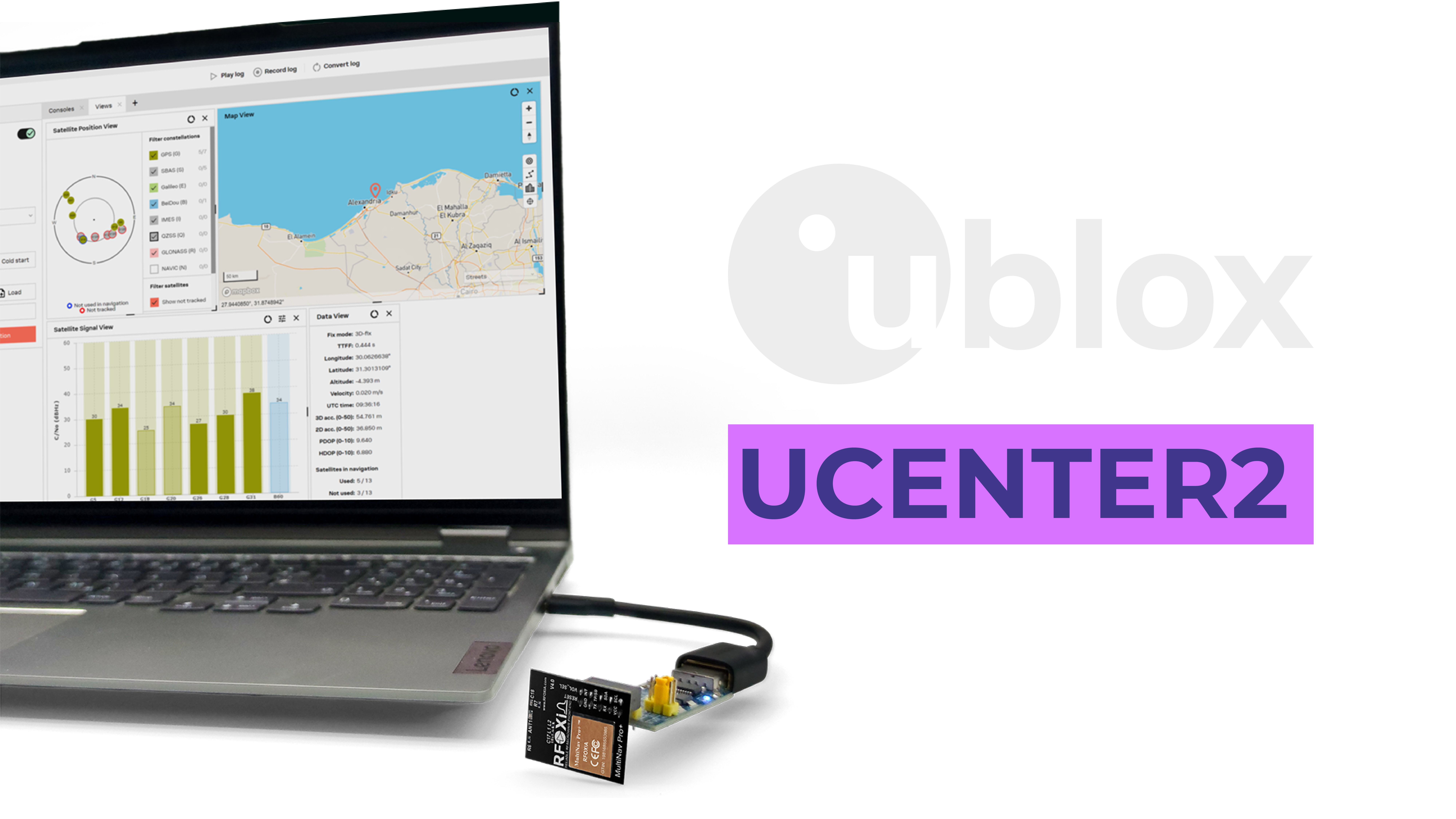
Because the MultiNav Pro+ is built on the u-blox MIA-M10Q, it is fully compatible with u-center — u-blox's professional GNSS evaluation and configuration software. u-center gives robotics developers a powerful GUI environment to:
- Visualize satellite acquisition — see exactly which satellites are in view, their signal strength, and constellation distribution
- Track live movement — map-based visualization of real-time position updates, perfect for validating robot navigation paths
- Configure output messages — select which NMEA sentences to enable, set fix rates, configure power modes
- Log and analyze data — capture positioning sessions for post-mission analysis
- Evaluate accuracy — compare live position against known reference points to validate module performance
For a robotics engineer validating a new navigation system, u-center compresses what would otherwise be days of serial terminal debugging into minutes of graphical analysis. It is the professional tool that makes the professional module even more useful.
GNSS Module Robotics Applications: Where the MultiNav Pro+ Excels

The MultiNav Pro+ is not optimized for a single vertical — it is engineered to be the right GNSS module for robotics across a broad range of demanding applications:
Autonomous Ground Robots
Waypoint navigation, geofencing, and outdoor localization all depend on accurate, fast-updating position data. The MultiNav Pro+'s 18Hz fix rate enables smooth position feedback for autonomous navigation controllers, while the 1.5m accuracy is sufficient for most outdoor waypoint-following applications without RTK correction.
Drone Navigation and Return-to-Home
For FPV pilots and autonomous drone builders alike, reliable GNSS is the backbone of safe flight. The MultiNav Pro+'s 1-second TTFF means the drone is ready to fly almost immediately after power-on. The 18Hz update rate provides smooth position hold and responsive GPS-assisted flight modes. Paired with the RFOXiA BLE module and Connect app, the full ecosystem enables live GPS tracking with kilometer-scale wireless range.
Agricultural Robotics
Crop row following, variable-rate application, and field mapping all require consistent outdoor positioning. The multi-constellation support ensures reliable satellite acquisition even when equipment is operating near terrain features or under partial canopy. The low power consumption is ideal for solar-charged field robots with constrained energy budgets.
Asset Tracking and Fleet Management
For tracking modules on vehicles, containers, or mobile equipment, the MultiNav Pro+'s compact form factor and I2C/UART flexibility make it easy to embed into custom tracking hardware. The fast fix rate means position updates are current even on fast-moving assets.
Research and Development
University labs, independent researchers, and hardware startups benefit from a GNSS module that delivers professional specifications without a $300+ price tag. The open-source driver, u-center compatibility, and clean interface documentation mean researchers spend time on their research — not fighting their tools.
Wearables and Portable Devices
The 26mm x 22mm footprint and 25–30mA power draw make the MultiNav Pro+ viable for wearable applications where size and battery life are constrained. GPS-enabled wearables, personal tracking devices, and handheld field instruments all benefit from the module's performance-to-power ratio.
The RFOXiA Ecosystem Advantage
The MultiNav Pro+ is not just a standalone module — it is a first-class citizen in the broader RFOXiA hardware ecosystem. For builders who want to go beyond basic navigation, combining the MultiNav Pro+ with other RFOXiA modules unlocks capabilities that simply do not exist in any other maker-accessible platform:
BLE Module + GNSS Module: Real-time GPS position transmitted wirelessly up to 20km from drone to ground station. No proprietary telemetry link required — your robotics project gets long-range position reporting for $108 total.
Sensors Module + GNSS Module: GPS-verified environmental data streaming with 7 onboard sensors. For research robots and field monitoring stations, this combination produces geolocated, timestamped environmental datasets of professional quality.
Developer Bundle (All Four Modules): The complete wireless developer ecosystem — long-range BLE communication, precision GNSS navigation, multi-sensor environmental awareness, and professional power management in one package at $199.
All modules are FCC certified, which matters for anyone moving from prototype to product. You are not building on uncertified hardware that will require recertification at scale — you are starting on a certified foundation.
Why the MultiNav Pro+ Wins on Value
Let us be direct about the competitive landscape. A u-blox based GNSS module with comparable specifications from industrial distributors typically runs $80–$150 for the chip alone, before PCB design, antenna integration, and firmware library work. Professional GNSS evaluation kits from u-blox themselves start at several hundred dollars.
The MultiNav Pro+ delivers:
- u-blox MIA-M10Q (the latest chip generation)
- Integrated chip antenna (optimized RF design)
- Proprietary RF/microwave filter (interference reduction)
- Open-source C driver library (ready to use)
- u-center compatibility (professional evaluation)
- FCC certification (regulatory compliance)
- Quick Start Guide (immediate deployment)
All of this for $49.
For the robotics developer who has been compromising on positioning quality because professional GNSS was out of budget, or who has been spending weeks writing GPS drivers from scratch, the MultiNav Pro+ represents a genuine shift in what is accessible.
Getting Started with the MultiNav Pro+ in Your Robotics Project
Deployment is intentionally straightforward:
- Power the module at 3.3V via the standard pin headers — compatible with Arduino, Raspberry Pi, STM32, ESP32, and virtually every maker platform
- Connect UART or I2C depending on your available interface pins
- Import the open-source library into Arduino IDE or your preferred toolchain
- Open u-center to validate satellite acquisition and configure output messages to match your application requirements
- Parse NMEA sentences in your firmware — the library handles the heavy lifting
From unboxing to first valid GPS fix: under 15 minutes for an experienced embedded developer. For newcomers, the Quick Start Guide and RFOXiA Dev Hub resources provide step-by-step guidance.
The RFOXiA Club platform also offers an AI Firmware Builder — describe your navigation application in plain language, and the AI generates production-ready firmware integrating the GNSS module. For robotics teams that need to move fast, this tool dramatically compresses the development timeline.
Ready to add professional-grade positioning to your next build? Explore the RFOXiA Accurate GNSS Module and see the full technical documentation, library downloads, and ordering information.
Technical Specifications Summary
| Parameter | Specification |
|---|---|
| Accuracy | < 1.5 meters CEP |
| Fix Rate | Up to 18Hz |
| Time to First Fix | 1 second |
| GNSS Constellations | GPS, Galileo, GLONASS, BeiDou (concurrent) |
| GNSS Chip | u-blox MIA-M10Q |
| Antenna | Integrated high-gain chip antenna |
| Interfaces | UART (TX/RX), I2C (SCL/SDA) |
| Supply Voltage | 1.8V / 3.3V |
| Power Consumption | 25–30mA |
| Dimensions | 26mm x 22mm |
| Certifications | FCC certified |
| Driver | Open-source C library, NMEA standard protocol |
| Software | u-center compatible |
| Price | $49 |
Final Word: The GNSS Module Robotics Projects Have Been Waiting For
Precision navigation should not be a luxury reserved for well-funded projects. Every robotics builder — whether they are a university student building their first autonomous rover, an FPV pilot upgrading their drone's positioning, an agricultural startup developing field robots, or an independent researcher deploying a tracking system — deserves access to professional GNSS performance.
The MultiNav Pro+ is the GNSS module for robotics that closes that gap. At 1.5-meter accuracy, 18Hz fix rate, 1-second TTFF, and four-constellation concurrent reception — built on the u-blox MIA-M10Q with open-source firmware and FCC certification — it delivers specifications that genuinely belong in professional systems, at a price that belongs on a maker's workbench.
If your robotics project deserves better positioning, it is time to upgrade.
Get the MultiNav Pro+ GNSS Module for $49 →
The MultiNav Pro+ is part of the RFOXiA wireless developer ecosystem — including the long-range BLE module, multi-sensor Sensors Module, and Power/Program Kit. Join RFOXiA Club for $10 welcome credit, AI firmware tools, developer community access, and the complete documentation library.
Written by: Moamen Mohamed LinkedIn