
GNSS Signal Interference Solution: How the MultiNav Pro+ Delivers Flawless Precision Navigation
The Best GNSS Signal Interference Solution for Makers, Drone Builders, and IoT Engineers
If you have ever watched your GPS coordinates jump erratically mid-flight, seen your drone wander off course, or struggled with ghost readings in your tracking system, you already understand the real-world cost of poor GNSS signal quality. Interference is not a fringe problem — it is one of the most common and frustrating barriers engineers face when deploying precision navigation in real environments.
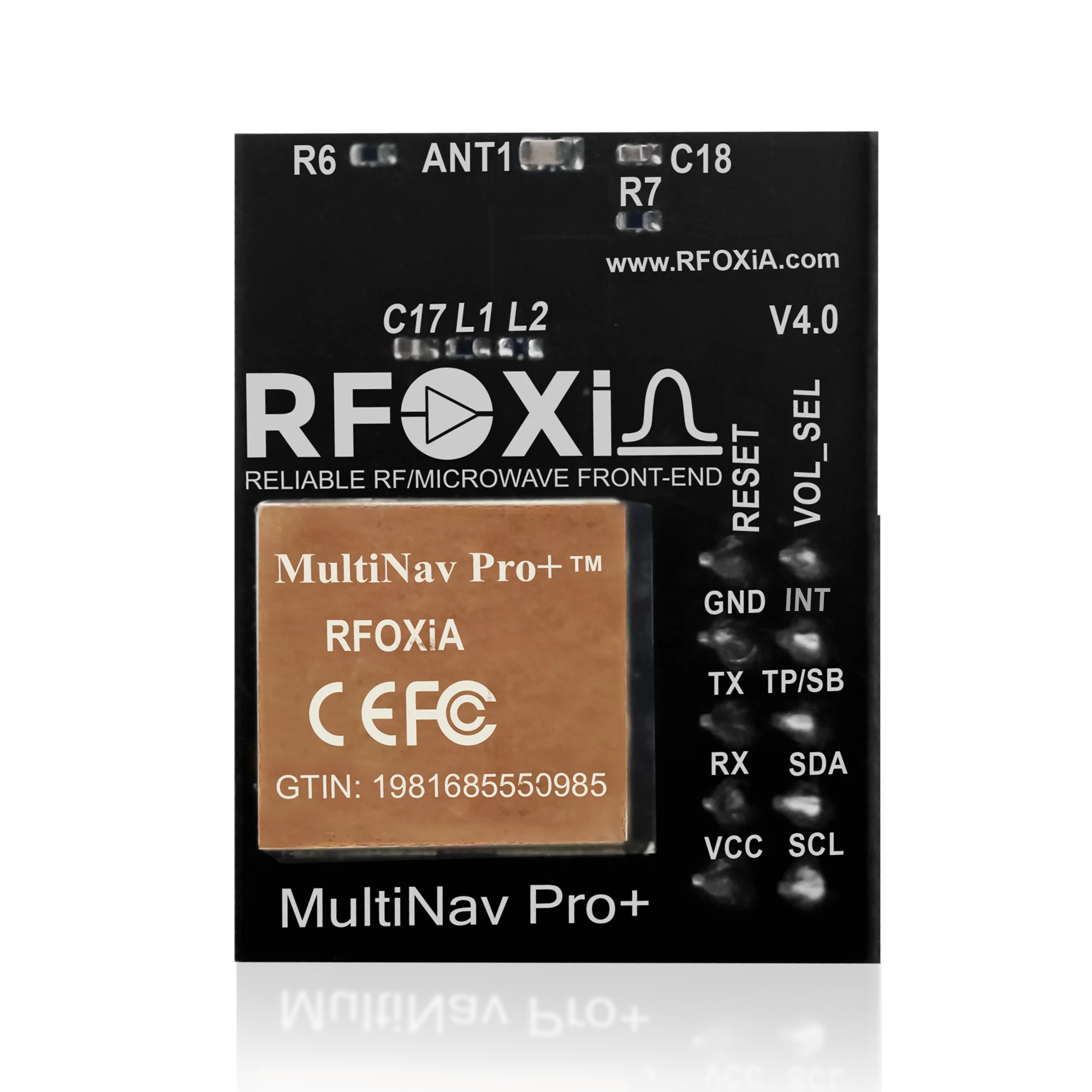
The good news is that a robust GNSS signal interference solution does not require a five-figure military module. The RFOXiA Accurate GNSS Module, the MultiNav Pro+™, was engineered from the ground up to solve exactly this problem — delivering sub-1.5-meter accuracy, an 18Hz fix rate, and proprietary RF filtering technology in a compact 26mm x 22mm footprint at a price that every serious builder can access.
In this guide, we will break down exactly what GNSS signal interference is, why it degrades navigation performance, and how the MultiNav Pro+ architecture addresses each interference vector in a way that commodity modules simply cannot match.
What Is GNSS Signal Interference and Why Does It Matter?
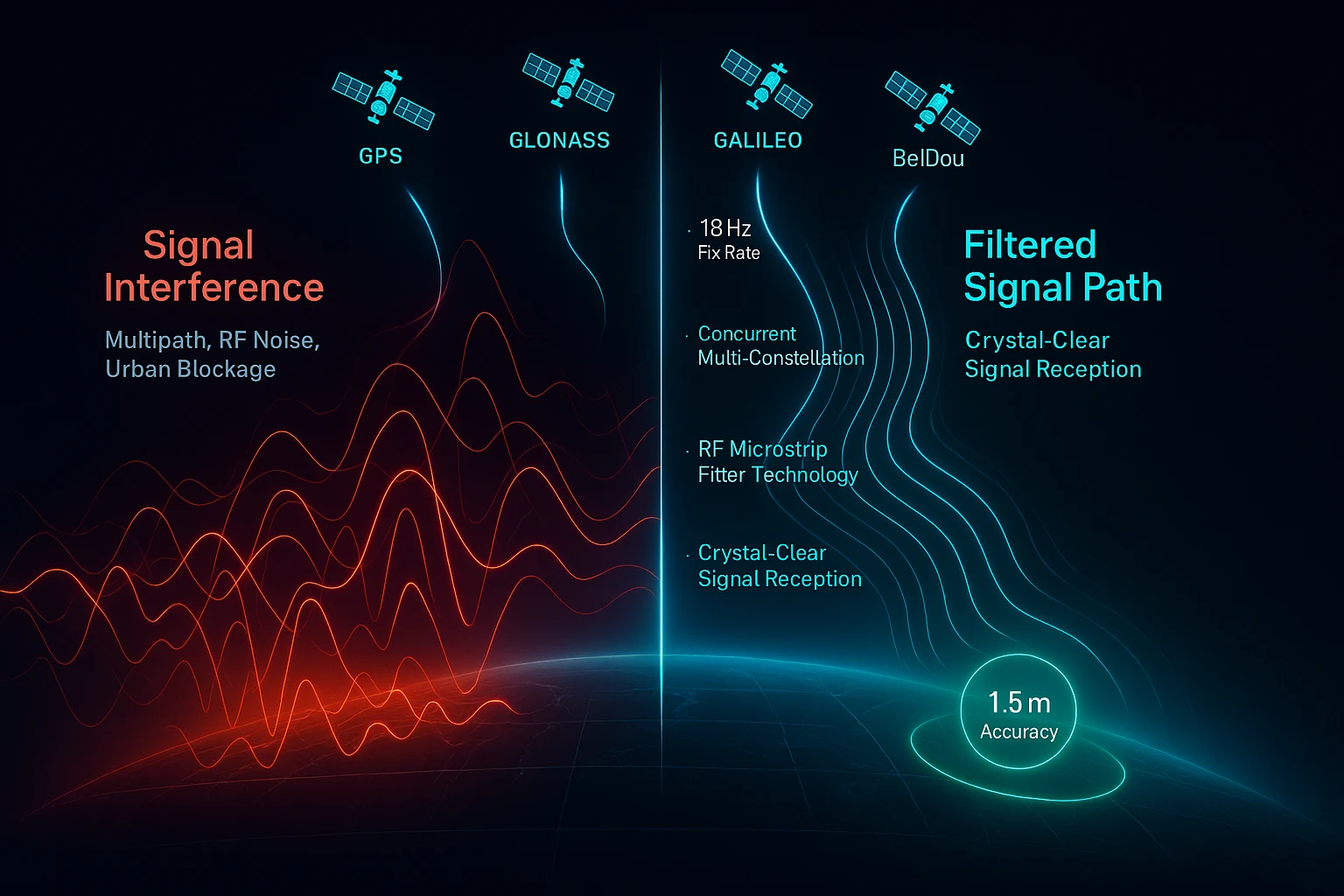
Global Navigation Satellite Systems — GPS, Galileo, GLONASS, and BeiDou — transmit signals from orbit at extremely low power levels. By the time those signals reach your module on the ground, they are extraordinarily weak. This makes GNSS receivers inherently vulnerable to interference from nearby electronics, radio frequency noise, multipath reflections, and physical obstructions.
The consequences of unresolved interference include:
- Position drift — coordinates that wander meters or tens of meters from the true location
- Fix loss — the receiver loses satellite lock entirely, halting navigation
- Slow TTFF (Time to First Fix) — the module takes minutes instead of seconds to acquire satellites
- Reduced fix rate — updates slow from real-time to sporadic, making dynamic tracking impossible
- Ghost readings — the receiver reports false positions caused by reflected signals
For a hobby GPS logger, these issues are annoying. For a precision drone, an autonomous vehicle, an agricultural sprayer, or a research instrument, they are mission-critical failures.
A real GNSS signal interference solution must address the problem at the hardware level — in the RF front end, the antenna design, the chip architecture, and the signal processing pipeline. Software corrections alone cannot rescue a fundamentally noisy hardware stack.
The MultiNav Pro+: Engineering a Real GNSS Signal Interference Solution
The MultiNav Pro+ was not designed to be a minimum viable GNSS module. It was designed to be the most capable navigation module accessible to the maker and professional developer community — one that treats interference as a primary engineering constraint, not an afterthought.
Here is how the architecture delivers on that promise.
1. Proprietary RF/Microwave Microstrip Filter Technology
The most direct GNSS signal interference solution in the MultiNav Pro+ is its proprietary RF/microwave microstrip filter integrated into the signal path. This filter is designed to attenuate out-of-band RF energy before it can reach the sensitive GNSS receiver front end.
In dense electronic environments — near motors, ESCs, power converters, cellular radios, Wi-Fi modules, or other RF sources — the GNSS band is constantly bombarded with harmonic noise. Commodity modules with no filtering pass this noise directly to the receiver, degrading sensitivity and position accuracy.
The MultiNav Pro+ filter rejects these interferers at the hardware level. The result is a cleaner signal chain, better sensitivity, and accuracy that holds in environments where unfiltered modules fail.
2. u-blox MIA-M10Q Chip — Multi-Constellation Satellite Diversity
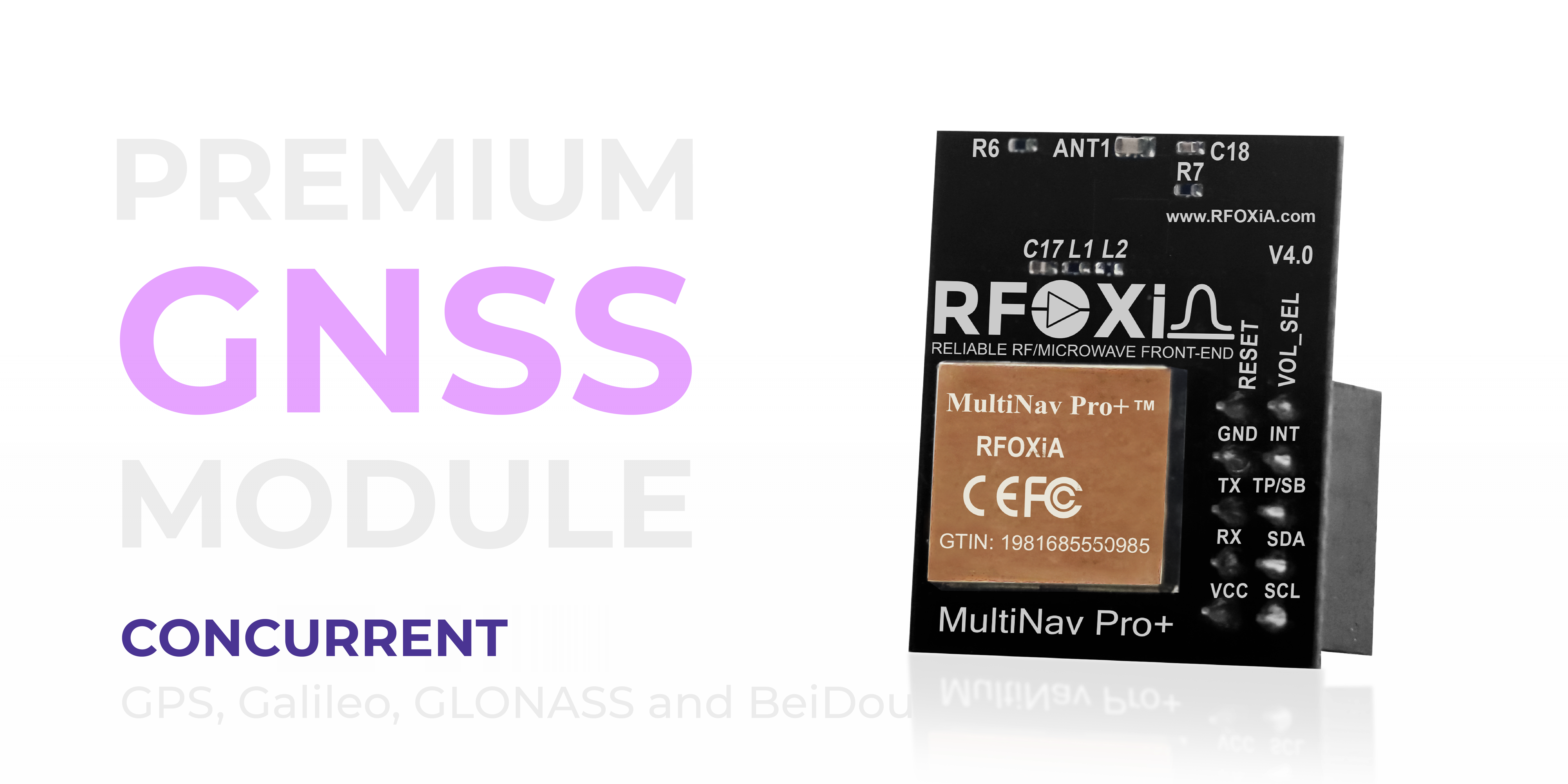
The MultiNav Pro+ is powered by the u-blox MIA-M10Q, one of the most advanced low-power GNSS chips available to hardware developers. The MIA-M10Q supports concurrent reception of all four major GNSS constellations simultaneously:
- GPS (USA)
- Galileo (EU)
- GLONASS (Russia)
- BeiDou (China)
This multi-constellation capability is itself a powerful GNSS signal interference solution strategy. When one constellation's signals are degraded by interference, geometric obstruction, or ionospheric conditions, the receiver can draw on dozens of additional satellites from other constellations to maintain position lock and accuracy.
A single-constellation module running GPS alone might track 8-12 satellites in view. The MultiNav Pro+ running all four constellations concurrently can track 30+ satellites simultaneously. More satellites means stronger geometric dilution of precision (GDOP), better redundancy against interference, and faster recovery from signal disruption.
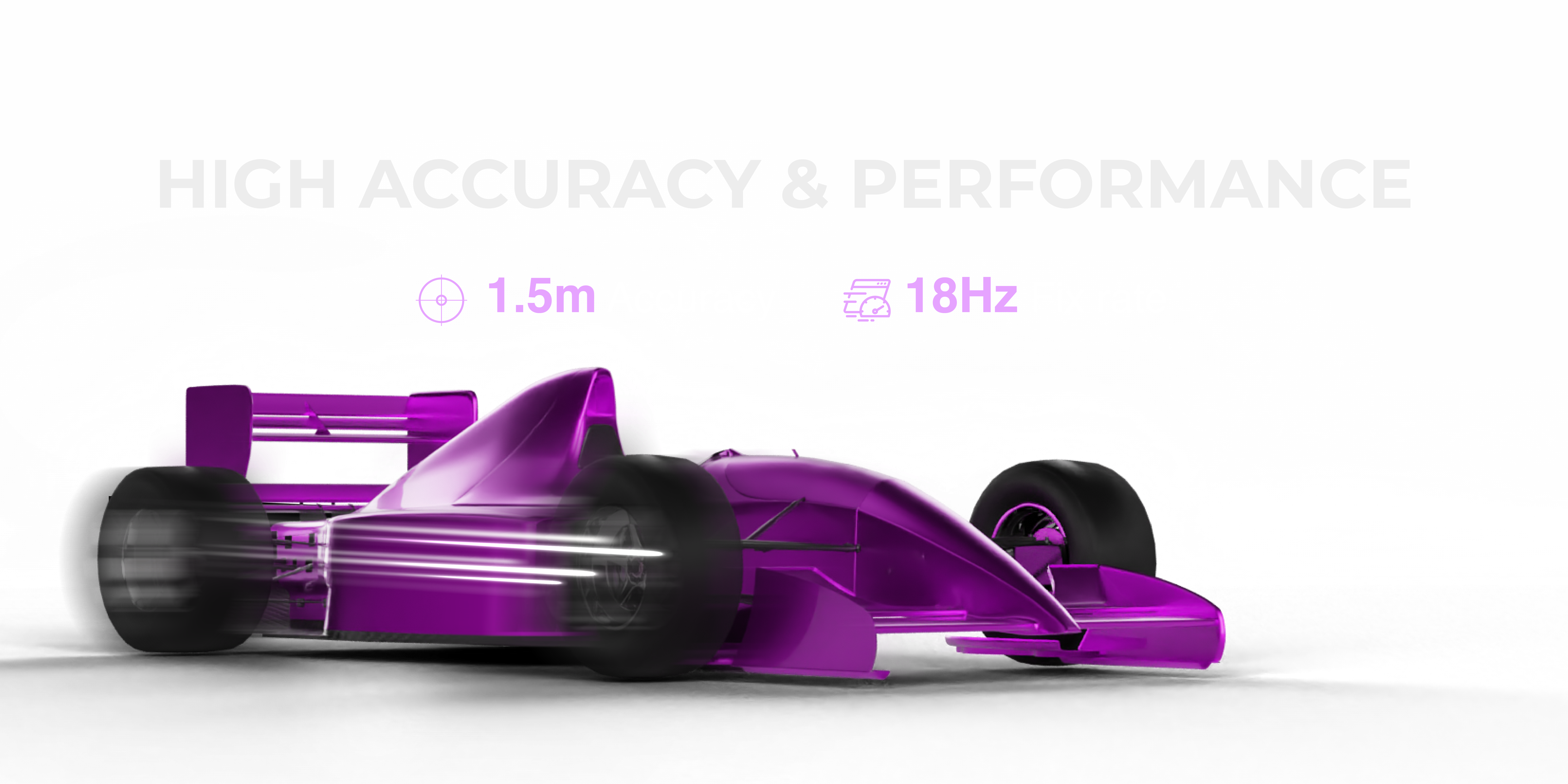
The result: less than 1.5-meter position accuracy and a fix rate of up to 18Hz — with first fix in just 1 second under open sky conditions. That 18Hz update rate is particularly critical for dynamic applications like drone navigation, where a module updating at 1Hz or even 5Hz creates dangerous latency between the drone's true position and what the flight controller sees.
3. Integrated High-Gain Chip Antenna — Optimized Signal Reception
Antenna design is one of the most overlooked aspects of a GNSS signal interference solution. A poor antenna not only receives weaker satellite signals — it also acts as a more effective capture surface for interference. The wrong antenna geometry, the wrong ground plane, or a poorly matched antenna impedance all degrade carrier-to-noise ratio before the signal even reaches the chip.
The MultiNav Pro+ integrates a high-gain chip antenna that is impedance-matched and optimized for the GNSS frequency bands. This is not an afterthought component — it is engineered into the module's PCB layout to maximize signal capture from the sky while minimizing susceptibility to lateral RF noise from surrounding electronics.
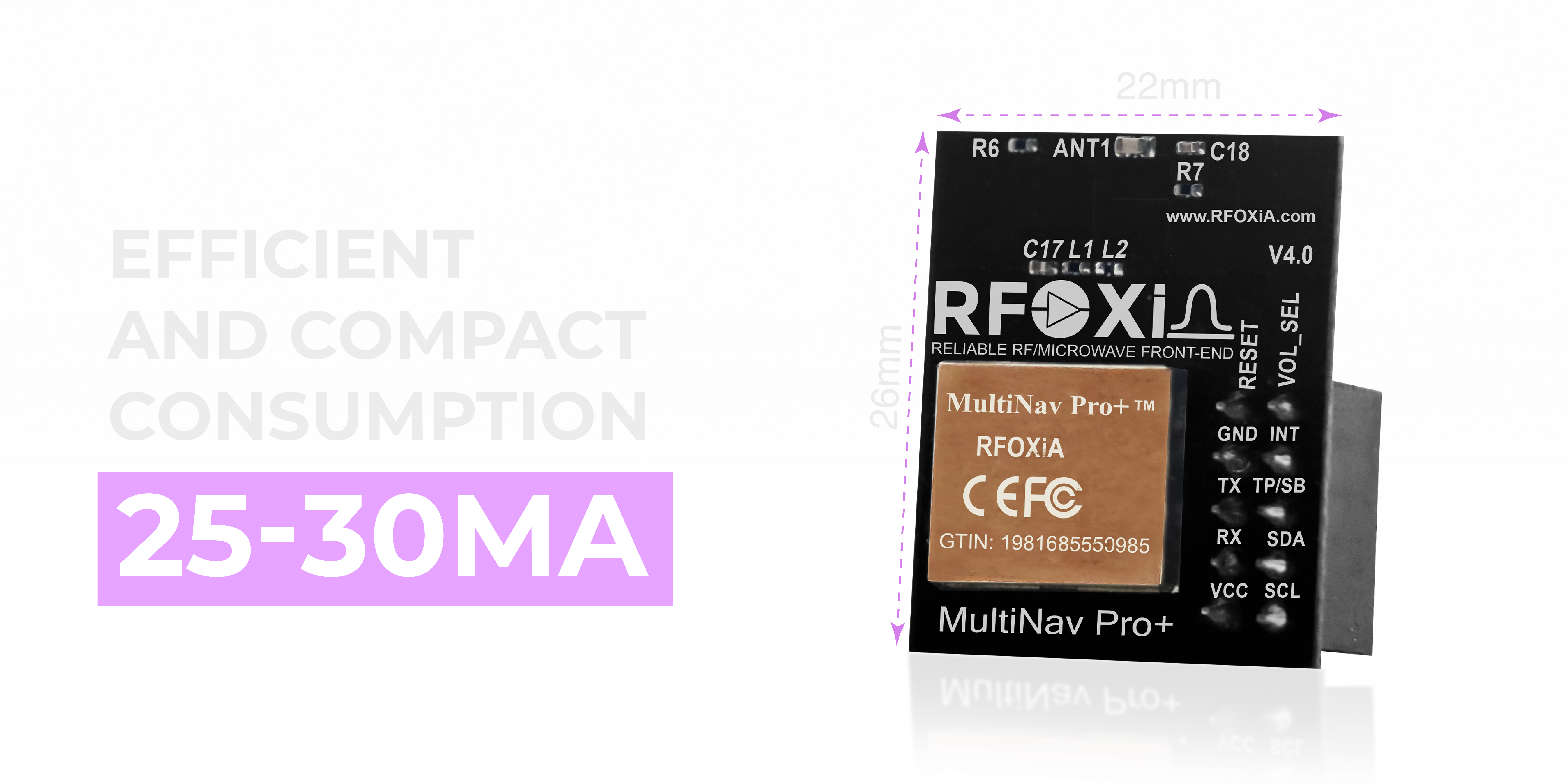
Despite this performance, the module maintains an exceptionally compact 26mm x 22mm footprint and operates at just 25-30mA — making it practical for battery-powered and weight-sensitive applications like drones, wearables, and field instruments.
4. Dual Interface Support — UART and I2C
Integration problems are another source of system-level interference. When a GNSS module's data interface runs close to high-frequency digital switching circuits without proper layout, digital noise can couple back into the RF section and degrade sensitivity.
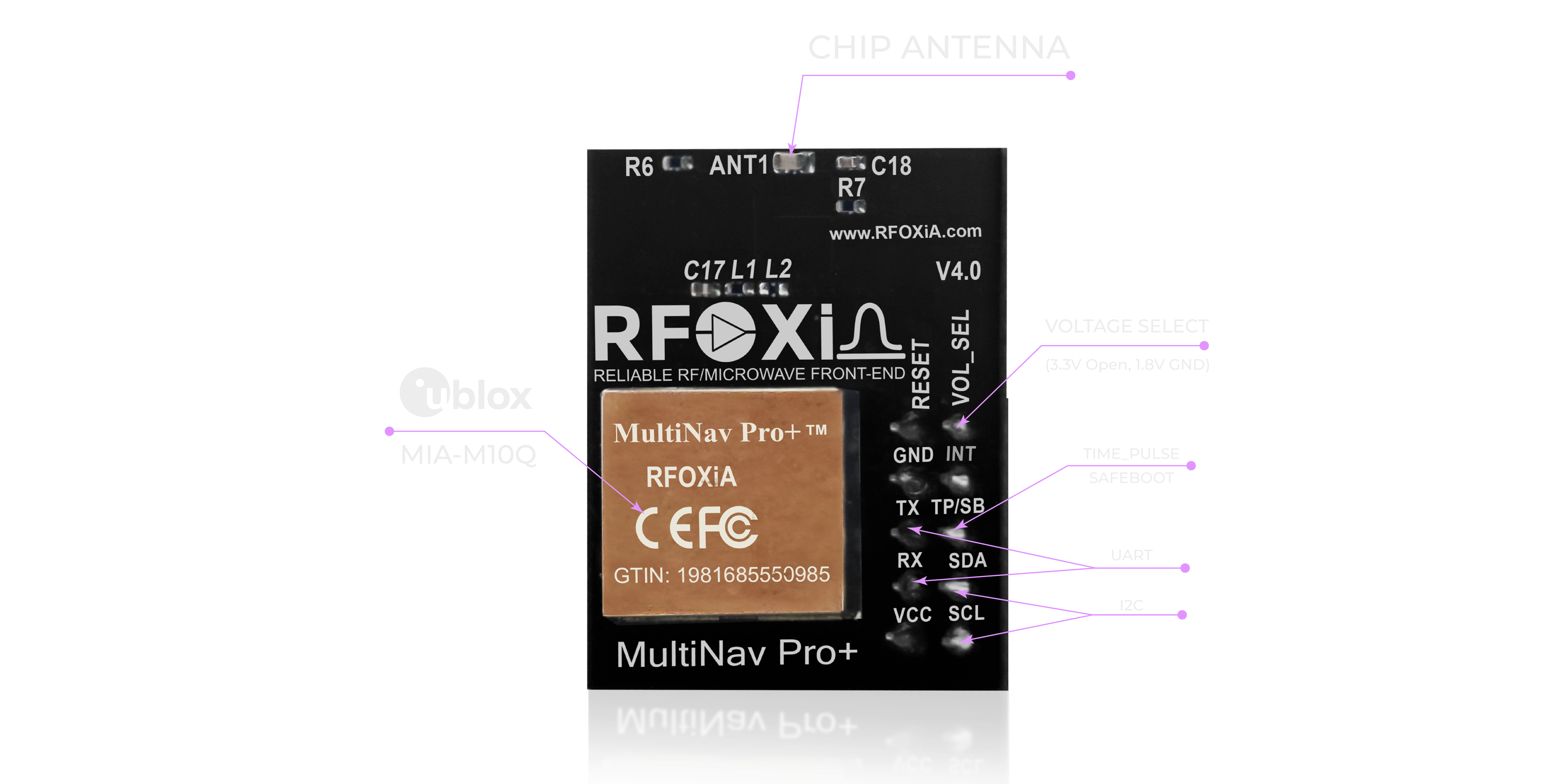
The MultiNav Pro+ supports both UART (TX/RX) and I2C (SCL/SDA) interfaces with flexible operating voltages of 1.8V and 3.3V. This flexibility allows developers to choose the interface geometry and routing that minimizes digital noise coupling in their specific PCB layout — an important detail that experienced hardware engineers will immediately appreciate.
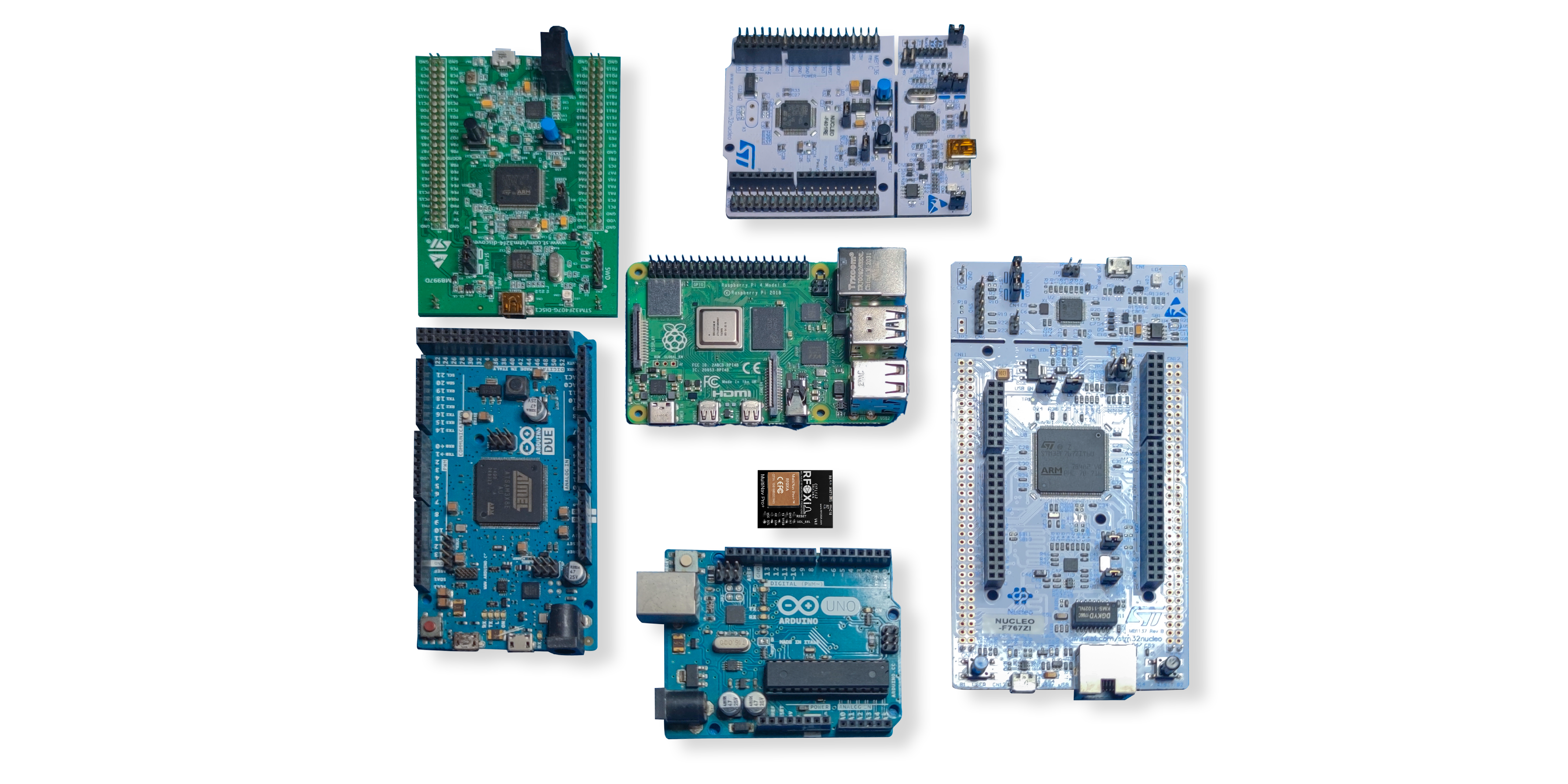
For embedded systems and microcontroller-based projects, plug-and-play compatibility means you spend time on your application — not fighting hardware integration.
Open-Source Firmware — The Software Layer of the Interference Solution
A GNSS signal interference solution is only complete when developers have the tools to configure, monitor, and tune the receiver's behavior for their specific deployment environment.
The MultiNav Pro+ ships with a fully open-source C language driver library that includes complete NMEA standard protocol command support. The library is structured for easy import into Arduino IDE or any embedded toolchain — STM32, ESP32, Raspberry Pi, and custom hardware alike.
With this library, developers can:
- Configure constellation selection, fix rate, and power modes
- Read position, velocity, and time data from parsed NMEA sentences
- Implement custom filtering and smoothing on top of raw GNSS output
- Monitor satellite count and signal strength to diagnose interference conditions in the field
This open-source approach reflects RFOXiA's core philosophy: the tools for professional-grade navigation development should be accessible to every builder, not locked behind expensive proprietary SDKs.
U-Center Software — Visual Diagnostics for Interference Analysis
For developers who need to deeply analyze their GNSS signal environment and tune module performance, the MultiNav Pro+ is fully compatible with u-blox's U-Center software — a powerful, free desktop application for GNSS evaluation and configuration.
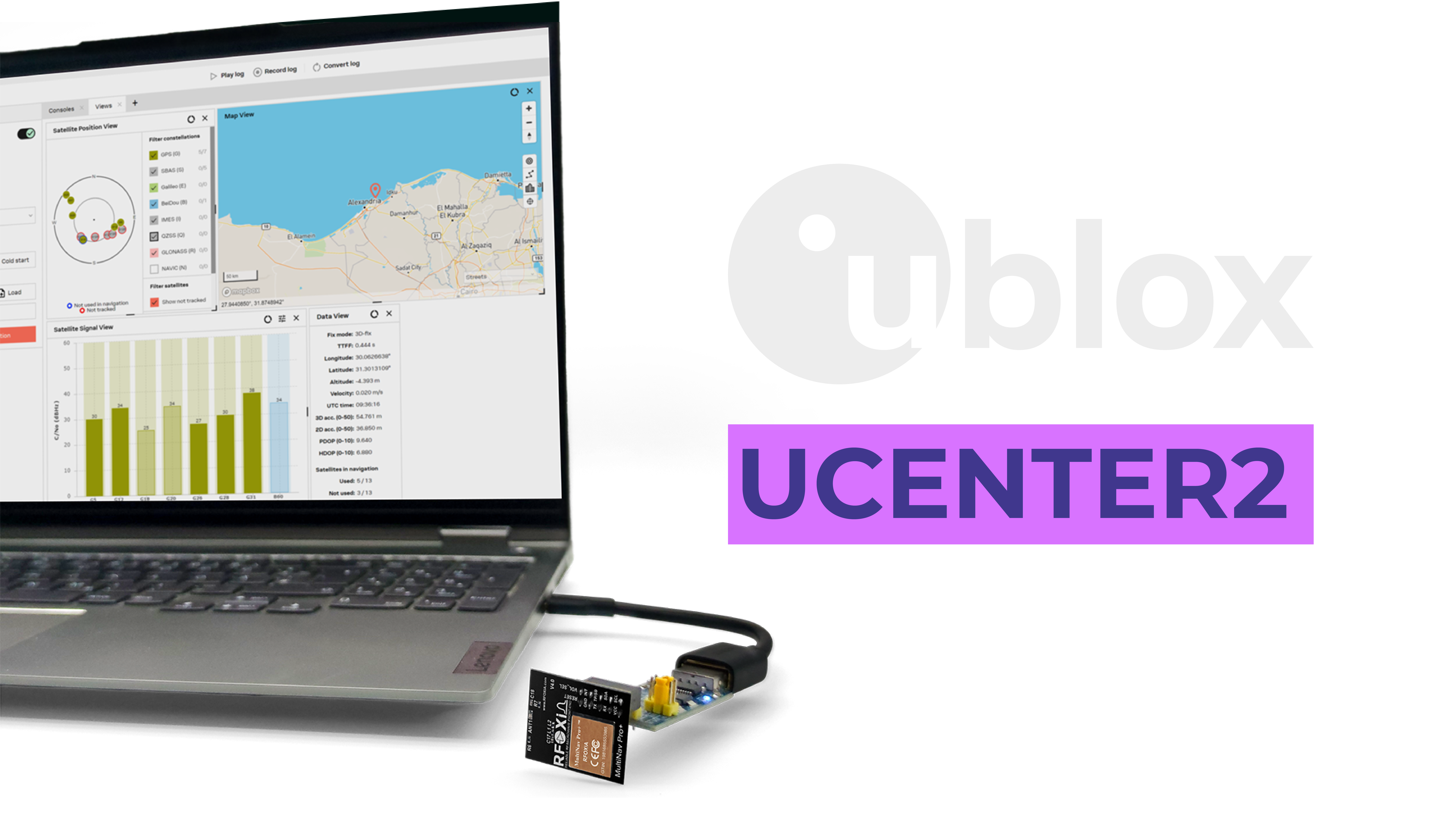
U-Center provides:
- Satellite sky plot — visualize which satellites are in view and their signal strength in real time
- Carrier-to-noise (C/N0) monitoring — directly measure interference impact on each satellite signal
- Position tracking — watch fix accuracy in real time as you move or change RF environments
- Configuration management — adjust fix rate, constellation selection, power modes, and more through a graphical interface
- Data logging — capture full GNSS session logs for post-processing and analysis
For anyone seriously diagnosing a GNSS signal interference problem in a specific deployment environment, U-Center combined with the MultiNav Pro+ gives you the diagnostic depth of professional test equipment at zero additional cost.
Who Needs This Level of GNSS Signal Interference Solution?
The MultiNav Pro+ is designed for applications where position accuracy and signal reliability are non-negotiable.

Drone builders and FPV pilots — Flight controllers need high-rate, low-latency position data. The 18Hz fix rate and multi-constellation robustness of the MultiNav Pro+ keep the flight controller's position estimate accurate even during aggressive maneuvers and in electrically noisy airframes.
Precision agriculture — Spraying drones, autonomous field robots, and soil monitoring systems require sub-2-meter accuracy to operate effectively. The MultiNav Pro+ delivers this without the cost of RTK systems.
IoT asset tracking — Industrial asset trackers, logistics monitors, and vehicle tracking systems deployed in urban canyons benefit enormously from multi-constellation reception and RF filtering that maintain lock where GPS-only systems fail.
Wearable and handheld devices — Compact size and low 25-30mA power draw make the MultiNav Pro+ ideal for wearable navigation devices, handheld survey instruments, and search-and-rescue equipment.
Research and scientific instruments — Field researchers need a GNSS module they can trust. The open-source driver, U-Center compatibility, and documented performance specifications make the MultiNav Pro+ appropriate for scientific data collection where position accuracy directly affects data validity.
Automotive and robotics — Autonomous ground vehicles navigating mixed RF environments need a receiver that maintains fix integrity near motors, inverters, and other strong interference sources. The MultiNav Pro+'s filtered front end is built for exactly this.
For all of these use cases, the RFOXiA Accurate GNSS Module represents an unmatched combination of performance, integration ease, and accessible pricing.
Technical Specifications Summary
| Specification | MultiNav Pro+ |
|---|---|
| GNSS Accuracy | < 1.5 meters |
| Fix Rate | Up to 18Hz |
| Time to First Fix | 1 second (open sky) |
| Constellations | GPS, Galileo, GLONASS, BeiDou (concurrent) |
| GNSS Chip | u-blox MIA-M10Q |
| Antenna | Integrated high-gain chip antenna |
| Interfaces | UART (TX/RX), I2C (SCL/SDA) |
| Operating Voltage | 1.8V / 3.3V |
| Power Consumption | 25-30mA |
| Dimensions | 26mm x 22mm |
| Certification | FCC certified |
| Software | Open-source C library + U-Center compatible |
| Price | $49 |
Part of the Complete RFOXiA Wireless Ecosystem
The MultiNav Pro+ does not exist in isolation. It is one module in RFOXiA's vertically integrated wireless development ecosystem — designed to pair directly with the MultiNav Pro+ BLE Module (5km ground-to-ground range, up to 20km man-to-drone), the Sensors Module (7 onboard environmental sensors), and the Power/Program Kit (5-minute charge, 24-hour runtime on supercapacitors).
When these modules are used together as the Developer Bundle, the result is a complete field-deployable system: precision GNSS positioning, long-range wireless communication, full environmental sensing, and professional power management — all integrated, all FCC certified, all supported by RFOXiA's AI Firmware Builder and the RFOXiA Connect mobile application.
For developers who need the most capable and cost-effective GNSS signal interference solution available, the MultiNav Pro+ is the answer — and the ecosystem around it makes it the foundation of a professional wireless development platform that scales with your ambitions.
Get the MultiNav Pro+ Today
At $49 with FCC certification, open-source drivers, U-Center compatibility, and hardware-level RF interference filtering built in, the MultiNav Pro+ delivers professional-grade GNSS performance at a price no competing module at this specification level can match.
Whether you are building drones, tracking assets, conducting field research, or developing the next generation of IoT hardware, the MultiNav Pro+ gives you the precision and reliability your application demands — even in the most challenging RF environments.
Explore the full specifications, compatibility details, and ordering information at the RFOXiA Accurate GNSS Module product page and join the RFOXiA developer community to access open-source firmware, AI-assisted firmware development, and a growing ecosystem of builders pushing the limits of wireless hardware.
Written by: Moamen Mohamed LinkedIn