
GPS GNSS Module Maker: Why MultiNav Pro+ Is the Precision Standard
The GPS GNSS Module Maker Community Finally Has a Worthy Contender
For years, the GPS GNSS module maker community has faced an uncomfortable compromise: affordable modules that deliver mediocre accuracy, or precision-grade hardware priced for enterprise budgets that most independent builders and small teams simply cannot justify. The gap between a $5 hobbyist GPS breakout board and a $500 professional-grade GNSS receiver has been wide enough to swallow entire project ambitions whole.
That gap is now closed.
The RFOXiA MultiNav Pro+™ is a professional-grade GNSS module engineered specifically for makers, drone builders, researchers, and IoT developers who refuse to compromise on precision but also refuse to break their budget. At $49, it delivers specifications that belong in a datasheet from a company charging five to ten times more.
This guide covers everything you need to know: how it works, what makes it technically superior, who it is built for, and why it has become the go-to precision navigation module for serious builders worldwide.
What Makes a GNSS Module "Professional Grade"?
Before diving into the MultiNav Pro+ specifically, it is worth understanding what separates a professional-grade GNSS module from a commodity GPS breakout board — because the difference is significant and directly impacts what your projects can actually do.
Accuracy
Most low-cost GPS modules advertise accuracy figures like "2.5m CEP" or "3m accuracy" under ideal conditions. In practice, with atmospheric interference, multipath signals, and suboptimal antenna placement, real-world accuracy on budget modules often degrades to 5–10 meters or worse. For a hiking tracker, this is acceptable. For drone precision landing, precision agriculture, or autonomous robotics, this is unusable.
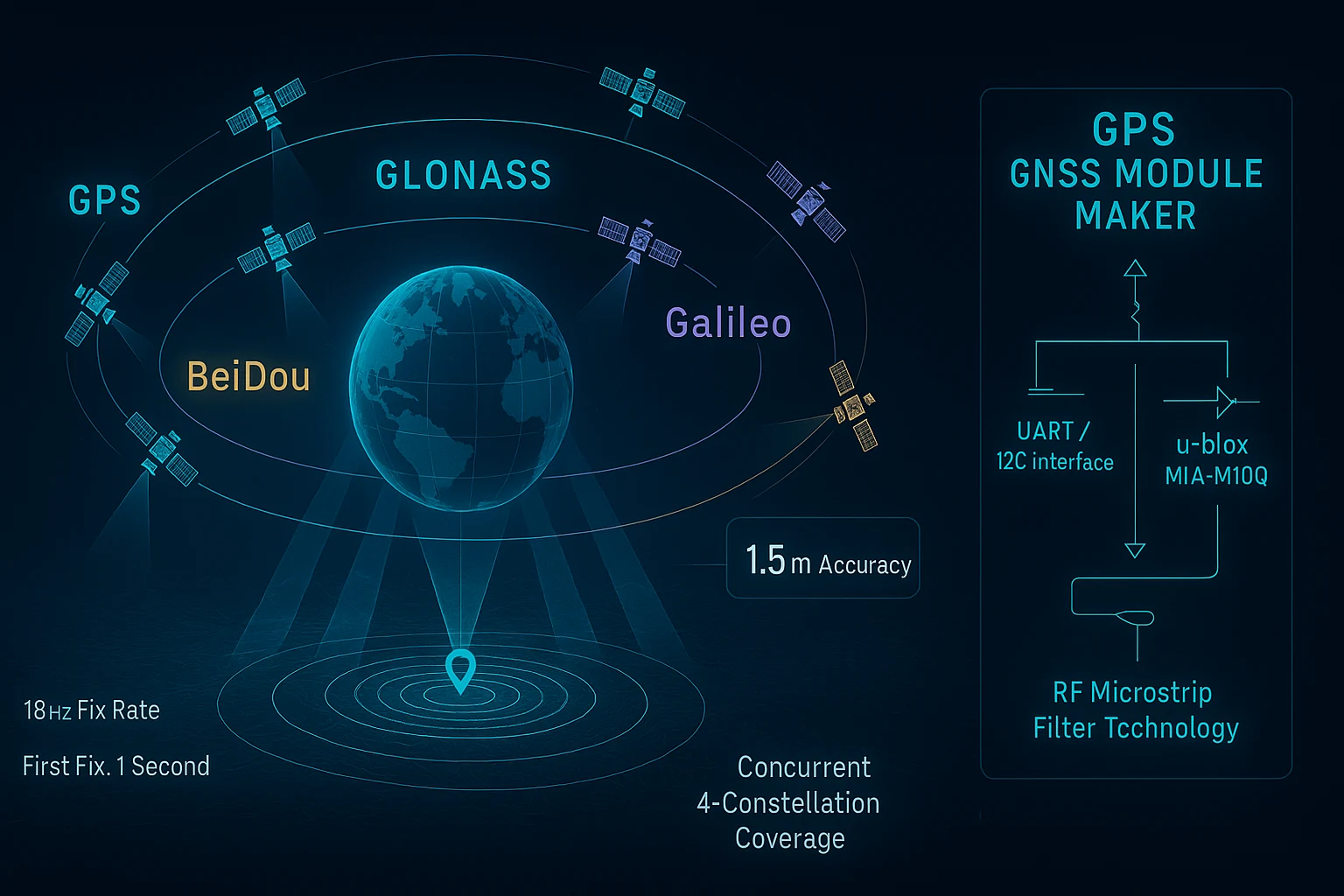
The MultiNav Pro+ achieves less than 1.5 meters of accuracy — a figure that reflects real-world performance, not laboratory ideals.
Fix Rate
Fix rate, measured in Hz, tells you how many times per second the module updates its position estimate. A 1Hz fix rate means one position update per second — which is completely inadequate for any fast-moving platform like a drone, autonomous vehicle, or high-speed robot.
The MultiNav Pro+ delivers an 18Hz fix rate. That is eighteen position updates per second. For a drone moving at speed, this means position updates every 55 milliseconds — more than sufficient for real-time flight controller integration.
Constellation Support
Single-constellation GPS modules rely exclusively on the American GPS satellite network. Multi-constellation modules can simultaneously receive signals from multiple global navigation satellite systems, dramatically increasing satellite visibility, especially in urban canyons, under foliage, or in challenging RF environments.
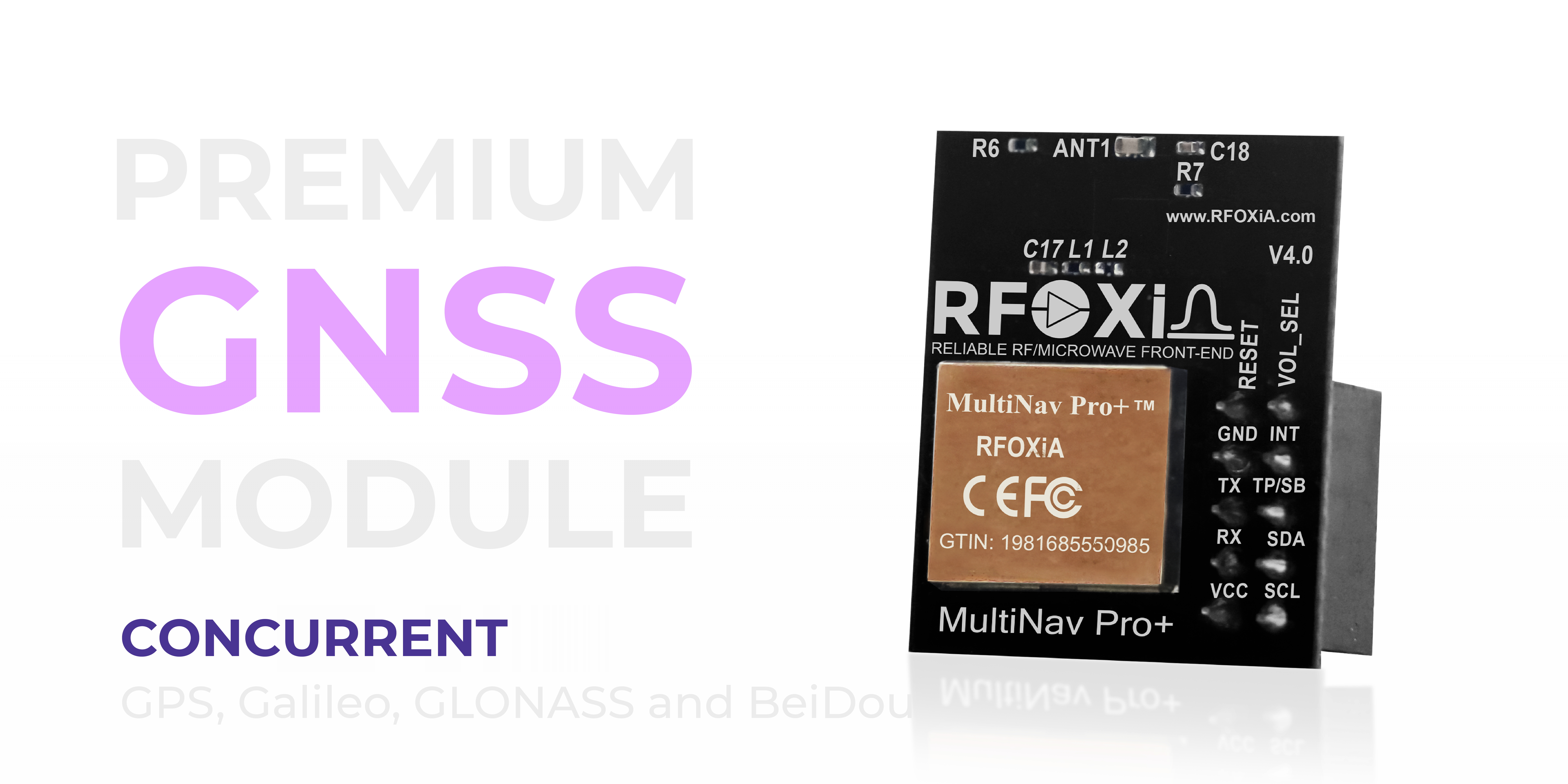
The MultiNav Pro+ supports GPS, Galileo, GLONASS, and BeiDou concurrently — four complete satellite networks working together for you at all times.
Time to First Fix
Time to First Fix (TTFF) measures how long a module takes to acquire enough satellites to deliver a valid position. Cheap modules can take 30–90 seconds for a cold start. The MultiNav Pro+ achieves first fix in as little as 1 second under favorable conditions, making it suitable for time-critical deployment scenarios.
MultiNav Pro+: Technical Specifications Deep Dive
The u-blox MIA-M10Q Core
At the heart of the MultiNav Pro+ is the u-blox MIA-M10Q — one of the most advanced GNSS chipsets currently available for embedded applications. u-blox is the industry gold standard for precision GNSS, supplying chipsets to automotive manufacturers, aerospace companies, and professional surveying equipment makers. This is not a generic Chinese GNSS clone. This is the same silicon that powers professional applications demanding accuracy and reliability.
The MIA-M10Q brings several critical advantages:
- SuperSense® technology — u-blox's proprietary algorithm for acquiring and tracking satellites in challenging signal environments
- Multi-band rejection filtering — hardware-level filtering against RF interference from adjacent electronics
- Low power architecture — designed for battery-powered and energy-constrained applications
- Automotive-grade temperature tolerance — operates reliably across extreme temperatures
When you choose a module built on the MIA-M10Q, you are not choosing based on marketing claims. You are choosing based on a proven chipset with a decade of professional deployment behind it.
Accuracy and Fix Rate
The numbers that matter most for any GPS GNSS module maker are accuracy and update speed — and the MultiNav Pro+ leads decisively on both.

Accuracy: Less than 1.5 meters under normal operational conditions. This is not a best-case figure — it is the engineering specification the module is designed to maintain. For drone-based surveying, this means usable aerial maps. For precision agriculture applications, this means row-level crop tracking. For robotics, this means reliable outdoor localization.
Fix rate: 18Hz. To put this in context: a drone moving at 30 meters per second (about 108 km/h) travels 1.67 meters between each position update at 18Hz. That is tight enough for real-time flight control. At 1Hz, that same drone travels 30 meters between updates — completely useless for any navigation application.
First fix: 1 second. Power on, acquire, navigate. No waiting. No lengthy initialization sequences. For field deployment where time matters, this is a meaningful advantage.
Power Efficiency and Form Factor
One of the most overlooked specifications in GNSS module selection is power consumption. In battery-powered applications — and most embedded GPS GNSS module maker projects are battery-powered — current draw directly determines battery life and thermal performance.
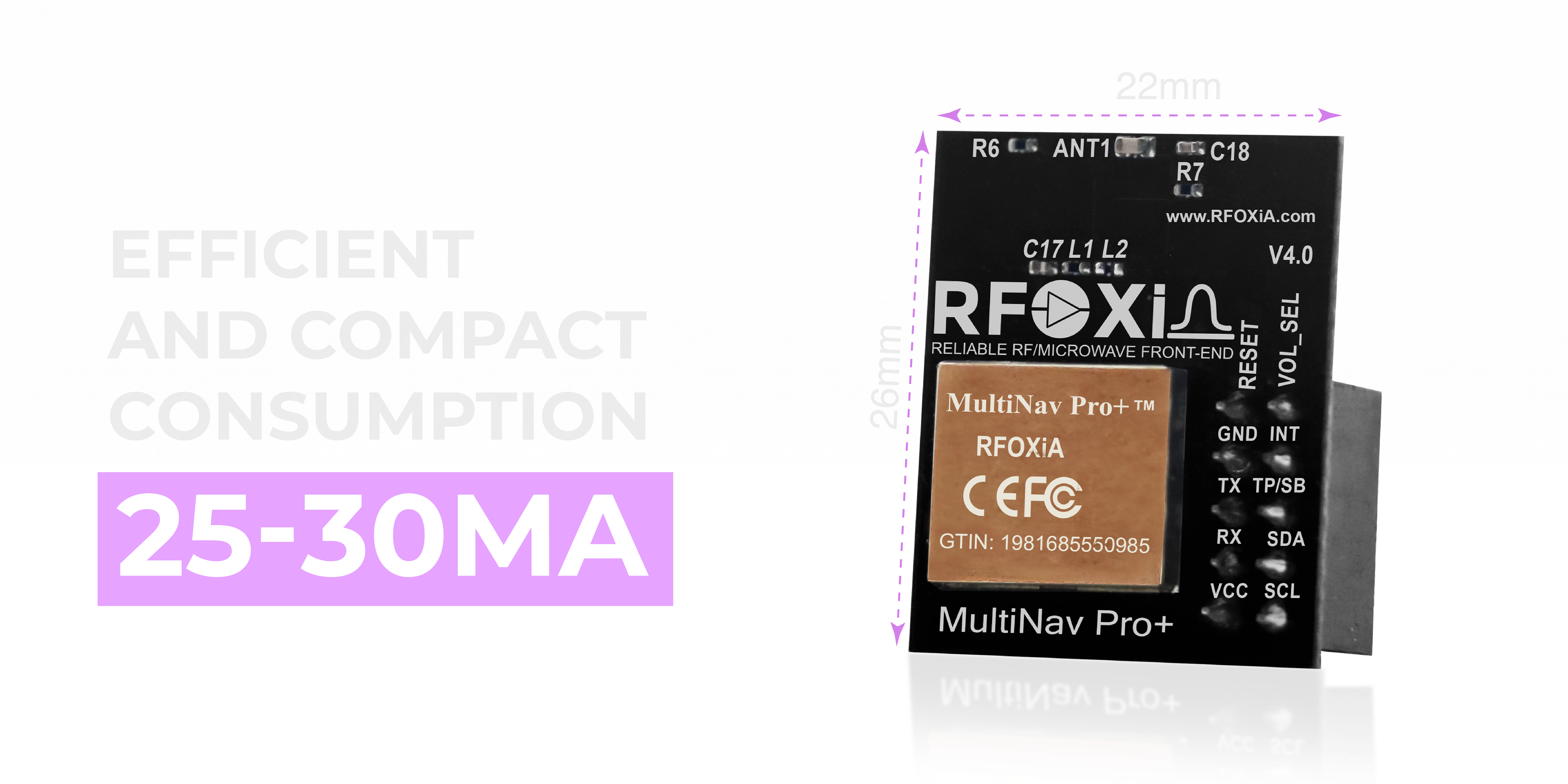
The MultiNav Pro+ operates at 25–30mA during active tracking — remarkably efficient for a module running four concurrent satellite constellations. For comparison, many older GNSS modules draw 50–100mA for single-constellation operation.
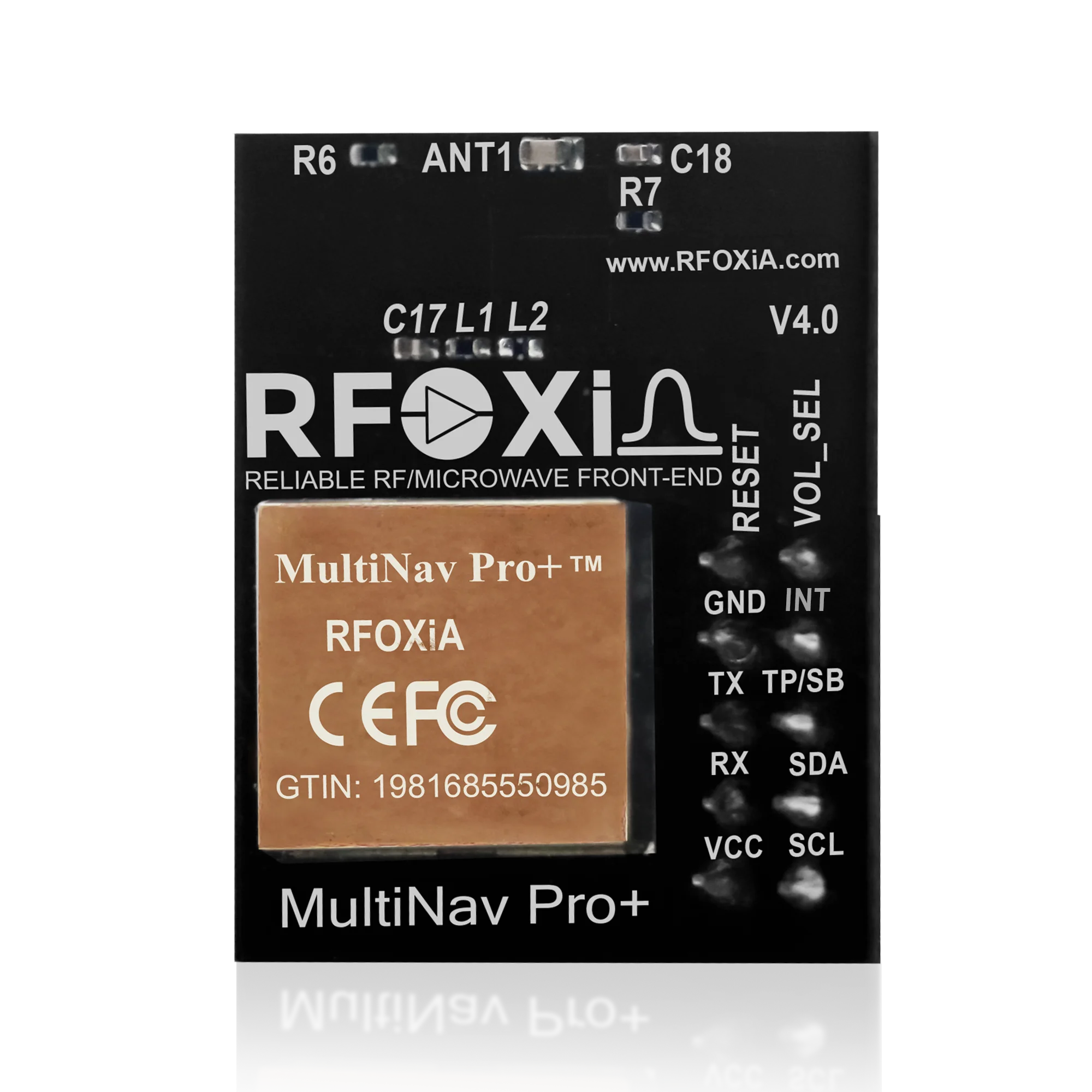
The physical footprint is 26mm × 22mm — smaller than a postage stamp. It integrates a high-gain chip antenna into this compact form factor, eliminating the need for an external antenna in most applications while maintaining excellent signal reception.
Interface and Integration: Built for Real Builders
UART and I2C Support
One of the most frustrating experiences in embedded development is purchasing a module that only supports one communication protocol — and then discovering it does not match your microcontroller's available peripherals. The MultiNav Pro+ eliminates this problem by supporting both UART and I2C interfaces natively.
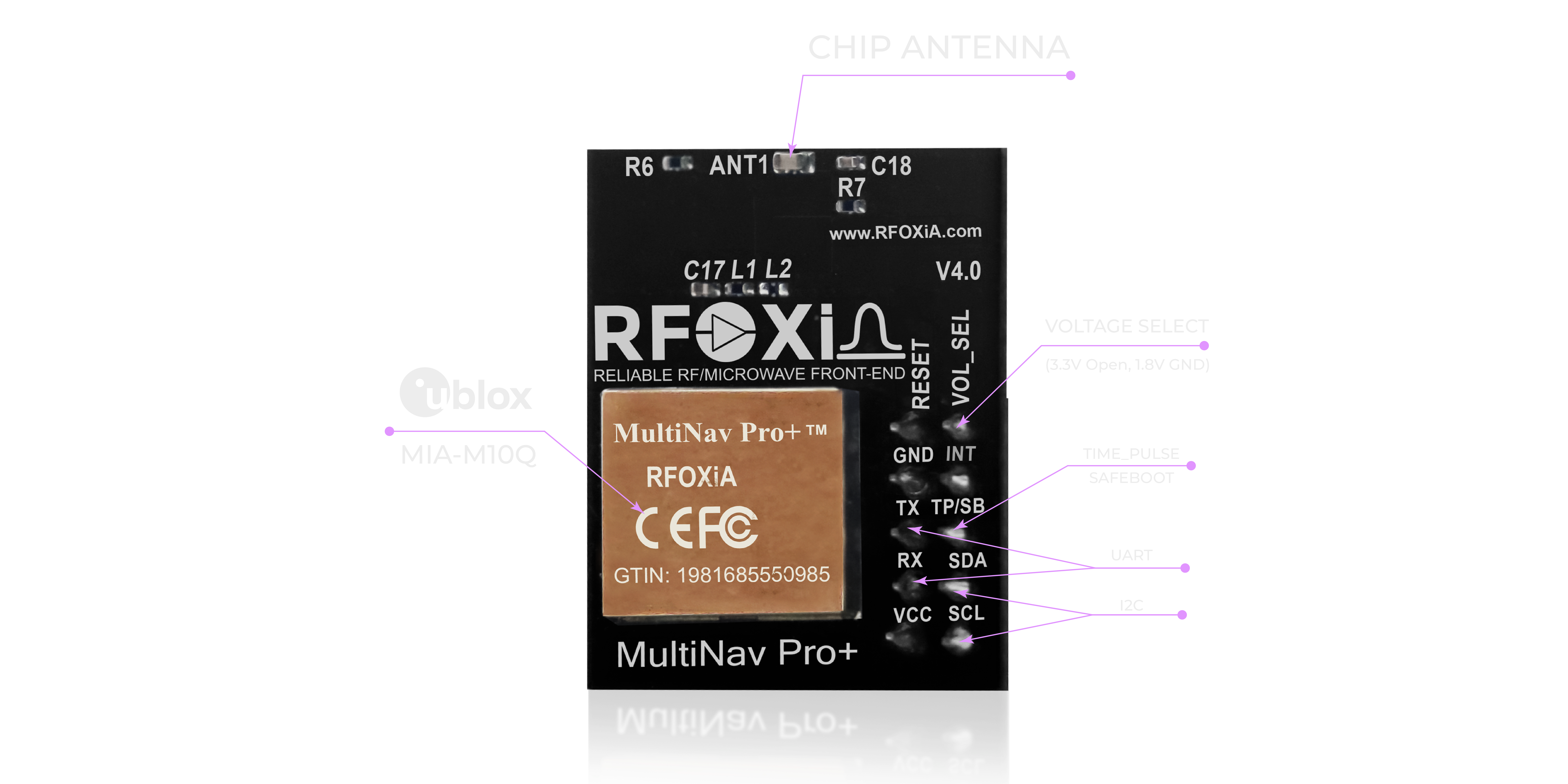
UART (TX/RX): The traditional choice for GNSS modules, UART provides reliable high-bandwidth communication for streaming NMEA sentences at high update rates. This is the recommended interface for flight controller integration and applications requiring maximum data throughput at 18Hz.
I2C (SCL/SDA): When you are already using UART for another peripheral or building a bus-based sensor network, I2C integration allows the GNSS module to share a two-wire bus with other sensors. This is particularly useful when combining the MultiNav Pro+ with additional sensors in a compact IoT device.
Voltage flexibility: The module supports both 1.8V and 3.3V operation — compatible with the full spectrum of modern microcontrollers from low-power Nordic Semiconductor designs running at 1.8V to standard 3.3V Arduino and STM32 ecosystems.
Open Source Driver Library
Hardware is only as useful as how quickly you can get it working. RFOXiA ships the MultiNav Pro+ with a fully open-source C language driver library that includes complete NMEA standard protocol command support.
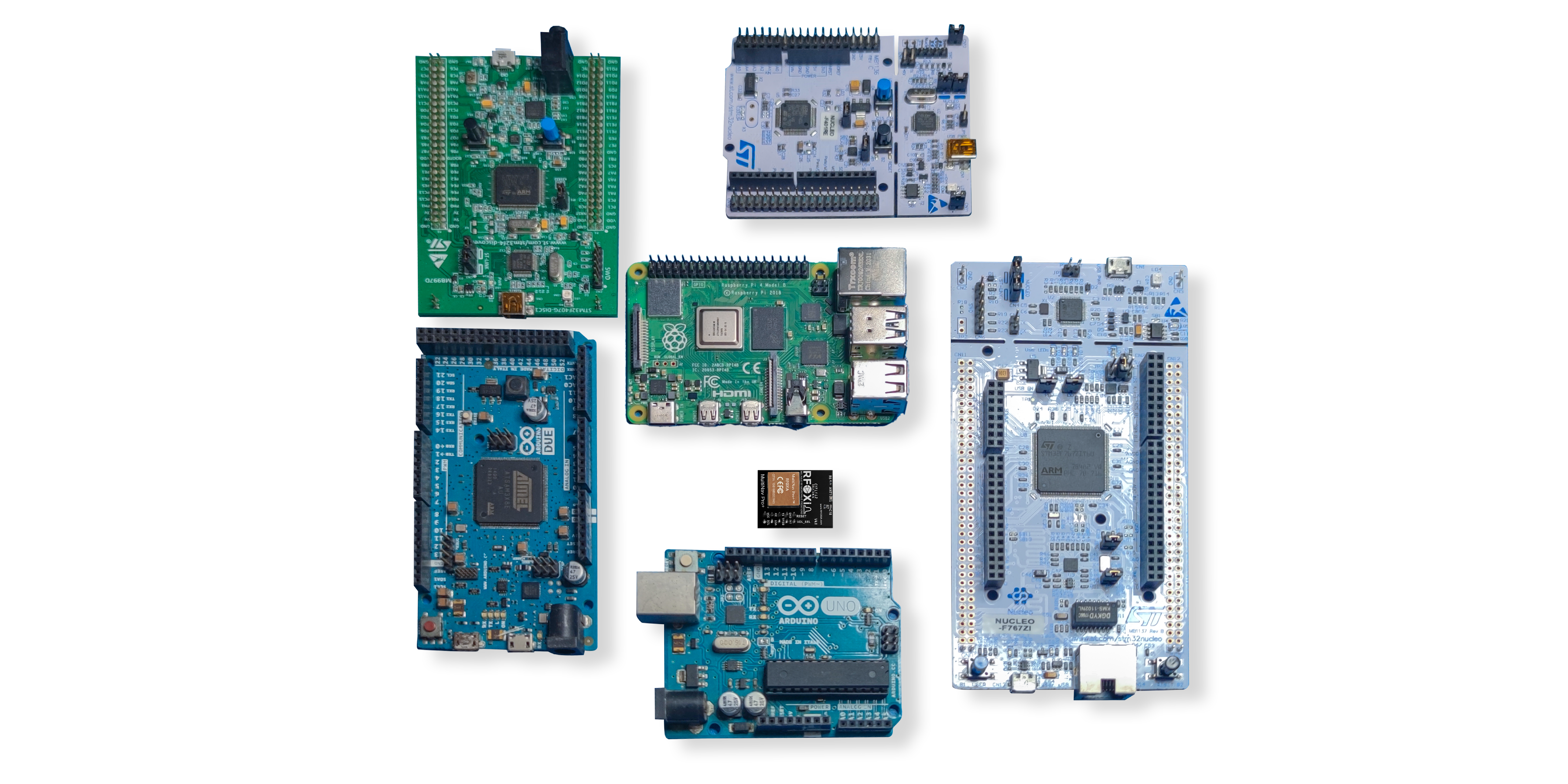
This library is not a stripped-down demo. It is production-ready code that handles:
- NMEA sentence parsing (GGA, RMC, VTG, GSA, GSV and more)
- Satellite constellation status reporting
- Position, velocity, and time (PVT) data extraction
- Fix quality and dilution of precision (DOP) monitoring
- Configuration command generation for fix rate, constellation selection, and power modes
Importing into Arduino IDE is a matter of minutes. Integration with PlatformIO, STM32CubeIDE, Zephyr RTOS, or any other modern embedded toolchain follows the same simple process. This is the kind of driver quality that normally comes from paying for a vendor software development kit at significant cost. RFOXiA ships it open source with every module.
For any GPS GNSS module maker who has spent days reverse-engineering undocumented protocols or wrestling with incomplete manufacturer libraries, this is a meaningful quality-of-life improvement that translates directly into faster project development. RFOXiA Accurate GNSS Module is available now with full open-source library access included.
u-center Software Compatibility
Beyond the embedded driver library, the MultiNav Pro+ is fully compatible with u-blox's professional u-center desktop application — one of the most capable GNSS evaluation and configuration tools available.
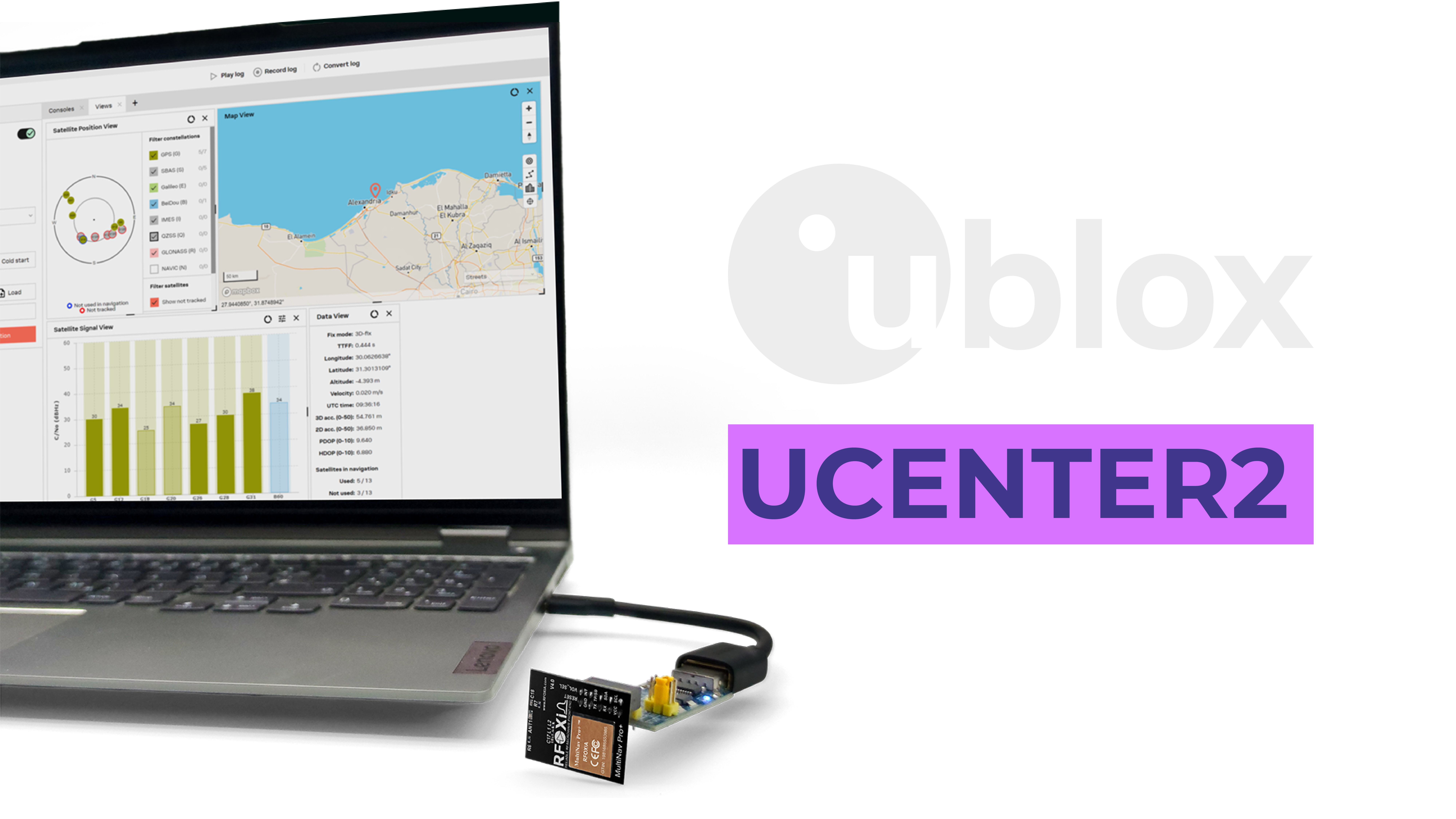
u-center provides:
- Real-time satellite sky view — visualize exactly which satellites are in view, their signal strength, and their geometric distribution
- Live position tracking — watch your module's position update in real time on a map
- Signal quality analysis — identify interference sources and antenna placement issues
- Configuration management — adjust fix rate, enabled constellations, power modes, and output message selection through a graphical interface
- Data logging — capture position logs for post-analysis and accuracy verification
- Assessment tools — evaluate position accuracy against reference points
For developers building precision applications, u-center provides the diagnostic visibility needed to optimize module placement, antenna orientation, and configuration parameters before committing to a final hardware design. This is the evaluation toolkit that GNSS engineers use — and it is fully compatible with your $49 MultiNav Pro+.
Who Is This Module Built For?
The MultiNav Pro+ was designed with a specific builder profile in mind: technically serious, resourced for professional components, and demanding of both quality and value. Here is how it fits across different application domains.

Drone Builders and FPV Pilots
For drone applications, GNSS quality directly determines how well position hold, return-to-home, and waypoint navigation functions perform. An 18Hz fix rate at 1.5m accuracy is fully capable of supporting ArduPilot, PX4, and Betaflight GPS rescue mode integration. The module's fast first fix means your drone is navigation-ready within seconds of power-on — critical for field deployment where every minute of battery time matters.
Paired with the RFOXiA Accurate GNSS Module and the RFOXiA BLE Module with its 15–20km man-to-drone range, you have the foundation for serious long-range autonomous drone operations.
Precision Agriculture
Micro-climate mapping, variable-rate application, yield mapping, and autonomous tractor guidance all require GNSS performance that a $10 module simply cannot provide. The MultiNav Pro+'s 1.5m accuracy and 18Hz update rate make it suitable for data collection passes at operating speed, with position accuracy tight enough to correlate sensor readings with specific crop rows.
IoT Tracking Systems
Asset tracking, vehicle fleet monitoring, wildlife research collars, and logistics container tracking all benefit from the MultiNav Pro+'s multi-constellation support and power efficiency. At 25–30mA active current, the module can run continuously for extended periods on reasonable battery capacity — a critical consideration for deployments where recharging is impractical.
Robotics and Autonomous Systems
Outdoor autonomous robot navigation requires position updates fast enough to correct heading at operational speed. At 18Hz, the MultiNav Pro+ provides position data fast enough for meaningful real-time control loops. Combined with the module's I2C or UART interface, integration with common robotics controllers — including ROS-based systems — is straightforward.
Academic and Commercial Research
Researchers requiring GPS-verified environmental data, movement studies, or geographic information system (GIS) data collection will find the MultiNav Pro+'s accuracy and concurrent constellation support significantly outperforming the modules typically available at research budget price points. The u-center compatibility also means data collection sessions can be logged directly without custom software.
The RFOXiA Ecosystem Advantage
The MultiNav Pro+ is not a standalone module — it is a component of a complete, integrated wireless development ecosystem. This is where the value proposition becomes genuinely exceptional for any serious GPS GNSS module maker.
Integration with the RFOXiA Developer Bundle
When combined with the RFOXiA BLE Module (5km ground-to-ground, 20km man-to-drone range), the Sensors Module (7-sensor environmental suite), and the Power/Program Kit (5-minute charge, 24-hour runtime), the MultiNav Pro+ becomes part of a system that has no direct competitor at any price point.
The Developer Bundle integrates:
- Precision location from the MultiNav Pro+ GNSS module
- Long-range wireless telemetry from the BLE Module
- Environmental sensing from the 7-sensor Sensors Module
- Field-deployable power from the supercapacitor Power/Program Kit
- Mobile control and visualization through the RFOXiA Connect app
- AI-assisted firmware development through RFOXiA Club
Every module in the ecosystem is FCC certified — meaning it is legally deployable across the United States and eligible for distribution through major electronics distributors.
RFOXiA Club and AI Firmware Builder
Every MultiNav Pro+ purchase connects you to the RFOXiA Club platform, where the AI Firmware Builder can generate complete, production-ready firmware for your specific application — described in plain language. Instead of spending days integrating NMEA parsing, BLE telemetry, and sensor fusion from scratch, describe your application and receive working firmware in hours.
This is not a toy feature. It is a professionally built AI development tool that has been used to accelerate serious hardware projects.
Data Network Participation
For builders who deploy their Sensors Module outdoors with GNSS verification from the MultiNav Pro+, RFOXiA's data network rewards you for contributing verified environmental data. GPS-verified outdoor data sessions earn daily rewards — your hardware working for you passively while deployed in the field.
Specifications Summary
| Specification | MultiNav Pro+ |
|---|---|
| Chipset | u-blox MIA-M10Q |
| Accuracy | < 1.5 meters |
| Fix Rate | Up to 18Hz |
| Time to First Fix | 1 second |
| Constellations | GPS, Galileo, GLONASS, BeiDou (concurrent) |
| Interface | UART (TX/RX), I2C (SCL/SDA) |
| Operating Voltage | 1.8V and 3.3V |
| Current Draw | 25–30mA |
| Dimensions | 26mm × 22mm |
| Antenna | Integrated high-gain chip antenna |
| Certification | FCC Certified |
| Software | Open-source C library, u-center compatible |
| Price | $49 |
Why FCC Certification Matters More Than You Think
Many GPS GNSS module options available to makers arrive without FCC certification — technically illegal to use in products sold in the United States and ineligible for listing on major distributors like DigiKey and Mouser. For builders prototyping personal projects, this may seem like an academic concern. For anyone building a product intended for commercial sale, this is a compliance issue that can halt an entire product launch.
The MultiNav Pro+ carries full FCC certification. This means:
- Legal to sell in US commercial products
- Eligible for DigiKey, Mouser, and other distributor listings
- Demonstrates that the module has passed conducted and radiated emissions testing
- Reduces your own product's certification burden through modular authorization pathways
For any GPS GNSS module maker building toward a commercial product, this certification is not optional — and the MultiNav Pro+ already has it.
Getting Started
Getting the MultiNav Pro+ running in your project takes minutes, not days. Here is the typical integration path:
- Connect — Wire TX/RX for UART or SCL/SDA for I2C to your microcontroller. Apply 1.8V or 3.3V power.
- Import — Download the open-source C library from RFOXiA's GitHub. Import into Arduino IDE or your preferred toolchain in seconds.
- Configure — Use u-center to verify signal quality and configure fix rate and constellation selection for your application.
- Deploy — Place the module with clear sky view. First fix arrives in approximately 1 second under good conditions.
- Integrate — Parse NMEA data from the library into your application logic. Position, velocity, altitude, and time data are all available through clean API calls.
The open-source library handles the complexity of NMEA parsing so your application code can focus on what your project actually needs to do with the position data.
Final Thoughts: The GPS GNSS Module Maker Standard
The MultiNav Pro+ was built with a clear philosophy: precision navigation should not require a professional engineering budget. A maker building a precision agriculture drone deserves the same GNSS performance that a $50,000 commercial UAV uses — and at $49 with FCC certification, open-source drivers, u-center compatibility, and concurrent four-constellation support, the MultiNav Pro+ delivers exactly that.
No other module in this price range offers the combination of u-blox MIA-M10Q silicon, 18Hz fix rate, 1.5m accuracy, concurrent GNSS support, dual-interface flexibility, and professional software tooling. For any GPS GNSS module maker who is serious about precision, performance, and building products that actually ship, this is the module to build on.
Ready to build with professional-grade precision? RFOXiA Accurate GNSS Module is available now at $49, with open-source firmware, u-center compatibility, and full integration into the RFOXiA ecosystem waiting for you.
Written by: Moamen Mohamed LinkedIn