
GPS Module for Sale: Why the MultiNav Pro+ Is the Precision GNSS Module Builders Have Been Waiting For
The GPS Module for Sale That Changes What Builders Can Expect
If you have spent any time searching for a GPS module for sale that delivers real professional-grade precision without a four-figure price tag, you already know how frustrating the market can be. Most modules you find in the sub-$100 bracket are slow, inaccurate, or stripped down to the point where they are barely useful for anything beyond basic waypoint logging. Then there is the professional tier — u-blox F9P-based modules, survey-grade receivers, and precision timing hardware — which routinely costs $200 to $1,000 or more per unit.
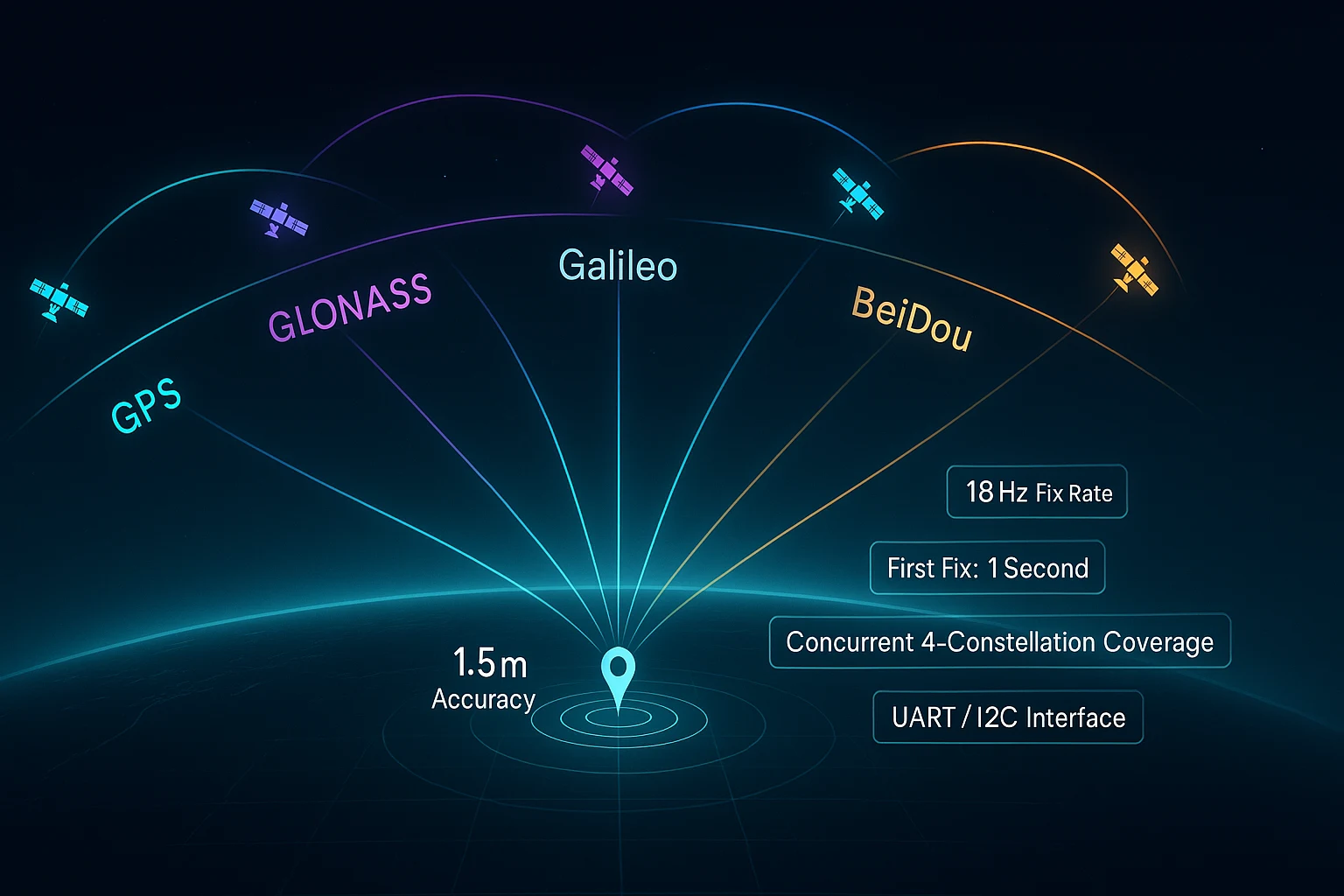
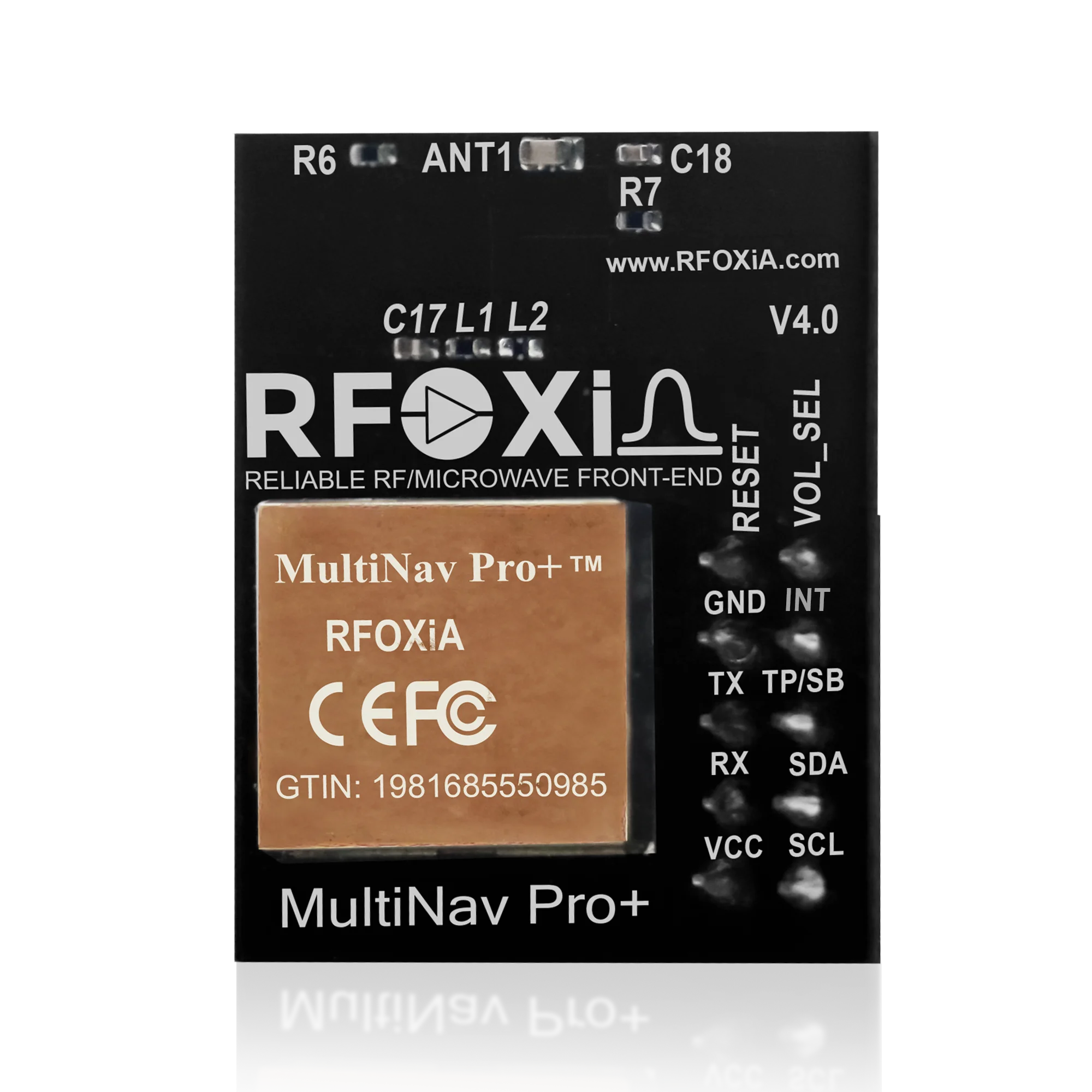
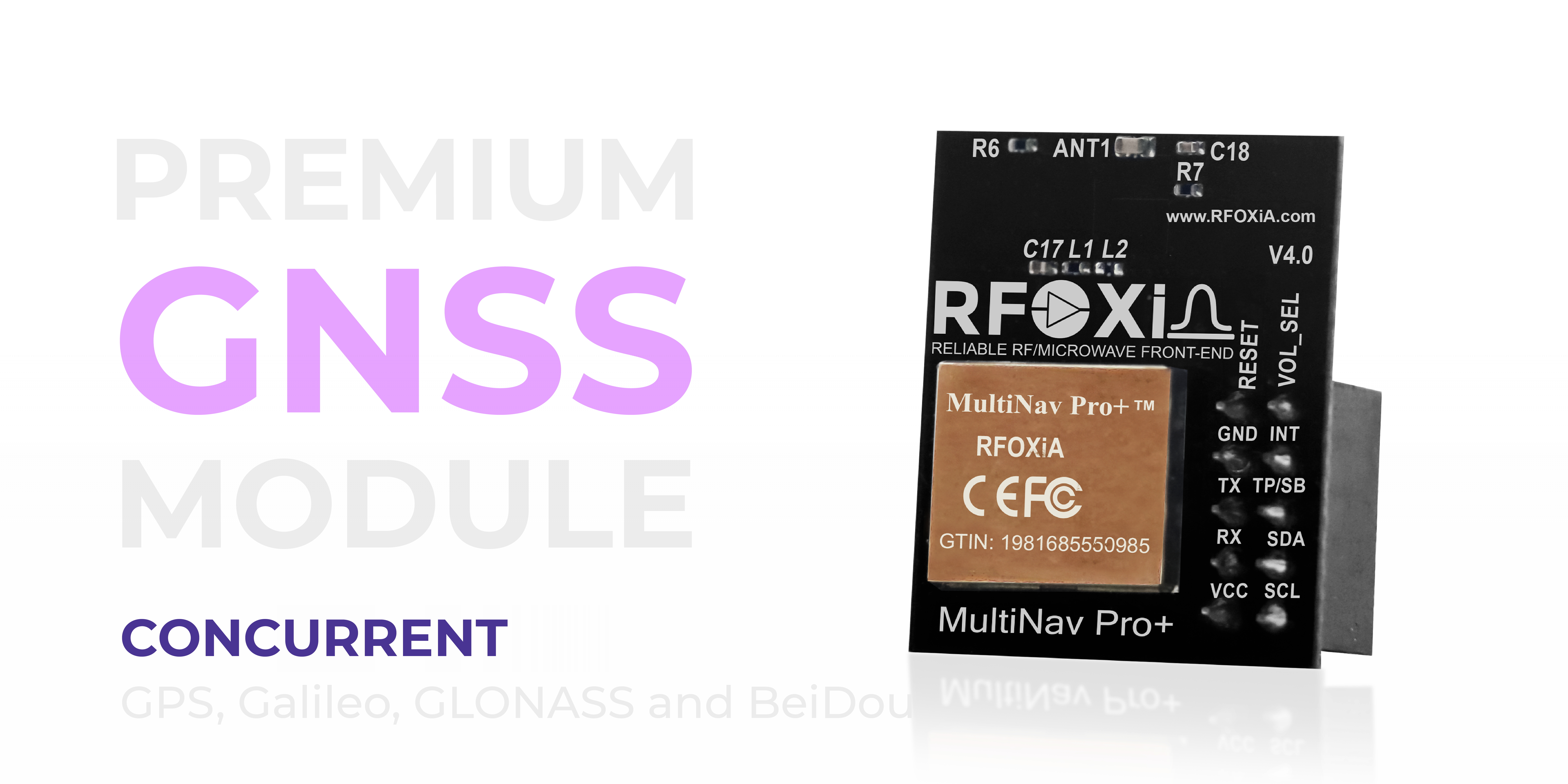
The MultiNav Pro+™ from RFOXiA sits in neither of those camps. It is a compact, FCC-certified GNSS module built on the latest u-blox MIA-M10Q chip, delivering 1.5-meter accuracy, an 18Hz fix rate, and concurrent support for GPS, GLONASS, Galileo, and BeiDou — all in a 26mm × 22mm form factor priced at $49.
This post covers everything you need to know: the hardware design, the performance specs, the software ecosystem, real-world use cases, and why the MultiNav Pro+ is the GPS module for sale that developers, drone builders, and IoT engineers are adding to their projects right now.
What Makes a GNSS Module Worth Buying in 2025
Before getting into the MultiNav Pro+ specifically, it is worth establishing what actually matters when you are evaluating a GPS module for sale.
Accuracy is the obvious starting point. Consumer-grade GPS chips typically achieve 2.5 to 5 meters of accuracy under open sky. For applications like drone surveying, precision agriculture, asset tracking, or robotics, that margin of error is often unacceptable. Sub-2-meter accuracy requires a better chipset, better antenna design, and better filtering.
Fix rate matters enormously for moving platforms. A 1Hz fix rate — one position update per second — is standard for cheap GPS modules. That is workable if you are tracking a slow-moving asset. But if you are flying a drone at 60 km/h, 1Hz means your position data is already outdated by the time it arrives. 18Hz gives you 18 position updates per second, which is a completely different level of responsiveness.
Time to first fix (TTFF) determines how fast your device becomes operational. The MultiNav Pro+ achieves first fix in approximately one second under good sky conditions — critical for applications where waiting 30-60 seconds for a GPS lock is not an option.
Multi-constellation support is increasingly non-negotiable for professional applications. GPS alone gives you access to roughly 30 satellites. Add GLONASS, Galileo, and BeiDou and you have more than 100 satellites available globally. More satellites means faster fixes, better accuracy, and reliable performance in urban canyons, valleys, and partially obstructed environments.
Interface flexibility determines how easily the module integrates into your existing hardware. Proprietary pinouts, unusual voltage requirements, and undocumented protocols all add friction. The MultiNav Pro+ supports both UART and I2C, works at 1.8V and 3.3V, and ships with an open-source C library that works with Arduino IDE and any standard toolchain.
With that framework in mind, let's look at how the MultiNav Pro+ performs across each of these dimensions.
MultiNav Pro+ Hardware Design: Built on the u-blox MIA-M10Q
The heart of the MultiNav Pro+ is the u-blox MIA-M10Q, one of u-blox's latest generation GNSS chips. u-blox is the gold standard in professional GNSS silicon — the same company whose modules appear in everything from commercial survey equipment to aerospace applications. The MIA-M10Q brings that lineage to a compact, low-power form factor without sacrificing the performance characteristics that make u-blox chips worth specifying.
RFOXiA's engineering team has designed the MultiNav Pro+ around the MIA-M10Q with a focus on RF signal integrity. The module includes a proprietary RF/microwave microstrip filter that suppresses interference before it reaches the receiver. This is not a standard feature on commodity GPS breakout boards — it is an engineering choice that has a real impact on accuracy in electrically noisy environments like drone frames, industrial enclosures, and urban RF-dense settings.
The result is a module that achieves the MIA-M10Q's full potential rather than compromising it with poor PCB layout or inadequate filtering.
Accuracy and Fix Rate: The Numbers That Matter

The headline specification is 1.5-meter CEP accuracy — circular error probable, meaning 50% of positions fall within 1.5 meters of the true location. For most builder applications, this is exceptional. Hobby-grade GPS modules commonly specify 2.5 to 5 meters CEP, and that is under ideal conditions. Real-world performance is often worse.
The 18Hz fix rate is where the MultiNav Pro+ separates itself most clearly from commodity hardware. At 18 position updates per second, fast-moving platforms like racing drones, tracked vehicles, and robotic systems get the resolution they need for smooth, lag-free position control. This is why RFOXiA positions the MultiNav Pro+ specifically for drone applications — at speed, fix rate is often more operationally important than raw accuracy.
First fix in approximately one second under open sky with a valid almanac is the other critical operational specification. Cold start performance degrades this somewhat, but the MIA-M10Q's multi-constellation capability means it acquires satellites faster than single-constellation receivers — more satellites to choose from means faster lock under all conditions.
Compact Footprint, Low Power Draw
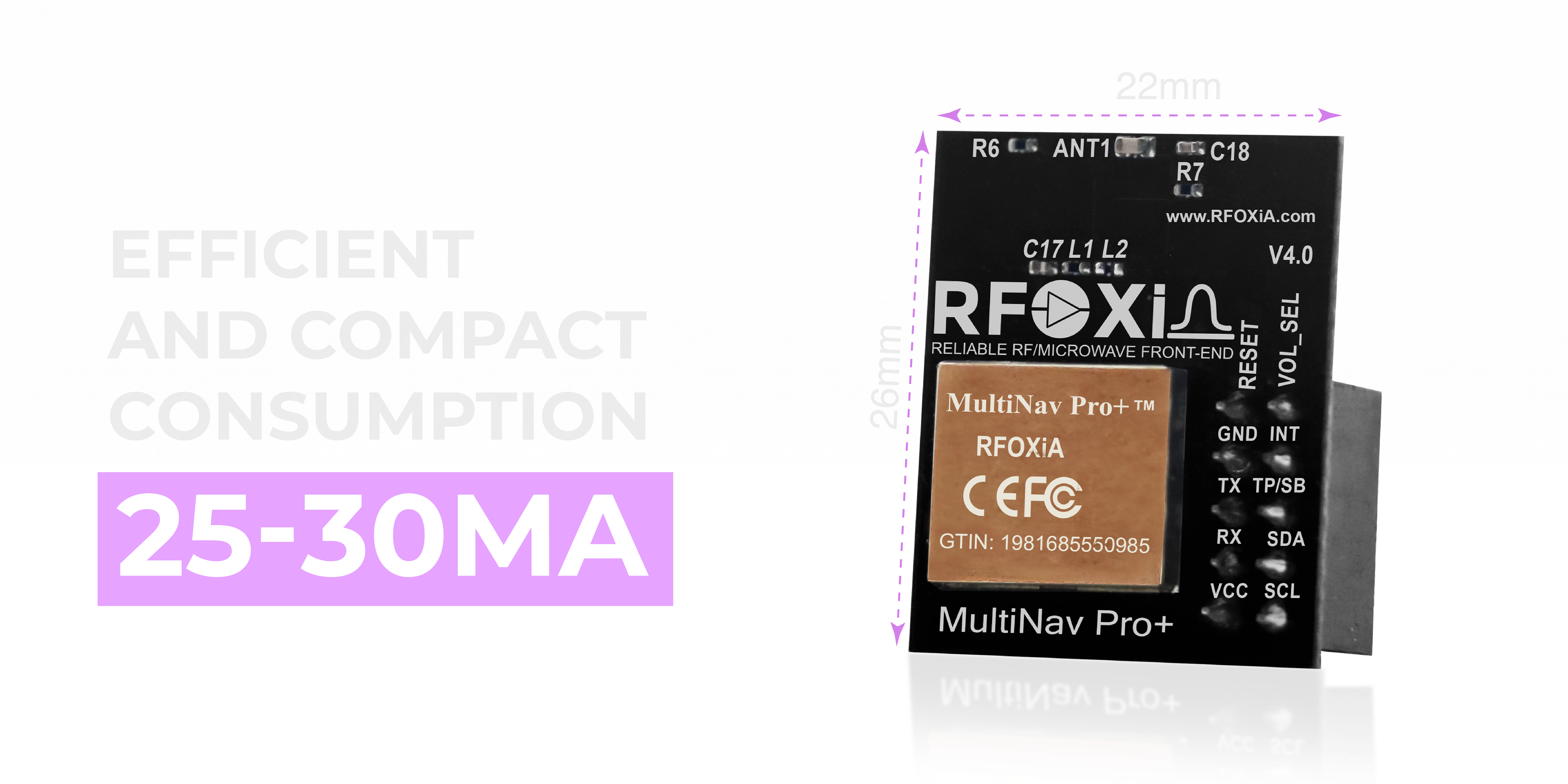
At 26mm × 22mm, the MultiNav Pro+ is small enough to fit on virtually any PCB or into any enclosure. This is not a developer evaluation board — it is a module designed for actual integration into finished products and projects.
Power consumption runs at 25-30mA during active tracking. For battery-powered applications, that is an acceptable draw when you consider the performance being delivered. The module also supports power-saving modes inherited from the MIA-M10Q's architecture, which can reduce average current consumption significantly for applications that do not require continuous high-rate tracking.
The integrated chip antenna maintains that compact footprint while providing reliable signal reception. No external antenna connector, no awkward cable routing — the antenna is part of the module. For integration into compact platforms where space and weight are at a premium, this is a significant practical advantage.
Interface and Integration: Built for Real Projects
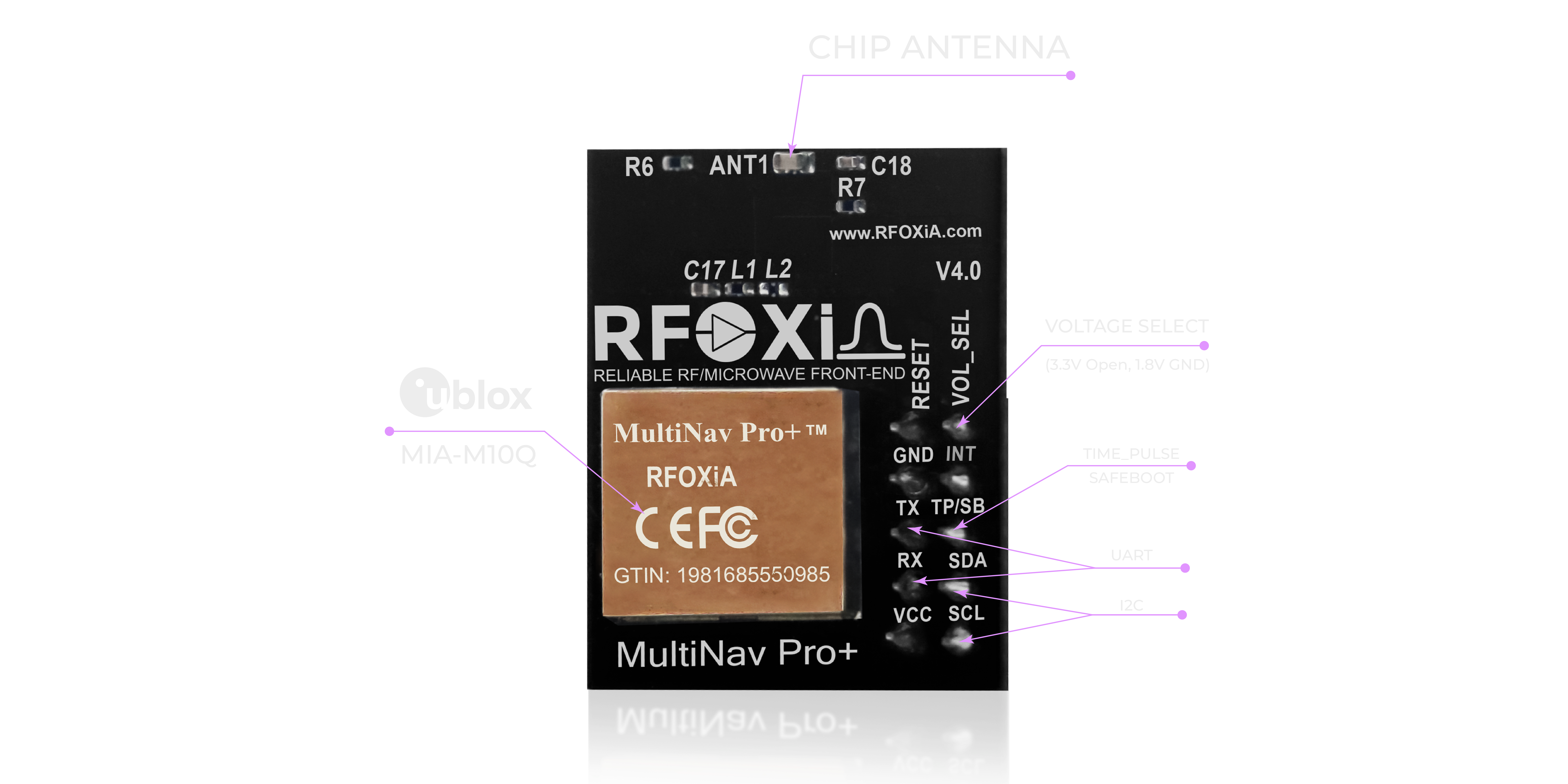
The MultiNav Pro+ supports two communication interfaces:
- UART (TX, RX) — the standard serial interface supported by virtually every microcontroller and single-board computer on the market
- I2C (SCL, SDA) — useful when UART pins are already allocated or when connecting multiple devices on a shared bus
Voltage compatibility spans 1.8V and 3.3V, which covers the full range of modern microcontrollers from STM32 series to ESP32, Nordic nRF, Raspberry Pi RP2040, and beyond. No level shifting required for most common platforms.
This interface flexibility is genuinely useful. Many GPS modules for sale support only UART at 3.3V, which creates headaches when your target microcontroller runs at 1.8V or when your UART pins are already committed to another peripheral. The MultiNav Pro+ removes that friction.
If you are looking for a GPS module for sale that integrates cleanly into your existing hardware design without requiring significant rework, the MultiNav Pro+ interface design reflects real engineering consideration for how developers actually work.
You can explore the full technical specifications and order the MultiNav Pro+ directly at the RFOXiA Accurate GNSS Module product page.
Open Source Driver and Software Ecosystem
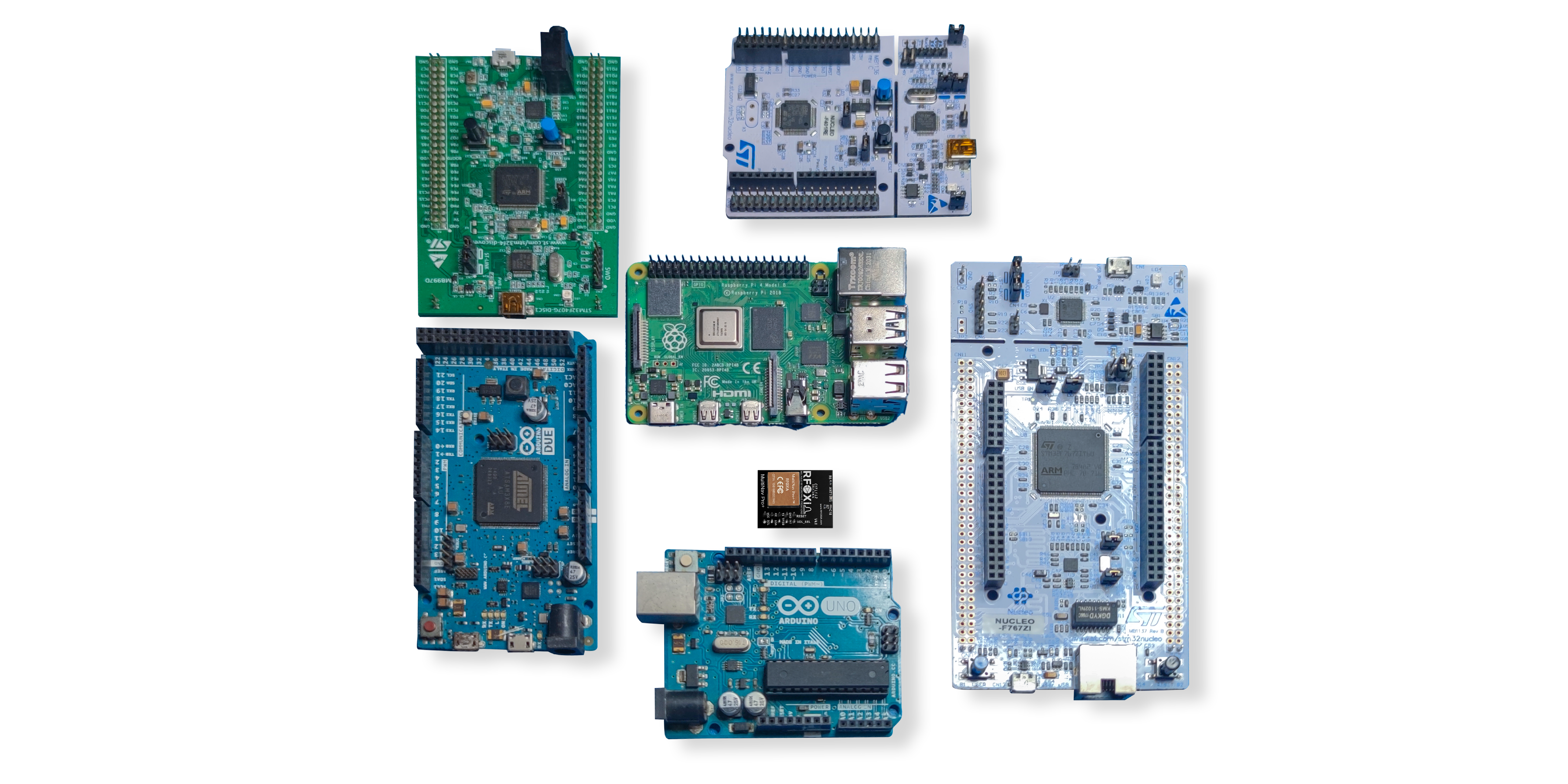
Hardware is only half the story. The MultiNav Pro+ ships with a fully open-source C language library that implements NMEA standard protocol commands. This means:
- No vendor lock-in. The NMEA protocol is an open standard. You can read the raw output with any UART terminal if you want to verify exactly what the module is reporting.
- Immediate compatibility with Arduino IDE. Import the library, connect the pins, and you are reading latitude, longitude, altitude, speed, and heading within minutes.
- Compatibility with any toolchain. PlatformIO, STM32CubeIDE, Zephyr RTOS, bare-metal C — the library works in all of them.
- Full source code access. You can inspect, modify, and extend the library for your specific application. This is critical for commercial projects where you cannot ship a product built on a black-box driver.
Open source firmware is increasingly a baseline expectation in the professional maker and embedded development community. The MultiNav Pro+ delivers on that expectation without reservation.
U-Center Software Support
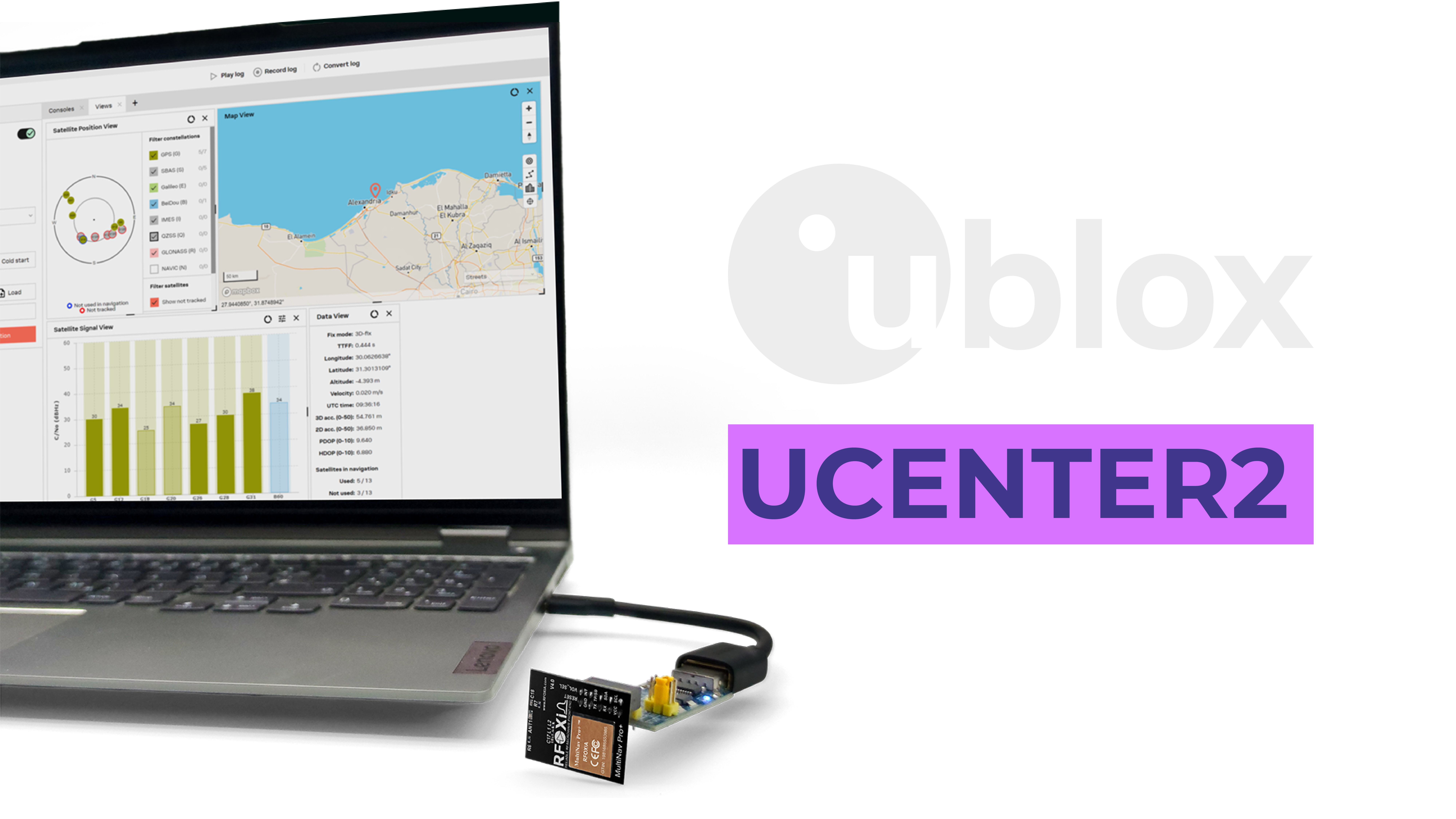
Because the MultiNav Pro+ is built on genuine u-blox silicon, it is fully compatible with u-center — u-blox's professional GNSS evaluation and configuration software.
u-center provides:
- Satellite visualization — see exactly which satellites are in view, their signal strengths, and their positions in the sky
- Real-time tracking — watch your position update on a map at the full 18Hz rate
- Configuration tools — adjust output rates, enable or disable constellations, configure power modes, and save settings to the module's non-volatile memory
- Data logging — record sessions for post-processing or performance analysis
- Signal quality analysis — diagnose interference, multipath, and other RF issues
For professional developers and researchers, u-center compatibility is a significant advantage. It turns the MultiNav Pro+ from a simple breakout module into a fully characterizable GNSS platform that you can evaluate, configure, and validate with the same professional tools used by embedded engineers at major OEMs.
This is not something you get with a generic GPS module for sale on commodity electronics sites. u-center support is a consequence of using real u-blox hardware — and RFOXiA has built the MultiNav Pro+ to take full advantage of that.
Use Cases: Where the MultiNav Pro+ Excels

The MultiNav Pro+ is designed to be genuinely useful across a wide range of applications. Here are the primary use cases where its specification profile delivers the most value:
Drone Navigation and Control
The 18Hz fix rate and 1.5m accuracy make the MultiNav Pro+ a strong choice for autonomous drone navigation, return-to-home functionality, waypoint missions, and precision landing. Fast-moving platforms need fast position updates — this module delivers them.
Precision Agriculture
Field mapping, spray path planning, and equipment guidance all benefit from sub-2-meter accuracy. Paired with the RFOXiA Sensors Module for environmental data, the MultiNav Pro+ enables a complete precision agriculture sensing platform.
Asset and Fleet Tracking
High fix rates mean smooth, accurate tracks even for vehicles moving at highway speeds. Multi-constellation support ensures reliable fixes in areas with poor GPS geometry.
IoT Environmental Data Networks
The MultiNav Pro+ is a core component of the RFOXiA data network — GPS validation confirms that sensor nodes are genuinely deployed outdoors, enabling verified data collection that commands premium pricing from enterprise data buyers.
Robotics and Autonomous Vehicles
Ground robots, autonomous vehicles, and UAVs all benefit from the high update rate and accuracy. First-fix-in-one-second means minimal startup delay before the platform becomes operational.
Research and Education
Open-source drivers, u-center compatibility, and NMEA protocol support make the MultiNav Pro+ an excellent platform for GNSS research, signal processing experiments, and educational projects at the university level.
Wearables and Personal Tracking
The compact form factor and low power draw make the MultiNav Pro+ viable for wearable applications where size and battery life are constrained.
The RFOXiA Ecosystem Advantage
What distinguishes the MultiNav Pro+ from other GPS modules for sale is not just the hardware — it is the ecosystem it belongs to.
RFOXiA has built a vertically integrated wireless development platform that combines the MultiNav Pro+ with:
- BLE Module (MultiNav Pro+™) — 5km ground-to-ground, 15-20km man-to-drone long-range Bluetooth communication
- Sensors Module — temperature, humidity, pressure, air quality, accelerometer, gyroscope, and magnetometer in one board
- Power/Program Kit — supercapacitor-based power with 5-minute charge and 24-hour runtime
- RFOXiA Connect App — iOS and Android mobile application with live GPS map, sensor display, and drone control interface
- AI Firmware Builder — describe your application in plain language, receive production-ready firmware
- Data Monetization Network — deploy your sensor node and earn daily rewards for verified environmental data
The Developer Bundle combines all four hardware modules into one integrated kit at $199. If you are building a serious wireless project — drone control, remote sensing, field research, or IoT deployment — the bundle is the fastest path from concept to working prototype.
When you are ready to go beyond the MultiNav Pro+ alone, visit the RFOXiA Accurate GNSS Module page to explore bundle options and the full ecosystem.
Technical Specifications Summary
| Specification | Value |
|---|---|
| Accuracy | < 1.5 meters CEP |
| Fix Rate | Up to 18Hz |
| Time to First Fix | ~1 second (hot start) |
| GNSS Systems | GPS, GLONASS, Galileo, BeiDou |
| Chip | u-blox MIA-M10Q |
| Antenna | Integrated chip antenna |
| Interface | UART (TX, RX) and I2C (SCL, SDA) |
| Operating Voltage | 1.8V and 3.3V |
| Current Consumption | 25-30mA (active tracking) |
| Dimensions | 26mm × 22mm |
| Certification | FCC certified |
| Price | $49 |
| Software | Open-source C library, NMEA protocol, u-center compatible |
Why the MultiNav Pro+ Is the Right GPS Module for Sale for Your Next Build
The market for GNSS modules is bifurcated. On one side you have cheap, slow, inaccurate modules that technically work but disappoint the moment your application demands real performance. On the other side you have survey-grade and professional-grade hardware priced for enterprise procurement budgets.
The MultiNav Pro+ occupies the space between those extremes with clarity and confidence. It delivers sub-2-meter accuracy, 18Hz position updates, concurrent multi-constellation reception, open-source software, professional evaluation tools, and FCC certification — all at $49.
For drone builders who need reliable position data at speed. For IoT developers who need a GPS module that integrates cleanly and works the first time. For researchers who need u-center compatibility and NMEA data they can trust. For anyone who has been searching for a GPS module for sale that does not force a compromise between price and performance.
The MultiNav Pro+ is ready to ship. FCC certified. Backed by RFOXiA's proven track record across four funded hardware campaigns and a growing community of engineers and developers who build serious things.
Get the MultiNav Pro+ and join the RFOXiA ecosystem at the RFOXiA Accurate GNSS Module product page — and sign up for RFOXiA Club to claim your $10 welcome credit toward your first order.
Frequently Asked Questions
What is the difference between the MultiNav Pro+ and a standard Arduino GPS module? Standard Arduino-compatible GPS modules typically achieve 2.5-5 meter accuracy at 1Hz update rates. The MultiNav Pro+ delivers 1.5m accuracy at 18Hz — roughly 18 times more position updates per second with meaningfully better accuracy. It also supports four GNSS constellations simultaneously and uses genuine u-blox silicon with professional software support.
Does the MultiNav Pro+ work with Raspberry Pi? Yes. The UART interface is compatible with Raspberry Pi's GPIO UART pins at 3.3V. The I2C interface also works with Raspberry Pi's I2C bus. The open-source C library can be compiled and run on Raspberry Pi without modification.
Is the MultiNav Pro+ FCC certified? Yes. The MultiNav Pro+ is FCC certified, making it legal for use in commercial and consumer products in the United States without additional certification of the GNSS subsystem in most cases.
Can the MultiNav Pro+ be used with the RFOXiA BLE module and Sensors Module together? Yes. All RFOXiA modules are designed to work together as an integrated ecosystem. The Developer Bundle includes all four modules — BLE, GNSS, Sensors, and Power/Program Kit — in one package optimized for builders who want the complete platform.
What software do I need to get started? The included open-source C library works with Arduino IDE out of the box. u-center (free download from u-blox) provides a full GUI for configuration and evaluation. No proprietary software required.
Written by: Moamen Mohamed LinkedIn