
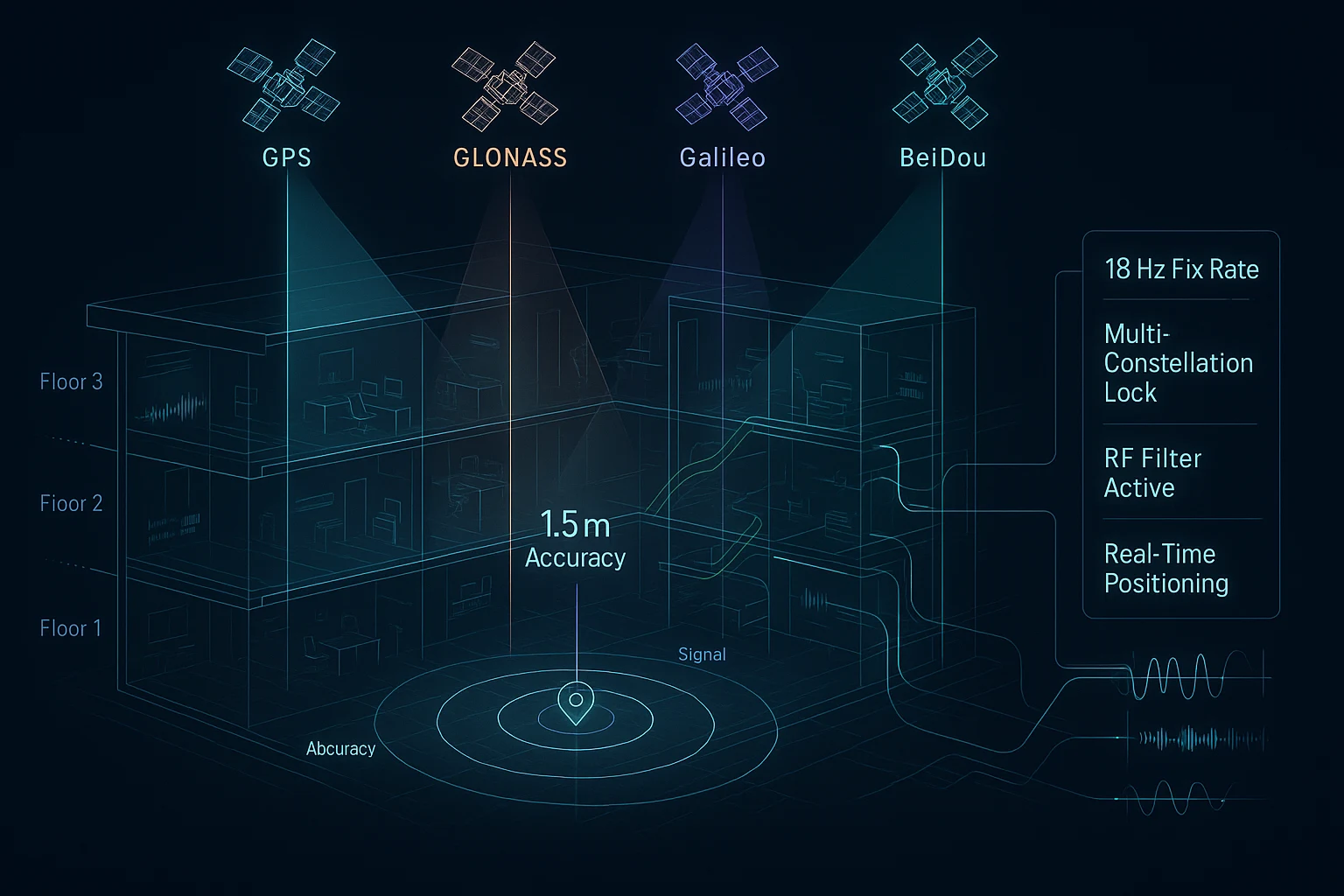
GPS Module Indoor Performance: What Every Engineer and Builder Must Know
Understanding GPS Module Indoor Performance Before You Build
If you've ever tried to lock a GPS signal inside a warehouse, under a concrete ceiling, or even near a window in a dense urban building, you already know the frustration. GPS module indoor performance is one of the most misunderstood — and most critical — factors in embedded hardware development. Engineers lose weeks of project time discovering this limitation after they've already committed to a module and a product architecture.
This guide is written for builders who refuse to compromise. Whether you're developing a drone tracking system, an industrial IoT asset tracker, an autonomous robot, or a smart city sensor node, understanding the real-world behavior of GNSS modules — indoors and out — will determine whether your project succeeds or stalls.
We'll cover how GPS signals work, why indoor environments degrade performance so severely, what specs actually matter when selecting a module, and how the MultiNav Pro+™ Accurate GNSS Module from RFOXiA is engineered to maximize signal acquisition wherever your application takes it.
How GPS Signals Actually Work (And Why Buildings Kill Them)
GPS — and by extension the broader GNSS constellation — relies on line-of-sight microwave signals transmitted from satellites orbiting at roughly 20,200 kilometers altitude. These signals arrive at ground level incredibly faint, typically around -130 dBm. To put that in perspective, that's about 20 billion times weaker than a typical Wi-Fi signal.
Your GPS module's receiver must detect, decode, and triangulate these whisper-thin signals using at least four satellites simultaneously to produce a usable location fix. When you introduce building materials — concrete, steel, glass, brick — between the sky and your receiver, those already-faint signals get attenuated by anywhere from 10 dB to 30 dB or more. At that point, most consumer-grade GPS modules simply fail to maintain a fix.
Here's what actually happens to GPS module indoor performance in different indoor scenarios:
- Near a window, thin wall: Signal degrades 10-15 dB. Marginal fix possible with high-sensitivity receiver
- One concrete floor above ground level: Signal degrades 20-25 dB. Fix highly unlikely with standard modules
- Deep interior, basement, parking structure: Signal degrades 30+ dB. Virtually no fix achievable without external antenna or assisted GNSS
- Glass-dominant office building: Signal degrades 5-15 dB. Some fix possible with high-sensitivity module
This isn't a flaw in any specific product — it's physics. But it does mean the quality of your module's receiver sensitivity, its first-fix time, its multi-constellation support, and its antenna design become enormously more important than they appear in a data sheet comparison.
Why Multi-Constellation Support Is the Biggest Factor in Marginal Environments
The single most impactful specification for improving GPS module indoor performance isn't receiver sensitivity alone — it's the number of satellite constellations your module can simultaneously access.
Here's why this matters so much in challenging environments:
GPS (American) provides roughly 31 operational satellites. GLONASS (Russian) adds 24. Galileo (European) contributes 24. BeiDou (Chinese) adds over 35. When your receiver can listen to all four simultaneously, the total visible satellite count in any given sky view jumps from a typical 8-12 (GPS only) to potentially 30+ satellites across all constellations.
In outdoor open sky, this gives you faster first fix and better position accuracy. But in marginal GPS module indoor performance scenarios — near windows, on partially-obstructed rooftops, in light industrial settings — this multi-constellation advantage becomes critical. More visible satellites means your receiver can maintain a fix using whatever combination of signals is strong enough to penetrate your specific obstruction geometry.
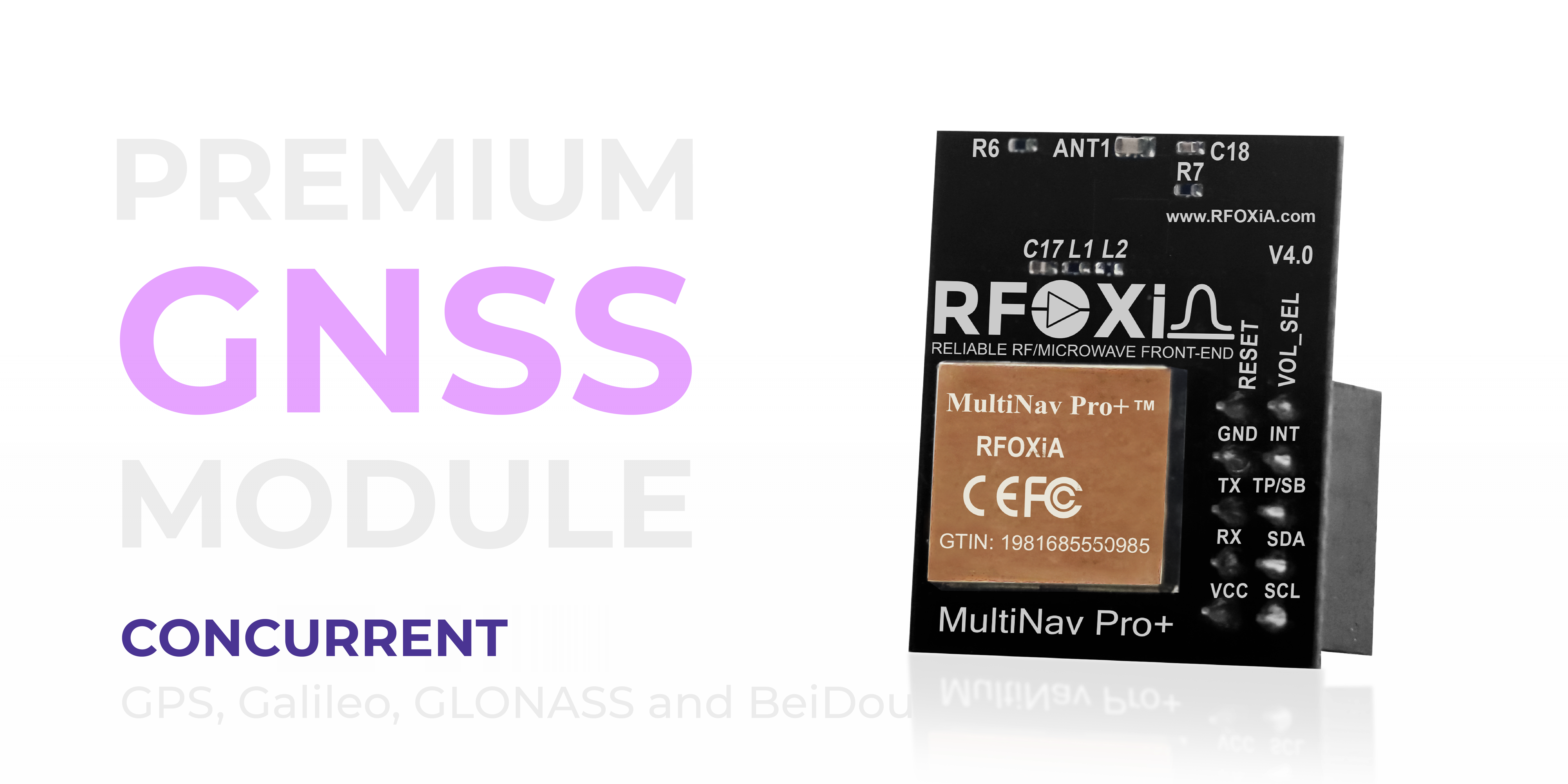
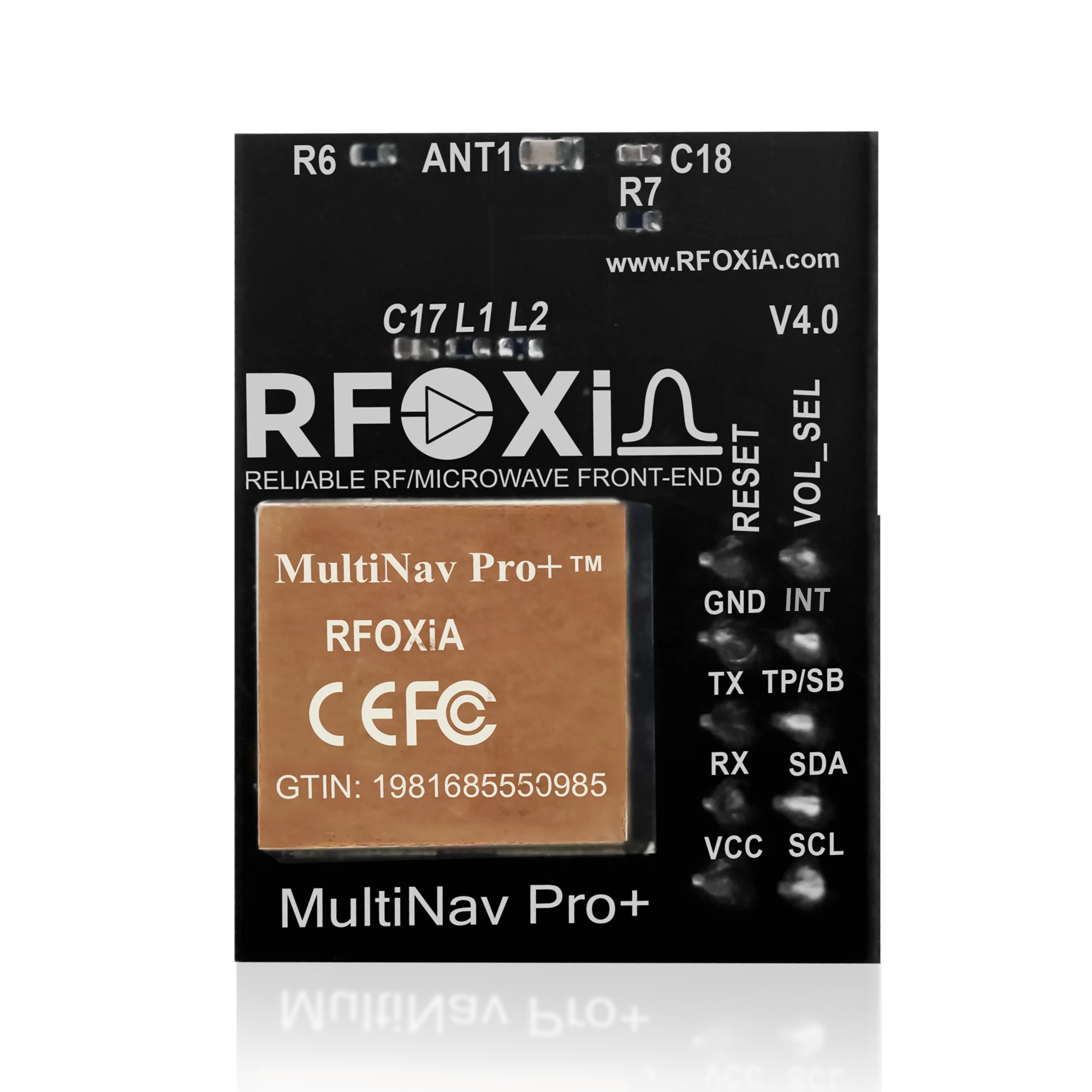
The MultiNav Pro+™ is built on the u-blox MIA-M10Q, one of the most advanced GNSS chipsets available for compact module design. It simultaneously tracks all four major constellations — GPS, Galileo, GLONASS, and BeiDou — in a package measuring just 26mm x 22mm. This is not a cost-cut single-constellation chip with a GNSS label on the box. This is a professional-grade concurrent multi-constellation receiver that maximizes your visible satellite count in every environment.
The Specs That Actually Matter for Real-World Performance
Let's move beyond marketing language and talk about what specifications genuinely affect your experience:
Accuracy: 1.5 Meters CEP
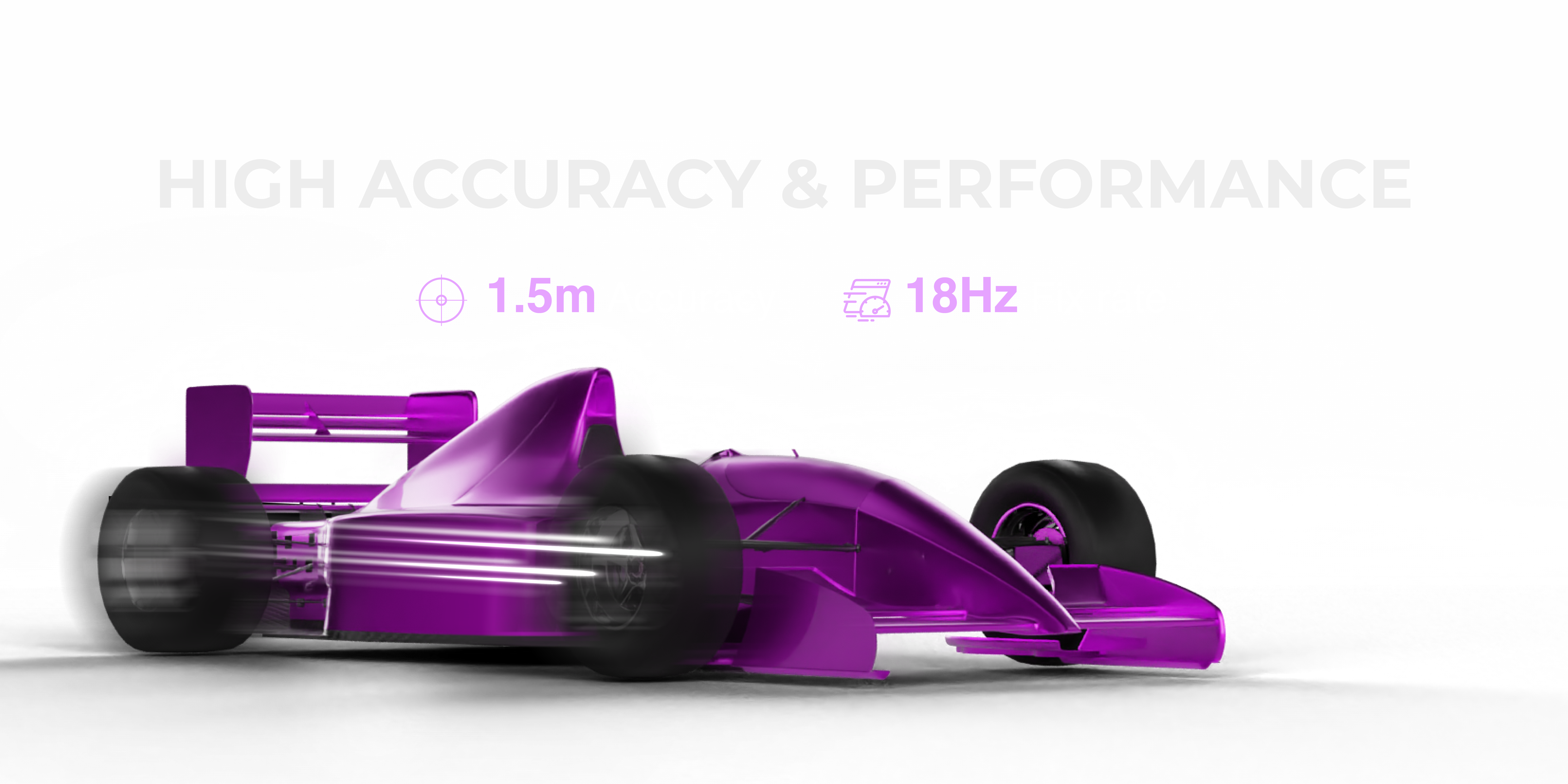
The MultiNav Pro+™ achieves 1.5-meter CEP (Circular Error Probable) accuracy. CEP means 50% of all reported positions will be within 1.5 meters of the true position. For tracking fast-moving objects like drones, delivery robots, or field research platforms, this level of precision is the difference between a useful system and one that can't be trusted.
Compare this to typical consumer GPS chipsets embedded in smartphones, which report 3-5 meters best-case accuracy and often perform significantly worse in obstructed environments. For professional applications, 1.5m accuracy isn't a luxury — it's a requirement.
Fix Rate: 18Hz
Most GNSS modules update at 1Hz — once per second. Some step up to 5Hz or 10Hz for an additional cost. The MultiNav Pro+™ delivers an 18Hz fix rate, meaning it reports position 18 times per second.
Why does this matter? Consider a drone flying at 60 km/h. At 1Hz update rate, the drone travels 16.7 meters between each GPS position report. At 18Hz, that gap shrinks to under 1 meter. For any application involving fast-moving platforms — drones, autonomous vehicles, racing, precision landing, dynamic tracking — an 18Hz fix rate transforms GPS from a rough position reference into a genuinely usable real-time tracking system.
First Fix Time: 1 Second
The MultiNav Pro+™ achieves first fix in as little as 1 second under good conditions. In outdoor environments with clear sky view, this means your system is ready almost instantly from power-on. In marginal indoor or semi-indoor environments, fast first-fix capability combined with multi-constellation reception means your module recovers signal faster after brief obstructions — useful in any application where the device moves between indoor and outdoor environments.
Power Consumption: 25-30mA
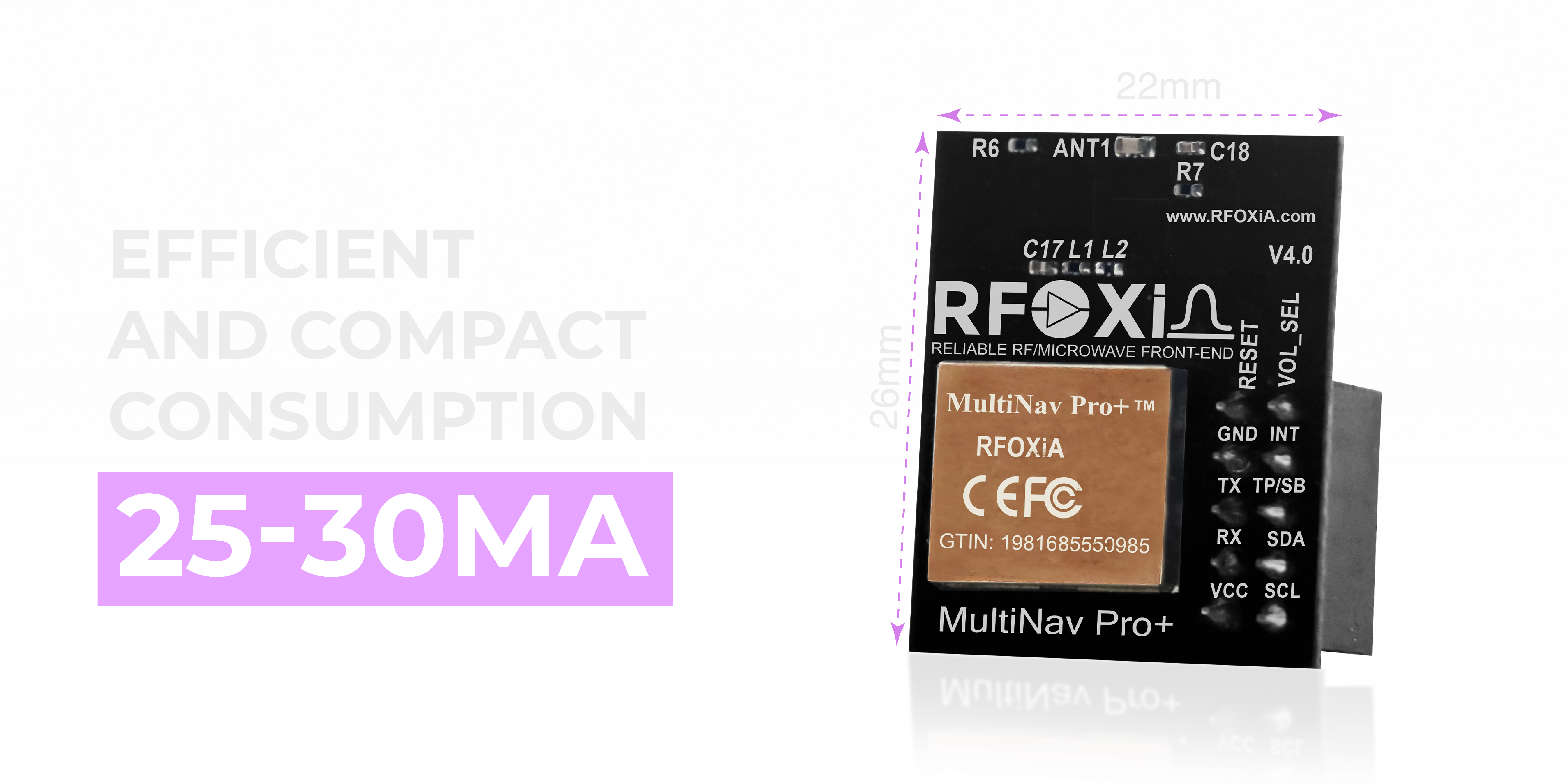
Running all four GNSS constellations simultaneously at 25-30mA is genuinely efficient for a professional-grade module. Battery-powered IoT devices, field research units, and drone systems can sustain continuous GNSS operation without excessive power budget impact. When paired with the RFOXiA Power/Program Kit — which provides 24-hour runtime from a 5-minute supercapacitor charge — continuous GNSS tracking for full-day field deployments becomes entirely practical.
Interface Flexibility: UART and I2C Support
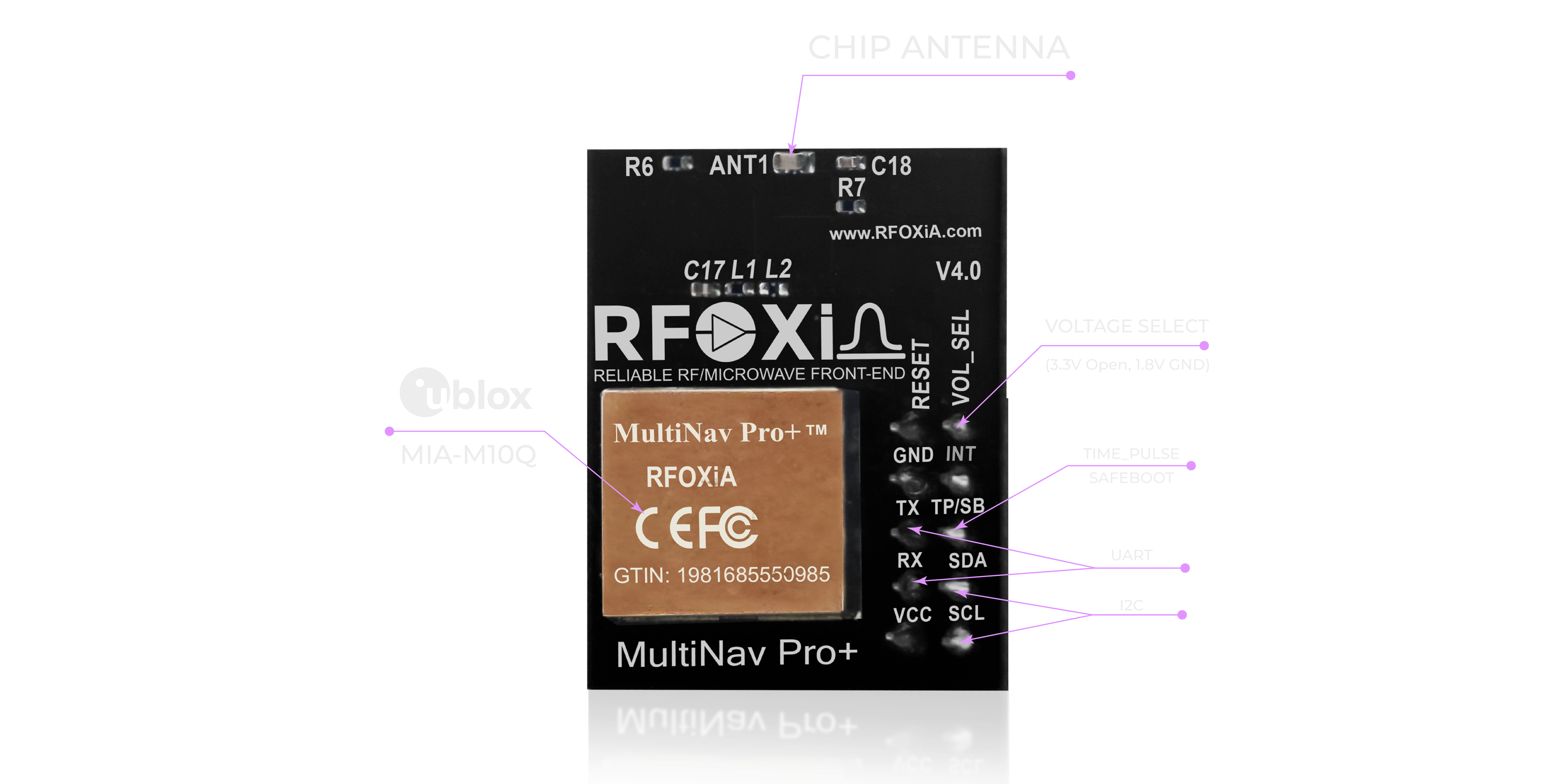
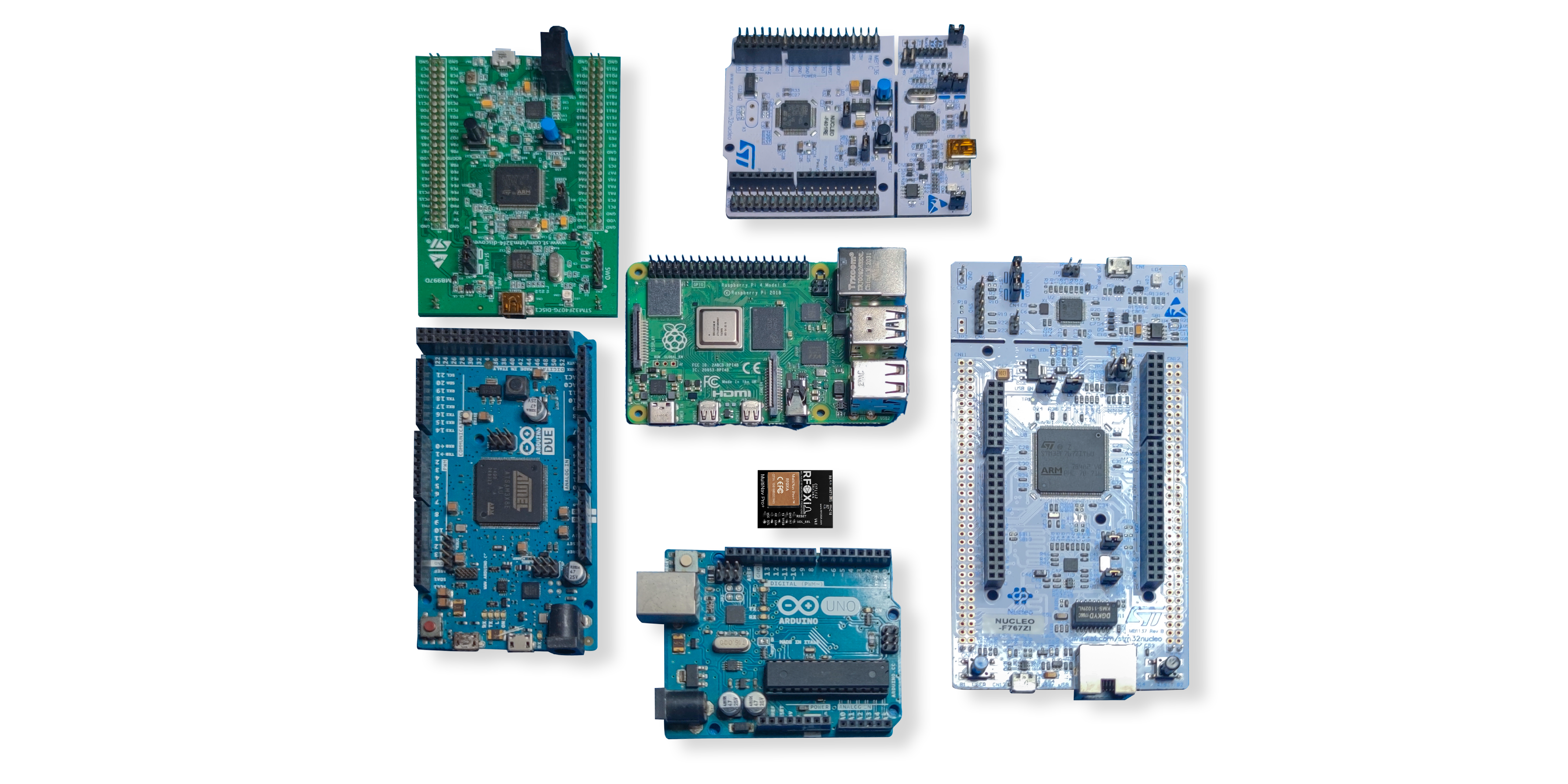
The MultiNav Pro+™ supports both UART (TX/RX) and I2C (SCL/SDA) communication interfaces, operating at both 1.8V and 3.3V logic levels. This broad interface compatibility means the module integrates cleanly into virtually any microcontroller environment:
- Arduino-based projects — UART or I2C, 3.3V logic
- STM32 platforms — UART or I2C, 1.8V or 3.3V
- Raspberry Pi and Pi Pico — I2C or UART, 3.3V
- ESP32 projects — UART or I2C, 3.3V
- Custom PCB designs — dual voltage support simplifies power rail planning
The dual-interface design also means you can share the I2C bus with other sensors in your design (like the RFOXiA Sensors Module) while keeping UART available for high-throughput NMEA data streaming when needed.
For teams building the RFOXiA Accurate GNSS Module into a complete sensor stack, this interface flexibility is not a minor convenience — it's what makes complex multi-module designs manageable without interface conflicts.
Open Source Driver: Real Developer-Friendly Integration
One of the most underrated aspects of selecting a GNSS module is software support. A module with great hardware specs but poor software support costs engineering teams enormous amounts of time in driver development, debugging, and maintenance.
The MultiNav Pro+™ ships with a fully open-source C language driver library that includes complete NMEA standard protocol command parsing. The library is designed for direct import into Arduino IDE or any C-compatible toolchain. This means:
- You're parsing real location data in minutes, not days
- Full source code visibility — no black-box dependencies
- Customizable to your application's specific data needs
- Compatible with the RFOXiA AI Firmware Builder for rapid application development
- Community-supported and maintained
For teams using RFOXiA Club's AI Firmware Builder, describing your GNSS application in plain language generates production-ready firmware that interfaces directly with the MultiNav Pro+™ library — compressing what would normally be days of driver integration work into a single session.
U-Center Software: Visualization and Configuration
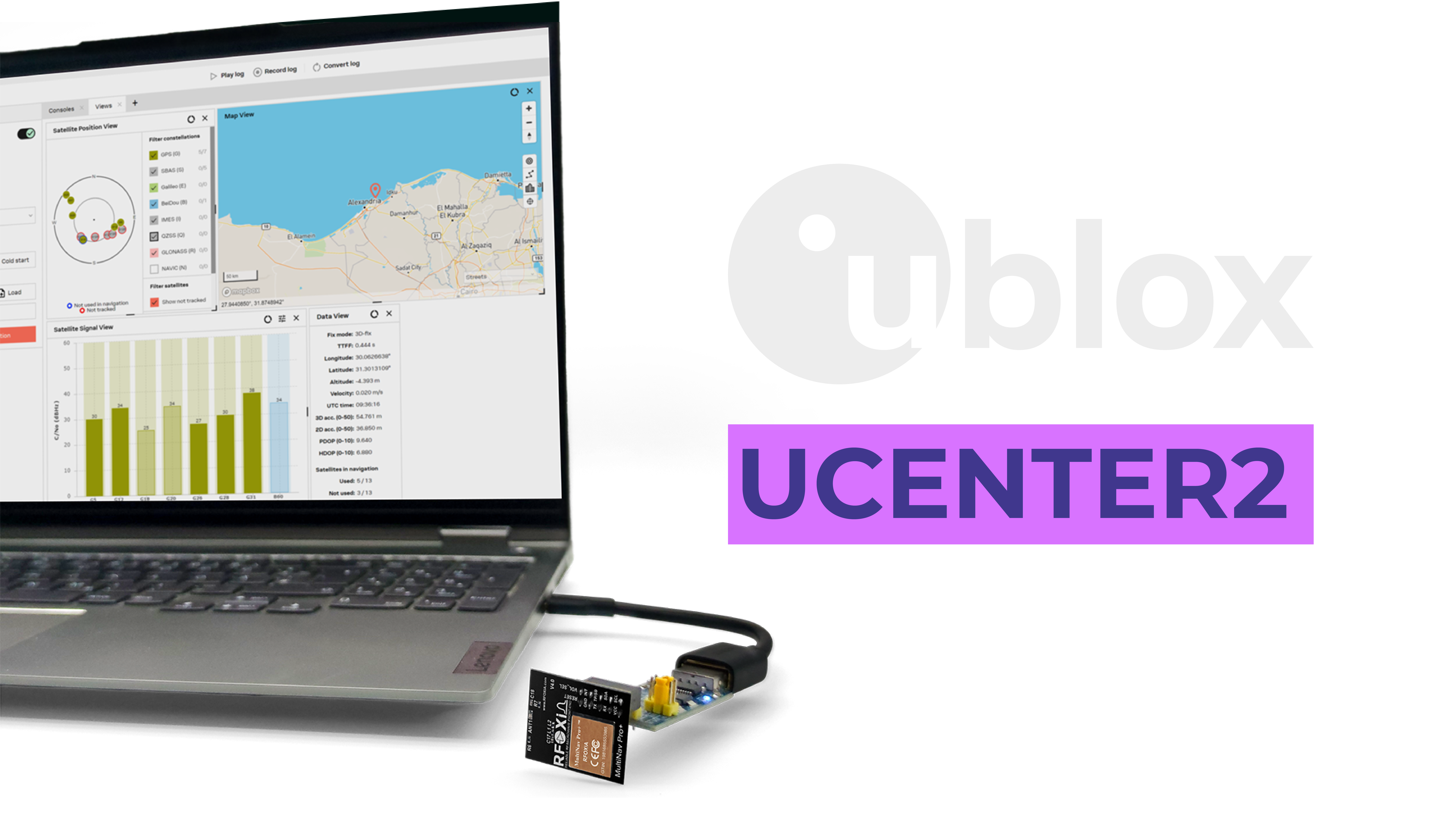
Because the MultiNav Pro+™ is built on the u-blox MIA-M10Q, it is fully compatible with u-center — u-blox's professional GNSS evaluation and configuration software. U-center provides:
- Live satellite sky view — visualize which satellites are visible and their signal strength
- Real-time position tracking on integrated map
- Signal quality analysis and logging
- Configuration of fix rate, power modes, NMEA output sentences
- Protocol logging for firmware debugging
- Evaluation of GNSS performance in your specific deployment environment
For engineers who want to characterize GPS module indoor performance in their specific application environment before finalizing their design, u-center is an invaluable tool. You can run the MultiNav Pro+™ through your actual deployment scenario — near windows, in partially obstructed locations, on moving platforms — and log exactly what signal quality and fix reliability you can expect.
This professional-grade evaluation capability at a $49 price point is essentially unmatched in the market.
Practical Strategies to Maximize GPS Module Indoor Performance
Even with the best hardware, indoor GNSS has physical limits. Here are proven engineering strategies to maximize GPS module indoor performance in your application:
1. Position Your Module Near the Best Sky View Available
Even partial sky view dramatically improves signal acquisition. Position antennas near windows, roof penetrations, or skylights wherever your enclosure design allows.
2. Use an External Active Antenna for Deep Indoor Deployments
For applications requiring GPS inside dense structures, an external active antenna mounted on the exterior with a coaxial run to the module is the most reliable solution. The MultiNav Pro+™'s u-blox chipset supports external active antenna configurations.
3. Implement Sensor Fusion for Indoor Dead Reckoning
For applications where the device moves between outdoor and indoor environments — delivery robots, field research platforms, wearables — sensor fusion with an IMU (accelerometer + gyroscope + magnetometer) extends accurate positioning through indoor segments using dead reckoning. The RFOXiA Sensors Module provides all three IMU sensors in a single board, making sensor fusion integration with the MultiNav Pro+™ straightforward within the RFOXiA ecosystem.
4. Use Assisted GNSS (A-GNSS) Where Available
A-GNSS pre-loads satellite orbital data via cellular or Wi-Fi connection, dramatically reducing first-fix time and enabling faster acquisition of weak signals. The u-blox MIA-M10Q supports A-GNSS protocols.
5. Maximize Fix Rate to Recover Faster from Signal Dropout
At 18Hz, the MultiNav Pro+™ re-acquires position almost instantly when moving from a briefly obstructed area back into view. Applications that alternate between marginal indoor and clear outdoor exposure benefit disproportionately from high fix rates.
Use Cases: Where the MultiNav Pro+™ Delivers
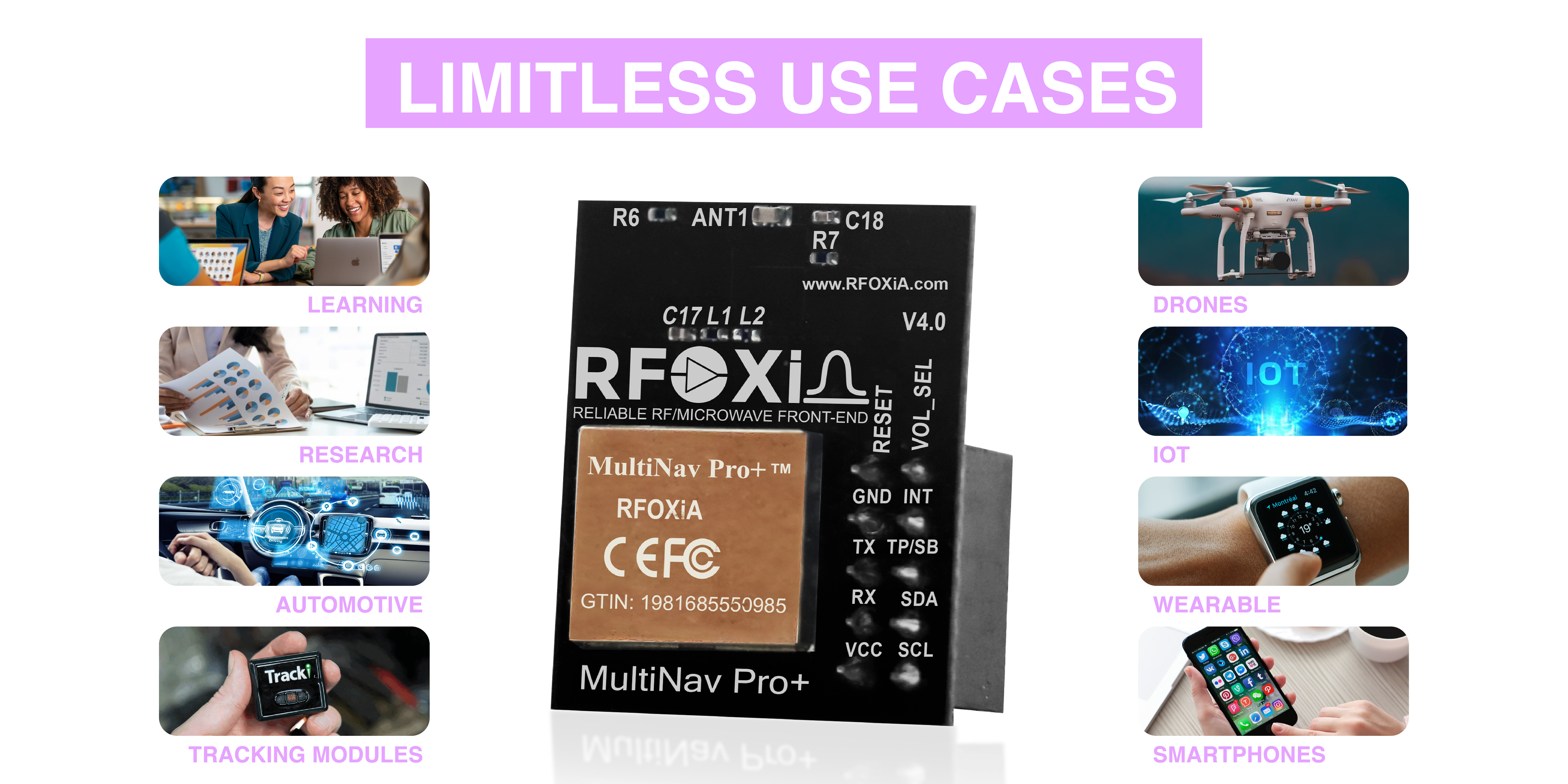
The MultiNav Pro+™ is engineered for professional applications where location data is not optional:
Drone and UAV Applications The 18Hz fix rate and 1.5m accuracy make this module ideal for drone position hold, autonomous waypoint navigation, and precision landing systems. Combined with the RFOXiA BLE Module's 15-20km man-to-drone range, you have the core of a complete long-range autonomous drone platform.
Industrial IoT Asset Tracking Manufacturing facilities, logistics yards, construction sites — anywhere high-value assets move between indoor and outdoor environments benefits from the MultiNav Pro+™'s fast acquisition and multi-constellation reception. The compact 26mm x 22mm footprint integrates into tracker designs without compromising form factor.
Wearable and Field Research Devices Researchers, surveyors, and field teams need reliable positioning even in semi-obstructed environments. The 25-30mA power consumption enables multi-day battery operation for field instruments that log continuous position and sensor data.
Smart City and Environmental Monitoring GPS-verified outdoor deployment is the backbone of the RFOXiA Data Network. The MultiNav Pro+™ provides the location validation that makes RFOXiA sensor data commercially valuable to enterprise data buyers.
Automotive and Mobile Robotics Ground vehicle navigation, delivery robots, and mobile industrial platforms benefit from the high fix rate for smooth position tracking even at vehicle speeds.
For developers ready to integrate professional GNSS into their next project, the RFOXiA Accurate GNSS Module is available at $49 with immediate shipment from stock.
The RFOXiA Ecosystem Advantage
Hardware is only as useful as the ecosystem that surrounds it. The MultiNav Pro+™ is designed from the ground up to work within the complete RFOXiA wireless development ecosystem:
- Pair with the BLE Module for wireless transmission of GPS position data over distances up to 50km drone-to-drone
- Pair with the Sensors Module for complete environmental + location data logging
- Pair with the Power/Program Kit for 24-hour field deployment on a 5-minute supercapacitor charge
- Integrate with RFOXiA Connect App for live GPS tracking on your phone's map display
- Contribute GPS-verified sensor data to the RFOXiA Data Network and earn daily rewards
- Use the AI Firmware Builder to generate complete firmware for your GNSS application without months of development time
All modules in the RFOXiA ecosystem are FCC certified, ship from stock, and are supported by open-source firmware and the RFOXiA Club developer community.
Specifications Summary
| Specification | MultiNav Pro+™ Value |
|---|---|
| Accuracy | 1.5m CEP |
| Fix Rate | 18Hz |
| First Fix | 1 second |
| GNSS Constellations | GPS, Galileo, GLONASS, BeiDou (concurrent) |
| GNSS Chipset | u-blox MIA-M10Q |
| Interface | UART (TX/RX) + I2C (SCL/SDA) |
| Operating Voltage | 1.8V and 3.3V |
| Power Consumption | 25-30mA |
| Dimensions | 26mm x 22mm |
| Antenna | Integrated high-gain chip antenna |
| Driver | Open-source C library, Arduino compatible |
| Certification | FCC certified |
| Price | $49 |
Final Verdict: Choosing the Right Module for Performance That Matters
GPS module indoor performance will never be perfect — physics sets hard limits on what radio signals can do through concrete and steel. But the gap between a well-engineered professional GNSS module and a commodity chip is enormous in marginal environments. Multi-constellation reception, high receiver sensitivity, fast first-fix, and high update rates are not spec-sheet luxuries — they are the engineering choices that determine whether your application works reliably in the real world.
The MultiNav Pro+™ from RFOXiA delivers professional-grade GNSS performance at a price point that has historically been inaccessible to independent developers and small engineering teams. 1.5-meter accuracy. 18Hz fix rate. Four concurrent GNSS constellations. Open-source driver. u-center compatible. FCC certified. $49.
If your next project demands location data you can trust — in clear sky, in semi-obstructed deployments, on fast-moving platforms — this is the module built for that requirement.
Explore the full specifications and order directly from the RFOXiA Accurate GNSS Module product page. Join RFOXiA Club for $10 welcome credit toward your first order and access to the complete developer ecosystem.
RFOXiA — Democratizing Connectivity and Computing Power.
Written by: Moamen Mohamed LinkedIn