
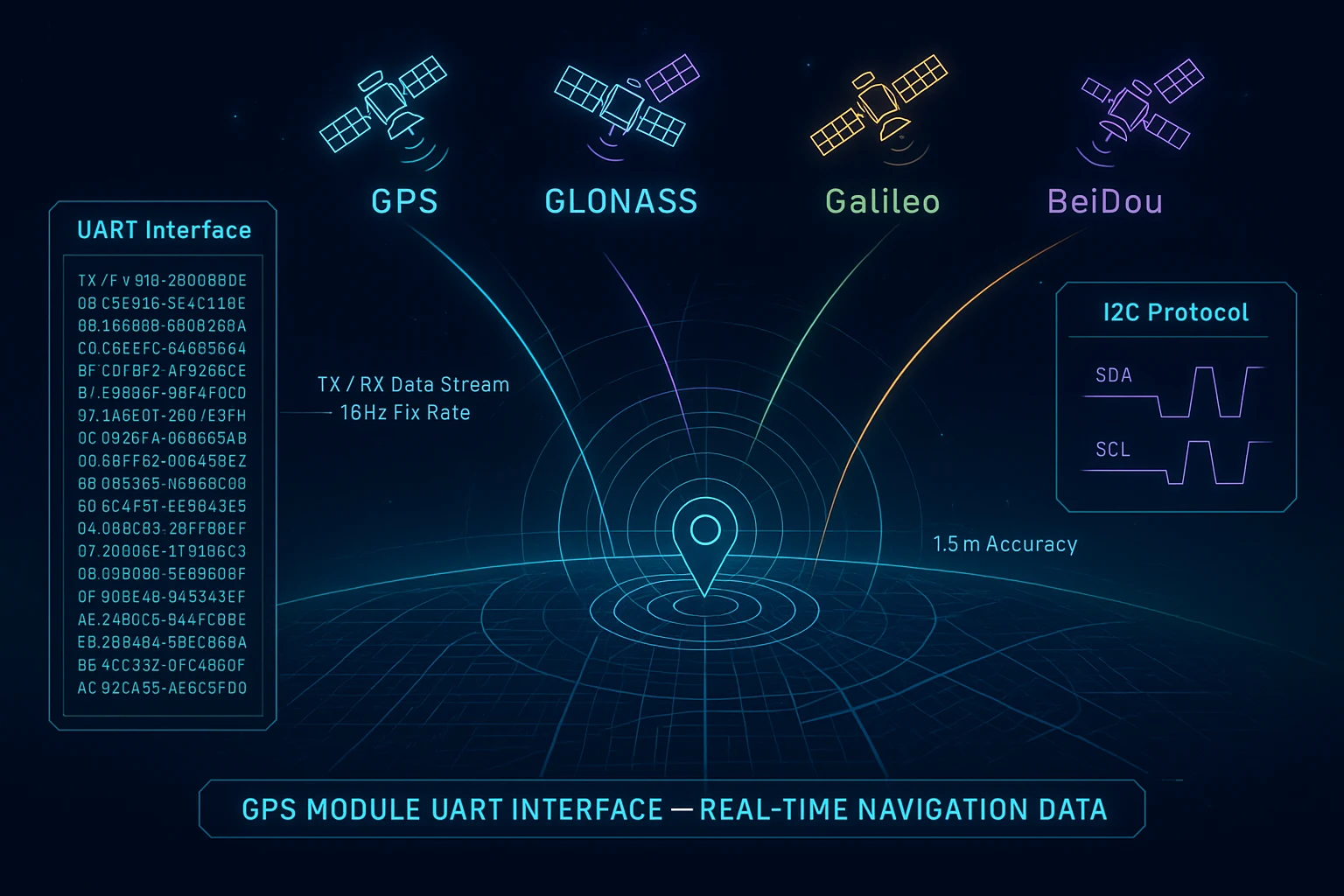
GPS Module UART Interface: The Complete Guide to the MultiNav Pro+ Accurate GNSS Module
GPS Module UART Interface — Redefining Precision Navigation for Builders and Engineers
If you have ever tried to build a drone, a robotics platform, or an IoT tracking system that demands real location accuracy, you already know the frustration. Most GNSS modules on the market force you to choose between affordability and performance. Either you buy a cheap module with sluggish fix rates and mediocre accuracy, or you spend a fortune on industrial-grade hardware that comes with a datasheet thicker than a textbook and zero community support.
The MultiNav Pro+ by RFOXiA was built specifically to destroy that compromise.
With a 1.5-meter accuracy ceiling, an 18Hz fix rate, concurrent multi-constellation support, and a clean GPS module UART interface that plugs directly into your existing toolchain, the MultiNav Pro+ delivers professional navigation capability at a price point that makes sense for serious builders. Whether you are flying FPV drones, building precision agriculture systems, designing wearables, or deploying outdoor IoT sensor networks, this module gives you the location engine your project actually deserves.
This guide covers everything — the hardware architecture, the interface options, the software ecosystem, real-world use cases, and why the MultiNav Pro+ sits in a class of its own.
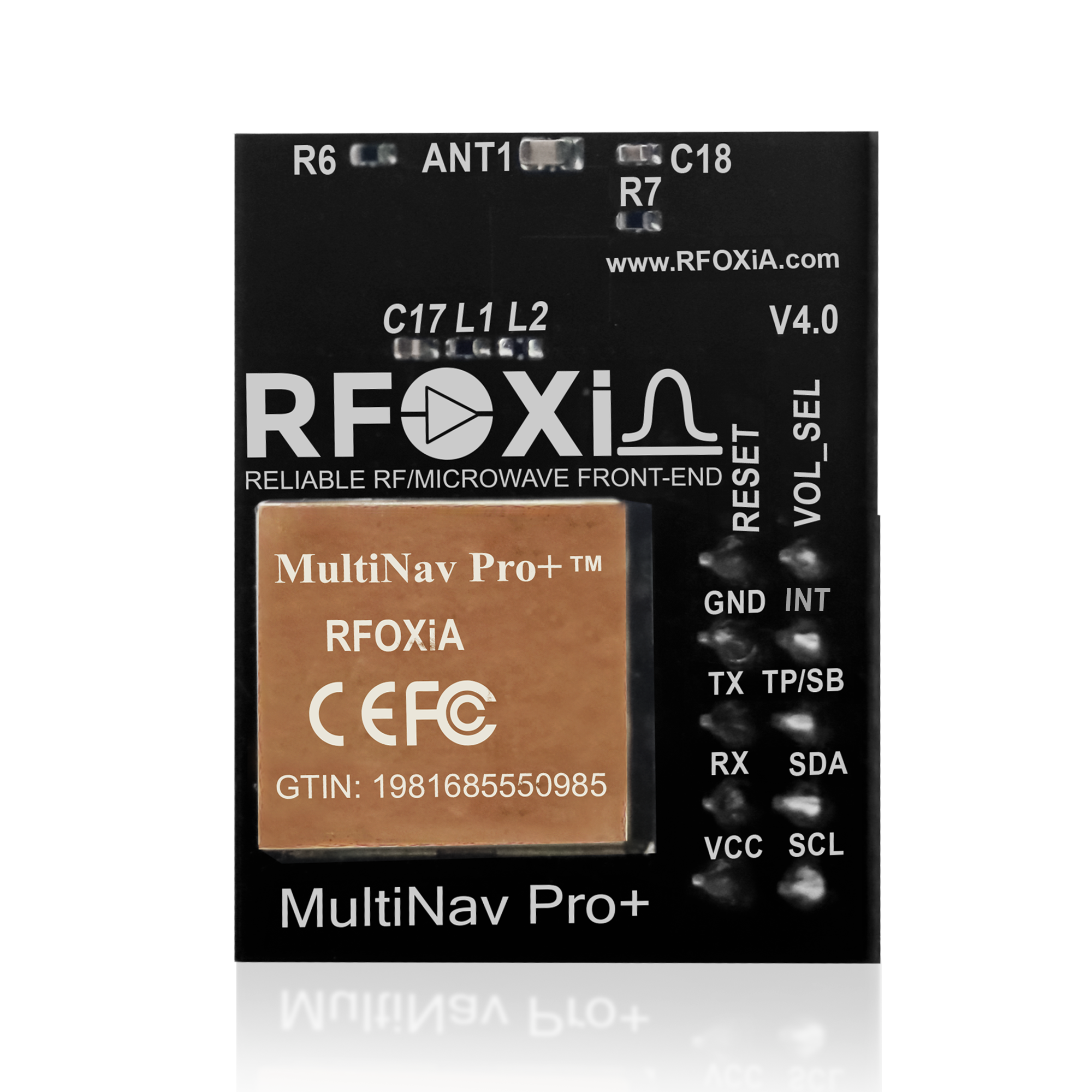
What Makes a GPS Module UART Interface Worth Caring About
Before we dive into the specs, it is worth spending a moment on why the interface layer matters as much as the sensor layer.
A GNSS module can have world-class RF front-end performance, but if the interface to your microcontroller is clunky, poorly documented, or limited to a single protocol, you end up fighting your toolchain instead of building your application. The GPS module UART interface is, in practical terms, the bridge between raw satellite data and the logic your project actually runs on.
UART — Universal Asynchronous Receiver-Transmitter — is the most widely used serial communication standard in embedded development. It is natively supported by virtually every microcontroller on the planet, from Arduino and ESP32 to STM32 and Raspberry Pi. A GNSS module with a well-implemented UART interface means:
- Zero protocol translation overhead — data flows directly from module to MCU
- NMEA sentences readable natively by most GPS parsing libraries
- Simple wiring — TX, RX, power, ground — that is the entire connection
- Compatibility with every major IDE and framework without custom drivers
The MultiNav Pro+ delivers exactly this. It exposes a clean, fully functional GPS module UART interface with standard NMEA 0183 output — and backs it up with I2C as an alternative for applications where bus sharing matters.
MultiNav Pro+ Hardware Architecture
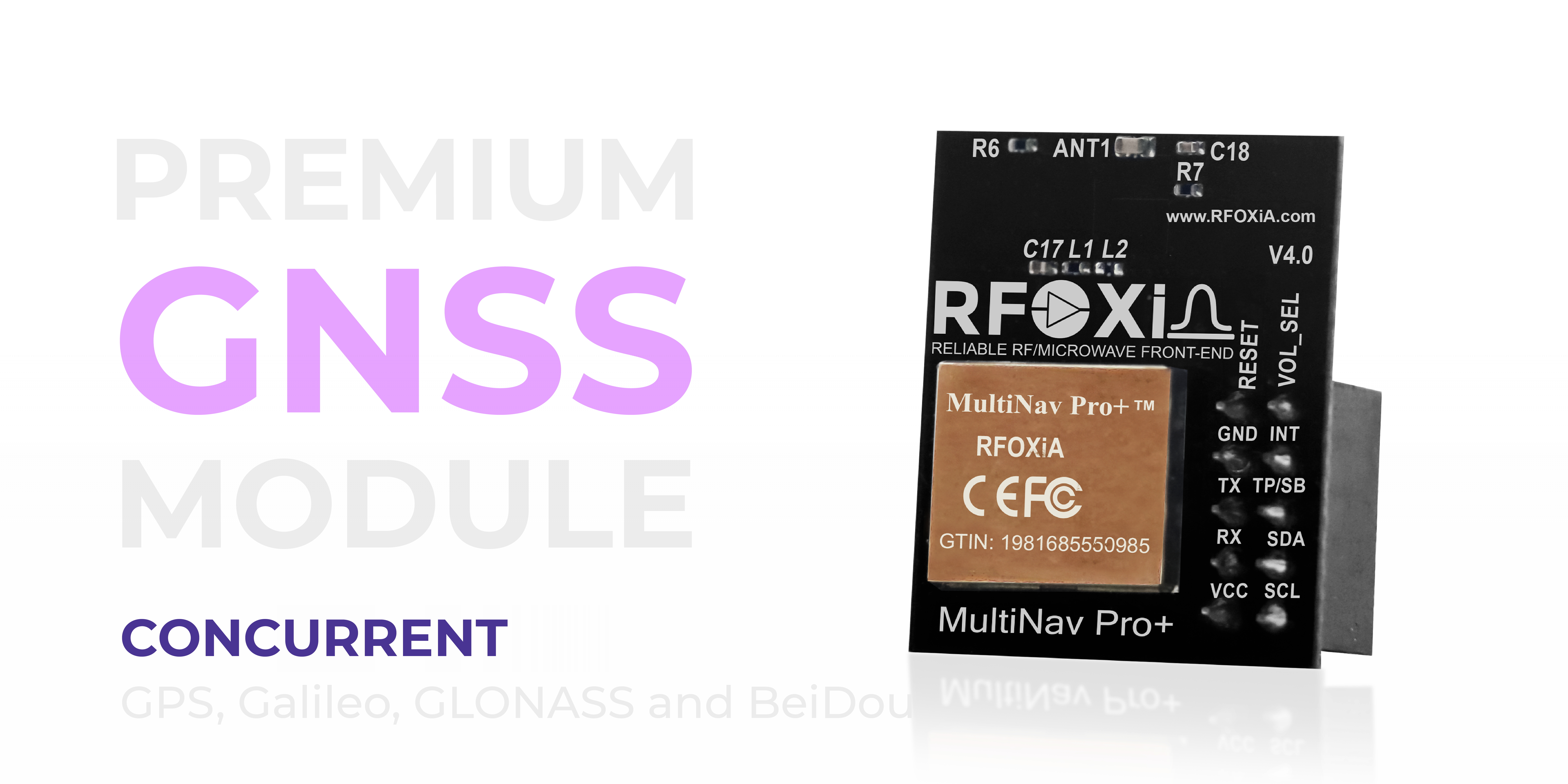
At the heart of the MultiNav Pro+ is the u-blox MIA-M10Q — one of the most capable ultra-low-power GNSS chips available today. u-blox is the gold standard in precision GNSS silicon, and the MIA-M10Q represents their latest generation of multi-constellation receiver technology.
What this means for you in practice:
Concurrent Multi-Constellation Reception
The MultiNav Pro+ connects simultaneously to GPS, Galileo, GLONASS, and BeiDou satellite constellations. This is not sequential scanning — it is true parallel reception across all four systems at once. More visible satellites means:
- Stronger position fixes in challenging environments (urban canyons, tree cover, partial sky obstruction)
- Faster cold and warm start acquisition times
- Higher geometric dilution of precision (GDOP) resilience
- Consistent performance across all global regions
Proprietary RF Filtering
RFOXiA's engineering team integrated RF/microwave microstrip filter technology directly into the module design. This is not a generic passthrough from the chip vendor — it is an active RF design decision that minimizes interference from adjacent electronics and maximizes signal clarity. In real-world deployments with noisy electronics nearby (motor controllers, switching regulators, high-frequency processors), this filtering makes a measurable difference.
Integrated High-Gain Chip Antenna
The module includes a high-gain integrated chip antenna in a form factor of just 26mm x 22mm. This eliminates the need for external antenna design, dramatically simplifies integration, and keeps the overall footprint small enough for wearables, compact drones, and space-constrained PCB designs.
Accuracy and Fix Rate — The Numbers That Matter

Let's talk about the two specifications that separate professional GNSS modules from commodity GPS chips.
1.5-Meter Horizontal Accuracy
Consumer-grade GPS modules typically advertise 2.5–5 meter accuracy under ideal conditions. Real-world performance is often worse. The MultiNav Pro+ achieves sub-1.5 meter accuracy — a performance tier that normally requires differential correction systems or survey-grade hardware costing thousands of dollars.
At 1.5 meters, you are operating with enough precision for:
- Drone return-to-home with confidence that the vehicle lands within a defined safe zone
- Precision agriculture row tracking and variable rate application
- Asset tracking that distinguishes between objects on adjacent shelves or platforms
- Survey-grade waypoint navigation without the survey-grade price tag
18Hz Fix Rate
This is where the MultiNav Pro+ genuinely separates itself from the competition. Most consumer GNSS modules update at 1Hz or 5Hz. The MultiNav Pro+ delivers 18 position fixes per second.
For static or slow-moving applications, fix rate barely matters. But for anything that moves fast — drones, racing vehicles, high-speed robotics, athletic tracking — a high fix rate is the difference between smooth, responsive control and jerky, latency-plagued position data.
At 18Hz, a drone traveling at 20 m/s receives a new position fix every 1.1 meters of travel. That is the resolution needed for precise autopilot control loops, accurate flight logging, and reliable geofencing enforcement.
First Fix in 1 Second
The hot start performance — acquiring a first valid position fix from a recent almanac — happens in approximately 1 second. For applications that need to be operational immediately after power-on (emergency beacons, rapidly deployed field devices, power-cycling IoT nodes), this acquisition speed is critical.
Power Profile and Physical Specifications
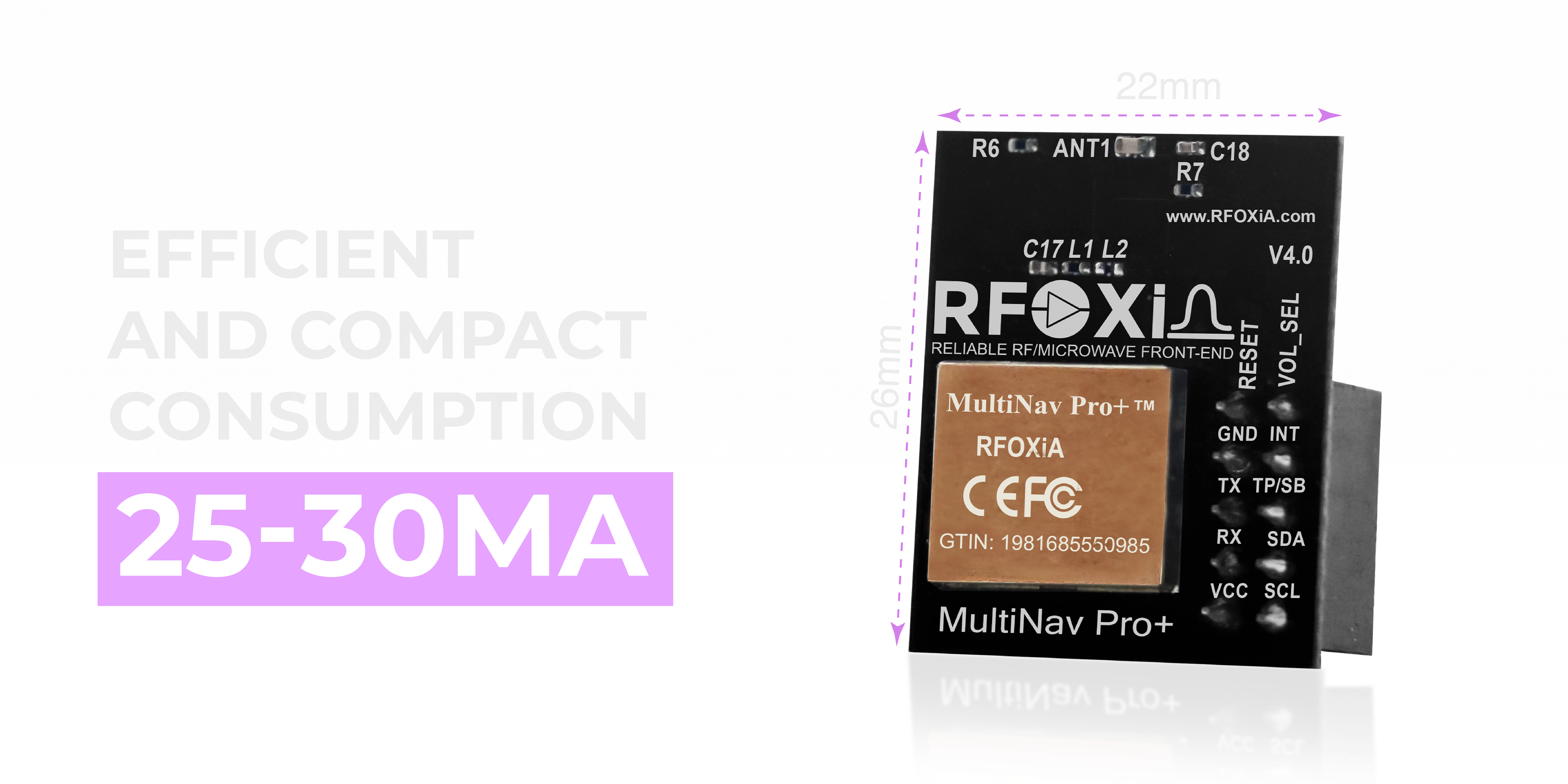
The MultiNav Pro+ operates at 25–30mA during active tracking — a genuinely power-efficient profile for a full multi-constellation receiver. For battery-powered deployments, this matters enormously. Running from a 500mAh LiPo, the module operates continuously for over 16 hours at full tracking power.
The physical footprint — 26mm x 22mm — places it firmly in the compact module category. This is small enough for:
- Integration into 3-inch and larger FPV drone flight controllers
- Wearable device PCB designs
- Handheld instrument enclosures
- Multi-module sensor stacks (particularly within the RFOXiA ecosystem alongside the BLE and Sensors modules)
Interface Options — UART and I2C
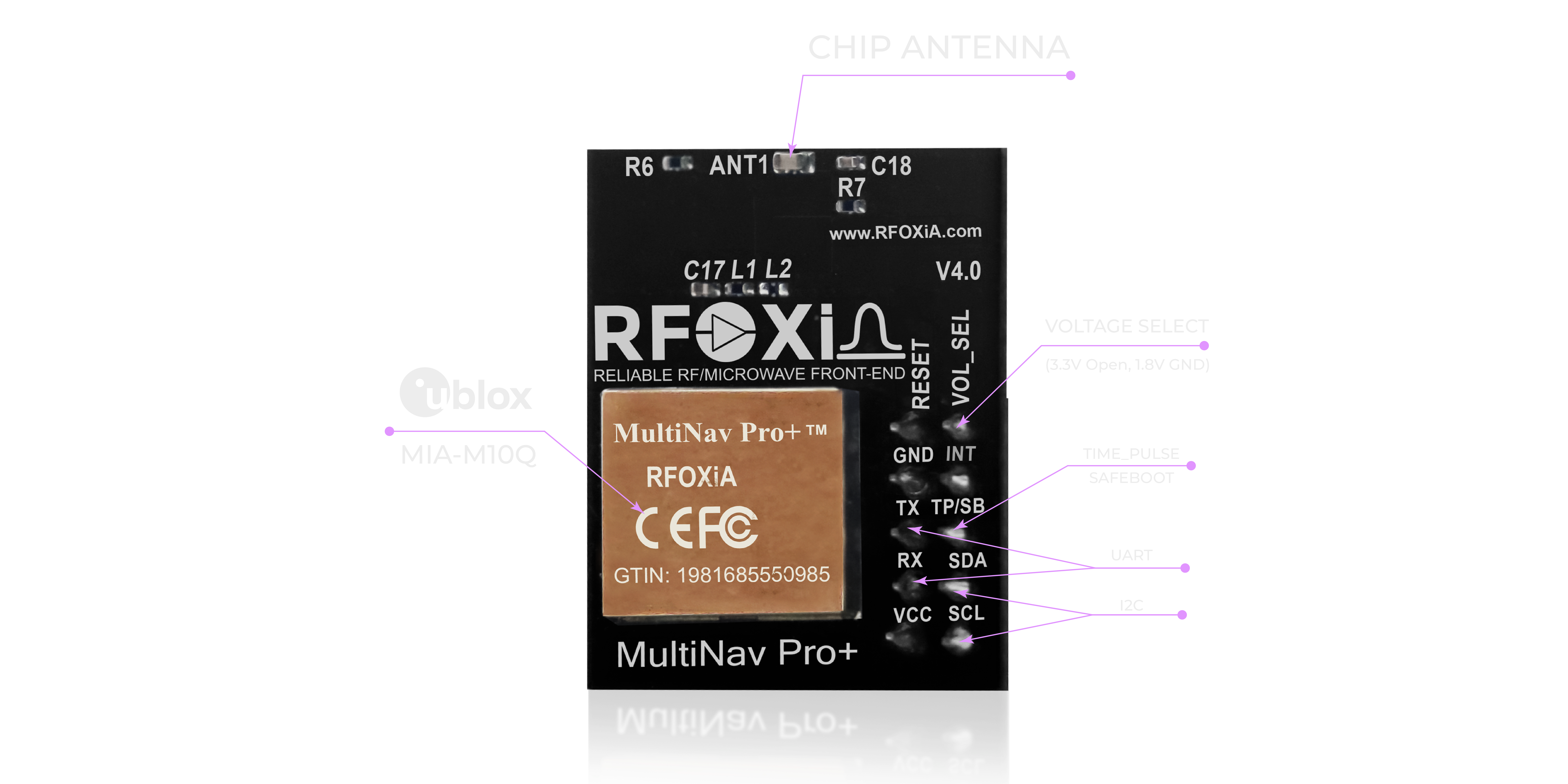
The MultiNav Pro+ exposes two interface options:
GPS Module UART Interface
The primary GPS module UART interface uses standard TX/RX lines at configurable baud rates. The module outputs standard NMEA 0183 sentences — GGA, RMC, VTG, GSA, GSV, and GLL — which are parsed by virtually every GPS library in existence for Arduino, MicroPython, CircuitPython, STM32 HAL, and more.
For most applications, this is the interface you will use. Wiring is four connections: VCC, GND, TX to MCU RX, RX to MCU TX. The module is recognized immediately by any GPS parsing library without custom configuration.
I2C Interface
For applications where UART pins are already allocated or where multiple modules share a single bus, the module supports I2C via SCL and SDA lines. This is particularly useful in dense multi-module designs where the RFOXiA Sensors module and GNSS module might share the same I2C bus on a single controller.
Voltage Flexibility
The module supports both 1.8V and 3.3V logic levels — covering both the 3.3V ecosystem (ESP32, STM32, Raspberry Pi) and the 1.8V ecosystem (Nordic nRF5 series, newer ARM Cortex-M0+ platforms). No level shifting required for the majority of modern embedded platforms.
Open Source Software Library
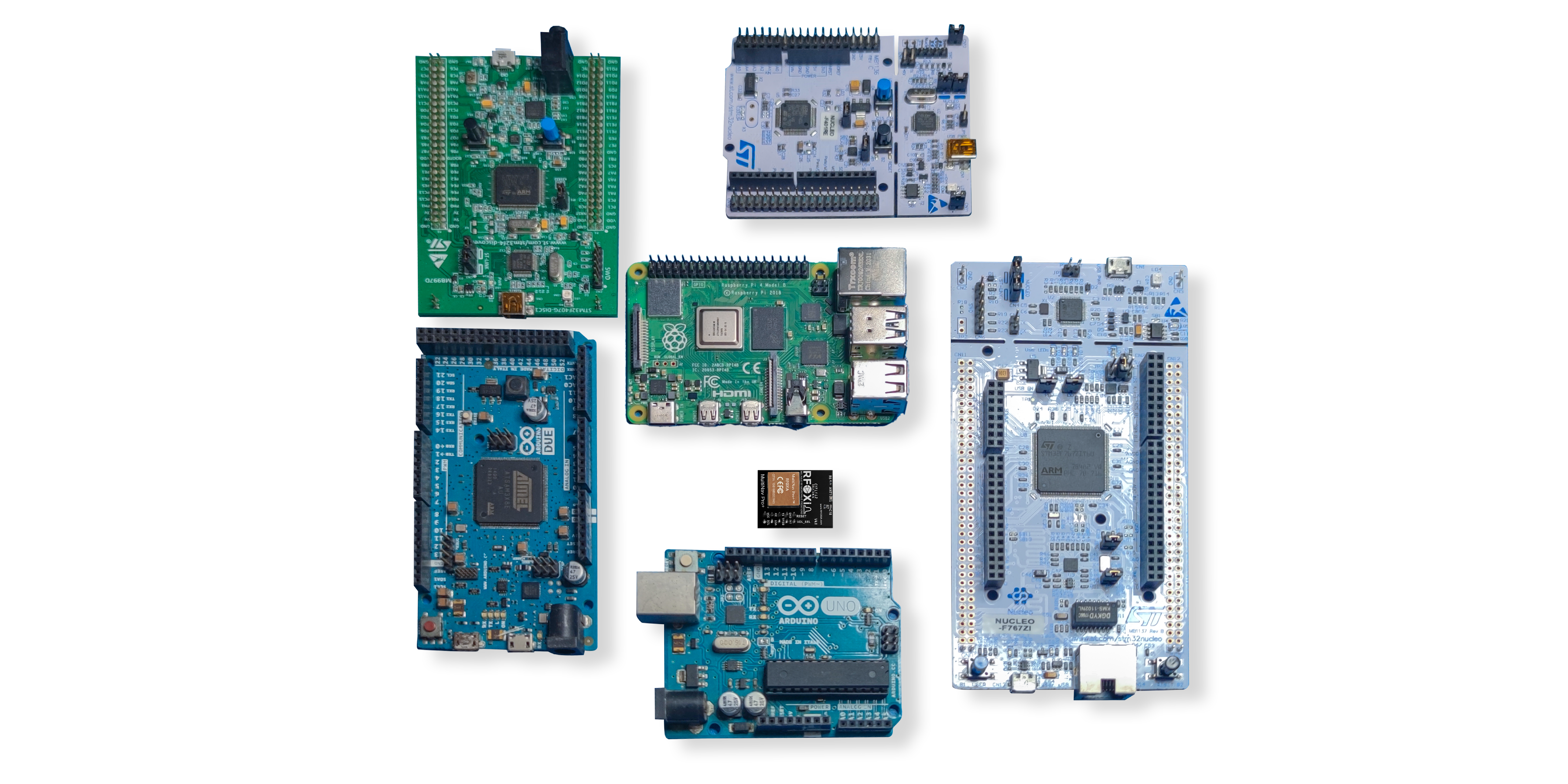
Hardware without accessible software is hardware that sits on a shelf. RFOXiA ships the MultiNav Pro+ with a fully open-source C language driver library that includes:
- Complete NMEA standard protocol parsing
- Position, velocity, and time (PVT) data extraction functions
- Satellite visibility and signal strength reporting
- Configuration commands for fix rate, constellation selection, and NMEA sentence filtering
- Example projects ready to compile in Arduino IDE
The library is designed to be imported into any IDE toolchain in minutes. Whether you are working in Arduino IDE, PlatformIO, STM32CubeIDE, or a bare-metal C environment, the library integrates without modification to its core logic.
This is the practical benefit of a GPS module UART interface built on NMEA standards — the entire ecosystem of GPS parsing libraries that the embedded development community has built over decades just works. You are not learning a proprietary protocol. You are using an open, well-documented standard with abundant community support.
For users who want to go deeper — modifying fix rates, adjusting power modes, or configuring specific NMEA outputs — the RFOXiA software library exposes these configuration options directly through function calls, without requiring manual UBX command construction.
Explore the MultiNav Pro+ GNSS Module and download the library at RFOXiA
U-Center Software for Evaluation and Configuration
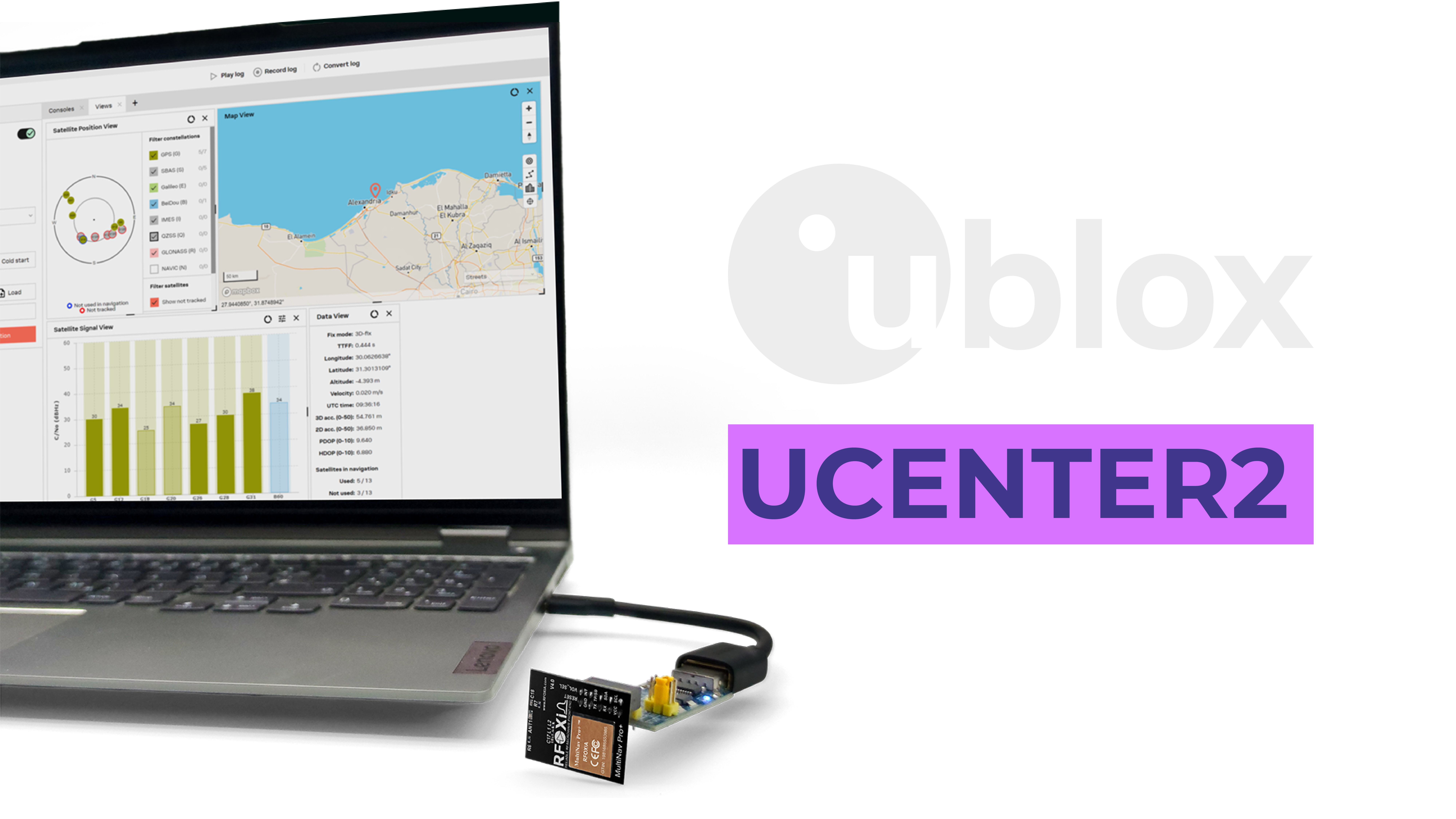
Because the MultiNav Pro+ is built on the u-blox MIA-M10Q, it is fully compatible with u-center — u-blox's free desktop evaluation and configuration software for Windows.
u-center provides:
- Sky view — real-time visualization of every visible satellite across all four constellations, with signal strength bars
- Live map tracking — position plotted on a map in real time
- Fix quality indicators — HDOP, PDOP, satellite count, accuracy estimates
- Configuration GUI — change fix rate, enable or disable constellations, configure NMEA outputs, set power modes — all without writing a single command
- Data logging — record raw NMEA logs for offline analysis, post-processing, or debugging
- Message viewer — inspect raw UBX and NMEA messages at the byte level
For evaluating a new deployment environment, validating antenna placement, troubleshooting signal issues, or simply understanding what the module sees before writing application code, u-center is an invaluable tool. The fact that the MultiNav Pro+ is fully compatible with this professional-grade evaluation software out of the box is a direct benefit of the u-blox chipset choice.
Real-World Use Cases

The MultiNav Pro+ is not a niche product for one application. The combination of high accuracy, high fix rate, compact form factor, low power draw, and accessible GPS module UART interface makes it suitable across an extremely wide range of applications:
Drone Navigation and Autonomy
The 18Hz fix rate provides the positional update speed needed for responsive autopilot control loops. The 1.5-meter accuracy enables reliable geofencing, return-to-home, and waypoint navigation. Paired with the RFOXiA BLE module for long-range telemetry and the RFOXiA Sensors module for environmental awareness, the MultiNav Pro+ becomes part of a complete drone intelligence stack.
IoT Asset Tracking
For outdoor IoT nodes — equipment tracking, wildlife monitoring, vehicle fleet management — the combination of low power consumption, fast acquisition, and accurate positioning makes the MultiNav Pro+ an ideal location engine. The GPS module UART interface connects directly to any ESP32, STM32, or Arduino-based IoT gateway without additional components.
Precision Agriculture
Row tracking, variable rate application, and field mapping all benefit from sub-2-meter accuracy. The MultiNav Pro+ provides the location resolution needed for precision agriculture tools at a cost that makes sense for individual operators and small-scale deployments, not just large enterprise systems.
Wearables and Personal Tracking
The 26x22mm footprint and 25-30mA power profile make the MultiNav Pro+ viable for wearable integration. Athlete performance monitors, hiking GPS devices, and personal safety beacons all benefit from the module's fast fix rate and compact size.
Research and Education
The open-source library and u-center compatibility make the MultiNav Pro+ an excellent platform for GNSS research, university projects, and learning embedded GPS development. The accessible interface and comprehensive documentation remove the barrier to entry while delivering professional-grade data quality.
Robotics
Ground robots navigating outdoor environments need reliable, fast, accurate position data. Whether it is a lawn mowing robot maintaining row discipline or a research platform executing GPS-guided missions, the MultiNav Pro+ delivers the positioning performance that autonomous outdoor robotics requires.
Integration with the RFOXiA Ecosystem
The MultiNav Pro+ is designed to work as a standalone module, but it reaches its full potential as part of the RFOXiA Developer Bundle — the complete wireless development ecosystem that combines:
- MultiNav Pro+ GNSS Module — precision location at 18Hz
- BLE Module (MultiNav BLE) — long-range wireless communication up to 20km man-to-drone
- Sensors Module — 7 environmental sensors including temperature, humidity, pressure, air quality, accelerometer, gyroscope, and magnetometer
- Power/Program Kit — supercapacitor-based power system with 5-minute charge and 24-hour runtime
The RFOXiA Connect app (Android live, iOS pending) reads live GPS position from the GNSS module and displays it on a real-time map alongside sensor data and drone control interface — all without internet connectivity. The GPS module UART interface connects the MultiNav Pro+ to the BLE module, which relays position data to the app over the long-range wireless link.
For developers who want to build around this ecosystem, RFOXiA Club — the developer platform at rfoxia.com — provides access to firmware examples, the AI Firmware Builder (describe your application in plain language, receive production-ready firmware), community projects, and the data monetization network where outdoor sensor nodes earn daily rewards.
Get the MultiNav Pro+ GNSS Module and start building at rfoxia.com
Technical Specifications Summary
| Parameter | Specification |
|---|---|
| GNSS Chip | u-blox MIA-M10Q |
| Accuracy | < 1.5 meters (CEP) |
| Fix Rate | Up to 18Hz |
| First Fix (Hot Start) | ~1 second |
| Constellations | GPS, Galileo, GLONASS, BeiDou (concurrent) |
| Interface | UART (TX/RX) + I2C (SCL/SDA) |
| Supply Voltage | 1.8V / 3.3V |
| Current Draw | 25–30mA (active tracking) |
| Antenna | Integrated high-gain chip antenna |
| Dimensions | 26mm x 22mm |
| Protocol | NMEA 0183 standard |
| Certification | FCC certified |
| Software | Open-source C library + u-center compatible |
| Price | $49 |
Why the MultiNav Pro+ Is the Right GPS Module UART Interface Choice
There is no shortage of GNSS modules available online. What is rare — genuinely rare — is a module that delivers 1.5-meter accuracy, 18Hz fix rate, multi-constellation concurrent reception, a clean GPS module UART interface, open-source drivers, professional software tool compatibility, FCC certification, and an integrated ecosystem for under $50.
Most modules in this price range achieve 3–5 meter accuracy at 1–5Hz from a single constellation. Most modules with these specs cost $150–$300 and come with proprietary software requirements, limited community support, and no ecosystem integration.
RFOXiA built the MultiNav Pro+ for the builders, engineers, and researchers who refuse to accept that professional-grade hardware has to mean professional-grade prices. The GPS module UART interface is not an afterthought — it is the deliberate design choice that makes the module work immediately, in any toolchain, for any builder, from their first line of code.
FCC certified. Battle tested. Ready to ship.
Order the RFOXiA Accurate GNSS Module — $49 — at rfoxia.com
Getting Started
Every MultiNav Pro+ ships with:
- The MultiNav Pro+ GNSS Module
- Quick Start Guide covering wiring, library installation, and first fix verification
The open-source C library is available through RFOXiA Club and imports directly into Arduino IDE via the library manager or manual ZIP install. First fix in a clear sky environment typically happens within 1 second of power-on if recent almanac data is available, or within 30–60 seconds on a true cold start.
For developers building within the RFOXiA ecosystem, the GNSS module slots directly into the Developer Bundle hardware stack, with firmware examples available in the RFOXiA Club Dev Hub showing GPS-to-app data streaming, GPS-validated outdoor sensor deployment for the data monetization network, and GPS-integrated drone telemetry over the long-range BLE link.
Start with a module. Build a system. Connect the world — without infrastructure, without compromise, without the price tag that used to stand between your vision and the hardware that could make it real.
Written by: Moamen Mohamed LinkedIn