
High Accuracy GNSS Module: The MultiNav Pro+™ That Changes Everything
Why Builders Are Switching to This High Accuracy GNSS Module
Precision navigation has always been the difference between a project that works and a project that wins. Whether you are building an autonomous drone, a precision agriculture robot, a wearable tracker, or a next-generation IoT device, the GNSS module you choose is not a detail — it is the foundation of everything your system does in the physical world.
The problem most builders run into is a brutal trade-off: consumer-grade GNSS modules are cheap but imprecise, drifting several meters under real-world conditions, struggling to maintain fix rates on fast-moving platforms, and losing lock the moment signal conditions get difficult. Professional survey-grade GNSS systems solve those problems but cost thousands of dollars, weigh far more than embedded applications can tolerate, and require specialized expertise to integrate.
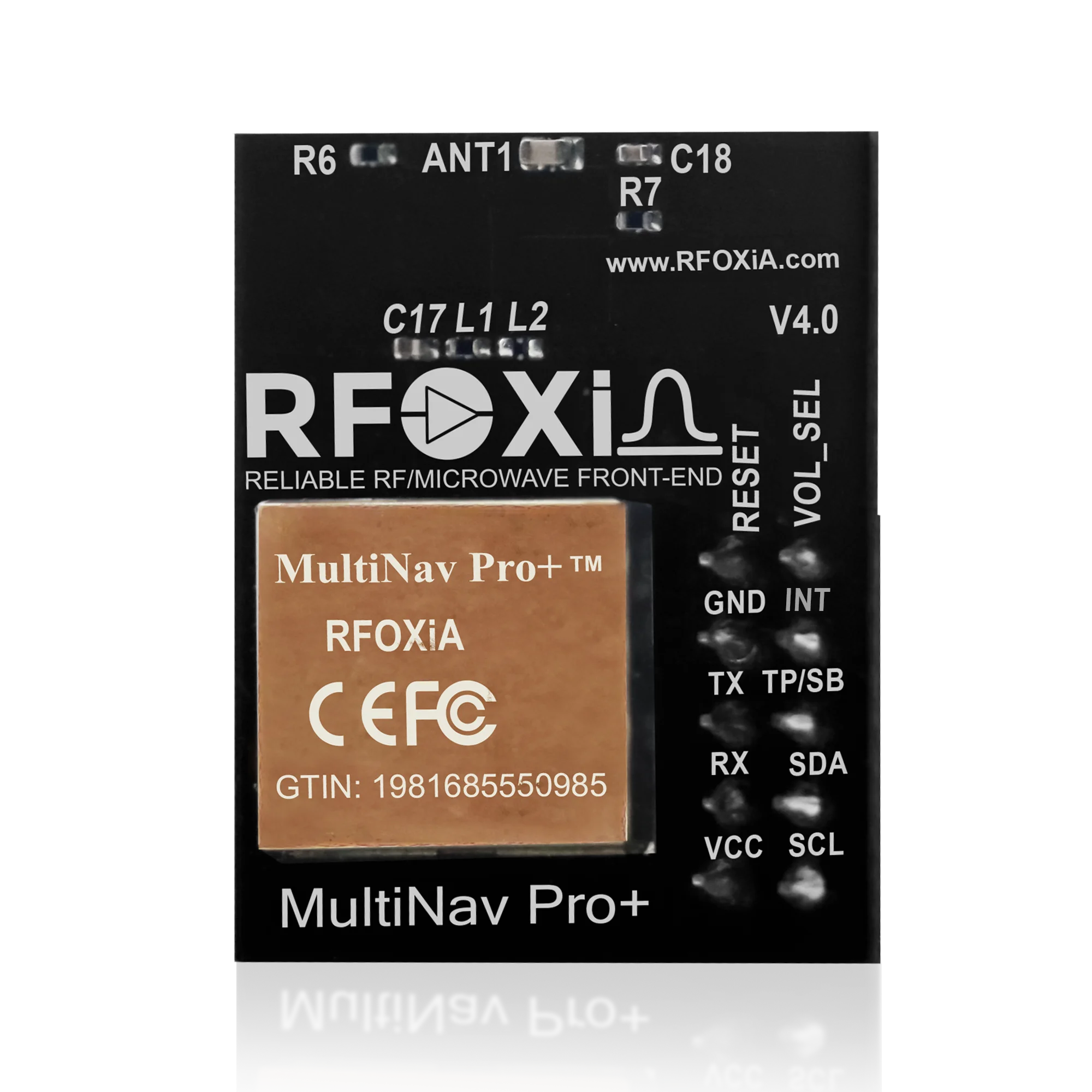
RFOXiA built the RFOXiA Accurate GNSS Module to eliminate that trade-off entirely. The MultiNav Pro+™ delivers 1.5-meter accuracy, an 18Hz fix rate, concurrent multi-constellation support, and a footprint small enough to embed in virtually any design — at a price that puts professional navigation within reach of every serious builder.
This guide covers everything you need to know: the full technical specification, what makes this module different from everything else on the market, real-world use cases, and how to get started building with it today.
What Is the MultiNav Pro+™ GNSS Module?
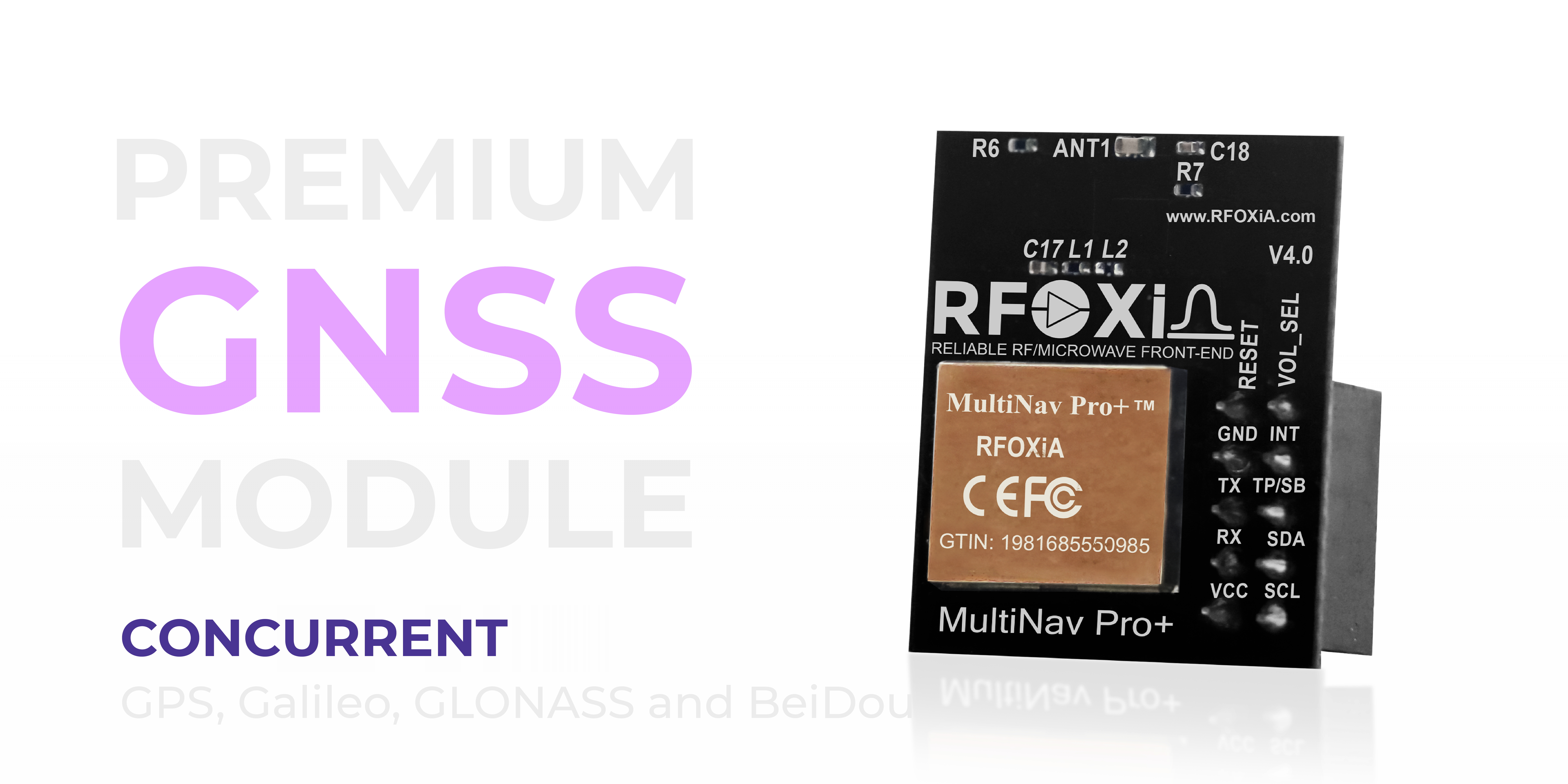
The MultiNav Pro+™ is RFOXiA's precision location module, engineered for professional embedded applications that demand both accuracy and speed. At its core is the u-blox MIA-M10Q, one of the most advanced GNSS chips available for embedded integration today. u-blox is the gold standard in professional GNSS design, and the MIA-M10Q represents their latest generation of ultra-low-power, high-performance positioning technology.
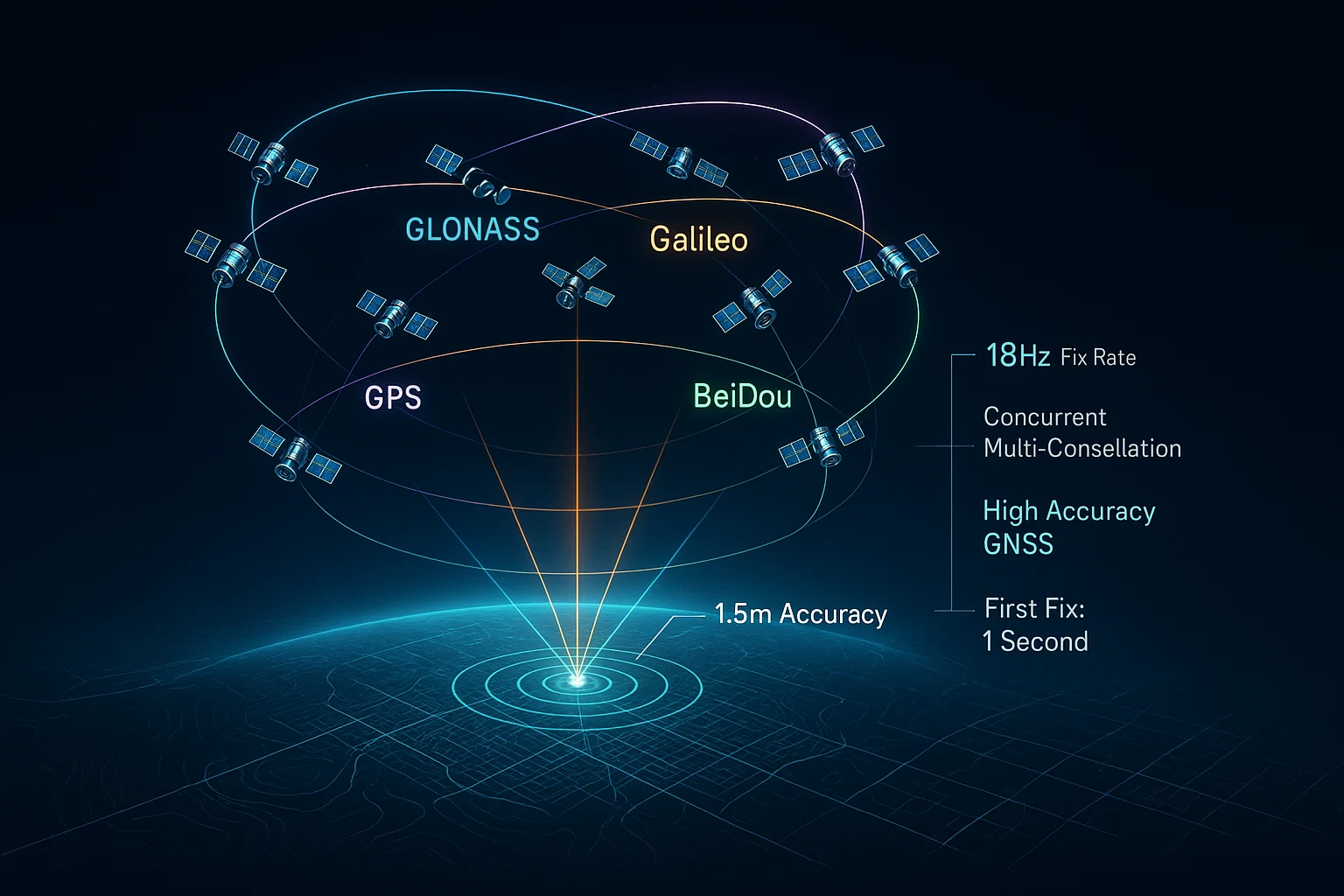
The module supports four satellite constellations simultaneously:
- GPS — the original and most established global positioning network
- Galileo — the European system offering excellent precision in mid-latitude regions
- GLONASS — Russia's constellation, critical for accuracy in northern latitudes
- BeiDou — China's rapidly expanding system, now offering global coverage
Receiving signals from all four constellations concurrently means the module always has the maximum possible number of satellites in view. More satellites mean better geometry, faster fixes, and dramatically improved accuracy — especially in partially obstructed environments like urban canyons, dense forests, or low-elevation deployments.
This is not a module you bolt on as an afterthought. It is a module you architect your system around, because when your location data is this precise and this fast, it unlocks capabilities that simply are not possible with ordinary GNSS hardware.
Full Technical Specifications
Accuracy and Fix Performance

The headline numbers for the MultiNav Pro+™ are not marketing estimates — they are engineering specifications from the u-blox MIA-M10Q platform, validated in real-world deployments:
Positional Accuracy: Less than 1.5 meters CEP (Circular Error Probable) under open-sky conditions with a good satellite geometry. For comparison, standard consumer GNSS modules typically deliver 2.5–5 meters under similar conditions. The MultiNav Pro+ is consistently in a different class.
Fix Rate: 18Hz. This means your system receives a fresh, updated position 18 times every second. This specification is critical for fast-moving platforms — racing drones, autonomous vehicles, precision robotics — where a 1Hz or even 5Hz update rate creates dangerous latency between where your platform actually is and where your controller thinks it is.
Time to First Fix (TTFF): 1 second hot start. Cold start performance is equally impressive thanks to the MIA-M10Q's fast acquisition engine. In practice, your application will have a solid position lock almost immediately after power-on in normal conditions.
Concurrent Constellation Support: GPS + Galileo + GLONASS + BeiDou simultaneously. No switching. No prioritization. All four networks feeding position data at the same time.
Physical and Electrical Specifications
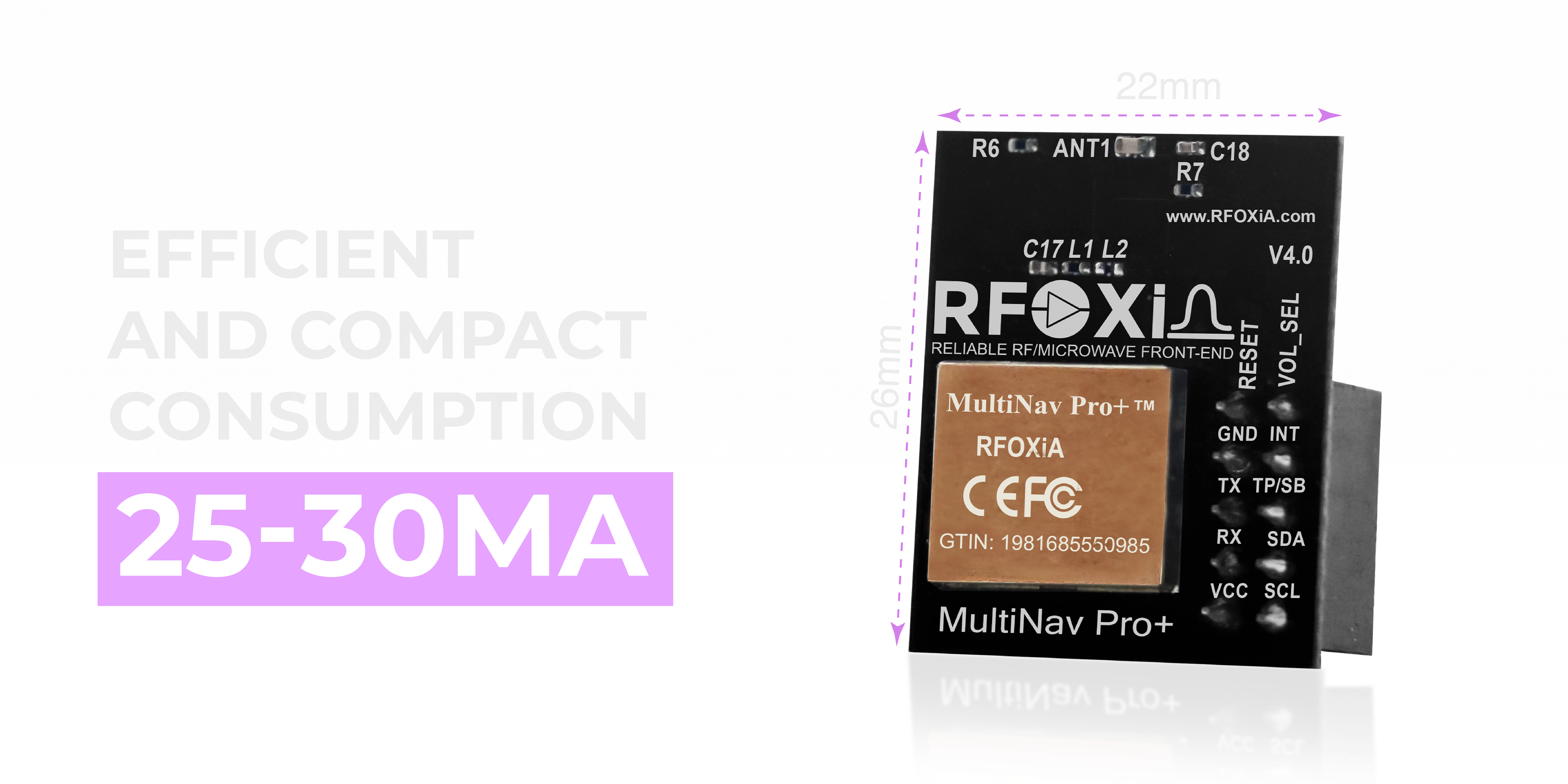
Dimensions: 26mm × 22mm. This is a genuinely compact footprint. It fits comfortably on drone flight controllers, inside wearable enclosures, on custom PCBs with tight real estate constraints, and inside IoT sensor nodes where every millimeter matters.
Current Draw: 25–30mA during active tracking. This is exceptionally efficient for a multi-constellation receiver operating at 18Hz. Battery-powered applications — field sensors, wearables, remote trackers — can maintain continuous GNSS operation for extended periods without excessive power budget impact.
Operating Voltage: Supports both 1.8V and 3.3V logic levels. This dual-voltage compatibility is significant for system integration. Whether your microcontroller operates at 1.8V (as many modern ARM Cortex-M4 and M33 devices do) or 3.3V (as Arduino, ESP32, STM32, and many others do), the MultiNav Pro+™ interfaces cleanly without level shifting in most cases.
Antenna: Integrated high-gain chip antenna. No external antenna required for standard deployment. The antenna is optimized for the module's compact form factor, providing reliable signal reception without adding connectors, cables, or antenna placement complexity to your design.
Connectivity and Interface
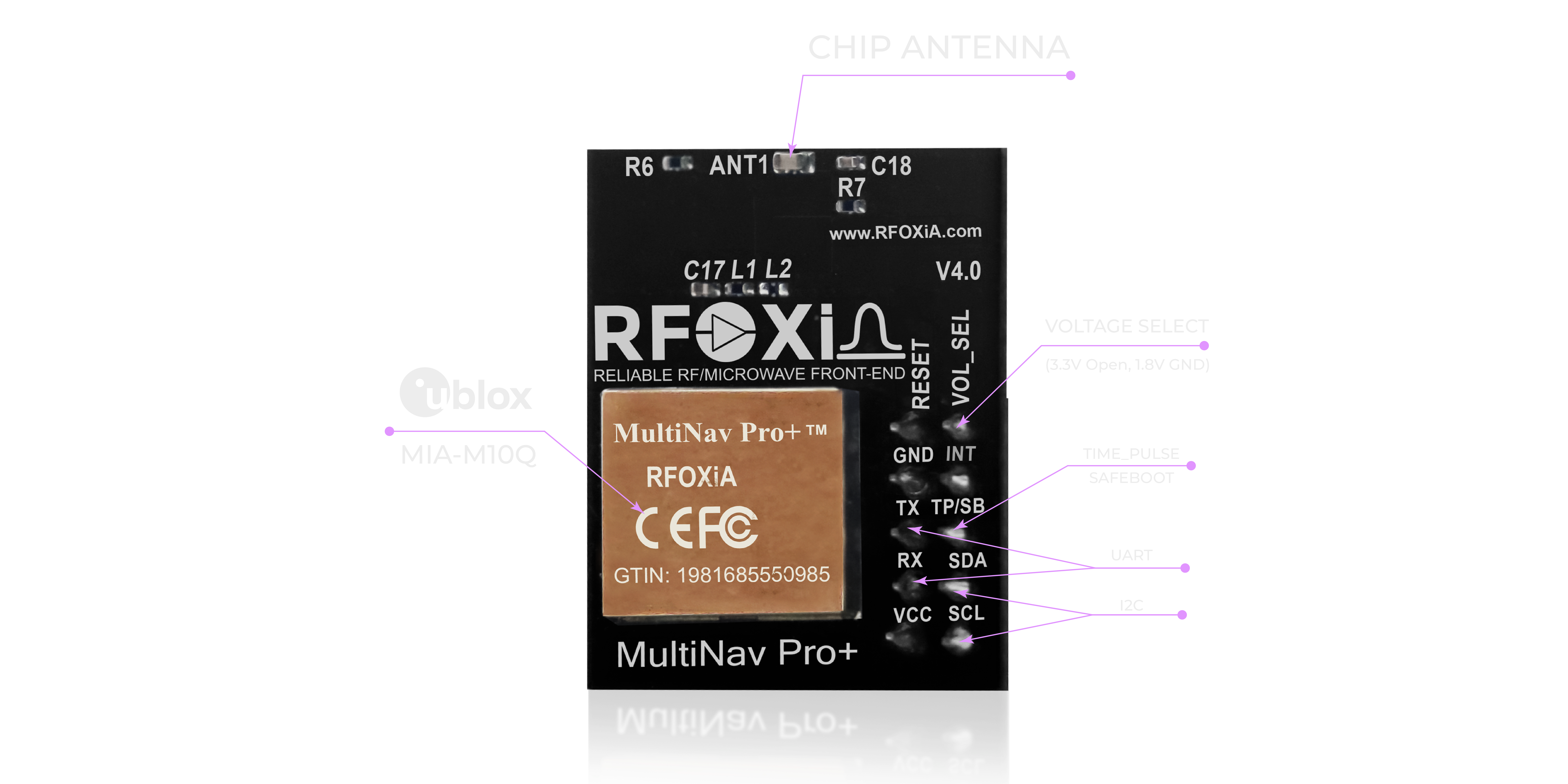
The MultiNav Pro+™ supports two communication interfaces, giving you flexibility in how it integrates with your host system:
UART (TX/RX): The most common interface for GNSS modules. NMEA sentences stream continuously over the serial link. Compatible with virtually every microcontroller platform, from Arduino Uno to Raspberry Pi to STM32 to ESP32. No additional hardware required.
I2C (SCL/SDA): For systems where UART pins are already in use or where you want to share a common bus with other sensors and peripherals. I2C integration enables clean, minimalist designs without dedicating a serial port exclusively to GNSS.
Both interfaces output standard NMEA protocol data, ensuring compatibility with any software stack, navigation library, or data logging system that understands GNSS input — which is essentially everything.
Open Source Driver and Software Ecosystem
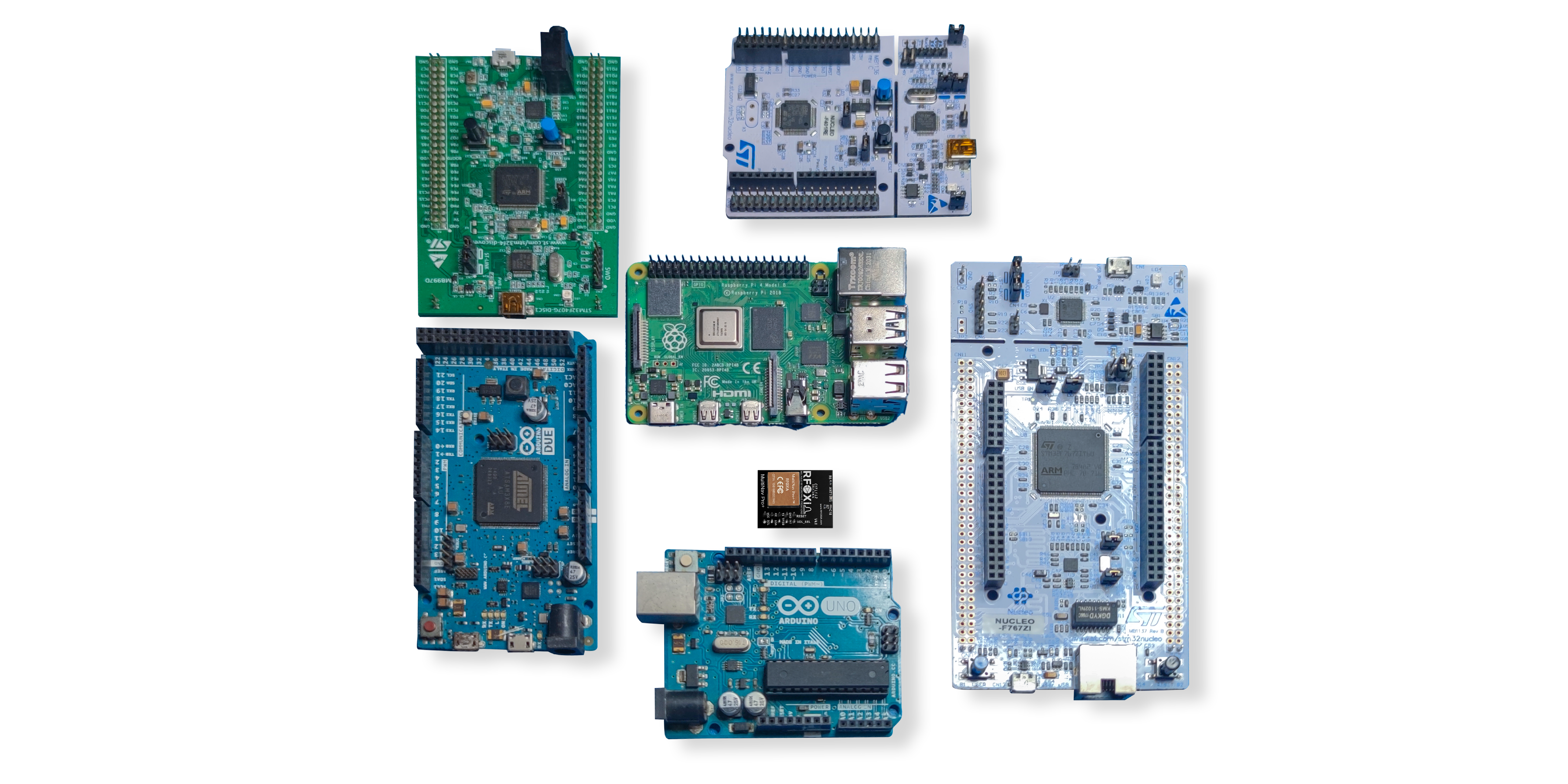
Hardware without software support is half a product. RFOXiA ships the MultiNav Pro+™ with a complete, fully open-source C language driver library covering the full NMEA standard protocol command set.
What this means for you as a developer:
- Zero driver development time. Pull the library into your project and start reading position data immediately.
- Arduino IDE compatible. If you work in Arduino, integration is a matter of importing the library and calling a few functions.
- Compatible with any C-capable toolchain. STM32CubeIDE, PlatformIO, ESP-IDF, Zephyr, bare-metal GCC — the library works everywhere C works.
- Open source means customizable. Need to extend the parser for a custom NMEA sentence? Fork it, modify it, make it yours. RFOXiA does not lock you into a proprietary SDK.
- Community contributions welcome. As the RFOXiA developer community grows, so does the ecosystem of example code, integration guides, and application templates.
This philosophy — professional hardware paired with open, accessible software — is central to how RFOXiA operates. The goal is to remove every possible barrier between a builder with an idea and a working system in the field.
U-Center Software Visualization and Configuration
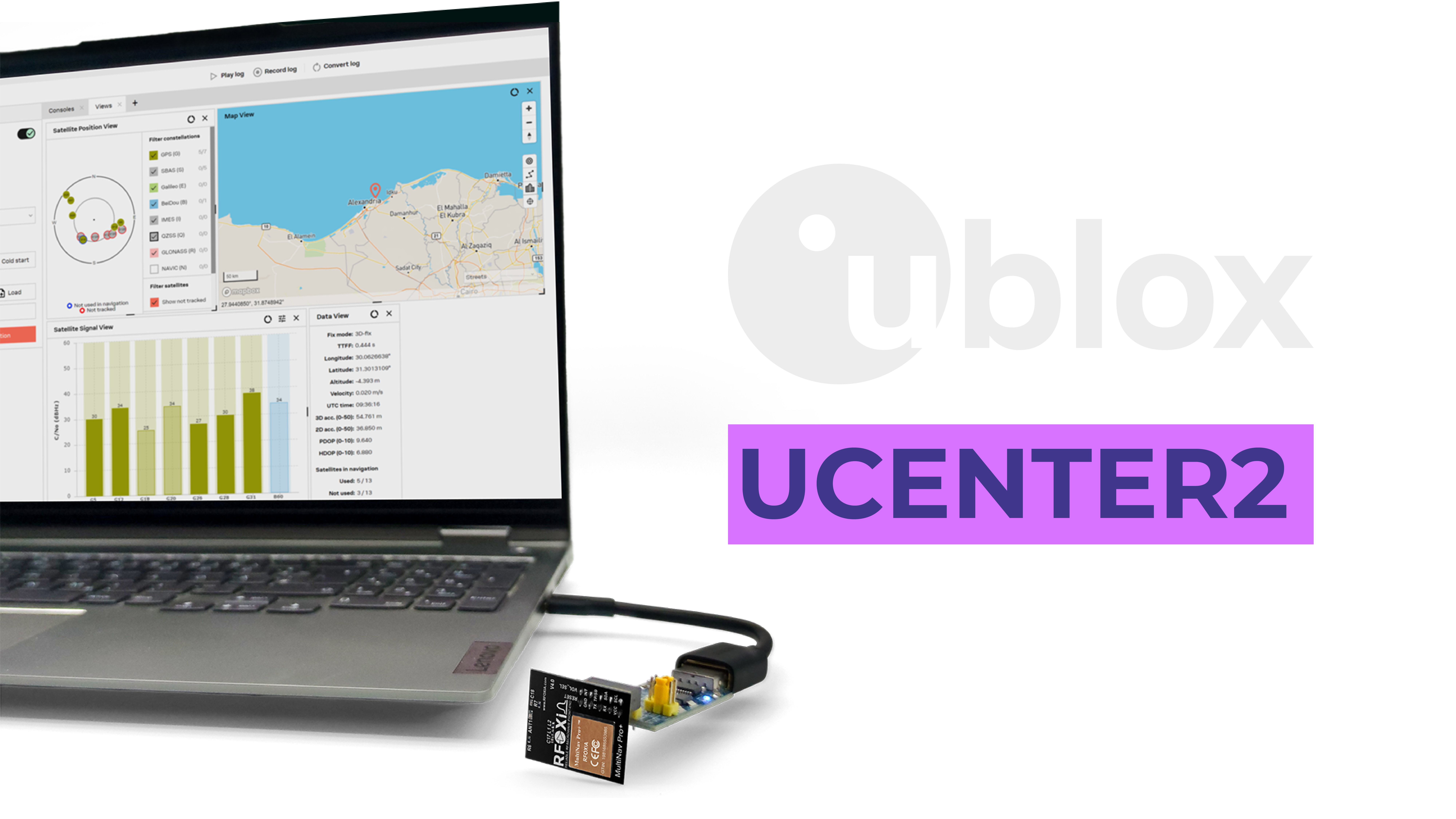
Because the MultiNav Pro+™ is built on the u-blox MIA-M10Q, it is fully compatible with u-blox's industry-standard U-Center software — a professional-grade GUI for GNSS evaluation, configuration, and testing.
U-Center gives you:
- Real-time satellite visualization — see exactly which satellites are in view, their signal strength, and their sky position at any moment
- Live position tracking — watch your module's position trace on a map in real time
- Fix quality monitoring — observe DOP values, fix type (2D/3D), and satellite count live
- Configuration management — tune output rate, enable or disable specific NMEA sentences, adjust power modes
- Data logging — record full GNSS sessions for post-processing and analysis
- Performance evaluation — compare accuracy across different deployment scenarios
For development and validation purposes, U-Center is invaluable. You can characterize the module's performance in your specific deployment environment before writing a single line of application code. This eliminates integration surprises and accelerates your path from prototype to field-ready product.
What Makes This a True High Accuracy GNSS Module — Not Just a Marketing Claim
The phrase "high accuracy GNSS module" appears on product listings across the internet, attached to hardware that delivers wildly varying levels of actual performance. Here is what makes the MultiNav Pro+™ specification real and verifiable:
1. u-blox MIA-M10Q platform. u-blox publishes detailed datasheets, application notes, and independently verified performance data for all of their GNSS chips. The MIA-M10Q's accuracy and fix rate specifications are not manufacturer estimates — they are documented, tested, and trusted by the industry.
2. Concurrent four-constellation reception. Many lower-cost modules advertise multi-constellation support but actually switch between constellations rather than tracking all simultaneously. Simultaneous reception from GPS + Galileo + GLONASS + BeiDou is the difference between 15 satellites in view and 6. That difference directly determines accuracy.
3. Advanced RF/microwave microstrip filter technology. RFOXiA's proprietary filter design minimizes interference from adjacent electronics — a real-world problem on any PCB where a GNSS antenna sits near switching regulators, motors, or RF transmitters. Clean signals equal accurate positions.
4. FCC certified. The MultiNav Pro+™ has completed FCC certification. This is not optional compliance paperwork — it means the module has been independently tested for RF emissions and performance standards. FCC-certified hardware is a prerequisite for commercial deployment, distributor listing, and professional integration.
Real-World Use Cases for the MultiNav Pro+™

The combination of 1.5-meter accuracy, 18Hz update rate, and compact form factor opens the MultiNav Pro+™ to an exceptionally wide range of applications:
Autonomous and Semi-Autonomous Drones
Drone navigation at the control loop speeds required for stable autonomous flight demands position updates faster than most GNSS modules can provide. The 18Hz fix rate means your flight controller gets a fresh position 18 times per second — fast enough to feed even aggressive control loops. Combined with 1.5-meter accuracy, this is precision suitable for waypoint navigation, return-to-home, precision landing, and survey grid flight paths.
FPV Racing and Long-Range FPV
FPV pilots building tracking systems, OSD position displays, or return-to-home safety features need fast, accurate position data that keeps up with a craft moving at 100+ km/h. The MultiNav Pro+™ delivers.
Precision Agriculture
Field mapping, variable rate application guidance, and autonomous tractor navigation all demand consistent sub-2-meter accuracy across entire field operations. The MultiNav Pro+™ integrates cleanly into agricultural computing platforms and provides the accuracy tier that precision ag applications require.
Asset and Vehicle Tracking
Fleet management, equipment tracking, and logistics monitoring applications need accurate, timely position data that can be logged and transmitted. The module's low power draw makes battery-powered tracker designs practical for multi-week or multi-month deployments.
Wearable Location Devices
Sports performance monitoring, personal safety devices, hiking GPS units — any wearable application where size, weight, and battery life are constraints benefits directly from the MultiNav Pro+'s compact footprint and 25-30mA power profile.
IoT Environmental Monitoring Networks
When combined with RFOXiA's Sensors Module and data network, the GNSS module provides GPS-verified location data that validates sensor node placement — a requirement for data quality assurance in distributed environmental monitoring applications. Nodes with verified GNSS coordinates earn higher data rewards in the RFOXiA network.
Research and Education
University laboratories, research institutions, and engineering education programs all benefit from professional-grade GNSS hardware that is accessible in price and open in software. The open-source driver and U-Center compatibility make it an ideal teaching and research platform.
The RFOXiA Ecosystem Advantage
The MultiNav Pro+™ is not just a standalone module. It is part of the complete RFOXiA wireless developer ecosystem — a vertically integrated hardware, software, and data platform built specifically for serious builders.
When you pair the GNSS module with RFOXiA's long-range BLE Module (5km ground-to-ground, up to 20km man-to-drone), the RFOXiA Connect mobile app provides live GPS tracking on a real-time map alongside full drone and robot control — all completely internet-independent. Your position data, your control link, and your sensor telemetry run entirely over RFOXiA's proprietary long-range BLE connection.
For the complete integrated solution — GNSS + long-range BLE + 7-sensor environmental monitoring + professional power management — the Developer Bundle brings everything together in one package at $199.
For builders who want to start specifically with precision navigation, the RFOXiA Accurate GNSS Module is available individually at $49, FCC certified, with open-source driver, ready to integrate with Arduino, STM32, ESP32, or any other platform you are building on.
Why $49 Changes the Calculation
Professional GNSS modules with these specifications — concurrent four-constellation reception, sub-2-meter accuracy, 18Hz update rate, u-blox platform — have historically been positioned in the $150–$400 range when sold as development modules. Survey-grade GNSS receivers with similar accuracy specifications in complete receiver packages typically cost $500–$2,000+.
At $49, the MultiNav Pro+™ is not a compromise. It is the same u-blox MIA-M10Q silicon, the same concurrent constellation reception, the same accuracy specification — delivered at a price point that RFOXiA achieves through direct manufacturing relationships, efficient hardware design, and a direct-to-builder sales model that eliminates distributor margin stacking.
This is the core of RFOXiA's mission: democratizing the connectivity and computing power that was previously available only to well-funded teams and large organizations, and putting it in the hands of every builder who has the vision to use it.
Getting Started with the MultiNav Pro+™
Getting from unboxing to live position data is straightforward:
- Connect the module to your microcontroller via UART or I2C
- Power with 3.3V or 1.8V depending on your system
- Import the open-source C driver library into your Arduino IDE or preferred toolchain
- Deploy outdoors with clear sky view
- Read NMEA data — your first fix arrives within seconds
Every MultiNav Pro+™ ships with a Quick Start Guide covering pinout, connection diagrams for common platforms, and basic firmware examples to get your first position reading as fast as possible.
For advanced configuration, U-Center software provides the full professional toolchain for characterizing performance, tuning output settings, and validating accuracy in your specific deployment environment.
Ready to build with professional precision? The RFOXiA Accurate GNSS Module is in stock and ships now. FCC certified. Open source. Built for builders who do not compromise.
Summary: MultiNav Pro+™ Key Specifications
| Specification | Value |
|---|---|
| Accuracy | < 1.5 meters CEP |
| Fix Rate | 18Hz |
| Time to First Fix | 1 second (hot start) |
| Constellations | GPS + Galileo + GLONASS + BeiDou (concurrent) |
| GNSS Chip | u-blox MIA-M10Q |
| Dimensions | 26mm × 22mm |
| Current Draw | 25–30mA |
| Operating Voltage | 1.8V / 3.3V |
| Interface | UART (TX/RX) + I2C (SCL/SDA) |
| Antenna | Integrated high-gain chip antenna |
| Certification | FCC Certified |
| Driver | Open-source C library (NMEA standard) |
| Price | $49 |
The MultiNav Pro+™ sets a new standard for what a high accuracy GNSS module should deliver at a maker-accessible price. Concurrent four-constellation reception, sub-2-meter accuracy, and an 18Hz fix rate — in a 26×22mm FCC-certified module for $49. There is no comparable offering in this category at this price point. Build with the best.
Written by: Moamen Mohamed LinkedIn