
High Sensitivity GPS Receiver Module: The Complete Guide to MultiNav Pro+
Why Your Next Build Deserves a High Sensitivity GPS Receiver Module
If you've ever watched a drone drift off course, lost track of a fast-moving robot, or struggled with sluggish position updates that made your application feel unreliable — the problem almost certainly wasn't your code. It was your GNSS hardware.
Most developers accept commodity GPS modules as a necessary compromise: cheap, slow, imprecise, and frustratingly inconsistent under real-world conditions. They work well enough on a desk. In the field, on a moving platform, in environments with signal reflections or atmospheric interference, they fall apart exactly when you need them most.
The RFOXiA Accurate GNSS Module — the MultiNav Pro+™ — was built to end that compromise.
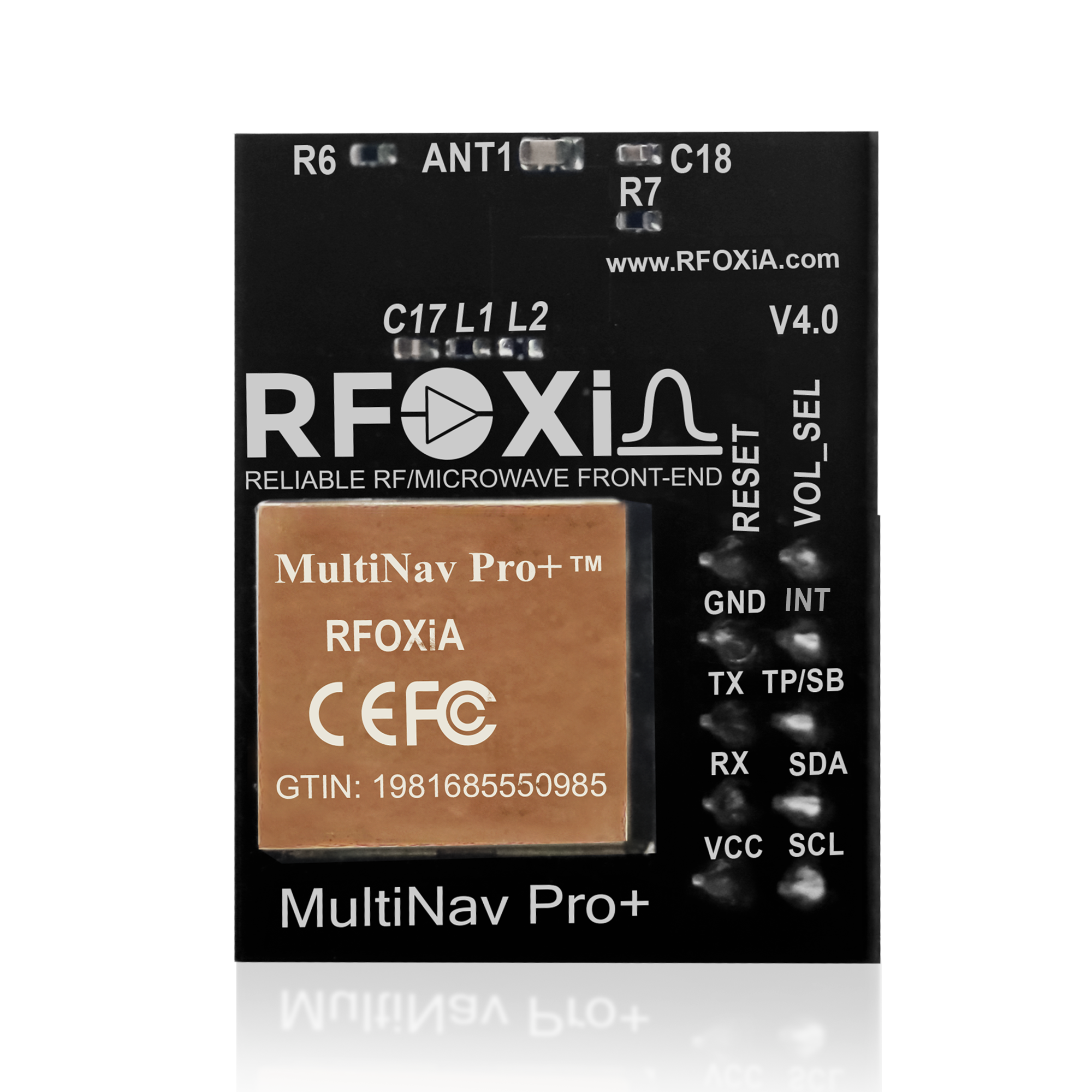
This is a professional-grade high sensitivity GPS receiver module designed for the people who build serious things: drone operators, robotics engineers, precision agriculture developers, field researchers, and IoT builders who need location data they can actually trust. And it delivers that performance in a compact, affordable, FCC-certified package that integrates directly into the full RFOXiA hardware ecosystem.
This guide breaks down everything you need to know — what makes this module different, how its specifications translate into real-world performance, who it's built for, and how to integrate it into your next project.
What Is the MultiNav Pro+™ GNSS Module?
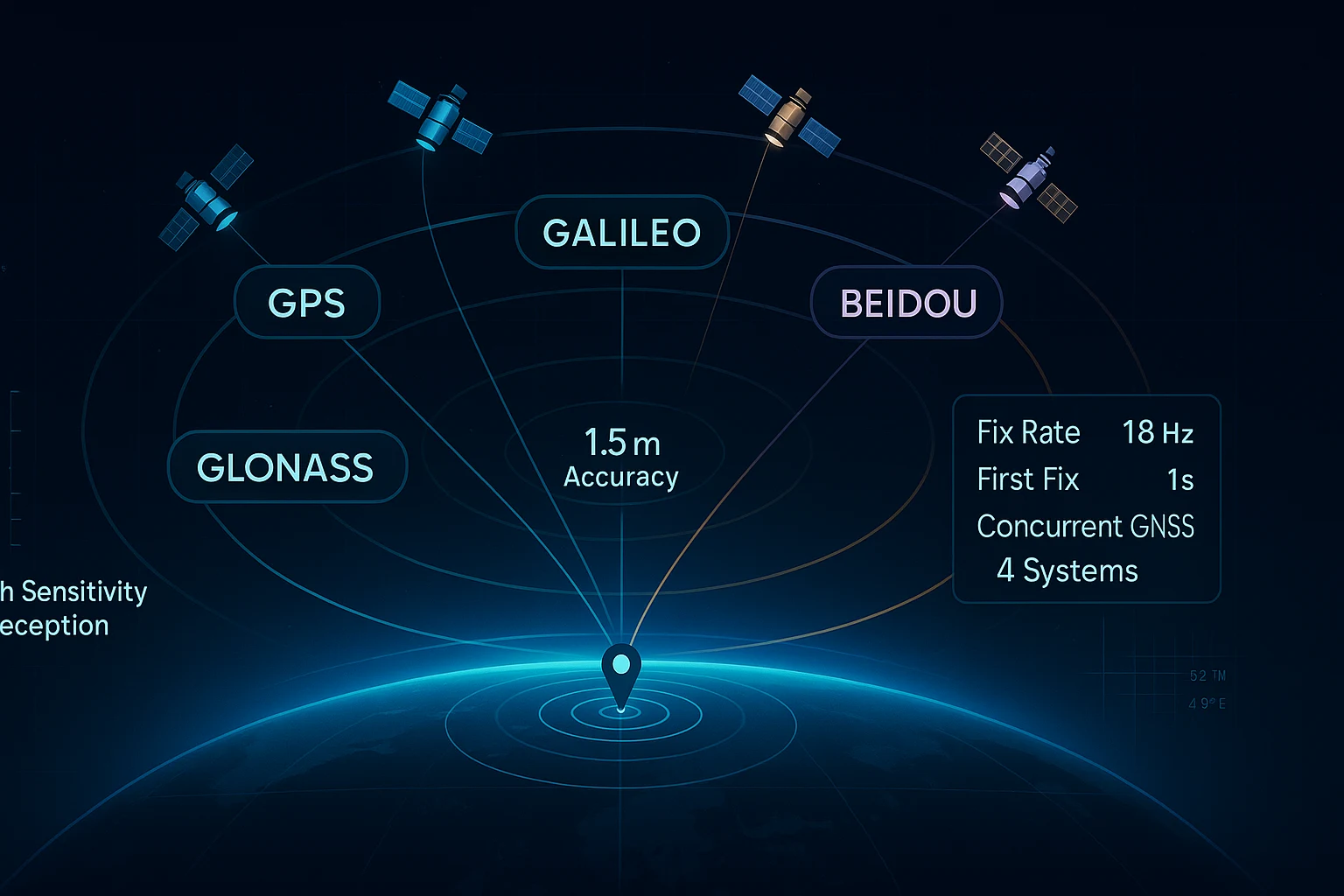
The MultiNav Pro+ is RFOXiA's precision location module, engineered around the latest u-blox MIA-M10Q GNSS chip. It supports concurrent reception from four global satellite constellations — GPS, Galileo, GLONASS, and BeiDou — simultaneously, delivering sub-1.5-meter accuracy with an 18Hz fix rate and first fix in under one second.
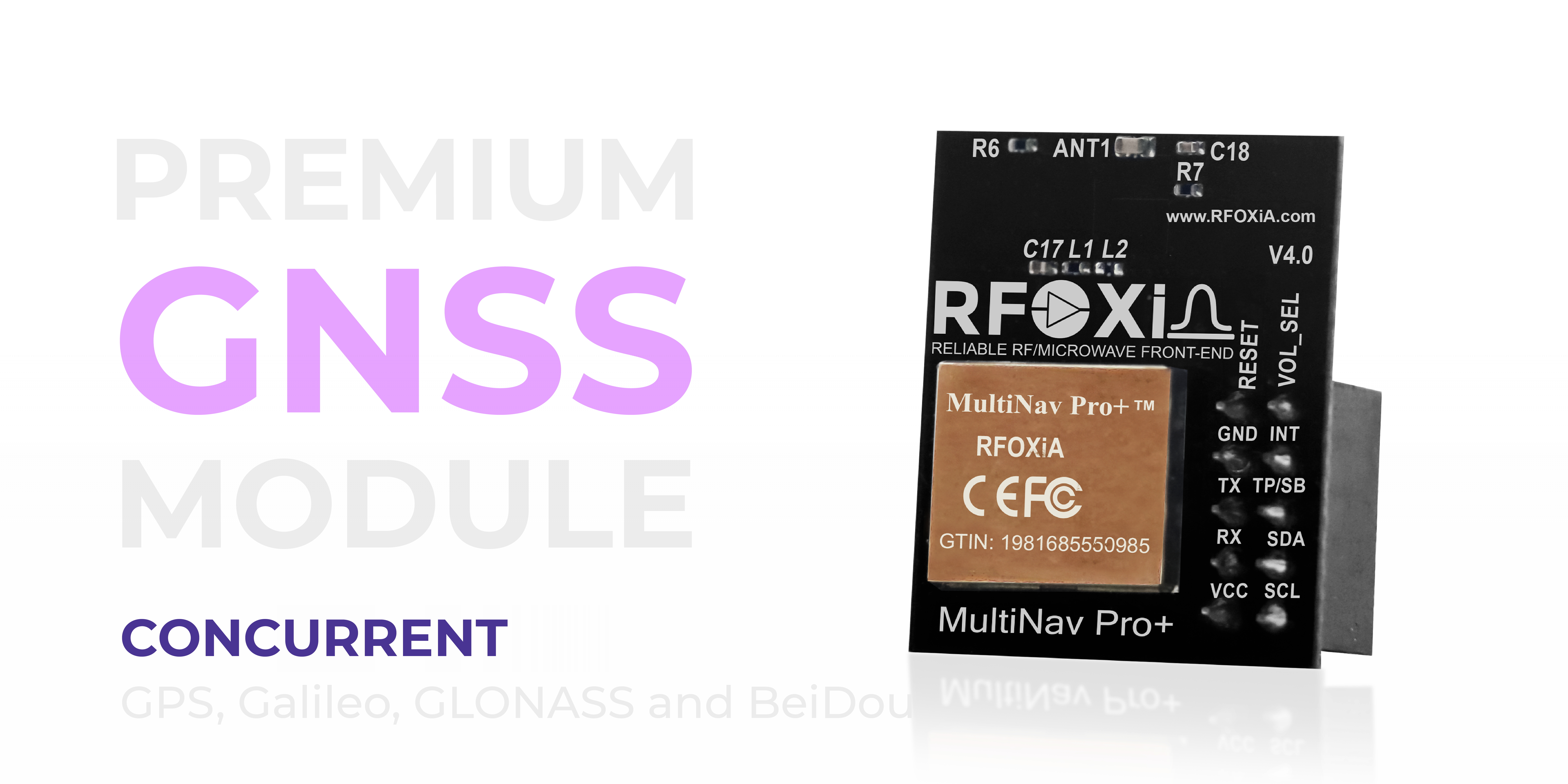
At 26mm x 22mm, it's compact enough to fit into nearly any form factor — wearables, drone frames, compact IoT enclosures, research instruments. Despite its small footprint, it includes an integrated high-gain chip antenna, eliminating the need for external antenna components in most deployments.
Priced at $49, it sits in a category of its own: professional GNSS performance at a price that doesn't require a research grant to justify.
Core Specifications at a Glance
Before diving into what these specs mean in practice, here's the full technical picture:
- Accuracy: Less than 1.5 meters CEP
- Fix Rate: Up to 18Hz
- First Fix: 1 second (hot start)
- GNSS Constellations: GPS, Galileo, GLONASS, BeiDou (concurrent)
- GNSS Chip: u-blox MIA-M10Q
- Antenna: Integrated high-gain chip antenna
- Interface: UART (TX/RX) and I2C (SCL/SDA)
- Operating Voltage: 1.8V and 3.3V
- Current Draw: 25–30mA
- Dimensions: 26mm x 22mm
- Certification: FCC certified
- Price: $49
1.5-Meter Accuracy: What It Actually Means
A high sensitivity GPS receiver module is only as useful as the accuracy it delivers under real conditions. Generic GPS modules — the kind that appear in low-cost maker kits — typically specify accuracy in the 2.5–5 meter range under ideal conditions. In practice, under partial sky coverage or near structures, that can degrade to 10 meters or worse.
The MultiNav Pro+ achieves sub-1.5-meter accuracy through a combination of multi-constellation reception, advanced RF filtering, and the precision capabilities of the u-blox MIA-M10Q chip. By simultaneously pulling data from GPS, Galileo, GLONASS, and BeiDou, the module has access to significantly more satellites at any given moment than a single-constellation receiver. More satellites means better geometric dilution of precision (GDOP), which translates directly into tighter position estimates.

For drone operators mapping agricultural fields, the difference between 1.5m and 5m accuracy is the difference between actionable data and expensive guesswork. For robotics developers building autonomous navigation systems, it's the difference between a robot that reaches its target and one that crashes into it. Precision matters — and 1.5 meters is a genuine engineering achievement at this price point.
18Hz Fix Rate: Built for Moving Platforms
Fix rate is the specification that separates navigation-grade modules from tracking-grade modules. Most commodity GPS receivers update at 1Hz — once per second. Some higher-quality consumer modules push to 5Hz or 10Hz.
The MultiNav Pro+ delivers 18Hz — eighteen complete position updates per second.
This matters enormously for any application involving fast movement. A drone flying at 60 km/h covers approximately 16 meters per second. At 1Hz, your position update is already 16 meters stale by the time it arrives. At 18Hz, the lag drops to under one meter. That's the difference between smooth real-time tracking and jerky, unreliable position data that makes control systems unstable.
For FPV racing drones, autonomous flight systems, high-speed ground robots, or any application where the platform is moving faster than walking pace, 18Hz isn't a luxury — it's a requirement.
Compact Design and Efficient Power Consumption
Integrating a GNSS module into a weight-sensitive or power-constrained application always involves trade-offs. The MultiNav Pro+ minimizes those trade-offs on both dimensions.
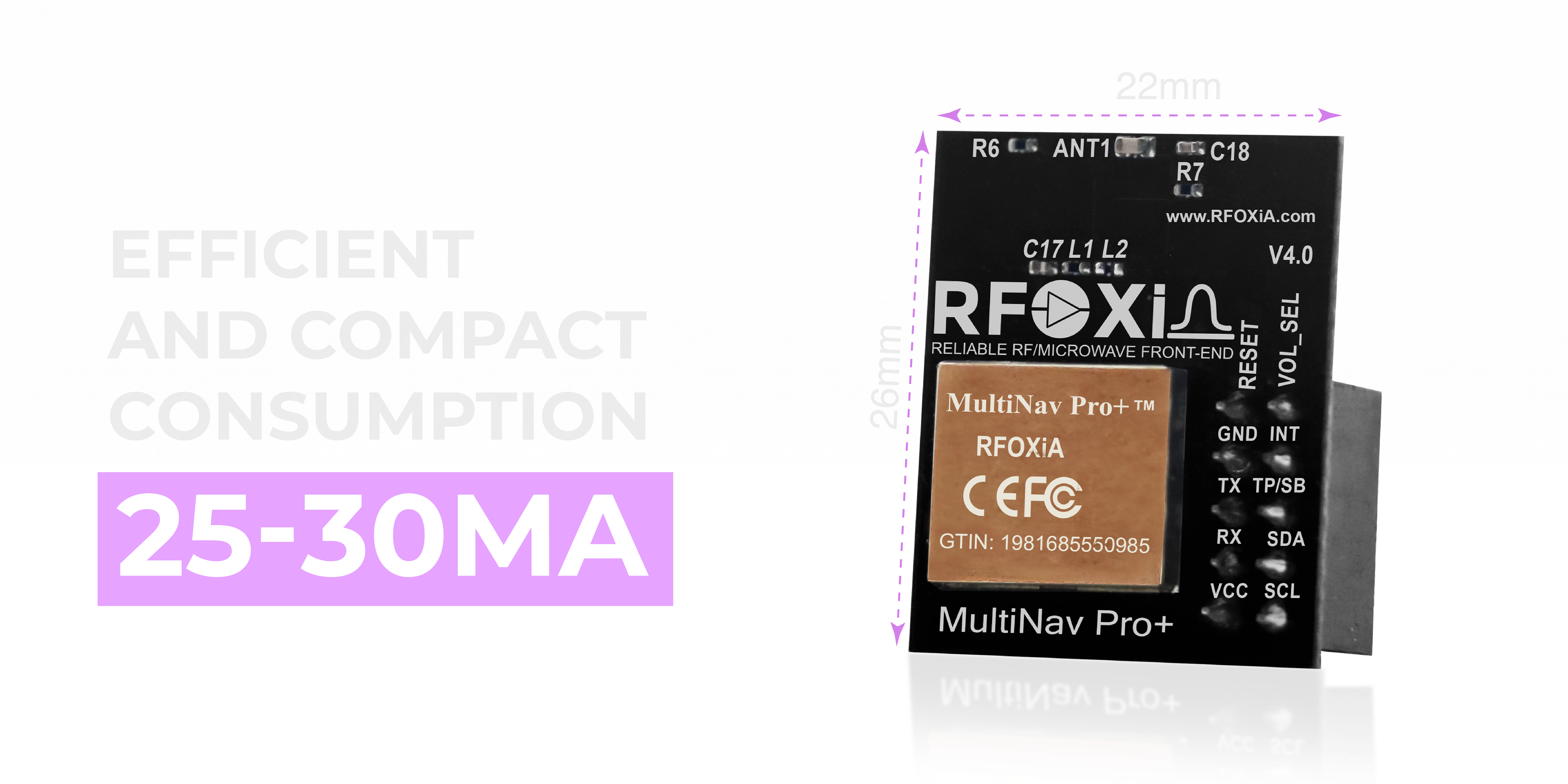
At 26mm x 22mm, the module fits comfortably on a small breakout board, inside a drone frame, or embedded into a wearable device. The integrated chip antenna means you don't need to route a pigtail to an external antenna or worry about connector orientation during assembly.
Power consumption sits between 25–30mA during active operation — reasonable for a multi-constellation receiver delivering 18Hz updates. For battery-powered applications, the module supports power-saving modes that can reduce consumption significantly during periods when high-rate updates aren't required.
The combination of small footprint and controlled power draw makes this module viable for applications that typical professional-grade GNSS receivers would be excluded from by size or battery constraints alone.
Versatile Connectivity: UART and I2C
The MultiNav Pro+ supports two standard communication interfaces, giving you maximum flexibility in how you integrate it into your hardware.
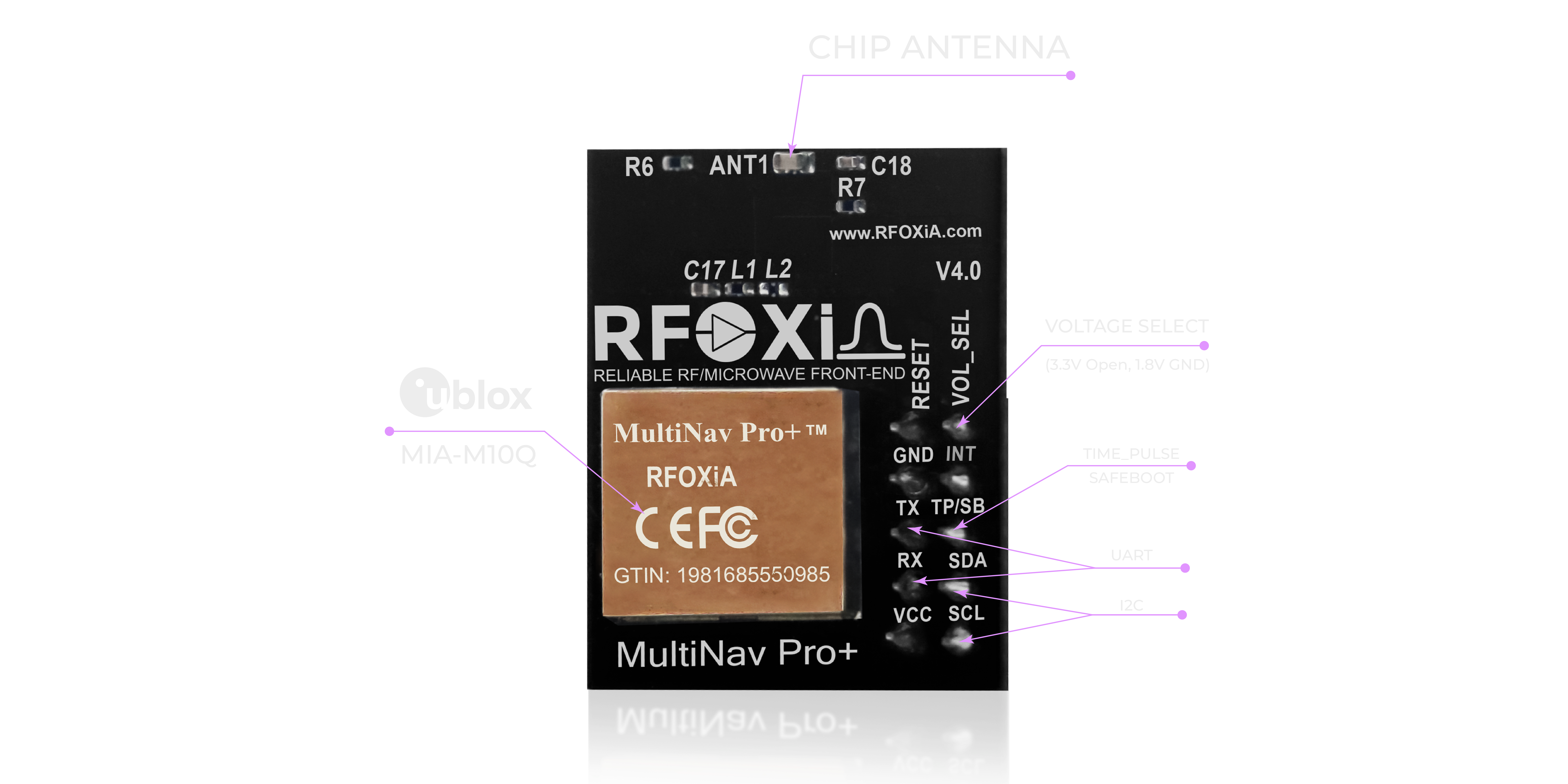
UART (TX/RX) is the most common interface for GPS modules and is compatible with virtually every microcontroller and single-board computer on the market — Arduino, ESP32, STM32, Raspberry Pi, Teensy, and hundreds of others. If you're using a serial port, you can talk to this module.
I2C (SCL/SDA) is ideal when you need to share a bus with other sensors or when UART pins are already allocated to another peripheral. This is particularly useful in dense IoT builds where pin count is limited.
Operating voltage support for both 1.8V and 3.3V logic levels ensures compatibility with modern low-voltage microcontrollers without requiring level-shifting hardware. This is a detail that often goes overlooked in spec sheets but becomes critical when you're integrating into systems running at 1.8V.
Open-Source Driver: Fastest Path from Hardware to Data
Hardware is only half the integration story. The MultiNav Pro+ ships with a fully open-source C language driver library that implements the NMEA standard protocol — the universal language of GNSS receivers.
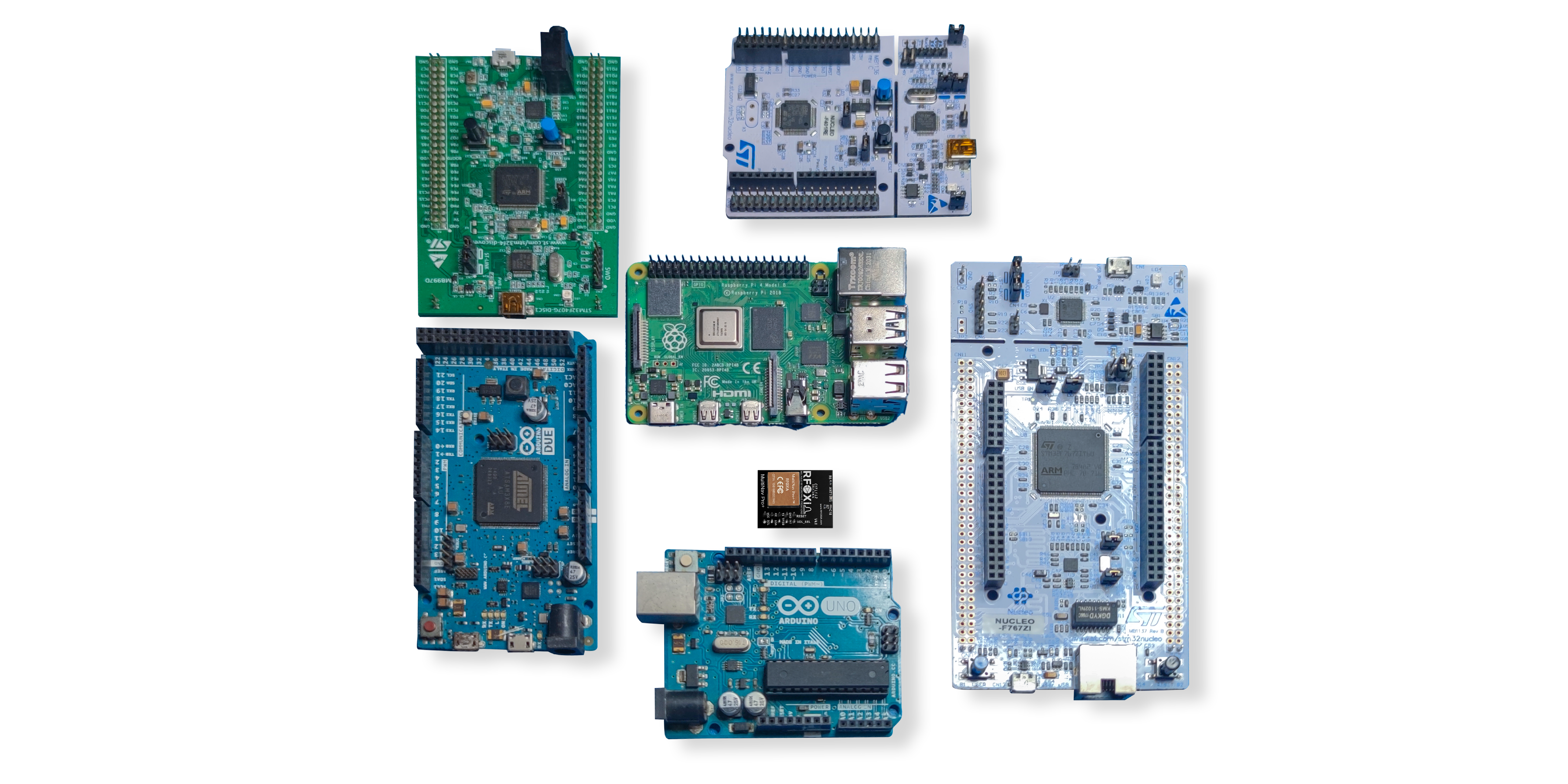
The library is designed to drop directly into Arduino IDE or any standard C/C++ toolchain. Import the library, initialize the interface, and you're reading live position data in minutes — not hours. For developers who want to go deeper, the full source is available for modification, extension, or porting to different RTOS environments.
This open-source approach aligns with RFOXiA's core mission of democratizing professional technology. You shouldn't need to reverse-engineer a proprietary binary blob to use a GNSS module you paid for. With the MultiNav Pro+, the entire software stack is transparent, modifiable, and yours.
For developers who want AI-assisted firmware development, the RFOXiA Accurate GNSS Module integrates with RFOXiA Club's AI Firmware Builder — describe your application in plain language and receive production-ready firmware that includes GNSS data handling, ready to compile and flash.
U-Center Software: Visualize and Configure Your GNSS Data
Beyond the embedded library, the MultiNav Pro+ is fully compatible with u-blox's U-Center software — the industry-standard desktop application for GNSS module evaluation, configuration, and debugging.
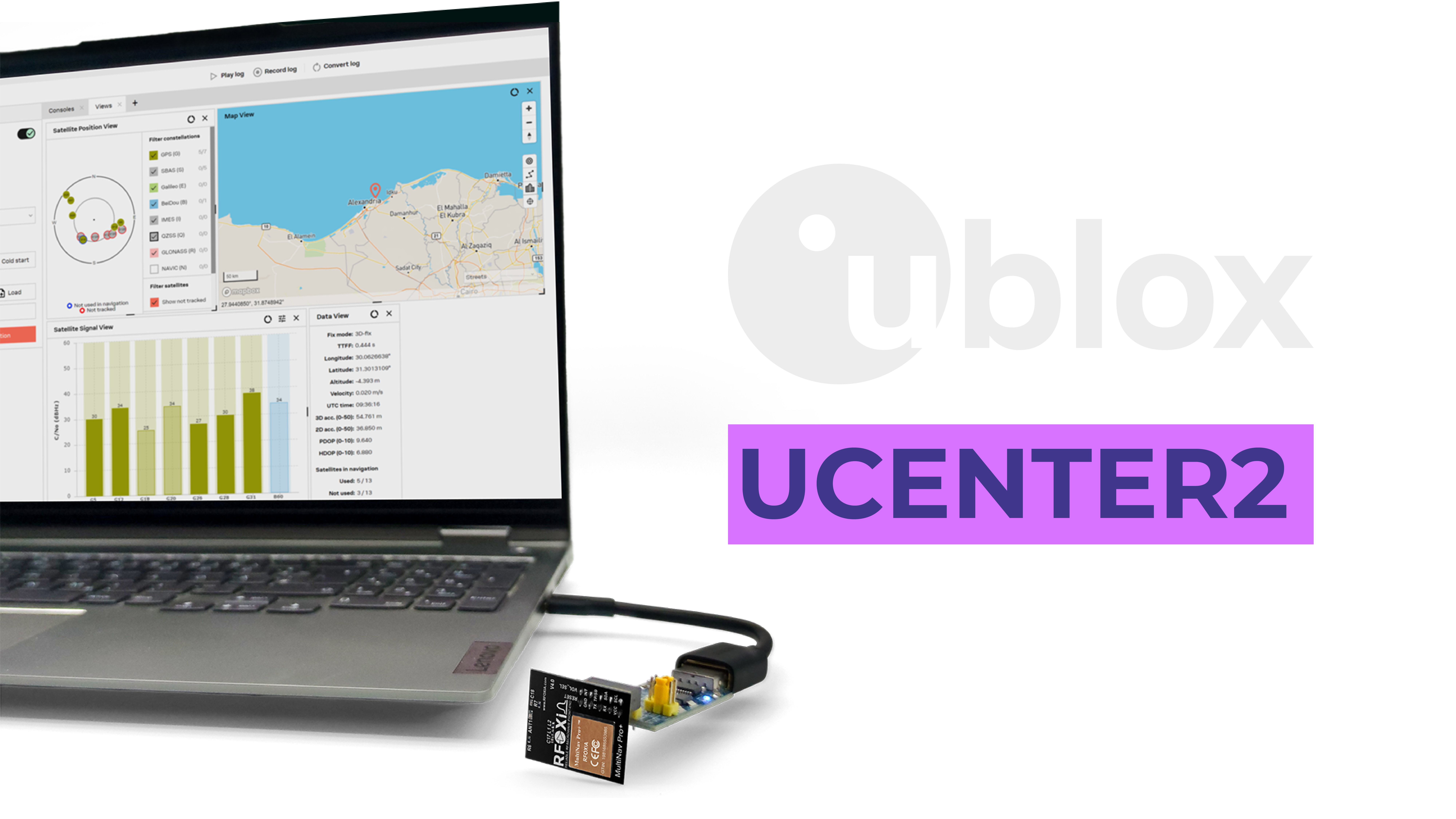
U-Center provides a graphical interface for visualizing satellite constellation geometry, signal strength per satellite, real-time position plotting, NMEA message parsing, and module configuration. For developers evaluating the module before integration, it's an invaluable tool for validating fix quality and understanding what the module is doing at every moment.
For production applications, U-Center allows you to configure the module's output rate, message selection, and power modes, then save those settings to the module's non-volatile memory so it powers up with your exact configuration every time.
This level of professional tooling support — typically associated with GNSS modules costing five to ten times more — is available out of the box with every MultiNav Pro+ purchase.
RF Filtering Technology: Clean Signals in Noisy Environments
One of the less-visible but critically important features of the MultiNav Pro+ is its proprietary RF/microwave microstrip filter technology. GNSS signals are exceptionally weak by the time they arrive from orbit — typically around -130 dBm — which makes them vulnerable to interference from nearby electronics, motor noise, cellular signals, and Wi-Fi transmissions.
A high sensitivity GPS receiver module that doesn't actively filter RF interference will deliver inconsistent, degraded accuracy in real-world environments. The MultiNav Pro+'s integrated microstrip filtering attenuates out-of-band interference before it reaches the receiver chain, preserving the integrity of the satellite signals that matter.
This is particularly important for drone integration, where ESCs, motors, and video transmission systems generate significant RF noise across a wide spectrum. The MultiNav Pro+ is designed to operate reliably in exactly these challenging electromagnetic environments.
Applications: Where the MultiNav Pro+ Belongs

The combination of 1.5m accuracy, 18Hz updates, multi-constellation reception, and compact form factor makes the MultiNav Pro+ the right choice across a wide range of professional applications:
Autonomous Drones and UAV Systems High-speed flight requires high-speed position data. The 18Hz fix rate keeps position data fresh even at maximum flight speeds, enabling smooth autonomous navigation and accurate waypoint-based mission execution.
Precision Agriculture Field mapping, variable-rate application, and autonomous ground vehicle guidance all demand sub-2-meter accuracy. The MultiNav Pro+ delivers that accuracy over every square meter of the field.
IoT Asset Tracking Real-time tracking of vehicles, equipment, or high-value assets benefits from both the accuracy and the rapid first-fix time — critical for systems that power down between tracking events.
Robotics and Ground Vehicles Autonomous ground robots operating outdoors need reliable, accurate position feedback to navigate precisely. The MultiNav Pro+ provides the location data that makes autonomous outdoor navigation feasible.
Wearable Technology and Personal Tracking The compact footprint and low power consumption make the MultiNav Pro+ viable for integration into wearable devices — fitness trackers, safety devices, personal navigation tools.
Research and Environmental Monitoring When paired with RFOXiA's Sensors Module, the GNSS data enables GPS-verified outdoor environmental monitoring with hyper-local geographic resolution — the foundation of RFOXiA's distributed data network.
Automotive Applications Vehicle tracking, fleet management, and driver assistance systems all benefit from accurate, fast-updating position data that reflects real-world vehicle dynamics.
Integration with the RFOXiA Ecosystem
The MultiNav Pro+ is designed to function both as a standalone module and as a core component of the complete RFOXiA developer ecosystem.
When combined with the BLE Module (5km ground-to-ground range, 15–20km man-to-drone), the GNSS module enables real-time GPS tracking displayed live on the RFOXiA Connect mobile app — with position updates streamed wirelessly over long-range Bluetooth. You see exactly where your drone, robot, or asset is on a live map, updated 18 times per second, with no internet connection required.
In the Developer Bundle — which includes the BLE Module, GNSS Module, Sensors Module, and Power/Program Kit — the MultiNav Pro+ serves as the location backbone for a complete wireless sensing and control platform. The GNSS data also validates outdoor deployment for the data network, enabling users to earn daily rewards for verified environmental data contributions.
For developers who want the complete picture before purchasing, the RFOXiA Accurate GNSS Module product page includes full documentation, integration guides, and access to the open-source library.
Why Choose the MultiNav Pro+ Over Alternatives?
The GNSS module market segments into two broad categories: cheap commodity modules with mediocre specs, and expensive professional receivers designed for survey-grade applications.
Commodity modules — the kind that appear in $5 maker kits — typically deliver 2.5–5 meter accuracy at 1Hz update rates, with single-constellation reception (GPS only) and no RF filtering. They're fine for applications where you just need a rough idea of location and don't mind waiting a second between updates.
Survey-grade and industrial GNSS receivers deliver centimeter accuracy and high update rates, but they start at several hundred dollars and scale into thousands. They're designed for land surveyors and precision mapping professionals, not for hardware developers building the next generation of autonomous systems.
The MultiNav Pro+ occupies the gap: professional performance specifications, professional tooling support, professional build quality — at a $49 price point that makes it accessible to every serious hardware developer. There is genuinely no direct competitor at this combination of price and performance.
What's Included
Every MultiNav Pro+ purchase includes:
- MultiNav Pro+™ GNSS Module (FCC certified)
- Quick Start Guide
- Access to open-source C language driver library
- U-Center software compatibility
- Full RFOXiA Club documentation and support resources
As a standalone module at $49, or as part of the Developer Bundle, the MultiNav Pro+ represents the most accessible entry point into professional-grade location technology available today.
Final Verdict: The High Sensitivity GPS Receiver Module That Changes the Equation
For too long, hardware developers have had to choose between affordable and accurate, between fast and small, between professional tooling and accessible pricing. The MultiNav Pro+™ eliminates those trade-offs.
With sub-1.5-meter accuracy, 18Hz updates, four-constellation concurrent reception, integrated RF filtering, open-source drivers, U-Center compatibility, and a 26mm x 22mm footprint — all at $49 — this is the high sensitivity GPS receiver module that serious builders have been waiting for.
Whether you're flying autonomous missions, mapping agricultural fields, tracking assets in real time, building a wearable navigation device, or contributing verified location data to RFOXiA's distributed sensor network, the MultiNav Pro+ delivers the precision, speed, and reliability your application demands.
Ready to build with precision? Explore the full specifications and order the MultiNav Pro+ at the RFOXiA Accurate GNSS Module product page. FCC certified, open-source, and ready to ship.
Written by: Moamen Mohamed LinkedIn