
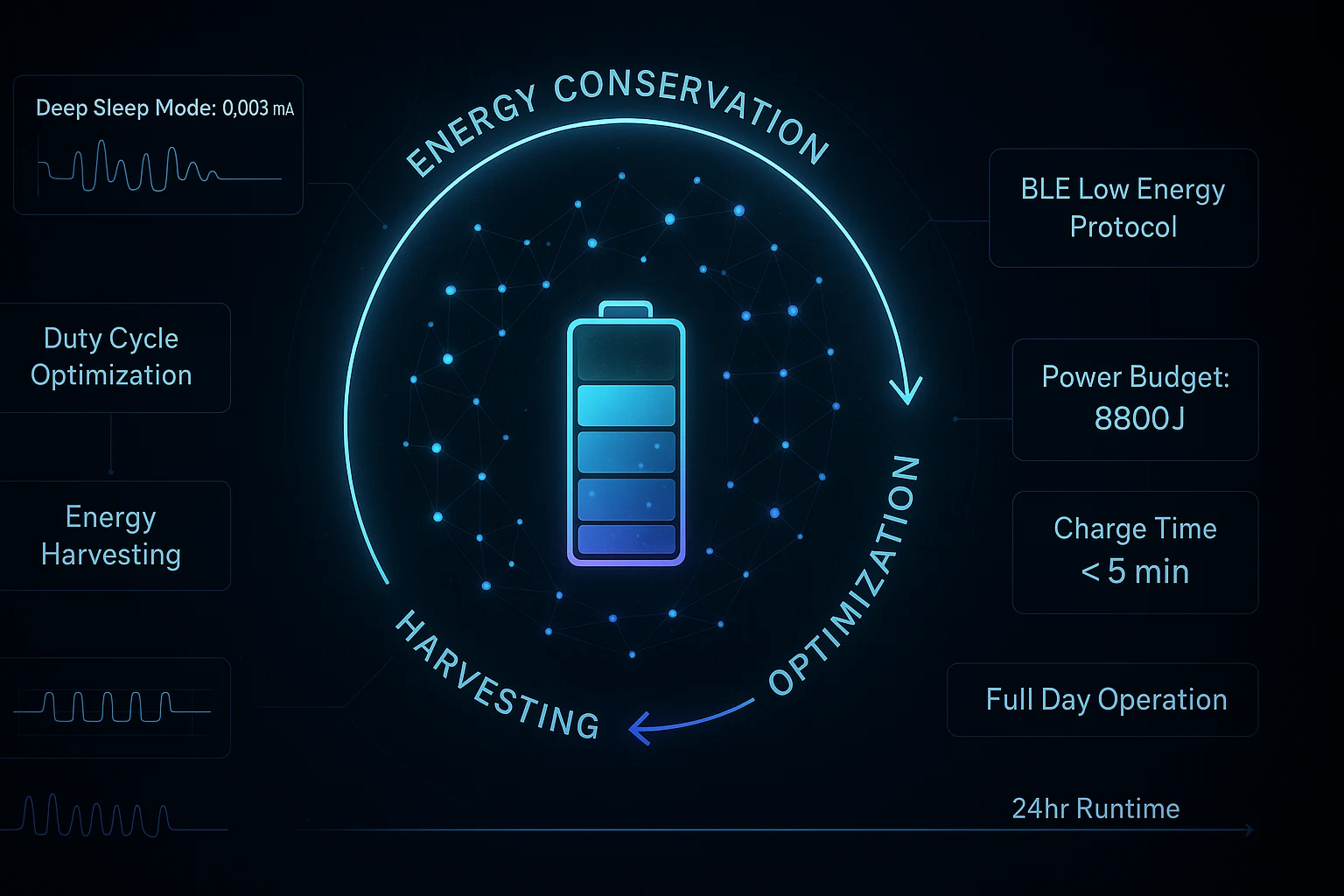
How to Extend IoT Battery Life: The Supercapacitor Revolution for Wireless Developers
RFOXiA SuperCapacitor Battery and Programmer Kit
How to Extend IoT Battery Life Beyond What Traditional Batteries Allow
If you have ever deployed a wireless IoT system in the field — whether it is a drone-mounted sensor array, a remote environmental monitoring node, or a long-range robotics platform — you already know the single most frustrating bottleneck in the entire development cycle: power.
Batteries die at the worst possible moments. Lithium cells take hours to recharge. LiPo packs degrade after a few hundred cycles. Alkaline batteries are wasteful and expensive over time. And when your IoT hardware is strapped to a drone at altitude or bolted to a weather station in a field twenty kilometers from the nearest power outlet, "just plug it in and wait" is not a viable strategy.
This is the fundamental challenge every serious IoT developer faces, and it is the exact problem that the MultiNav Pro+ Power/Program Kit from RFOXiA was engineered to solve.
In this guide, we are going to break down the real reasons IoT battery life suffers, explain why supercapacitor technology represents a genuine engineering leap forward, and show you exactly how the RFOXiA power architecture eliminates the downtime that kills productivity in field deployments.
Why Traditional IoT Battery Solutions Fall Short
Before we talk about solutions, it is worth being precise about the problem. Most IoT developers encounter one or more of the following battery-related failure modes:
1. Charge Time Kills Field Productivity
A standard 3000mAh LiPo battery pack charges at roughly 1C, meaning it takes approximately one hour to reach full charge. High-quality packs with 2C charging capability still require 30 minutes. In a professional field deployment context — where you may be running multiple sessions per day across multiple devices — this dead time accumulates fast.
If you are managing a sensor network or doing iterative firmware testing in the field, spending 30 to 60 minutes per charge cycle between sessions is not just inconvenient. It is a genuine productivity tax that compounds across every deployment day.
2. Cycle Life Degrades Fast Under Heavy Use
Lithium-ion and LiPo chemistries typically support between 300 and 500 full charge cycles before capacity degrades to roughly 80% of the original rating. For a developer running multiple charge cycles per day during an active project phase, this means a battery pack that is effectively worn out within a few months.
Supercapacitors, by contrast, support upward of 500,000 to 1,000,000 charge cycles with negligible capacity degradation. This is not a marginal improvement. It is a fundamentally different category of technology.
3. Cold Temperature Performance Collapses
Lithium chemistry batteries lose significant capacity in cold environments. A LiPo pack operating at 0°C may deliver only 60-70% of its rated capacity. At -20°C, capacity loss can exceed 50%. For outdoor IoT deployments in northern climates, winter field research, or high-altitude drone operations, this is a real and serious limitation.
Supercapacitors maintain consistent energy delivery across a much wider temperature range, making them genuinely suitable for the harsh environments where IoT hardware is most often deployed.
4. Voltage Sag Under Load Disrupts RF Performance
Many developers overlook this one. As a lithium battery discharges, its terminal voltage drops — sometimes significantly under high-current loads. For RF hardware like long-range BLE modules, this voltage sag can directly impact transmit power, receiver sensitivity, and ultimately the effective range of the system.
A supercapacitor system maintains a much flatter discharge curve under load, delivering consistent voltage throughout the operating session. For precision RF applications, this matters.
What Supercapacitor Technology Actually Does Differently
A supercapacitor — also called an ultracapacitor or electric double-layer capacitor (EDLC) — stores energy electrostatically rather than through chemical reactions. This fundamental difference in energy storage mechanism is what produces such dramatically different performance characteristics.
Energy storage mechanism: Electrostatic charge separation at the electrode-electrolyte interface, rather than electrochemical reactions.
Charge/discharge speed: Because there are no chemical reaction kinetics to limit charge rate, supercapacitors can accept charge extremely rapidly — limited primarily by the current capacity of the charging circuit.
Cycle life: With no chemical reactions occurring during charge and discharge, there is no equivalent of the electrode degradation that limits lithium battery cycle life. Supercapacitors genuinely last for the lifetime of the product.
Power density: Supercapacitors excel at delivering high instantaneous current. For IoT devices with transient high-power loads — transmitting RF bursts, activating sensors, driving motors — this high power density means the power supply does not struggle under peak demand.
The trade-off is energy density: supercapacitors store less total energy per unit weight or volume compared to lithium batteries. This is why the engineering challenge is designing a supercapacitor system with sufficient total energy storage to meet the runtime requirements of the target application — which is exactly what the RFOXiA power architecture has done.
Introducing the MultiNav Pro+ Power/Program Kit
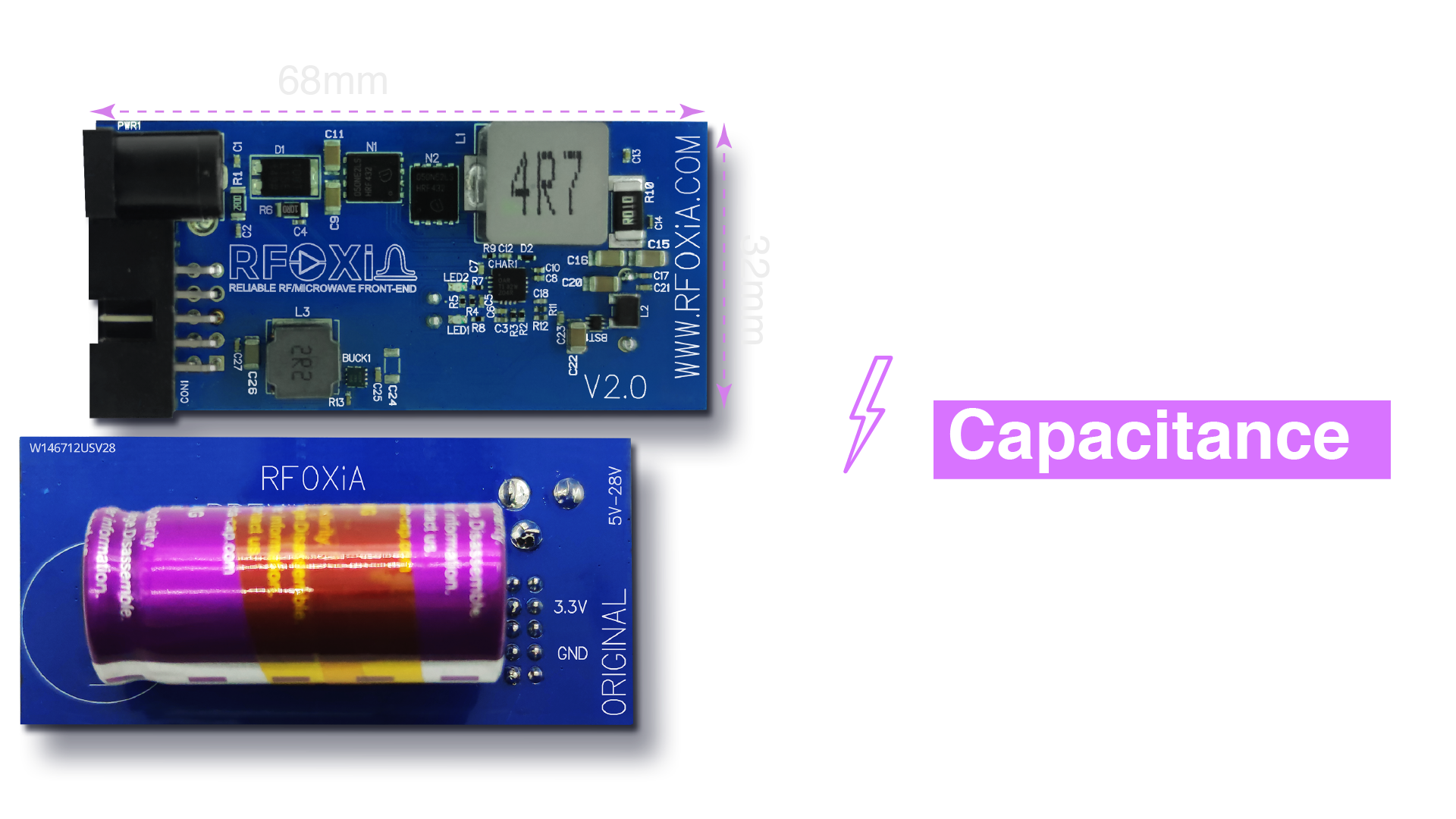
The MultiNav Pro+ Power/Program Kit is RFOXiA's answer to every power-related complaint in the IoT developer toolkit. It is not an incremental improvement on existing battery solutions. It is a rearchitected approach to how field-deployed IoT hardware should be powered.
The 1100F Supercapacitor System
At the core of the kit is an 1100F supercapacitor bank — a genuinely substantial energy storage system. At the operating voltage of the system, this stores 8,800 Joules of usable energy. To put that in practical terms: 8,800 Joules is sufficient to power the full MultiNav Pro+ module stack — BLE Module, GNSS Module, and Sensors Module operating simultaneously — for a complete 24-hour working day.
This is not a marketing estimate. It is derived from the actual measured power consumption of the MultiNav Pro+ module stack during normal operation, including the BLE radio in active communication mode, the GNSS module tracking and reporting at 18Hz, and all seven onboard sensors streaming data.
If you are running the BLE module alone, runtime extends further. If you are running a duty-cycled application that puts the radio to sleep between transmission windows, runtime extends further still. The 24-hour figure represents continuous full-stack operation — the most demanding use case.
5-Minute Charge Time: A Real-World Game Changer
The 1100F supercapacitor bank charges to full capacity in under 5 minutes using the included high-power charging adapter.
Five minutes. Not thirty. Not sixty. Five.
This changes the entire rhythm of field deployment work. Instead of planning your sessions around battery charge cycles, you charge while you review your previous session's data. By the time you have looked at your readings and decided what to adjust in your next test, the system is ready to go again.
For iterative firmware development — where you are flashing new code, testing behavior, adjusting parameters, and testing again — this rapid turnaround is transformative. The STLink programmer included in the kit handles the firmware side; the supercapacitor system handles the power side. The result is a workflow where hardware constraints stop dictating your development pace.
The High-Power Charging Adapter
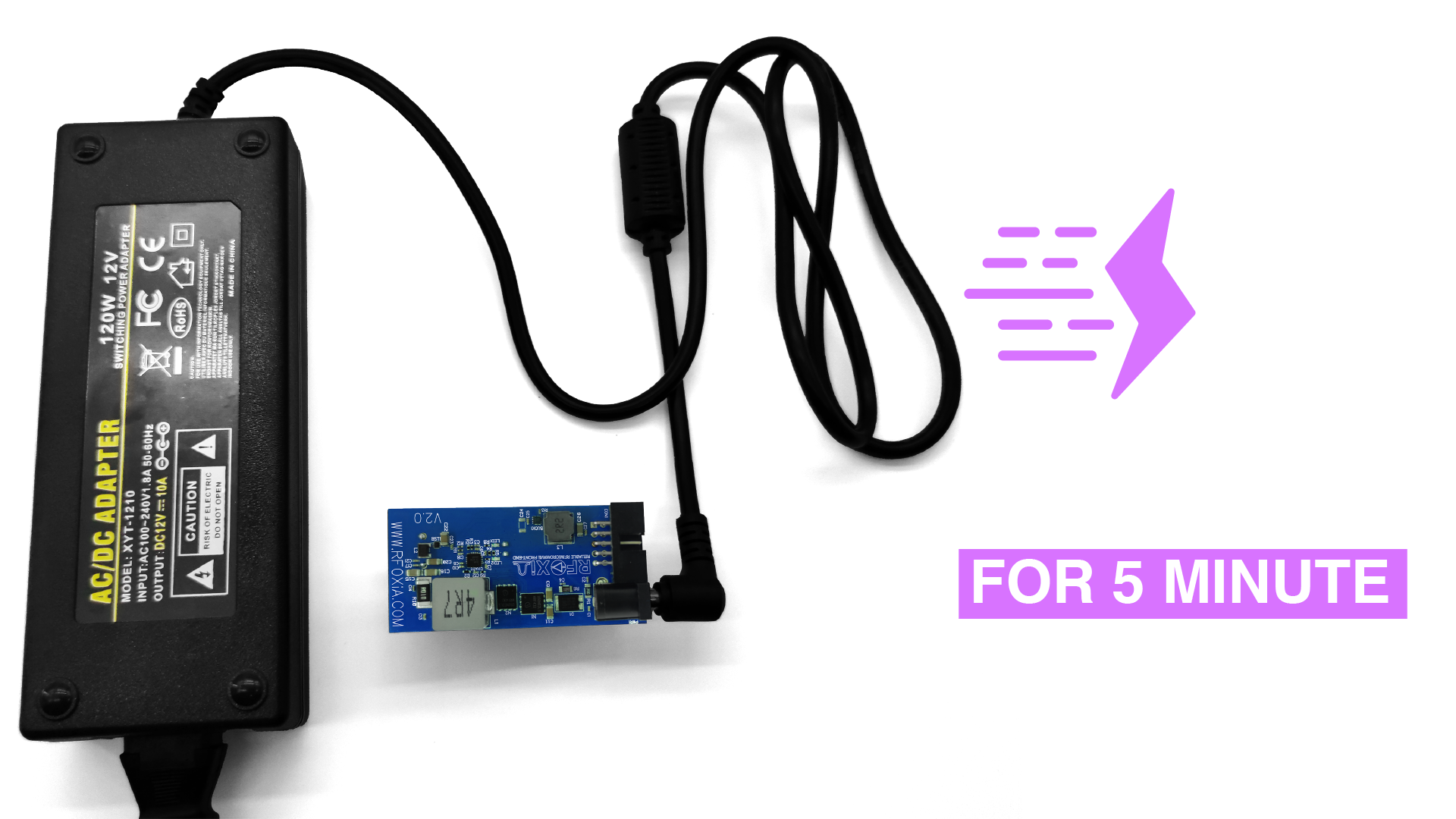
Achieving a 5-minute charge time on an 1100F supercapacitor bank requires a charging system that can deliver high current without compromising safety or component longevity. The included 12V 5A charging adapter delivers power to the supercapacitor bank at 4V 10A — a carefully engineered charging profile that maximizes charge rate while managing thermal load and protecting the supercapacitor cells.
The charging circuit includes the necessary protection and voltage regulation to ensure that the supercapacitor bank charges correctly every time, regardless of the state of charge when you plug in. Whether the bank is fully depleted or half charged, the system handles the charge profile intelligently.
This is not a generic power brick. It is a purpose-built charging solution matched to the specific characteristics of the supercapacitor chemistry in this kit.
Full-Day Power for the Complete Module Stack
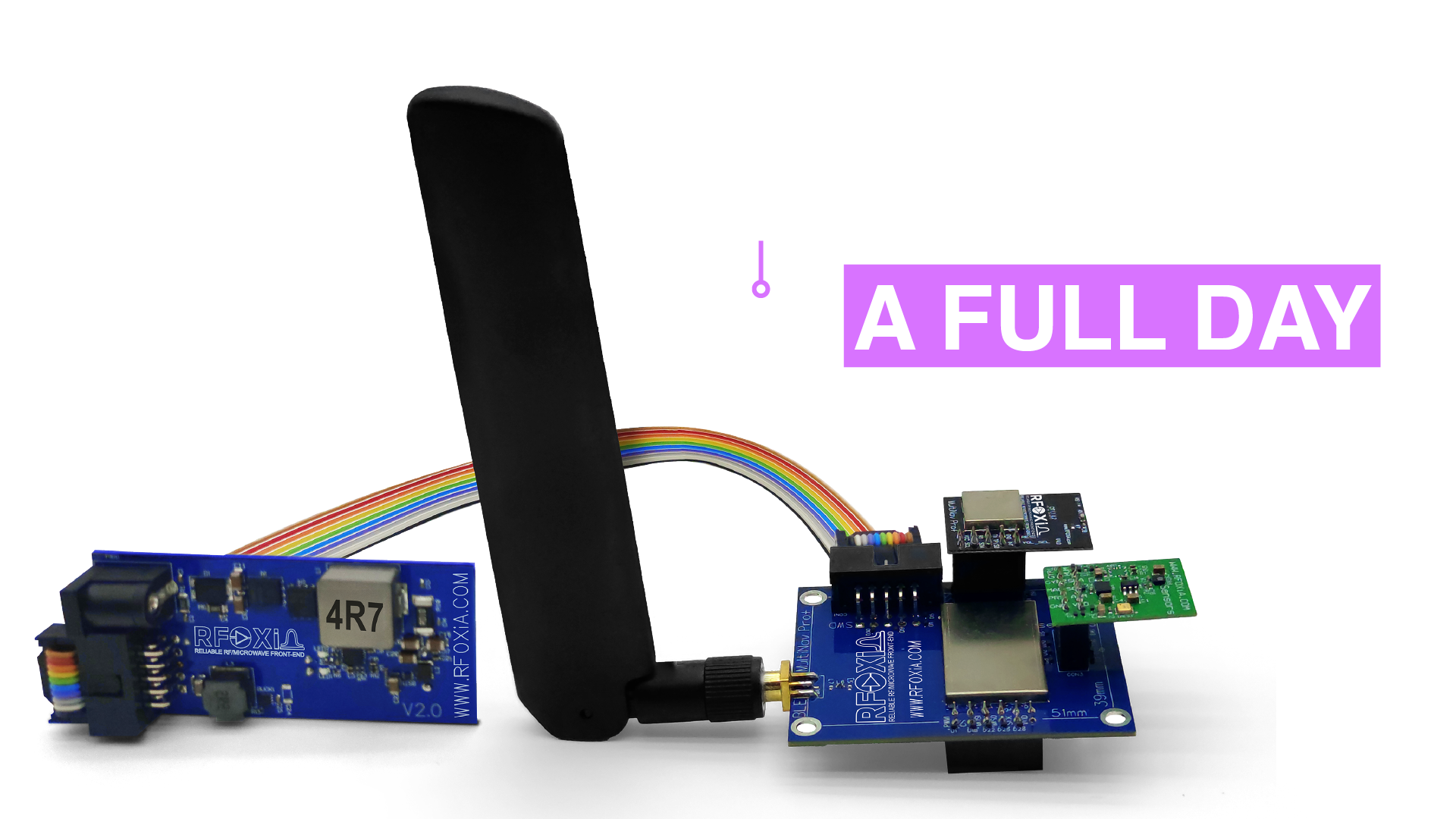
One of the most important things to understand about the Power/Program Kit is that "full day" power means the complete MultiNav Pro+ ecosystem running simultaneously — not just the BLE module in isolation.
When you are building a serious IoT or drone telemetry application, you are not running one module. You are running a stack: the BLE module for long-range wireless communication, the GNSS module for precision position tracking at 18Hz, and the Sensors Module for environmental data including temperature, humidity, pressure, air quality, accelerometer, gyroscope, and magnetometer data.
Running all of this simultaneously for a full working day, without worrying about power, is what the Power/Program Kit enables. This is the engineering foundation that makes real field deployments viable — whether you are conducting environmental research, operating drone surveys, developing robotics platforms, or contributing data to the RFOXiA decentralized sensor network.
Knowing how to extend IoT battery life for multi-module stacks has historically required complex power management design. The RFOXiA kit simplifies this entirely by providing a single, integrated power solution for the full ecosystem.
The Integrated STLink Programmer
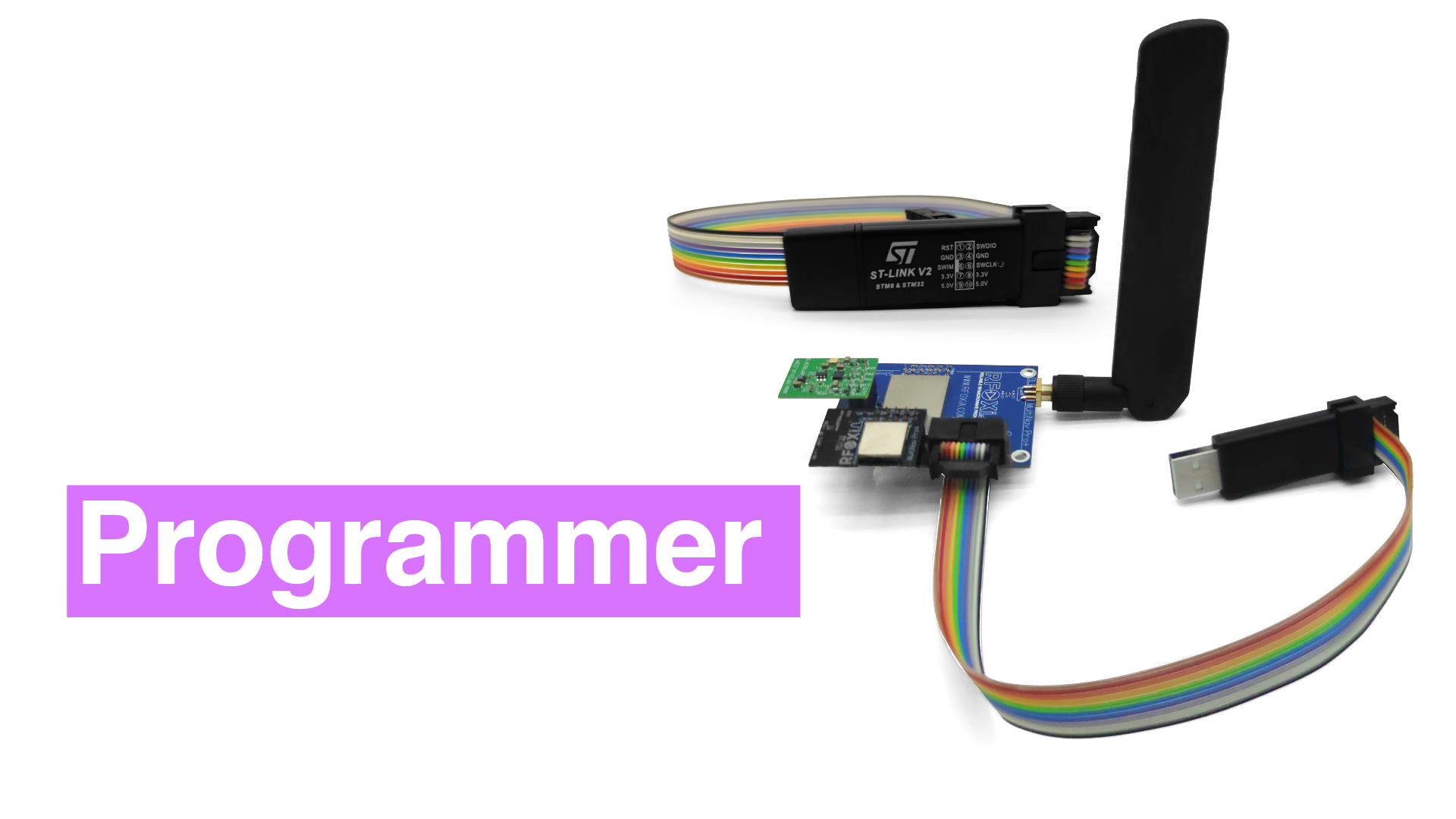
Power is only half of the development equation. The other half is firmware — and the STLink programmer included in the kit addresses this directly.
The MultiNav Pro+ BLE Module is built around the STM32WB07 microcontroller, and programming and debugging it requires an STLink interface. Buying a standalone STLink programmer adds cost and complexity to your development setup. The Power/Program Kit integrates this functionality directly, giving you a single piece of hardware that handles both power management and firmware development.
The STLink programmer in the kit enables:
- Firmware flashing — Load your compiled firmware directly onto the BLE module
- Real-time debugging — Step through code, set breakpoints, inspect register states
- Firmware updates — Apply RFOXiA firmware updates as they are released
- Custom firmware development — Use the RFOXiA GitHub repository as a starting point for your own applications
For developers using the RFOXiA Club's AI Firmware Builder — which generates production-ready STM32 firmware from plain-language descriptions of your application — the STLink programmer is the bridge between the AI-generated code and the actual hardware. Describe your application, generate the firmware, flash it with the STLink, power it with the supercapacitor system, and test it in the field. All in the same session.
Complete Connectivity — No Hunting for Cables
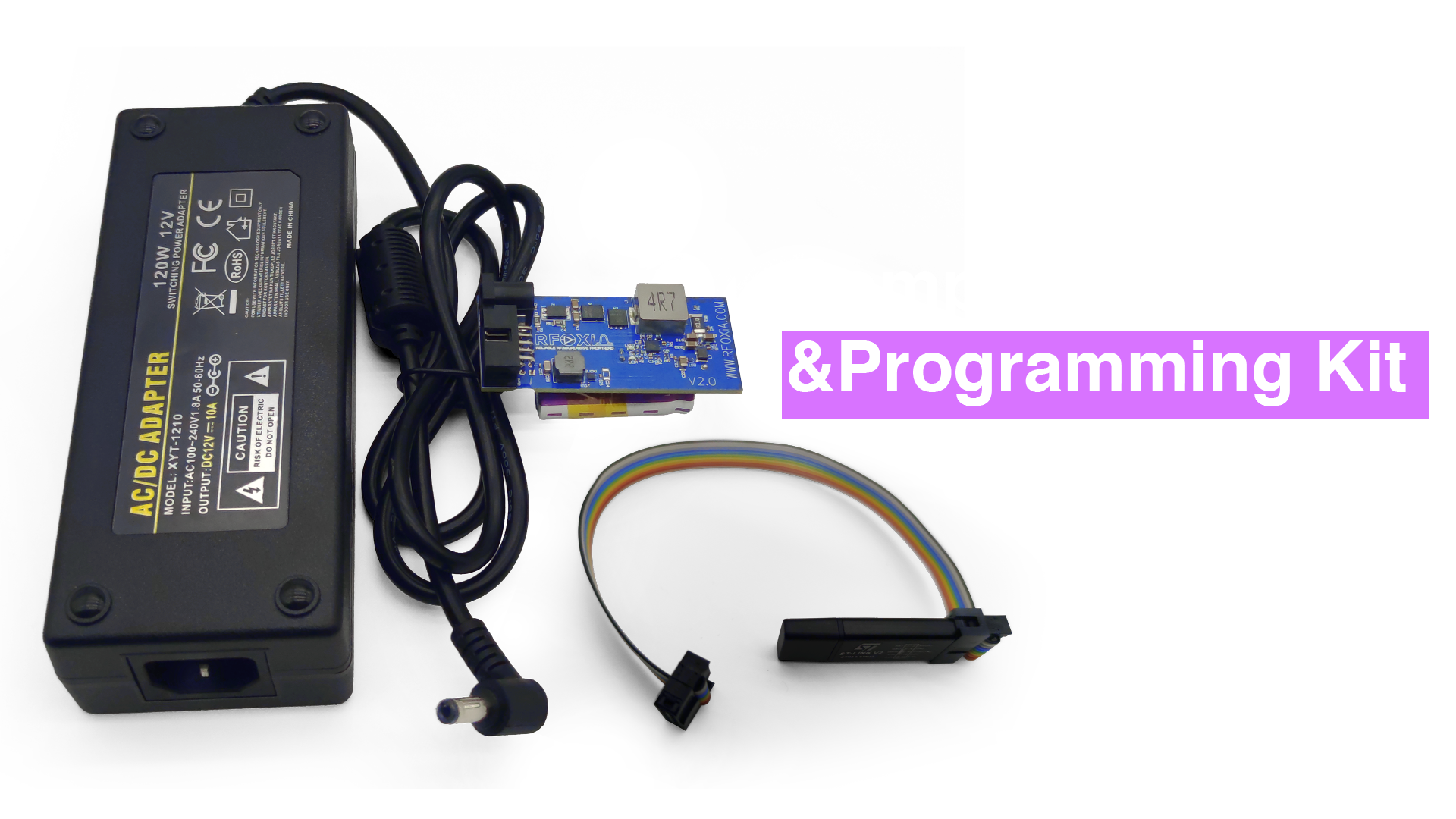
One of the small but meaningful design decisions in the Power/Program Kit is the inclusion of all necessary cables for immediate setup. Specifically, the kit includes the flat ribbon cables needed to connect:
- The BLE module to the power module
- The STLink programmer to the BLE module
This matters because cable compatibility is one of those friction points that causes real delays in hardware development. The wrong connector pitch, the wrong ribbon width, the wrong wire gauge — any of these can bring a development session to a halt while you wait for the right cable to arrive from an online order.
The Power/Program Kit eliminates this friction entirely. Everything you need to connect the system and start working is in the box.
How to Extend IoT Battery Life: Practical Strategies Combined with the Right Hardware
The Power/Program Kit addresses the hardware side of the power equation, but it is worth pairing that hardware foundation with software and system-level strategies that further extend effective runtime and maximize deployment efficiency.
Duty Cycling the Radio
The BLE module in the MultiNav Pro+ ecosystem supports configurable duty cycling — the ability to alternate between active transmission windows and low-power sleep states. For applications where continuous real-time data is not required, duty cycling can dramatically reduce average current consumption. A module transmitting for 10% of the time and sleeping for 90% draws roughly one-tenth the average current of a continuously active radio.
With the supercapacitor system already providing 24-hour runtime at full continuous operation, adding duty cycling to your application design can extend effective deployment time to multiple days between charges.
Sensor Sampling Rate Optimization
The Sensors Module supports configurable sampling rates. Running all seven sensors at maximum rate consumes more power than running them at rates matched to your actual data requirements. For environmental monitoring applications where temperature and humidity change slowly, sampling every 60 seconds rather than every second reduces sensor subsystem power consumption by roughly two orders of magnitude.
GNSS Fix Rate Matching to Application Needs
The GNSS module's 18Hz fix rate is designed for tracking fast-moving platforms like drones. For stationary or slow-moving applications, reducing the fix rate to 1Hz or 5Hz significantly reduces power consumption in the GNSS subsystem while maintaining adequate position accuracy for the application.
Using the AI Firmware Builder for Power-Aware Firmware
RFOXiA Club's AI Firmware Builder can generate firmware with specific power management requirements described in plain language. Telling the AI to implement duty cycling, low-power sleep modes, or adaptive sampling rates produces production-ready firmware that incorporates these power management strategies from the start — without requiring you to manually implement complex STM32 low-power mode sequences.
This combination of hardware capability and AI-assisted firmware development is precisely how to extend IoT battery life without spending weeks on power optimization manually.
The Developer Bundle: The Complete Ecosystem
If you are evaluating the Power/Program Kit as part of a broader development setup, it is worth understanding how it fits into the complete MultiNav Pro+ ecosystem.
The MultiNav Pro+ Developer Bundle combines:
- BLE Module (2 units) — 5km ground-to-ground, 15-20km man-to-drone, 50km drone-to-drone range at 2Mbps
- GNSS Module — 1.5m accuracy, 18Hz fix rate
- Sensors Module — 7 environmental sensors, data network compatible
- Power/Program Kit — everything described in this article
All four modules are FCC certified and ship from the US. The Developer Bundle is the fastest path to a complete, field-ready wireless development platform — and the RFOXiA SuperCapacitor Battery and Programmer Kit is what keeps that platform running when it matters most.
For developers who are serious about understanding how to extend IoT battery life in real field conditions — not just on a bench in a lab — the combination of supercapacitor power management, precision GNSS, multi-sensor environmental data, and long-range BLE communication in a single integrated kit represents a genuinely unique offering in the current hardware market.
Specifications Summary
| Feature | Specification |
|---|---|
| Supercapacitor capacity | 1100F |
| Energy storage | 8,800 Joules |
| Charge time | Under 5 minutes |
| Runtime (full module stack) | 24 hours |
| Charging adapter | 12V 5A input / 4V 10A output |
| Programmer interface | STLink (STM32WB07 compatible) |
| Included cables | Flat ribbon cables for full connectivity |
| FCC certification | Yes |
| Price | $119 |
Who This Kit Is For
The Power/Program Kit is the right choice for any developer or engineer who:
- Is actively developing firmware for the MultiNav Pro+ BLE Module and needs rapid iteration cycles without charge-time bottlenecks
- Deploys IoT hardware in field environments where reliable, long-duration power is operationally critical
- Is building drone-mounted or robot-mounted sensor platforms where consistent power delivery under variable loads is important
- Wants to contribute to the RFOXiA data network and needs the Sensors Module powered continuously for maximum daily rewards
- Is tired of managing battery degradation across a development toolkit and wants a power solution that will outlast every other component in the system
If any of those descriptions match your situation, the answer to how to extend IoT battery life in your specific context is the RFOXiA SuperCapacitor Battery and Programmer Kit.
Getting Started
The Power/Program Kit is available directly from RFOXiA at $119. It ships with everything included: the supercapacitor bank, the high-power charging adapter, the STLink programmer, and all necessary cables.
New members who sign up for RFOXiA Club receive a $10 welcome credit that can be applied toward any hardware purchase — including the Power/Program Kit or the Developer Bundle. The Club is also where you access the AI Firmware Builder, the Dev Hub community, and the data network activation flow that turns your Sensors Module into a passive income node.
If you have been asking yourself how to extend IoT battery life in a way that actually changes how you work rather than just delaying the same problem by a few hours, the supercapacitor architecture in the MultiNav Pro+ Power/Program Kit is the answer worth exploring.
Visit the RFOXiA SuperCapacitor Battery and Programmer Kit page for full product details, compatibility information, and ordering.
RFOXiA is a Delaware-based hardware technology company building professional-grade wireless development tools at maker-accessible prices. All MultiNav Pro+ modules are FCC certified and ship from the United States.
Written by: Moamen Mohamed LinkedIn