
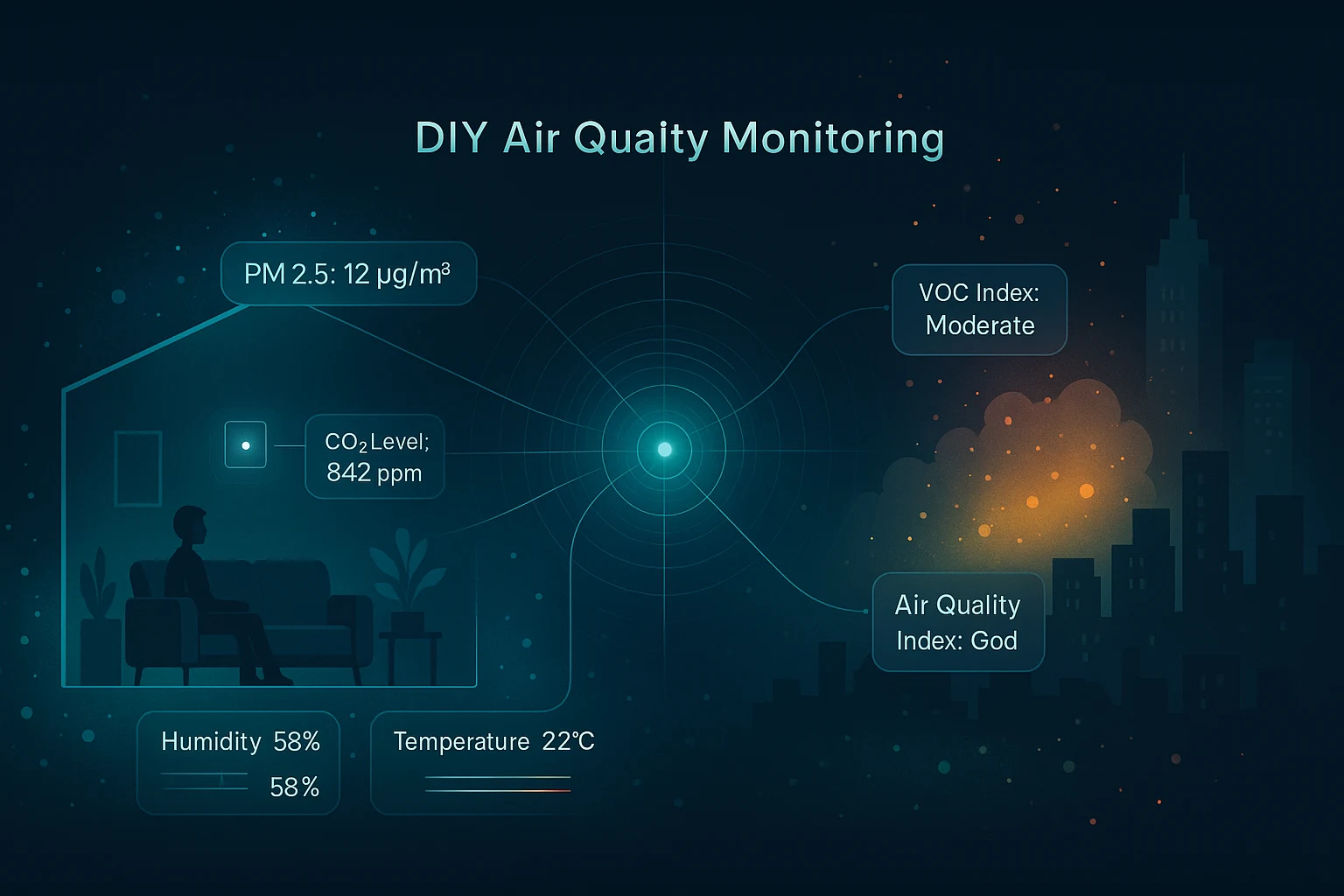
How to Monitor Air Quality DIY: Build a Professional Environmental Sensing System
RFOXiA Integrated Sensors Module
How to Monitor Air Quality DIY Has Never Been More Accessible — Or More Powerful
Air quality affects everything — your health, your crops, your city's infrastructure, and the environments your drones and robots operate in. For years, professional-grade environmental monitoring was locked behind expensive proprietary systems costing thousands of dollars and requiring specialized integration work. Today, that has completely changed.
In this guide, you will learn exactly how to monitor air quality DIY using modern sensor hardware, I2C communication protocols, and a complete all-in-one module that puts seven industrial-grade sensors on a single 24mm × 18mm board. Whether you are building a smart home monitor, deploying field sensors across an agricultural site, or adding environmental awareness to your drone platform, this walkthrough gives you everything you need — from understanding the sensors to wiring, firmware, and real-world deployment.
By the end of this post, you will understand:
- Which sensors you actually need and why
- How I2C simplifies multi-sensor builds
- How to integrate motion sensing alongside environmental monitoring
- Why a single integrated module beats a breadboard of individual chips
- How to turn your DIY build into a live data node that earns passive income
Let us get into it.
Why Air Quality Monitoring Matters for Makers and Engineers
Before we get into hardware, it is worth understanding what we are actually measuring and why it matters.
Air quality is not a single number. It is a composite picture made up of multiple measurements:
- Particulate matter and gas concentration — VOCs (volatile organic compounds), oxidizing gases, CO₂ equivalents
- Temperature — thermal environment affects sensor accuracy and is a standalone data point for many applications
- Humidity — relative humidity affects both human comfort and the accuracy of other sensor readings
- Atmospheric pressure — altitude, weather fronts, and indoor/outdoor pressure differentials all carry real information
For DIY builders, the traditional approach has been to buy these sensors separately — a BME280 for temperature/humidity/pressure, a CCS811 or SGP30 for air quality, a separate IMU if motion data is also needed — and then wire them all together on a breadboard or custom PCB. This works, but it creates problems:
- Address conflicts on the I2C bus
- Inconsistent power supply across multiple chips
- Physical footprint that does not fit compact form factors
- Time spent on integration instead of on the actual application
The smarter approach — especially for anyone serious about how to monitor air quality DIY at a professional level — is to start with a purpose-built integrated module that solves all of these problems from day one.
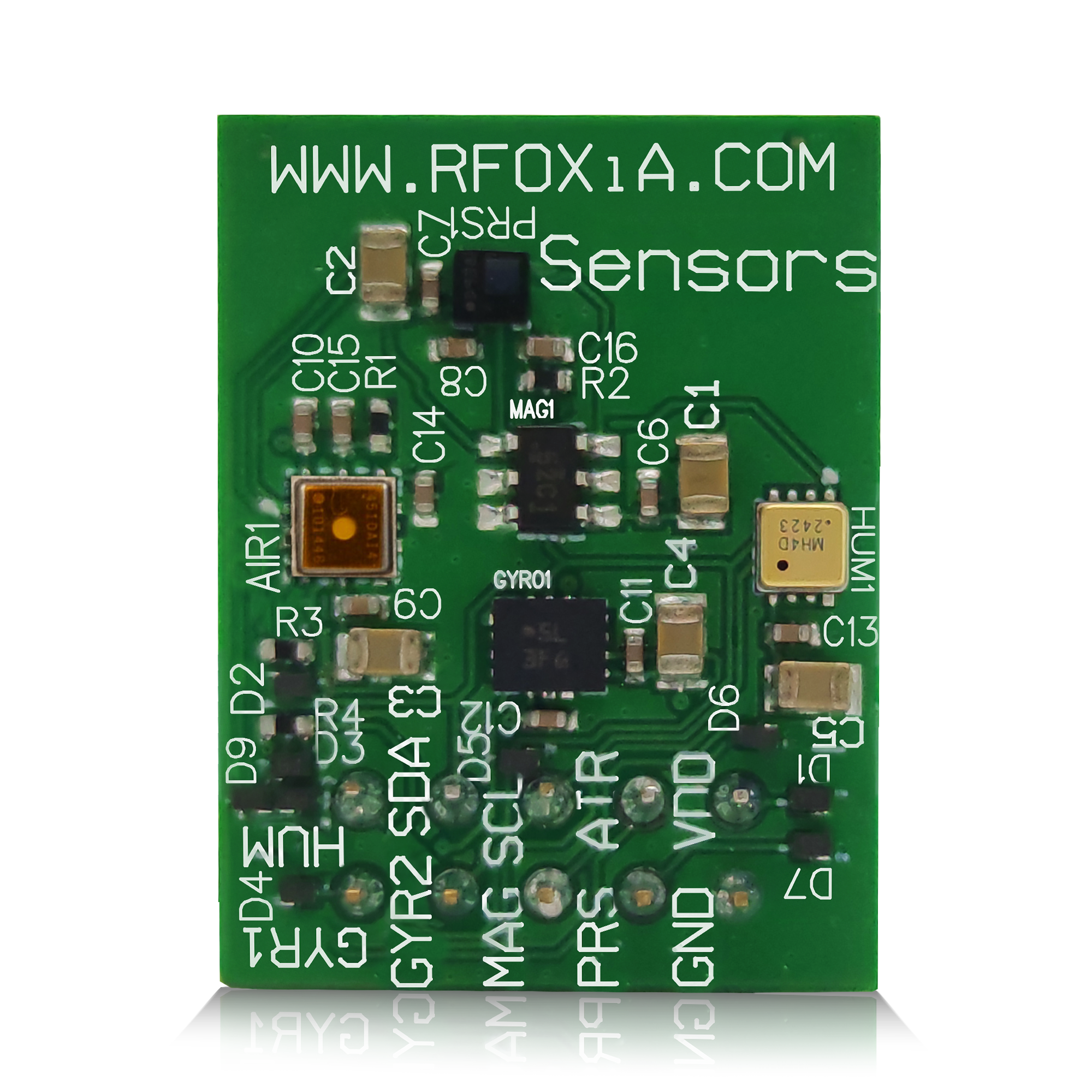
The Sensors You Need: A Technical Breakdown
Let us look at what a complete environmental and motion sensing stack actually requires, and then map that to the specific components that matter.
Air Quality: ZMOD4510AI4R from RENESAS
The ZMOD4510 is a gas sensor designed specifically for outdoor air quality monitoring. It detects ozone and nitrogen dioxide — two of the primary indicators of environmental air quality in urban and industrial contexts. This is the sensor used in professional air quality stations. Getting it on a maker-accessible module is a significant win for the DIY community.
For applications like drone-based environmental surveys, rooftop monitoring stations, or agricultural field deployments, this chip delivers data that is genuinely useful — not just a vague "air quality index" derived from a basic MOS sensor.
Temperature and Humidity: MVH4003D from MEMSVision
The MVH4003D is a MEMS-based combined temperature and humidity sensor. MEMS sensors offer superior long-term stability compared to traditional polymer-based humidity sensors, which means your calibration holds up over months of field deployment — critical for anyone building a serious monitoring system.
Air Pressure: LPS22HHTR from STMicroelectronics
ST's LPS22HH is a 24-bit absolute pressure sensor with a measurement range of 260–1260 hPa. At 24-bit resolution, it captures altitude changes as small as 10 centimeters. For drone applications this enables barometric altitude hold. For environmental monitoring it captures weather front pressure changes with precision.
Accelerometer and Gyroscope: BMI270 from Bosch Sensortec
The BMI270 is the same IMU class used in professional drone flight controllers and wearable devices. It delivers 16-bit resolution on both accelerometer and gyroscope axes with low noise density and high vibration robustness. If your application involves any kind of moving platform — drone, vehicle, wearable — the BMI270 gives you motion data you can actually trust.
Magnetometer: TMAG5273C1QDBVR from Texas Instruments
TI's TMAG5273 is a 3D hall-effect sensor that delivers magnetic field measurements across all three axes. Combined with the BMI270 accelerometer/gyroscope, it completes a full 9-DOF (degrees of freedom) IMU stack — enabling heading estimation, compass applications, and magnetic anomaly detection.
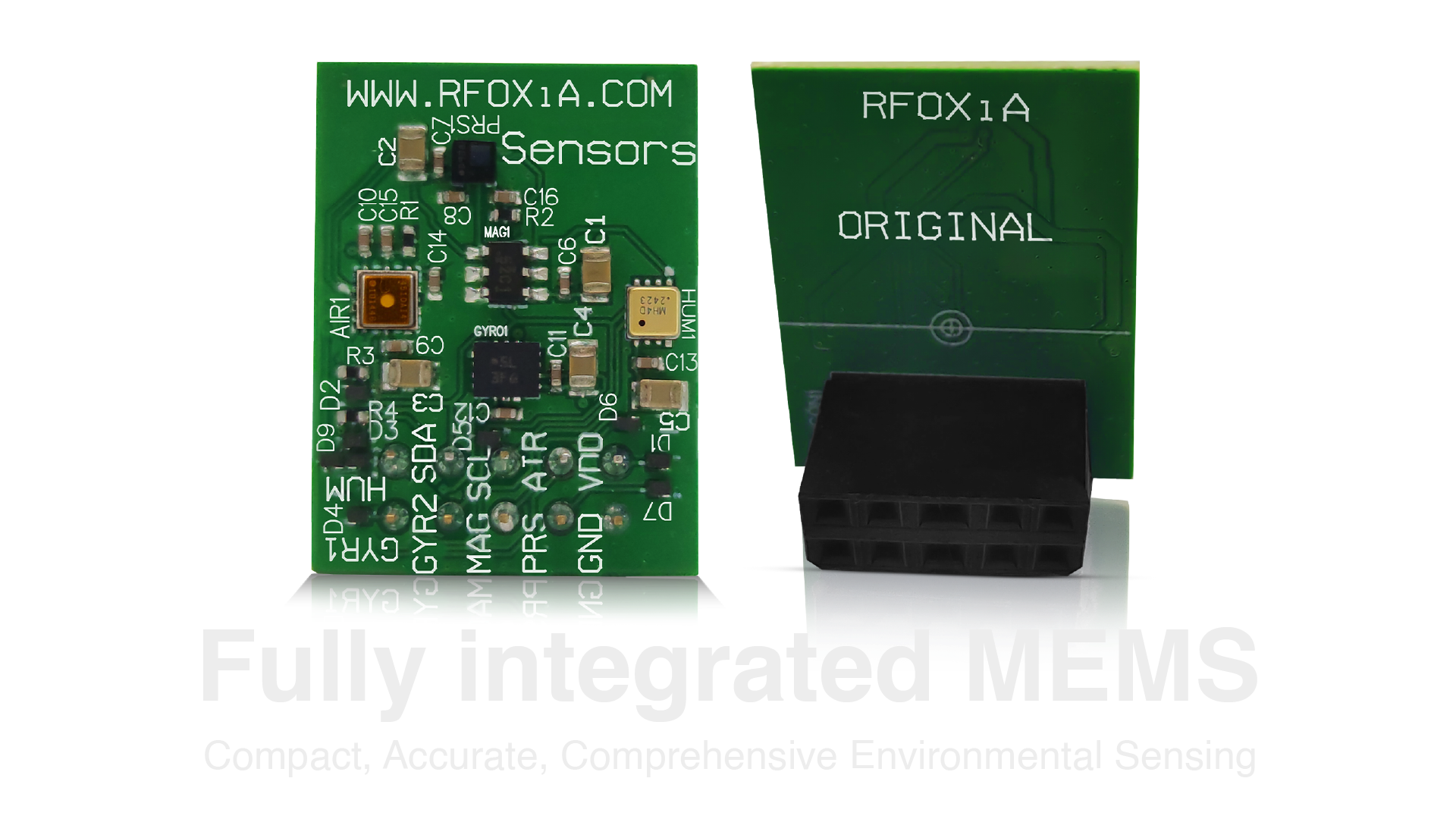
How I2C Makes Multi-Sensor Builds Simple
One of the most common friction points when builders first attempt how to monitor air quality DIY with multiple sensors is the communication bus. Each sensor needs to talk to your microcontroller, and managing multiple SPI devices or handling I2C address conflicts can turn a simple project into a debugging nightmare.
The MultiNav Pro+™ Sensors Module solves this elegantly: all seven sensors share a single I2C line, each assigned a dedicated, non-conflicting I2C address. This means:
- Two wires (SDA and SCL) connect your microcontroller to all seven sensors simultaneously
- No address conflicts — every sensor has its own unique address
- No data collisions — I2C's arbitration protocol handles bus access cleanly
- Minimal GPIO usage — critical for compact microcontroller platforms
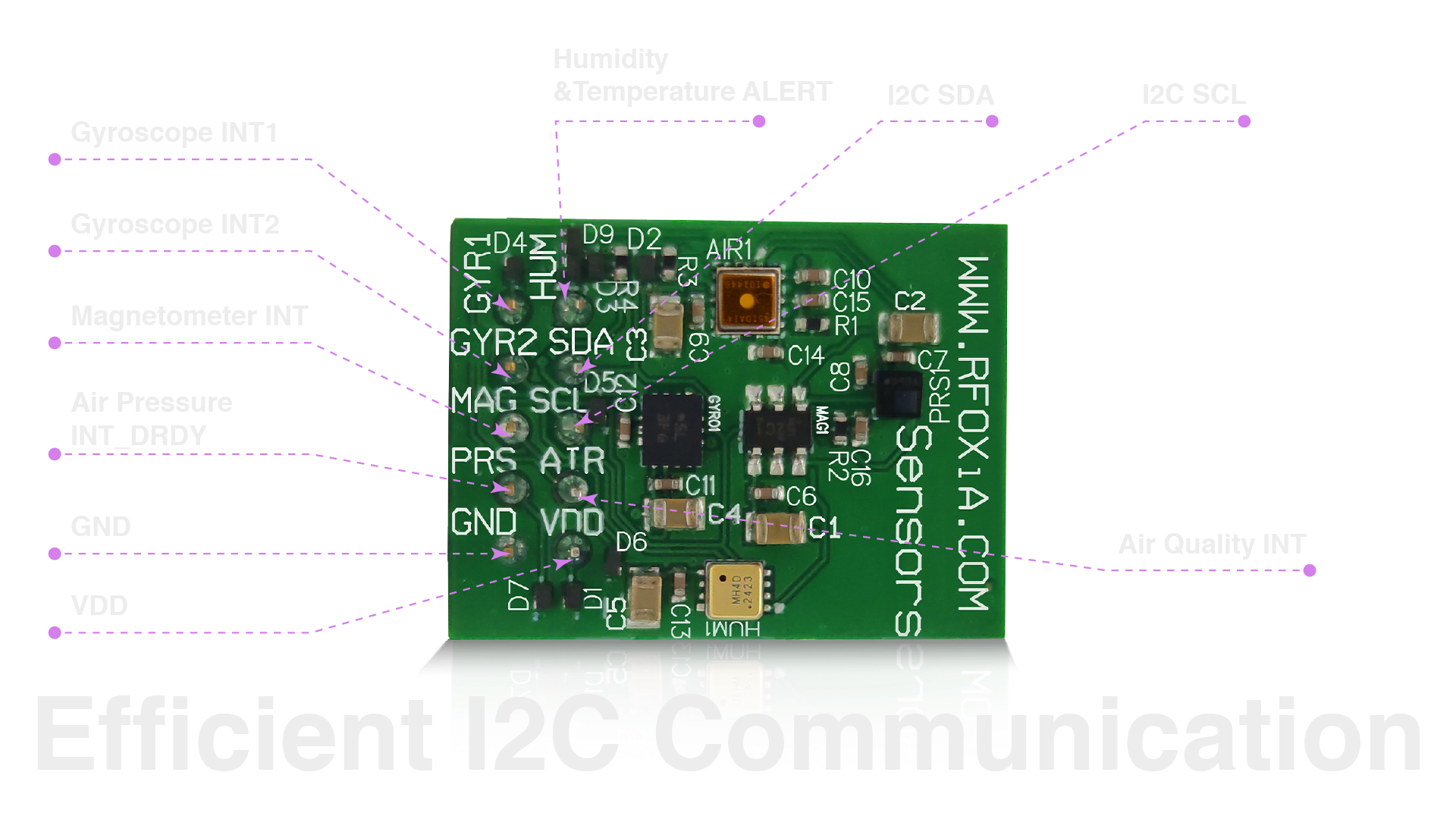
For anyone coming from a breadboard background, this is a revelation. Instead of managing separate SPI chip selects, separate power decoupling networks, and potential ground loop issues across a rat's nest of wires, you get clean, reliable communication from a single connector.
Practical I2C Wiring
For most microcontrollers (STM32, Arduino, ESP32, Raspberry Pi), connecting the module is:
Module SDA → MCU SDA pin
Module SCL → MCU SCL pin
Module VCC → 3.3V
Module GND → GND
That is it. Four connections. All seven sensors are immediately accessible through their respective I2C addresses.
Precision Motion and Environmental Sensing Together
One of the things that separates a truly professional DIY air quality monitor from a basic desktop sensor is the ability to contextualize environmental data with motion and orientation data.
Consider these real-world scenarios:
Drone environmental survey: You are flying a grid pattern over an agricultural field to map air quality. Without orientation data, you cannot know whether a spike in VOC readings correlates with a particular crop zone, a drainage channel, or a wind direction shift. With 9-DOF motion data from the BMI270 and TMAG5273, you can log GPS position, drone heading, and environmental readings in a single synchronized data stream.
Industrial monitoring station: A sensor mounted in a factory needs to distinguish between genuine air quality events and sensor noise caused by vibration from nearby machinery. The BMI270 accelerometer can identify vibration signatures and flag readings taken during high-vibration periods for review.
Wearable environmental monitor: A personal air quality tracker worn during a commute benefits from knowing whether the wearer was stationary (office) or moving (street level, transit) when a reading was taken. Activity context completely changes the interpretation of the data.
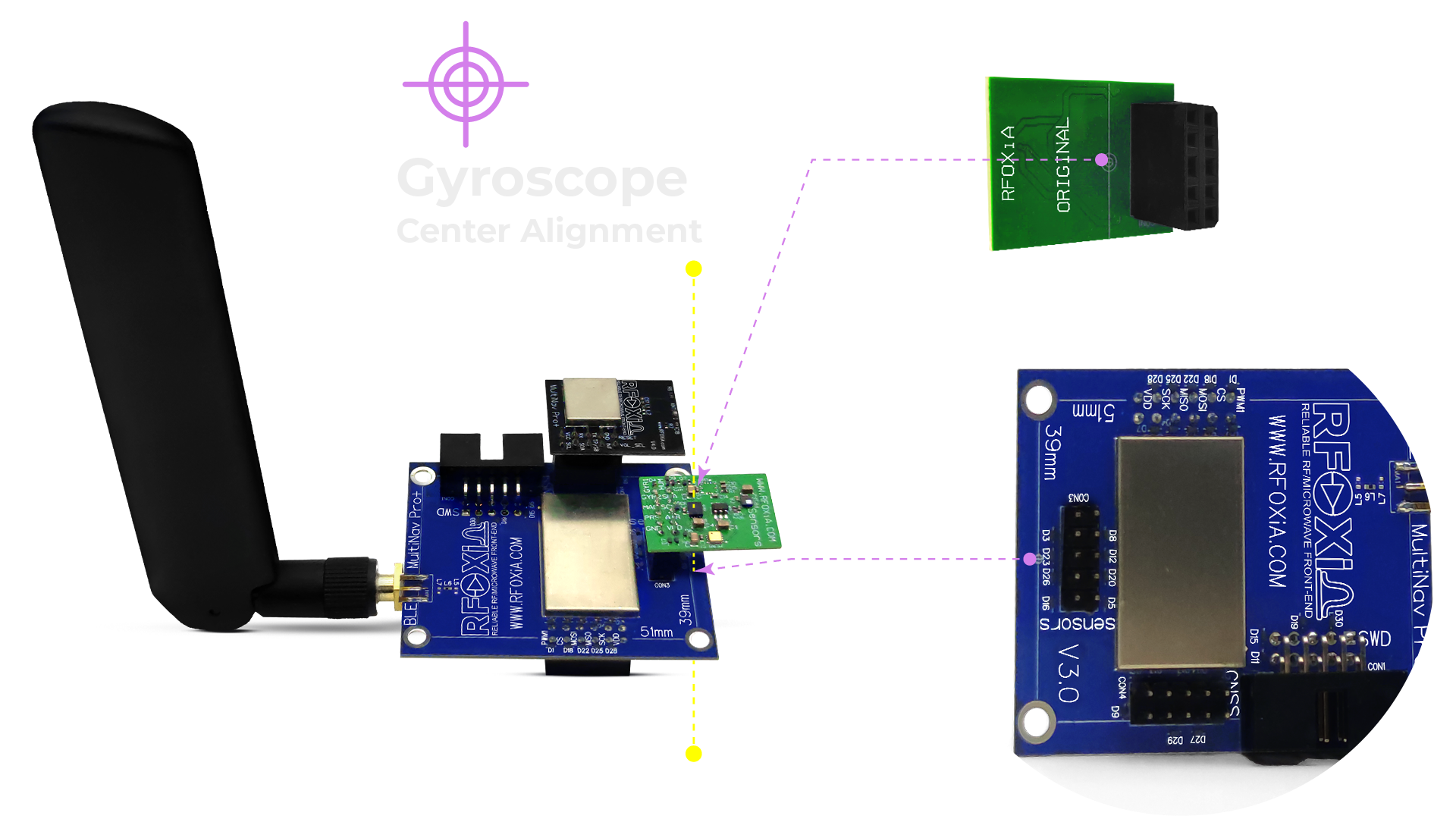
This is why combining motion and environmental sensing in a single integrated module is not just a convenience — it is a fundamentally better architecture for serious applications.
The Hardware Behind the Module
Let us be specific about what is on this board, because the sensor choices matter. Budget sensor modules often use generic Chinese-manufactured sensors with no publicly available datasheet, inconsistent factory calibration, and short operational lifespans.
The MultiNav Pro+™ Sensors Module uses exclusively components from Bosch Sensortec, Texas Instruments, STMicroelectronics, MEMSVision, and RENESAS — semiconductor companies whose sensors are used in aerospace, automotive, and industrial applications globally.
| Function | Component | Manufacturer |
|---|---|---|
| Accelerometer + Gyroscope | BMI270 | Bosch Sensortec |
| Magnetometer | TMAG5273C1QDBVR | Texas Instruments |
| Air Pressure | LPS22HHTR | STMicroelectronics |
| Humidity + Temperature | MVH4003D | MEMSVision |
| Air Quality | ZMOD4510AI4R | RENESAS |
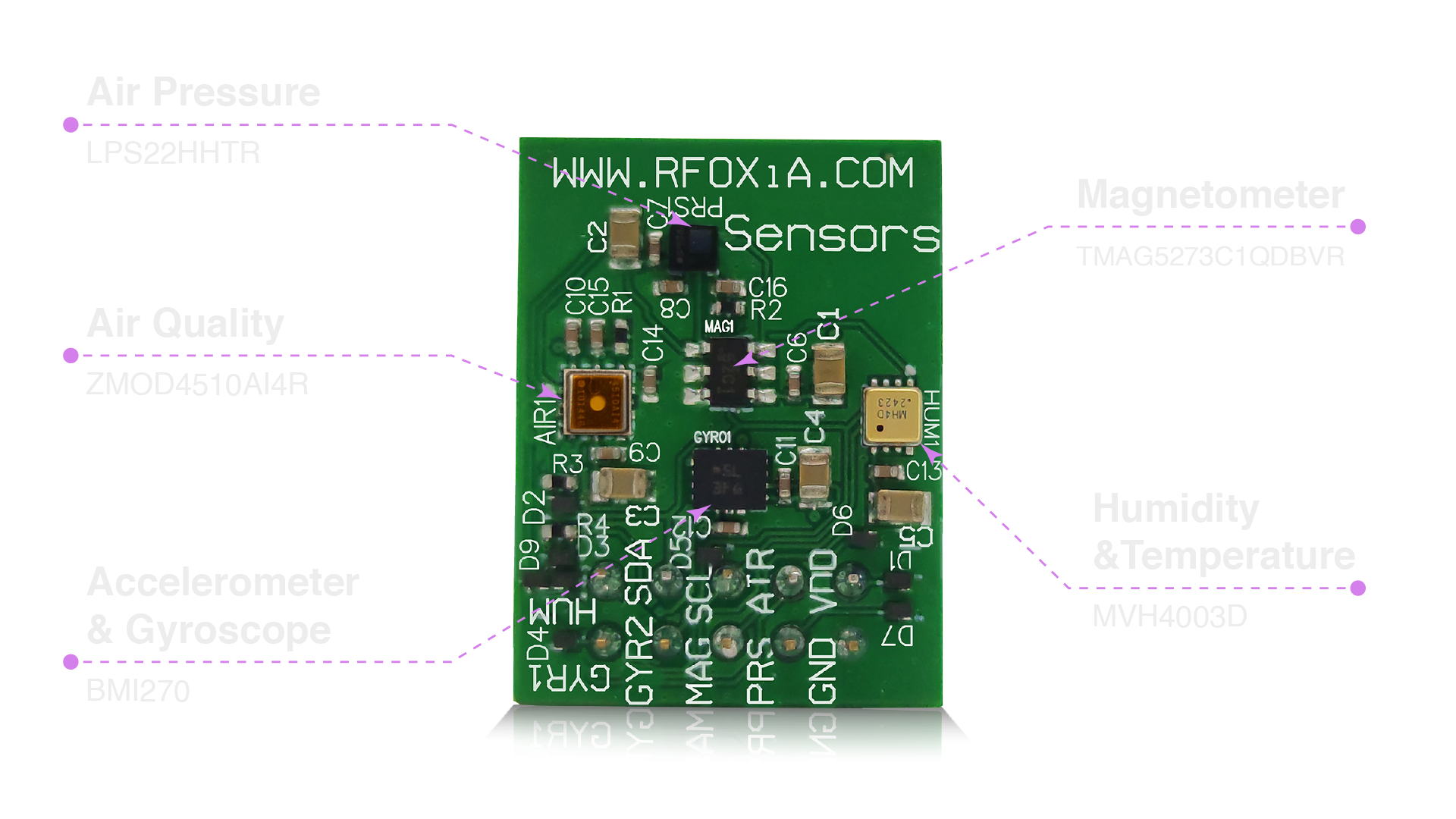
Each of these components is production-grade, with publicly available datasheets, application notes, and driver libraries. Your firmware does not depend on reverse-engineered protocols or vendor lock-in.
Compact Design for Space-Constrained Applications
At 24mm × 18mm, the MultiNav Pro+™ Sensors Module fits comfortably in applications where every cubic millimeter counts.
For comparison:
- A standard Arduino Nano is 45mm × 18mm — the sensor module is smaller than your microcontroller
- Most FPV drone frames have 20mm × 20mm or 30mm × 30mm stack mounting — the module fits either
- Wearable form factors typically require sub-25mm component widths — the module qualifies
This compact footprint is not achieved by compromising on components. It is achieved through professional PCB layout — the same discipline that RFOXiA applies across its entire hardware line.
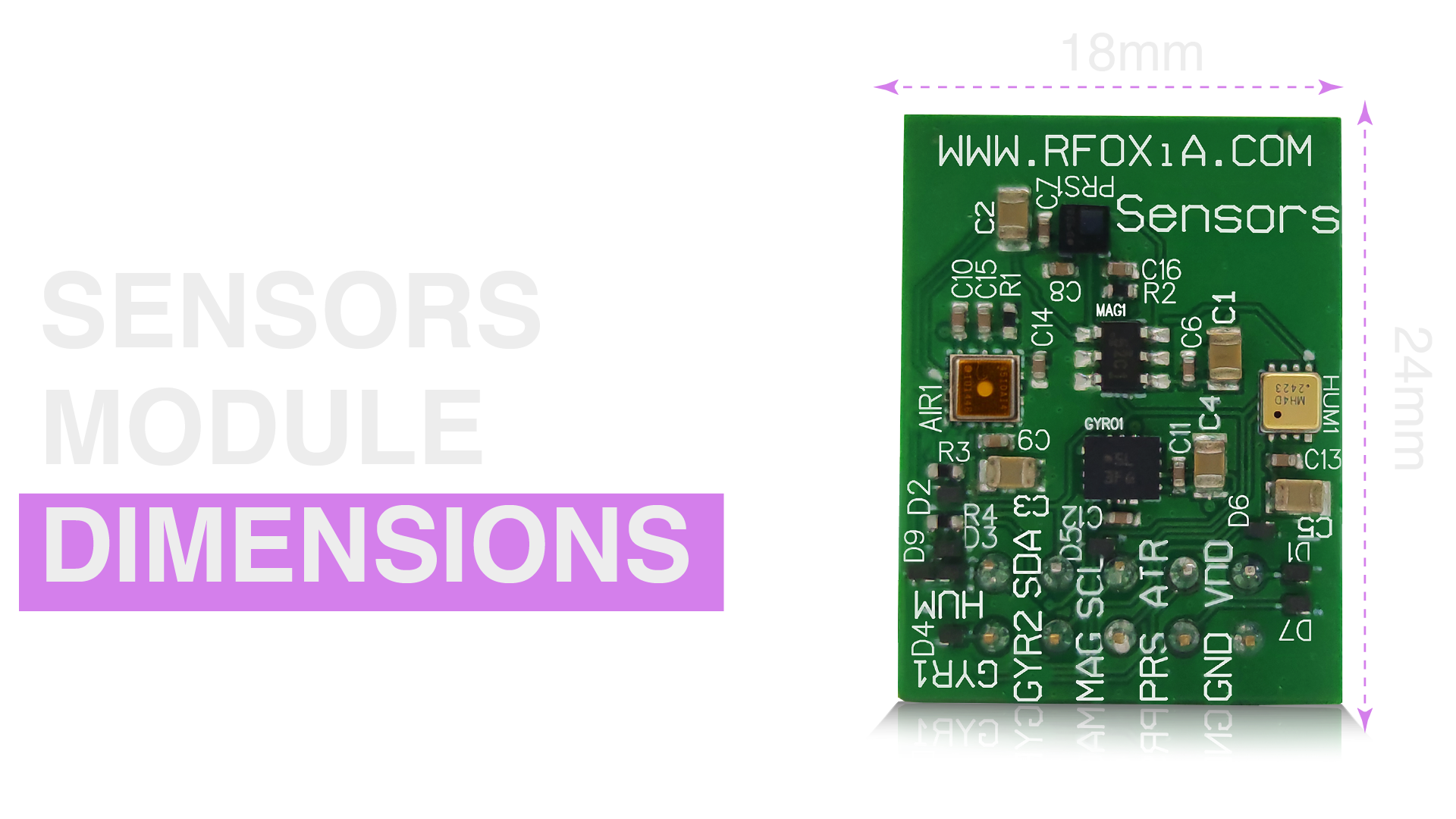
The module is also FCC certified — a critical qualification for anyone planning to deploy in commercial, research, or regulated contexts. FCC certification means the module has been tested for electromagnetic compliance and will not interfere with other electronics in your system or on your platform.
Real-Time Environmental Data: What You Can Do With It
Understanding how to monitor air quality DIY is only the beginning. The more interesting question is: what do you do with that data once you have it?
Option 1: Local Display and Alerting
The simplest integration — pipe sensor data to a local OLED display, log to SD card, and trigger alerts when readings exceed thresholds. This is appropriate for fixed monitoring stations and indoor air quality projects.
Option 2: Wireless Telemetry
Pair the Sensors Module with the RFOXiA BLE Module for wireless data transmission at ranges up to 5km ground-to-ground or 15-20km when one module is airborne. Your ground station receives a continuous stream of environmental data from a drone or remote field unit in real time — without any internet infrastructure.
Option 3: Cloud Logging and Visualization
Connect through your gateway of choice (ESP32 Wi-Fi, cellular modem, or the RFOXiA platform) to log data to cloud dashboards. The RFOXiA Club platform includes a live data visualization interface that displays streaming sensor data with time-series graphs and map overlays.
Option 4: Contribute to the RFOXiA Data Network
This is where the project gets genuinely interesting. RFOXiA operates a distributed data network that aggregates verified hyper-local environmental data from deployed Sensors Modules around the world. When you deploy your module outdoors with GNSS validation and stream verified data — all five data points, with GPS confirming outdoor placement — you earn daily rewards ranging from $0.08 to $0.40 per day depending on your location's data scarcity and your network tier.
Enterprise buyers — agricultural technology companies, smart city operators, insurance companies, logistics firms, and climate researchers — pay for this data because it offers second-level temporal resolution and street-level geographic resolution that no public weather API can match.
Your DIY air quality monitor becomes a node in a globally valuable sensor network. Your sensor works while you sleep.
To get started with your own sensor deployment and connect to the RFOXiA Integrated Sensors Module ecosystem, visit the RFOXiA Club where you can access documentation, firmware examples, and the data network enrollment flow.
Step-by-Step: How to Monitor Air Quality DIY With the MultiNav Pro+™ Sensors Module
Here is a practical quick-start sequence for getting your environmental monitoring system up and running.
Step 1: Connect the Module
Connect SDA, SCL, VCC (3.3V), and GND to your microcontroller. For STM32-based platforms, the RFOXiA AI Firmware Builder in the Dev Hub can generate complete initialization and polling firmware for all seven sensors from a plain-language description of your application.
Step 2: Initialize Each Sensor
Each sensor has its own I2C address and initialization sequence. In a typical firmware flow:
// Initialize all sensors at startup
bmi270_init(&imu_dev);          // Accelerometer + Gyroscope
tmag5273_init(&mag_dev);        // Magnetometer
lps22hh_init(&pressure_dev);   // Air Pressure
mvh4003d_init(&humidity_dev);  // Temperature + Humidity
zmod4510_init(&aq_dev);         // Air Quality
Because all sensors share the I2C bus but have unique addresses, initialization is sequential and non-conflicting.
Step 3: Poll and Log Data
Set your polling interval based on application requirements. For drone telemetry, 50-100Hz on the IMU and 1-10Hz on environmental sensors is typical. For fixed monitoring stations, 0.1-1Hz environmental polling conserves power significantly.
Step 4: Validate and Transmit
For data network participation, the RFOXiA platform validates that all five environmental data points are present, that GPS confirms outdoor deployment, and that readings fall within physically plausible ranges. This prevents spoofed data from degrading the network's value to enterprise buyers.
Step 5: Monitor and Iterate
Use the RFOXiA Club Command Center to view your live data stream, verify data completeness, and track your earnings from the data network.
Endless Applications: What Builders Are Actually Doing With This
The MultiNav Pro+™ Sensors Module is not a single-use product. The combination of environmental sensing, precision motion tracking, and ecosystem integration opens the door to an unusually wide range of applications.

Here is a sampling of what is actually being built:
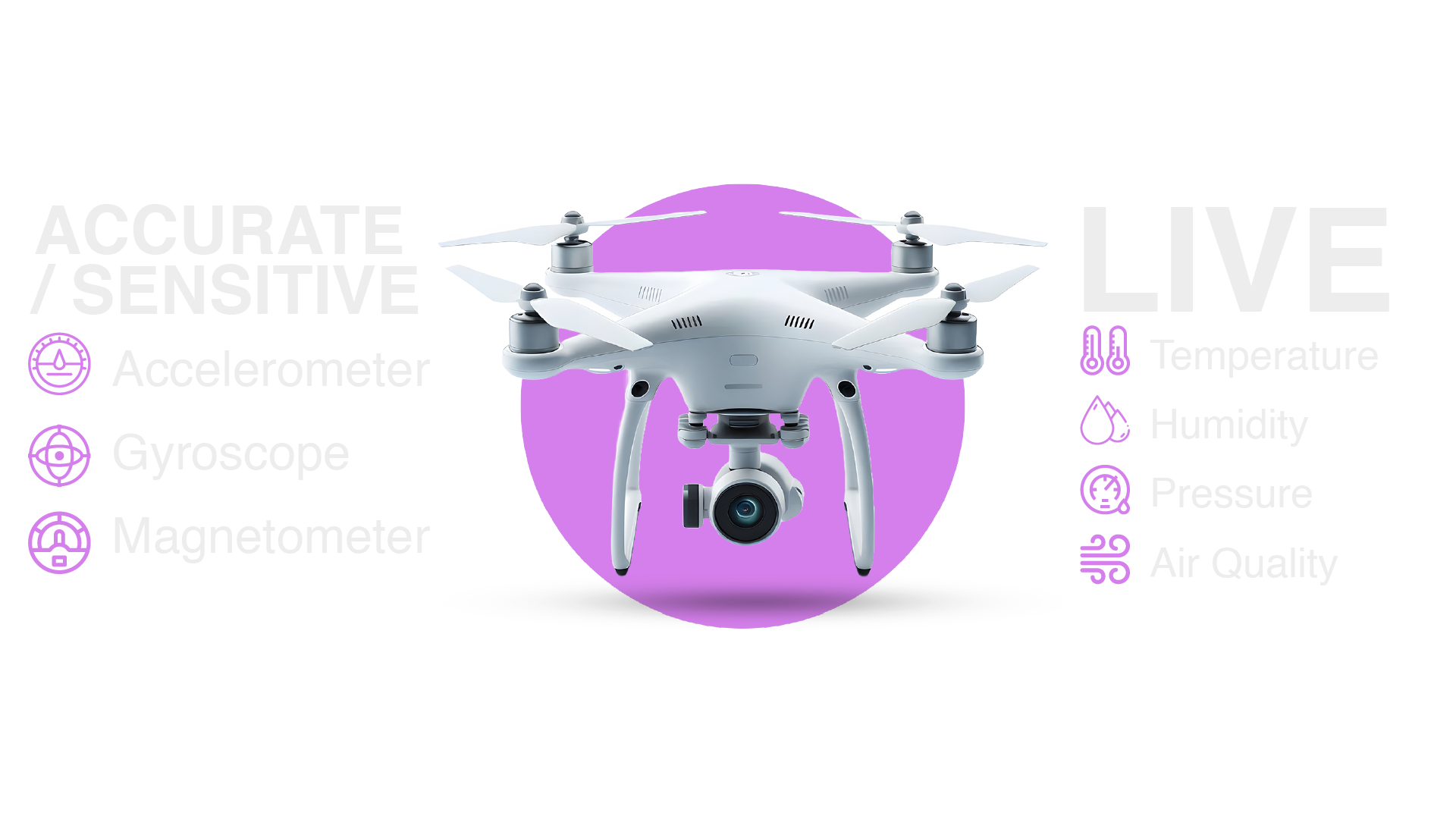
Drone-based environmental surveys — Mapping air quality, temperature gradients, and pressure profiles across agricultural land or urban areas. The 9-DOF IMU enables attitude-corrected sensor readings and precise flight logging.
Smart agricultural stations — Fixed nodes deployed across fields to monitor micro-climate variation. Temperature and humidity gradients across a farm can predict disease pressure, frost risk, and irrigation needs at a resolution no weather station provides.
Urban air quality networks — Community-owned monitoring grids that fill the gaps between official monitoring stations. With the data network, these deployments actually generate income for their operators.
Industrial facility monitoring — Continuous air quality monitoring in warehouses, manufacturing floors, and chemical processing facilities. The ZMOD4510 detects oxidizing gases that indicate solvent or chemical presence.
Robotics and autonomous vehicles — 9-DOF IMU integration enables attitude estimation, vibration analysis, and navigation assistance for ground robots operating in unstructured environments.
Research and education — Universities and research institutions deploying low-cost verified sensor networks for climate research, urban studies, and environmental science programs.
Why Choose an Integrated Module Over Building From Scratch
You could source the BMI270, TMAG5273, LPS22HH, MVH4003D, and ZMOD4510 individually, design a PCB, route I2C, handle decoupling, layout the antenna keep-outs, get the board manufactured, and assemble it. If you have the skills, this is a legitimate path.
But here is the honest accounting:
- Component sourcing: 5 sensors × research time + ordering from multiple distributors
- PCB design: 4-6 hours minimum for a clean 4-layer layout at this component density
- Manufacturing: MOQ at JLCPCB or PCBWay is typically 5-10 units minimum
- Debugging: I2C address conflicts, decoupling issues, and layout-induced noise are common first-revision problems
- FCC compliance: Your custom board is not FCC certified — deployment in commercial contexts requires testing
The RFOXiA Integrated Sensors Module costs $39, arrives FCC certified, fits on a 24mm × 18mm footprint, connects in four wires, and has firmware examples ready in the Dev Hub. For most builders, the economics are clear.
For builders who want to go deep on customization, the module is a proven reference design that tells you exactly which sensors work reliably together, at what power supply specs, on what I2C topology.
Integrating With the Full RFOXiA Ecosystem
The Sensors Module is designed to operate as part of the complete RFOXiA hardware ecosystem. When combined with:
- MultiNav Pro+™ BLE Module — stream environmental data wirelessly over 5km ground-to-ground or 15-20km to an airborne platform, without any internet infrastructure
- MultiNav Pro+™ GNSS Module — GPS-validate your sensor's outdoor deployment location for data network participation and geospatial data logging
- Power/Program Kit — power your complete sensor stack for 24 hours from a 5-minute supercapacitor charge, eliminating battery management headaches in field deployments
- RFOXiA Connect App — view live sensor data on your phone's map interface in real time, with no internet connection required
This combination — available as the Developer Bundle at $199 — is the only product on the market that integrates long-range wireless communication, precision GNSS, complete environmental and motion sensing, professional power management, mobile control, and a data monetization network in a single coherent ecosystem.
For builders who are serious about how to monitor air quality DIY at a professional level, and who want that monitoring capability to eventually pay for itself, the ecosystem approach is the most direct path from first sensor reading to deployed, earning network node.
Frequently Asked Questions
Q: What microcontrollers are compatible with the Sensors Module? A: Any microcontroller with I2C support — STM32, ESP32, Arduino (3.3V logic), Raspberry Pi, and Nordic nRF52 series all work. The RFOXiA firmware examples in the Dev Hub are primarily STM32-targeted, but the I2C protocol is universal.
Q: Does the module require any external components? A: No. Decoupling capacitors, pull-up resistors on SDA/SCL, and sensor-specific support components are all integrated on the module PCB. Connect power and I2C and you are reading data.
Q: Can I use just the air quality sensor and ignore the others? A: Absolutely. Each sensor has its own I2C address and can be initialized and queried independently. You only pay communication overhead for the sensors you choose to poll.
Q: Is the air quality reading a raw output or a processed index? A: The ZMOD4510 outputs raw ADC values that are processed through RENESAS's ZMOD AI libraries into a standardized air quality index and raw gas sensor resistance values. Both raw and processed outputs are available.
Q: Can this module be used outdoors continuously? A: The sensors are rated for extended operation, but the module PCB should be housed in an appropriate enclosure for outdoor long-term deployment. The ZMOD4510 is specifically designed for outdoor air quality monitoring.
Conclusion: Start Monitoring, Start Earning
Knowing how to monitor air quality DIY used to mean cobbling together mismatched sensors, fighting I2C address conflicts, and ending up with an uncertified board that could not leave your workbench. That is no longer the situation.
With the MultiNav Pro+™ Sensors Module, you get seven industrial-grade sensors from Bosch, Texas Instruments, STMicroelectronics, MEMSVision, and RENESAS — on a single FCC-certified 24mm × 18mm board, connected through a clean single-wire I2C bus, ready to integrate in minutes, and designed to operate as part of a complete wireless ecosystem that can transmit your data kilometers without a cell tower or Wi-Fi network in sight.
And when you connect that module to the RFOXiA data network, your DIY air quality monitor stops being just a project and starts being infrastructure — contributing verified hyper-local environmental data to enterprise buyers who will pay for it, daily, as long as your node stays online.
That is the vision behind RFOXiA: build something real, build it right, and let it work for you.
Explore the full specifications and order your module at the RFOXiA Integrated Sensors Module product page. Join RFOXiA Club for free and receive $10 in welcome credits toward your first order.
Written by: Moamen Mohamed LinkedIn