
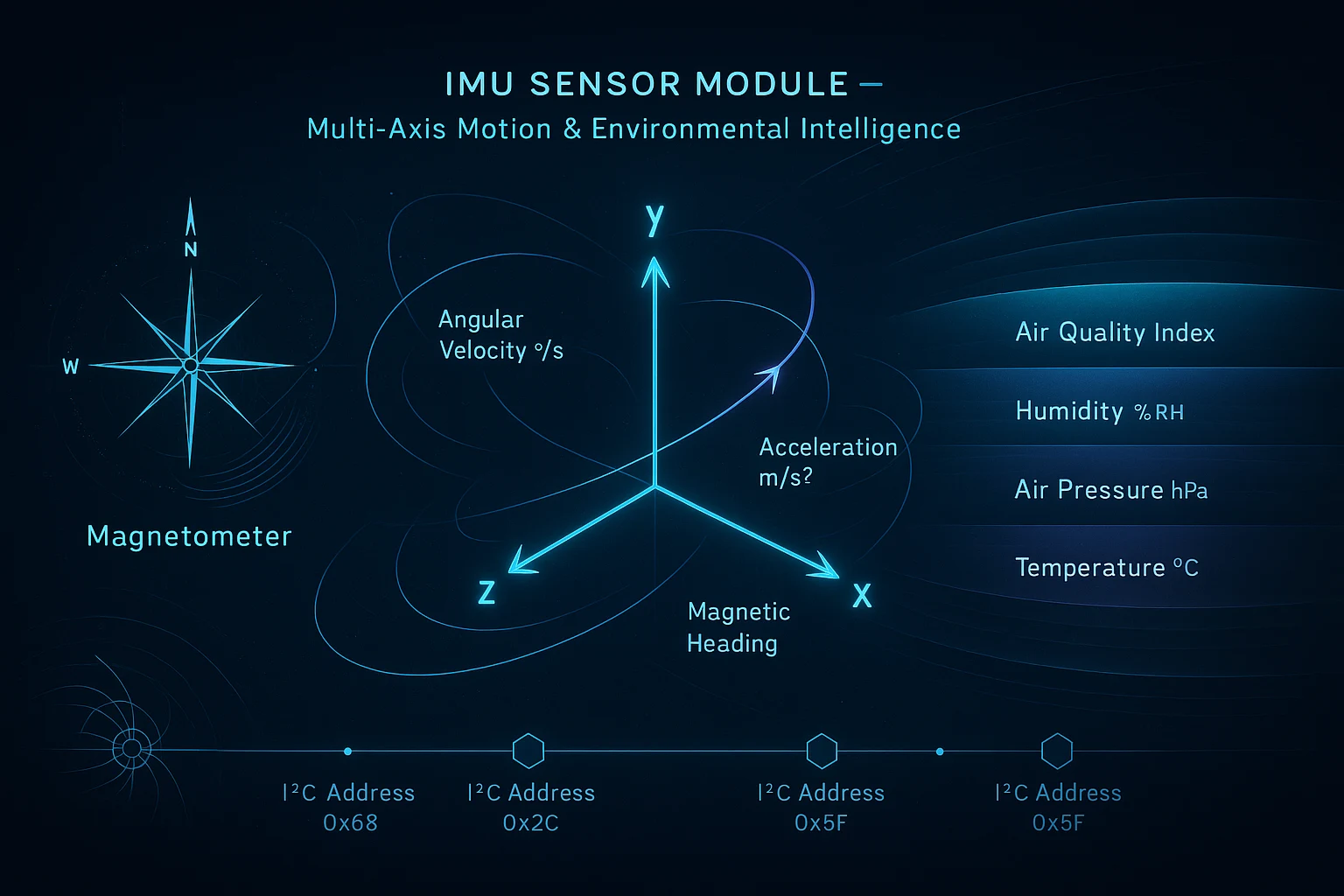
The Best IMU Sensor Module for Makers: Everything You Need in One Compact Board
RFOXiA Integrated Sensors Module
Why Every Serious Maker Needs an IMU Sensor Module Built for Real-World Demands
If you've ever tried to build a drone flight controller, a precision robot, an environmental monitoring station, or a wearable IoT device from scratch, you know the pain. You're sourcing an accelerometer from one vendor, a gyroscope from another, hunting down a magnetometer breakout board, then separately wiring up temperature, humidity, pressure, and air quality sensors — each on its own PCB, each demanding its own I2C address management, each adding weight, wiring complexity, and development time to your project.
The result? A tangled nest of wires, a prototype that barely fits the enclosure, and firmware that took three times longer to write than it should have.
The MultiNav Pro+™ Sensors Module from RFOXiA was built specifically to solve this problem. It is, without question, the most capable IMU sensor module for maker applications available at its price point — and it backs that claim with real engineering, real certifications, and real components from the world's most trusted sensor manufacturers.
In this deep-dive review, we're going to cover everything: what's inside the module, how those components perform, why the architecture matters, what applications this sensor array genuinely unlocks, and how it fits into the broader RFOXiA wireless ecosystem. Whether you're a drone builder, a robotics engineer, an environmental researcher, or an IoT developer building something new, this post will give you everything you need to know.
What Makes the MultiNav Pro+ the Right IMU Sensor Module for Makers?
Before we go component by component, let's zoom out. The phrase "IMU sensor module for maker" gets thrown around a lot in community forums and product listings. But most products that carry that label are incomplete. They give you motion sensing — accelerometer and gyroscope, maybe a magnetometer — and leave you to figure out environmental sensing separately.
The MultiNav Pro+ takes a different philosophy: complete sensing in one board.
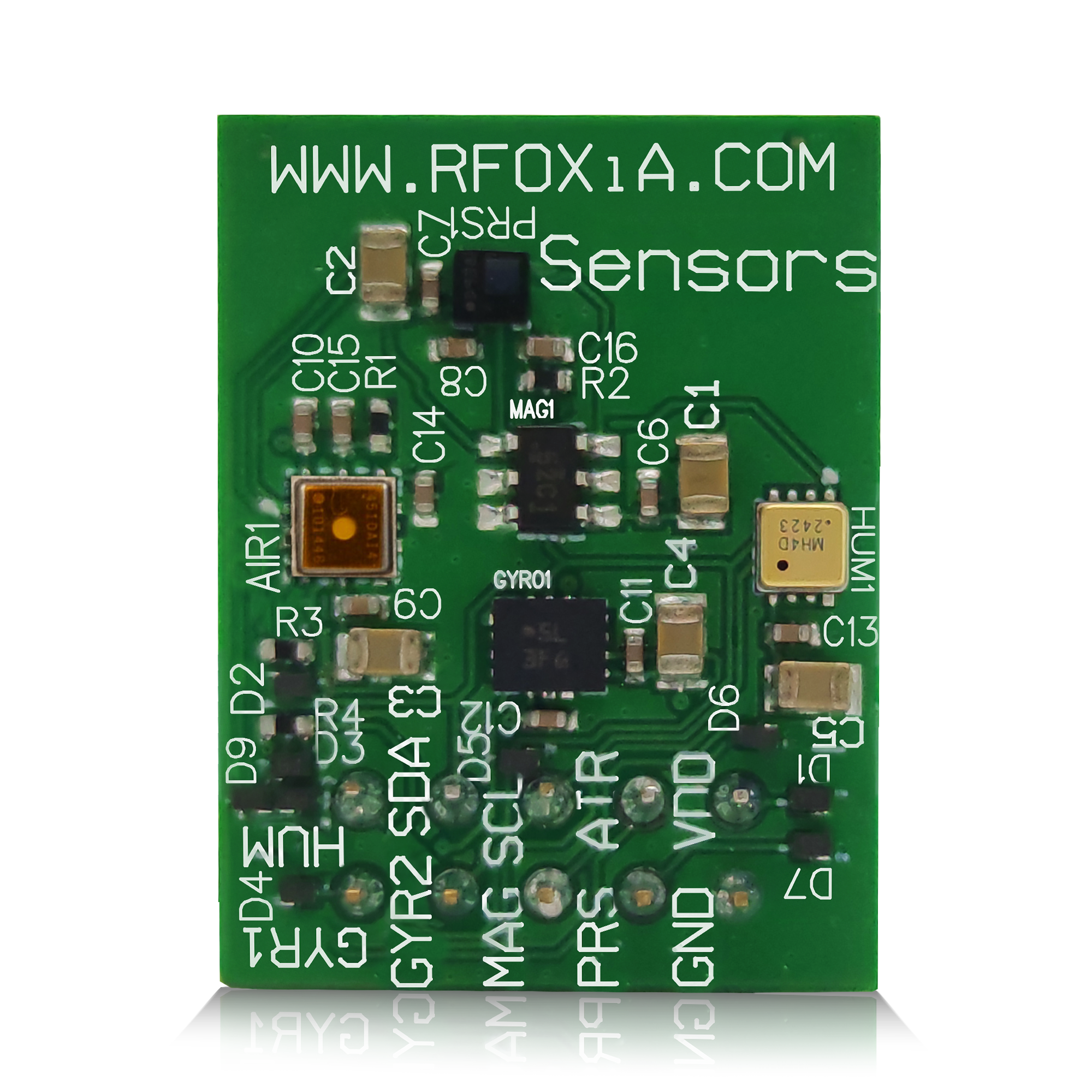
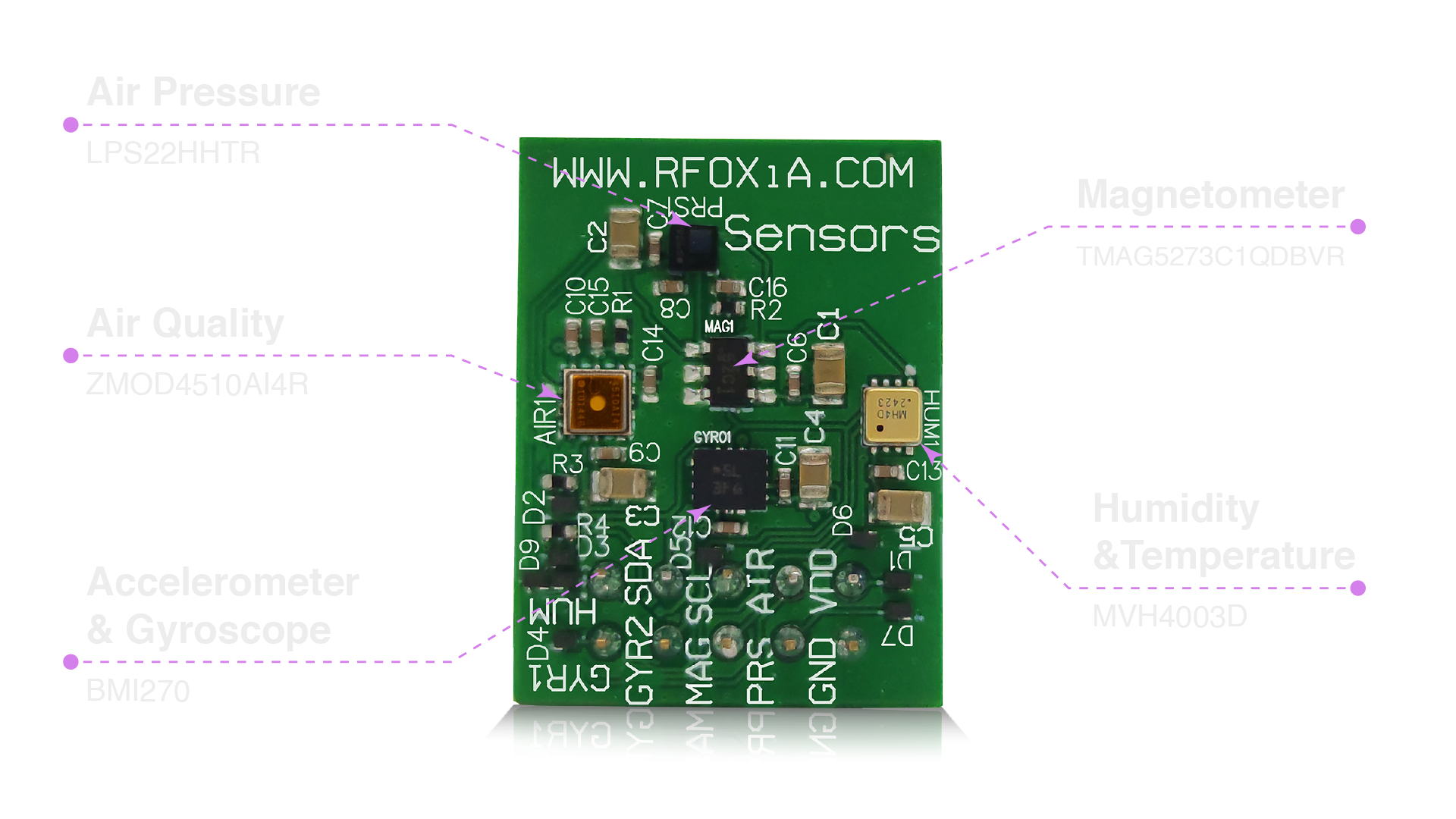
Seven sensors. One module. 24mm × 18mm footprint. Single I2C bus. One product purchase. One integration task.
Here's the full sensor manifest:
- Accelerometer & Gyroscope — BMI270 from Bosch Sensortec
- Magnetometer — TMAG5273C1QDBVR from Texas Instruments
- Air Pressure — LPS22HHTR from STMicroelectronics
- Humidity & Temperature — MVH4003D from MEMSVision
- Air Quality — ZMOD4510AI4R from Renesas
These aren't generic no-name components. These are production-grade sensors from the industry's most respected manufacturers — the same parts used in professional instruments, automotive systems, and industrial IoT deployments. The fact that they're integrated together at a $39 price point, FCC certified, and ready to ship is genuinely remarkable.
The Seven Sensors: A Deep Technical Breakdown
1. BMI270 — Accelerometer & Gyroscope (Bosch Sensortec)
The BMI270 is not a beginner sensor. Bosch Sensortec developed it specifically for wearables and high-performance motion sensing applications where power efficiency and precision both matter. It delivers:
- 16-bit resolution on both accelerometer and gyroscope axes
- Ultra-low noise density
- Integrated step counter and activity recognition
- Advanced interrupt engine for gesture detection
- Power modes that scale from always-on low-power to full-performance burst modes
For drone builders, the BMI270's fast response time and low noise floor mean your flight controller gets the clean, responsive data it needs for stable attitude estimation. For robotics, the combined accelerometer and gyroscope data enables dead-reckoning navigation, fall detection, vibration analysis, and precise orientation tracking.
This is the same class of IMU used in professional-grade flight controllers, not budget modules.
2. TMAG5273C1QDBVR — Magnetometer (Texas Instruments)
A magnetometer completes your orientation solution by giving you absolute heading — essential for any application that needs to know which direction it's pointing in the real world. The TMAG5273 from Texas Instruments is a Hall-effect sensor designed for precision magnetic field measurement across three axes.
For drone operators, this means reliable compass functionality that integrates with GPS for autonomous flight. For robotics, it means accurate heading for navigation algorithms. For researchers, it means magnetic anomaly detection and field mapping capability.
Paired with the BMI270, you have a complete 9-DOF (degrees of freedom) IMU in a single module — the foundation of any serious orientation and navigation system.
3. LPS22HHTR — Barometric Pressure Sensor (STMicroelectronics)
STMicroelectronics built the LPS22HH for applications that demand both precision and speed. Key specifications include:
- Pressure range: 260 to 1260 hPa
- Absolute accuracy: ±0.5 hPa
- Output data rate: up to 200 Hz
- Embedded temperature compensation
For drone pilots, barometric pressure translates directly to altitude holding — the LPS22HH's high output rate means your altitude controller gets fast, fresh data for responsive height stabilization. For weather station builders and environmental monitors, the precision ensures your readings are scientifically meaningful.
4. MVH4003D — Humidity & Temperature Sensor (MEMSVision)
MEMSVision's MVH4003D delivers capacitive humidity sensing alongside precision temperature measurement in a minimal footprint. Environmental context — knowing the temperature and relative humidity of the deployment environment — matters in almost every serious IoT application:
- Agricultural systems need to track crop microclimate conditions
- Industrial deployments need to monitor conditions that affect equipment performance
- Smart building systems use this data for HVAC optimization
- Researchers collecting longitudinal environmental data need reliable, drift-stable sensors
The MVH4003D provides the stable, accurate environmental baseline that makes sensor data scientifically valid rather than directionally approximate.
5. ZMOD4510AI4R — Air Quality Sensor (Renesas)
This is where the MultiNav Pro+ goes beyond what any standard IMU module offers. The ZMOD4510 from Renesas is a metal oxide semiconductor gas sensor designed for outdoor air quality monitoring. It measures ozone (O₃) and nitrogen dioxide (NO₂) — the key pollutants in outdoor urban and agricultural environments.
For the RFOXiA data network (more on this below), air quality data is one of the five verified data points that qualifies a sensor node for daily rewards. For environmental researchers and smart city developers, having a calibrated outdoor air quality sensor integrated into the same compact board as motion and environmental sensors opens up deployment scenarios that simply weren't accessible before at this price point.
Precision Motion and Environmental Sensing: Why Both Matter Together
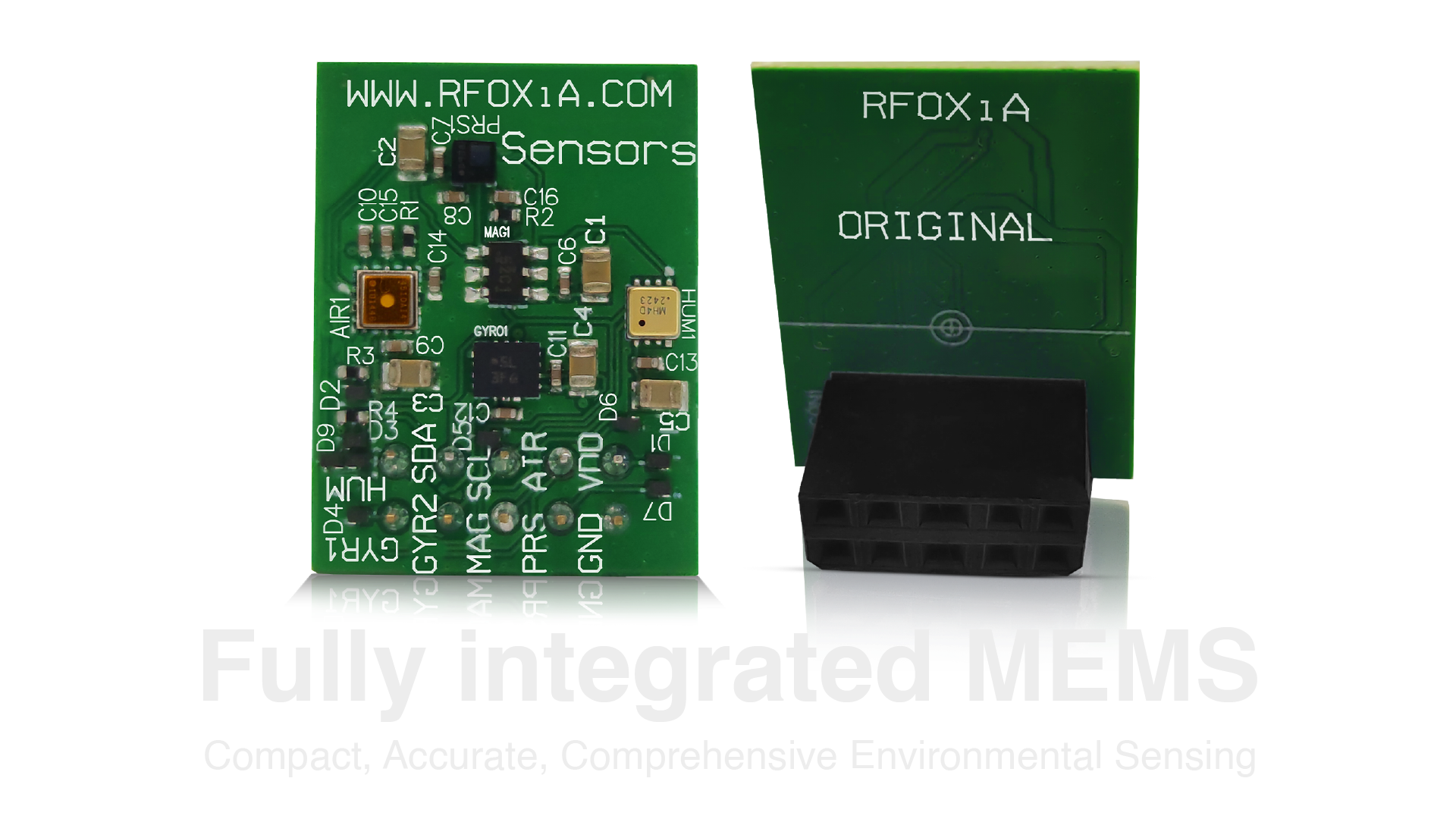
Most maker sensor modules force you to choose: either you get great motion sensing or you get environmental sensing. The MultiNav Pro+ refuses that compromise.
Consider a real-world deployment scenario: you're building an autonomous agricultural drone that needs to maintain precise altitude over crop rows while simultaneously logging micro-climate data — temperature, humidity, pressure, and air quality — at each GPS waypoint. With conventional modules, this requires sourcing, wiring, and integrating at least four separate boards. With the MultiNav Pro+, all of that capability is present on a single 24mm × 18mm PCB.
Or consider a ground-based environmental monitoring node: the accelerometer and gyroscope can detect physical tampering or vibration events, while the environmental sensors are collecting the primary dataset. One module handles both the physical security sensing and the primary data collection function simultaneously.
This dual capability — precision motion sensing alongside precision environmental sensing — is the architectural decision that makes the MultiNav Pro+ genuinely different from everything else in the maker sensor space.
The Component Quality Advantage: Why Sensor Manufacturer Choice Matters
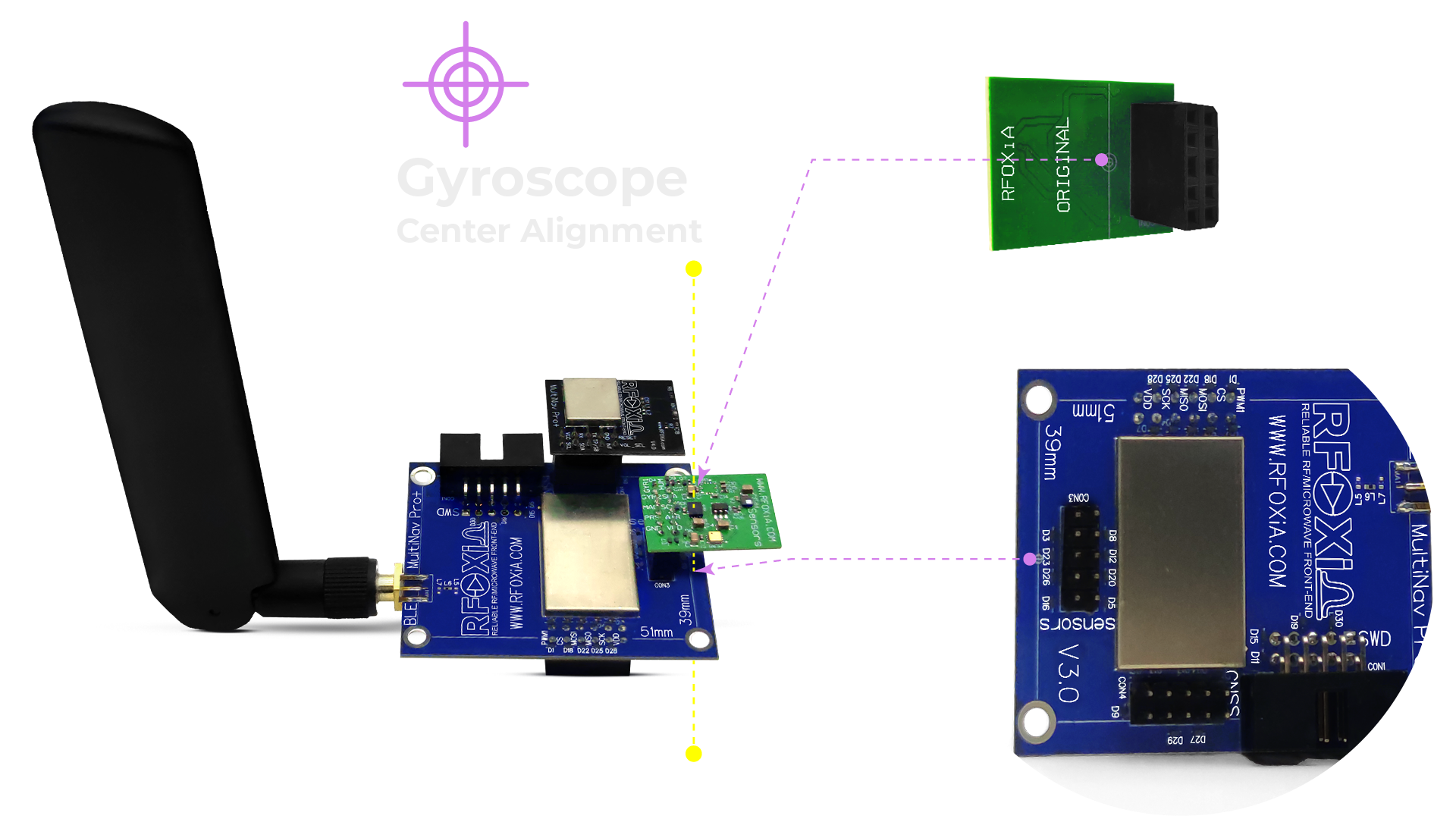
When you're evaluating an IMU sensor module for maker projects, it's tempting to focus only on the headline specs. But component quality — specifically, the manufacturer behind each sensor — determines how that module performs in production conditions: temperature extremes, vibration, long-term drift, and reliability over thousands of hours of operation.
The MultiNav Pro+ draws exclusively from manufacturers with demonstrated track records in demanding industrial and automotive applications:
- Bosch Sensortec is the standard-setter for MEMS motion sensors, with their IMUs used in everything from smartphones to automotive safety systems.
- Texas Instruments needs no introduction in precision analog and sensing — the TMAG5273 carries all of TI's quality manufacturing heritage.
- STMicroelectronics is one of the world's largest semiconductor manufacturers, and the LPS22HH is used in professional weather instruments globally.
- MEMSVision specializes in humidity and temperature sensors for demanding industrial environments.
- Renesas is a global leader in embedded and sensing semiconductor solutions, with the ZMOD4510 specifically engineered for outdoor environmental deployment.
For makers building professional-grade systems, this component provenance matters. You're not gambling on unverified generic components — you're integrating known, documented, supported sensors with published performance data and long-term supply chain stability.
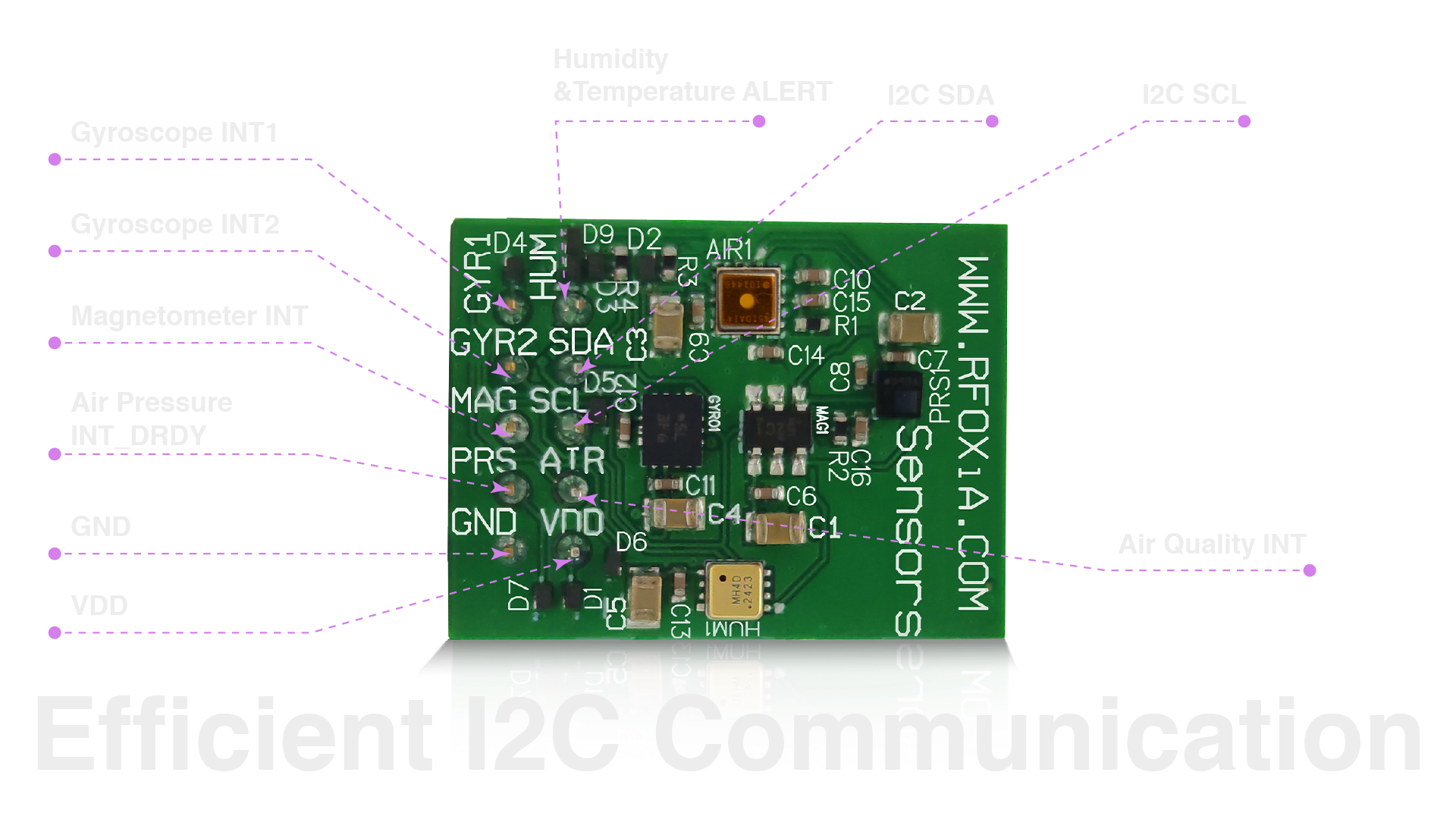
I2C Architecture: Why Shared Bus Design Is the Right Engineering Decision
One of the cleanest engineering decisions in the MultiNav Pro+ is its I2C bus architecture. All seven sensors share a single I2C line, each assigned a unique device address. This means:
For your hardware: One data line, one clock line. Two GPIO pins on your microcontroller handle all seven sensors. No SPI buses, no additional chip selects, no GPIO expanders, no level shifters for multiple protocol types.
For your firmware: Standard I2C library calls to sequential device addresses. The AI Firmware Builder in RFOXiA Club can generate complete, production-ready firmware for this module in minutes — you describe your application, and it generates the I2C initialization sequence, sensor read functions, and data processing pipeline for all seven sensors simultaneously.
For your PCB: Two traces from your processor to the module header. Simpler routing, cleaner signal integrity, fewer opportunities for noise coupling.
For reliability: I2C's acknowledged protocol means every read operation is verified. Bus errors are detectable. Data integrity is maintained even in electrically noisy environments like drone frames.
This is a considered, professional architecture decision — not an accidental byproduct of component selection. It's what separates a thoughtfully designed IMU sensor module for maker use from a collection of sensors dumped onto a breakout board.
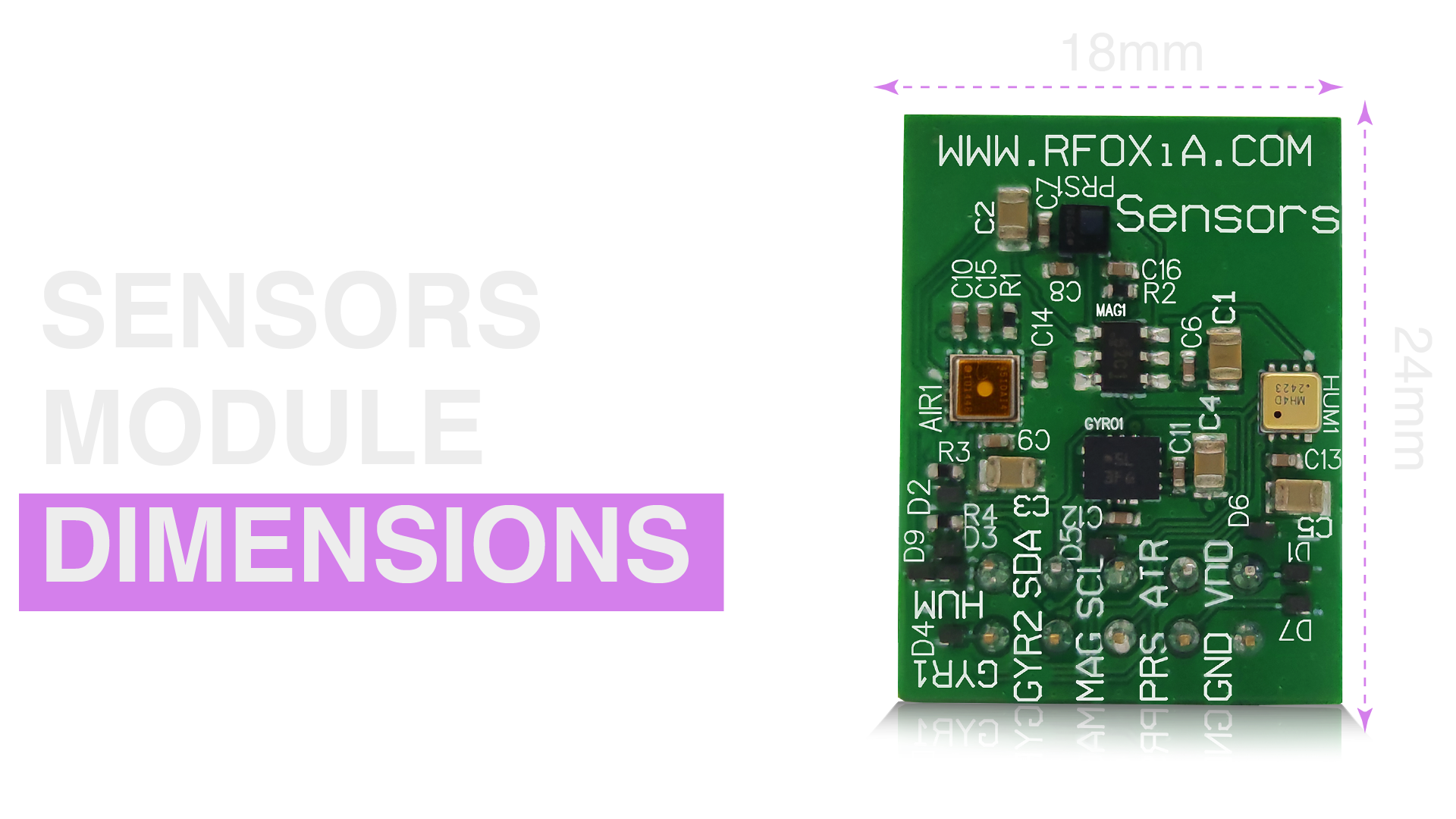
The 24mm × 18mm Compact Form Factor: Why Size Is a Feature
At 24mm wide and 18mm long, the MultiNav Pro+ Sensors Module occupies roughly the same footprint as a large postage stamp. This isn't accidental — it's the result of careful component selection and PCB layout optimization.
For drone builders working within tight weight and volume budgets, this footprint means the sensor array can be integrated without sacrificing payload capacity or forcing awkward frame modifications. For wearable device developers, the small size enables body-worn deployments. For compact IoT nodes designed for permanent installation in infrastructure, the small footprint means the entire sensing package disappears inside the enclosure.
Contrast this with building equivalent capability from seven separate breakout boards: you'd be looking at approximately 5-7x the board area, several times the wiring harness weight, and significantly increased assembly time on every unit you build.
The compact design is not a limitation — it's the point. Professional hardware is dense hardware.
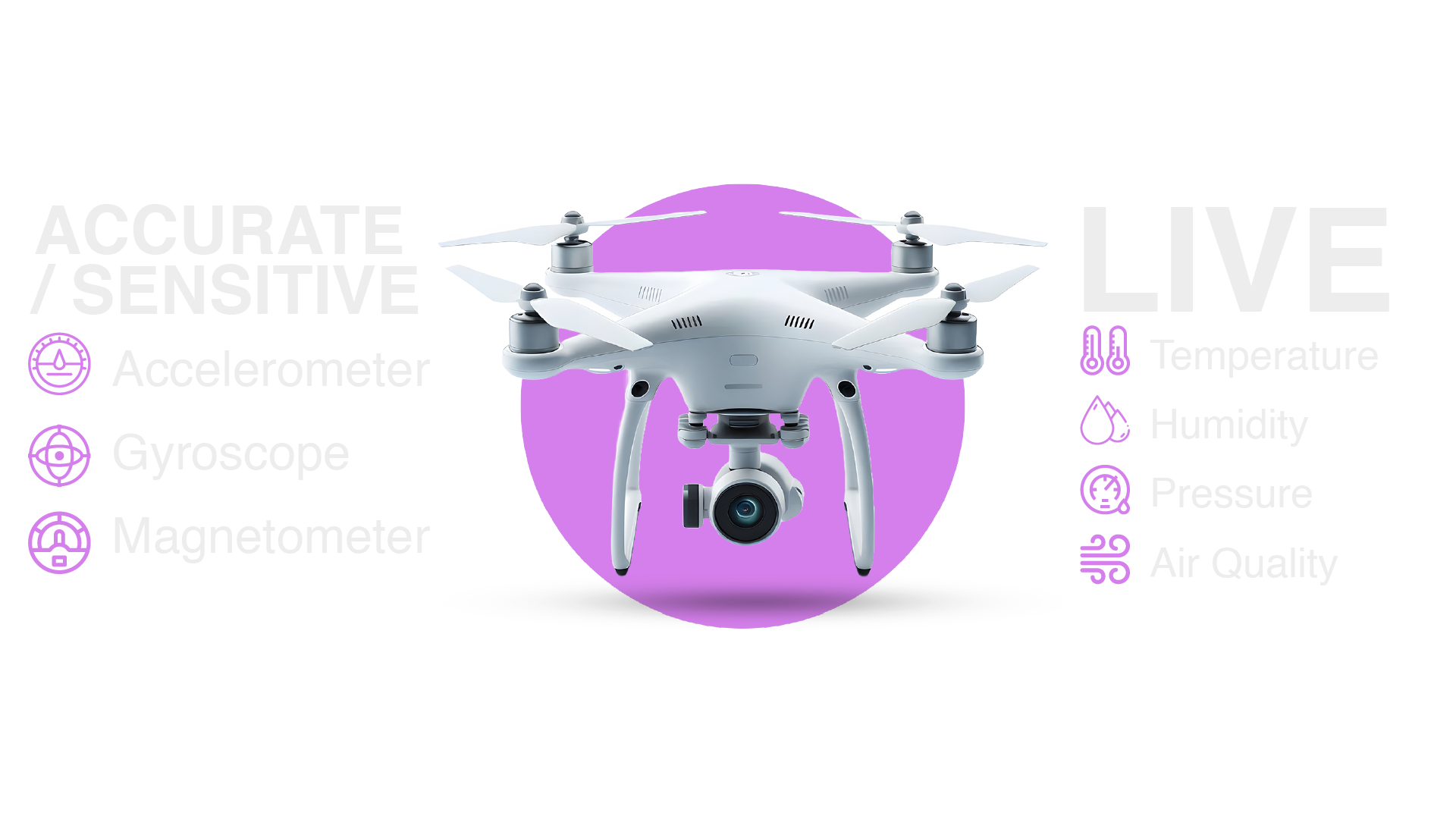
Real-Time Environmental Data: What It Enables
The MultiNav Pro+ isn't just a passive sensor array — it's a live data engine. When connected to the RFOXiA Connect app or a custom firmware application built with the AI Firmware Builder, the module streams all seven sensor channels in real time.
This enables a class of applications that traditional static sensing cannot support:
Dynamic environmental compensation: Your drone's flight controller reads live temperature and pressure data and adjusts motor thrust calculations in real time to compensate for air density changes. This is how professional commercial drones maintain consistent behavior across altitudes and weather conditions.
Live environmental mapping: As your drone or ground vehicle traverses a route, every GPS coordinate gets stamped with a complete environmental snapshot — temperature, humidity, pressure, air quality index, and orientation. The result is a spatially resolved environmental map, not just a point measurement.
Anomaly detection: Your IoT node's accelerometer detects a vibration signature consistent with nearby industrial machinery. Your firmware flags the event, timestamps it, and logs the concurrent environmental data. Cause-and-effect relationships become visible.
RFOXiA Data Network participation: When the Sensors Module is deployed outdoors with GPS validation via the GNSS Module, it contributes verified environmental data to the RFOXiA data network — earning daily rewards while collecting data. This is the passive income model that makes hardware pay for itself.
Learn more about the RFOXiA Integrated Sensors Module and how it integrates with the full RFOXiA data network and wireless ecosystem.
Application Showcase: What You Can Actually Build
The best test of any IMU sensor module for maker projects is the range and sophistication of the applications it enables. Here's a realistic cross-section of what the MultiNav Pro+ unlocks:
Drone and Aerial Applications
- Autonomous flight stabilization — 9-DOF IMU (accelerometer + gyroscope + magnetometer) provides full attitude estimation for flight controller integration
- Altitude hold — barometric pressure sensor feeds precise altitude data to the flight controller
- Environmental data collection — simultaneous logging of temperature, humidity, pressure, and air quality at each waypoint
- Drone-to-ground telemetry — paired with the BLE Module (5km ground-to-ground, 15-20km man-to-drone range), all sensor data streams live to the RFOXiA Connect app
Robotics and Ground Vehicles
- Dead-reckoning navigation — accelerometer + gyroscope integration provides position estimation between GPS fixes
- Heading and orientation — magnetometer provides compass heading for navigation algorithms
- Fall and tip detection — accelerometer interrupt triggers protective response if vehicle tips or falls
- Environmental awareness — pressure and temperature data can inform terrain-adaptive behaviors
Environmental Monitoring
- Distributed sensor networks — deploy multiple MultiNav Pro+ nodes across a field, forest, or urban area for high-resolution environmental mapping
- Air quality monitoring stations — the ZMOD4510 provides outdoor-calibrated ozone and NOₓ sensing
- Agricultural microclimate monitoring — temperature, humidity, and pressure data at crop level, not weather station level
- Research data collection — all seven channels simultaneously, timestamped and GPS-validated
Wearable and Personal Devices
- Activity tracking — BMI270's integrated step counter and activity recognition features
- Personal environmental monitoring — carry your own air quality and weather sensor everywhere
- Navigation aids — 9-DOF heading and orientation for heads-up display or AR applications
Smart Infrastructure
- Building environmental monitoring — temperature, humidity, and air quality for HVAC optimization and occupant health
- Structural monitoring — accelerometer for vibration analysis and anomaly detection
- Weather station networks — street-level resolution environmental data that feeds the RFOXiA data marketplace

The RFOXiA Ecosystem: Why the Sensors Module Is More Powerful Inside It
The MultiNav Pro+ Sensors Module is a capable standalone product. But it reaches its full potential as part of the complete RFOXiA wireless development ecosystem.
Paired with the BLE Module
The RFOXiA BLE Module achieves 5km ground-to-ground range, 15-20km man-to-drone range, and 50km drone-to-drone range — at $59 for two units. When the Sensors Module is deployed on a drone or remote node with the BLE Module as its communication link, you get live seven-channel sensor telemetry streaming over that extraordinary range. No Wi-Fi. No cellular. No infrastructure.
Paired with the GNSS Module
The GNSS Module delivers 1.5-meter accuracy at an 18Hz fix rate — fast enough to track drones and other high-speed platforms precisely. Paired with the Sensors Module, every sensor reading gets a precise GPS coordinate. This is the spatial dimension that transforms sensor data into environmental maps.
Powered by the Power/Program Kit
The Power/Program Kit uses supercapacitor technology to deliver 24 hours of runtime from a 5-minute charge. For field-deployed sensor nodes, this eliminates battery anxiety entirely. Deploy your node, charge it in five minutes at the end of the day, and it's ready for another 24-hour session.
Controlled via RFOXiA Connect
The RFOXiA Connect app for iOS and Android displays live sensor data from the Sensors Module on an intuitive dashboard — temperature, humidity, pressure, air quality, and orientation — alongside GPS tracking on a live map. No internet connection required. Everything works peer-to-peer over the BLE Module link.
Built Faster with AI Firmware
RFOXiA Club's AI Firmware Builder means you don't spend weeks writing I2C drivers for seven sensors from scratch. Describe your application in plain language, and the AI generates production-ready firmware with full source code in minutes. This is what democratizing connectivity really means in practice.
FCC Certification: The Credential That Matters for Professional Deployment
The MultiNav Pro+ Sensors Module carries FCC certification. For many makers, this may seem like a compliance checkbox — but it's actually a significant product distinction.
FCC certification means:
- The module has been independently tested and verified to meet US electromagnetic compatibility requirements
- It can be legally integrated into products sold in the US market
- Distributors like DigiKey, Mouser, and similar professional channels require it
- Enterprise buyers and institutional customers require it for procurement approval
- It validates that RFOXiA operates as a professional hardware company, not a prototype shop
For the maker building a one-off personal project, this matters less. For the maker who is building a product to sell, spinning out a startup, or deploying nodes at scale for enterprise clients, FCC certification is non-negotiable. The MultiNav Pro+ has it.
Pricing and Value Analysis
At $39, the MultiNav Pro+ Sensors Module represents an extraordinary value proposition for the performance it delivers:
| What You Get | Market Alternative | Typical Cost |
|---|---|---|
| BMI270 breakout board | Generic Bosch IMU breakout | $12-18 |
| Magnetometer breakout | TI or Honeywell mag breakout | $10-15 |
| Barometric pressure breakout | BMP390 or LPS22 breakout | $8-12 |
| Humidity + temperature breakout | SHT30 or similar | $8-12 |
| Air quality breakout | SGP30 or similar | $15-20 |
| Total equivalent | Five separate boards | $53-77 |
| MultiNav Pro+ | One integrated board | $39 |
And that comparison doesn't account for the wiring harness, the I2C multiplexer you'd probably need, the extra PCB area, the additional weight, or the firmware integration time you'd spend getting five separate libraries working harmoniously.
The MultiNav Pro+ is not just cheaper — it's architecturally superior.
For makers ready to add even more capability, the complete Developer Bundle — BLE Module + GNSS Module + Sensors Module + Power/Program Kit — is available at $199 (after credits), making it the most cost-effective path to a fully integrated wireless development ecosystem in the maker market.
Explore the RFOXiA Integrated Sensors Module and the complete Developer Bundle at rfoxia.com
Who Should Buy the MultiNav Pro+ Sensors Module?
This is the right module if you are:
- A drone builder who needs an integrated IMU and environmental sensor stack for flight control and telemetry
- A robotics engineer who needs 9-DOF motion sensing plus environmental awareness in a compact form factor
- An IoT developer building environmental monitoring nodes and needs reliable, GPS-verifiable sensor data
- A researcher who needs multi-parameter environmental data collection with verified hardware components
- An agricultural technology developer building precision monitoring solutions for crop environments
- A smart city developer building distributed environmental sensor networks
- A maker who is tired of sourcing, wiring, and debugging five separate sensor boards for every new project
- Anyone who wants their hardware to earn daily rewards by contributing verified environmental data to the RFOXiA data network
Getting Started: Integration and Resources
RFOXiA has built the full support infrastructure to get you from unboxing to working firmware as fast as possible:
RFOXiA Club (free to join, $10 welcome credit) gives you access to the AI Firmware Builder, complete documentation for all seven sensors, example projects from the developer community, and live data visualization tools. Joining the Club is the fastest path to a working firmware application.
RFOXiA Connect App (available for Android, iOS pending) lets you see live data from your Sensors Module without writing a single line of firmware — essential for initial hardware validation and demos.
AI Firmware Builder — describe your specific application in plain language and receive complete, production-ready firmware covering all seven sensor channels. This alone eliminates weeks of development time from typical IoT projects.
Developer community — RFOXiA Club's Dev Hub features active discussion, shared projects, and direct access to the RFOXiA engineering team.
Final Assessment: The IMU Sensor Module for Makers That Actually Delivers
The IMU sensor module for maker market is full of compromises: limited sensor sets, generic components, no ecosystem support, or prices that make prototype-grade products inaccessible to independent developers.
The MultiNav Pro+ Sensors Module is a direct refusal of all those compromises. Seven sensors from industry-leading manufacturers. A professional I2C architecture that simplifies integration. A 24mm × 18mm compact footprint that fits anywhere. FCC certification that validates it for professional deployment. And a $39 price point that makes it the most accessible professional-grade sensor array on the market.
It works standalone. It becomes transformative when paired with the RFOXiA BLE Module, GNSS Module, and Power/Program Kit. And it earns daily rewards for its owner when deployed as a verified node in the RFOXiA environmental data network.
This is what professional hardware at maker-accessible prices actually looks like.
Get the MultiNav Pro+ Sensors Module at RFOXiA — $39, FCC certified, ready to ship.
Written by: Moamen Mohamed LinkedIn