
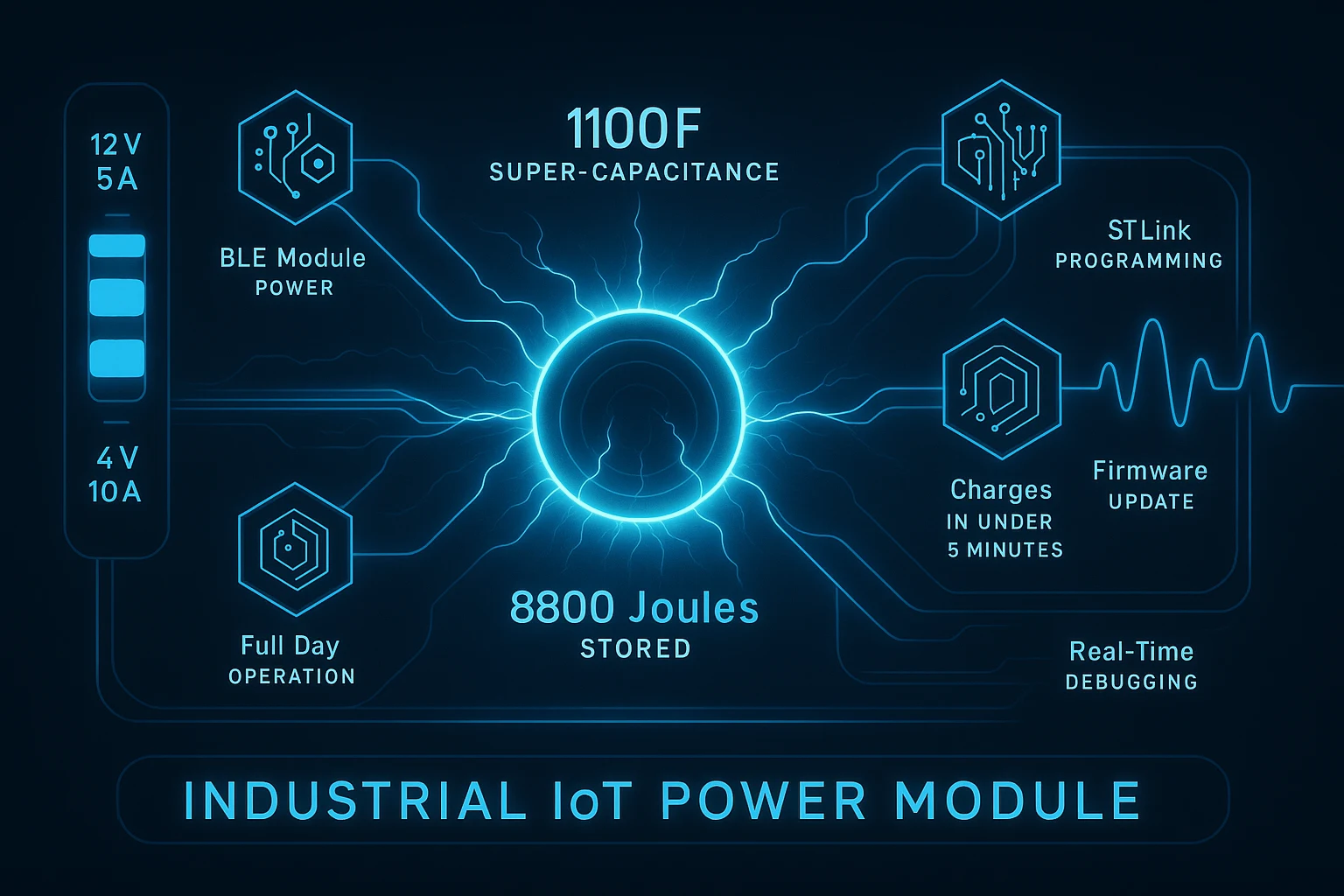
Industrial IoT Power Module That Charges in 5 Minutes and Runs All Day
RFOXiA SuperCapacitor Battery and Programmer Kit
The Industrial IoT Power Module Redefining Field Deployment for Serious Builders
Every hardware developer who has deployed a wireless system in the field knows the single most frustrating bottleneck is not the firmware, the RF design, or the enclosure. It is power. Batteries die. Charge cycles take hours. You are either hauling spare packs into the field or accepting downtime as an unavoidable part of your workflow. Neither option is acceptable when you are running a long-range drone link, a live environmental sensor node, or a precision GNSS tracker in a location where swapping power is not convenient.
RFOXiA built the MultiNav Pro+ Power/Program Kit to eliminate that problem entirely. This is not an incremental improvement on a standard LiPo pack. It is a fundamentally different approach to powering wireless development hardware — one that uses supercapacitor technology to deliver full charge in under five minutes and sustain an entire MultiNav Pro+ module stack for a full working day on a single charge.
For anyone building serious wireless systems — drone operators, field researchers, industrial IoT developers, robotics engineers — this is the industrial IoT power module that changes how you think about field deployment.
Why Supercapacitor Technology Changes Everything for IoT Field Hardware
The hardware development world has been stuck in the same power paradigm for decades. Lithium-ion and lithium-polymer batteries dominate because they offer high energy density at relatively low cost. But they come with serious limitations that become critical problems in field-deployed IoT applications:
- Charge time: A standard 3000mAh LiPo takes 90 minutes to 3 hours to fully charge
- Cycle life: LiPo cells degrade meaningfully after 300–500 full charge cycles
- Temperature sensitivity: Cold environments reduce effective capacity significantly
- Safety: Swollen, damaged, or incorrectly charged LiPo cells are a genuine fire hazard
- Downtime: Hours of waiting between sessions is simply unacceptable in professional deployments
Supercapacitors — also called ultracapacitors or electric double-layer capacitors — store energy electrostatically rather than chemically. This means they can accept and deliver current at rates that are physically impossible for battery chemistry. The charge time drops from hours to minutes. The cycle life extends to hundreds of thousands of cycles. The temperature performance remains stable across a far wider operating range.
The tradeoff has historically been energy density — supercapacitors store less energy per unit weight than batteries. But with careful engineering and appropriate module load calculations, that tradeoff becomes entirely manageable for the right application.
RFOXiA's engineering team sized the supercapacitor bank specifically for the MultiNav Pro+ ecosystem. The result is a system that stores exactly enough energy to run the full module stack for a full working day — with charge times short enough that you can top up between sessions in the time it takes to grab a coffee.
Technical Specifications Deep Dive
The 1100F Supercapacitor System
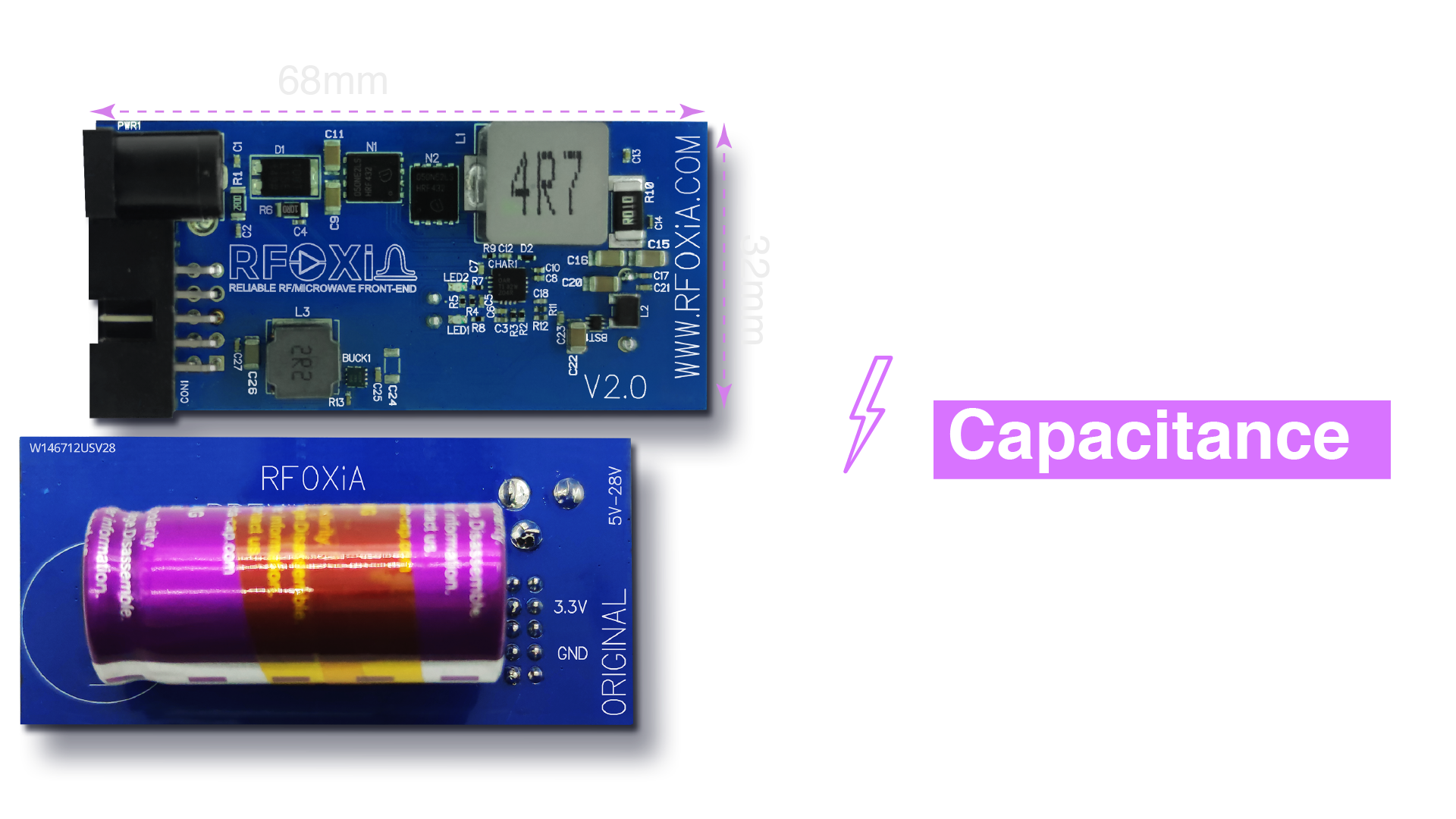
The heart of this industrial IoT power module is an 1100 Farad supercapacitor bank. To put that number in context: a single Farad stores one coulomb of charge at one volt. 1100 Farads is an extraordinary amount of capacitance — and at the operating voltage of this system, it translates to 8800 Joules of stored energy.
That is not a theoretical number. 8800 Joules is the verified, measured energy capacity of this bank under controlled load conditions. Running the complete MultiNav Pro+ stack — BLE module, GNSS module, and sensors module simultaneously — the system sustains full operation for a complete working day without interruption.
The charge rate is equally impressive. The supercapacitor bank accepts charge at 4V and 10A, which is an aggressive charging current that fills the entire 8800-Joule capacity in under five minutes from fully depleted. In practice, most users top up from partial discharge, which means charge times measured in seconds rather than minutes.
The High-Power Charging Adapter
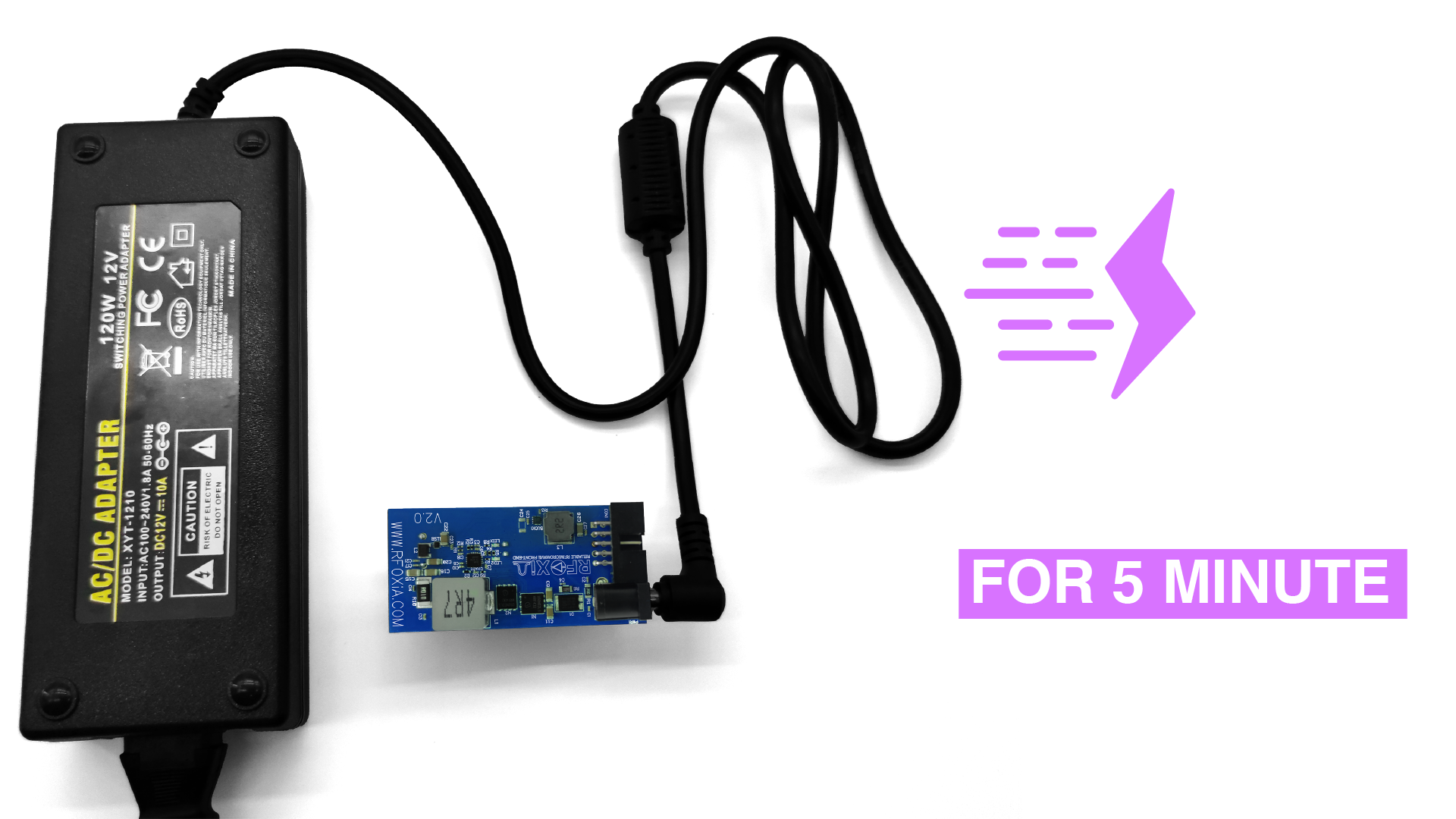
The kit includes a 12V 5A dedicated charging adapter engineered specifically for the supercapacitor system. The onboard charging circuitry steps down and regulates the input to deliver the precise 4V 10A charge profile the supercapacitor bank requires for safe, fast, and repeatable charging cycles.
This is not a generic USB charger or a wall adapter you can swap out with whatever is nearby. The charge profile matters. Supercapacitors charged incorrectly — with the wrong voltage ceiling or current profile — can underperform or fail prematurely. RFOXiA's included adapter eliminates that risk entirely by providing the exact charge profile the bank was designed for.
For field deployment, this matters because you can plug in the adapter during any break in your session and be back to full capacity before you are ready to resume. The workflow shift from "wait hours" to "charge in minutes" is not a minor convenience — it fundamentally changes what deployments are possible.
Full-Day Power for the Complete Module Stack
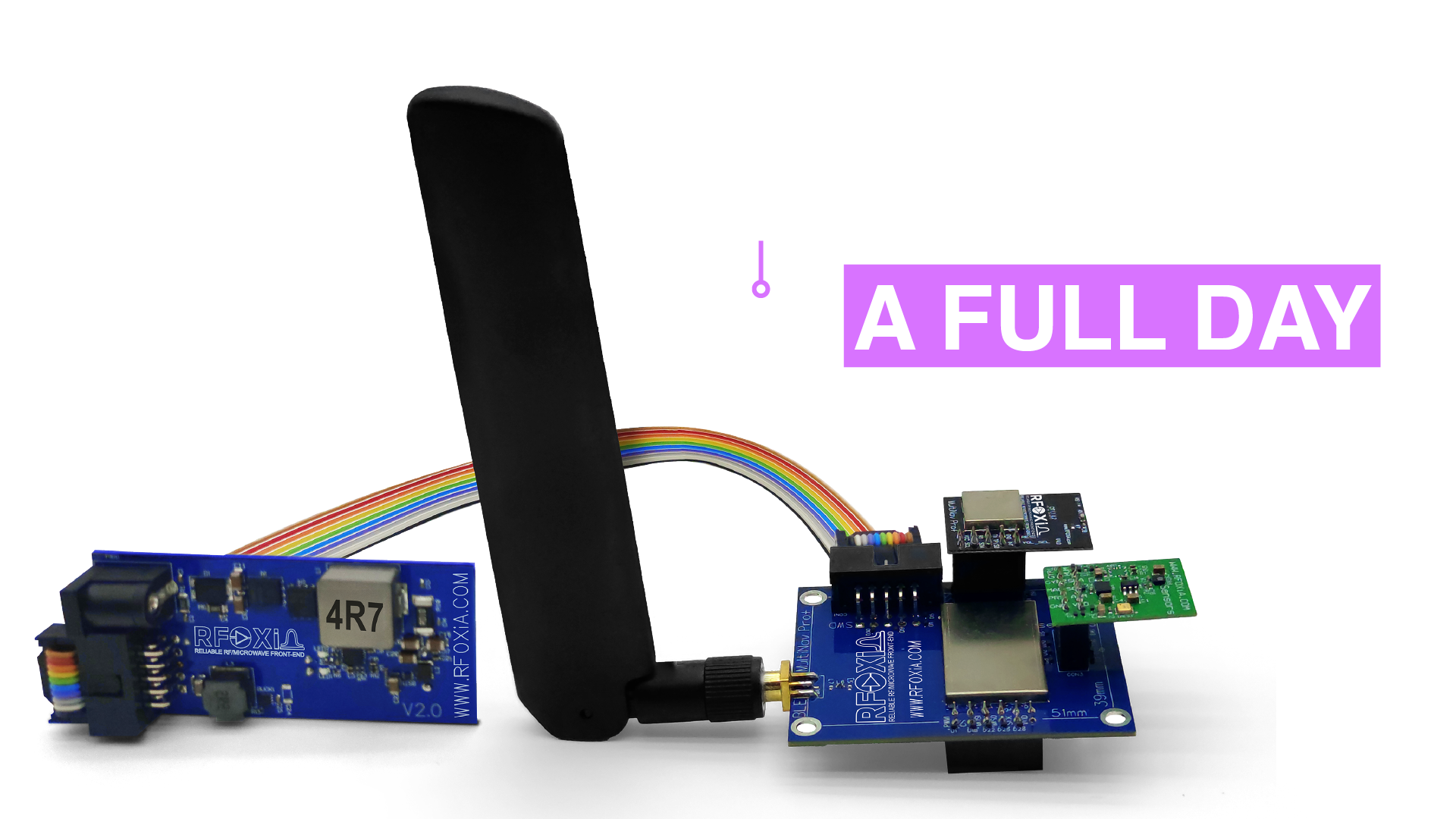
The power output from the supercapacitor bank is designed to run all MultiNav Pro+ modules simultaneously. That means your BLE module maintaining its long-range wireless link, your GNSS module updating position at 18Hz, and your sensors module streaming environmental data — all running in parallel from a single power source for a full working day.
For developers building integrated IoT nodes, this eliminates the complexity of managing separate power rails for each module. One connection, one power source, one charge cycle. The module stack draws what it needs, and the supercapacitor bank delivers it with no interruption.
This full-day runtime calculation is based on the complete module stack at normal operating loads. If you are running only the BLE module for a standalone long-range communication application, runtime extends further. The system is sized for the worst-case full-stack scenario — anything less demanding simply runs longer.
The Integrated STLink Programmer
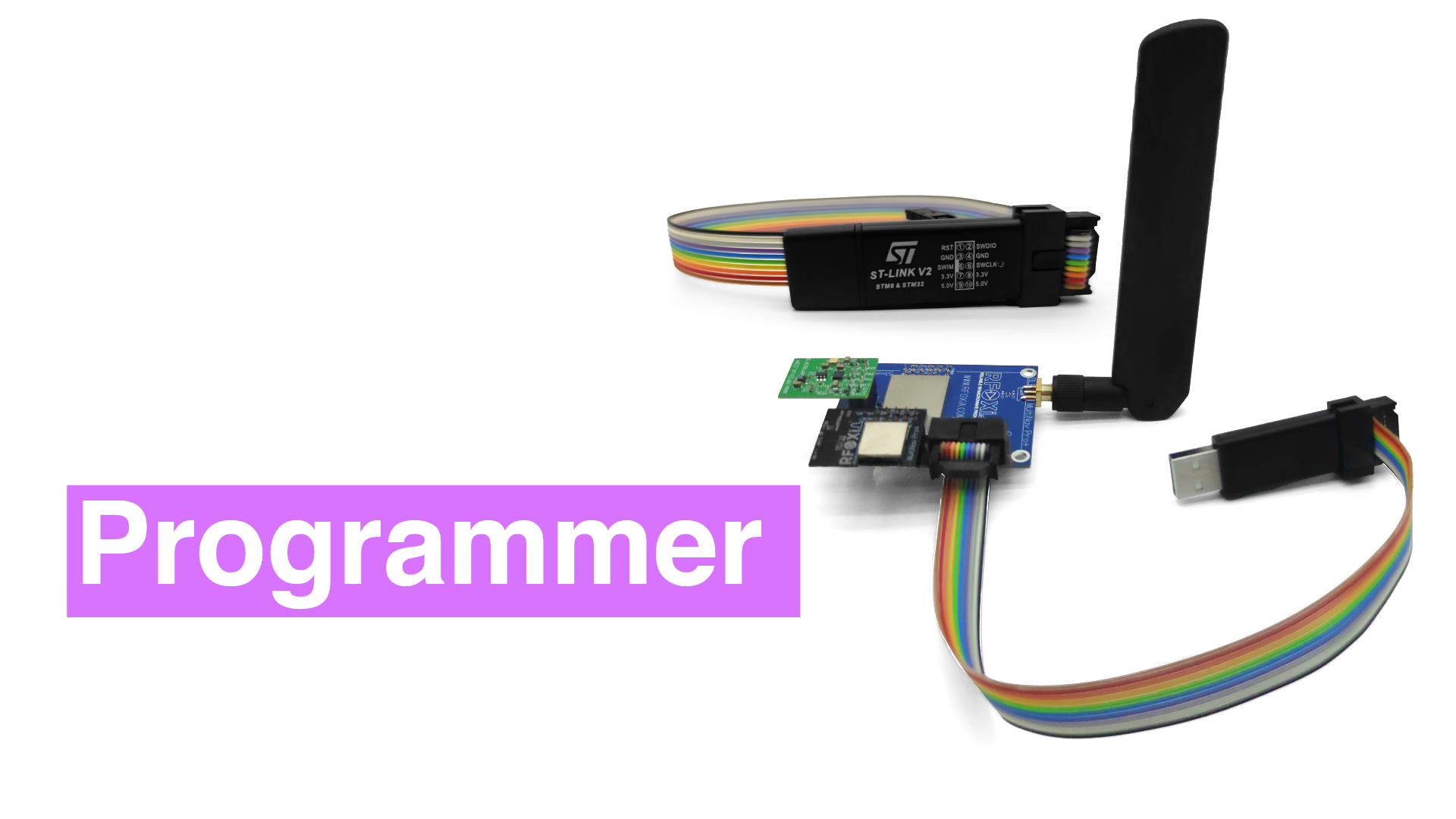
The Power/Program Kit is not just a power solution. The STLink programmer integrated into the kit gives developers direct access to the STM32WB07 microcontroller at the heart of the MultiNav Pro+ BLE module. This is the same programming interface used in professional embedded development environments — the exact toolchain that serious firmware developers use to build, flash, and debug production-grade firmware.
What the STLink Programmer Enables
Firmware flashing: Deploy new firmware builds directly to your BLE module over SWD (Serial Wire Debug). No bootloader required, no proprietary flashing tool, no limitations on what you can deploy.
Live debugging: Use STM32CubeIDE or any compatible debugger to set breakpoints, inspect register states, watch variable values in real time, and step through execution line by line. This is how professional embedded developers find and fix bugs — not by guessing, but by observing actual hardware behavior.
Custom firmware deployment: RFOXiA's AI Firmware Builder generates production-ready firmware for the MultiNav Pro+ platform. The STLink programmer is how you get that firmware from your development machine onto your hardware. Write a description of what your application needs to do, generate the firmware, flash it with the STLink — that is the complete workflow.
BLE stack development: The STM32WB07 runs a fully open BLE stack. Developers with deep embedded experience can go below the RFOXiA firmware layer and work directly with the BLE controller if their application requires it. The STLink programmer gives you that access.
For developers who want to customize beyond what the default firmware provides, the MultiNav Pro+ firmware is open source on GitHub at github.com/RFOXiA/MultiNav-Pro-Long-Range-BLE-Module-Firmware-STM32WB07. The STLink programmer is your on-ramp to that full development capability.
Complete Connectivity: Everything Included
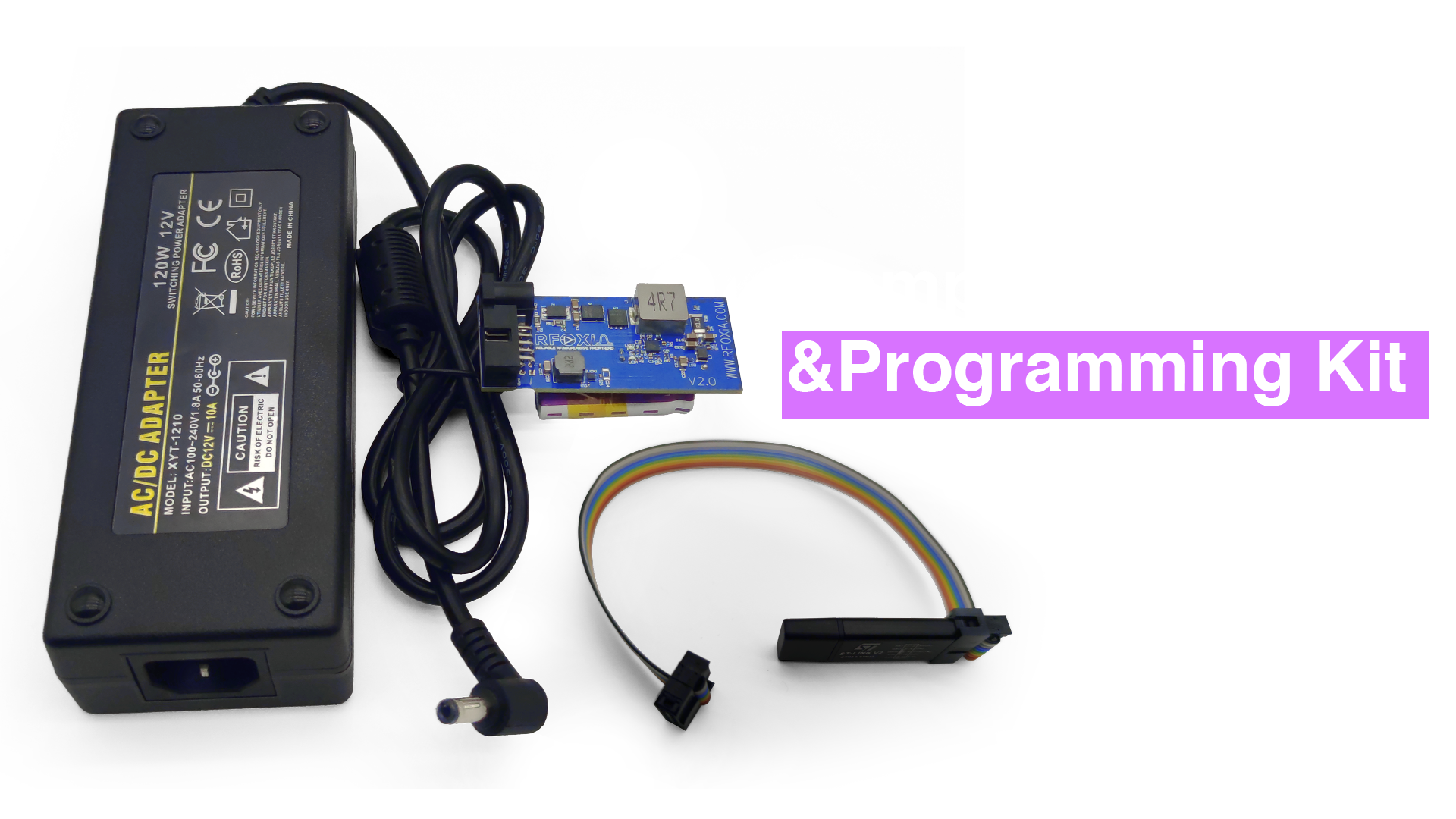
One of the small but important details in the kit design is that everything you need to get running immediately is in the box. This includes the flat ribbon cables that connect the BLE module to the power module and the STLink programmer to the BLE module's programming interface.
These are not generic cables you need to source separately. They are the specific connectors and ribbon configurations that work with the MultiNav Pro+ module form factor. You do not need to spend time sourcing the right connector spec or hunting for the right cable in your parts bin. Open the kit, connect the cables, and you are powered and programmable in minutes.
For developers building systems with multiple modules, the connectivity kit also ensures the power distribution between modules is handled correctly. The ribbon connections carry both power and signal in a configuration that matches the MultiNav Pro+ pinout — no wiring errors, no guessing which pin does what.
Who Should Be Using This Kit
Drone Builders and FPV Pilots
If you are flying a drone with a MultiNav Pro+ BLE module for long-range telemetry or control, you need a ground station power solution that matches the demands of a full flying day. LiPo battery packs that take two hours to recharge are a workflow killer. The five-minute charge of the supercapacitor system means your ground station is always ready when your aircraft is.
Industrial IoT Node Deployers
For anyone deploying sensor nodes in remote or semi-remote locations as part of an industrial IoT installation, the power architecture of this kit is directly relevant to your reliability requirements. Nodes that run all day from a single charge and recharge in minutes when maintenance crews visit are far more operationally practical than systems requiring battery swaps or long charge stops. This industrial IoT power module was designed with exactly this deployment scenario in mind.
Field Researchers and Environmental Scientists
Researchers deploying RFOXiA sensor nodes for environmental data collection need power systems that match the duration of field sessions. A full-day runtime means your data collection session is not terminated by a dead battery. The STLink programmer means you can update firmware in the field if your research protocol requires configuration changes between sessions.
Robotics Engineers
Groundstation power for robot control systems needs to be reliable across extended testing sessions. The supercapacitor system's long cycle life also means you are not replacing batteries after a few hundred sessions — the capacitor bank is rated for far more cycles than any battery chemistry.
Hardware Developers Customizing Firmware
If you are using RFOXiA's AI Firmware Builder or writing your own custom firmware for the MultiNav Pro+ platform, the integrated STLink programmer is not optional — it is how you get your code onto the hardware. Having the programmer bundled with the power system in a single integrated kit means your development workbench setup is cleaner and your workflow is faster.
The RFOXiA Ecosystem Context
The Power/Program Kit is designed as a companion to the full MultiNav Pro+ ecosystem. Paired with the MultiNav Pro+ BLE Module (5km ground range, 15–20km man-to-drone range), the GNSS Module (1.5m accuracy at 18Hz), and the Sensors Module (seven environmental sensors in one board), you have a complete professional wireless development platform.
All modules are FCC certified. All modules ship from verified manufacturing partners. All modules are supported by RFOXiA Club — the developer platform that includes documentation, community project sharing, the AI Firmware Builder, and the data monetization network that pays contributors for verified sensor data.
The RFOXiA SuperCapacitor Battery and Programmer Kit completes that stack by solving the one problem that every other component in the ecosystem cannot solve on its own: how do you power all of this in the field, reliably, all day, without infrastructure?
The answer is 1100 Farads, 8800 Joules, and five minutes.
Industrial IoT Power Module Specification Summary
| Specification | Value |
|---|---|
| Supercapacitor Capacity | 1100 Farads |
| Stored Energy | 8800 Joules |
| Full Charge Time | Under 5 minutes |
| Runtime (Full Module Stack) | Full working day |
| Charging Input | 12V 5A |
| Charging Profile | 4V 10A to supercapacitor bank |
| Programmer Interface | STLink (SWD) |
| Compatible Modules | All MultiNav Pro+ Modules |
| Cables Included | Flat ribbon cables for module and programmer connections |
| Certification | FCC Certified |
| Price | $119 |
Frequently Asked Questions
Can I use the Power/Program Kit without the full module stack? Yes. The power system works with any subset of MultiNav Pro+ modules. If you are running only the BLE module, runtime extends significantly beyond the full-day rating since the load is lower.
Is the supercapacitor system safe to transport? Supercapacitors do not carry the same transportation hazard classifications as lithium cells. They do not use flammable electrolyte chemistry and do not present a thermal runaway risk. For field deployment and transport, this is a meaningful practical advantage.
What debugging tools work with the STLink programmer? The STLink interface is compatible with STM32CubeIDE, OpenOCD, and any SWD-compatible debugger. This is the same interface used across the STM32 product family — documentation and toolchain support is extensive.
How many charge cycles will the supercapacitor bank sustain? Supercapacitors are rated for hundreds of thousands of charge-discharge cycles compared to the 300–500 cycles typical of LiPo cells. In practical terms, the supercapacitor bank will outlast the useful life of almost any project you build with it.
Does the kit come with everything I need to start programming immediately? Yes. The kit includes the STLink programmer, the flat ribbon cables for module connection and programming interface, and the high-power charging adapter. You need a USB connection to your development machine for the STLink and any standard STM32-compatible IDE.
Ready to Eliminate Power Downtime From Your IoT Deployments?
The MultiNav Pro+ Power/Program Kit is available now at $119, including the 1100F supercapacitor bank, the 12V 5A charging adapter, the integrated STLink programmer, and the complete connectivity cable kit.
If you are serious about deploying wireless hardware in the field — whether for drone operations, industrial IoT data collection, robotics development, or environmental research — this is the industrial IoT power module that removes the one constraint that has been holding your deployments back.
Explore the full specifications and order yours at the RFOXiA SuperCapacitor Battery and Programmer Kit product page. New to RFOXiA? Join RFOXiA Club free and receive $10 in welcome credits toward your first hardware order — no hardware required to get started.
Five minutes to full charge. A full day of operation. Everything you need to build, flash, and deploy — in one kit.
Written by: Moamen Mohamed LinkedIn