
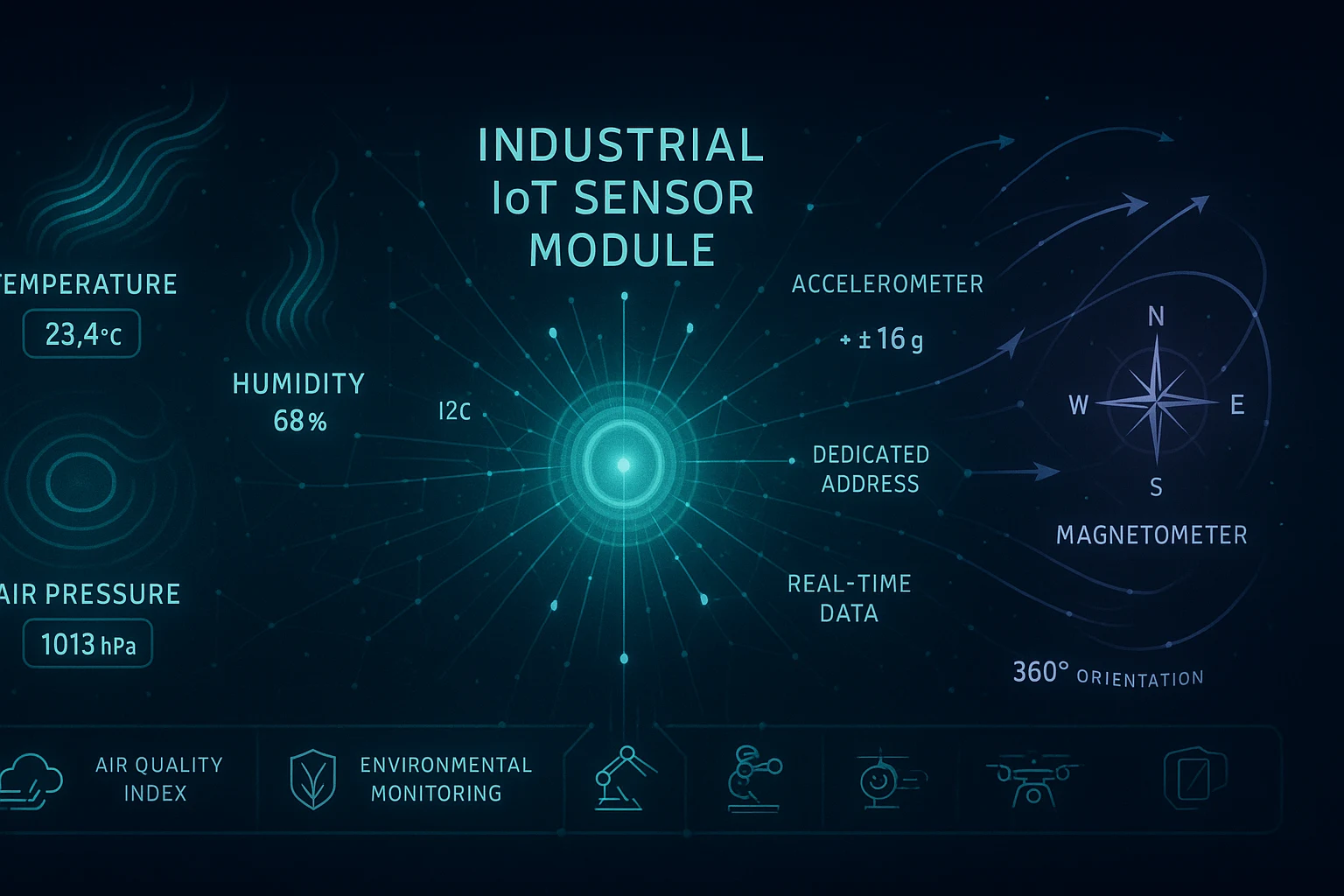
Industrial IoT Sensor Module: The MultiNav Pro+ Complete Guide
RFOXiA Integrated Sensors Module
Why Every Serious Builder Needs a True Industrial IoT Sensor Module
If you've ever tried to wire up seven different sensors across a breadboard, juggle incompatible libraries, fight conflicting I2C addresses, and still somehow squeeze everything into a drone frame or compact enclosure — you already understand the problem. Sensor integration is brutal. It eats prototyping time, introduces noise and reliability issues, and forces compromises that hurt the final product.
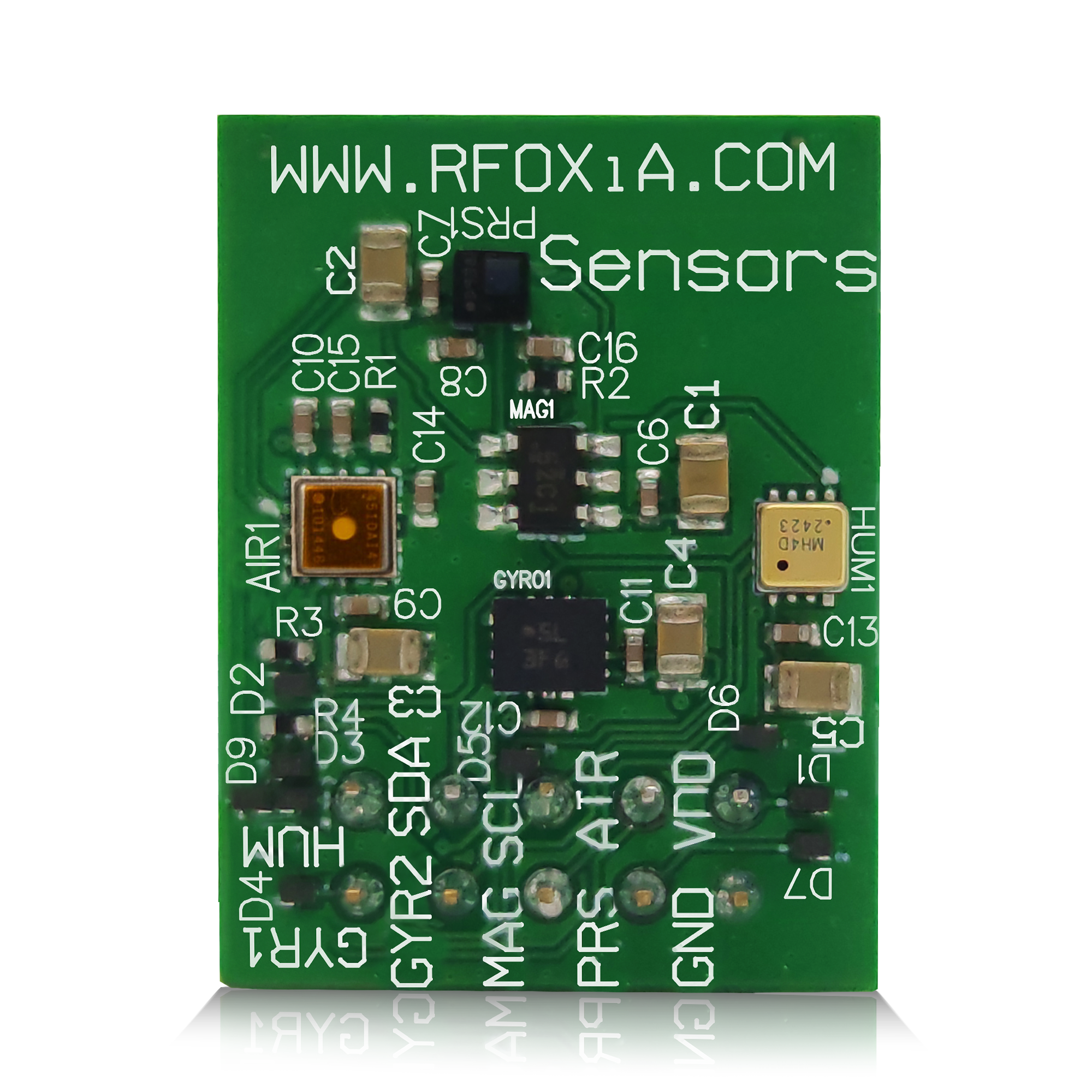
The MultiNav Pro+ Sensors Module from RFOXiA was built to solve exactly that problem. It combines seven professional-grade sensors — accelerometer, gyroscope, magnetometer, temperature, air pressure, humidity, and air quality — onto a single 24mm × 18mm board, all sharing a clean I2C bus with dedicated addresses. It's an industrial IoT sensor module designed for builders who are serious about what they're making, not a hobbyist breakout board that cuts corners on chip selection.
This guide covers everything: the hardware, the sensor specifications, the communication architecture, real-world applications, and why the component choices RFOXiA made matter more than the marketing copy ever could.
What Makes a Sensor Module Truly "Industrial Grade"?
The phrase "industrial IoT sensor module" gets thrown around loosely. Let's define what it actually means before explaining how the MultiNav Pro+ earns that description.
An industrial-grade sensor module must satisfy several non-negotiable criteria:
1. Component sourcing from Tier-1 manufacturers. Industrial applications demand predictable, calibrated, well-documented sensors with long-term availability. You can't build a fleet of 500 environmental monitoring nodes on a sensor chip that gets EOL'd in six months.
2. Reliable communication architecture. Multi-sensor boards often fail in practice because of bus contention, address conflicts, or noise coupling between sensors. Industrial designs prevent this at the hardware level.
3. FCC certification. If your device is going into commercial deployments, government installations, or enterprise environments, it needs to be certified. Full stop.
4. Compact form factor without sacrificing accuracy. Industrial IoT devices go into tight spaces — drone frames, wearable enclosures, HVAC panels, agricultural equipment, vehicle telemetry systems. Size matters.
5. Real-time data capability. Industrial control loops and monitoring systems need sensor data that reflects what's happening now, not 500ms ago.
The MultiNav Pro+ Sensors Module checks every one of these boxes. Let's break down exactly how.
The Seven Sensors: Component-Level Breakdown
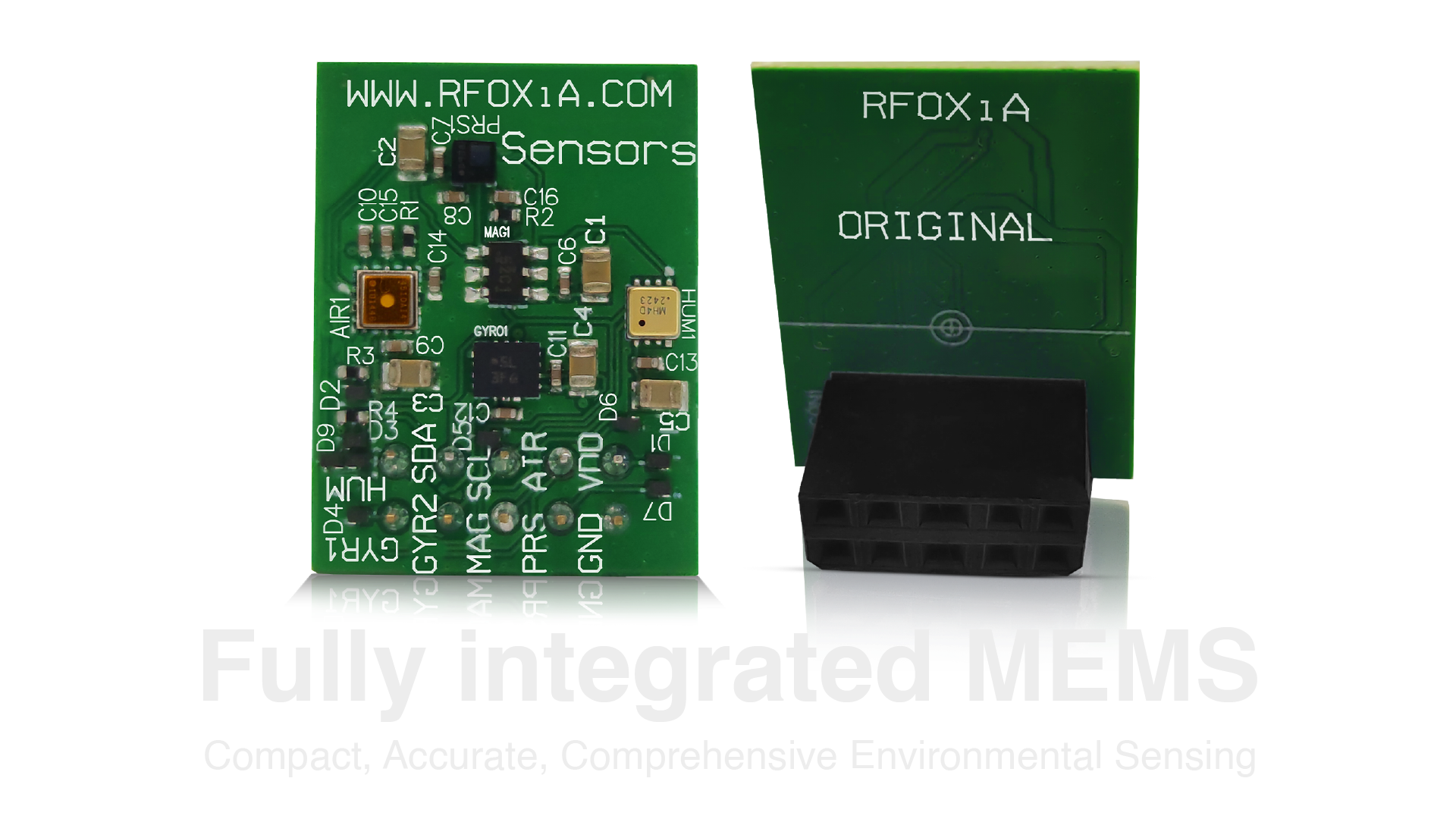
Most "all-in-one" sensor boards use whatever generic chips are cheapest at the moment. RFOXiA took a different approach — selecting each sensor based on performance characteristics matched to the application demands of professional drone builders, robotics engineers, and IoT developers. Here's what's on the board and why it matters:
Accelerometer & Gyroscope: BMI270 — Bosch Sensortec
The BMI270 is a 6-axis IMU designed specifically for wearable and robotics applications demanding high accuracy with low power consumption. Bosch Sensortec built the BMI270 with an integrated step counter, gesture recognition, and activity classification engine — meaning it's intelligent at the chip level, not just a raw data source.
For drone applications, the BMI270 delivers the vibration-robustness and noise rejection that cheap MPU-6050 clones simply cannot match. If you're building a flight controller integration or an autopilot system, this is the chip class you want underneath you.
Magnetometer: TMAG5273C1QDBVR — Texas Instruments
Texas Instruments' TMAG5273 is a 3-axis linear Hall-effect sensor that delivers exceptionally low power consumption with high accuracy magnetic field measurement. It's designed for precise angle sensing and position detection in demanding environments — exactly what heading estimation, compass calibration, and motor position sensing require.
Unlike many low-cost magnetometers that struggle with hard-iron interference, the TMAG5273 provides the clean magnetic field data that serious navigation applications demand.
Air Pressure: LPS22HHTR — STMicroelectronics
ST's LPS22HH is a MEMS absolute pressure sensor with a measurement range of 260 to 1260 hPa and a relative accuracy of ±0.1 hPa. In drone applications, this translates to altitude hold performance at the sub-meter level. In environmental monitoring applications, it provides the barometric pressure precision that weather modeling and climate data collection require.
The LPS22HH is a component that appears in professional avionics and industrial equipment — not because it's cheap, but because it delivers.
Humidity & Temperature: MVH4003D — MEMSVision
MEMSVision's MVH4003D is a calibrated humidity and temperature sensor optimized for accuracy across a wide operating range. Environmental monitoring, agricultural applications, HVAC control systems, and climate data networks all depend on humidity and temperature readings that don't drift over time or require frequent recalibration.
The MVH4003D delivers factory-calibrated output with minimal post-processing requirements — which is exactly what you need when you're deploying dozens of nodes and can't manually calibrate each one.
Air Quality: ZMOD4510AI4R — RENESAS
The RENESAS ZMOD4510 is a metal-oxide gas sensor specifically designed for outdoor air quality monitoring. It detects ozone (O₃) and nitrogen dioxide (NO₂) — the primary pollutants relevant to urban environmental monitoring, agricultural applications, and industrial site safety.
This is not a generic VOC sensor repurposed for outdoor use. The ZMOD4510 was engineered for outdoor deployment from the ground up, with sensor algorithms calibrated to the outdoor chemistry environment. This distinction matters enormously when the data you're collecting is being compared against reference station readings or sold into enterprise datasets.
Chip-Level Selection: Why It Matters for Your Project
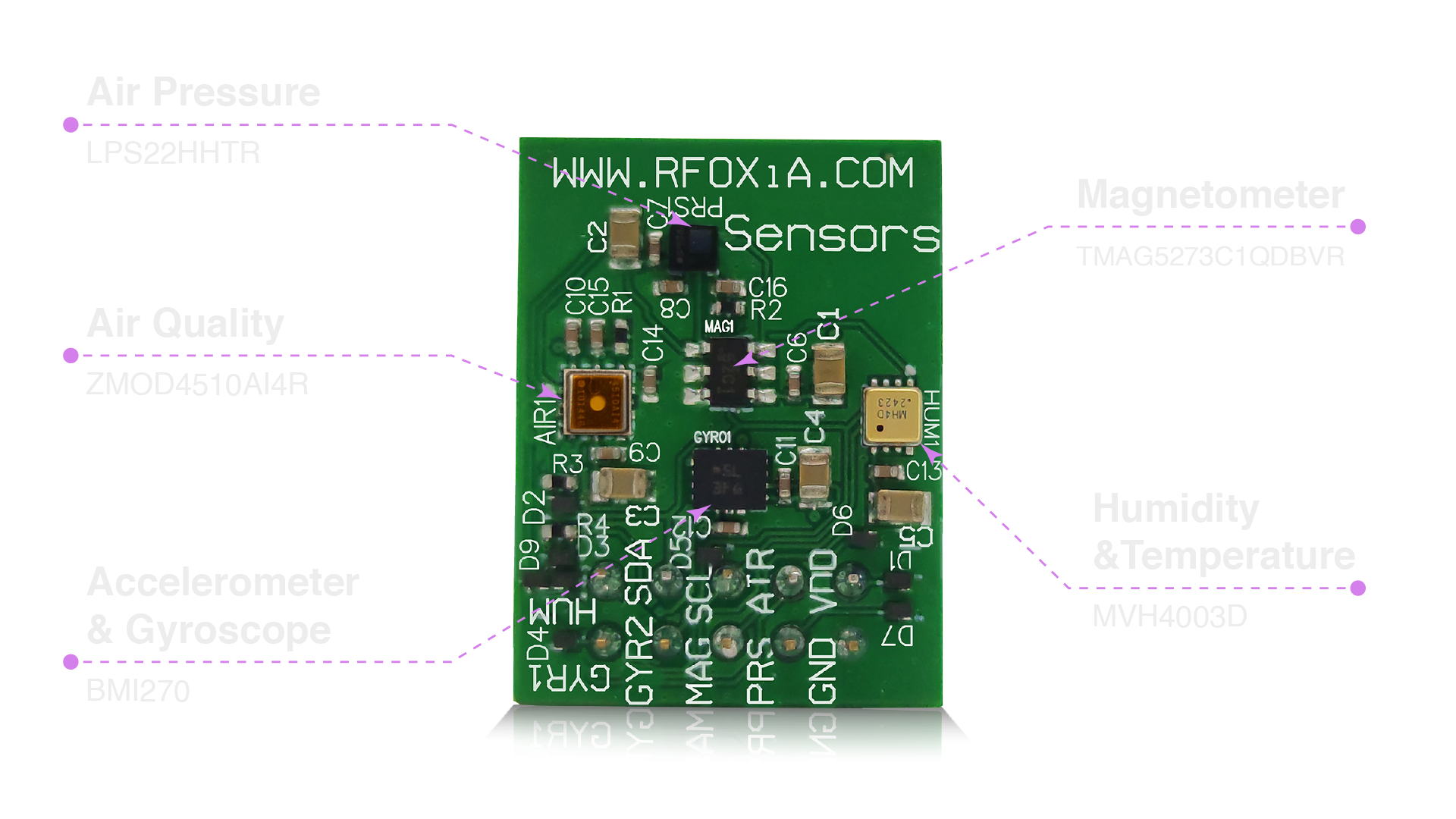
The five sensor ICs on the MultiNav Pro+ board represent a combined engineering pedigree from Bosch Sensortec, Texas Instruments, STMicroelectronics, MEMSVision, and RENESAS. Every one of these is a name you'll find in professional instrumentation, medical devices, automotive systems, and industrial control equipment.
This isn't incidental. The component selection is a deliberate statement about the tier of product this is. When you're integrating this industrial IoT sensor module into your project, you're building on the same sensor technology used in professional equipment — at a price point that makes sense for a development team, a startup, or an independent researcher.
I2C Architecture: How Seven Sensors Share One Bus Without Fighting
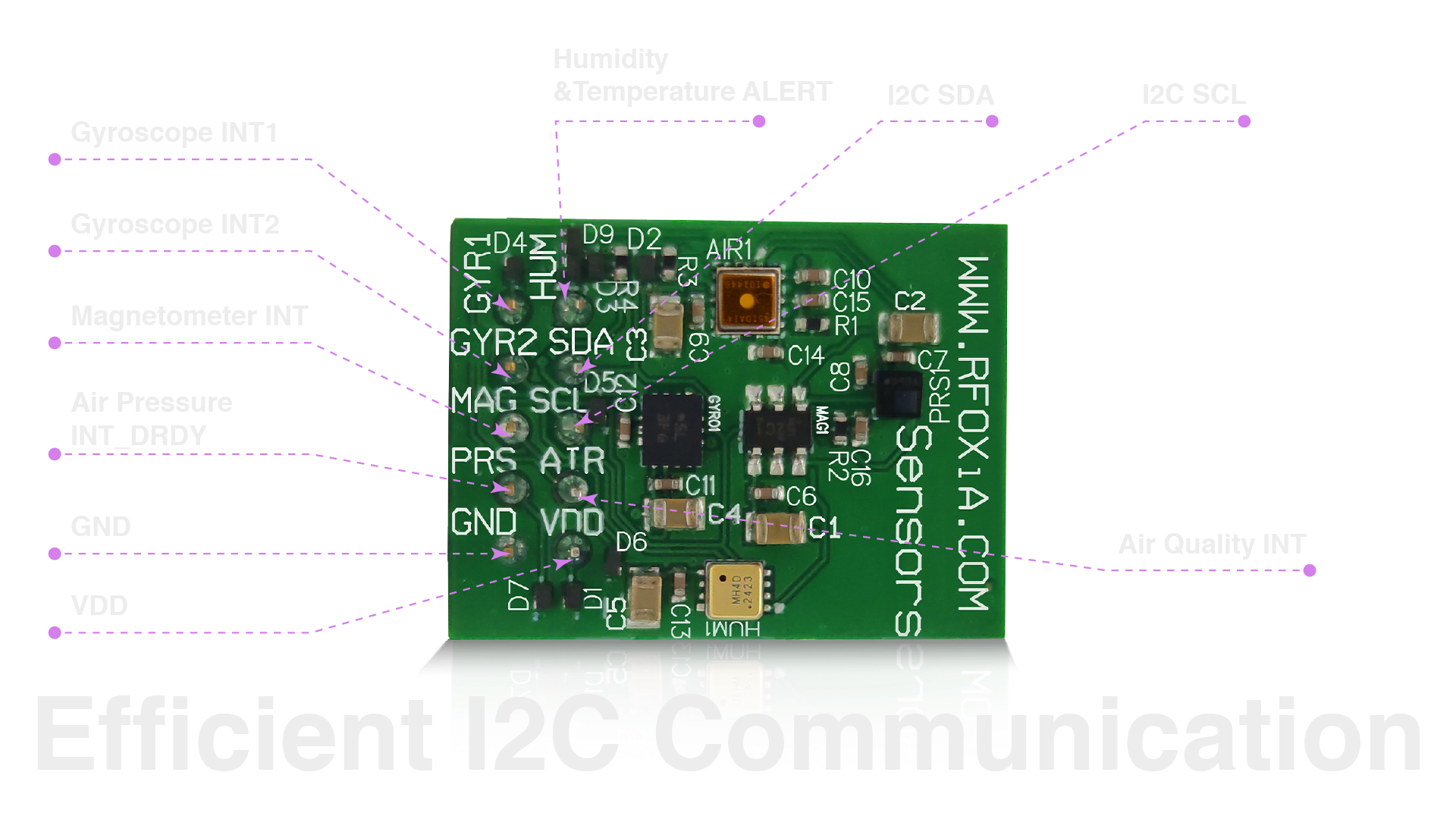
One of the most common failure modes in multi-sensor designs is bus contention. When multiple sensors share an I2C line and address collisions occur, you end up with corrupted reads, communication lockups, and debugging nightmares that have nothing to do with your application code.
The MultiNav Pro+ solves this at the hardware design level. Every sensor on the board has a dedicated I2C address, and the board's wiring ensures there are no address conflicts between any of the seven devices. You connect a single I2C line from your microcontroller — SDA and SCL — and immediately have access to all seven sensors through clean, collision-free communication.
This matters for several practical reasons:
- Reduced wiring complexity. One bus, one pair of wires. No multi-bus multiplexer needed.
- Faster integration. Your firmware only needs to implement standard I2C reads to each sensor address. The board does the hard work.
- Easier debugging. When all sensors are on a single, well-designed bus, isolation of issues is straightforward.
- Scalability. If your design needs to chain multiple boards or add additional I2C devices, the dedicated address architecture prevents conflicts with expansion.
For developers building firmware from scratch, RFOXiA's AI Firmware Builder — integrated into RFOXiA Club — can generate production-ready I2C initialization code for the entire sensor array from a plain language description of your application. What would take days of reading datasheets takes hours.
Form Factor: 24mm × 18mm of Capability
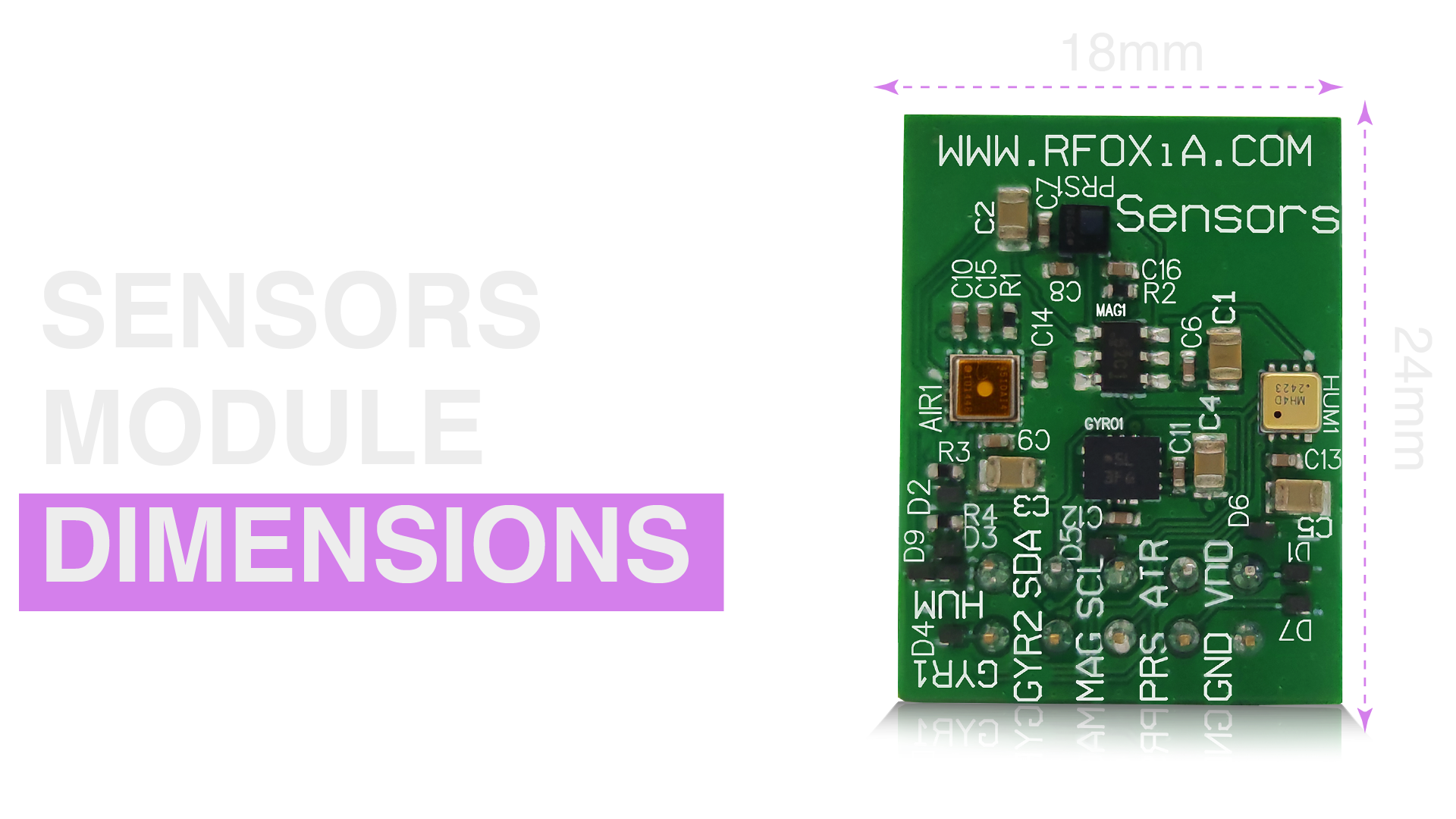
At 24mm × 18mm, the MultiNav Pro+ Sensors Module fits where it needs to fit. For context, a standard US postage stamp is 25mm × 21mm. This is a complete seven-sensor environmental and motion monitoring system in less than a square inch.
That form factor enables integration into:
- Drone frames where every gram and every millimeter is contested
- Wearable devices where boards larger than a coin are impractical
- Compact IoT nodes deployed in enclosures sized for specific mounting locations
- Robotic limbs and end effectors where spatial constraints are defined by mechanical design, not PCB size
- Research instruments that need to be unobtrusive and lightweight
Small form factor without component compromise is genuinely difficult to execute. It requires careful PCB layout, thermal management between adjacent sensors, and deliberate routing to prevent cross-interference between the motion sensors and the environmental sensors. The MultiNav Pro+ reflects that engineering discipline.
Real-Time Data: What It Enables
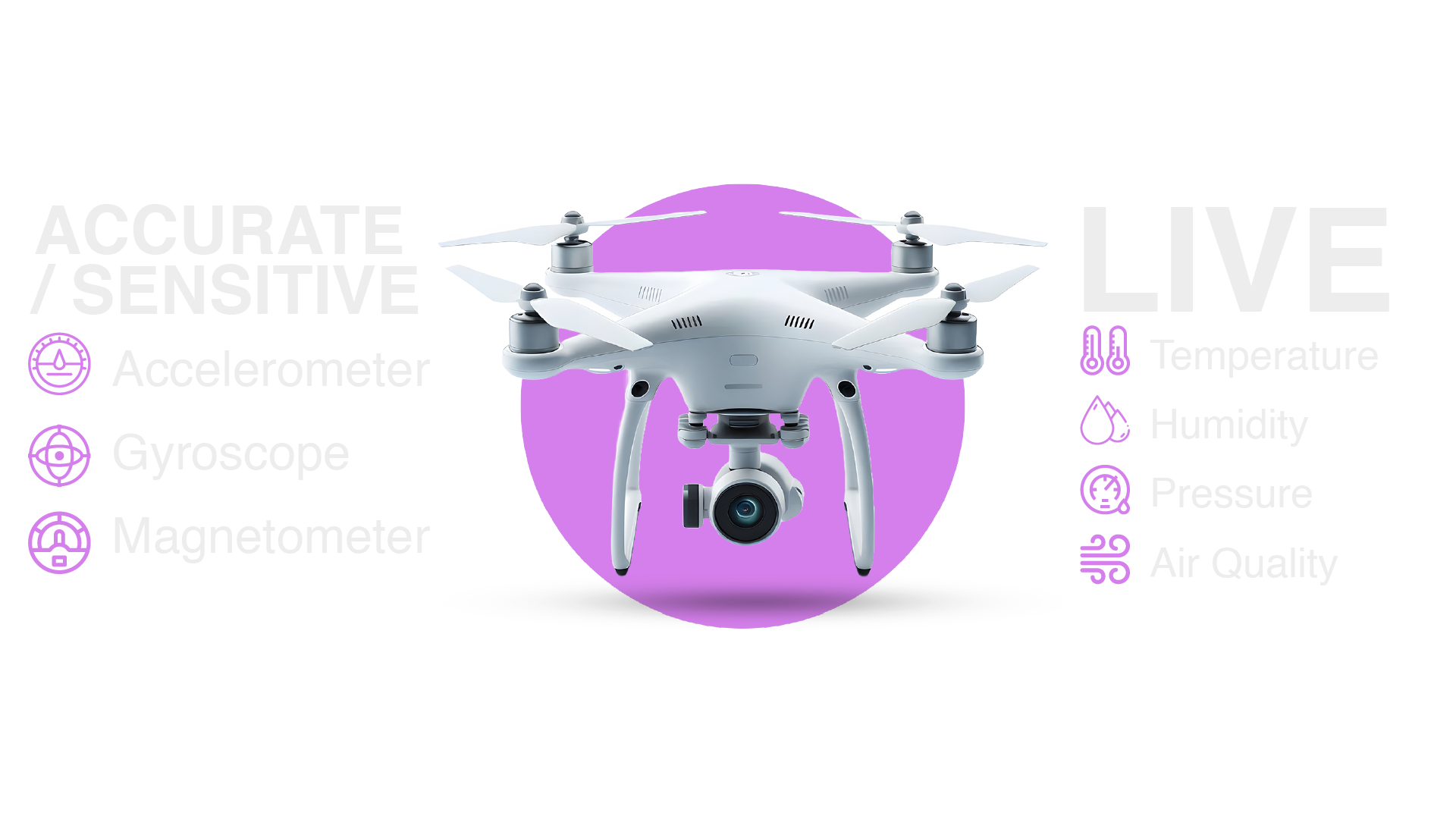
Real-time sensor data isn't just about speed. It's about the decisions you can make — and the systems you can build — when your data latency is measured in milliseconds rather than seconds or minutes.
Consider what real-time environmental sensing unlocks across different application domains:
Drone Operations: Real-time barometric altitude from the LPS22HH feeds directly into altitude hold algorithms. Real-time IMU data from the BMI270 feeds attitude estimation and flight stabilization. Real-time magnetometer data from the TMAG5273 supports heading lock and compass calibration. All of this happening simultaneously, at the update rates professional control loops demand.
Environmental Monitoring Networks: When you're contributing data to the RFOXiA Data Network — which pays verified outdoor sensor contributors daily rewards for complete, GPS-validated environmental data — the quality of your data directly determines your earning rate. Tier-1 sensor components with factory calibration deliver the data quality that passes anomaly detection verification and earns maximum reward rates.
Agricultural IoT: Micro-climate data at field level — temperature, humidity, air pressure, and air quality — sampled at second-level resolution gives precision agriculture applications the environmental context that coarse weather station data cannot provide. Real-time data enables real-time irrigation decisions, pest pressure alerts, and frost protection activation.
Industrial Safety Monitoring: The ZMOD4510's outdoor air quality sensing detects ozone and NO₂ concentrations that matter for worker safety in industrial environments. Real-time readings enable automated alerts and response protocols that delayed data cannot support.
Smart Cities: Urban planners and environmental agencies need the kind of hyper-local, high-temporal-resolution environmental data that only distributed sensor networks can deliver. A grid of MultiNav Pro+ nodes, each streaming real-time air quality, temperature, pressure, and humidity data, creates the street-level environmental picture that weather stations and satellite data can't resolve.
Applications: Where This Module Fits

The breadth of applications for a professional industrial IoT sensor module like the MultiNav Pro+ reflects the breadth of the sensor array it contains. Here's where builders and developers are putting this module to work:
Professional Drone Development
Flight controller integration, payload sensor fusion, autonomous navigation, precision landing, environmental data collection during flight missions. The combination of high-quality IMU data and barometric altitude sensing is foundational to any serious autopilot implementation.
Robotics and Autonomous Vehicles
Attitude estimation, heading determination, environmental awareness, collision avoidance using air pressure changes — all require the sensor types the MultiNav Pro+ provides. A single I2C connection gives a robot brain access to a complete picture of its orientation and environment.
Environmental Research
Field researchers deploying sensor networks for climate studies, pollution mapping, or ecological monitoring need calibrated, reliable sensors that can operate unattended in outdoor conditions. The MultiNav Pro+ combined with the RFOXiA Power/Program Kit — which provides 24 hours of runtime from a 5-minute supercapacitor charge — creates a field-deployable sensor node that runs through a full day without attention.
Wearable Technology
Sports performance monitors, health tracking devices, industrial wearables for worker safety — all benefit from the combination of motion sensing and environmental monitoring in a form factor small enough to embed in garments or equipment.
Smart Building and HVAC Systems
Temperature, humidity, air pressure, and air quality data from distributed nodes throughout a building gives HVAC control systems the environmental context needed to optimize comfort and energy efficiency simultaneously.
Data Network Contribution
RFOXiA's Data Network pays daily rewards to contributors who deploy the Sensors Module outdoors with GPS validation and stream verified environmental data. The ZMOD4510's outdoor-specific air quality sensing, combined with the LPS22HH barometric pressure, MVH4003D humidity and temperature, and GNSS position verification, creates a complete verified data contribution package that meets the network's strict verification requirements. This transforms the sensor module from a pure cost center into a revenue-generating asset.
Integration with the RFOXiA Ecosystem
The MultiNav Pro+ Sensors Module is designed as part of a complete, vertically integrated development ecosystem. It doesn't exist in isolation — it's one layer of a full-stack wireless development platform.
With the MultiNav Pro+ BLE Module: Stream sensor data wirelessly over distances up to 5km ground-to-ground or 20km man-to-drone, without internet infrastructure. The RFOXiA Connect app displays live sensor readings on your phone in real time, paired to the BLE module via Bluetooth.
With the MultiNav Pro+ GNSS Module: Add precise 1.5-meter GPS positioning with an 18Hz fix rate to your sensor node. Location-stamped environmental data with high temporal resolution is exactly what the RFOXiA Data Network verifies and pays for.
With the Power/Program Kit: Deploy the complete sensor stack for 24 hours on a single 5-minute supercapacitor charge. No battery management, no downtime, no interruption to your data stream.
With the Developer Bundle: The complete ecosystem — BLE Module, GNSS Module, Sensors Module, and Power/Program Kit — ships as an integrated package for $199. For builders who want everything working together from day one, this is the direct path. Explore the RFOXiA Integrated Sensors Module as part of the full Developer Bundle ecosystem.
With AI Firmware Builder: Describe your sensor application in plain language through RFOXiA Club's Dev Hub. The AI generates production-ready firmware with full I2C initialization, sensor read loops, data formatting, and wireless transmission — complete source code, ready to compile. What took months of embedded development now takes hours.
Technical Specifications Summary
| Specification | Detail |
|---|---|
| Sensors | Accelerometer, Gyroscope, Magnetometer, Temperature, Air Pressure, Humidity, Air Quality |
| Motion IC | BMI270 — Bosch Sensortec |
| Magnetometer IC | TMAG5273C1QDBVR — Texas Instruments |
| Pressure IC | LPS22HHTR — STMicroelectronics |
| Humidity/Temp IC | MVH4003D — MEMSVision |
| Air Quality IC | ZMOD4510AI4R — RENESAS |
| Communication | I2C (single bus, dedicated addresses) |
| Form Factor | 24mm × 18mm |
| Certification | FCC Certified |
| Price | $39 |
| Applications | Drones, robotics, environmental monitoring, wearables, IoT, smart city, data networks |
FCC Certification: Why It Matters for Your Deployment
FCC certification is not a minor detail. If you're integrating sensor hardware into a commercial product, deploying it in an enterprise environment, listing it for sale in the United States, or distributing it through professional electronics channels, FCC certification is a prerequisite.
The MultiNav Pro+ Sensors Module is FCC certified — as are all four modules in the RFOXiA product line. This means you can:
- Integrate it into commercial products without holding up your own certification timeline for your sensor module
- Sell end products incorporating the module with documented RF compliance
- Deploy it in environments that require certified components
- List it through professional distributors like DigiKey and Mouser that require certification documentation
For a professional industrial IoT sensor module at $39, FCC certification is extraordinary value. It's one of the key reasons the MultiNav Pro+ exists in a category of its own.
Getting Started
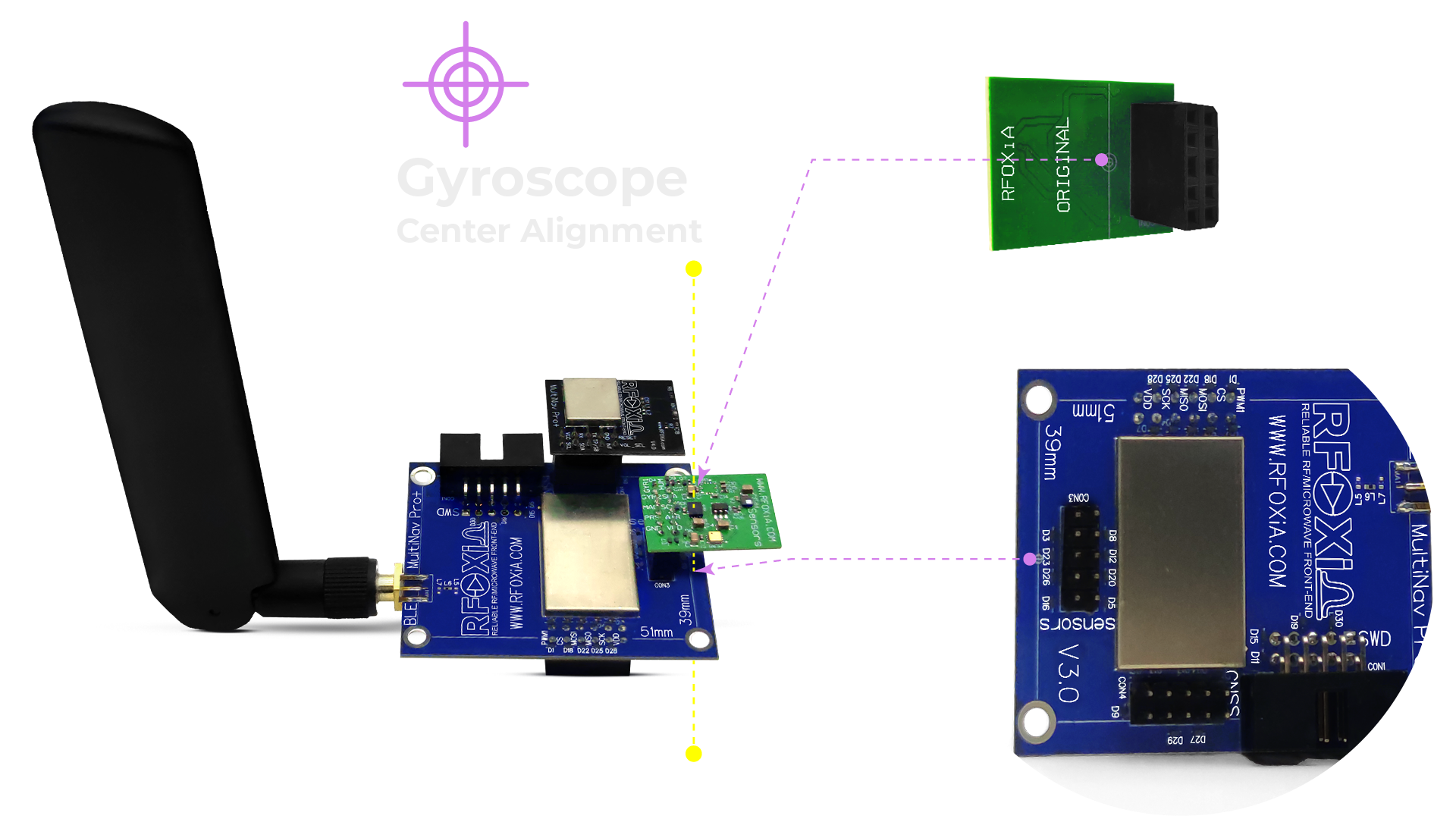
The MultiNav Pro+ Sensors Module ships ready to integrate. Connect I2C SDA and SCL to your microcontroller, power the board, and you have access to all seven sensors through their dedicated I2C addresses. RFOXiA's documentation in the Club Resources section provides initialization examples, register maps, and complete firmware templates for common microcontroller platforms.
For developers who want AI-assisted firmware generation, the AI Firmware Builder in RFOXiA Club Dev Hub takes a plain language description of your application and returns complete, production-ready embedded code — dramatically compressing the time from hardware in hand to working prototype.
For builders ready to deploy the complete ecosystem, the RFOXiA Integrated Sensors Module is available individually at $39 or as part of the Developer Bundle that includes the BLE Module, GNSS Module, and Power/Program Kit.
Sign up for RFOXiA Club and receive $10 in welcome credit toward your first order. The Club platform includes the store, AI firmware tools, developer community, live data visualization, and complete documentation — free access with no hardware required to start exploring.
Conclusion: The Industrial IoT Sensor Module Built for Builders Who Demand More
The MultiNav Pro+ Sensors Module represents what happens when professional hardware engineering meets maker-accessible pricing. Seven sensors. Tier-1 components from Bosch, Texas Instruments, ST, MEMSVision, and RENESAS. A clean I2C architecture that eliminates integration complexity. A 24mm × 18mm form factor that fits anywhere. FCC certification that opens commercial and enterprise doors. And a $39 price point that makes this level of capability accessible to independent developers, startups, and research teams who've never had access to this sensor quality at this cost.
This is not a breakout board. This is a true industrial IoT sensor module designed to go into real products, real deployments, and real environments — and deliver the data quality those applications demand.
Explore the full specifications and order the RFOXiA Integrated Sensors Module today. Your next build deserves sensors that are actually up to the task.
Written by: Moamen Mohamed LinkedIn