
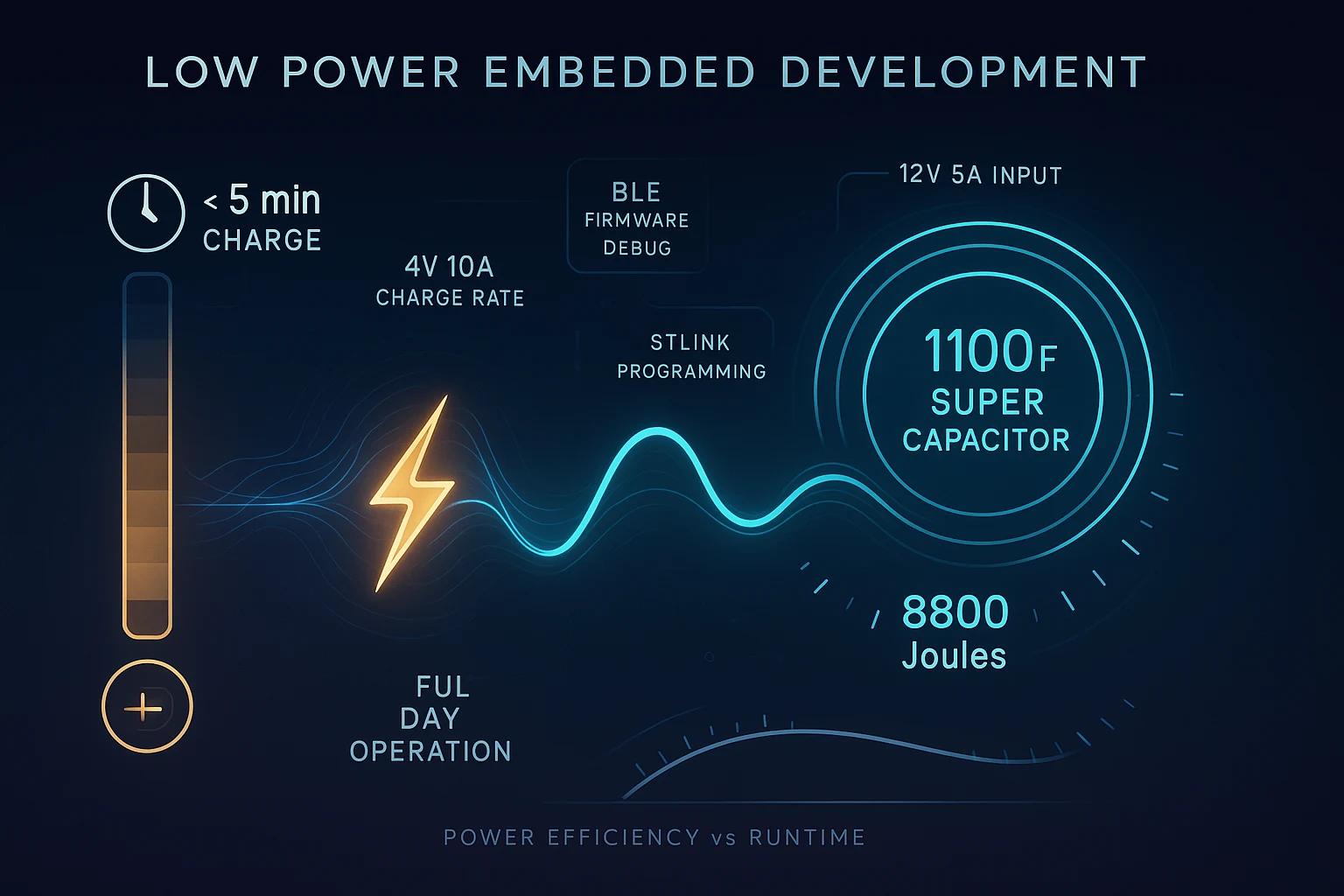
The Best Low Power Embedded Development Kit for Serious Wireless Builders
RFOXiA SuperCapacitor Battery and Programmer Kit
Why Every Hardware Developer Needs a Low Power Embedded Development Kit Built Around SuperCapacitor Technology
If you've ever had a field session cut short by a dead battery, waited 2 hours for a LiPo to charge before you could continue testing, or lost firmware progress because your power supply browned out mid-flash — you already know the problem. Power management and programming friction are two of the most underrated bottlenecks in hardware development.
The MultiNav Pro+ Power/Program Kit from RFOXiA is built specifically to solve both of those problems at once. It's not just a battery pack. It's a complete low power embedded development kit that combines a professional-grade supercapacitor energy storage system with an integrated STLink programmer, a high-power charging adapter, and all the connectivity hardware you need to go from zero to fully operational in minutes — not hours.
This post covers everything you need to know: how the kit works, what makes supercapacitor technology a genuine engineering advantage over lithium batteries in embedded development environments, who this kit is built for, and why it may be the single most important accessory you add to your wireless development setup.
The Core Problem with Power in Embedded Development
Ask any embedded systems developer or drone builder about their biggest workflow pain points, and power management will appear somewhere near the top of the list. The issues are well known:
- Long charge cycles — standard LiPo batteries at standard charge rates take 1–3 hours to reach full capacity. In a field development session, this is dead time.
- Cycle degradation — lithium batteries lose capacity over hundreds of charge cycles. After a year of active development, your 5000mAh pack is likely performing at 70–80% of rated capacity.
- Voltage sag under load — when multiple modules draw simultaneous peak current, lithium cells can sag in ways that destabilize sensitive RF circuitry and cause erratic BLE behavior.
- Safety and handling constraints — lithium chemistry requires careful charge management. Overcharge, puncture, or thermal abuse creates real hazards.
- Programming interference — many field power setups don't integrate cleanly with STLink or JTAG programmers, forcing developers to swap cables, reconfigure power rails, and troubleshoot ground loops before every firmware flash.
A purpose-built low power embedded development kit eliminates or dramatically reduces every one of these friction points. The MultiNav Pro+ Power/Program Kit is designed from the ground up to do exactly that.
What's Inside the MultiNav Pro+ Power/Program Kit
1. The SuperCapacitor Battery System
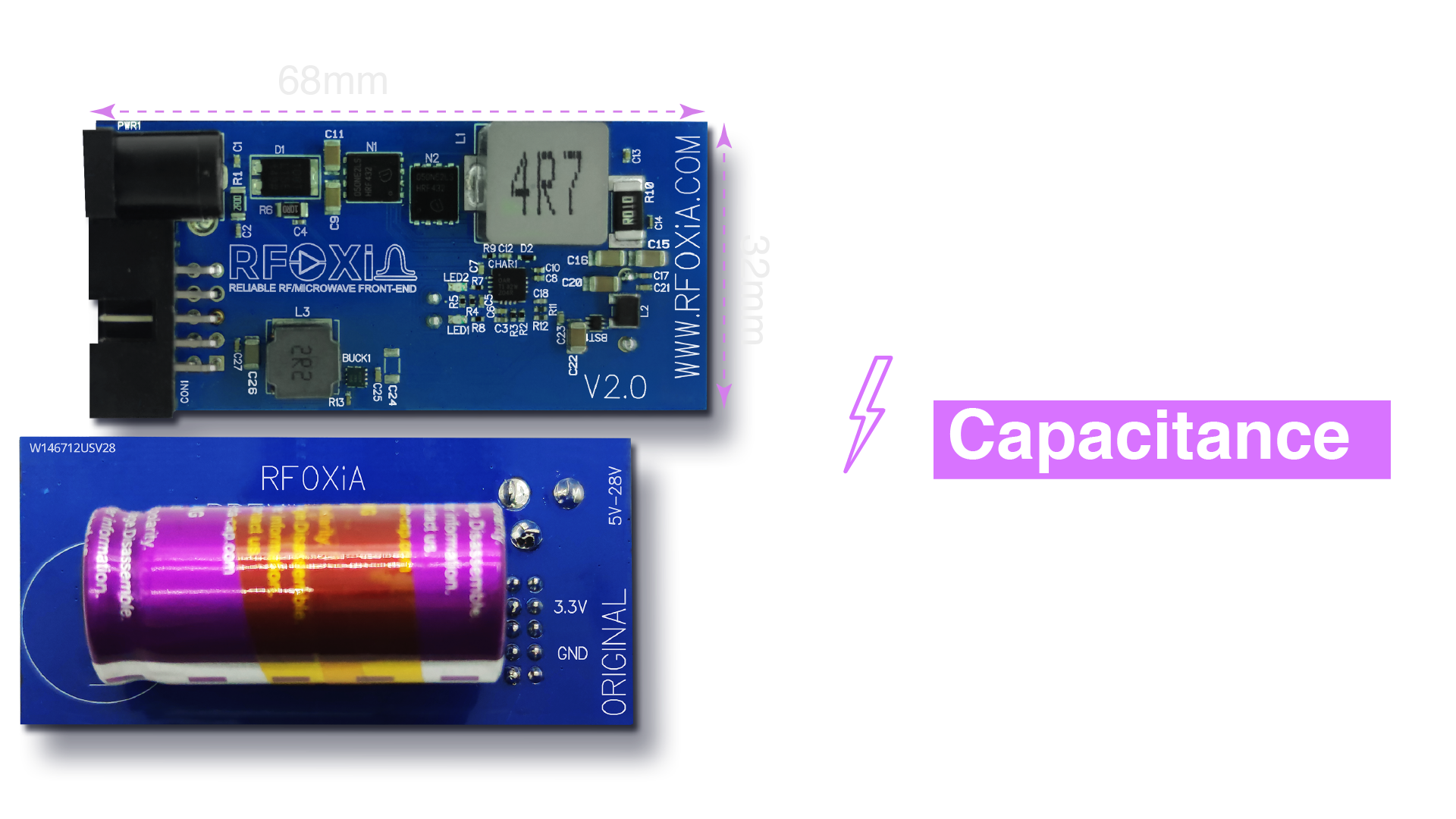
The centerpiece of this kit is a 1100F supercapacitor energy storage system storing 8800 Joules of usable energy. This is not a lithium battery with a marketing spin applied. This is a fundamentally different storage technology with fundamentally different performance characteristics.
What 1100F actually means in practice:
Supercapacitors store energy electrostatically rather than electrochemically. The practical consequences of this physical difference are significant:
Charge time: under 5 minutes to full capacity. Charged at 4V / 10A using the included adapter, the supercapacitor array reaches full charge in a fraction of the time required by any equivalent lithium system. A 5-minute top-up during a lunch break is enough to guarantee a full afternoon of uninterrupted operation.
Runtime: 24 hours powering the complete MultiNav Pro+ module stack. The 8800 Joules stored is sufficient to run the BLE Module, GNSS Module, and Sensors Module simultaneously for a full working day. This is real, field-validated capacity — not peak theoretical performance under ideal laboratory conditions.
Cycle life: measured in hundreds of thousands, not hundreds. Supercapacitors do not degrade meaningfully with charge cycles the way lithium cells do. The same unit will perform identically in year three as it did on day one.
No voltage sag under peak load. Supercapacitors deliver energy with a relatively flat discharge curve. When your BLE module fires its amplifier, when your GNSS module locks a fix, when your sensors all poll simultaneously — the power rail stays stable. Stable power means stable RF behavior, accurate sensor readings, and reliable firmware execution.
Temperature resilience. Supercapacitors operate across a wider temperature range than lithium batteries. Field development in cold environments (mountain surveying, winter drone testing, cold climate IoT deployment) doesn't compromise your power system.
For a hardware developer who uses their tools regularly, this is a transformational upgrade over battery-based power solutions.
2. The High-Power Charging Adapter
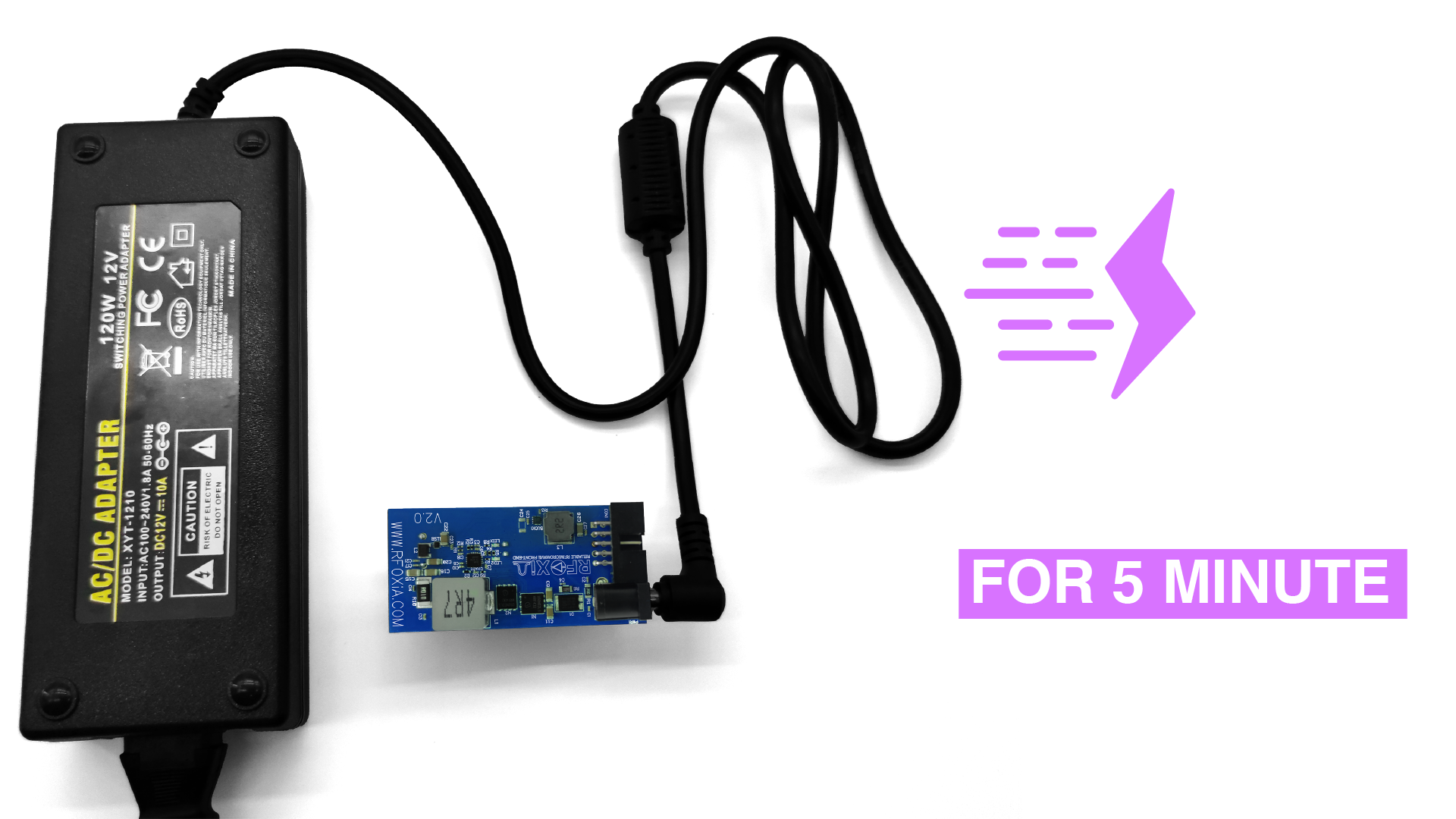
The kit includes a dedicated 12V / 5A charging adapter that drives the supercapacitor system at 4V / 10A — the high-current charge rate necessary to achieve the sub-5-minute full charge cycle.
This is not an afterthought accessory. The charging adapter is engineered as part of the system. Using an undersized or generic adapter would dramatically extend charge time and potentially fail to reach the correct charge voltage, limiting the usable energy stored.
With the included adapter, the charge cycle is predictable and fast:
- Plug in
- Wait under 5 minutes
- Unplug and go
There are no charge management apps to monitor, no balance leads to check, no cell voltages to verify. The supercapacitor system handles its own charge acceptance naturally, and the adapter provides the correct current profile. It's a genuinely plug-and-go power solution for developers who want to focus on building, not managing their power supply.
3. Full-Day Power for the Entire MultiNav Pro+ Module Stack
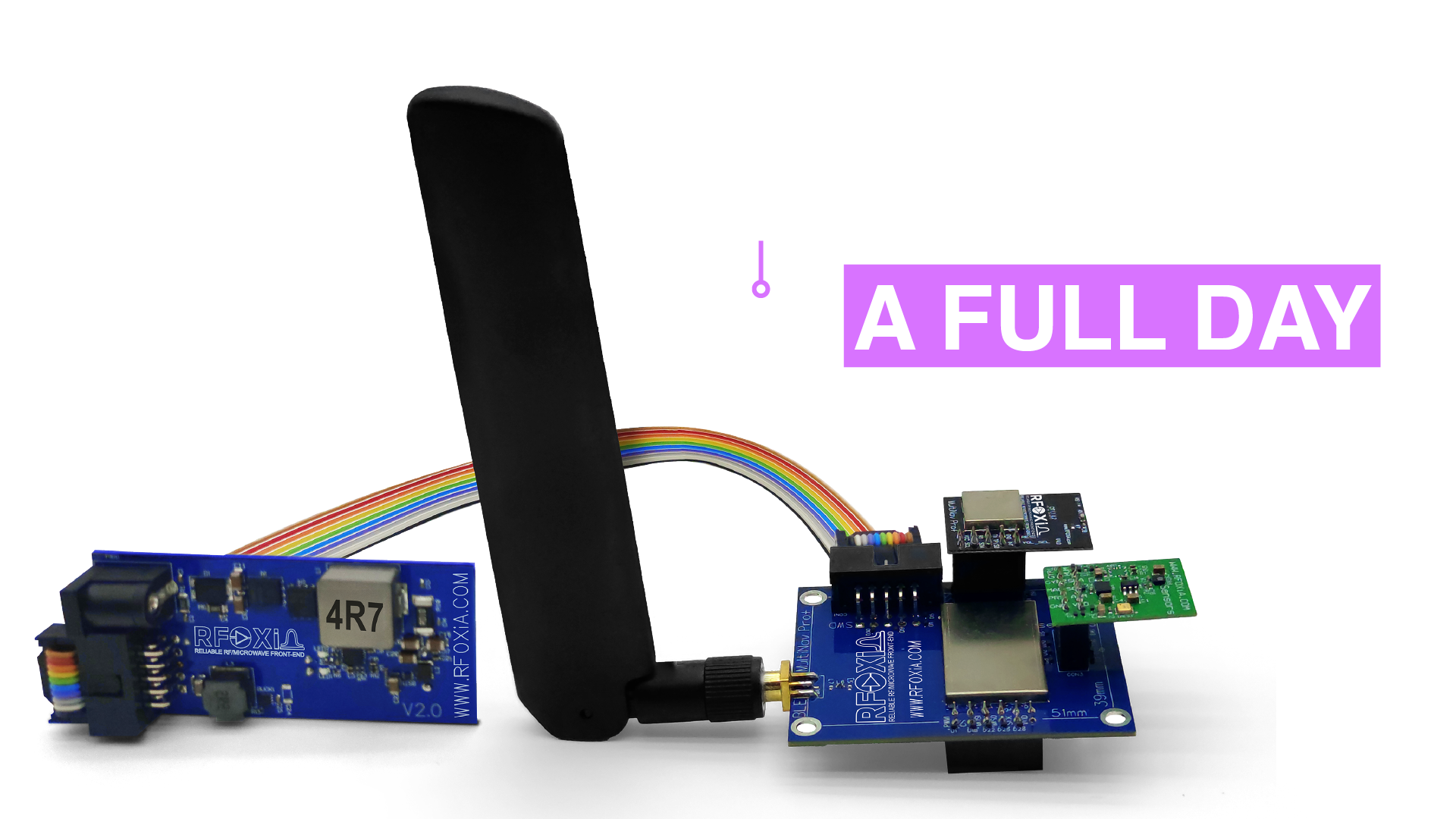
The Power/Program Kit is rated to power the complete MultiNav Pro+ ecosystem — BLE Module, GNSS Module, and Sensors Module — simultaneously for a full 24-hour day. This matters for several specific use cases:
Field data collection deployments. When you're running the Sensors Module as part of the RFOXiA data network, you need uninterrupted power through extended outdoor sessions. A single charge in the morning runs your full node stack through the day without interruption.
Extended drone and robot testing. Bench testing a drone control system or autonomous robot requires hours of iterative firmware-flash-and-test cycles. The Power/Program Kit keeps your development system alive through the entire session without a single recharge interruption.
Remote location development. If you're developing an IoT node intended for deployment in a location without convenient power access, you need your development kit to simulate real operational conditions. The 24-hour runtime gives you that operational window on a single charge.
Multi-module integration testing. When your BLE Module, GNSS Module, and Sensors Module are all running simultaneously and you're testing inter-module communication, data fusion, and firmware behavior across the stack — you need a power supply that can handle the combined load without sagging or interrupting. This kit provides that stability.
This is what makes the MultiNav Pro+ Power/Program Kit a genuine low power embedded development kit rather than a simple battery accessory. It's designed for the full ecosystem, not just a single module in isolation.
4. Integrated STLink Programmer

The STLink programmer integrated into this kit eliminates one of the most persistent friction points in embedded development: the cable management and grounding challenges that come from using a separate programmer with a separate power source.
The MultiNav Pro+ BLE Module runs on an STM32WB07 microcontroller — the same ARM Cortex-M0+ core that powers a wide range of professional wireless embedded applications. The STLink interface is the standard programming and debugging interface for the STM32 family, providing:
Full firmware flashing capability. Push new firmware builds to your BLE module directly from your IDE or command line via the STLink interface. No bootloader tricks, no over-the-air update latency during development.
Real-time debugging. Set breakpoints, inspect memory, monitor register states, and step through firmware execution line by line using the STLink debug connection and ST's development tools.
Reliable and repeatable. The STLink interface is mature, battle-tested, and supported by every major embedded development environment including STM32CubeIDE, Keil, IAR, and OpenOCD. If you're developing firmware for RFOXiA's BLE module — or using RFOXiA's AI Firmware Builder to generate production-ready code — the STLink programmer in this kit is your direct path from code to silicon.
Integrating the programmer into the power kit is a deliberate design decision. Power and programming are not separate concerns in an embedded development workflow — they're deeply interrelated. The same physical connection that delivers stable power to your module stack also provides the ground reference and signal integrity needed for reliable SWD communication. Keeping them integrated eliminates a class of debugging problems before they start.
If you're using the RFOXiA SuperCapacitor Battery and Programmer Kit alongside the AI Firmware Builder available in RFOXiA Club, your development loop becomes: describe your application in plain language → receive production-ready firmware → flash directly to your module in seconds. That's an end-to-end development workflow that would have required a team of engineers and thousands of dollars in tooling just a few years ago.
5. Complete Connectivity Kit
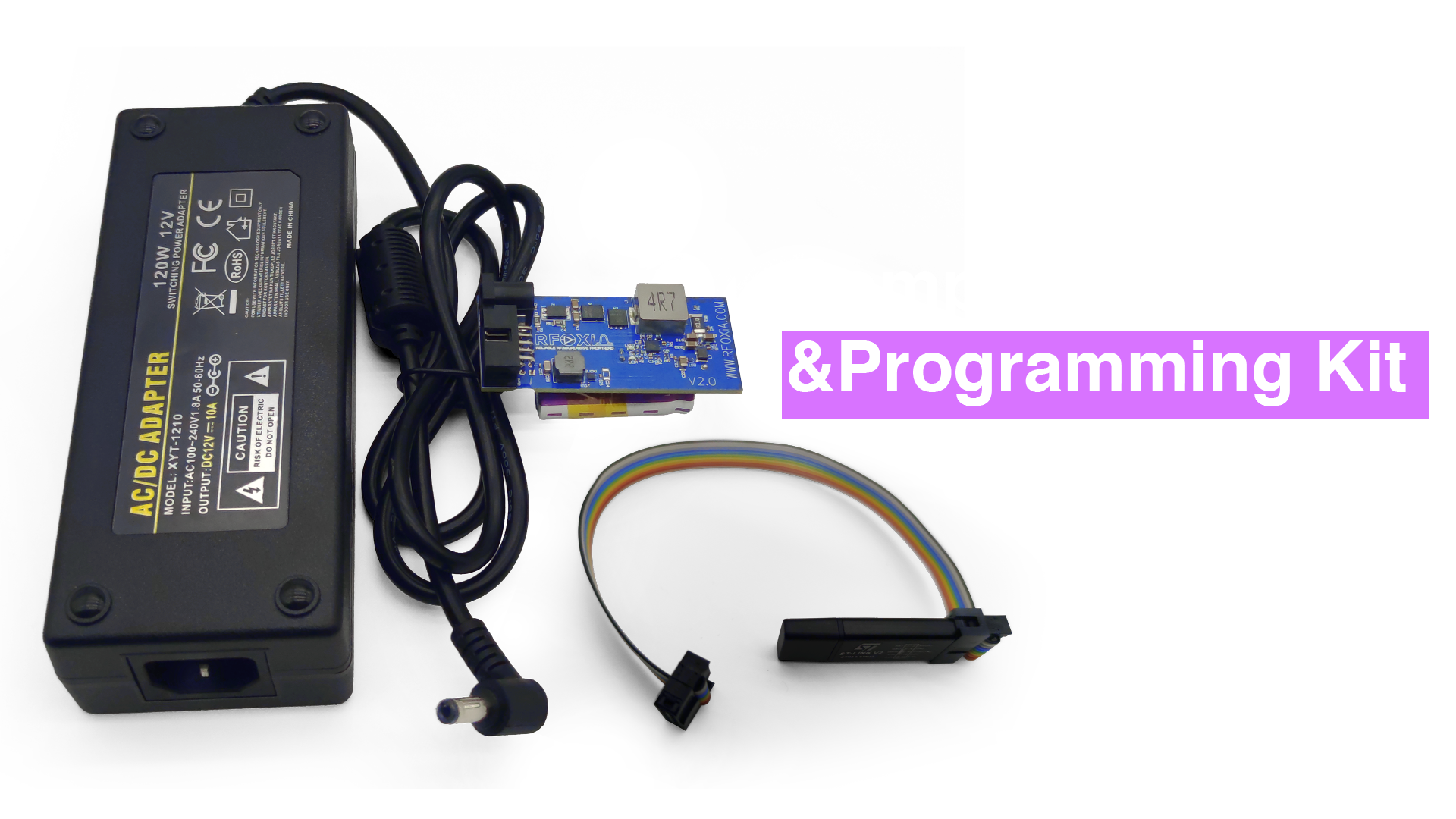
The kit ships with all necessary cables for immediate operation:
- Flat ribbon cables connecting the BLE Module to the Power/Program Kit
- Programmer interface cables connecting the STLink programmer to the BLE module
- Power adapter cable for the 12V charging input
Flat ribbon cables are a deliberate choice for embedded development environments. They maintain consistent pin alignment, resist accidental disconnection, and keep your bench or field setup clean and organized. When you're in the middle of a 6-hour development session, a cable that stays connected and properly oriented matters.
Everything you need to go from unboxing to powered, programmed, and operational is in the box. No sourcing adapters, no hunting for compatible cables, no compatibility guessing between components.
Who This Kit Is Built For
The MultiNav Pro+ Power/Program Kit is the right tool for a specific kind of builder. Here's how to know if that's you:
Drone Builders and FPV Pilots
You're integrating the MultiNav Pro+ BLE Module into a custom drone build for long-range control or telemetry. You need to flash and test firmware repeatedly across bench sessions. You need stable power that won't brown out your RF system during testing. You need the STLink programmer available every time you're at the bench. This kit is the professional infrastructure for that workflow.
IoT and Embedded Systems Developers
You're building a wireless IoT node — environmental monitoring, asset tracking, agricultural sensing, smart city infrastructure. You're developing firmware in C or using RFOXiA's AI Firmware Builder to accelerate your development cycles. You need reliable power and programming in a single kit that works every time without configuration overhead. This is the low power embedded development kit built for your workflow.
Field Researchers and Remote Deployment Teams
You're deploying sensor nodes in locations without reliable power infrastructure. You need your development system to simulate real deployment conditions — extended runtime on a single charge, stable sensor operation across temperature variations, reliable communication performance. The supercapacitor system's 24-hour runtime and temperature resilience make it an ideal research companion.
Robotics Engineers
You're building autonomous ground vehicles, robotic arms, or other platforms where the BLE Module provides the wireless control or data link. Extended bench sessions require stable power and frequent firmware iterations. The integrated STLink programmer keeps your development loop tight.
Data Network Contributors
If you're deploying MultiNav Pro+ Sensors Modules as part of the RFOXiA data network — earning daily rewards for contributing verified environmental data — the Power/Program Kit is what keeps your node running reliably through full 24-hour collection windows. One charge per day. Continuous operation. Maximum data contribution and maximum daily reward.
SuperCapacitor Technology vs. Lithium Battery: A Technical Comparison
For developers evaluating whether supercapacitor technology genuinely delivers on its performance claims, here's a direct technical comparison relevant to embedded development use cases:
| Parameter | Supercapacitor (MultiNav Pro+) | Typical LiPo Battery |
|---|---|---|
| Charge time to full | < 5 minutes | 1–3 hours |
| Cycle life | 500,000+ cycles | 300–500 cycles |
| Voltage sag under peak load | Minimal | Moderate to significant |
| Temperature range | -40°C to +65°C | 0°C to +45°C optimal |
| Safety | No thermal runaway risk | Thermal runaway risk if damaged |
| Runtime (full module stack) | 24 hours | Varies by capacity |
| Degradation over years | Negligible | Significant |
For a developer who runs multiple charge cycles per day across years of active development, the lifetime cost and reliability advantage of the supercapacitor system is substantial. The upfront investment in the RFOXiA SuperCapacitor Battery and Programmer Kit pays back in reduced replacement costs, eliminated downtime, and sustained peak performance across the entire lifecycle of your development work.
Integration with the RFOXiA Ecosystem
The MultiNav Pro+ Power/Program Kit is designed as a native component of the RFOXiA ecosystem. Every element of its design assumes you're working with MultiNav Pro+ modules and the RFOXiA development platform.
With the BLE Module: The power kit provides stable, sag-free power to the RF amplifier and STM32WB07 processor. The STLink programmer connects directly for firmware development. The flat ribbon cables maintain signal integrity across the power-programmer-module interface.
With the GNSS Module: Stable power means consistent GNSS fix acquisition. Voltage sag during peak RF transmission moments won't interrupt your GNSS lock or corrupt position data.
With the Sensors Module: All seven environmental sensors — temperature, humidity, air pressure, air quality, accelerometer, gyroscope, magnetometer — draw stable, regulated power from the supercapacitor system throughout extended data collection sessions.
With RFOXiA Club and the AI Firmware Builder: Your firmware generation and flashing workflow integrates directly. Generate production-ready firmware in the Club Dev Hub, transfer to your development machine, and flash immediately via the integrated STLink programmer. No workflow interruptions, no power management distractions.
With the Developer Bundle: The Power/Program Kit is included in the complete Developer Bundle — the comprehensive package that brings together the BLE Module, GNSS Module, Sensors Module, and Power/Program Kit in a single integrated development ecosystem. If you're building a complete wireless development capability from scratch, the Developer Bundle is the most efficient path.
Technical Specifications Summary
- Supercapacitor Capacity: 1100F
- Energy Storage: 8800 Joules
- Charge Time: Under 5 minutes
- Runtime (full module stack): 24 hours
- Charging Adapter Input: 12V / 5A
- Charging Adapter Output to Supercapacitor: 4V / 10A
- Programmer Interface: STLink (SWD)
- Compatible Microcontroller: STM32WB07 (MultiNav Pro+ BLE Module)
- Included Cables: Flat ribbon (power), programmer interface, charging adapter
- Certification: FCC certified
- Price: $119
Why FCC Certification Matters for Your Development Kit
FCC certification is not a checkbox. For hardware that operates as part of a wireless development system — particularly one intended for commercial or commercial-adjacent applications — FCC certification is the difference between a product you can deploy professionally and one you cannot.
The MultiNav Pro+ Power/Program Kit is FCC certified, as are all four MultiNav Pro+ modules. This means:
- You can use this kit in professional research environments without regulatory concerns
- You can deploy systems built with these components in commercial settings
- Distributors, resellers, and enterprise clients can accept your hardware without requiring separate certification documentation
For a developer working toward any kind of commercial deployment — data network contribution, custom drone builds for clients, IoT product development — FCC certification on your development infrastructure is a prerequisite, not an upgrade.
Ready to Build Without Limits?
The MultiNav Pro+ Power/Program Kit was built for developers who take their work seriously. Five minutes to full charge. Twenty-four hours of runtime. Integrated STLink programmer. Professional-grade supercapacitor technology at a price point that belongs in a maker's toolkit, not a military procurement budget.
This is what a purpose-built low power embedded development kit looks like when it's engineered by someone who builds hardware for a living and has lived every power management frustration this kit was designed to solve.
If you're ready to eliminate power and programming friction from your embedded development workflow, explore the RFOXiA SuperCapacitor Battery and Programmer Kit and see the complete technical specifications, pricing, and compatibility information.
And if you're building a complete wireless development capability from scratch, explore the full MultiNav Pro+ ecosystem at RFOXiA Club — where you'll find the Developer Bundle, AI Firmware Builder, data network access, and a community of serious hardware builders working on projects that push wireless technology forward.
Your next development session doesn't have to start with a 2-hour wait. It can start in 5 minutes.
RFOXiA builds professional-grade wireless hardware and development tools for makers, engineers, and researchers. All MultiNav Pro+ modules are FCC certified and available for immediate delivery.
Written by: Moamen Mohamed LinkedIn