
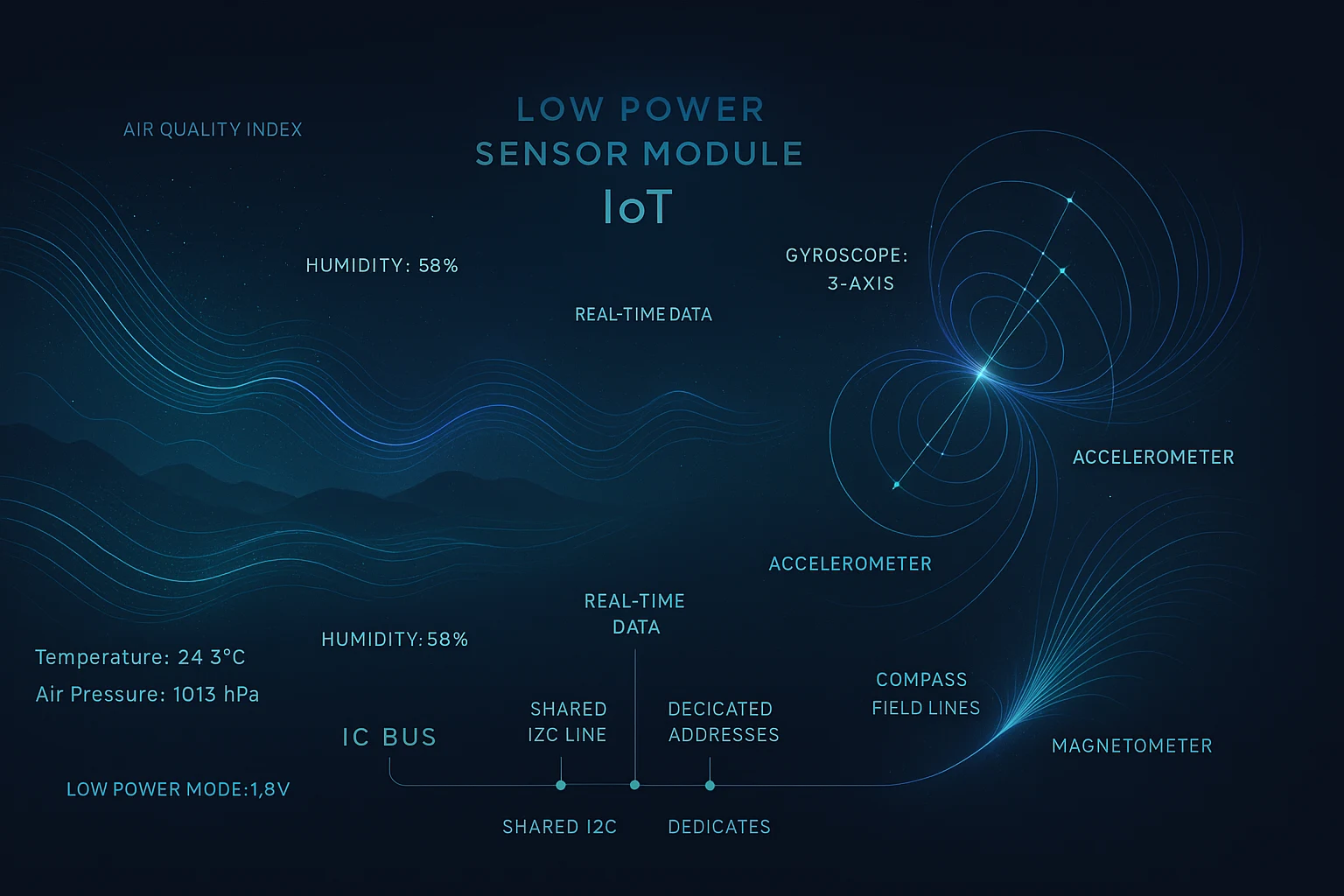
Low Power Sensor Module IoT: The MultiNav Pro+™ Sensors Module That Changes Everything
RFOXiA Integrated Sensors Module
The Ultimate Low Power Sensor Module IoT Builders Have Been Waiting For
If you have spent any meaningful time building IoT systems, robotics platforms, or drone payloads, you already know the frustration. You need motion data. You need environmental data. You need all of it to run on minimal power, fit into a tight form factor, communicate cleanly over a shared bus, and not require you to spend three weeks sourcing, soldering, and integrating five different breakout boards from five different manufacturers.
The hardware ecosystem has not made this easy — until now.
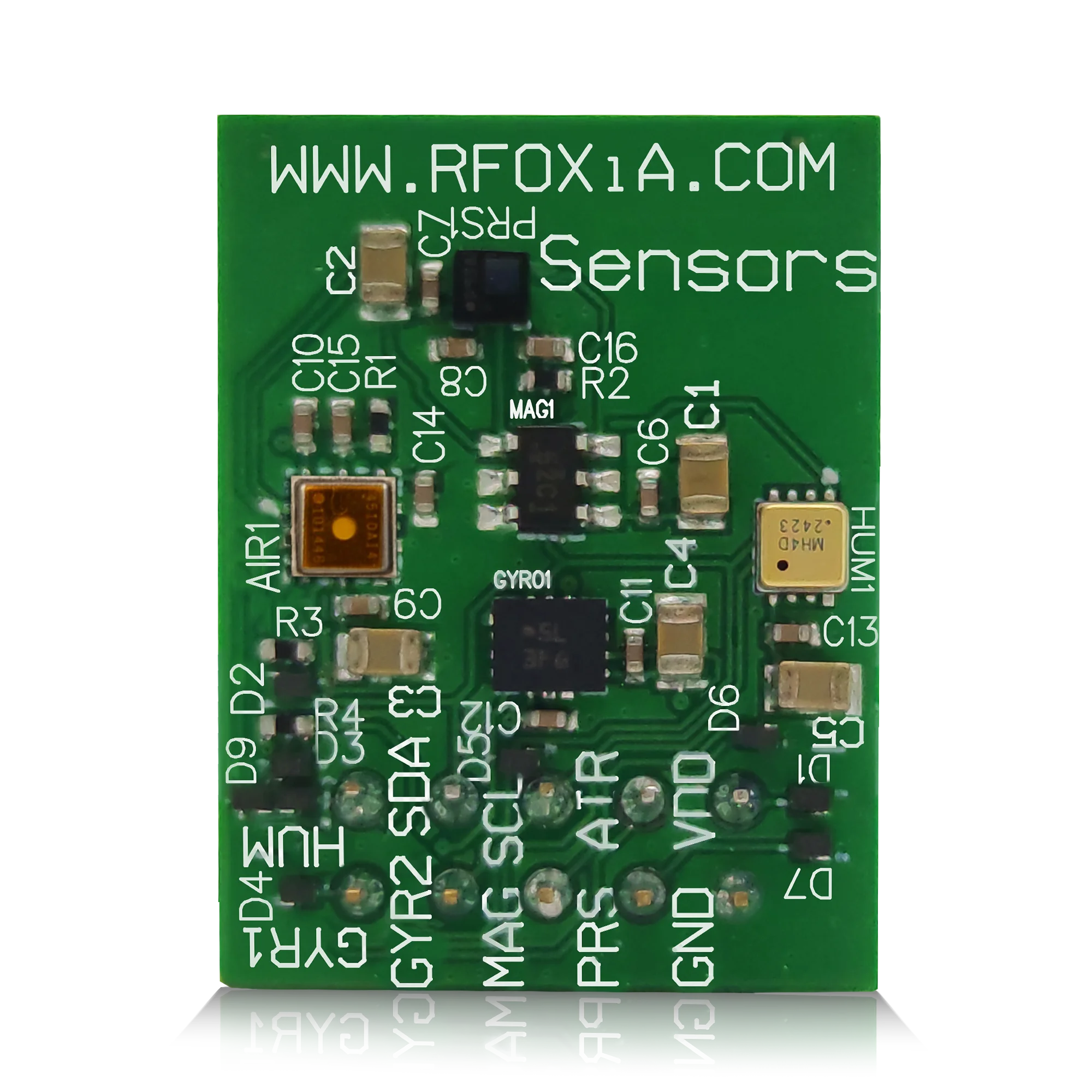
The MultiNav Pro+™ Sensors Module from RFOXiA is a purpose-built, FCC-certified low power sensor module IoT platform that puts seven professional-grade sensors on a single 24mm × 18mm board, communicating over a single I2C line, ready to drop into your project the day it arrives. This is not a hobbyist breakout board. This is professional sensor integration designed for developers who build real things that operate in real environments.
In this post, we will cover everything you need to know about this module: what it contains, how it works, what makes it different from anything else on the market, and exactly which applications it is designed for. If you are evaluating sensor modules for your next build, read this carefully — because this one is in a category by itself.
What Is Inside the MultiNav Pro+™ Sensors Module?
Seven sensors. One board. One I2C bus. Every sensor selected from a tier-one semiconductor manufacturer with a proven track record in demanding applications.
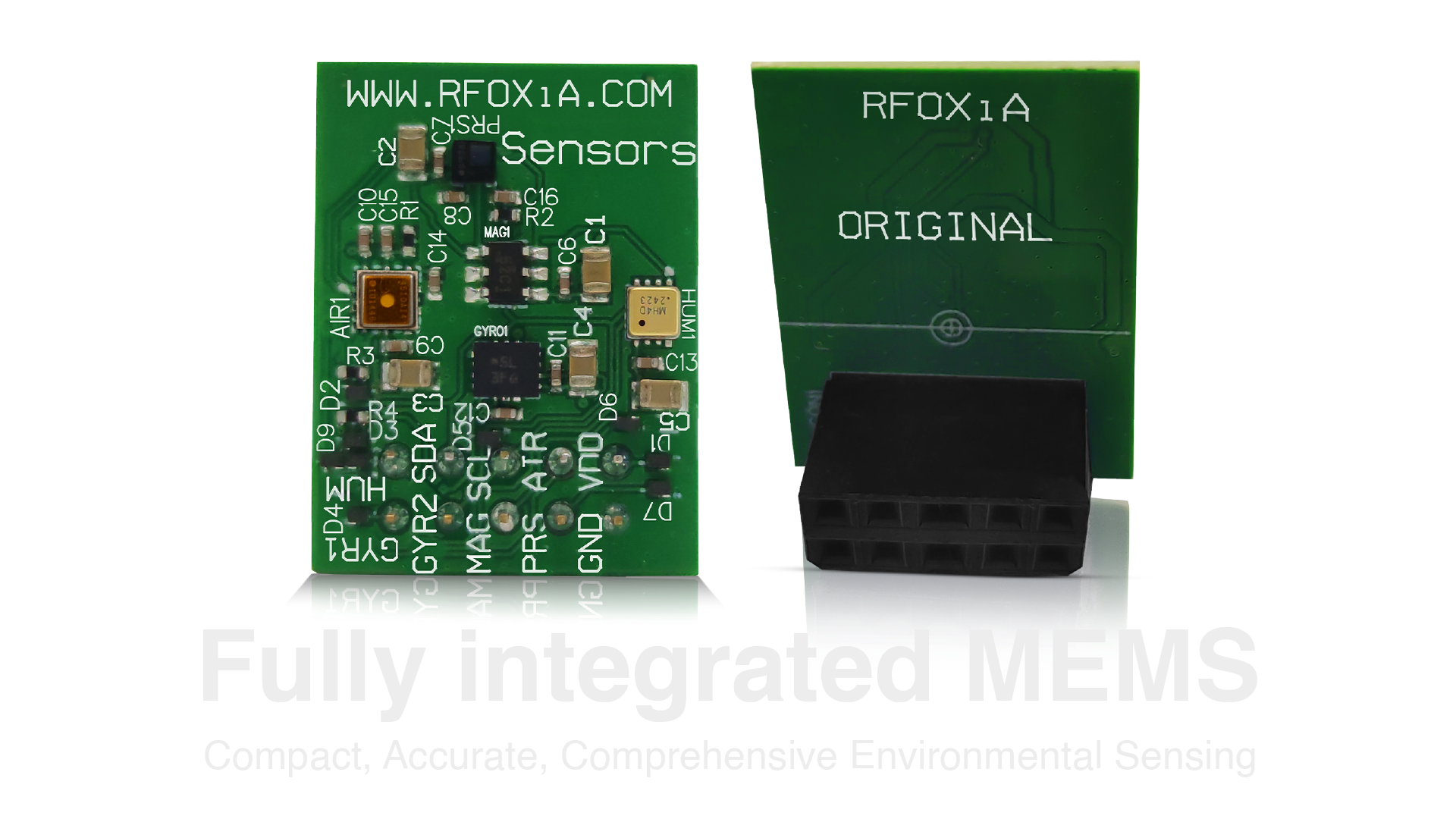
Here is the complete sensor lineup:
Motion Sensing
Accelerometer and Gyroscope: BMI270 from Bosch Sensortec The BMI270 is not a consumer-grade IMU. It is a smart, low-power inertial measurement unit engineered specifically for wearable and high-performance applications. It delivers precise six-axis motion data with ultra-low noise and power consumption, making it ideal for applications where the processor needs to stay informed without burning through your power budget. Bosch built the BMI270 with advanced power modes that allow it to operate in the background without dominating the system's energy footprint.
Magnetometer: TMAG5273C1QDBVR from Texas Instruments The TMAG5273 is a high-precision, low-power 3D Hall-effect sensor from Texas Instruments. It provides accurate magnetic field measurements across three axes and includes a built-in temperature sensor for compensation. For compass heading, motor position sensing, and navigation applications, this sensor provides data quality that is not typically found in consumer-grade modules.
Environmental Sensing
Air Pressure: LPS22HHTR from STMicroelectronics STMicroelectronics' LPS22HH is a high-accuracy MEMS pressure sensor with an absolute pressure range of 260 to 1260 hPa. It is a workhorse in professional drone altimetry and weather station applications. The LPS22HH delivers reliable pressure readings with excellent temperature stability and is optimized for low power continuous operation — exactly what you need in a battery-powered IoT node.
Humidity and Temperature: MVH4003D from MEMSVision The MVH4003D delivers calibrated, compensated temperature and relative humidity data in a miniature MEMS package. MEMSVision designs sensors specifically for challenging environments, and the MVH4003D reflects that design philosophy with fast response time and stable long-term accuracy.
Air Quality: ZMOD4510AI4R from RENESAS The ZMOD4510 from Renesas is an outdoor air quality sensor designed to detect ozone and nitrogen dioxide — the markers most relevant for outdoor environmental monitoring, air quality indexing, and smart city applications. This is not a generic VOC sensor. Renesas engineered the ZMOD4510 for the precision demanded by environmental monitoring applications, including the kind of data collection that RFOXiA's data network rewards its contributors for.
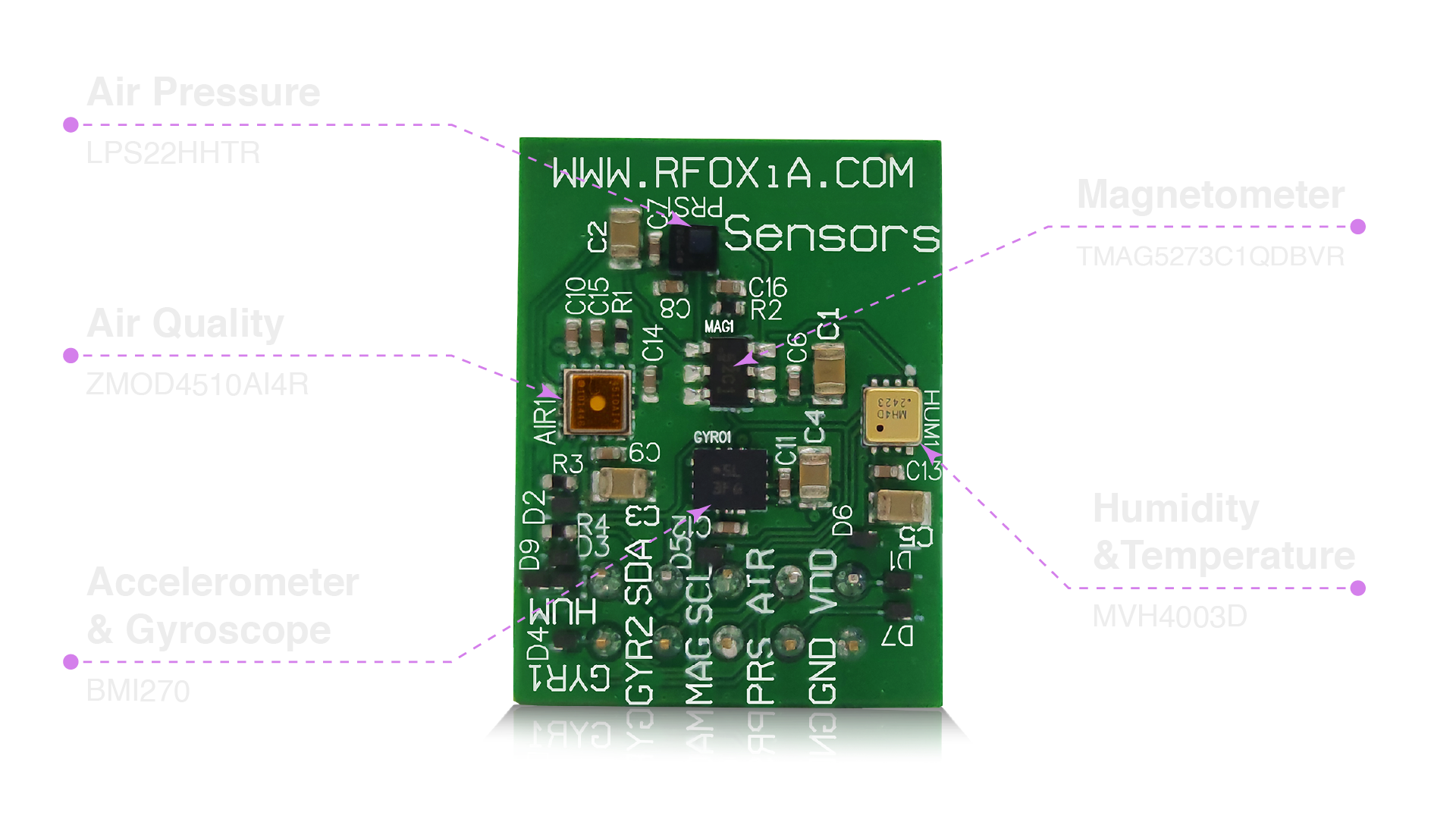
Every sensor on this board was selected deliberately. This is not a bill of materials built around whatever was cheapest or most available. It is a curated collection of best-in-class sensors from Bosch, Texas Instruments, STMicroelectronics, MEMSVision, and Renesas — names that engineers trust when the data actually matters.
Precision Motion and Environmental Sensing: Both Worlds in One Module
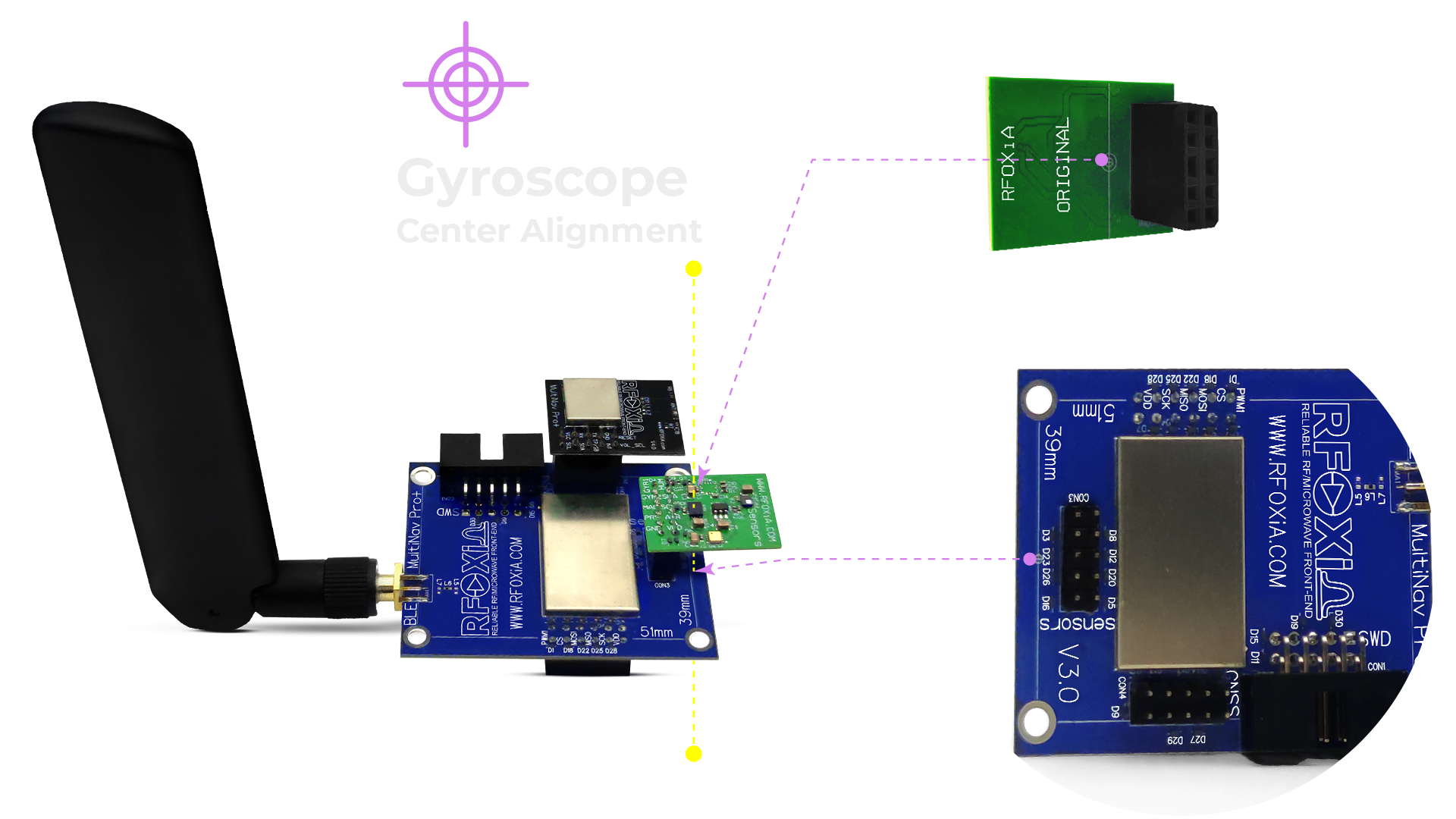
Most sensor boards specialize in one domain. You can find a good IMU breakout board from several vendors. You can find environmental sensor boards that read temperature and humidity. What almost nobody offers is a single board that delivers professional-quality motion sensing and professional-quality environmental sensing simultaneously, in a package small enough to fly on a drone.
The MultiNav Pro+™ Sensors Module does exactly that.
The motion sensing cluster — the BMI270 accelerometer/gyroscope combined with the TMAG5273 magnetometer — gives you nine axes of inertial data. Acceleration in X, Y, and Z. Angular rate in X, Y, and Z. Magnetic field in X, Y, and Z. From that data you can derive orientation, heading, velocity estimation, vibration analysis, and fall detection. You can run attitude and heading reference system (AHRS) algorithms, implement sensor fusion for drone stabilization, or build dead reckoning navigation when GPS is unavailable.
The environmental sensing cluster — LPS22HH for pressure, MVH4003D for temperature and humidity, and ZMOD4510 for air quality — gives you a complete picture of what is happening in the surrounding atmosphere. Pressure data enables altitude estimation without GPS. Temperature and humidity inform weather modeling and environmental compensation. Air quality data opens applications in environmental research, smart city infrastructure, and industrial monitoring.
For a drone developer, this means one board can simultaneously handle flight stabilization, altitude hold, and environmental data logging — applications that previously required three separate sensor boards and significantly more wiring complexity.
Efficient I2C Communication: One Bus, No Collisions, No Complexity
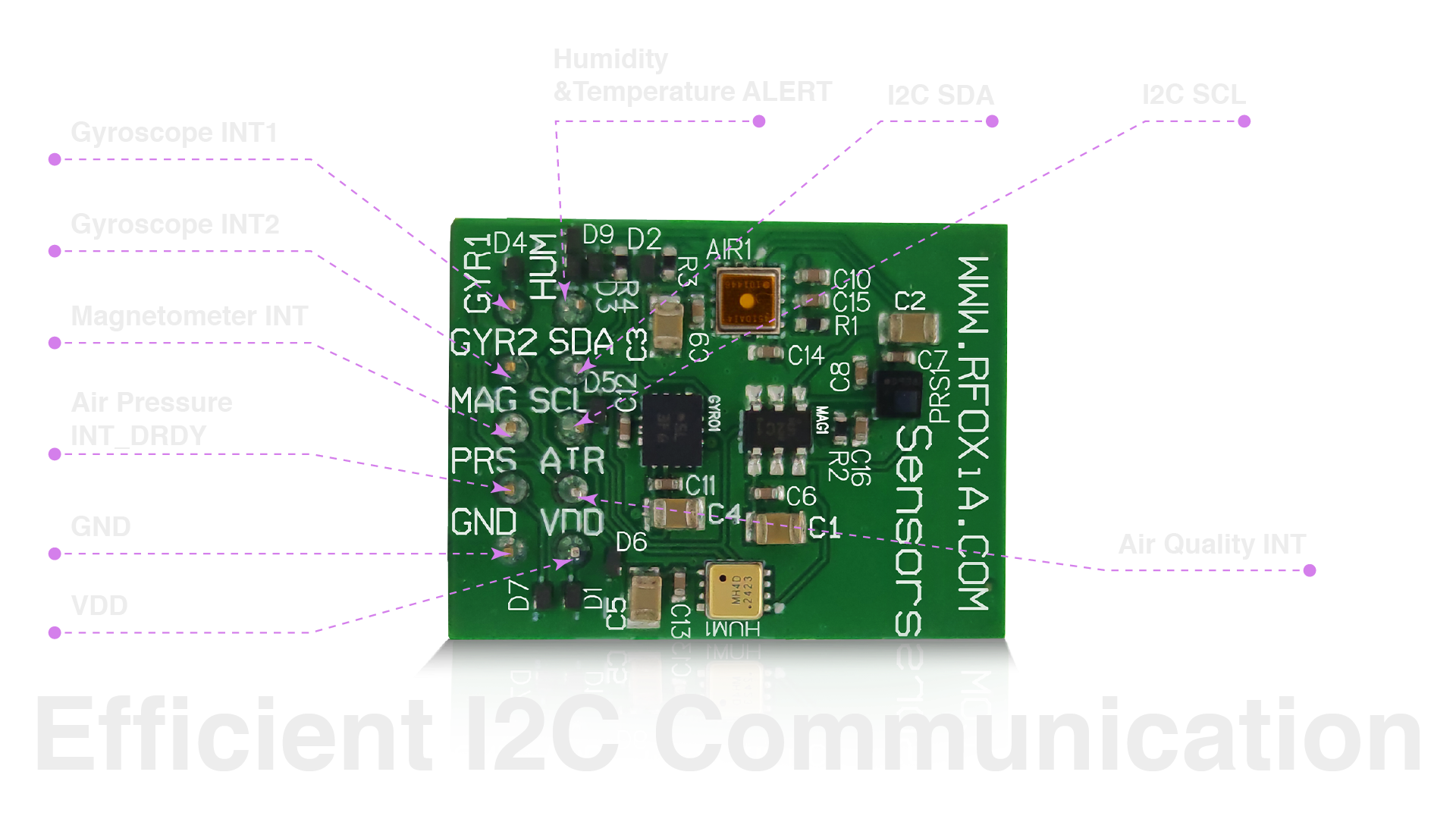
One of the most underappreciated engineering decisions in the MultiNav Pro+™ Sensors Module is its I2C architecture. All seven sensors share a single I2C bus. Each sensor has a dedicated, unique I2C address. Your microcontroller speaks to all seven sensors through two wires — SDA and SCL — with no multiplexers, no additional chip select lines, and no interrupt arbitration complexity.
This is how professional sensor integration is supposed to work. For developers who have dealt with SPI bus contention issues, conflicting I2C addresses from mixing sensors of different generations, or the nightmare of wiring five separate breakout boards into a harness that takes up more space than the payload itself, the simplicity of this bus architecture is immediately meaningful.
Practically speaking, it means:
- Reduced PCB trace routing complexity — Two signals connect your microcontroller to all seven sensors
- Lower pin count requirements — Frees GPIO pins for other functions on your main board
- Cleaner firmware architecture — A single I2C driver handles all sensor communications
- Easier debugging — Standard I2C bus analyzers capture all sensor traffic in one capture
- Scalable integration — Additional I2C peripherals can share the same bus if address space permits
For developers working in constrained environments — which is to say, most IoT developers — this level of integration is not just convenient. It is the difference between a clean, maintainable design and a tangle of wires that fails at the worst possible moment.
Compact Design: 24mm × 18mm, Built for the Real World
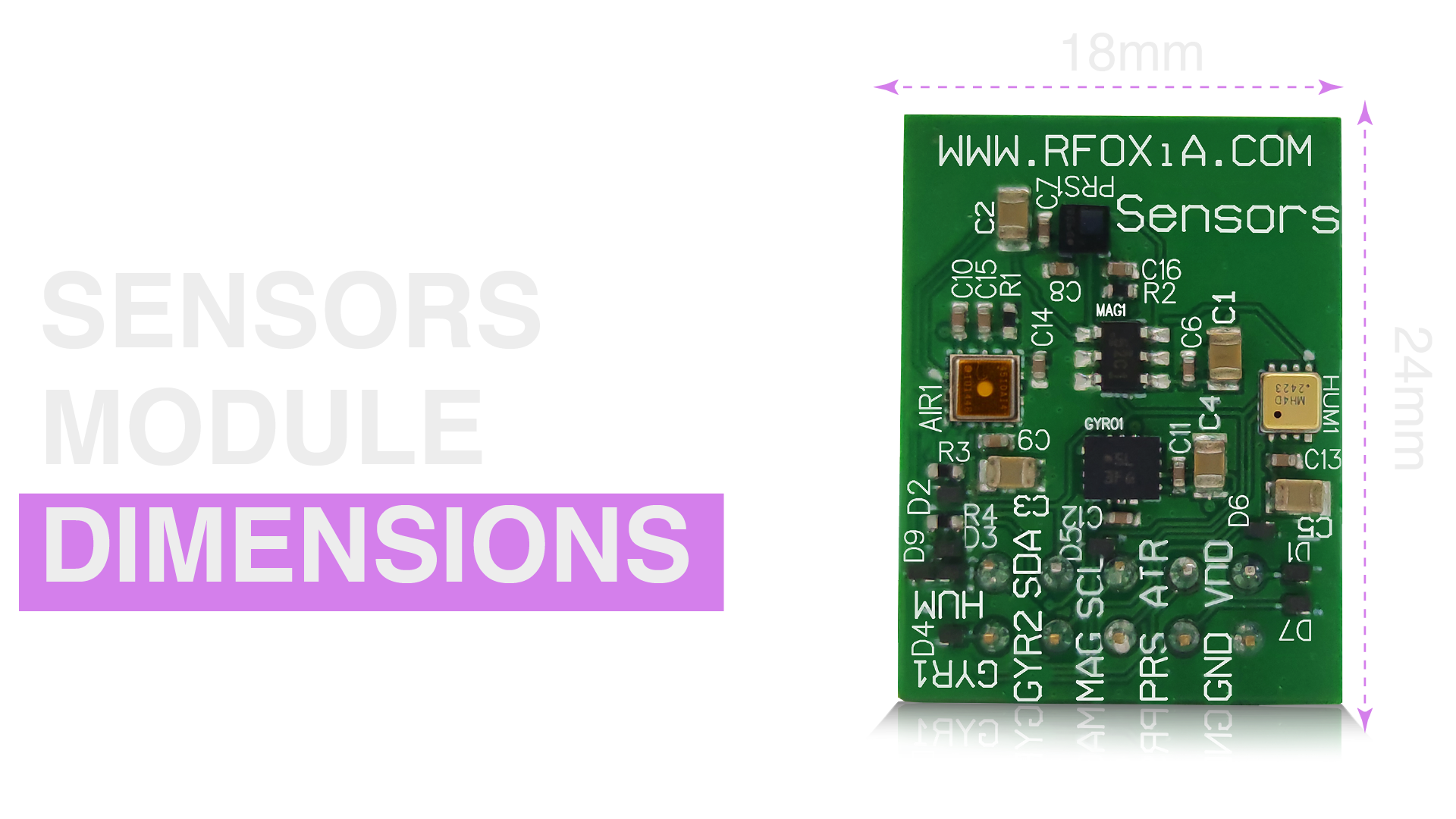
The MultiNav Pro+™ Sensors Module measures 24mm × 18mm. To put that in context, that is roughly the size of a US quarter coin, and it contains seven sensors from five different tier-one semiconductor manufacturers.
For drone builders, physical dimensions are not an aesthetic consideration — they are a design constraint. Every gram of payload weight costs flight time. Every cubic centimeter of volume competes with battery capacity, FPV camera mounts, and communication hardware. At 24mm × 18mm, the Sensors Module fits comfortably in the payload bay of even compact racing drones and fits within the footprint of most drone flight controllers, enabling clean stacking configurations.
For wearable device developers, sub-25mm form factors are essential for user comfort and device aesthetics. The MultiNav Pro+™ delivers nine-axis motion sensing and complete environmental data in a package that does not dominate the wearable's circuit board.
For compact IoT deployments — field sensors, agricultural monitoring nodes, industrial wireless sensors — smaller form factor means smaller enclosures, lower material cost, and easier weatherproofing.
The compact design is not an accident or a compromise. It reflects deliberate PCB layout engineering, careful component selection for package sizes, and the experience of building hardware that actually has to fit into real products.
Real-Time Environmental Data: What It Enables for Your Application
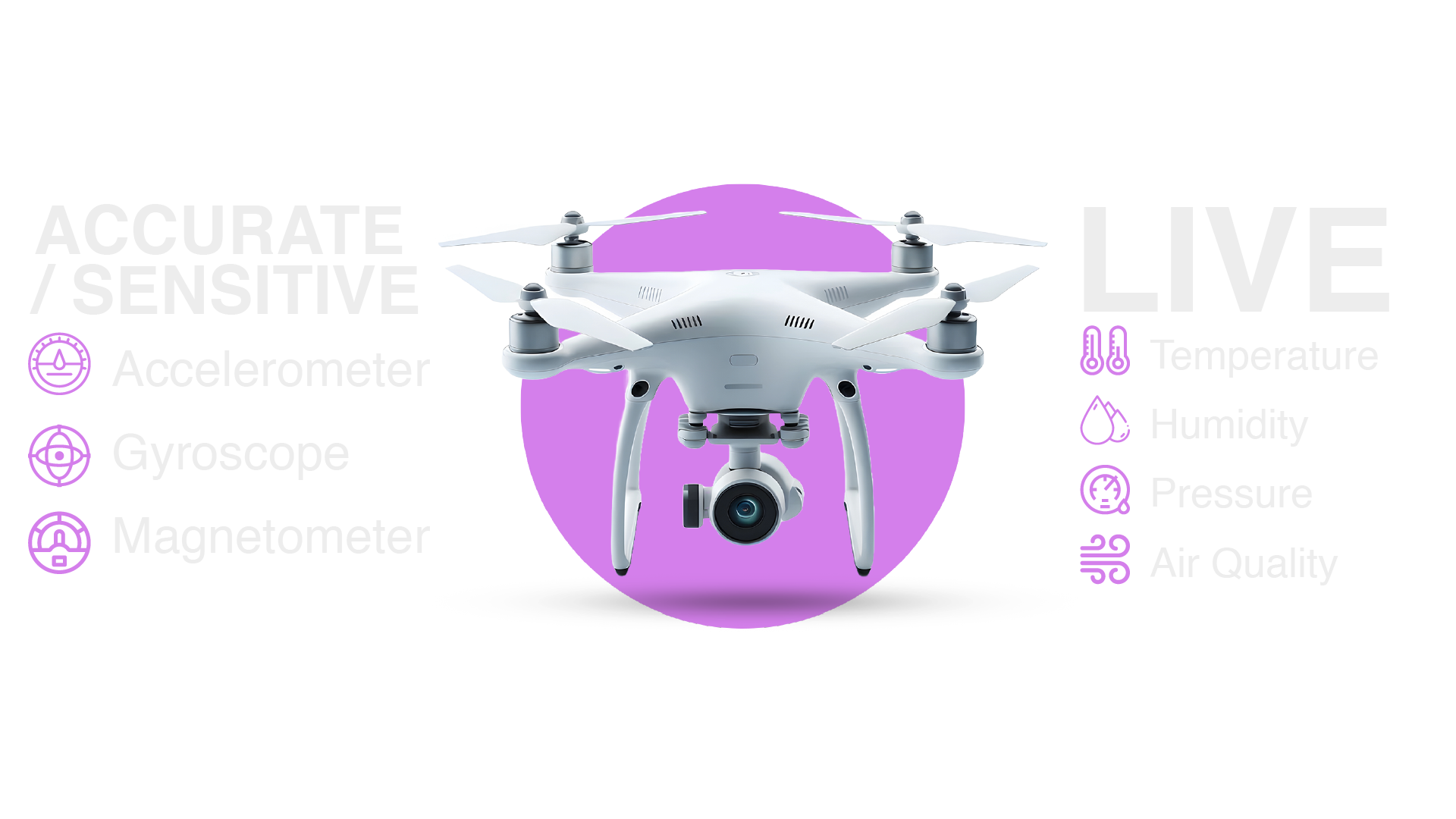
Real-time environmental data is the input that separates adaptive systems from fixed-response systems. A system that knows its temperature, pressure, humidity, and air quality can respond to its environment rather than operating on pre-programmed assumptions.
Consider some specific examples:
Drone flight control: Atmospheric pressure affects rotor efficiency. A flight controller with real-time pressure data can adjust throttle curves as altitude changes, delivering more consistent flight performance at varying elevations. Temperature affects battery chemistry — a system that knows the battery temperature can adjust discharge management accordingly.
Agricultural monitoring: Micro-climate variation across a single field can be dramatic. Real-time humidity and temperature data at multiple deployment points reveals moisture gradients that satellite imagery cannot detect. Air quality sensors detect dust, smoke, and airborne chemicals that indicate pest activity or crop disease before visual symptoms appear.
Industrial IoT: Equipment operating in high-temperature or high-humidity environments degrades faster. Sensors that monitor ambient conditions allow predictive maintenance systems to adjust service intervals based on actual operating environment rather than fixed schedules.
Smart city infrastructure: Street-level air quality monitoring at second-level temporal resolution provides data granularity that fixed weather stations and satellite observations cannot match. This is exactly the kind of hyper-local data that climate researchers, city planners, and logistics companies pay for.
The MultiNav Pro+™ Sensors Module is the hardware node that makes all of these applications possible — and when combined with the RFOXiA data network, it becomes a node that earns rewards for every verified data session it contributes.
The RFOXiA Ecosystem: More Than a Sensor Module
The MultiNav Pro+™ Sensors Module is designed to operate as part of the complete RFOXiA wireless ecosystem. When paired with the MultiNav Pro+™ BLE Module, sensor data streams over a long-range wireless link that reaches up to 5km ground-to-ground and 15-20km man-to-drone. When paired with the GNSS Module, every sensor reading is geographically tagged with 1.5-meter accuracy at 18Hz fix rate.
The RFOXiA Connect app displays live sensor data on your mobile device in real time, with no internet connection required. The RFOXiA Club platform provides AI-powered firmware development tools that can generate production-ready code for your sensor integration in hours rather than weeks.
And critically — when your Sensors Module is deployed outdoors and streaming verified environmental data to the RFOXiA data network, you earn daily rewards. Temperature, humidity, air pressure, air quality, and GPS location data from verified outdoor deployments earns contributors between $0.08 and $0.40 per day depending on location, data quality, and network tier. Your low power sensor module IoT node pays for itself.
This is the core value proposition that makes the MultiNav Pro+™ Sensors Module genuinely unique in the market: it is not just a sensor board. It is an active participant in a data economy that compensates the people who build and deploy it.
Explore the full capability of the RFOXiA Integrated Sensors Module and see how it fits into the complete ecosystem.
Application Breakdown: Who Should Be Using This Module

The MultiNav Pro+™ Sensors Module is a purpose-built low power sensor module IoT platform that serves a wide range of professional and advanced maker applications. Here is a breakdown by use case:
Drone Builders and FPV Pilots
Flight stabilization, altitude hold, compass heading, and real-time environmental monitoring in one module. Reduces payload weight and simplifies wiring compared to using separate sensor boards.
Robotics Engineers
Nine-axis motion sensing for robot navigation, orientation tracking, and fall detection. Environmental sensors enable context-aware behavior — a robot that knows it is in a high-temperature environment can adjust duty cycle to protect motors and electronics.
Environmental Researchers
Field-deployable sensor nodes that provide temperature, humidity, pressure, and air quality data with GPS validation. Battery-powered or supercapacitor-powered deployment with the RFOXiA Power/Program Kit enables weeks of continuous unattended operation.
Smart City Developers
Street-level environmental monitoring infrastructure that provides data resolution beyond what fixed weather stations can offer. The RFOXiA data network provides a commercial pathway for monetizing this data.
Precision Agriculture Operators
Micro-climate monitoring across field sections, soil environment correlation, crop stress early detection through air quality monitoring, and irrigation optimization through humidity tracking.
Industrial IoT Engineers
Environmental monitoring in manufacturing, storage, and logistics facilities. Equipment health monitoring through vibration analysis using the accelerometer and gyroscope. Predictive maintenance triggers based on ambient condition thresholds.
Wearable Device Developers
Nine-axis motion capture for fitness, health, and industrial safety wearables. The compact form factor and efficient I2C architecture simplify integration into custom PCB designs.
Data Network Contributors
Anyone who wants to deploy a verified environmental sensor node, earn daily data rewards, and contribute to a growing commercial dataset that serves enterprise buyers in agriculture, insurance, logistics, and climate science.
Why the MultiNav Pro+™ Sensors Module Is a Low Power Sensor Module IoT Platform, Not Just a Board
Low power operation is not a single specification — it is a system-level design philosophy that manifests across every component selection, power mode configuration, and bus architecture decision in the product.
The BMI270 from Bosch operates in multiple low-power modes, including a low-power accelerometer mode that draws under 20µA and a suspend mode for when motion sensing is not required. The LPS22HH from STMicroelectronics draws as little as 3µA in one-shot measurement mode. The TMAG5273 from Texas Instruments includes sleep and wake-on-interrupt capabilities. The ZMOD4510 from Renesas is specifically designed for long-duration outdoor deployment with intelligent power cycling.
The I2C bus architecture itself contributes to low power operation — a single shared bus means no additional power overhead from multiple SPI controllers, chip select circuits, or interrupt handler conflicts that can cause unnecessary CPU wake events.
The result is a sensor module that can operate continuously in a battery-powered or supercapacitor-powered IoT node without dominating the system's power budget — and when paired with the RFOXiA Power/Program Kit's supercapacitor system, can sustain 24 hours of operation on a 5-minute charge.
This is what it means to be a genuinely engineered low power sensor module IoT solution rather than a collection of breakout boards marketed as a platform.
Technical Specifications Summary
| Specification | Value |
|---|---|
| Form Factor | 24mm × 18mm |
| Communication Interface | I2C (single bus, dedicated addresses) |
| Accelerometer / Gyroscope | BMI270 — Bosch Sensortec |
| Magnetometer | TMAG5273C1QDBVR — Texas Instruments |
| Air Pressure | LPS22HHTR — STMicroelectronics |
| Humidity and Temperature | MVH4003D — MEMSVision |
| Air Quality | ZMOD4510AI4R — Renesas |
| Certification | FCC Certified |
| Price | $39 |
| Ecosystem Compatibility | RFOXiA BLE Module, GNSS Module, Power Kit, Connect App, Club Platform |
FCC Certification: Why It Matters for Your Project
FCC certification on the MultiNav Pro+™ Sensors Module is not a minor detail. For product developers who intend to commercialize their designs, FCC certification on integrated components is a fundamental requirement. Using uncertified modules in a commercial product creates compliance risk that can result in FCC enforcement action, product recalls, and channel partner rejection.
RFOXiA has pursued FCC certification on all four of its current modules precisely because the customers building with these components deserve hardware they can confidently integrate into products they sell, distribute, or deploy commercially. This level of compliance investment is uncommon in the maker hardware segment and reflects RFOXiA's positioning as a professional-grade hardware platform, not a hobbyist breakout board vendor.
Get the MultiNav Pro+™ Sensors Module
At $39, the MultiNav Pro+™ Sensors Module delivers seven professional-grade sensors from five tier-one semiconductor manufacturers, FCC certification, efficient I2C integration, and full compatibility with the RFOXiA ecosystem — in a 24mm × 18mm form factor that goes anywhere your project goes.
When you add the data network earning potential, the effective cost of this sensor module can reach zero over time for contributors who deploy it as an active environmental monitoring node.
If you are building the next generation of drones, robots, IoT infrastructure, environmental sensors, or wearable devices — and you want the cleanest, most capable low power sensor module IoT solution on the market — the MultiNav Pro+™ Sensors Module is where your bill of materials starts.
Pick up the RFOXiA Integrated Sensors Module today and get real environmental and motion data into your project from day one.
Join the RFOXiA Community
The MultiNav Pro+™ Sensors Module is fully supported through RFOXiA Club — the developer platform that includes documentation, firmware examples, an AI firmware builder that generates production-ready sensor integration code in plain language, and a developer community of builders working on similar problems.
New members receive a $10 welcome credit toward their first hardware order. If the Sensors Module is your entry point into the RFOXiA ecosystem, the Developer Bundle — which includes the BLE Module, GNSS Module, Sensors Module, and Power/Program Kit — is the most complete starting point for serious builders.
Visit the RFOXiA Integrated Sensors Module page to order, or sign up for RFOXiA Club to explore the full ecosystem, claim your welcome credit, and start building.
FCC certified. Battle tested. Ready to ship.
Written by: Moamen Mohamed LinkedIn