
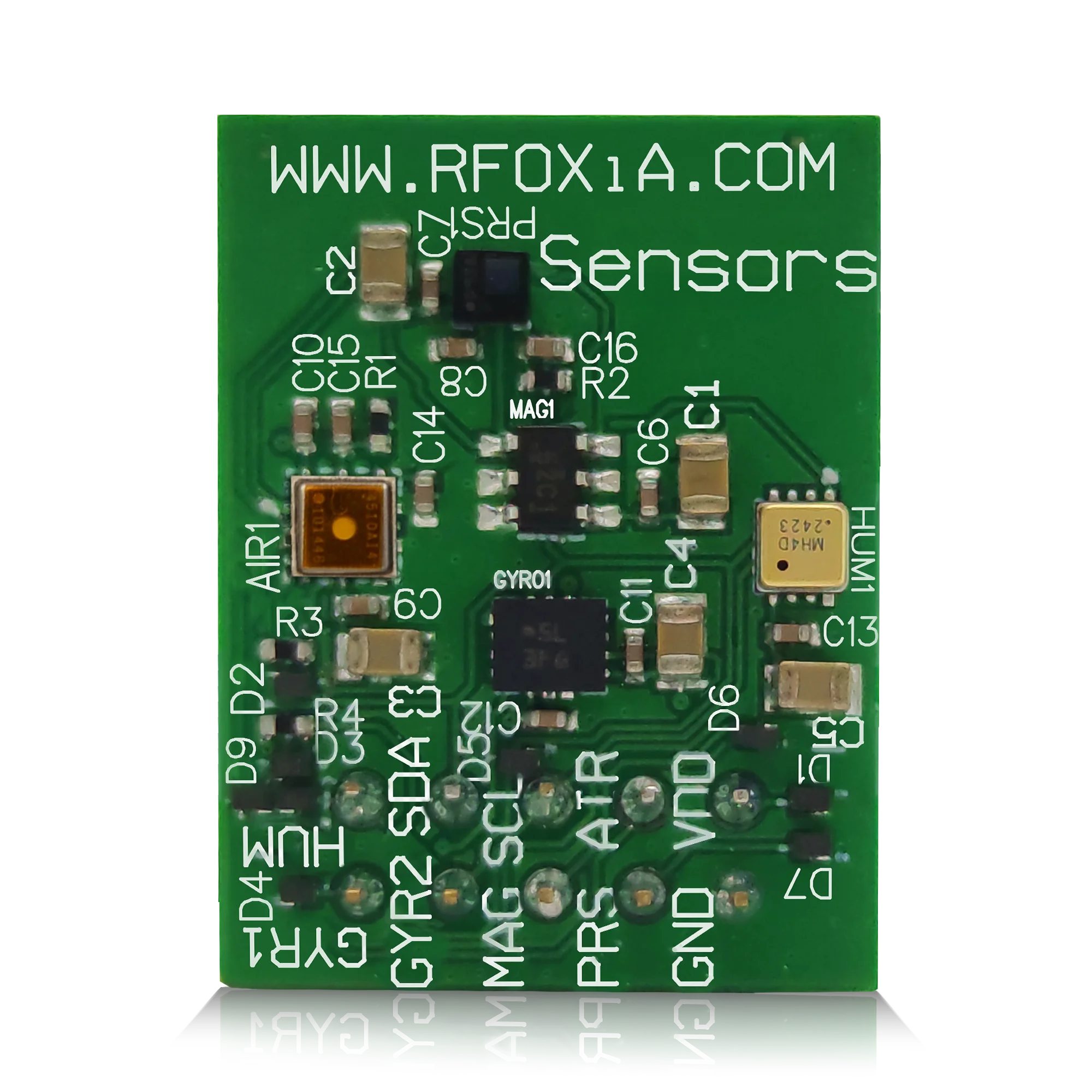
MEMS Sensors Module: The Complete 7-in-1 Array for Professional Drones and IoT
Why Every Serious Builder Needs a MEMS Sensors Module That Does It All
There is a moment every hardware developer knows well. You have a drone, a robot, or an IoT node that needs motion data, environmental context, and location awareness — and suddenly you are staring at a rats' nest of breakout boards, competing I2C addresses, power rail conflicts, and firmware libraries that refuse to coexist. You spend three days debugging a magnetometer interference issue instead of building the thing you actually came here to build.
That problem has a clean solution: the MultiNav Pro+™ MEMS sensors module from RFOXiA.
In a 24mm × 18mm footprint, this single board integrates seven professional-grade sensors from four of the most respected silicon manufacturers in the world — Bosch Sensortec, Texas Instruments, STMicroelectronics, MEMSVision, and RENESAS. Accelerometer, gyroscope, magnetometer, temperature, air pressure, humidity, and air quality. One board. One I2C line. One clean integration.
This post covers everything you need to know: what is inside the module, why the component choices matter, how to deploy it, and why it sits at the center of the RFOXiA ecosystem — including a passive data monetization network that can pay you back for every hour your sensors are running.
What Is a MEMS Sensors Module and Why Does It Matter?
MEMS stands for Micro-Electro-Mechanical Systems. MEMS sensor technology miniaturizes mechanical sensing structures — accelerometer proof masses, pressure membranes, humidity-sensitive polymers — down to the micron scale using semiconductor fabrication techniques. The result is sensors that are small enough to embed in a wristwatch, accurate enough for aerospace navigation, and cheap enough for consumer electronics.
A MEMS sensors module combines multiple MEMS sensor ICs on a single PCB with shared power conditioning, signal routing, and a standardized communication interface. Instead of sourcing, placing, and routing five to seven individual chips across your own PCB design, you drop one module onto your board, pull up two lines to VCC, and start reading data.
For professional applications — FPV racing drones, autonomous UAVs, field research instruments, precision agriculture nodes, industrial IoT deployments — the quality of the underlying MEMS components is everything. A cheap accelerometer with 20mg of zero-g offset will ruin your flight controller's attitude estimate. A humidity sensor with ±5% RH accuracy will produce environmental data that is worthless for any serious analysis. The MultiNav Pro+ was engineered from the component level up to avoid exactly these compromises.
Inside the MultiNav Pro+™: The Sensors and Why They Were Chosen
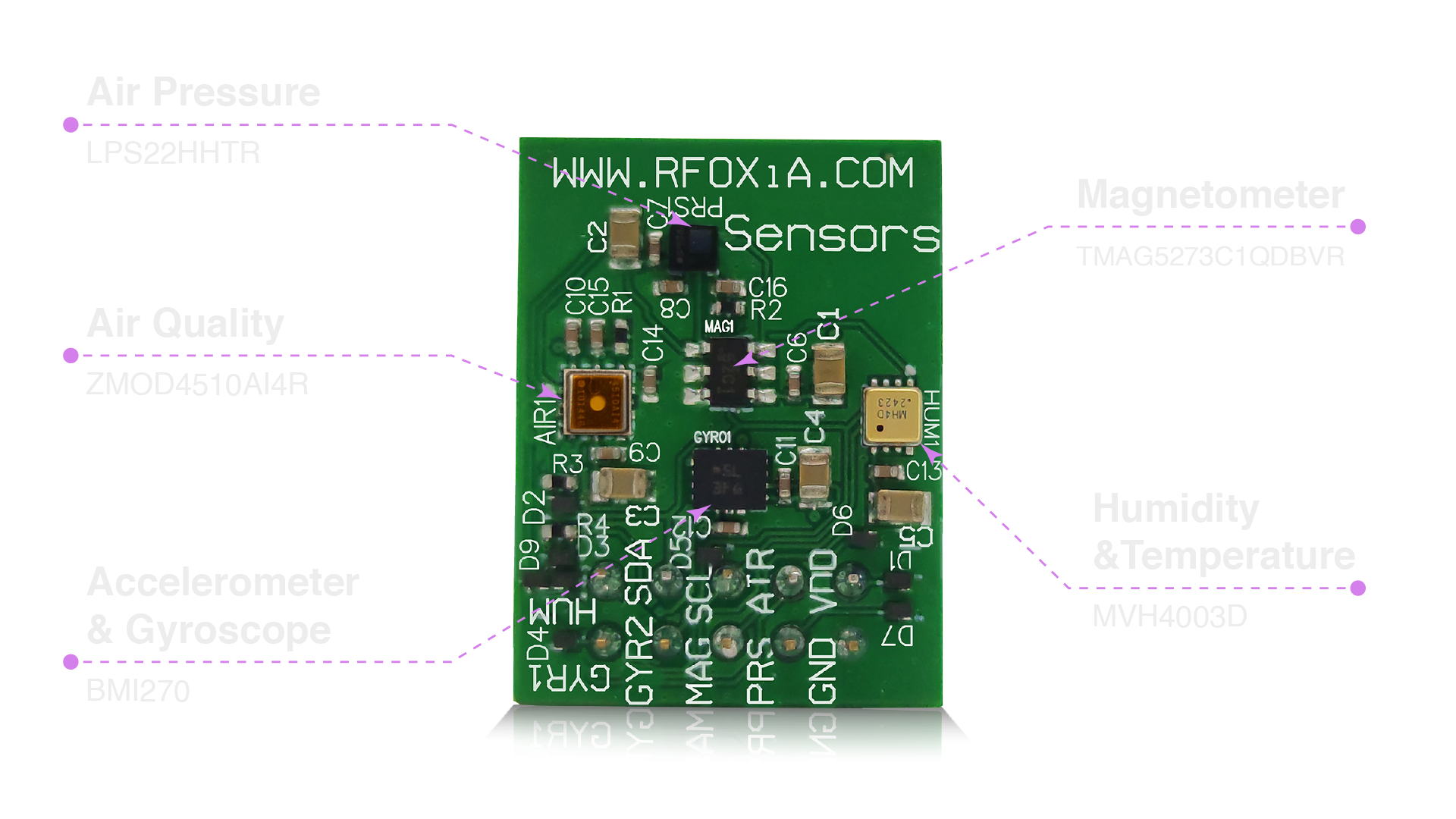
The component selection on this board is not accidental. Every sensor was chosen for its performance in demanding real-world conditions.
Accelerometer and Gyroscope: BMI270 — Bosch Sensortec
The BMI270 is Bosch Sensortec's flagship inertial measurement unit, purpose-designed for wearable and drone applications where low-latency, high-accuracy motion data is non-negotiable. It features a 16-bit accelerometer and a 16-bit gyroscope with an integrated motion engine that can perform step counting, activity recognition, and gesture detection entirely on-chip — offloading computation from your main processor.
For drone builders, what matters most is the BMI270's anti-vibration performance. The IMU includes advanced filtering and a proprietary vibration suppression algorithm that maintains accurate attitude data even when the airframe is generating significant mechanical noise from motor vibration. This is the same class of sensor used in professional flight controllers from top manufacturers.
Magnetometer: TMAG5273C1QDBVR — Texas Instruments
Compass heading accuracy is critical for GPS-assisted flight modes, autonomous waypoint navigation, and any application where your platform needs to know which direction it is pointing. The TMAG5273 from Texas Instruments is a 3D Hall-effect sensor with 12-bit resolution and an ultra-low noise floor, making it capable of detecting subtle magnetic field variations that cheaper magnetometers would classify as noise.
The automotive-qualified package variant used here also means the component is rated for extended temperature ranges — important when your drone is flying at altitude in winter or your IoT node is deployed in a hot enclosure.
Air Pressure: LPS22HHTR — STMicroelectronics
Barometric pressure serves dual purposes on mobile platforms: weather monitoring and altitude estimation. The LPS22HH from STMicroelectronics delivers absolute pressure measurement from 260 to 1260 hPa with a noise floor of 0.75 Pa RMS — fine enough to detect altitude changes of less than one meter when properly filtered. For drone operators, this means reliable barometric hold even in gusty conditions. For environmental researchers, it means pressure readings with the resolution to track frontal system movements at street level.
Humidity and Temperature: MVH4003D — MEMSVision
The MVH4003D is a capacitive MEMS humidity sensor with an integrated silicon temperature sensor. Capacitive humidity sensors are the technology of choice for precision environmental monitoring because they resist contamination, recover quickly from condensation events, and maintain calibration accuracy over time — unlike older resistive humidity sensors that drift with age and exposure.
For the RFOXiA data network, the combination of validated temperature and humidity data from a known-good sensor platform is what makes the environmental data commercially valuable to agricultural technology companies, insurance underwriters, and smart city operators.
Air Quality: ZMOD4510AI4R — RENESAS
The RENESAS ZMOD4510 rounds out the environmental sensing stack with outdoor air quality monitoring. This metal-oxide semiconductor gas sensor detects ozone and nitrogen dioxide — the two primary photochemical smog markers — using a micro-hotplate MEMS structure that heats a metal-oxide sensing layer and measures changes in electrical conductance as target gases adsorb to the surface.
What makes the ZMOD4510 appropriate for outdoor deployment in an IoT node is its power management architecture. The hotplate duty cycle can be controlled to achieve very low average power consumption, and the sensor includes an integrated signal conditioning algorithm that converts raw resistance readings into concentration estimates without requiring a separate algorithm on your microcontroller.
Taken together, this is not a collection of the cheapest available parts. It is a carefully curated stack of professional components from tier-one manufacturers, integrated onto a single MEMS sensors module that costs less than most individual breakout boards for equivalent chips.
Efficient I2C Architecture: One Bus, Zero Conflicts
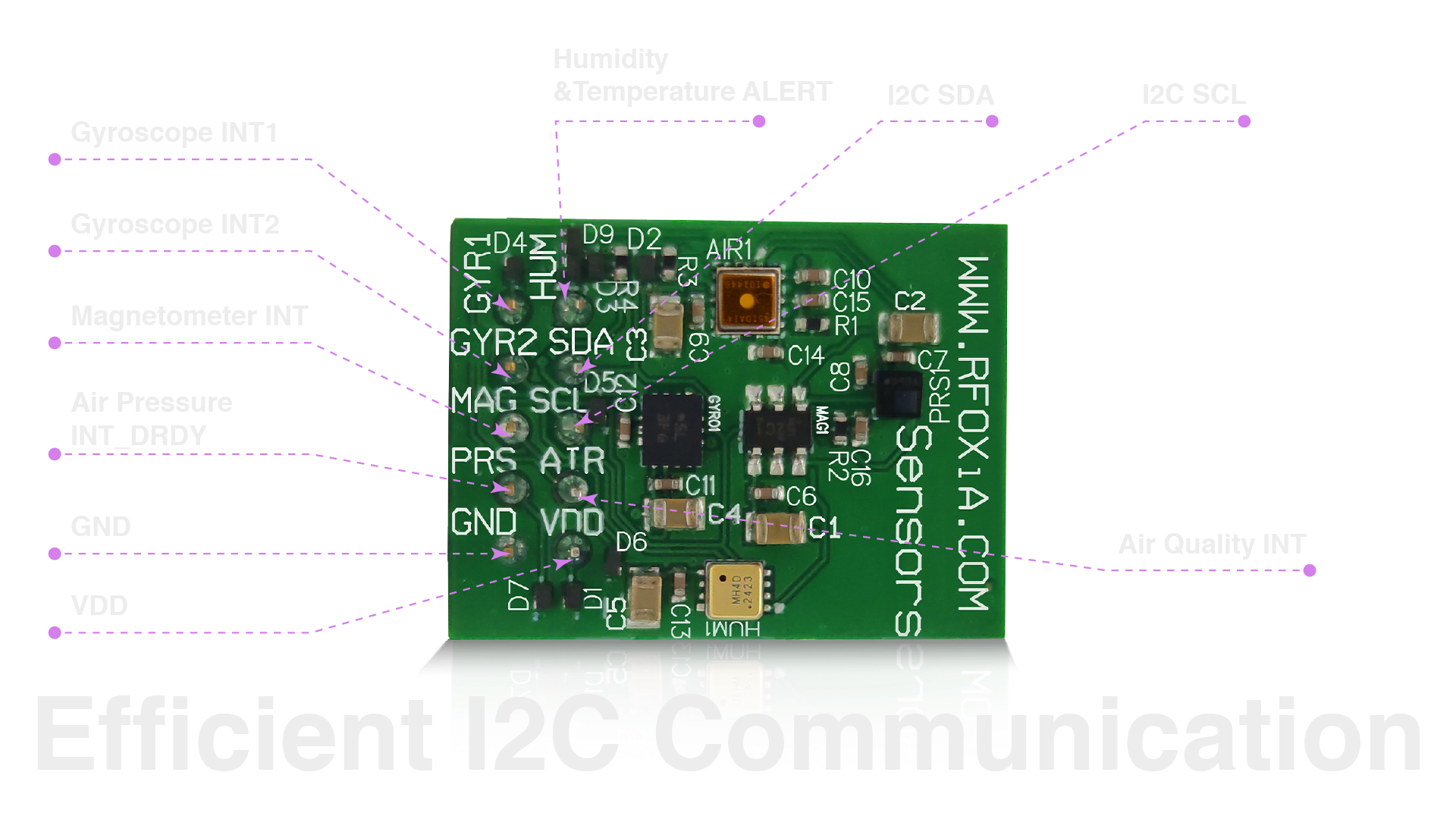
One of the most underappreciated engineering decisions in this MEMS sensors module is the I2C address architecture. All seven sensors communicate over a single I2C bus, each assigned a unique address. This means your microcontroller — whether it is an STM32, ESP32, Raspberry Pi, or Arduino — needs exactly two signal lines to talk to all seven sensors simultaneously.
I2C multi-device buses are notoriously prone to address conflicts when you are integrating sensors from different manufacturers. The MultiNav Pro+ eliminates this problem at the hardware level. There is no need for I2C multiplexers, no address remapping in software, and no risk of data collisions between the motion and environmental sensor subsystems.
For developers who want to get moving quickly, RFOXiA provides firmware examples and SDK access through the RFOXiA Sensors Module Info page, along with the AI Firmware Builder in RFOXiA Club — a tool that lets you describe your application in plain language and receive production-ready firmware with full source code in minutes.
Applications: Where This MEMS Sensors Module Belongs
Professional Drone Platforms
A UAV that carries only a flight controller IMU is flying blind to its environment. Add the MultiNav Pro+ and your drone knows the ambient temperature (critical for battery performance estimation), air pressure (barometric altitude hold), magnetic heading (GPS-assisted navigation), and air quality (compliance with environmental survey requirements). The compact 24mm × 18mm form factor means it mounts cleanly on even the tightest frames.
Field Research Instruments
Environmental researchers deploying field instruments need sensors that maintain calibration accuracy across seasons and weather events. The combination of components in this module — all sourced from manufacturers with automotive or industrial qualification grades — is appropriate for instruments that will live outdoors for months without maintenance.
Industrial IoT and Smart Factory
Factory floor IoT nodes need motion sensing to detect equipment vibration signatures that predict bearing failures, environmental sensing to track temperature and humidity in climate-controlled storage, and air quality sensing to detect process gas leaks. One MEMS sensors module handles the complete sensing requirement for a predictive maintenance node.
Wearable and Portable Devices
At 24mm × 18mm, the MultiNav Pro+ is genuinely wearable-scale. Sports performance monitors, safety wearables for industrial workers, and portable environmental loggers can all integrate this module without significant form factor compromise.
RFOXiA Data Network Nodes
This is where the hardware investment becomes a revenue-generating asset. Deploy the Sensors Module outdoors with a GNSS module for GPS validation, connect it to the RFOXiA data network, and your node begins earning daily rewards for every verified environmental data session it streams. The network pays $0.08–$0.40 per day depending on location scarcity, uptime, and network tier — with founding members locked into the highest available rates.
Enterprise buyers — agricultural technology companies, smart city operators, insurance underwriters, logistics firms, and climate researchers — pay for this hyper-local, high-temporal-resolution environmental data because it does not exist at this resolution in any public data source. Your sensor fills that gap and earns money while doing it.
The RFOXiA Ecosystem Advantage
The MultiNav Pro+ Sensors Module does not exist in isolation. It is one component of a vertically integrated wireless developer ecosystem that includes:
- MultiNav Pro+ BLE Module — 5km ground-to-ground, 15–20km man-to-drone long-range Bluetooth communication, FCC certified at $59 for two units
- MultiNav Pro+ GNSS Module — 1.5-meter accuracy at 18Hz fix rate, purpose-built for fast-moving drone platforms
- Power/Program Kit — supercapacitor-based power system with 5-minute charge time and 24-hour runtime, eliminating field battery management
- RFOXiA Connect App — iOS and Android mobile application with PS5-style controller interface, live GPS map, and real-time sensor data display
- AI Firmware Builder — describe your application in plain language, receive production-ready firmware with full source code
- RFOXiA Club — developer community, project sharing, documentation, and the data monetization dashboard
When you deploy the Sensors Module alongside the BLE Module and GNSS Module — available together in the Developer Bundle — you have a complete wireless environmental sensing and control platform that communicates at professional range, earns passive income from data contributions, and can be controlled from your phone without any internet connection.
No competitor offers this combination. Commodity sensor breakout boards have no ecosystem. Industrial sensor platforms start at five to ten times the price and ship without any wireless infrastructure, community, or monetization layer.
Technical Specifications Summary
| Parameter | Specification |
|---|---|
| Form Factor | 24mm × 18mm |
| Communication | I2C (single bus, dedicated addresses) |
| Accelerometer / Gyroscope | BMI270 — Bosch Sensortec |
| Magnetometer | TMAG5273C1QDBVR — Texas Instruments |
| Air Pressure | LPS22HHTR — STMicroelectronics |
| Humidity and Temperature | MVH4003D — MEMSVision |
| Air Quality | ZMOD4510AI4R — RENESAS |
| Certification | FCC certified |
| Price | $39 |
| Compatibility | Full RFOXiA ecosystem, any I2C host |
FCC Certification: Why It Matters for Deployment and Distribution
Every module in the RFOXiA lineup carries FCC certification — and the Sensors Module is no exception. For builders deploying nodes in commercial or research contexts, FCC certification is not optional. It determines whether your product can be legally sold in the United States, accepted by major distributors like DigiKey and Mouser, and integrated into commercial systems without triggering regulatory complications.
For makers and researchers, FCC certification means the module has been tested and verified to meet electromagnetic interference standards, which in practical terms means your sensors are not going to interfere with each other or with the wireless modules they sit alongside.
Getting Started with the MultiNav Pro+ Sensors Module
Getting the Sensors Module running in your project takes three steps:
Step 1 — Hardware integration. Connect VCC, GND, SDA, and SCL to your microcontroller. The module's single I2C bus supports standard and fast mode operation. Pull-up resistors are integrated on the module.
Step 2 — Firmware. Visit the RFOXiA Sensors Module Info page for firmware examples, initialization sequences, and register maps for each sensor. If you prefer to generate custom firmware for your specific application, the AI Firmware Builder in RFOXiA Club accepts plain-language descriptions and returns full source code.
Step 3 — Data and monetization. If your deployment is outdoors with a GNSS module providing GPS validation, connect your node to the RFOXiA data network through the Club dashboard. Your sensor begins contributing verified environmental data and earning daily rewards automatically.
For developers who want the complete ecosystem from day one, the Developer Bundle combines the Sensors Module with the BLE Module, GNSS Module, and Power/Program Kit at a bundled price — and new RFOXiA Club signups receive a $10 welcome credit toward their first purchase.
The Bottom Line
If you are building a drone, robot, field instrument, or IoT node that needs professional-grade environmental and motion sensing, the MultiNav Pro+™ is the most capable MEMS sensors module available at anywhere near this price point. Seven sensors from tier-one manufacturers. One I2C bus. FCC certified. 24mm × 18mm. $39.
And unlike any other sensor breakout board on the market, this one connects to a data monetization network that can turn your deployment into a passive income asset.
The full specifications, firmware resources, and ordering information are available at RFOXiA Sensors Module Info. Join RFOXiA Club free to claim your $10 welcome credit and access the AI Firmware Builder, developer community, and data network dashboard.
Build something real. Get paid for the data it generates. That is the RFOXiA difference.
Written by: Moamen Mohamed LinkedIn