
Multi-Constellation GNSS Module: Precision Navigation for Every Builder
The Multi-Constellation GNSS Module That Changes What's Possible at This Price Point
Precision navigation used to be a privilege reserved for well-funded aerospace programs, military contractors, and enterprise survey teams. If you were a drone builder, robotics engineer, IoT developer, or independent researcher, you were left choosing between cheap modules with mediocre accuracy and industrial-grade solutions priced so far out of reach they might as well not exist.
The RFOXiA MultiNav Pro+ was built to end that compromise.
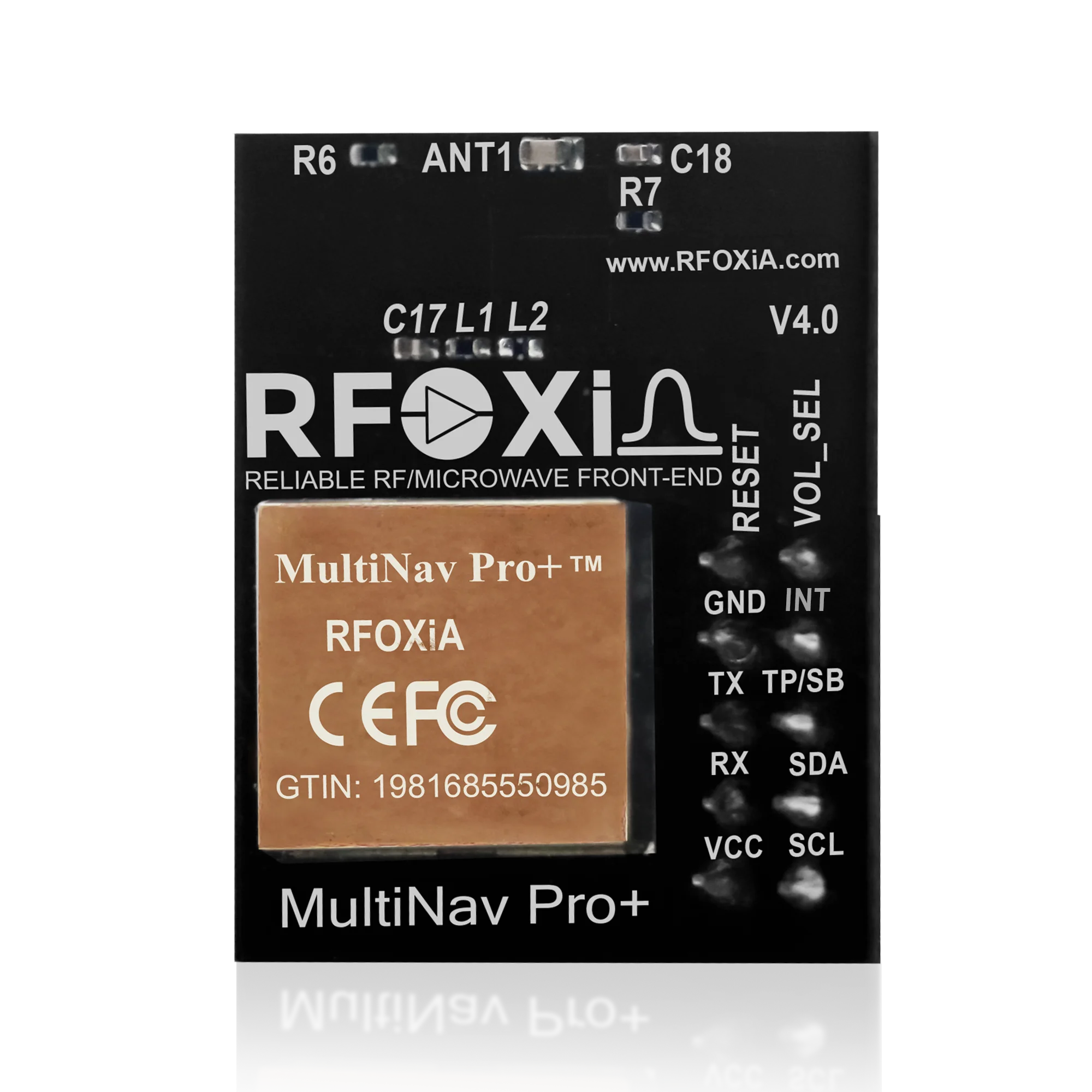
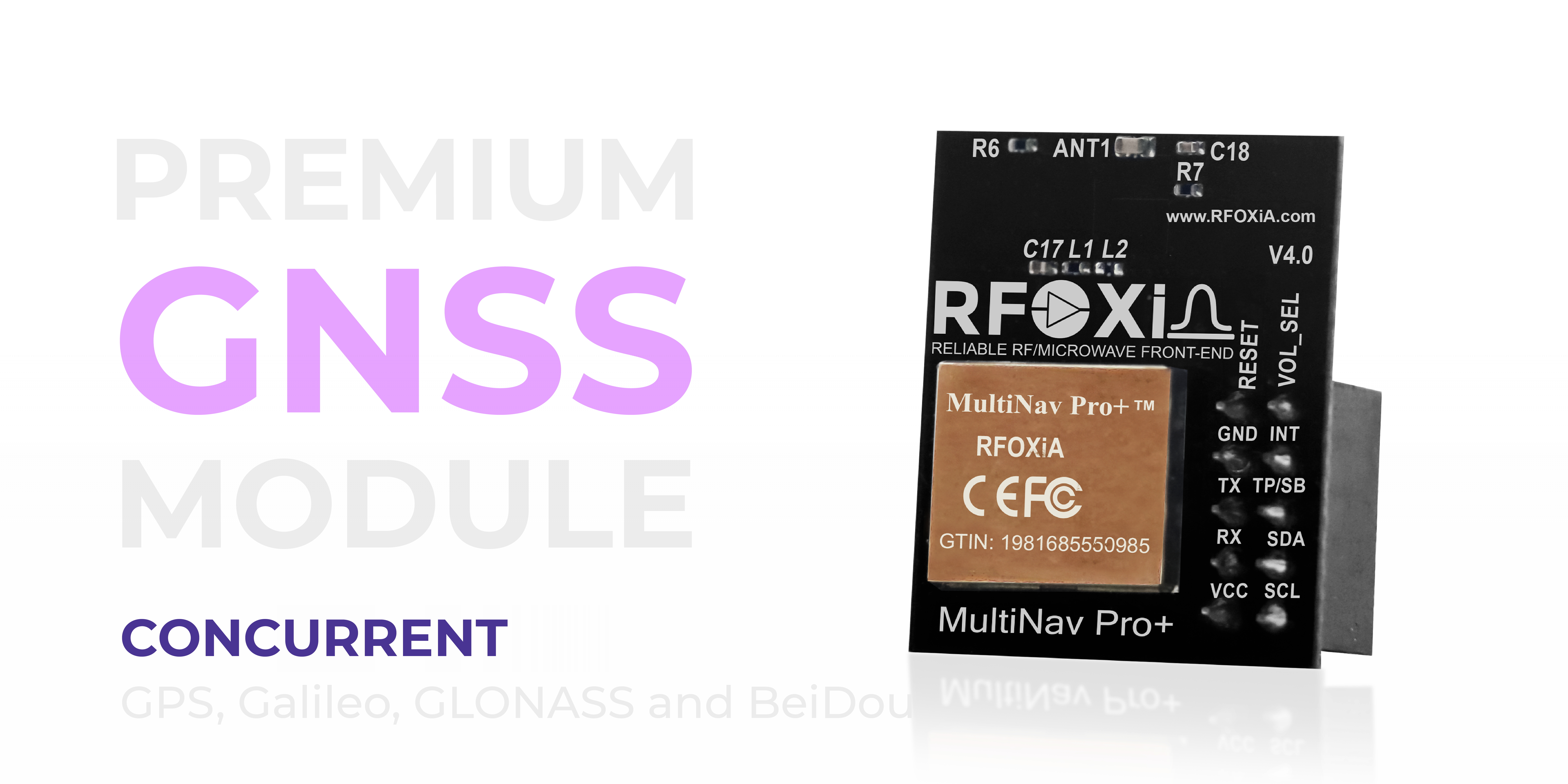
This is a professional multi-constellation GNSS module engineered for the builder who refuses to accept "good enough" — offering 1.5-meter accuracy, an 18Hz fix rate, concurrent reception across four global satellite systems, and a compact 26mm x 22mm footprint that fits anywhere your project demands.
This guide covers everything you need to know: how it works, what makes it different, who it is built for, and why the MultiNav Pro+ is the most capable GNSS module available at this price point.
What Is a Multi-Constellation GNSS Module — And Why Does It Matter?
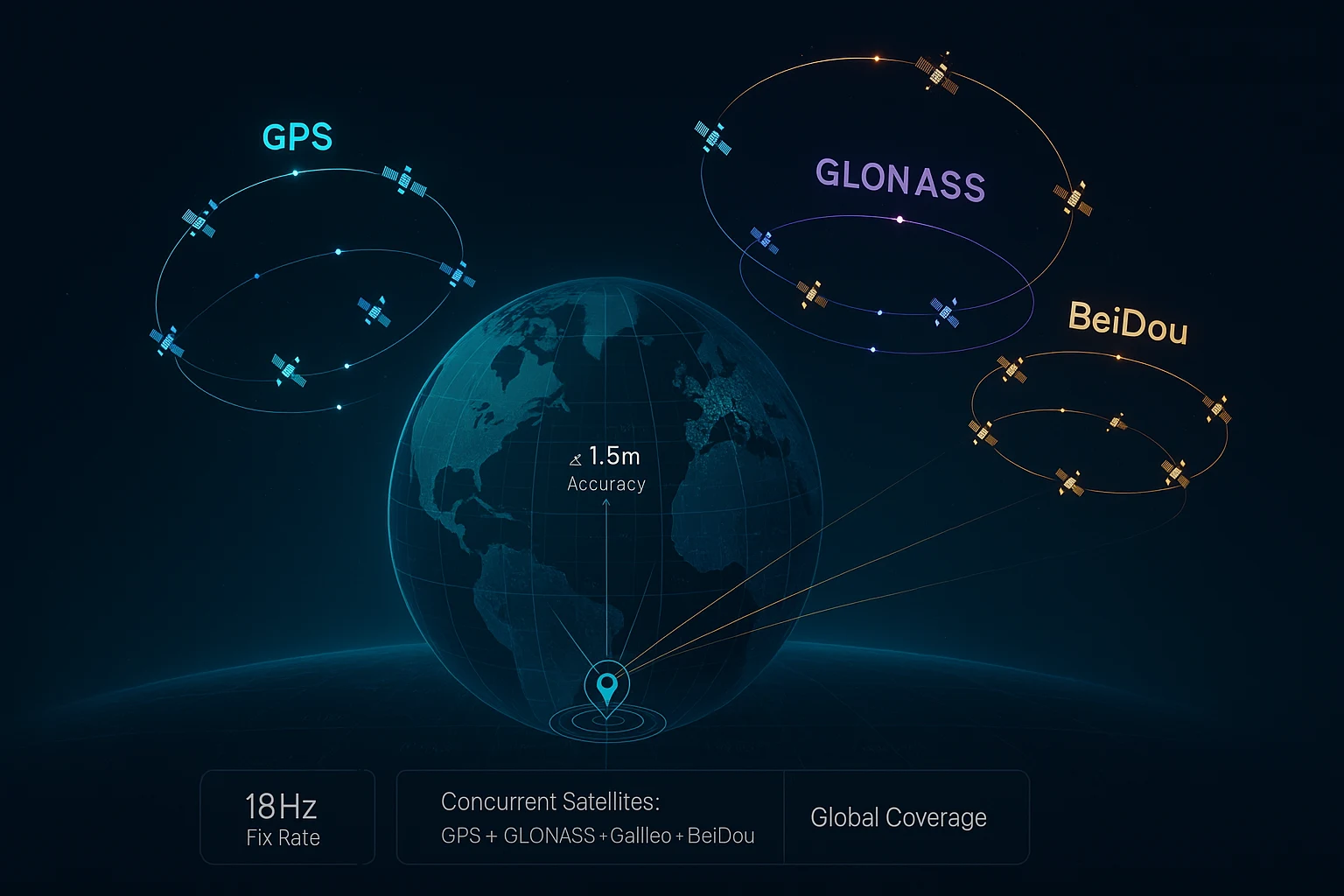
GNSS stands for Global Navigation Satellite System. GPS is the most well-known GNSS network — operated by the United States — but it is not the only one. There are four major global constellations in operation today:
- GPS — United States, 31 satellites
- GLONASS — Russia, 24 satellites
- Galileo — European Union, 30+ satellites
- BeiDou — China, 35+ satellites
A single-constellation receiver locks onto only one of these networks. A multi-constellation GNSS module receives signals from all four simultaneously. This matters enormously in practice:
More satellites in view = faster first fix. When your receiver can see 80+ satellites across four constellations instead of 30 from one, it acquires lock in a fraction of the time — especially in challenging conditions.
More satellites = better geometry. Positional accuracy depends heavily on the geometric spread of visible satellites. Multi-constellation reception dramatically improves this geometry, directly improving accuracy.
Redundancy in degraded environments. Urban canyons, dense forests, and areas with signal obstruction affect each constellation differently. A multi-constellation receiver maintains lock where a single-constellation receiver would fail.
For drone operators, precision agriculture, IoT tracking, and mobile robotics — this is not a nice-to-have. It is the difference between a system that works reliably in real-world conditions and one that fails precisely when you need it most.
MultiNav Pro+ Core Specifications
Before diving into features, here is the complete technical specification summary:
| Specification | Value |
|---|---|
| Accuracy | < 1.5 meters CEP |
| Fix Rate | Up to 18Hz |
| First Fix Time | 1 second (hot start) |
| Constellations | GPS, Galileo, GLONASS, BeiDou (concurrent) |
| GNSS Chip | u-blox MIA-M10Q |
| Antenna | Integrated high-gain chip antenna |
| Interfaces | UART (TX/RX), I2C (SCL/SDA) |
| Operating Voltage | 1.8V and 3.3V |
| Current Draw | 25–30mA |
| Dimensions | 26mm x 22mm |
| Certification | FCC Certified |
| Price | $49 |
Every number in that table is a real measured specification — not marketing approximation.
1.5-Meter Accuracy: What It Actually Means
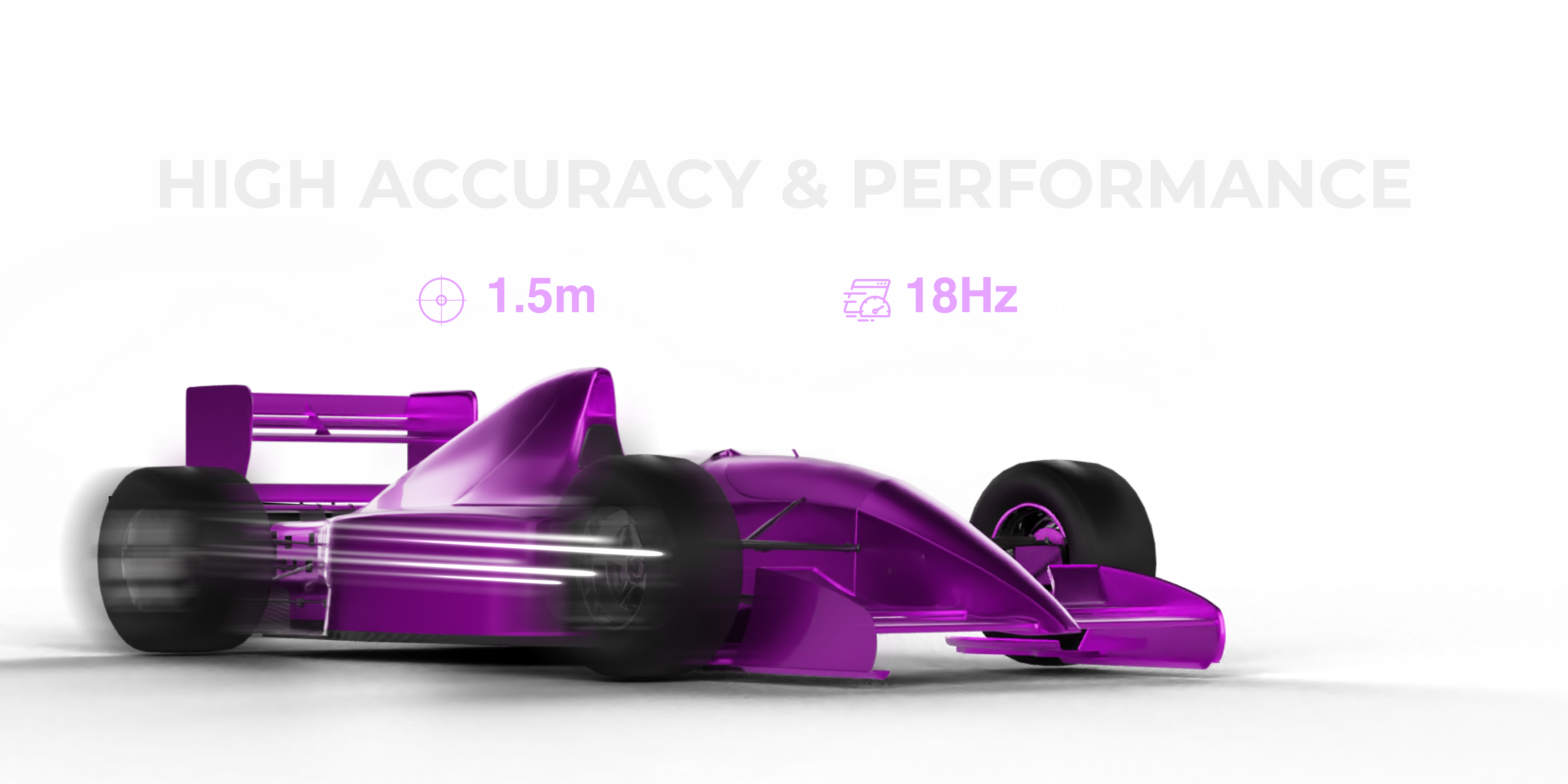
Accuracy in GNSS is typically stated as CEP — Circular Error Probable. A 1.5-meter CEP means that 50% of all position readings fall within 1.5 meters of the true position. In practice, with multi-constellation reception and good sky view, the MultiNav Pro+ regularly exceeds this specification.
For comparison:
- Consumer smartphone GPS: 3–5 meter accuracy under ideal conditions, 10–20 meters in degraded environments
- Basic maker GPS modules: 2.5–5 meters
- MultiNav Pro+: < 1.5 meters, enabled by multi-constellation reception and advanced RF filtering
For a drone delivery waypoint, precision landing, survey path, or autonomous vehicle navigation — 1.5 meters is the threshold that separates "useful" from "professional."
18Hz Fix Rate: Real-Time Tracking for Fast-Moving Platforms
Most GPS modules update at 1Hz or 5Hz. The MultiNav Pro+ delivers up to 18 position updates per second.
This matters most for:
- Racing drones and FPV aircraft moving at 30–120 mph where 1Hz updates create 13–53 meters of position lag per cycle
- Autonomous ground vehicles making rapid steering corrections requiring position data faster than 5Hz
- Precision landing systems where touchdown accuracy demands sub-second positional awareness
- Inertial navigation fusion where GNSS feeds an IMU/Kalman filter and high update rates dramatically improve state estimation
At 18Hz, the MultiNav Pro+ keeps pace with real-world platform dynamics. A 1Hz module simply cannot.
Compact and Power-Efficient: Built for Integration
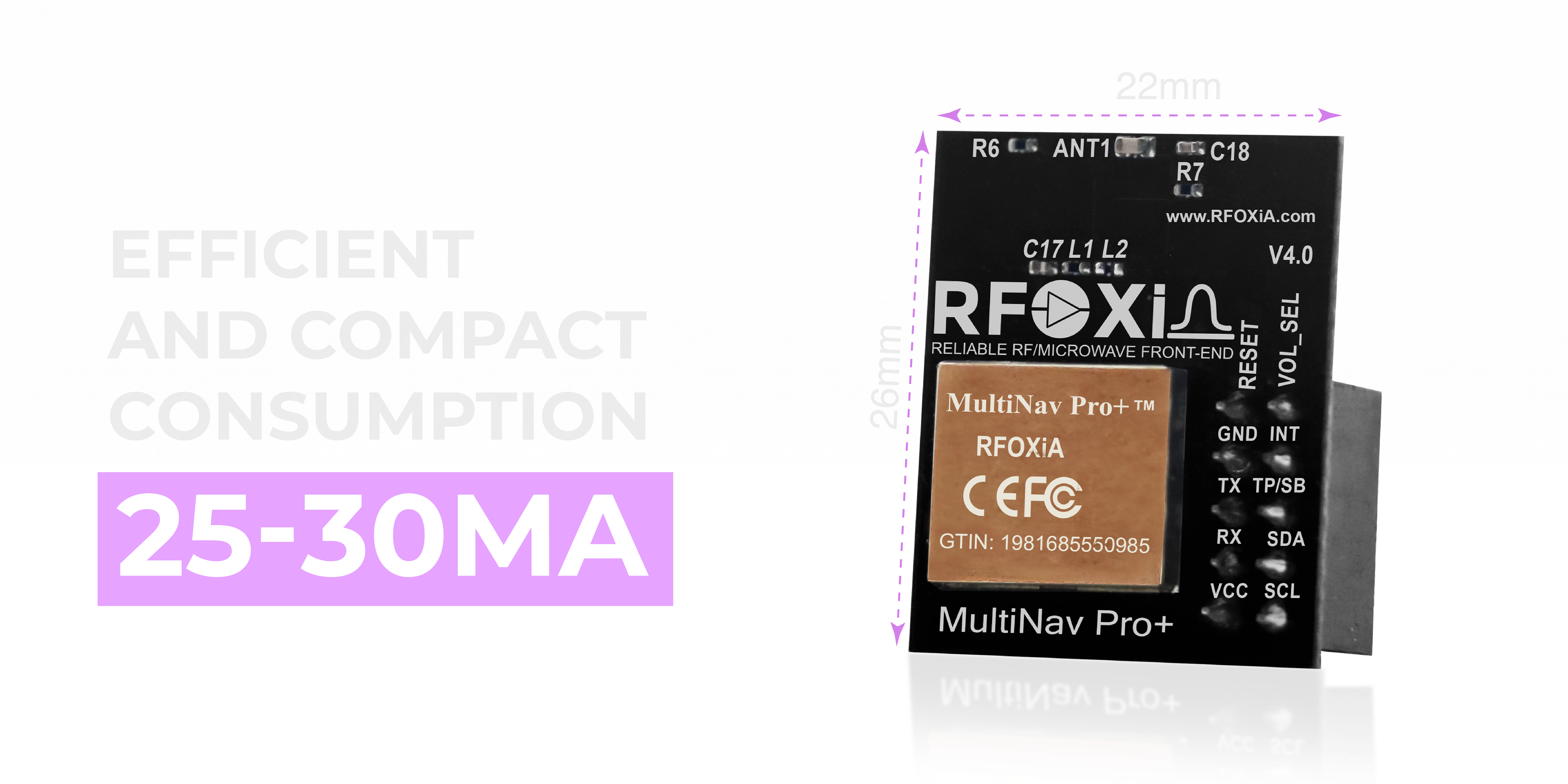
At 26mm x 22mm, the MultiNav Pro+ fits within the footprint of a postage stamp. For drone builders designing tight PCB stackups, wearable device engineers working with constrained form factors, or IoT developers packing sensors into field enclosures — this compact profile is a genuine engineering advantage.
Current draw of 25–30mA is efficient enough for battery-powered deployments that need to run for extended periods without thermal or power budget concerns. When paired with the RFOXiA Power/Program Kit — which delivers 24 hours of runtime from a 5-minute supercapacitor charge — the MultiNav Pro+ can run for extended field deployments without interruption.
The integrated high-gain chip antenna means no external antenna required. No SMA connector, no pigtail cable, no additional hardware to source, mount, and protect. The antenna is part of the module — clean, compact, and reliable.
Versatile Connectivity: UART and I2C
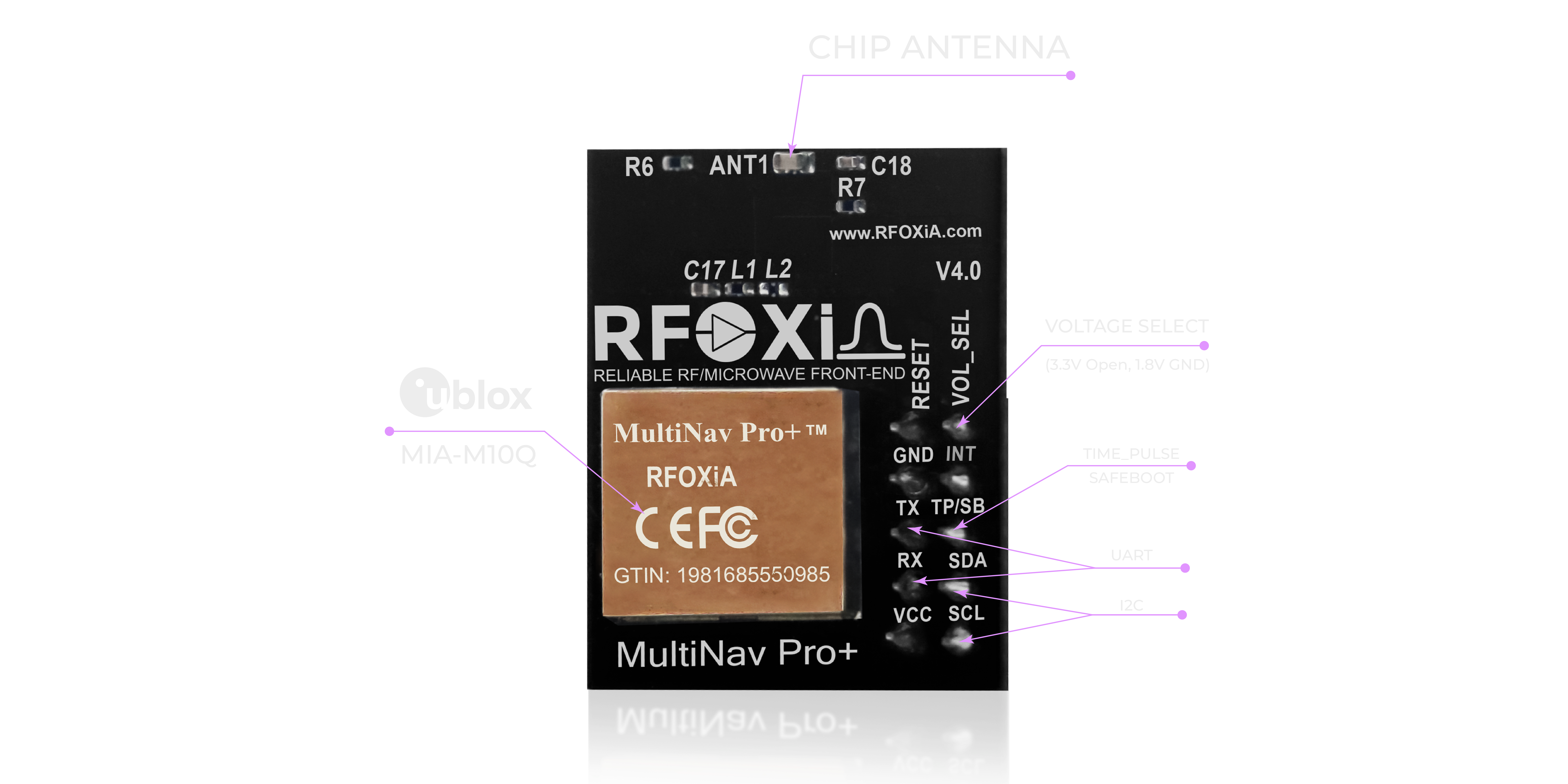
The MultiNav Pro+ supports both UART and I2C interfaces, giving developers flexibility to integrate it into virtually any microcontroller ecosystem:
UART (TX/RX): The most common interface for GNSS modules. Direct serial communication, supported natively by Arduino, STM32, ESP32, Raspberry Pi, and virtually every embedded platform. NMEA sentences stream directly to your parser.
I2C (SCL/SDA): Shared bus communication ideal when you are already consuming UART ports for other peripherals. Allows the GNSS module to share a two-wire bus with sensors, displays, or other modules.
Voltage compatibility at both 1.8V and 3.3V means it interfaces directly with modern low-voltage microcontrollers without level shifting.
This is a module designed by engineers who actually build systems, not just datasheets.
Powered by u-blox MIA-M10Q: The Gold Standard in GNSS
The u-blox MIA-M10Q is the latest-generation GNSS chip from u-blox — the Swiss company that has been the definitive standard for professional GNSS receivers for over two decades. When aerospace, automotive, and industrial applications need reliable GNSS, they reach for u-blox.
The MIA-M10Q represents u-blox's most advanced low-power multi-constellation architecture, combining:
- Full concurrent four-constellation reception
- Ultra-low power standby modes for battery-critical applications
- Advanced jamming and spoofing detection
- Secure boot and configuration protection
- Superior receiver sensitivity for degraded signal environments
RFOXiA built the MultiNav Pro+ around this chip because second-best was not acceptable. When you need the position to be right — for a precision landing, a survey waypoint, or a critical IoT deployment — the chip underneath matters.
Advanced RF Filtering: Crystal-Clear Signals in Real Environments
Raw GNSS signal is exceptionally weak — received at the antenna at power levels billions of times smaller than your WiFi signal. In any real-world environment, electromagnetic interference from motors, ESCs, power electronics, LTE signals, and countless other sources threatens to corrupt that signal before it ever reaches the receiver.
The MultiNav Pro+ incorporates proprietary RF/microwave microstrip filter technology that actively suppresses interference across the frequency bands that most commonly corrupt GNSS performance in embedded applications. This is not a passive component — it is an engineered filtering stage designed specifically for the interference environment of drones, robots, and field-deployed IoT systems.
The result is dramatically improved signal-to-noise ratio in real-world deployments — not just in a clean lab environment. This is the difference between a GNSS module that looks good on paper and one that actually performs on a drone frame surrounded by brushless motors and high-current switching regulators.
Open Source Driver: Your IDE, Your Rules
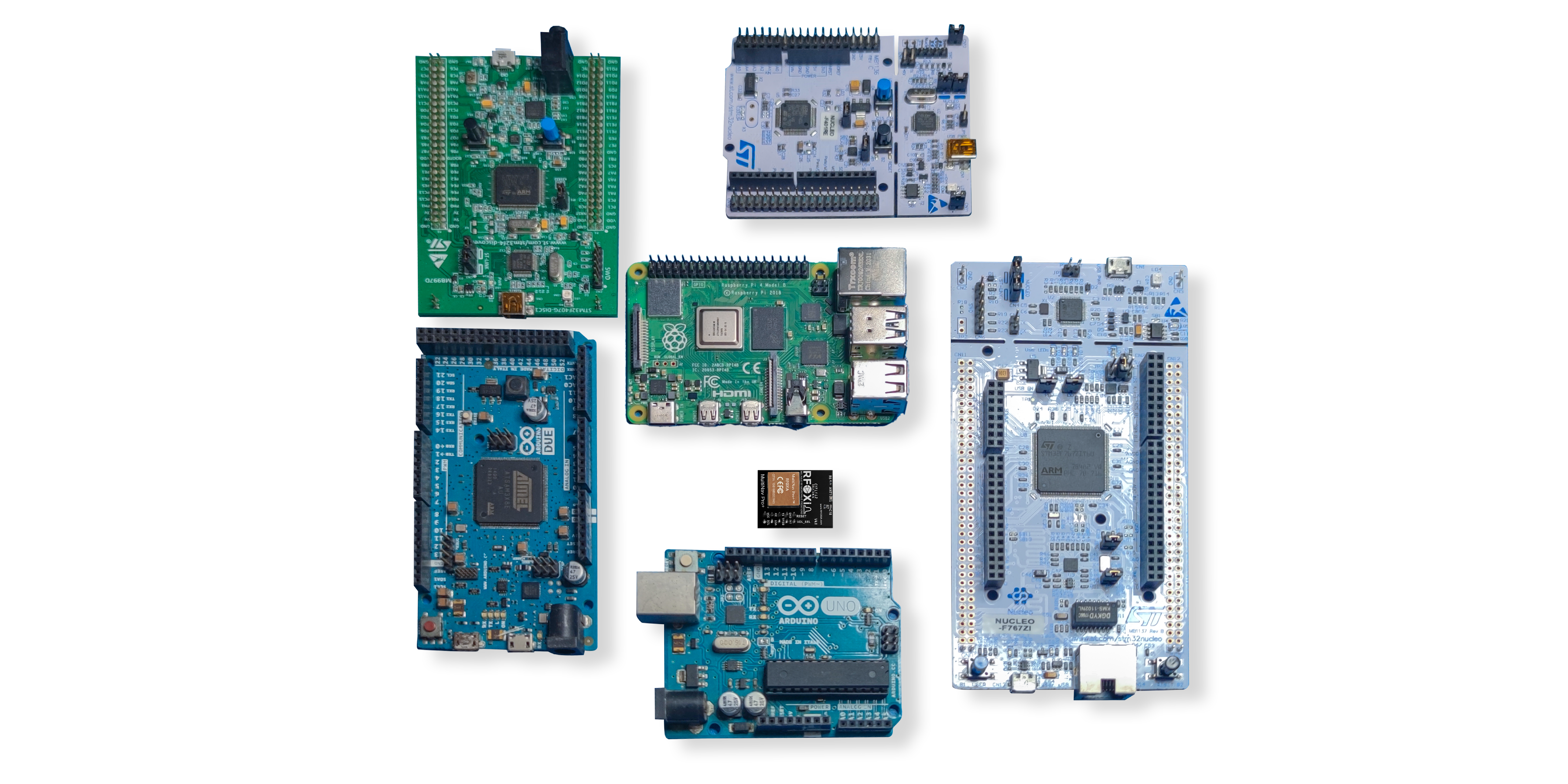
The MultiNav Pro+ ships with a fully open-source C language driver library that implements the complete NMEA standard protocol command set. This means:
- Full source code access — read it, modify it, learn from it, or customize it for your specific application
- Arduino IDE compatible — import the library in minutes and have position data flowing to your sketch
- Toolchain agnostic — the C library integrates cleanly into PlatformIO, STM32CubeIDE, ESP-IDF, and any standard embedded toolchain
- NMEA standard — standard protocol means compatibility with virtually every existing GNSS parsing library, mapping application, and data logging tool
For developers who want to go deeper — custom NMEA sentence configuration, power mode control, constellation selection — full access to the u-blox UBX binary protocol is available through the same interface.
This is not a black-box module with a locked proprietary library. RFOXiA believes in open development, and every line of driver code is available to the builder community.
U-Center Software: Professional Visualization and Configuration
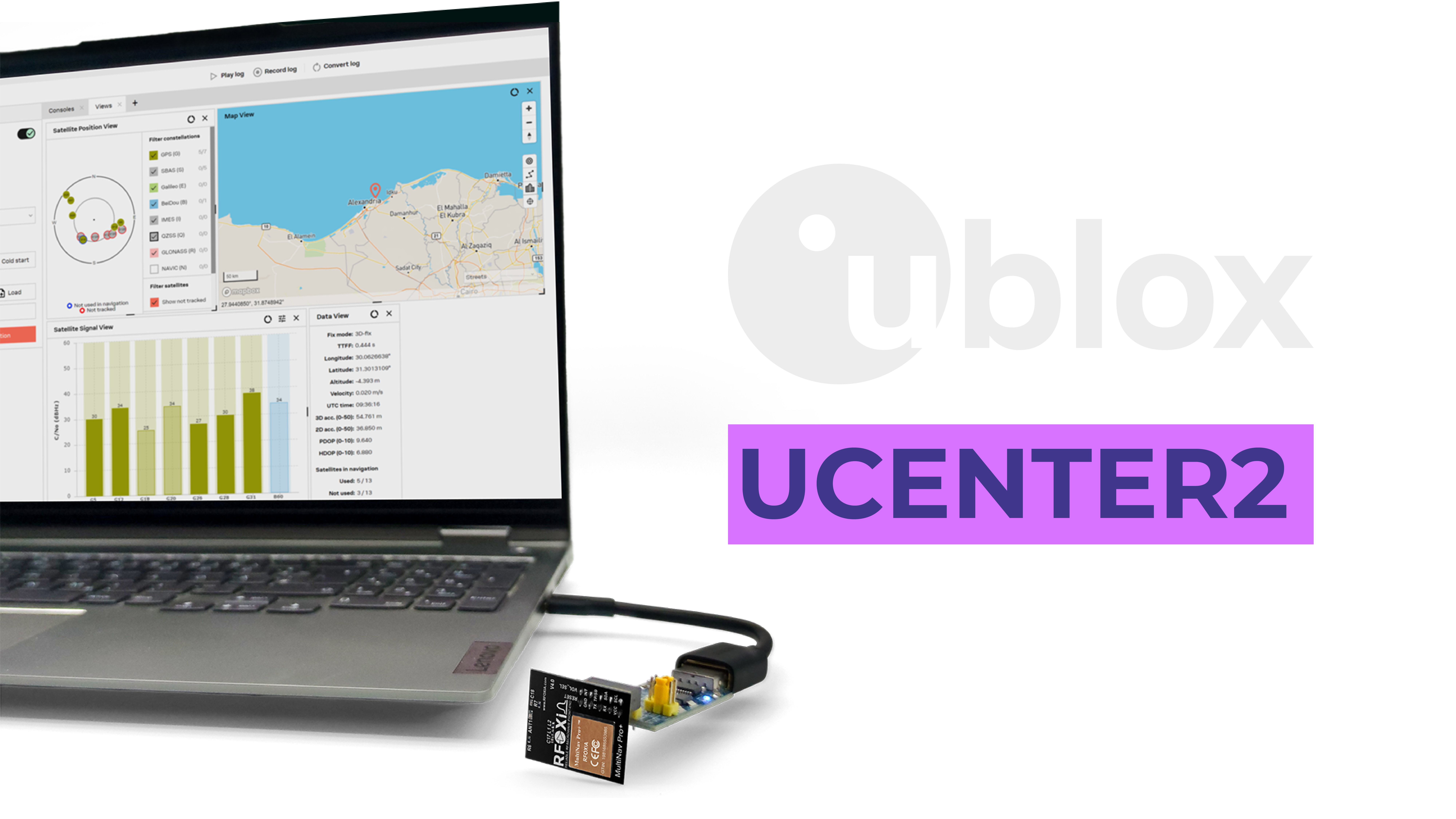
Beyond the embedded driver, the MultiNav Pro+ is fully compatible with u-center — u-blox's professional desktop GNSS evaluation and configuration tool. U-center provides:
- Sky view visualization — see every satellite in view across all four constellations, with signal strength bars and azimuth/elevation display
- Live track logging — record movement paths with full position, velocity, and accuracy data
- Configuration interface — tune fix rate, power modes, constellation selection, and message output without writing a line of firmware
- Data logging — capture raw GNSS data for post-processing or analysis
- GNSS service evaluation — assess AssistNow, RTK, and other u-blox augmentation services
For developers evaluating performance, debugging antenna placement, or characterizing accuracy in a new deployment environment — u-center turns the MultiNav Pro+ into a full professional testing instrument.
Use Cases: Where the MultiNav Pro+ Belongs

The MultiNav Pro+ is not a one-application module. The combination of high accuracy, high fix rate, multi-constellation reception, compact footprint, and open-source driver makes it applicable across an unusually wide range of platforms:
Drone Applications
- Autonomous waypoint navigation requiring precise path following
- Precision landing with sub-2-meter touchdown accuracy
- Geofencing and no-fly-zone enforcement
- Survey and mapping missions where position accuracy directly determines deliverable quality
- Search and rescue deployment with accurate return-to-home
IoT and Environmental Sensing
- GPS-verified node placement for data networks requiring outdoor validation
- Asset tracking with real-time position streaming
- Smart agriculture equipment requiring field boundary and row tracking
- Wildlife monitoring with accurate location tagging
Robotics and Ground Vehicles
- Autonomous ground vehicle navigation
- Agricultural robots following GPS-guided paths
- Outdoor delivery robot position management
- Outdoor SLAM systems augmenting visual or LiDAR navigation with GNSS ground truth
Research and Education
- University research requiring calibrated position data
- Atmospheric science balloon tracking
- Citizen science data collection with location validation
- GNSS education and signal processing research using real hardware
Wearable and Handheld
- Outdoor activity trackers requiring professional accuracy
- Field data collection devices for survey professionals
- Personal safety and emergency location devices
Explore the RFOXiA Accurate GNSS Module and see how the MultiNav Pro+ fits your specific application.
The RFOXiA Ecosystem Advantage
The MultiNav Pro+ is not just a standalone module — it is a native component of the complete RFOXiA wireless development ecosystem.
When combined with the full Developer Bundle, you add:
- BLE Module — 5km ground-to-ground, 15-20km man-to-drone range. The GNSS module provides real-time GPS position data that streams over the BLE link to the RFOXiA Connect app, displaying live position on a map at up to 20km from the operator.
- Sensors Module — temperature, humidity, pressure, air quality, accelerometer, gyroscope, magnetometer. Pairs with GNSS for GPS-tagged environmental data — essential for the RFOXiA data network.
- Power/Program Kit — 5-minute supercapacitor charge for 24 hours of runtime. Powers the complete module stack including the MultiNav Pro+ for full-day field operations.
- RFOXiA Connect App — displays live GPS position from the MultiNav Pro+ on a real-time map, paired with sensor data and drone control on a single mobile interface.
For builders who deploy the complete system outdoors and stream GPS-tagged sensor data to the RFOXiA data network, the GNSS module does double duty: it provides navigation position data for your platform and provides GPS verification for data network reward eligibility.
FCC Certified and Ready to Deploy
The MultiNav Pro+ carries full FCC certification — a critical requirement for any commercial product development, distributor listing, or regulatory-compliant deployment in the United States.
For developers building products that will ship to customers, this certification eliminates one of the most time-consuming and expensive steps in the hardware development process. The RF validation work is done. The regulatory submission is complete. You inherit the certification when you integrate the MultiNav Pro+ into your system.
For institutional buyers — universities, government agencies, enterprise IoT deployments — FCC certification is a mandatory procurement requirement. The MultiNav Pro+ meets it.
Technical Deep Dive: Why 18Hz at This Price Is Unprecedented
Achieving an 18Hz fix rate in a compact, low-power module at $49 requires more than just specifying a capable chip. The fix rate is limited by the entire signal processing chain:
Antenna gain — a higher-gain antenna delivers more signal power to the receiver frontend, enabling faster correlation and lock acquisition. The integrated high-gain chip antenna on the MultiNav Pro+ is optimized specifically for the L1 GNSS band.
Multi-constellation parallelism — the MIA-M10Q processes signals from all four constellations simultaneously in parallel hardware tracking channels. More satellites in simultaneous track = more robust position solution = faster valid fix computation.
Receiver sensitivity — the MIA-M10Q achieves -167 dBm tracking sensitivity. This allows it to maintain lock on satellites that would be invisible to less sensitive receivers, maintaining the satellite geometry needed for high-rate valid fixes.
RF filtering — the proprietary microstrip filter stage on the MultiNav Pro+ reduces the noise floor seen by the receiver frontend, directly translating to faster valid position computation at high update rates.
The combination of these four factors — not any single one alone — is what enables the MultiNav Pro+ to sustain 18Hz in real-world deployment conditions rather than only in ideal lab environments.
Pricing and Value: $49 for Professional-Grade Navigation
At $49, the MultiNav Pro+ sits in a price category typically occupied by modules with 5Hz update rates, single-constellation reception, and 3–5 meter accuracy.
The combination of:
- Concurrent four-constellation reception
- 18Hz fix rate
- 1.5-meter accuracy
- u-blox MIA-M10Q chip
- FCC certification
- Open-source C driver
- Compact integrated antenna design
...at $49 represents an engineering and manufacturing achievement that RFOXiA is uniquely positioned to deliver through its direct China manufacturing relationships and vertically integrated development approach.
For context: survey-grade GNSS receivers from Trimble or Leica with comparable multi-constellation capabilities start at $2,000–5,000. Industrial-grade u-blox-based OEM modules from authorized distributors typically price at $150–400. The MultiNav Pro+ delivers the core performance of those platforms in a form factor and at a price point built for the maker, engineer, and developer community.
Ready to upgrade your navigation stack? The RFOXiA Accurate GNSS Module ships now at $49 with full documentation and open-source driver included.
What's Included in the Package
Every MultiNav Pro+ ships with:
- MultiNav Pro+ GNSS Module — fully assembled and tested
- Quick Start Guide — covers power connections, interface wiring for UART and I2C, first firmware sketch, and u-center setup
- Access to RFOXiA Club — documentation, driver library, community support, AI firmware builder
The open-source firmware library is available on GitHub, and the RFOXiA Dev Hub provides community-contributed example projects, integration guides, and technical support from both the RFOXiA team and the growing developer community.
Frequently Asked Questions
Does the MultiNav Pro+ require an external antenna? No. The integrated high-gain chip antenna is designed for optimal L1 GNSS band reception without any external component.
What is the time to first fix (TTFF)? Hot start (satellite almanac cached): approximately 1 second. Cold start (no cached data): typically 30–60 seconds depending on sky view.
Can I use this module with Arduino? Yes. The open-source C library imports directly into Arduino IDE. The Quick Start Guide includes a working example sketch.
What voltage does it operate at? The module supports 1.8V and 3.3V. It is compatible with virtually all modern microcontrollers without level shifting.
Is it compatible with RTK correction services? The MIA-M10Q chip supports RTCM input for RTK correction data. Integration with correction services such as u-blox AssistNow or third-party RTK networks is possible through the UART interface.
Can it be used in the RFOXiA data network? Yes. The GNSS module provides GPS-tagged position verification required for RFOXiA data network node enrollment and reward eligibility.
Conclusion: The Multi-Constellation GNSS Module Built for Builders
The MultiNav Pro+ is not a compromise. It is not a module that meets some specifications while quietly failing on others. It is a professional multi-constellation GNSS module engineered from the ground up for developers who need real accuracy, real update rates, and real reliability — without real enterprise pricing.
1.5-meter accuracy. 18Hz fix rate. Concurrent GPS, Galileo, GLONASS, and BeiDou. u-blox MIA-M10Q. FCC certified. Open-source driver. $49.
This is the navigation foundation your next project deserves.
Get the RFOXiA Accurate GNSS Module and build without limits.
Written by: Moamen Mohamed LinkedIn