
Multi Sensor IoT Module: The Complete Guide to the MultiNav Pro+™ Sensors Module
RFOXiA Integrated Sensors Module
Why Every Serious Builder Needs a True Multi Sensor IoT Module
If you have ever tried to assemble a complete sensing stack for a drone, a robotics platform, or an environmental monitoring node, you already know the pain. You source an accelerometer from one vendor, a magnetometer from another, chase down a humidity sensor that fits your footprint, argue with conflicting I2C addresses, and end up with a nest of breakout boards held together by optimism and hot glue. The result is fragile, bulky, power-hungry, and almost impossible to replicate at scale.
The industry has needed a better answer for a long time. Not another single-sensor breakout. Not a development kit stuffed with redundant components you will never use. A proper, production-grade multi sensor IoT module — compact, professionally engineered, built from best-in-class silicon, and ready to drop into any serious project without compromise.
That answer is the RFOXiA MultiNav Pro+™ Sensors Module.
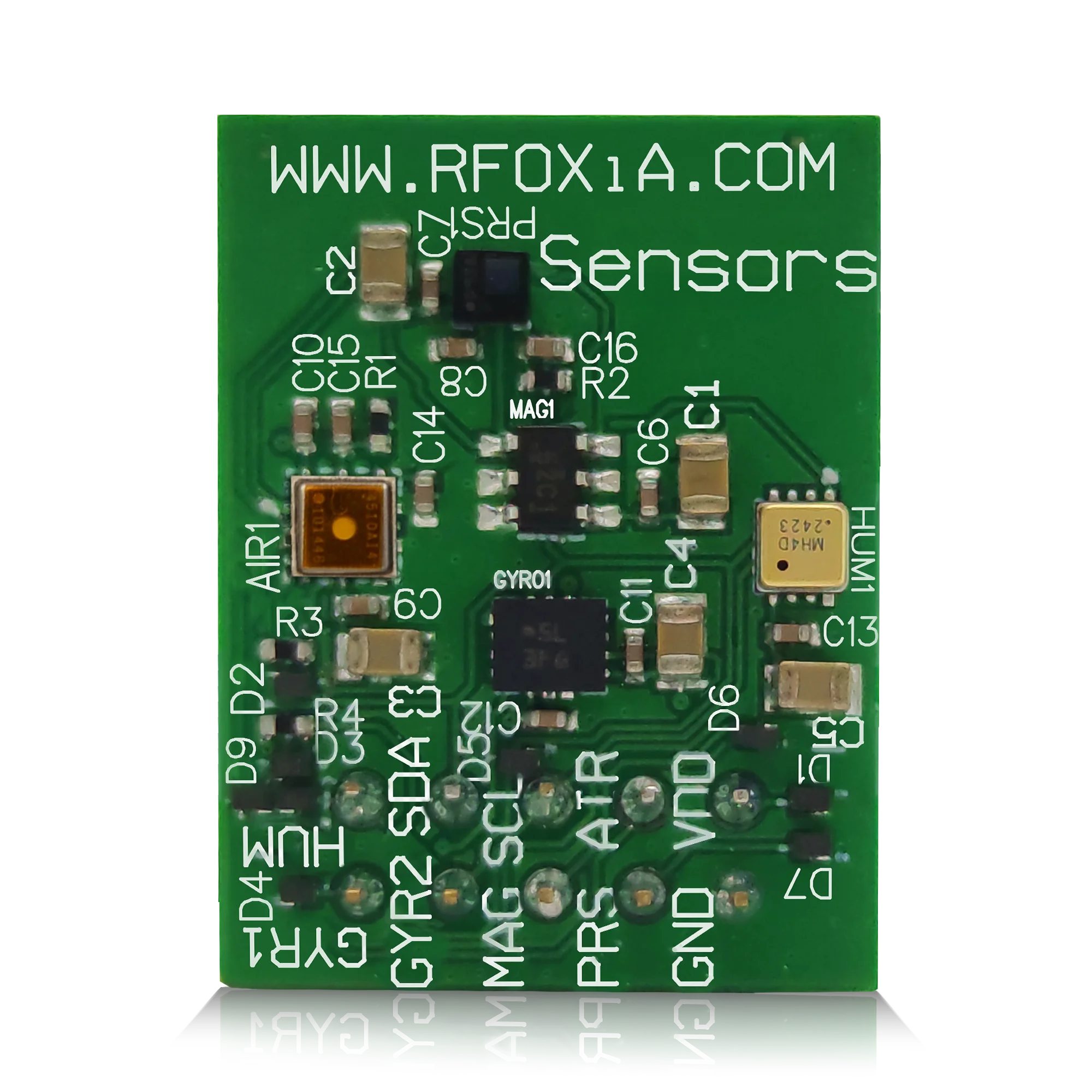
At just 24mm × 18mm, the MultiNav Pro+ packs seven independent sensors onto a single FCC-certified board. It is designed for builders who refuse to choose between capability and elegance — for the drone engineer who needs motion and environmental data simultaneously, for the IoT developer who wants a single module that does everything, and for the researcher who needs verified, real-time data they can trust.
This guide covers everything you need to know: the silicon choices and why they matter, the I2C architecture that makes it work, the applications that benefit most, how this module fits into the broader RFOXiA ecosystem, and why this is the most capable multi sensor IoT module available at any price near $39.
What Is the MultiNav Pro+™ Sensors Module?
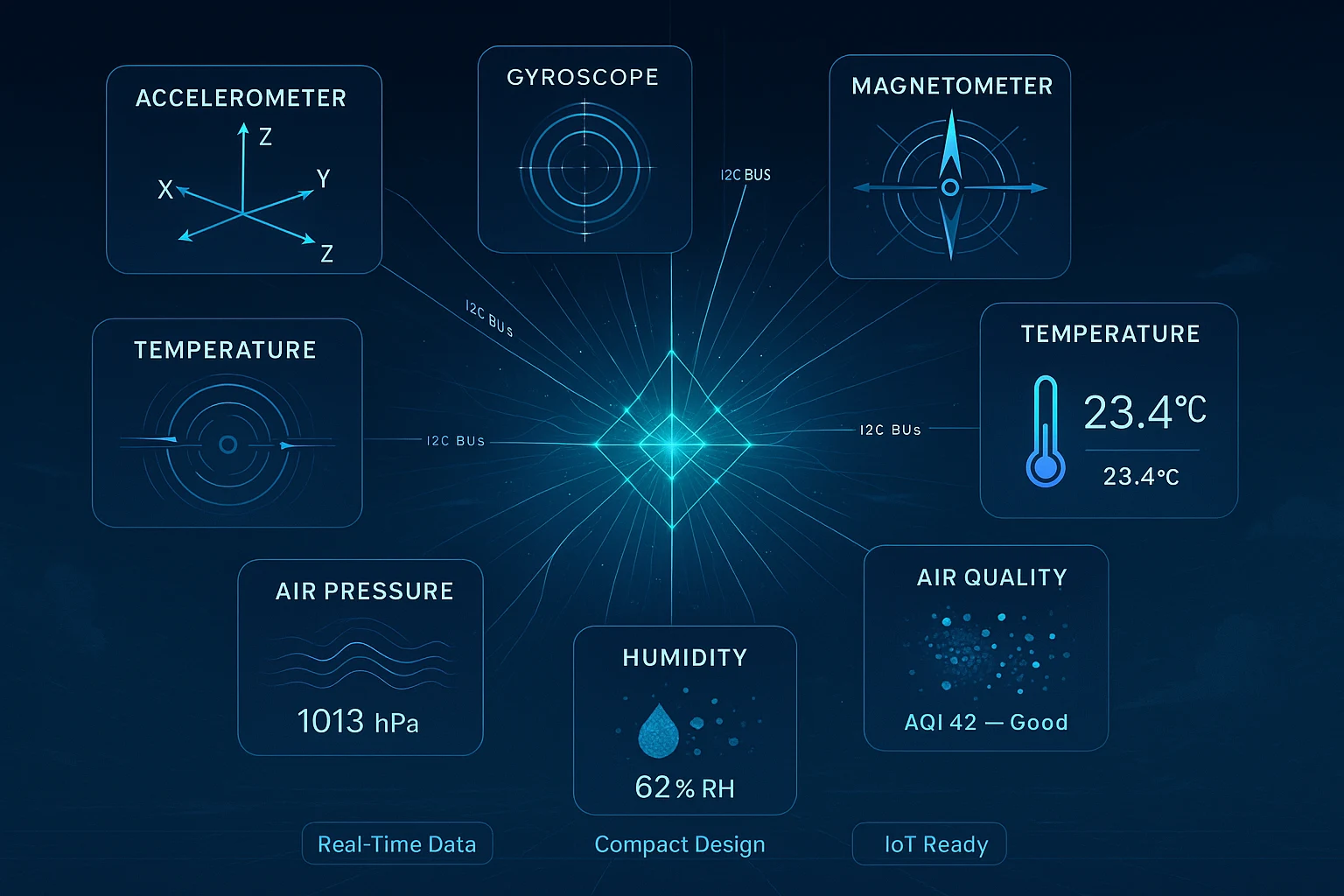
The MultiNav Pro+ Sensors Module is RFOXiA's all-in-one environmental and motion sensing board. It integrates seven distinct sensors across two functional categories — motion sensing and environmental sensing — all communicating over a single shared I2C bus.
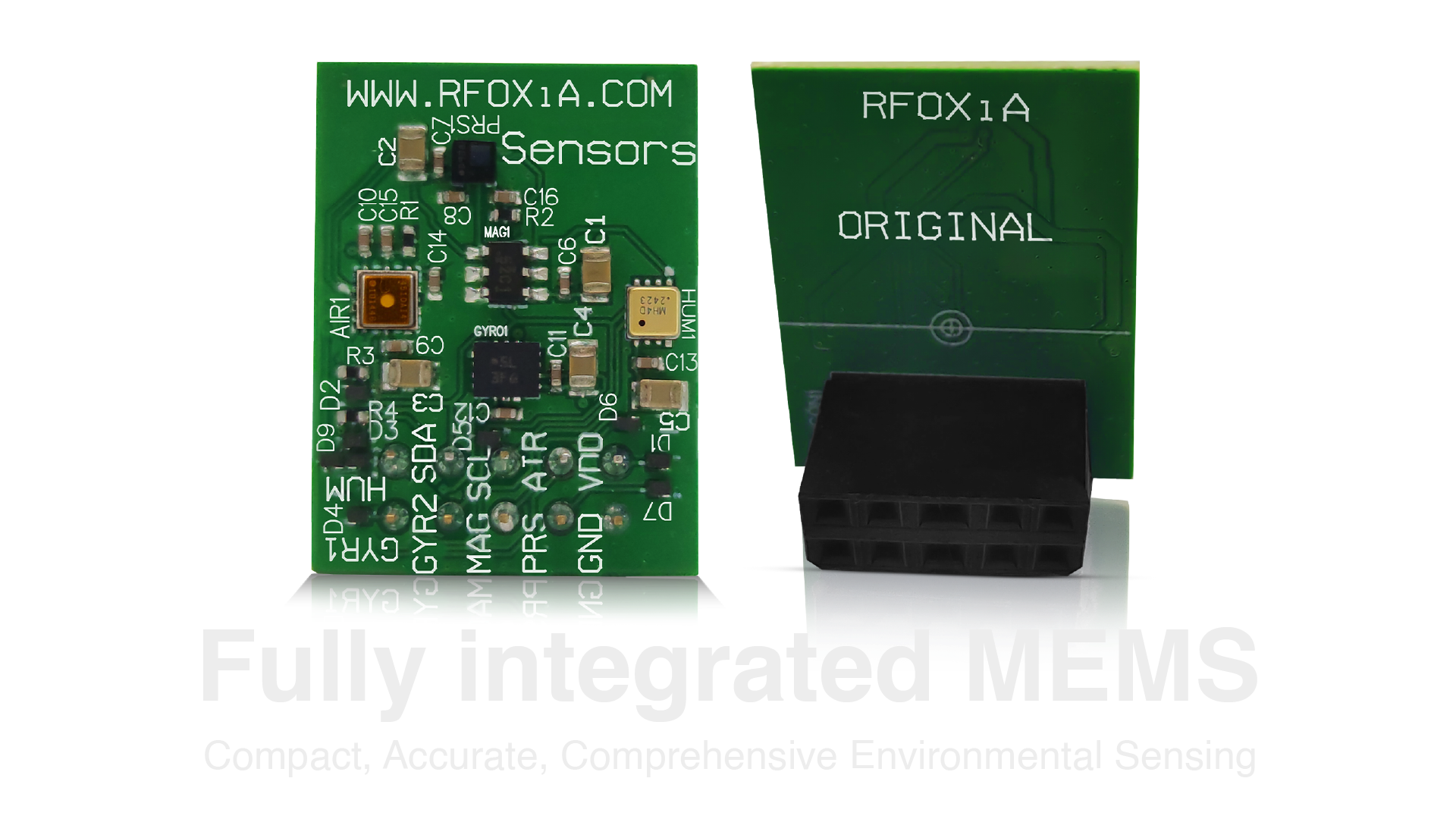
Motion Sensing:
- Accelerometer (3-axis)
- Gyroscope (3-axis)
- Magnetometer (3-axis)
Environmental Sensing:
- Temperature
- Humidity
- Air Pressure
- Air Quality
Every sensor is addressable over I2C, each with a unique address, so there is zero arbitration overhead and zero data collision risk. The module is priced at $39 and ships ready to integrate. No soldering on modules. No hunting for libraries. No debugging address conflicts between sensors sourced from five different vendors.
This is what a real multi sensor IoT module looks like when it is engineered from the ground up rather than assembled from whatever happened to be in stock.
The Silicon Inside: Why Component Choice Matters
A module is only as good as the chips it is built on. RFOXiA did not cut corners on component selection. Every sensor on the MultiNav Pro+ comes from a tier-one semiconductor manufacturer with a proven track record in demanding applications.
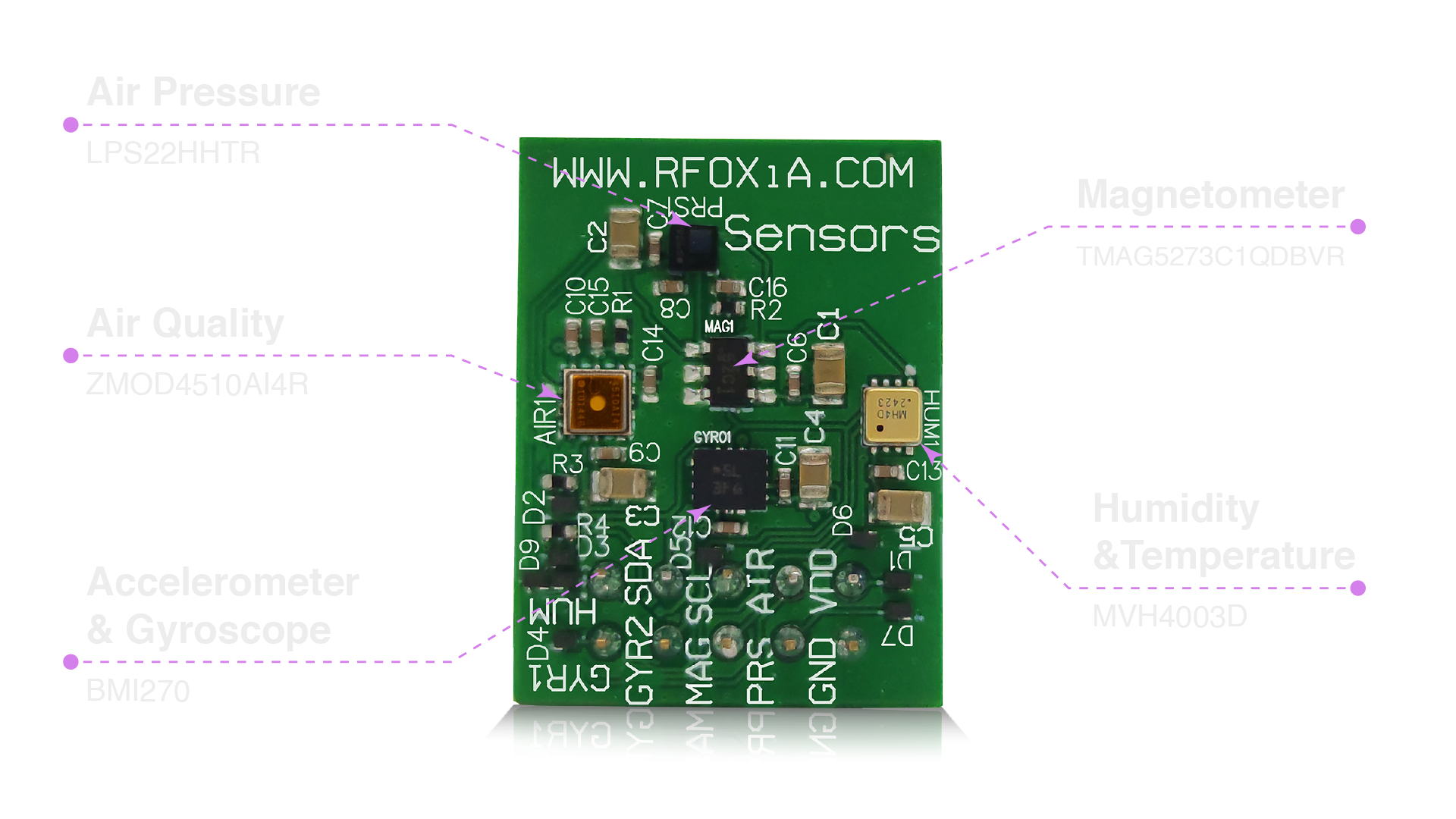
BMI270 — Bosch Sensortec (Accelerometer & Gyroscope)
The BMI270 is Bosch's flagship inertial measurement unit for professional and performance applications. It is the same silicon used in professional sports tracking wearables and high-performance drone flight controllers. It features ultra-low noise, a wide dynamic range, and built-in step detection and gesture recognition primitives that offload your main processor. For a drone application where you need fast, clean IMU data to feed your attitude estimation loop, the BMI270 is the right choice — not a budget substitute.
TMAG5273C1QDBVR — Texas Instruments (Magnetometer)
Texas Instruments' TMAG5273 is a three-axis linear Hall-effect sensor with I2C output, designed for precision angle measurement and position sensing. In the context of a multi sensor IoT module, the magnetometer provides compass heading, magnetic anomaly detection, and can be combined with the BMI270 accelerometer and gyroscope data for full AHRS (Attitude and Heading Reference System) output. For navigation, for robotics orientation, and for any application where you need to know which way is north, this is the sensor.
LPS22HHTR — STMicroelectronics (Air Pressure)
STMicroelectronics' LPS22HH is a high-accuracy MEMS pressure sensor capable of measuring absolute pressure from 260 hPa to 1260 hPa. At this accuracy level, it can detect altitude changes of less than one meter — useful for drone altitude hold, weather station logging, and industrial process monitoring. It is waterproof-rated and built for harsh environments.
MVH4003D — MEMSVision (Humidity & Temperature)
The MVH4003D combines high-accuracy relative humidity and temperature sensing in a single package. MEMSVision sensors are known for their fast response time and long-term stability — critical for environmental monitoring applications where you need data you can trust over days, weeks, and months of continuous operation.
ZMOD4510AI4R — Renesas (Air Quality)
The ZMOD4510 from Renesas is a metal-oxide gas sensor specifically calibrated for outdoor air quality monitoring. It detects ozone and nitrogen dioxide — the two primary markers of outdoor pollution and urban air quality degradation. This is not a generic VOC sensor repurposed for outdoor use. The ZMOD4510 is purpose-built for the outdoor monitoring applications that define the RFOXiA data network use case.
The I2C Architecture: Engineering Simplicity at Scale
One of the most thoughtful design decisions in the MultiNav Pro+ is the I2C implementation. Running seven sensors on a single board raises an immediate question: how do you avoid address conflicts and manage bus arbitration across seven independent devices?
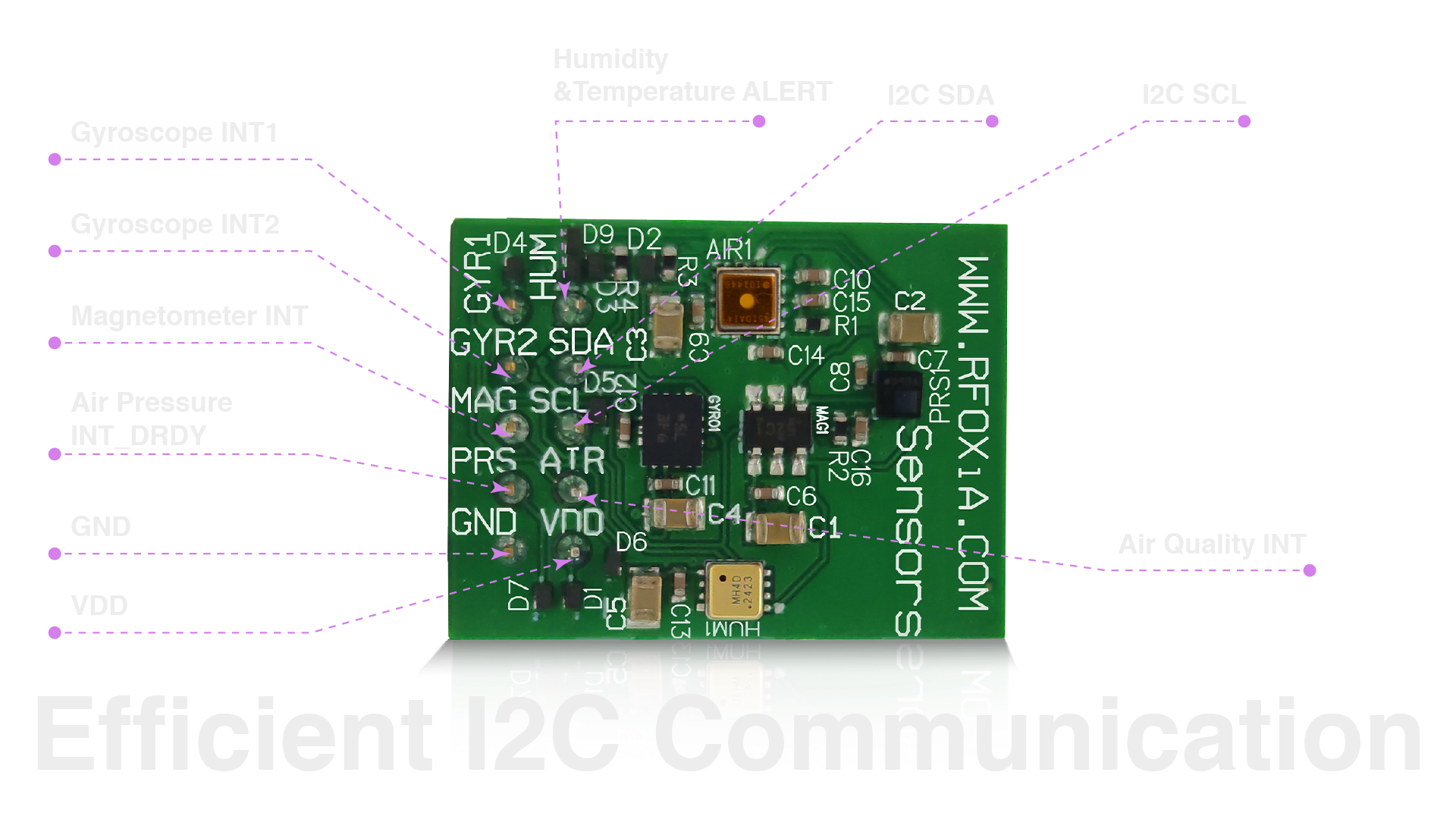
The answer on the MultiNav Pro+ is elegant: every sensor has been selected with a unique I2C address, and the bus is designed to support all seven simultaneously without any additional multiplexing hardware. This means:
- Single cable connection to your microcontroller or host processor
- No I2C mux required — saves BOM cost, saves board space, reduces failure points
- No address conflicts — each sensor responds only to its own address
- Standard I2C protocol — works with any microcontroller, any operating system, any firmware stack
For a developer building a prototype, this simplifies wiring to two wires (SDA and SCL) plus power and ground. For a developer moving to production, this means your multi sensor IoT module connects to your main PCB with a standard header and a few lines of I2C initialization code.
It also means that the RFOXiA AI Firmware Builder — integrated into the RFOXiA Club platform — can generate production-ready firmware for the complete sensor array from a plain-language description of your application. Describe what you want to measure and what you want to do with the data. The AI generates the I2C initialization, sensor configuration, data parsing, and output formatting. What would have taken a week of datasheet reading and register configuration takes minutes.
Compact Form Factor: 24mm × 18mm, No Compromises
Size matters. In a drone, every gram and every cubic centimeter is accounted for. In a wearable, the board has to fit inside a form factor defined by ergonomics, not electronics. In a compact IoT deployment node, you need to fit your entire sensing stack into an enclosure that can mount on a pole, a fence post, or a rooftop.
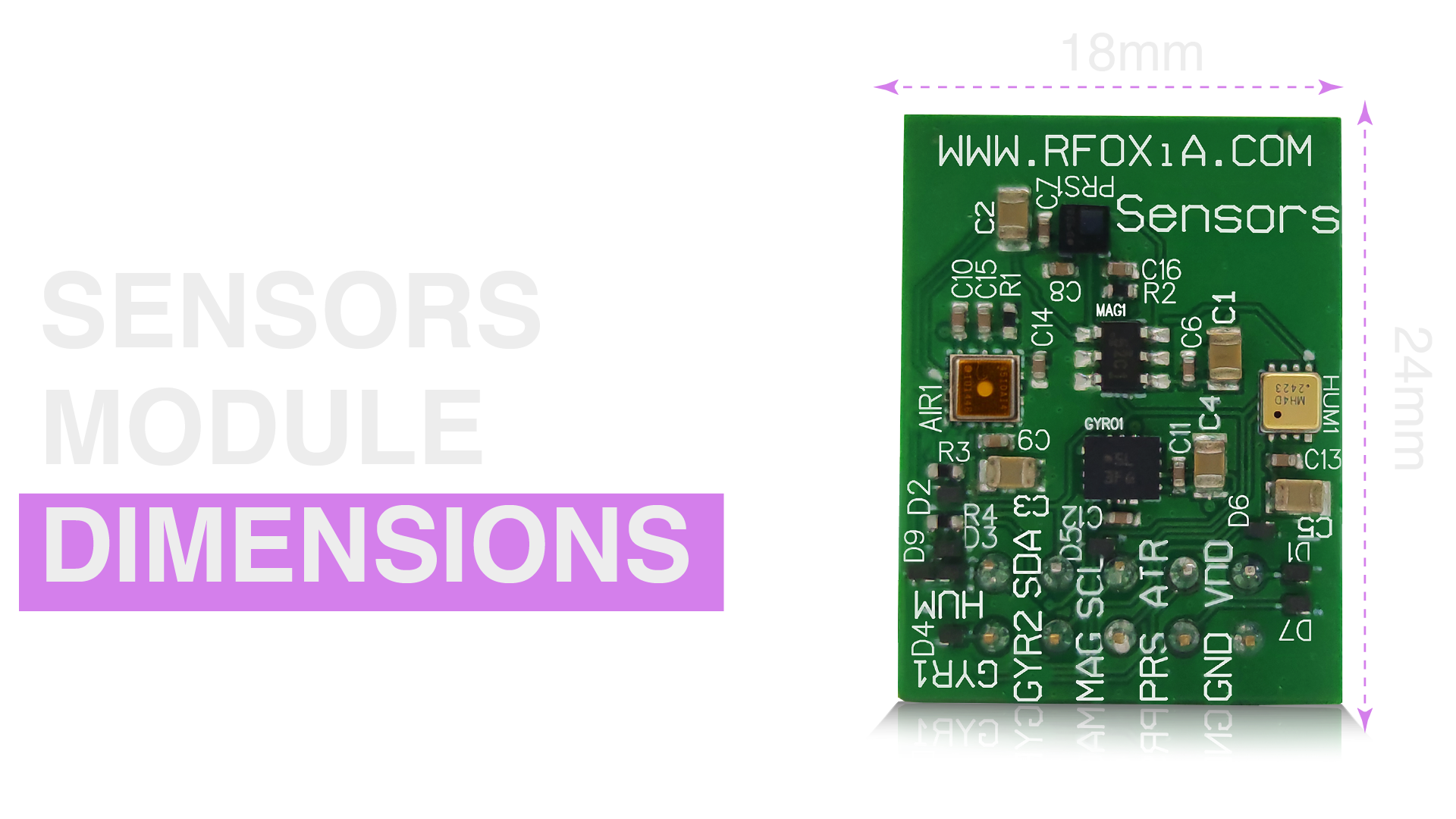
At 24mm × 18mm, the MultiNav Pro+ Sensors Module is genuinely small. To put that in perspective, it is smaller than a postage stamp. And at that size, it delivers seven independent sensors, all the supporting passive components, the I2C interface hardware, and the power conditioning circuitry required for clean sensor operation.
This is not a development board with through-hole components and jumper wires. This is a production-quality module designed to be integrated directly into your finished hardware. The form factor reflects real engineering discipline — the kind of discipline that comes from designing for constrained platforms like drones and wearables from the beginning, rather than retrofitting a bench-top design into a smaller package.
Real-Time Environmental Data: What You Can Do With It
The true value of a multi sensor IoT module is not the sensors themselves — it is what you do with the data they produce. The MultiNav Pro+ delivers real-time streams across all seven channels simultaneously, giving your application a complete picture of both motion state and environmental conditions.
Drone and Aerial Applications
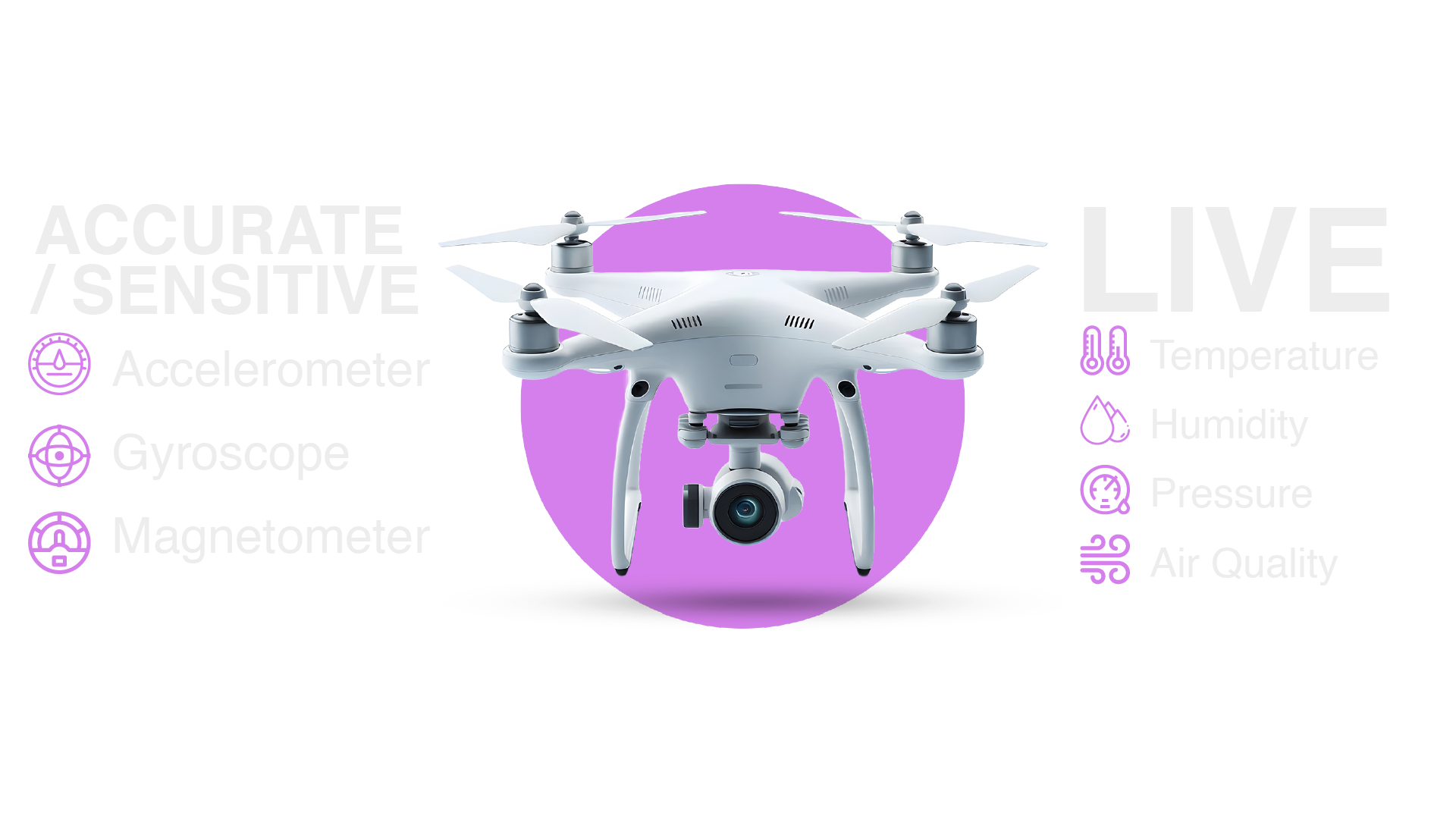
For a drone flight controller, the BMI270 IMU data feeds directly into your attitude estimation algorithm. The LPS22HH barometer provides altitude hold reference. The magnetometer provides compass heading for GPS-assisted navigation. And the environmental sensors — temperature, humidity, air quality — can be logged in flight to create geo-tagged environmental datasets with centimeter-level accuracy when paired with the RFOXiA GNSS Module.
This combination unlocks use cases that have previously required custom hardware costing orders of magnitude more: precision agricultural spraying with environmental-condition-aware application rates, aerial air quality mapping for environmental compliance monitoring, and meteorological data collection for research applications.
Robotics and Ground Vehicles
For a ground robot or autonomous vehicle, the full nine-axis motion sensing package (accelerometer + gyroscope + magnetometer) enables dead-reckoning navigation, terrain-adaptive behavior, and fall detection. The environmental sensors add situational awareness — a robot deployed in an industrial facility can monitor for hazardous gas conditions, temperature excursions, or pressure anomalies that indicate equipment failure.
Environmental Monitoring and IoT Networks
For a fixed IoT node — whether mounted on a building, a weather station mast, or a remote field installation — the MultiNav Pro+ delivers a complete environmental sensing package in a module that can run for 24 hours on the RFOXiA Power/Program Kit's supercapacitor system. Deploy it, connect it to the RFOXiA data network, and your node begins contributing verified environmental data that earns daily rewards through the RFOXiA reward program.
This is the most compelling use case for the data network contributor: a single $39 module, deployed outdoors with GPS verification, streaming seven channels of environmental data continuously, earning passive income while contributing to a growing hyper-local environmental dataset that has real commercial value to agricultural companies, insurance firms, logistics operators, and urban planners.
Precision Motion and Environmental Sensing in One Package
What makes the MultiNav Pro+ genuinely unusual in the market is the combination of motion sensing and environmental sensing in a single module. Most sensor modules choose one or the other. A 9-DOF IMU gives you motion data. An environmental sensor board gives you temperature, humidity, and pressure. Very few products — and certainly none at this price point — give you both, from premium silicon, in a form factor that fits in a drone or a wearable.
This matters because the most interesting applications are the ones that need both. A precision agricultural drone that adjusts spray application based on real-time wind (derived from IMU and barometer data) and humidity. A search-and-rescue robot that tracks its own orientation while monitoring air quality for survivor detection. A smart city environmental monitoring node that logs vibration data (to detect traffic density) alongside air quality and weather conditions.
The fusion of motion and environmental data is where the next generation of IoT applications lives. The MultiNav Pro+ makes that fusion accessible at $39.
Endless Applications Across Industries

The MultiNav Pro+ Sensors Module is designed to serve a wide range of demanding applications across multiple industries:
Aerospace and Drone Development Flight stabilization, altitude hold, GPS-fused navigation, in-flight environmental logging, payload condition monitoring.
Robotics and Autonomous Systems Orientation sensing, dead-reckoning navigation, terrain awareness, environmental hazard detection, industrial safety monitoring.
Environmental Research Mobile air quality mapping, micro-climate characterization, urban heat island analysis, agricultural field condition monitoring, atmospheric research.
Smart Cities and Infrastructure Building environmental monitoring, traffic-correlated air quality tracking, infrastructure vibration monitoring, urban weather network nodes.
Wearable Technology Activity tracking, fall detection, environmental exposure logging, occupational health monitoring.
Industrial IoT Equipment condition monitoring, process environment tracking, hazardous condition alerting, predictive maintenance data collection.
Education and Research Physics and engineering curriculum hardware, research instrumentation for environmental science, robotics competition platforms.
For any of these applications, the MultiNav Pro+ eliminates the multi-vendor sensor sourcing problem, the address conflict debugging problem, the library integration problem, and the form factor problem — all at once, for $39.
How the MultiNav Pro+ Fits Into the RFOXiA Ecosystem
The Sensors Module does not exist in isolation. It is designed as a core component of the RFOXiA integrated hardware ecosystem, which includes:
- MultiNav Pro+™ BLE Module — 5km ground-to-ground, 15-20km man-to-drone long-range Bluetooth communication
- MultiNav Pro+™ GNSS Module — 1.5m accuracy, 18Hz fix rate precision positioning
- MultiNav Pro+™ Sensors Module — the seven-sensor array described in this guide
- Power/Program Kit — supercapacitor power system, 5-minute charge, 24-hour runtime
- RFOXiA Connect App — live map, sensor data visualization, drone/robot control interface
- RFOXiA Club — platform for firmware development, data network participation, and community
The Developer Bundle combines all four hardware modules into a single kit at $199, giving you the complete stack for any long-range wireless sensing project. When the BLE Module, GNSS Module, and Sensors Module operate together — powered by the Power/Program Kit and connected through the RFOXiA Connect app — you have a complete platform for long-range wireless environmental sensing, real-time tracking, and data monetization.
For developers who want to go further, the RFOXiA Integrated Sensors Module is available as a standalone purchase for projects that already have communications and power handled, or as part of the Developer Bundle for a complete ecosystem deployment.
FCC Certification: Why It Matters for Your Project
Every module in the RFOXiA product line — including the Sensors Module — is FCC certified. For a developer or engineer, this matters more than it might initially seem.
FCC certification means:
- The module has been independently tested and verified for electromagnetic compatibility
- It will not interfere with other electronics in your system
- It is legal to deploy in the United States for commercial and research applications
- It qualifies for distribution through professional channels including DigiKey, Mouser, and other electronics distributors
- It simplifies your own product certification process if you are integrating it into a commercial device
For a multi sensor IoT module that you are deploying in a commercial application, professional research setting, or product that may eventually need regulatory approval, FCC certification is not optional — it is table stakes. RFOXiA delivers it on every product in the lineup.
Pricing, Availability, and How to Get Started
The MultiNav Pro+™ Sensors Module is priced at $39 and is available now with 150 units in stock. It ships FCC certified, ready to integrate, with full documentation available through the RFOXiA Club Dev Hub.
For new users, signing up for RFOXiA Club is free and includes a $10 welcome credit that can be applied toward any hardware purchase. The Club platform also gives you access to the AI Firmware Builder, the Dev Hub community, sensor data visualization tools, and the data network reward program.
If you are building a complete system, the Developer Bundle at $199 includes the Sensors Module alongside the BLE Module, GNSS Module, and Power/Program Kit — everything you need to build, control, and deploy a long-range wireless sensing platform from day one.
Visit the RFOXiA Integrated Sensors Module product page to order, check current availability, and access the technical documentation.
Frequently Asked Questions
Q: Can I use the Sensors Module without the rest of the RFOXiA ecosystem? Absolutely. The module communicates over standard I2C and is compatible with any microcontroller or single-board computer that supports the protocol — Arduino, ESP32, STM32, Raspberry Pi, and any other platform with I2C support.
Q: What firmware support is available? RFOXiA provides firmware examples through the Club Dev Hub, and the AI Firmware Builder can generate complete application firmware for the Sensors Module in minutes. Full source code is provided for all examples.
Q: Does the air quality sensor work indoors? The ZMOD4510 is specifically calibrated for outdoor air quality monitoring, detecting ozone and nitrogen dioxide. For indoor air quality monitoring (VOCs, CO2), a different sensor would be more appropriate. The module is optimized for outdoor deployment use cases.
Q: Can I participate in the data network with just the Sensors Module? The data network requires GPS-verified outdoor deployment, which means you will need the GNSS Module alongside the Sensors Module to participate and earn daily rewards. The Developer Bundle is the most cost-effective way to get both.
Q: Is the module compatible with 3.3V systems? Yes. The MultiNav Pro+ operates on 3.3V logic, making it directly compatible with the majority of modern microcontrollers and development boards.
Conclusion: The Right Multi Sensor IoT Module for Serious Builders
The MultiNav Pro+™ Sensors Module is not trying to be everything to everyone. It is engineered for builders who take their projects seriously — who understand why sensor selection matters, who have fought with I2C address conflicts before, and who know the difference between a development kit and a production-grade component.
At $39, it delivers seven sensors from tier-one silicon suppliers — Bosch, Texas Instruments, STMicroelectronics, MEMSVision, and Renesas — on an FCC-certified, 24mm × 18mm board with a clean single-bus I2C interface. It integrates seamlessly with the rest of the RFOXiA ecosystem and works as a standalone component with any standard microcontroller platform.
It is the most capable and most thoughtfully engineered multi sensor IoT module available at this price point. And with 150 units in stock and shipping now, it is also immediately available.
If you are building something that demands real environmental and motion sensing data — not approximations, not workarounds, not a stack of breakout boards — the MultiNav Pro+ is the module you have been waiting for.
Explore the RFOXiA Integrated Sensors Module and order yours today →
Written by: Moamen Mohamed LinkedIn