
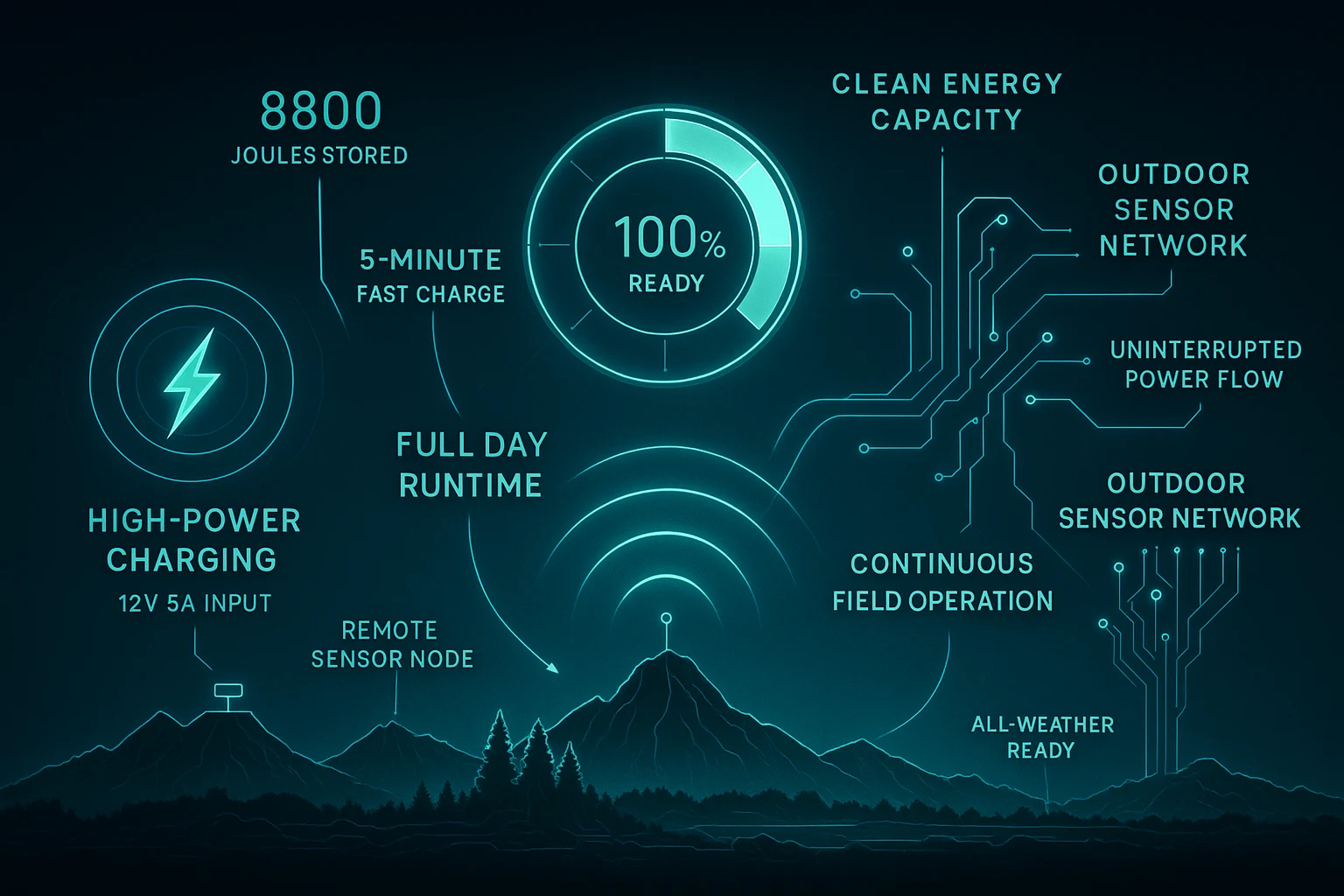
Outdoor Sensor Power Module: The 5-Minute Charge That Powers a Full Day in the Field
RFOXiA SuperCapacitor Battery and Programmer Kit
The Best Outdoor Sensor Power Module for Developers Who Can't Afford Downtime
If you've ever been deep in a field deployment — sensors streaming, BLE modules pinging, GNSS locked — and watched your power bank die at hour six, you already understand the problem this product solves.
Field work doesn't pause for a three-hour lithium charge cycle. Remote environmental monitoring doesn't care that your USB battery ran out. Drone telemetry doesn't stop because your power source gave up.
The RFOXiA SuperCapacitor Battery and Programmer Kit is built for exactly that reality. It's a professional-grade outdoor sensor power module engineered around supercapacitor technology — not lithium cells — which means full charge in under five minutes, 24 hours of uninterrupted runtime, and a power system that won't degrade after 500 cycles.
This isn't a power bank with a new label. It's a purpose-built power and programming solution for the MultiNav Pro+ ecosystem, and it changes how you deploy wireless hardware in the field.
Why Lithium Batteries Are the Wrong Solution for Field Sensor Deployments
Most developers default to lithium-based power — USB power banks, LiPo packs, 18650 cells. And for desktop development, they're fine. But for serious outdoor sensor deployments, lithium creates four real problems:
1. Long recharge times. A standard 10,000mAh power bank takes 4–6 hours to recharge. If you're running multiple deployment cycles in a single day — which field researchers and drone operators regularly do — you're either carrying multiple batteries or waiting.
2. Capacity degradation. Lithium cells lose capacity with every charge cycle. After 300–500 cycles, you're operating at 70–80% of original capacity. In cold environments, that drops even further.
3. Temperature sensitivity. LiPo batteries become dangerous below -20°C and lose significant capacity in cold field conditions. If you're deploying environmental monitoring hardware in winter or at altitude, lithium is a liability.
4. Replacement cost. When the battery degrades, you replace it. That's recurring cost and hardware management overhead.
Supercapacitors solve all four problems. They charge in minutes, not hours. They maintain capacity across hundreds of thousands of cycles. They operate reliably across extreme temperature ranges. And they last the lifetime of the hardware.
The MultiNav Pro+ Power/Program Kit is built around an 1100F supercapacitor system — and at 8,800 joules of stored energy, it has more than enough capacity to power a complete MultiNav Pro+ module stack for a full working day.
What's Inside the MultiNav Pro+ Power/Program Kit
The 1100F Supercapacitor System
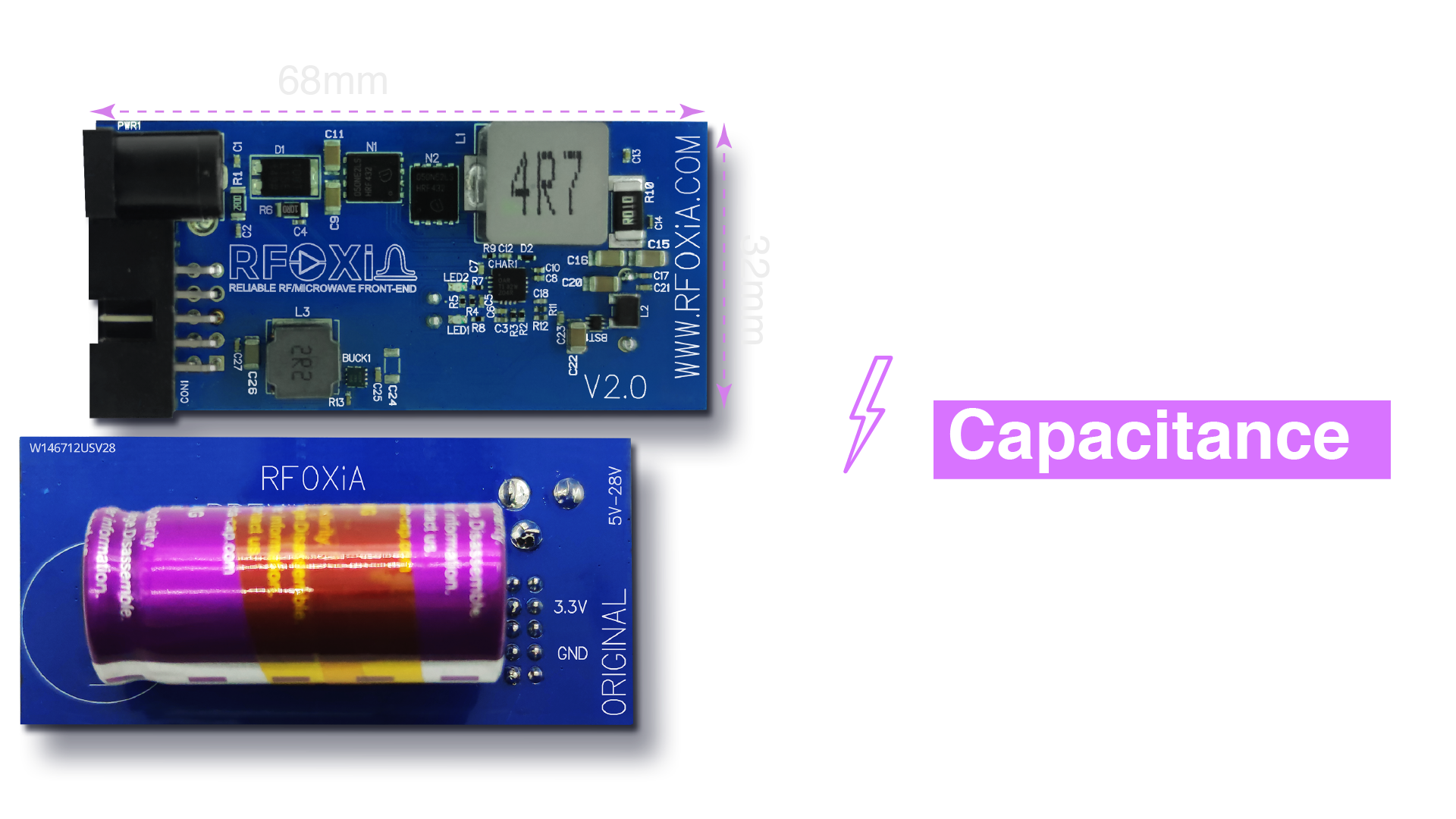
The core of this outdoor sensor power module is the 1100F supercapacitor bank. Here's what that number means in practice:
- 1100 Farads of capacitance at 4V working voltage
- 8,800 Joules of stored energy — enough to power the complete MultiNav Pro+ module stack (BLE Module + GNSS Module + Sensors Module) for a full day of continuous operation
- Full charge in under 5 minutes — connect the included 12V 5A adapter, wait five minutes, and you're fully charged for the next 24-hour deployment
- Cycle life measured in hundreds of thousands — not hundreds
For context: a standard LiPo battery storing equivalent energy for field sensor use would take 90–120 minutes to charge from a comparable input. The supercapacitor system does it in five. For field researchers running multiple daily deployments, that difference is the difference between a functional workflow and a broken one.
The system also delivers extremely clean, stable DC output — which matters for sensitive sensor accuracy. Voltage ripple that's acceptable for a phone charger can introduce noise into precision temperature, humidity, and air quality readings. The supercapacitor output is clean enough that sensor data integrity is preserved throughout the discharge cycle.
The 12V 5A High-Power Charging Adapter
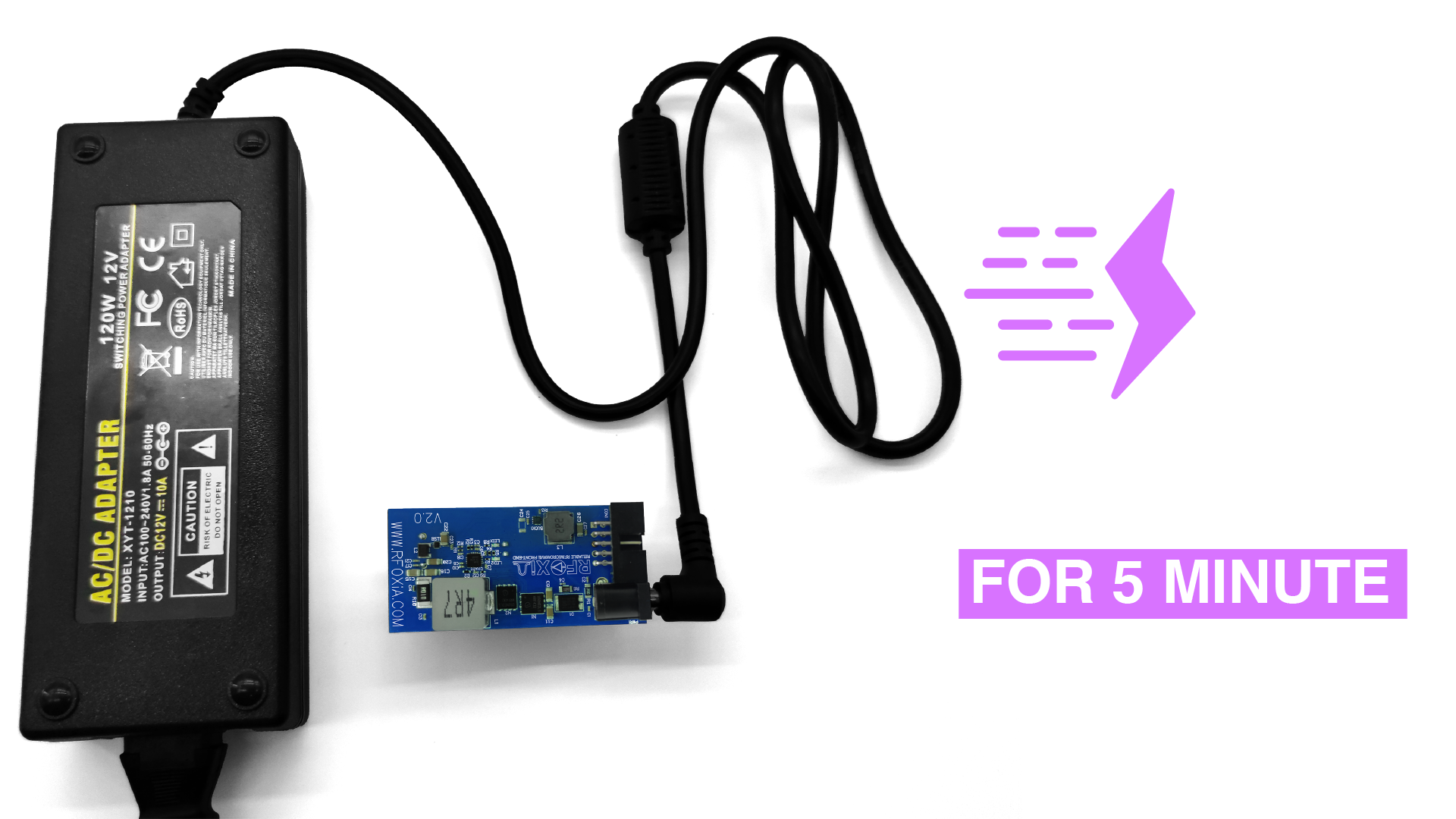
The included high-power charging adapter is matched specifically to the supercapacitor system. It delivers 12V at 5A input, which the onboard charging circuit converts to 4V at 10A — the optimal charging profile for the 1100F capacitor bank.
This isn't an off-the-shelf wall adapter thrown in the box. It's the correct adapter for the correct chemistry, delivering the correct current profile to get to full charge in under five minutes without stressing the capacitor cells.
For developers working in environments with access to vehicle power (12V DC from a car or truck), the input voltage compatibility makes the Power/Program Kit practical for mobile field stations. Connect to your vehicle's power system while setting up, and your sensor node is fully charged before you've finished configuring your deployment.
Full-Day Power for the Complete MultiNav Pro+ Stack
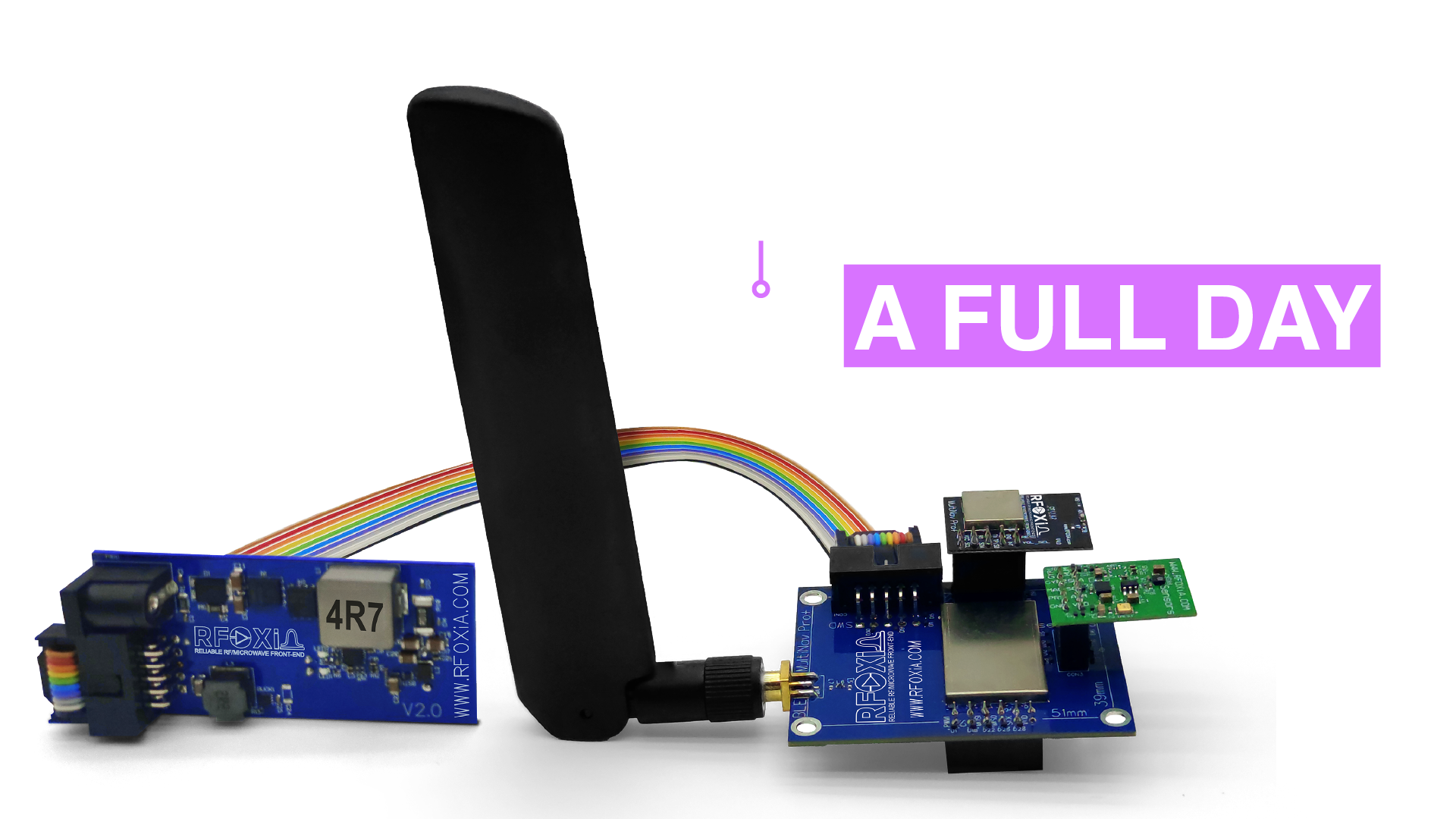
This is the specification that matters most for field deployments: the Power/Program Kit can power the complete MultiNav Pro+ module ecosystem — BLE Module, GNSS Module, and Sensors Module running simultaneously — for a full 24-hour period.
For the RFOXiA data network specifically, this is critical. Contributing verified environmental data to the network requires continuous outdoor streaming. A node that goes offline at hour eight isn't contributing verified uptime data. A node that runs for 24 hours on a single 5-minute charge earns maximum uptime bonuses and delivers the kind of consistent, high-resolution data stream that enterprise buyers actually pay for.
For drone operators and field researchers, the math is similarly clear: one charge in the morning powers a full day of data collection, telemetry streaming, and remote control operations without interruption.
As a dedicated outdoor sensor power module, the enclosure and power delivery system are designed for the kind of environments where you actually deploy wireless hardware — not a clean lab bench. The system handles the thermal variation, vibration, and handling stress of real field use.
The Integrated STLink Programmer

The STLink programmer built into the Power/Program Kit is the second major component — and for firmware developers, it may be the more immediately valuable one.
The MultiNav Pro+ BLE Module runs on an STM32WB07 microcontroller. Flashing custom firmware, updating production firmware, and debugging in-circuit all require an SWD programmer interface. The STLink is the standard tool for STM32 development, and having it integrated directly into the power kit means you're carrying one device, not two.
For developers working with the RFOXiA AI Firmware Builder — which generates complete, production-ready STM32WB07 firmware from plain-language descriptions — the workflow becomes: generate firmware in the Dev Hub, download the binary, connect the Power/Program Kit, flash. No additional hardware required.
The STLink interface also enables real-time debugging through SWD, which means you can use STM32CubeIDE or any compatible debugger to set breakpoints, inspect registers, and trace execution on live hardware. For developers building custom applications on top of the MultiNav Pro+ platform, this is a professional-grade development capability in a field-deployable package.
The firmware repository for the BLE Module is publicly available at https://github.com/RFOXiA/MultiNav-Pro-Long-Range-BLE-Module-Firmware-STM32WB07 — open source and ready for customization.
Complete Connectivity Kit
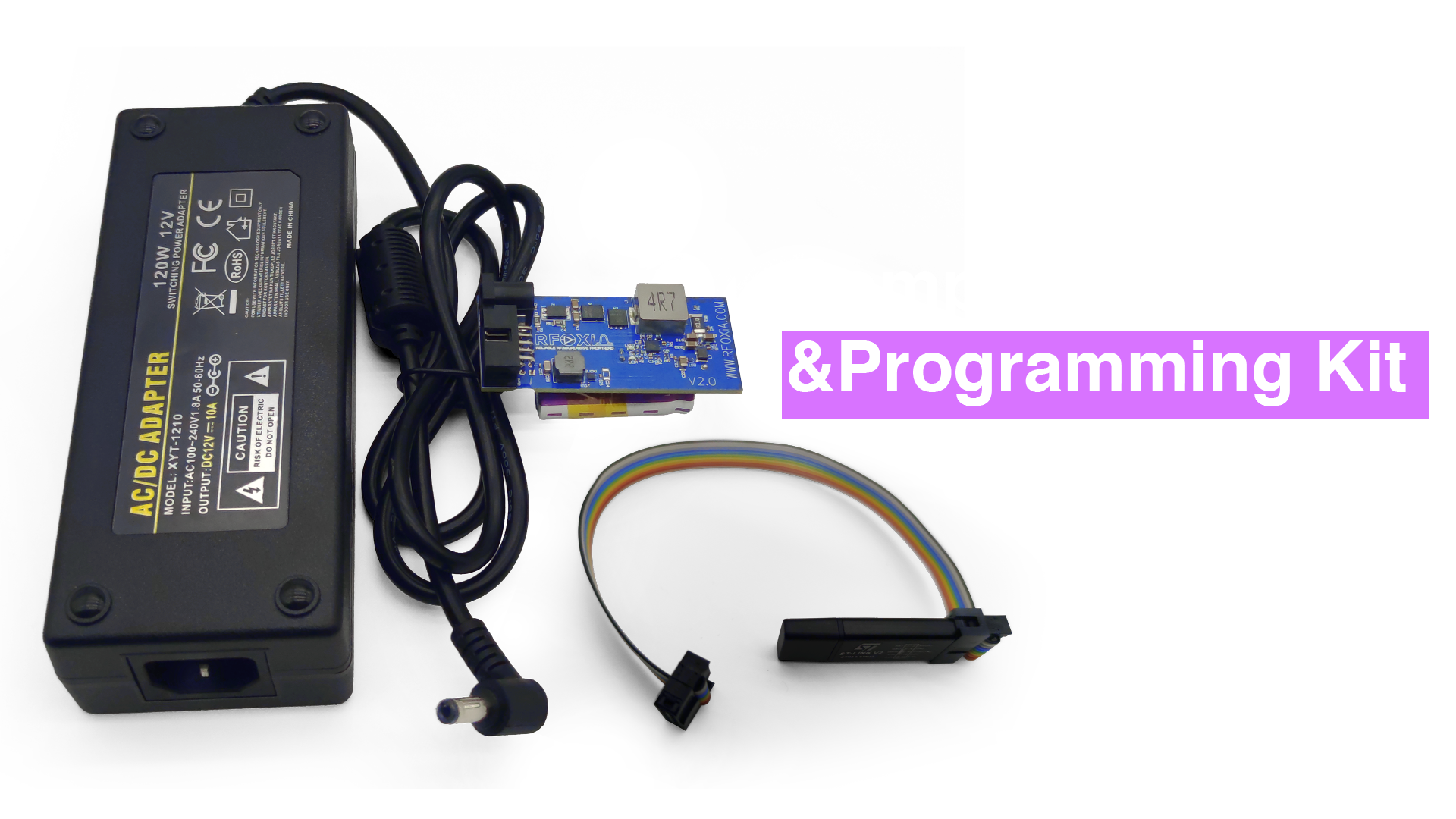
The Power/Program Kit ships with every cable required to connect the full MultiNav Pro+ ecosystem. Flat ribbon cables connect:
- The BLE Module to the Power/Program Kit (power delivery)
- The STLink programmer to the BLE Module (programming and debug)
- The full module stack (BLE + GNSS + Sensors) to the power system
Flat ribbon cables are the right choice for a compact field deployment — they lay flat against the enclosure, reduce the profile of the assembled system, and are significantly less prone to connector stress than barrel-connector or JST wiring in vibration-heavy environments like drone airframes.
Everything you need to connect, power, and program the complete MultiNav Pro+ stack is in the box.
Who Needs This Outdoor Sensor Power Module
Environmental Data Network Contributors
If you're running a Sensors Module as part of the RFOXiA data network — streaming verified temperature, humidity, pressure, air quality, and GPS location data — the Power/Program Kit is essentially required equipment. The data network rewards consistent uptime. A node that runs for 24 hours on a single charge earns maximum uptime bonuses. A node that dies at hour eight loses that day's reward potential.
The combination of 5-minute recharge and 24-hour runtime means your node is always ready. Morning charge, full day of verified data, maximum daily reward.
Drone Operators and FPV Builders
For drone builds using the MultiNav Pro+ BLE Module for long-range telemetry or the GNSS Module for precision position feedback, the Power/Program Kit provides ground-station power for extended flight sessions. Five minutes to charge before your first flight. Enough capacity for a full day of operations. STLink on board for firmware tweaks between sessions without packing up and going back to a desk.
Field Researchers and Environmental Scientists
Deploying a multi-sensor array in the field — whether for agricultural monitoring, atmospheric research, or urban environmental sensing — requires a power solution that matches the deployment duration. Researchers who need 24-hour continuous data collection can deploy the Sensors Module and GNSS Module on the Power/Program Kit and collect a full day of high-resolution data on a single charge.
Embedded Developers Building Custom Applications
If you're using the MultiNav Pro+ BLE Module as the foundation for a custom wireless product — using the AI Firmware Builder or writing your own STM32WB07 firmware — the integrated STLink programmer eliminates the need for a separate development board programmer. One device handles power, programming, and debugging throughout your development cycle.
Technical Specifications Summary
| Specification | Value |
|---|---|
| Supercapacitor Capacitance | 1100F |
| Stored Energy | 8,800 Joules |
| Working Voltage | 4V |
| Full Charge Time | < 5 minutes |
| Runtime (full MultiNav Pro+ stack) | 24 hours |
| Charging Input | 12V 5A (included adapter) |
| Charging Current to Supercapacitor | 4V at 10A |
| Programmer Interface | STLink (SWD) |
| Compatible MCU | STM32WB07 |
| Certifications | FCC |
| Included Cables | Flat ribbon cables (full connectivity kit) |
| Price | $119 |
How the Power/Program Kit Fits Into the RFOXiA Developer Bundle
The Power/Program Kit is included in the RFOXiA Developer Bundle — which combines the BLE Module, GNSS Module, Sensors Module, and Power/Program Kit in a single package at $199 (after credits).
For developers who want the complete ecosystem — long-range BLE connectivity, precision GNSS, seven-sensor environmental monitoring, and professional power management — the Developer Bundle is the complete package. For developers who already own one or more MultiNav Pro+ modules and need to add power management and programming capability, the Power/Program Kit at $119 is the direct path.
In both cases, the RFOXiA SuperCapacitor Battery and Programmer Kit is the power infrastructure that makes the full MultiNav Pro+ ecosystem viable for real-world field deployment.
Supercapacitor vs. LiPo: The Technical Case
For developers evaluating whether supercapacitor technology is the right choice for their application, here's the honest technical comparison:
Supercapacitor advantages for field sensor use:
- Charge time: 5 minutes vs. 90–180 minutes for equivalent LiPo
- Cycle life: 500,000+ cycles vs. 300–500 for lithium
- Temperature range: -40°C to +65°C vs. limited cold performance for lithium
- No thermal runaway risk — supercapacitors don't catch fire under abuse conditions
- No capacity degradation over deployment lifetime
- Clean output voltage profile beneficial for sensitive sensor accuracy
LiPo advantages (where they exist):
- Higher energy density by weight — smaller and lighter for equivalent joules
- Lower cost per joule of storage capacity
- More widely available replacement cells
For a field-deployed outdoor sensor power module that needs to charge quickly, run all day, and survive thousands of deployment cycles over years of use, supercapacitors are the correct engineering choice. For a drone battery where gram-weight is the primary constraint, LiPo is still appropriate.
The Power/Program Kit is optimized for the use case where it matters: powering a stationary or semi-stationary sensor node through a full day of data collection, with the ability to recharge between deployments in the time it takes to reconfigure your setup.
Getting Started with the Power/Program Kit
Setup is straightforward:
- Connect the charging adapter — plug the 12V 5A adapter into the Power/Program Kit charging port
- Charge for 5 minutes — the onboard charge management system handles the rest
- Connect your MultiNav Pro+ modules using the included flat ribbon cables
- Power on and deploy — your sensor node is now running on 8,800 joules of clean supercapacitor power
- Program and debug — connect the STLink interface to your BLE Module to flash firmware, update settings, or debug in-circuit
For new MultiNav Pro+ developers, the RFOXiA Club Dev Hub includes full documentation, firmware examples, and access to the AI Firmware Builder — which generates complete STM32WB07 firmware from plain-language project descriptions. No hardware programming experience required to get started.
The Bottom Line
The best outdoor sensor power module for the MultiNav Pro+ ecosystem isn't a generic power bank or a LiPo pack zip-tied to your enclosure. It's a purpose-built system that solves the two most common developer pain points in field deployments: power running out mid-session and firmware updates requiring a trip back to the desk.
8,800 joules. Five minutes to full. Twenty-four hours of runtime. Integrated STLink. Every cable included. FCC certified.
If you're deploying wireless sensor hardware in the field — whether for data network contribution, drone operations, environmental research, or custom IoT applications — the Power/Program Kit is the power infrastructure your MultiNav Pro+ modules deserve.
Get the RFOXiA SuperCapacitor Battery and Programmer Kit and run all day on a five-minute charge.
Written by: Moamen Mohamed LinkedIn