
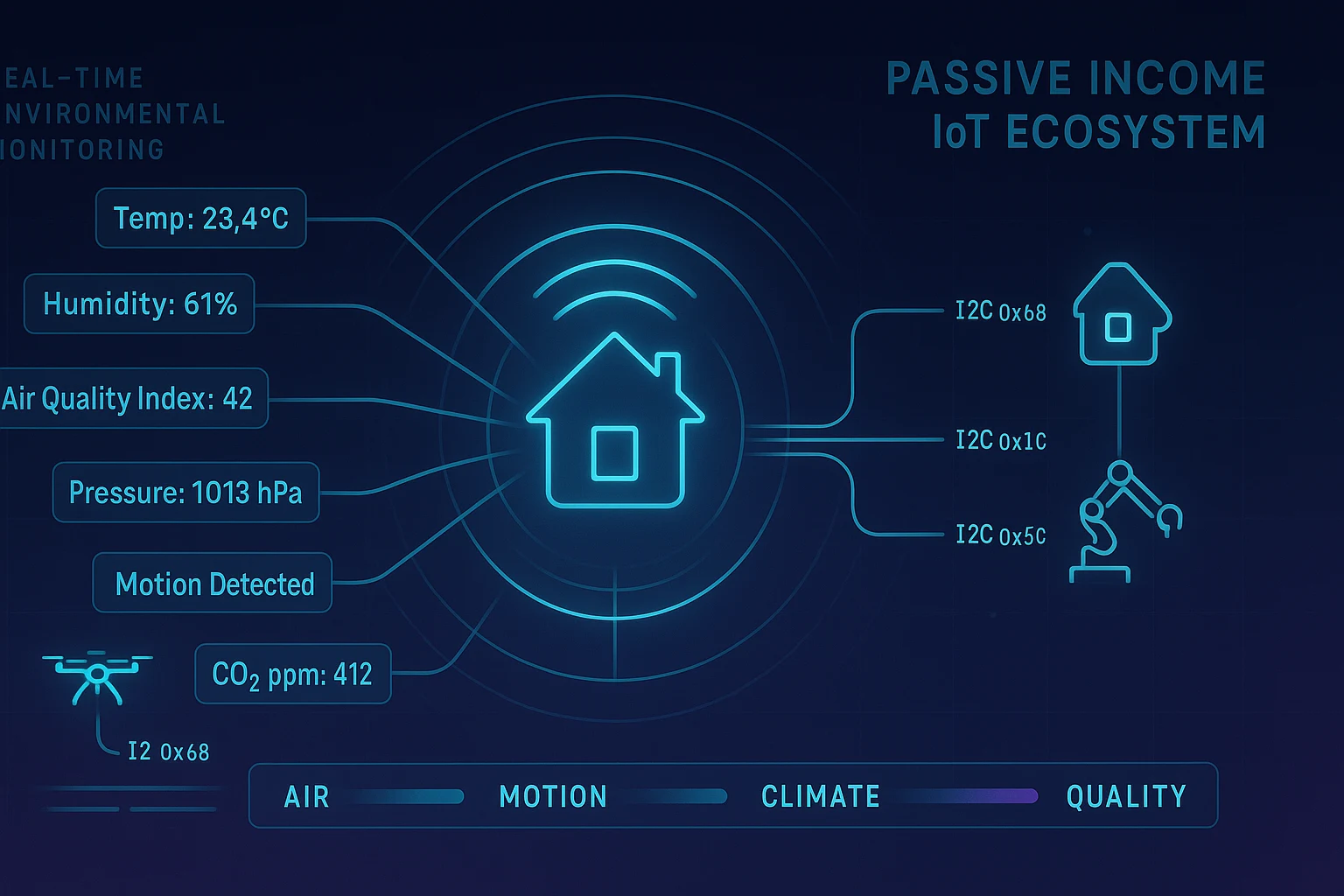
Passive Income IoT Sensor: How the MultiNav Pro+ Sensors Module Pays You While You Build
RFOXiA Integrated Sensors Module
Your Next Project Could Be Earning Money While You Sleep
The Passive Income IoT Sensor That Serious Builders Are Deploying Right Now
Most hardware projects cost money. They consume time, components, power, and bandwidth — and at the end of it all, you have something that works, sits on a shelf, and occasionally impresses people at meetups. That's the traditional equation.
RFOXiA is rewriting that equation.
The MultiNav Pro+ Sensors Module is not just one of the most capable all-in-one environmental and motion sensing boards available at its price point. It is also the cornerstone of a working passive income IoT sensor network that pays verified contributors every single day — in real currency, credited directly to your account.
This post covers everything: the hardware itself, the sensors inside it, the engineering choices that make it unique, and exactly how deploying one can start generating passive income from verified environmental data.
What Is the MultiNav Pro+ Sensors Module?
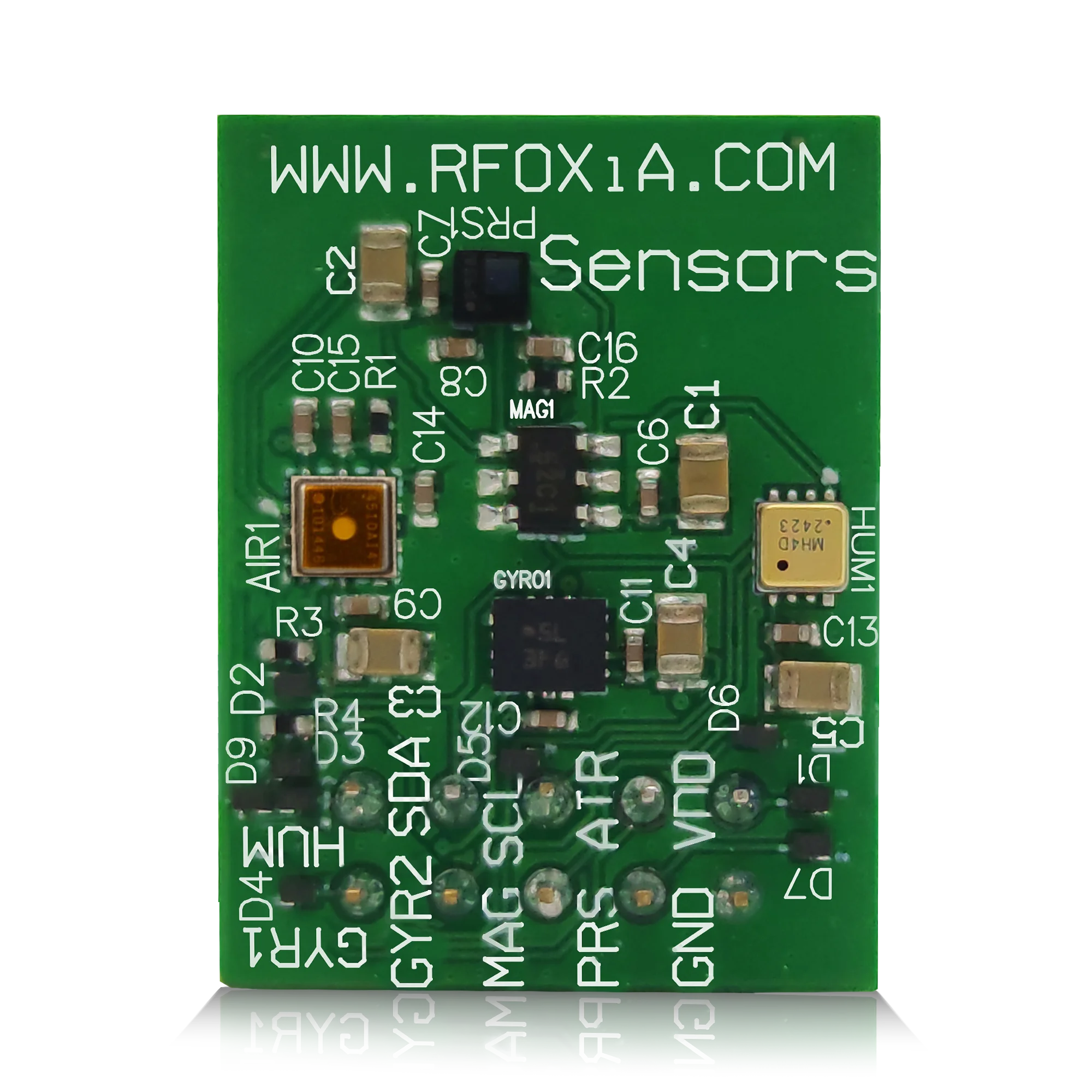
The MultiNav Pro+ Sensors Module is a compact 24mm × 18mm PCB that integrates seven distinct sensors into a single board with a unified I2C interface. Seven sensors. One board. One I2C line.
That alone is a feat of hardware design. But what makes this module genuinely interesting is what surrounds it: a complete ecosystem including AI-assisted firmware development, a mobile control app, a long-range BLE communication module, and the RFOXiA data network — a live system that purchases the data your sensors collect.
If you are an engineer, a drone builder, a researcher, or a serious maker who has been looking for a way to make your IoT infrastructure generate returns instead of just consume them, this is the hardware that makes that possible.
Seven Sensors. One Board. Zero Compromise.
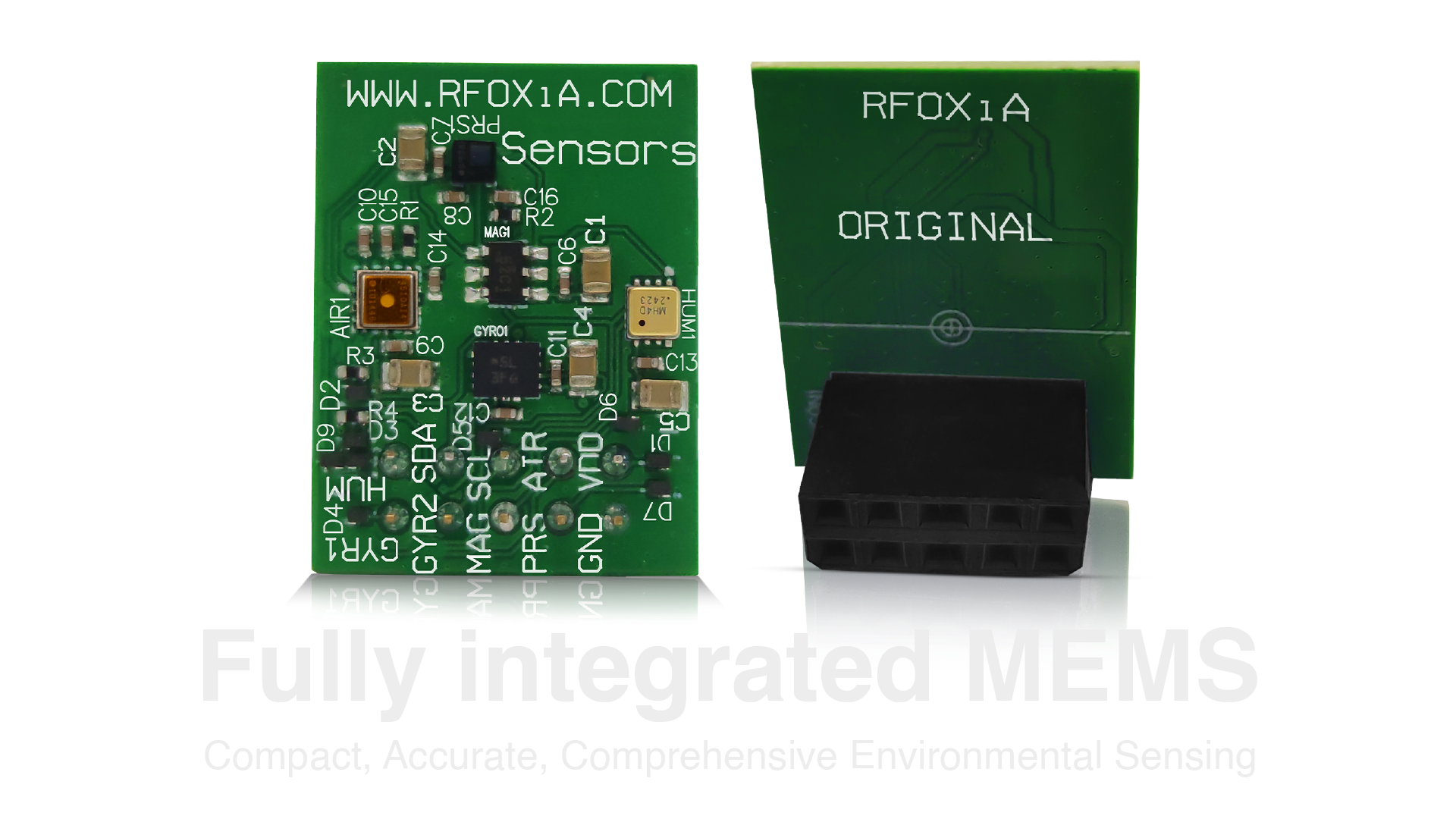
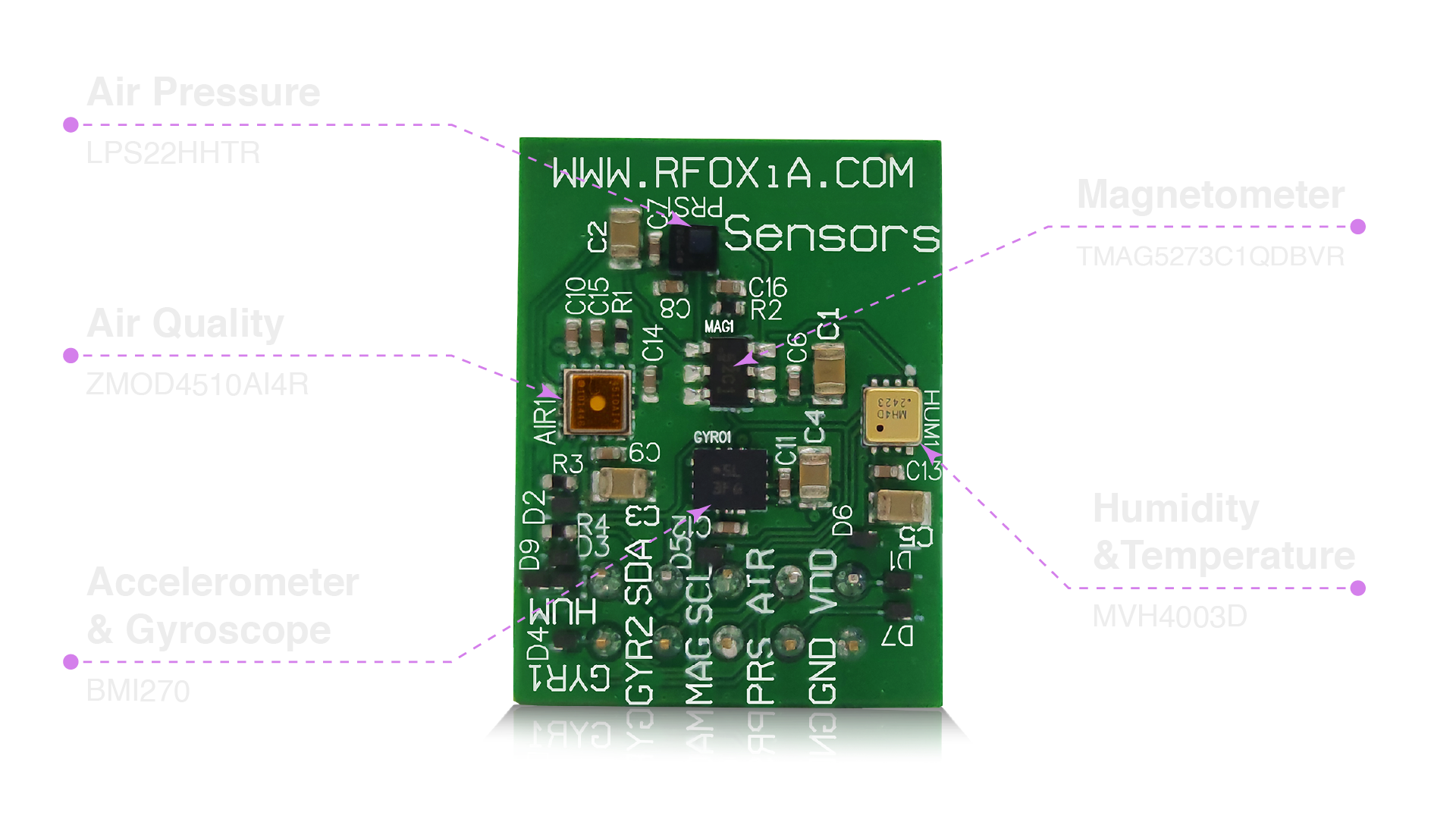
Let's talk about what is actually inside this module, because the component selection is not arbitrary. RFOXiA chose each sensor from best-in-class manufacturers for specific reasons.
Accelerometer & Gyroscope — BMI270 from Bosch Sensortec
The BMI270 is the same IMU found in professional sports performance trackers and high-end drone flight controllers. It delivers low-noise, high-bandwidth motion data with excellent power efficiency. For drone applications, that means accurate attitude estimation. For wearables, it means responsive gesture recognition. For industrial monitoring, it means reliable vibration analysis.
Magnetometer — TMAG5273C1QDBVR from Texas Instruments
Magnetometers are often the weak link in sensor fusion applications — cheap solutions suffer from significant noise and drift. The TMAG5273 from TI is a 3D Hall-effect sensor with 12-bit resolution and a low-power mode that makes it ideal for always-on heading estimation. Combined with the BMI270, you get a complete 9-DOF motion sensing stack.
Air Pressure — LPS22HHTR from STMicroelectronics
ST's LPS22HH is a MEMS absolute pressure sensor with a 260–1260 hPa range and ±0.1 hPa typical accuracy. For altitude estimation in drones and UAVs, this is the sensor that makes the difference between rough altitude hold and precision barometric tracking. It also contributes directly to the verified environmental data stream that generates passive income on the RFOXiA network.
Humidity & Temperature — MVH4003D from MEMSVision
MEMSVision's MVH4003D provides calibrated humidity and temperature readings in a miniaturized package. Temperature and humidity are two of the five verified data points required to earn rewards on the RFOXiA data network — and the MVH4003D delivers both with the accuracy and reliability that GPS-verified verification demands.
Air Quality — ZMOD4510AI4R from RENESAS
Air quality is arguably the most commercially valuable sensor in this stack. The ZMOD4510 from Renesas is a gas sensor module optimized for outdoor air quality monitoring, specifically tuned for detecting O3 (ozone) and NO2 (nitrogen dioxide). This is exactly the kind of hyper-local, street-level air quality data that insurance companies, agricultural technology firms, logistics operators, and smart city platforms are willing to pay for — and cannot get from public APIs at useful resolution.
The Engineering Behind the Integration
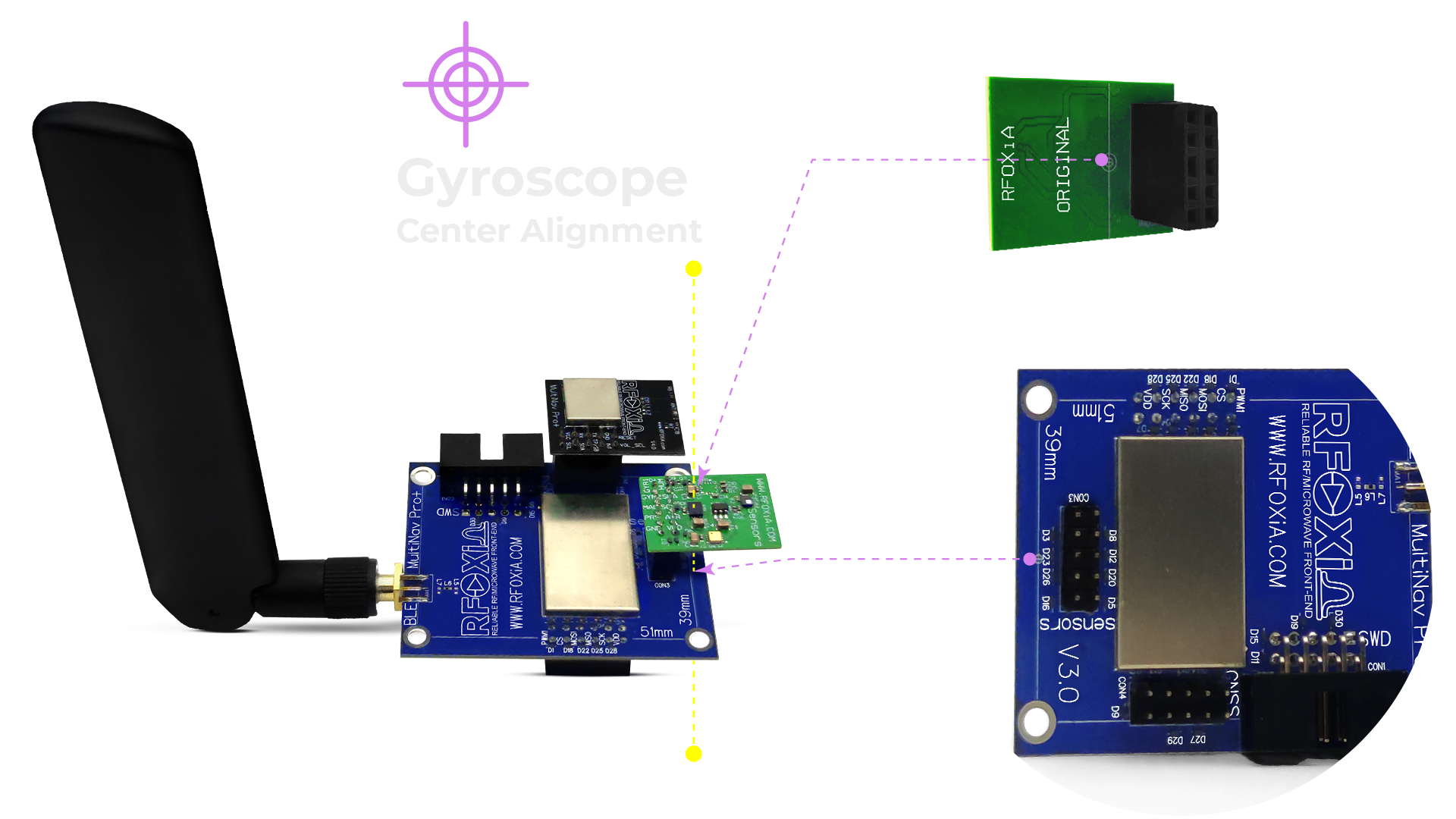
Putting seven sensors on a 24mm × 18mm board is not just a component sourcing exercise. It requires disciplined PCB layout, careful power rail isolation between analog and digital domains, and attention to thermal coupling between temperature-sensitive sensors and heat-generating components.
The MultiNav Pro+ Sensors Module handles this through a combination of ground plane segmentation, strategic component placement, and the use of dedicated decoupling networks for each sensor's power supply. The result is a board that behaves predictably across a wide range of operating conditions — from the vibration environment of a racing drone to the thermal cycling of an outdoor IoT enclosure.
Simplified I2C Architecture
One of the design decisions that makes this module genuinely developer-friendly is the I2C architecture.
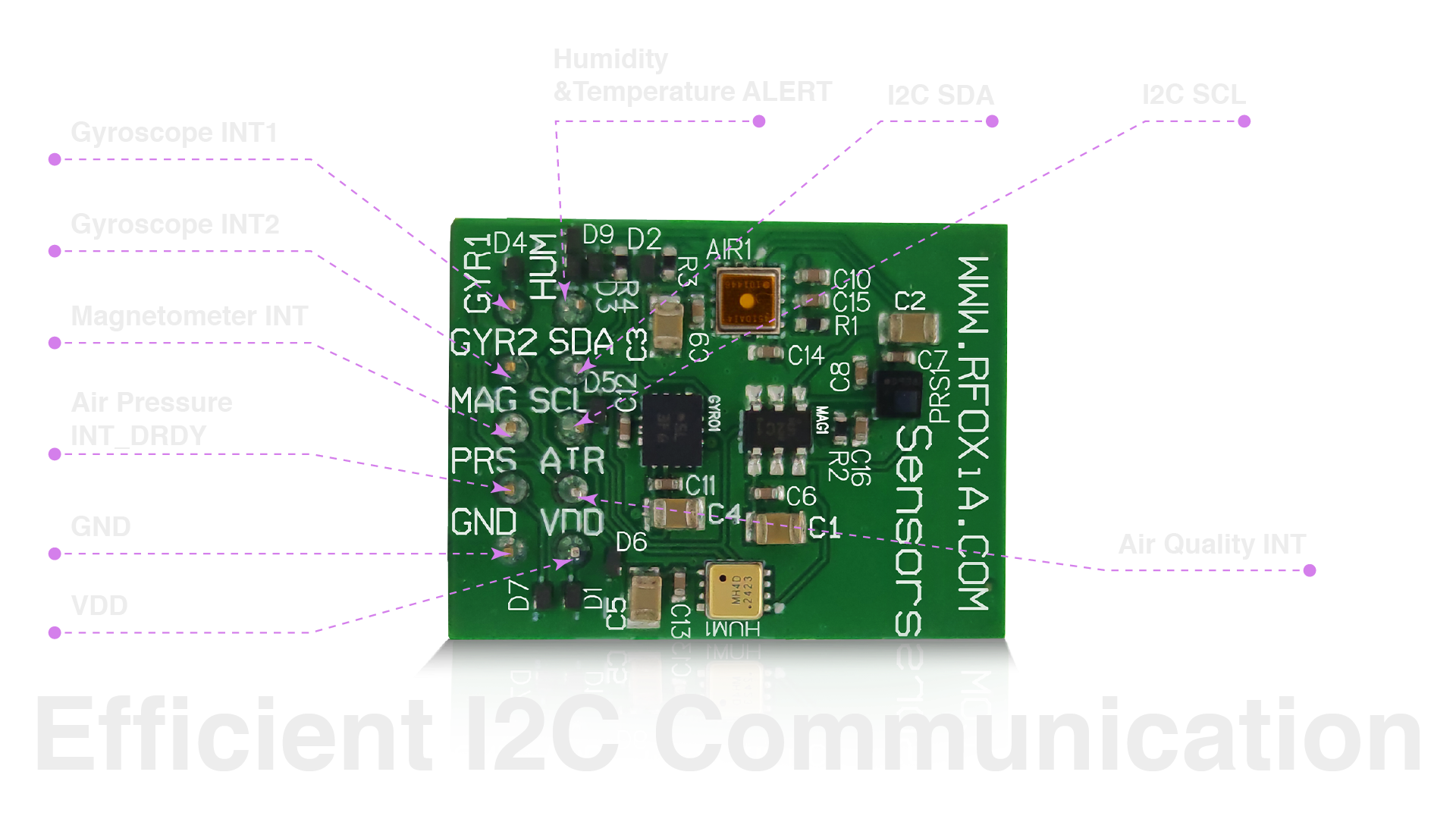
All seven sensors communicate over a single I2C bus. Each sensor has a dedicated address, so your firmware can address any sensor independently without bus contention or multiplexers. This dramatically simplifies your hardware design. You run two wires — SDA and SCL — from your microcontroller to the module header, and you have access to all seven sensors immediately.
For developers accustomed to managing SPI peripherals with individual chip-select lines, or dealing with I2C address conflicts across multiple modules from different manufacturers, this architecture is a significant quality-of-life improvement. For beginners building their first sensor-fusion project, it removes one of the most common integration headaches entirely.
RFOXiA's AI Firmware Builder — integrated into the RFOXiA Club Dev Hub — can generate production-ready firmware for the Sensors Module in plain-language prompts, further reducing the time from hardware arrival to first data stream.
Compact. Field-Ready. Precision-Built.
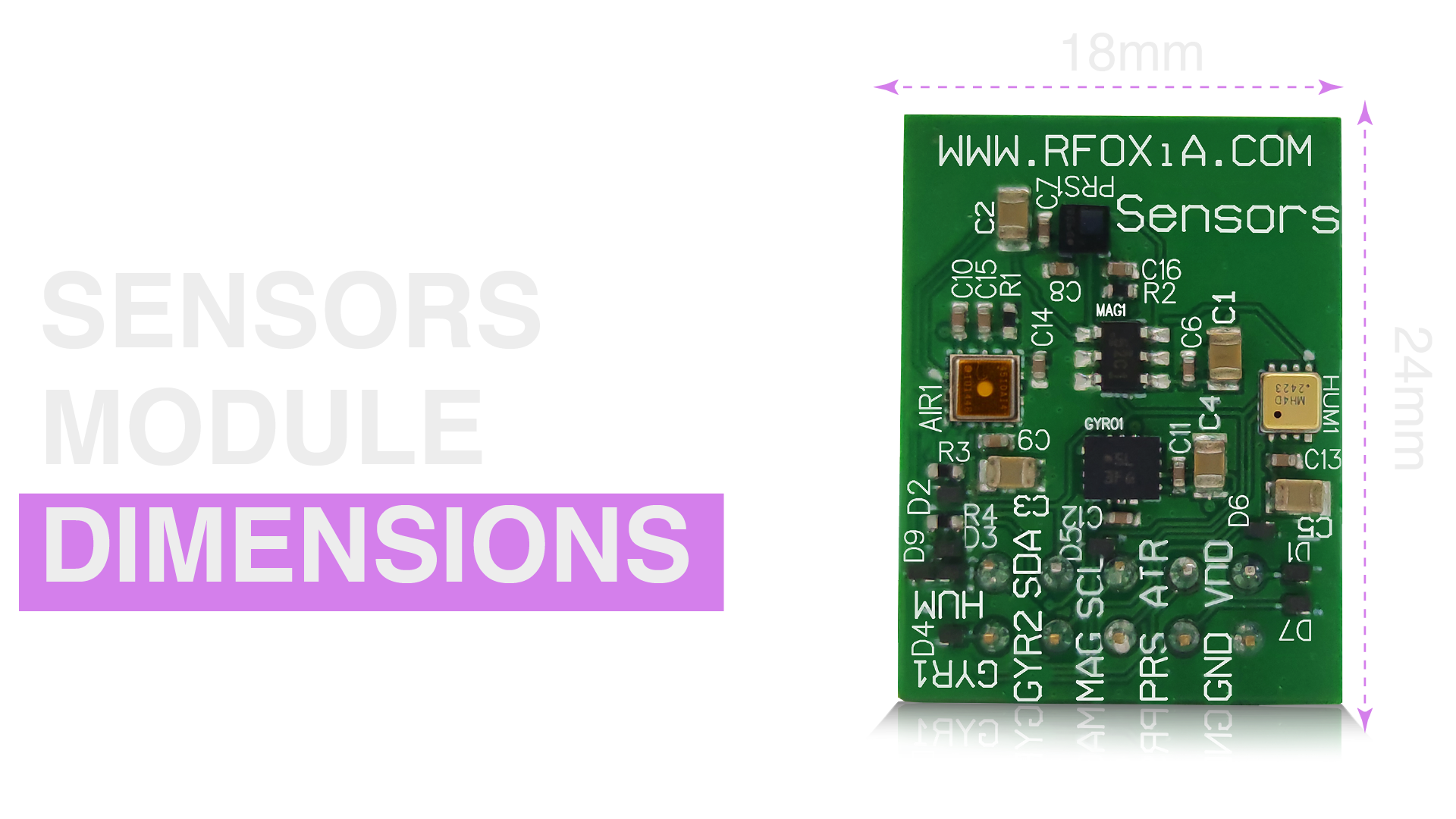
At 24mm × 18mm, the MultiNav Pro+ Sensors Module is smaller than most business cards. It fits on a racing drone frame without aerodynamic compromise. It integrates into a wearable enclosure without visible bulk. It deploys in an outdoor IoT node without demanding a large weatherproof housing.
Small form factor hardware typically means compromise — fewer sensors, lower-quality components, reduced accuracy. The MultiNav Pro+ inverts this assumption. The compactness is the result of careful layout discipline, not component elimination.
For field deployment as a passive income IoT sensor node, size matters for a practical reason: a smaller, lighter enclosure is easier to mount discretely, harder to dislodge by weather or vandalism, and cheaper to weatherproof. When you are deploying multiple nodes to maximize your data network coverage and earning potential, every gram and every millimeter of board space is a real-world cost consideration.
Real-Time Data. Real-World Applications.
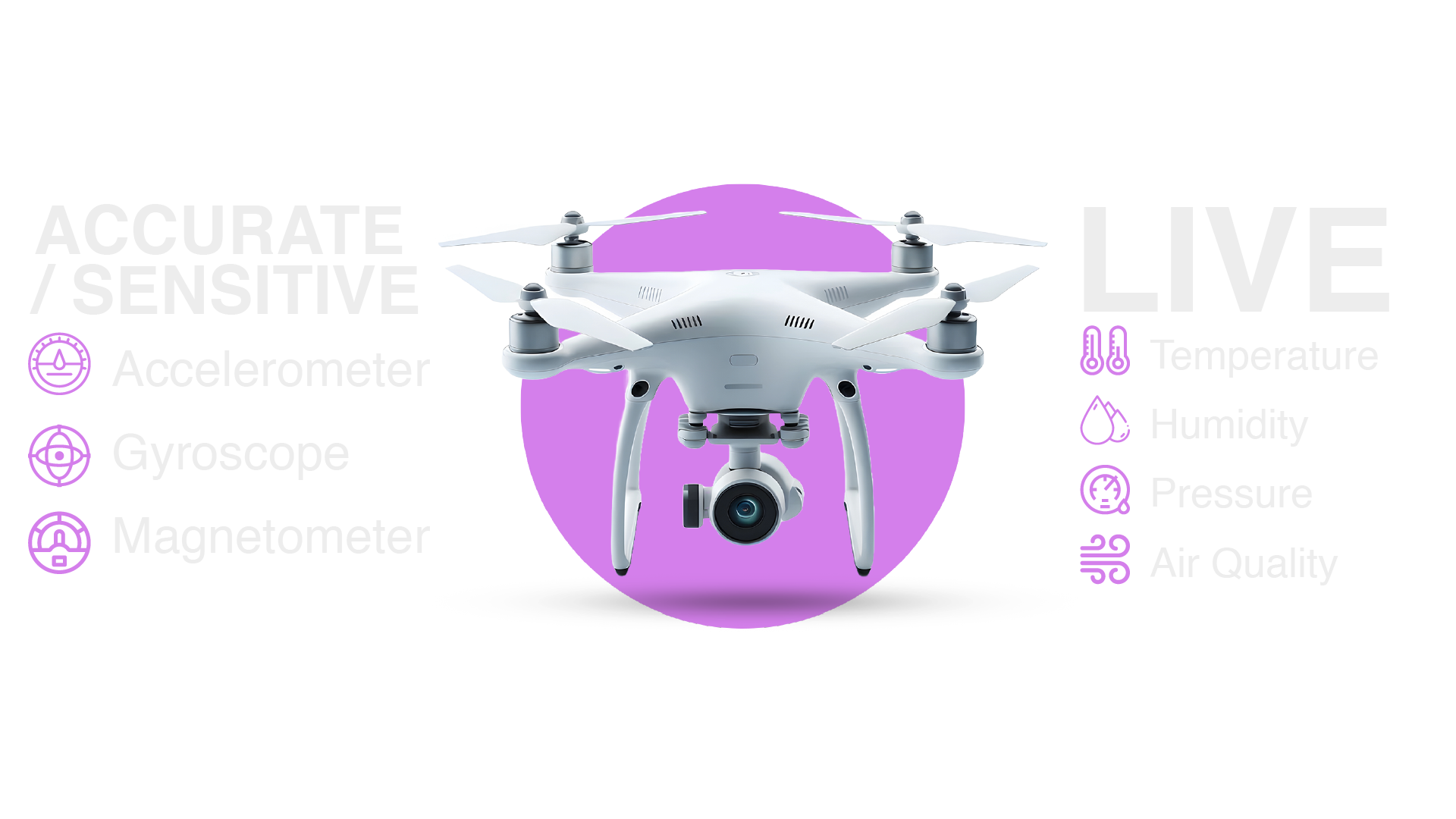
The MultiNav Pro+ Sensors Module streams real-time data across all seven sensor channels simultaneously. In the context of the RFOXiA ecosystem, that data flows through the BLE module — the MultiNav Pro+ BLE Module, with ground-to-ground range up to 5km and drone-to-drone range up to 50km — to the RFOXiA Connect app on your phone, and from there to the RFOXiA data servers for verification and storage.
The RFOXiA Connect app displays live sensor readings on a clean dashboard: temperature, humidity, pressure, air quality index, orientation from the IMU, heading from the magnetometer. You can monitor your deployment from your phone without an internet connection, because the BLE communication between the module and your phone is entirely local. No cloud dependency. No latency introduced by an MQTT broker in a distant data center.
For applications where real-time response to sensor data is critical — drone attitude control, environmental alarm triggers, field research data collection — this architecture means lower latency and higher reliability than cloud-first designs.
The Passive Income Mechanism: How the RFOXiA Data Network Works
This is where the MultiNav Pro+ Sensors Module becomes genuinely different from every other sensor board on the market.
RFOXiA operates a live environmental data network. Enterprise buyers — agricultural technology companies, insurance firms, smart city operators, logistics companies, climate research institutions — need hyper-local environmental data at resolutions that public APIs cannot provide. Weather stations are miles apart. Satellite data lacks street-level resolution. Government monitoring networks are sparse and slow.
RFOXiA fills that gap with a distributed network of verified sensor nodes. And the people running those nodes are builders like you, earning daily rewards for the data their hardware collects.
How You Earn
Deploy your Sensors Module outdoors — the GNSS module (available separately or in the Developer Bundle) provides GPS validation, confirming outdoor placement and preventing data spoofing from indoor deployments.
Stream verified data — all five environmental data points (temperature, humidity, pressure, air quality, GPS location) must be present and within expected ranges for a session to be verified. The system cross-references against online reference sources for anomaly detection.
Earn daily rewards — verified contributors earn between $0.08 and $0.25 per day depending on geographic location scarcity, network tier, and uptime consistency. Pioneer members and early network contributors receive higher locked-in rates. Nodes in data-sparse locations earn scarcity bonuses. Consistent uptime earns additional rate bonuses. Maximum verified earning potential reaches $0.40 per day per node.
This is a genuine passive income IoT sensor model. Your hardware works. Your hardware earns. The data your sensors generate has real commercial value to buyers who cannot get it anywhere else.
Why This Data Has Commercial Value
The RFOXiA network provides second-level temporal resolution and street-level geographic resolution. Most commercial weather APIs update every minute or every ten minutes. Most monitoring networks cover areas measured in square kilometers, not square meters.
For a crop insurance company modeling freeze risk in a specific agricultural region, street-level temperature data updated every second is worth paying for. For a logistics company monitoring cold chain integrity across a city, hyper-local humidity and temperature data from a distributed network is mission-critical intelligence. For a smart city operator modeling air quality by neighborhood, ZMOD4510-grade outdoor gas sensor data from hundreds of nodes is precisely what their AI models need.
Your node contributes to that dataset. You earn from that value.
Applications Beyond the Data Network

The passive income earning opportunity is compelling, but it is not the only reason to own the MultiNav Pro+ Sensors Module. The application landscape for a 7-sensor, compact, I2C-unified sensing board is genuinely broad:
Drone and UAV applications: IMU data from the BMI270 combined with barometric altitude from the LPS22HH enables precise attitude estimation and altitude hold. Magnetometer heading from the TMAG5273 provides compass-stabilized yaw control. Air quality data enables environmental survey missions — wildfire smoke mapping, agricultural field analysis, infrastructure inspection.
Robotics: 9-DOF motion data is the foundation of any mobile robot's state estimation. Whether you are building a wheeled ground robot, a hexapod, or an autonomous underwater vehicle, the MultiNav Pro+ gives you a single, compact sensor package that covers the full inertial sensing stack.
Wearable technology: The combination of compact size, low power consumption, and multi-modal sensing makes this module well-suited for human motion analysis, personal environmental monitoring, and health-adjacent sensing applications.
Agricultural IoT: Micro-climate monitoring at field level, pest pressure modeling from temperature and humidity trends, precision irrigation trigger systems — the Sensors Module is the sensing layer for all of these.
Industrial monitoring: Vibration analysis using the accelerometer, temperature monitoring of equipment, air quality compliance monitoring in manufacturing environments — the industrial IoT use cases for a 7-sensor module are extensive.
Research: Universities and research institutions routinely need portable, multi-modal environmental sensing platforms for field campaigns. The MultiNav Pro+ in the Developer Bundle — paired with the GNSS module for geotagged data and the Power/Program Kit for extended field runtime — is a researcher-grade mobile data collection platform at a fraction of the cost of purpose-built research instruments.
FCC Certified. Ready to Ship. Priced for Makers.
The MultiNav Pro+ Sensors Module carries FCC certification. This is not a detail to skip past. FCC certification means this hardware has been tested and approved for use in the United States without legal ambiguity. It also means the Sensors Module is qualified for distribution through professional channels — DigiKey, Mouser, SparkFun, Adafruit — that require certification documentation before listing.
For developers building commercial products that incorporate the Sensors Module, FCC certification is the difference between a design that can go to market and one that cannot. At $39, the MultiNav Pro+ is the only FCC-certified 7-sensor I2C environmental and motion sensing module available at this price point.
The Developer Bundle: The Complete Passive Income IoT Sensor Platform
If the Sensors Module is the sensing layer, the RFOXiA Integrated Sensors Module is best understood in the context of the complete Developer Bundle — the platform that makes it a full passive income IoT sensor deployment.
The Developer Bundle includes:
- MultiNav Pro+ BLE Module — 5km ground-to-ground, 15-20km man-to-drone, 50km drone-to-drone range. The communication layer that connects your sensor node to the network.
- MultiNav Pro+ GNSS Module — 1.5m accuracy, 18Hz fix rate. The GPS validation layer that verifies outdoor deployment and geotagging every data point.
- MultiNav Pro+ Sensors Module — the 7-sensor environmental and motion sensing stack described throughout this post.
- Power/Program Kit — supercapacitor-based power system with 5-minute charge time and 24-hour runtime. The field deployment enabler.
Together, these four modules form a complete, FCC-certified wireless sensor platform that builds, communicates, and earns. For $199 after credits — or as low as $150 with the $50 coupon available to RFOXiA Club members who complete the onboarding funnel — this is the most complete maker-accessible professional wireless sensing ecosystem on the market.
Getting Started
Becoming a verified contributor to the RFOXiA data network — and turning your hardware into a genuine passive income IoT sensor — begins with the Sensors Module.
Here is the path:
- Join RFOXiA Club at rfoxia.com — free signup, $10 welcome credit immediately applied to your account.
- Complete the onboarding funnel — earn up to $50 in credits through guided platform exploration stages.
- Purchase the Sensors Module at $39 standalone, or maximize your setup with the Developer Bundle at $199 (or $150 with earned credits).
- Deploy outdoors — mount your node, pair with the GNSS module for GPS validation, connect via the RFOXiA Connect app.
- Start streaming — verified data sessions begin earning daily rewards immediately.
The RFOXiA Integrated Sensors Module page has everything you need to order, review full specifications, and access the firmware documentation and AI Firmware Builder integration that gets your node online fast.
Conclusion: Seven Sensors, One Board, Daily Earnings
The traditional hardware project ends when it is built. The MultiNav Pro+ Sensors Module is hardware that keeps working — sensing, streaming, and earning — long after the build is complete.
With seven best-in-class sensors from Bosch, Texas Instruments, STMicroelectronics, MEMSVision, and Renesas integrated on a 24mm × 18mm FCC-certified board, it is the most capable compact sensing module in its class. With the RFOXiA data network providing daily verified rewards for environmental data, it is the only sensor module that operates as a genuine passive income IoT sensor node.
For builders who take their hardware seriously — and who believe that building things should generate value, not just consume it — the MultiNav Pro+ Sensors Module is the logical next component in your stack.
Explore the full specifications, order your module, and activate your first data node at the RFOXiA Integrated Sensors Module product page.
Your sensors should be working for you. This one does.
Written by: Moamen Mohamed LinkedIn