
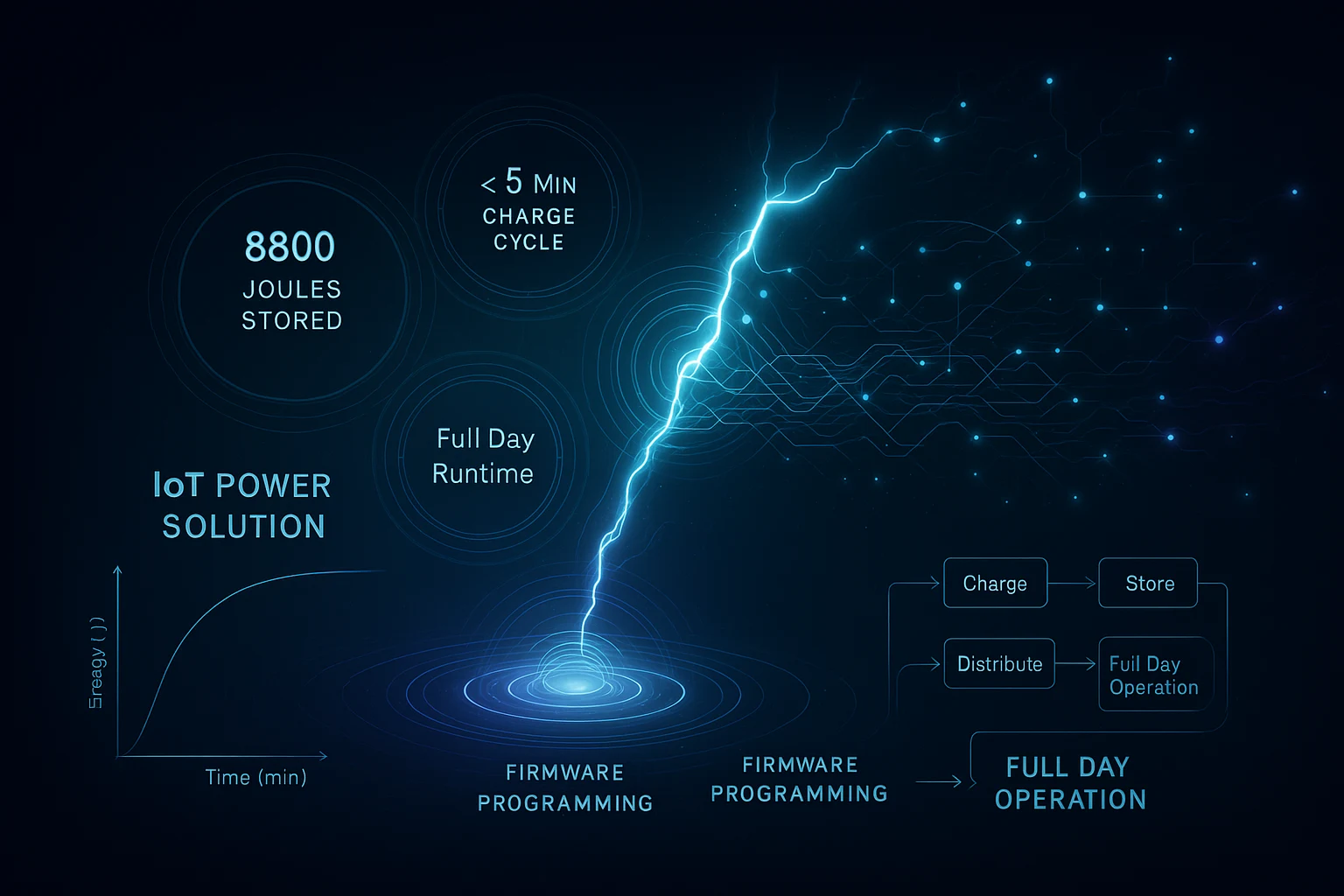
Power Kit IoT Development: The Supercapacitor Breakthrough Builders Have Been Waiting For
RFOXiA SuperCapacitor Battery and Programmer Kit
The Best Power Kit IoT Development Solution for Wireless Engineers and Drone Builders
Every serious hardware developer knows the pain. You are deep in a field test, your firmware is performing perfectly, your long-range BLE link is holding strong at 3 kilometers — and then your power system dies. Not because you ran out of ideas. Not because your hardware failed. Because the battery you trusted could not keep up with the demands of professional IoT development.
Battery-based power systems have been the silent bottleneck of wireless hardware development for years. Charging times measured in hours. Runtime that falls short of a full working day. The constant anxiety of watching a charge indicator drop when you are nowhere near a power outlet. For developers building serious IoT systems, drone communication links, field sensor networks, and long-range wireless platforms, this is not a minor inconvenience. It is a fundamental obstacle to doing real work in the real world.
The RFOXiA SuperCapacitor Battery and Programmer Kit was engineered specifically to eliminate that obstacle. This is not an incremental upgrade to an existing power solution. This is a complete rethinking of what a power kit IoT development workflow should look like — built around supercapacitor technology that charges in under five minutes, delivers 24 hours of continuous runtime, and integrates a professional STLink programmer directly into the same enclosure.
If you are building with the MultiNav Pro+ ecosystem — or if you are simply tired of power management being the weakest link in your development stack — this is the product that changes everything.
Why Conventional Batteries Fail IoT Developers
Before diving into what makes the MultiNav Pro+ Power/Program Kit exceptional, it is worth understanding exactly why conventional lithium battery systems fall short for serious power kit IoT development work.
Lithium-ion and lithium-polymer batteries are optimized for one thing: energy density. They store a lot of energy in a relatively small and light package, which makes them excellent for consumer electronics where you charge overnight and use throughout the day. But IoT development and field testing are not consumer electronics use cases. The demands are fundamentally different.
The charging time problem. A standard LiPo battery for a development kit or sensor node might take one to three hours to fully charge. If you are running multiple test sessions in a single day, or if you forget to plug in the night before, you are stuck waiting. Waiting is the enemy of productive development.
The cycle life problem. Lithium batteries degrade with every charge cycle. After 300 to 500 complete cycles, most LiPo cells have lost a meaningful percentage of their capacity. For a kit that you charge daily, that is less than two years before performance starts to decline noticeably. Supercapacitors, by contrast, are rated for hundreds of thousands of charge cycles with negligible degradation.
The discharge curve problem. Lithium batteries deliver relatively stable voltage through most of their discharge, then drop off sharply near the end. This can cause unpredictable behavior in sensitive RF hardware as the supply voltage sags. Supercapacitors discharge more linearly, and with proper power regulation circuitry, deliver clean, stable power throughout their discharge cycle.
The temperature sensitivity problem. LiPo batteries lose significant capacity in cold environments and can swell or fail in extreme heat. Field deployments — exactly the conditions where IoT developers need their equipment most — are often the conditions where lithium batteries perform worst.
Supercapacitor technology addresses all of these problems simultaneously. The trade-off has historically been energy density — supercapacitors store less total energy per unit of volume and weight compared to lithium cells. But with the right engineering, that trade-off becomes irrelevant. The MultiNav Pro+ Power/Program Kit stores 8800 Joules in its 1100F supercapacitor system — enough to power the complete MultiNav Pro+ module stack for a full working day. The energy density trade-off has been engineered away.
The 1100F Supercapacitor System: Engineering 24 Hours Into 5 Minutes
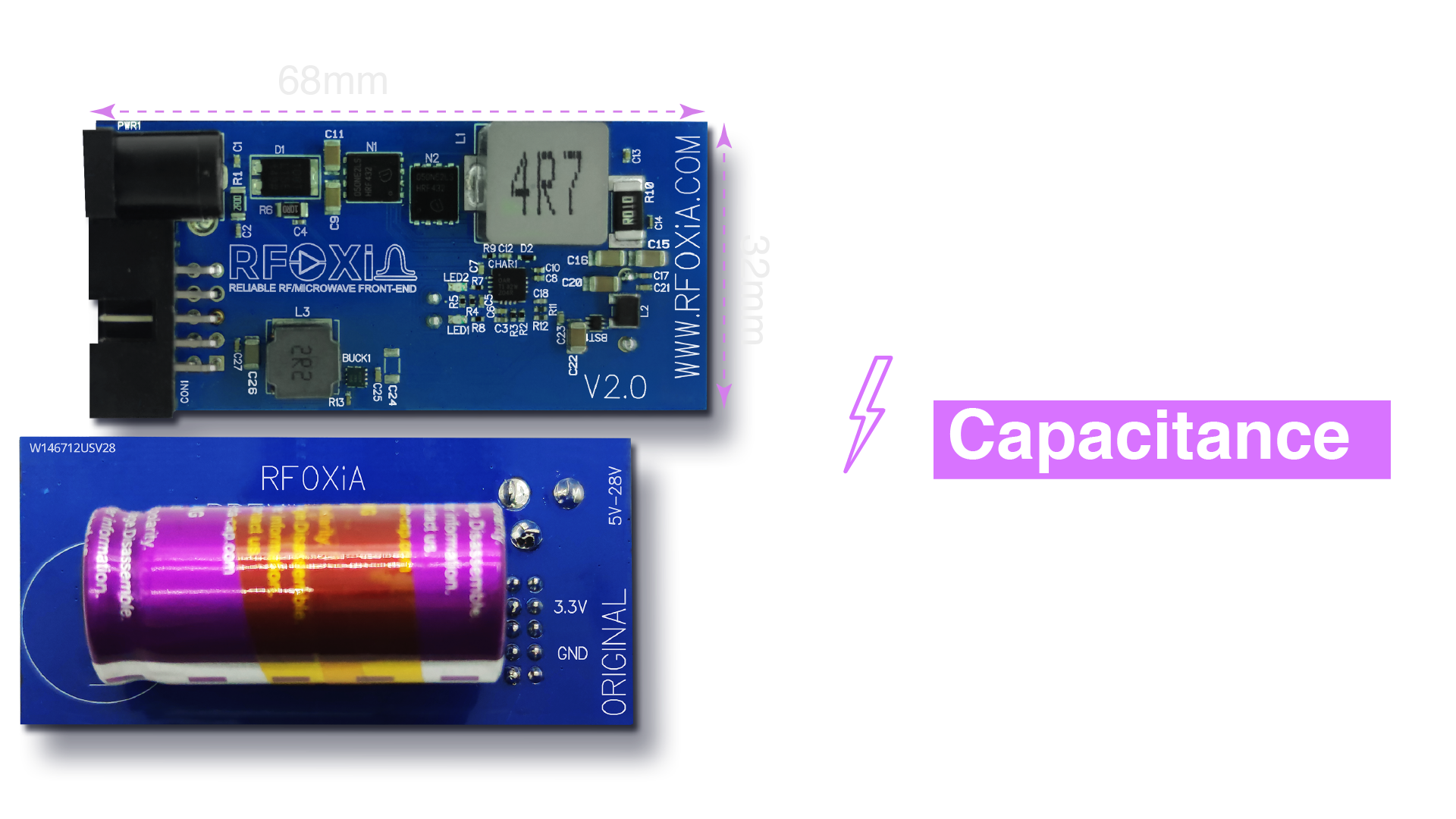
The heart of the MultiNav Pro+ Power/Program Kit is its 1100F supercapacitor array. That number — 1100 Farads — represents an extraordinary amount of capacitance. To put it in perspective, the capacitors you find on most PCBs are measured in microfarads or picofarads. The supercapacitors in this kit are measured in hundreds of Farads. The difference is not incremental. It is transformational.
The system stores 8800 Joules of electrical energy. That is sufficient to power your BLE Module continuously for a full working day — through range tests, firmware flashing sessions, data streaming validation, and whatever else your development workflow demands. You are not rationing power. You are not watching a percentage indicator with anxiety. You are working.
The charge time is where the supercapacitor advantage becomes visceral rather than theoretical: fully charged in under 5 minutes. Compare that to the one to three hours a lithium system requires. In a practical development workflow, this means that your power system is never the reason you cannot work. If you arrive at a field test site and realize your kit was not charged, you charge it in the time it takes to set up your laptop and review your test plan. It is ready when you are.
This 5-minute charge to 24-hour runtime ratio is not matched by any comparable product at this price point. It represents a genuine engineering achievement — the kind that changes how developers think about field work, remote deployments, and uninterrupted testing sessions.
High-Power Charging Adapter: The Infrastructure Behind the 5-Minute Charge
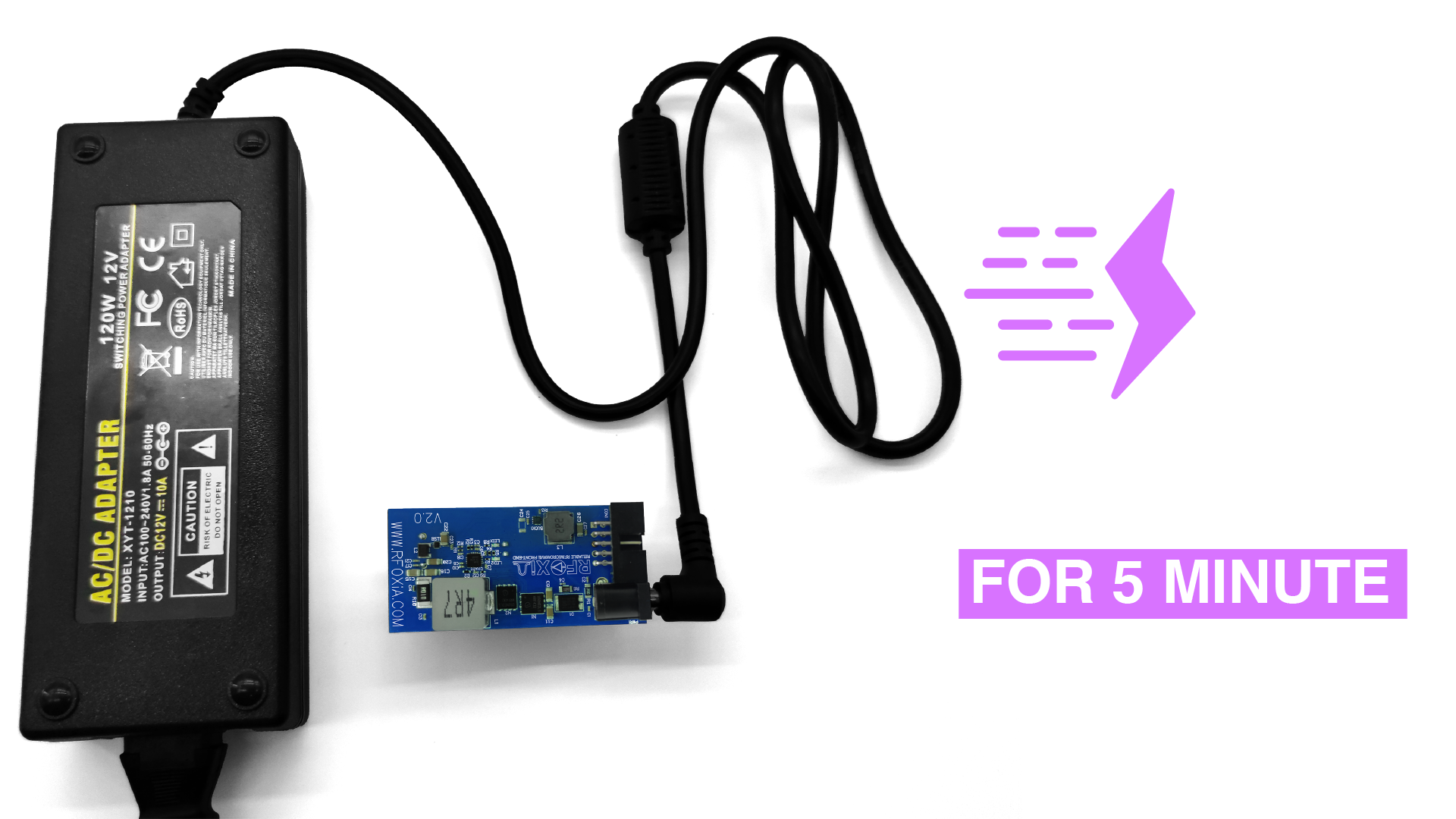
Achieving a sub-5-minute charge time requires more than a large supercapacitor array. It requires a charging infrastructure designed to match the supercapacitor's ability to accept current at a rate that conventional batteries would reject outright. The included 12V 5A charging adapter drives the supercapacitor system at 4V 10A — a high-current charging profile that lithium chemistry simply cannot tolerate but supercapacitors handle with ease.
This is what makes the charging speed real rather than theoretical. The adapter is included in the kit. You do not need to source a compatible high-current charger separately, and you do not need to worry about whether an aftermarket adapter will deliver the correct voltage and current profile. The complete charging system — supercapacitor array, charging circuitry, and adapter — has been engineered as an integrated unit.
For developers running the power kit IoT development workflow in a lab environment, this means plugging in between test sessions and having a full charge before your next session begins. For field deployments, it means that if you have access to a vehicle's power outlet or a portable generator, a 5-minute connection is all the resupply you need.
Power for the Entire MultiNav Pro+ Ecosystem
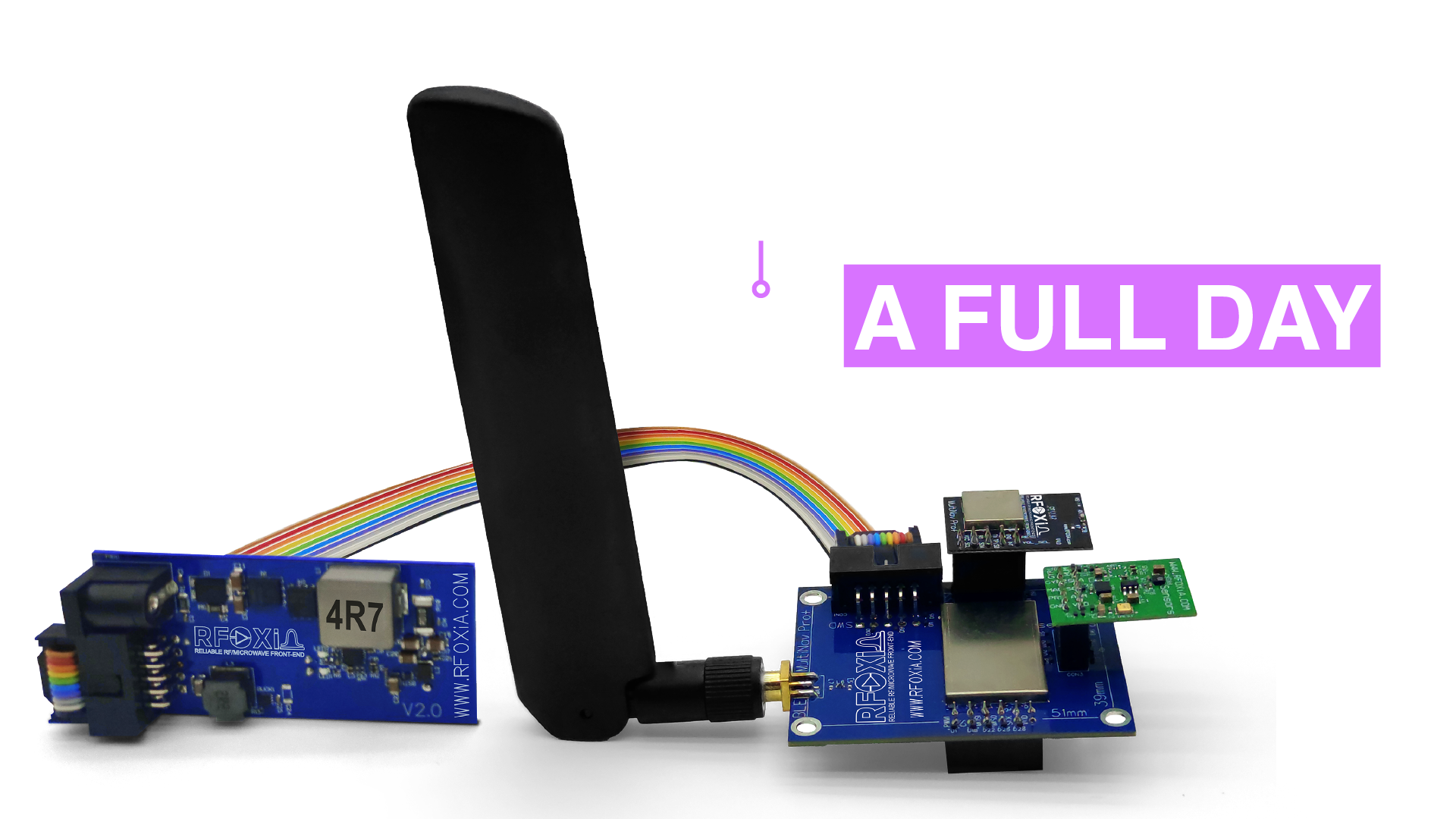
The MultiNav Pro+ ecosystem is built around four modules that work together to create a complete wireless development and deployment platform: the BLE Module for long-range communication (up to 20km man-to-drone), the GNSS Module for 1.5-meter precision positioning at 18Hz fix rate, the Sensors Module with seven integrated environmental sensors, and the Power/Program Kit itself.
The Power/Program Kit is designed to power not just the BLE Module, but the complete stack — all MultiNav Pro+ modules running simultaneously, for a full day. This is not a marketing approximation. It is an engineering specification. Whether you are running a complete field deployment with BLE communication, live GPS tracking, and environmental sensor streaming all active at once, or whether you are testing individual modules in isolation, the power system has the capacity to sustain your work through an entire day without requiring a recharge.
This full-ecosystem power capability is what transforms the Power/Program Kit from a peripheral accessory into an essential infrastructure component. When you are deploying a complete data node that streams verified environmental data to the RFOXiA network — temperature, humidity, air pressure, air quality, and GPS-verified location — you need a power system that will sustain that node through hours of continuous operation without intervention. The 1100F supercapacitor system delivers that reliability in a way that no conventional battery solution at this price point can match.
STLink Programmer: Professional Firmware Development in the Same Kit
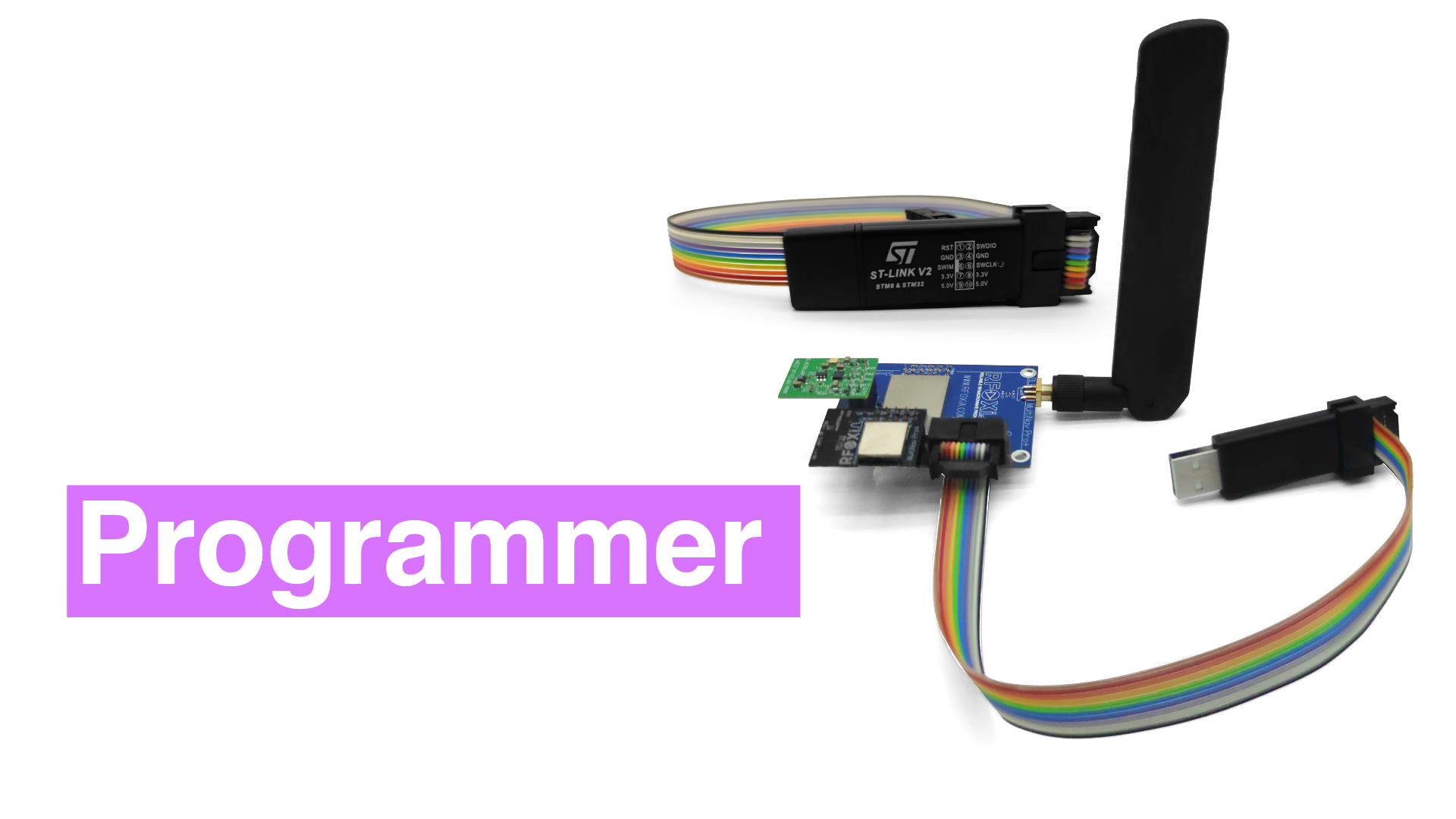
Power management and firmware development are two distinct challenges in IoT development — but they always happen in the same place, at the same time, with the same hardware. The MultiNav Pro+ Power/Program Kit addresses both in a single enclosure by integrating a professional STLink programmer directly into the kit.
The STLink programmer gives you direct access to the MultiNav Pro+ BLE Module's STM32WB07 microcontroller for firmware flashing, debugging, and development. Whether you are deploying RFOXiA's production firmware, customizing existing firmware for your specific application, or developing entirely new firmware using the AI Firmware Builder in RFOXiA Club, the STLink interface is your direct connection to the module's capabilities.
For developers who have worked with STLink programmers before, the integration is immediately intuitive. For developers new to embedded firmware work, having the programmer included and pre-configured in the kit removes one of the most common friction points in getting started with hardware development. You do not need to source a compatible programmer separately, figure out which pins to connect, or worry about voltage compatibility. Everything is integrated and ready.
The practical workflow this enables: you are in the field, your BLE module is running on supercapacitor power, you identify a firmware tweak that would improve your application's behavior, you connect the STLink, flash the updated firmware in seconds, and continue testing — all without returning to a lab or dedicated programming station. This is what professional power kit IoT development looks like when the tools are designed to work together.
Complete Connectivity Kit: Everything Included, Nothing to Source
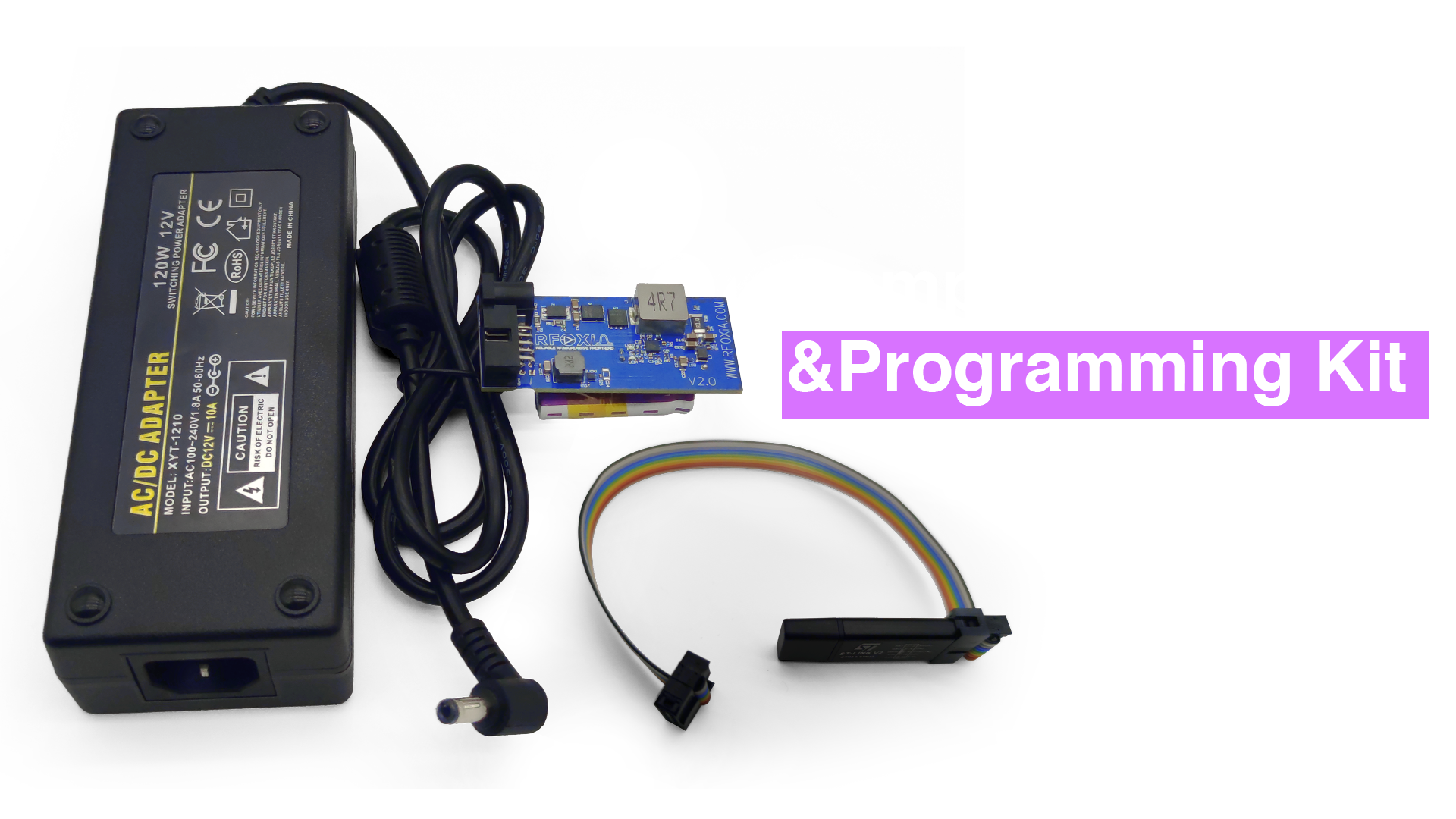
One of the most underappreciated aspects of a well-designed hardware kit is completeness. There are few experiences more frustrating than receiving a development kit, opening the box with enthusiasm, and discovering that you need a specific cable, connector, or adapter that was not included — and that you will not be able to source for two to five business days.
The MultiNav Pro+ Power/Program Kit ships complete. All necessary cables for quick and easy setup are included. Flat ribbon cables connect the BLE module to the power module and the STLink programmer to the BLE module. The physical integration of the system is pre-solved. You open the box, make the connections, charge for five minutes, and you are operational.
This completeness reflects the RFOXiA design philosophy: the goal is to remove every obstacle between a developer and productive work. Hunting for compatible cables is an obstacle. Waiting for a charger to arrive is an obstacle. Sourcing a programmer separately is an obstacle. The Power/Program Kit eliminates all of them in a single package.
The Power Kit IoT Development Workflow: What Changes in Practice
Abstract specifications are useful, but the real value of any development tool is in how it changes day-to-day workflow. Here is what a typical development session looks like with the MultiNav Pro+ Power/Program Kit compared to a conventional battery-based setup.
Morning of a field test — conventional battery system: You check the charge status and realize the battery is at 40%. You plug in and wait 45 minutes for a full charge before you can leave. Or you leave with 40% charge and spend the day rationing usage.
Morning of a field test — MultiNav Pro+ Power/Program Kit: You plug in the 12V adapter, complete your pre-test checklist, review your test plan, and unplug a full charge in under five minutes. You leave when you are ready to leave.
Mid-session firmware update — conventional setup: You need a separate programmer, you need to find the right cables, you need to return to your vehicle or lab to access the programming station.
Mid-session firmware update — MultiNav Pro+ Power/Program Kit: You connect the integrated STLink, flash the update, disconnect, and continue testing. Total interruption: under two minutes.
End of a long test day — conventional battery system: You have been monitoring charge throughout the day. The battery hit critical at hour six of an eight-hour test. You either stopped early or improvised power from another source.
End of a long test day — MultiNav Pro+ Power/Program Kit: You ran the complete MultiNav Pro+ module stack continuously through an eight-hour deployment. The supercapacitor system delivered full power throughout. You pack up and note in your log that the power system was not a variable in today's results.
That last point is the most important one. When your power system is truly reliable, it stops being a variable in your testing. It stops being something you think about. It becomes infrastructure — the invisible foundation that lets you focus entirely on the work you are actually trying to do.
Technical Specifications Summary
For developers who want the complete technical picture before committing to a purchase:
Supercapacitor System
- Capacitance: 1100F
- Energy storage: 8800 Joules
- Charge time: Under 5 minutes
- Runtime: Full working day powering complete MultiNav Pro+ module stack
- Cycle life: Hundreds of thousands of charge/discharge cycles
Charging Infrastructure
- Included adapter: 12V 5A
- Charging profile: 4V 10A to supercapacitor system
- Charging time: Under 5 minutes to full capacity
Programmer Interface
- Type: STLink
- Compatible: MultiNav Pro+ BLE Module (STM32WB07)
- Functions: Firmware flashing, debugging, development
Certifications
- FCC certified
Included Accessories
- 12V 5A charging adapter
- Flat ribbon cables for BLE module to power module connection
- Flat ribbon cables for STLink programmer to BLE module connection
Price: $119
Who Needs the MultiNav Pro+ Power/Program Kit
The MultiNav Pro+ Power/Program Kit is purpose-built for developers who are doing serious work with long-range wireless hardware. The profile of a typical user looks like this:
Drone builders and FPV pilots who are deploying the MultiNav Pro+ BLE Module for control links up to 20km and need reliable field power without returning to base for recharging.
IoT developers and researchers who are deploying sensor nodes for environmental monitoring, data network contribution, or field research and need power systems that sustain continuous operation through full deployment windows.
Robotics engineers who are using the MultiNav Pro+ ecosystem for control and telemetry and need both reliable power and rapid firmware iteration capability in a single integrated system.
Field researchers who work in environments where access to power infrastructure is limited or nonexistent and where the 5-minute charge capability from any 12V source is a genuine operational advantage.
Hardware developers at any experience level who want to eliminate power management and programming setup from the list of things that slow down their development process.
If you identify with any of these profiles, the RFOXiA SuperCapacitor Battery and Programmer Kit is not an optional accessory. It is the power infrastructure your development workflow requires.
Integrating the Power Kit Into the Complete RFOXiA Ecosystem
The MultiNav Pro+ Power/Program Kit reaches its full potential when it is deployed as part of the complete RFOXiA developer ecosystem. Combined with the MultiNav Pro+ BLE Module (5km ground-to-ground, 20km man-to-drone range), the GNSS Module (1.5m accuracy, 18Hz fix rate), and the Sensors Module (seven integrated environmental sensors), the Power/Program Kit creates a complete wireless development and deployment platform that is certified, ready to ship, and unmatched at its price point.
The RFOXiA Club platform — available at rfoxia.com — provides the software infrastructure that complements the hardware: AI-powered firmware generation, live data visualization, device command and control, and access to the data network where deployed sensor nodes earn daily rewards for verified environmental data contributions.
For developers who want the complete ecosystem in a single purchase, the Developer Bundle combines all four modules at a package price that represents significant savings over individual module purchases. The Power/Program Kit is a key component of that bundle — because no serious deployment of the MultiNav Pro+ system should be limited by its power infrastructure.
The RFOXiA Commitment: Professional-Grade Hardware at Builder-Accessible Prices
RFOXiA exists because the gap between commodity maker hardware and military-grade professional systems has been the silent ceiling on what independent developers, researchers, and engineers can build. Commodity BLE modules reach 80 to 100 meters. Military long-range systems cost $5,000 or more. For years, there was nothing in between — nothing that gave independent builders access to professional-grade range, reliability, and integration.
The MultiNav Pro+ ecosystem was built to eliminate that gap. FCC-certified hardware, real specifications, professional firmware support, AI-assisted development tools, and a data monetization network that turns deployed hardware into a source of passive income — all at prices designed for the maker and developer community, not defense contractors.
The Power/Program Kit is a direct expression of that commitment. A supercapacitor power system with sub-5-minute charge time and 24-hour runtime, integrated with a professional STLink programmer, sold at $119. That is the RFOXiA value proposition made concrete: extraordinary capability at prices that treat developers as the professionals they are.
Get Started: Power Your Development Without Limits
The MultiNav Pro+ Power/Program Kit is in stock and ready to ship. If you are building with the MultiNav Pro+ ecosystem — or if you are evaluating the complete RFOXiA Developer Bundle — the Power/Program Kit is the power infrastructure that makes everything else possible.
Visit the RFOXiA SuperCapacitor Battery and Programmer Kit product page to place your order, review complete documentation, and explore how the Power/Program Kit integrates with the rest of the MultiNav Pro+ ecosystem.
New to RFOXiA? Create a free account on RFOXiA Club at rfoxia.com and receive $10 in welcome credits toward your first hardware purchase. The platform includes access to the AI Firmware Builder, live data visualization, developer community resources, and the complete documentation library for every module in the MultiNav Pro+ ecosystem.
The power system that never makes you wait is ready. The only question is what you will build with a full day of uninterrupted development ahead of you.
MultiNav Pro+ Power/Program Kit — FCC Certified. In Stock. Ships from the USA. $119.
Written by: Moamen Mohamed LinkedIn