

Power Module Embedded Development: The SuperCap Kit That Changes Everything
RFOXiA SuperCapacitor Battery and Programmer Kit
Stop Letting Power Problems Kill Your Power Module Embedded Development Workflow
Every serious embedded developer knows the feeling. You are deep in a firmware debug session, your module is finally behaving exactly the way you want, data is streaming cleanly, the RF link is solid — and then your battery dies. Or worse, you are in the field with a drone prototype and your power solution browns out mid-flight because lithium cells under load do not deliver the clean, stable voltage your radio module demands.
Power management is not a glamorous problem. Nobody posts about it on forums. Nobody builds a YouTube channel around it. But talk to any engineer who has shipped a real wireless product and they will tell you the same thing: power module embedded development is where projects go to die. Unstable supply rails corrupt firmware. Voltage sag during TX bursts breaks RF links. Slow recharge cycles kill field productivity. And battery replacement in sealed or remote enclosures creates maintenance nightmares that scale badly.
RFOXiA built the RFOXiA SuperCapacitor Battery and Programmer Kit specifically to solve these problems — not with incremental improvements on existing battery technology, but with a fundamentally different approach to how embedded wireless hardware gets its power.
This post breaks down exactly how it works, why supercapacitor technology is a genuine paradigm shift for power module embedded development, and who this kit is built for.
What Is the MultiNav Pro+ Power/Program Kit?
The MultiNav Pro+ Power/Program Kit is a purpose-built companion for the RFOXiA MultiNav Pro+ module ecosystem. It combines two critical capabilities that developers typically have to source, wire, and configure separately:
A professional supercapacitor-based power system capable of powering the full MultiNav Pro+ module stack — BLE Module, GNSS Module, and Sensors Module — for a complete working day on a single charge that takes less than five minutes.
An integrated STLink programmer interface that lets you flash, debug, and iterate on firmware without external adapters, extra cables, or driver headaches.
These two capabilities packaged together in one kit is not just a convenience — it fundamentally changes the rhythm of embedded development. You spend time building and testing, not managing logistics.
The Supercapacitor Advantage in Power Module Embedded Development
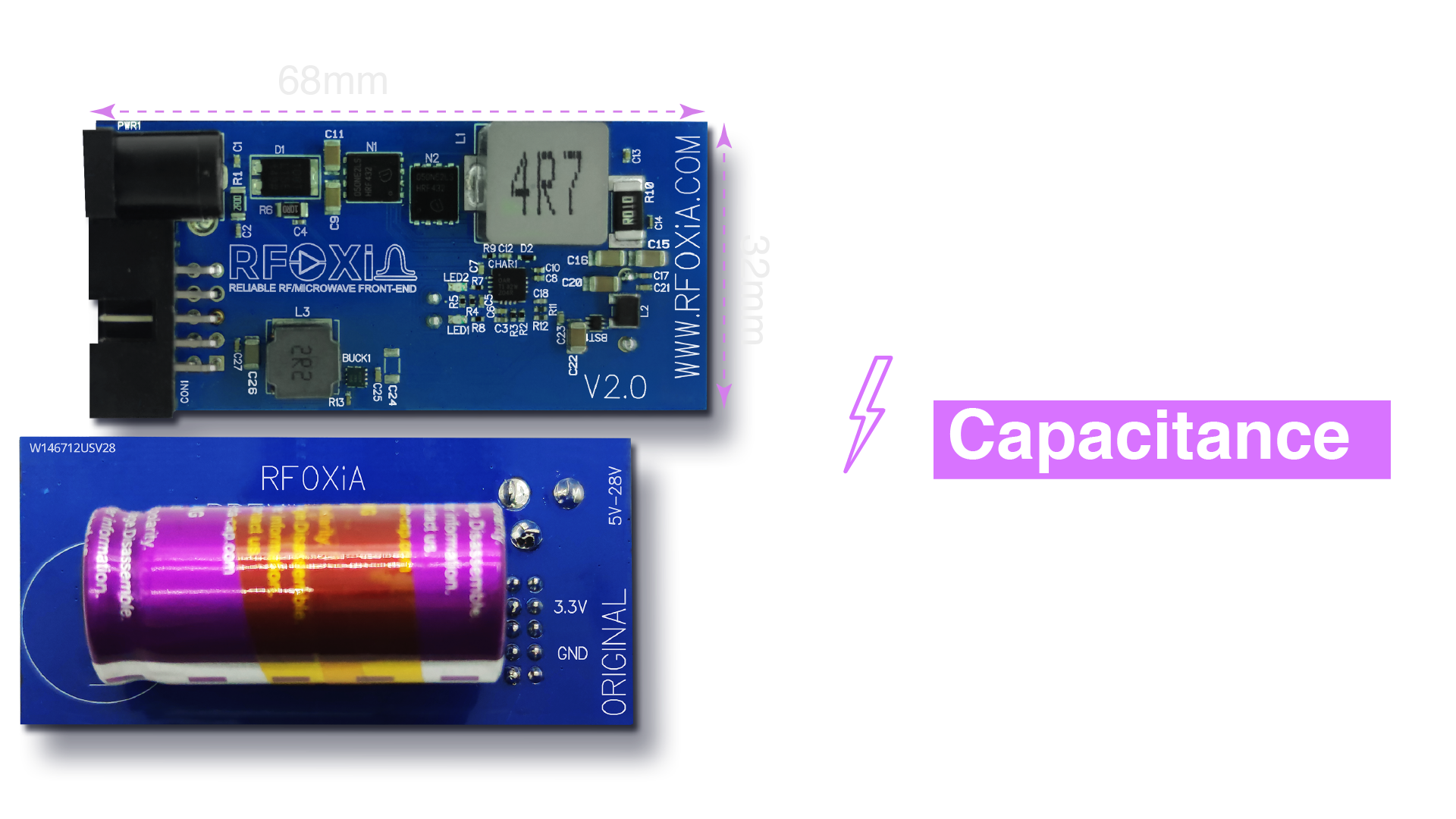
Let us talk about why supercapacitors matter for this application specifically.
Conventional lithium battery systems have three fundamental problems in RF and wireless embedded applications:
Voltage sag under load. When a BLE module transmits at high power, it draws burst current. Lithium cells under this kind of pulse load show measurable voltage sag — sometimes enough to reset microcontrollers or corrupt flash writes. In long-range BLE systems like the MultiNav Pro+, which uses external amplifiers to achieve 5km ground-to-ground and 15-20km man-to-drone range, those TX bursts are substantial. Stable supply voltage is not optional — it is the difference between a reliable link and random disconnects.
Slow recharge cycles. A lithium pack that takes 2-3 hours to recharge is a field productivity killer. When you are iterating on a firmware build and need to test outdoors repeatedly, waiting for a battery kills momentum. In a professional development context, this is a real cost.
Degradation over charge cycles. Lithium cells degrade. After 500-1000 cycles, capacity drops measurably. In high-use embedded development environments where you might charge a battery multiple times per day, this matters over the lifetime of a project.
Supercapacitors solve all three of these problems simultaneously.
The MultiNav Pro+ Power/Program Kit uses an 1100F supercapacitor system storing 8800 Joules of energy. That is enough to power the complete MultiNav Pro+ module stack — BLE, GNSS, sensors, the whole ecosystem — for a full 24-hour working day.
And it charges in under five minutes.
Not in two hours. Not in forty-five minutes. Under five minutes from flat to full using the included 12V 5A adapter, which charges the supercapacitor bank at 4V 10A. You finish a test session, plug in for five minutes while you review your data or push a commit, and you are ready for another full day of operation.
For power module embedded development workflows that involve repeated field testing, this is a transformative difference.
The 12V 5A High-Power Charging Adapter
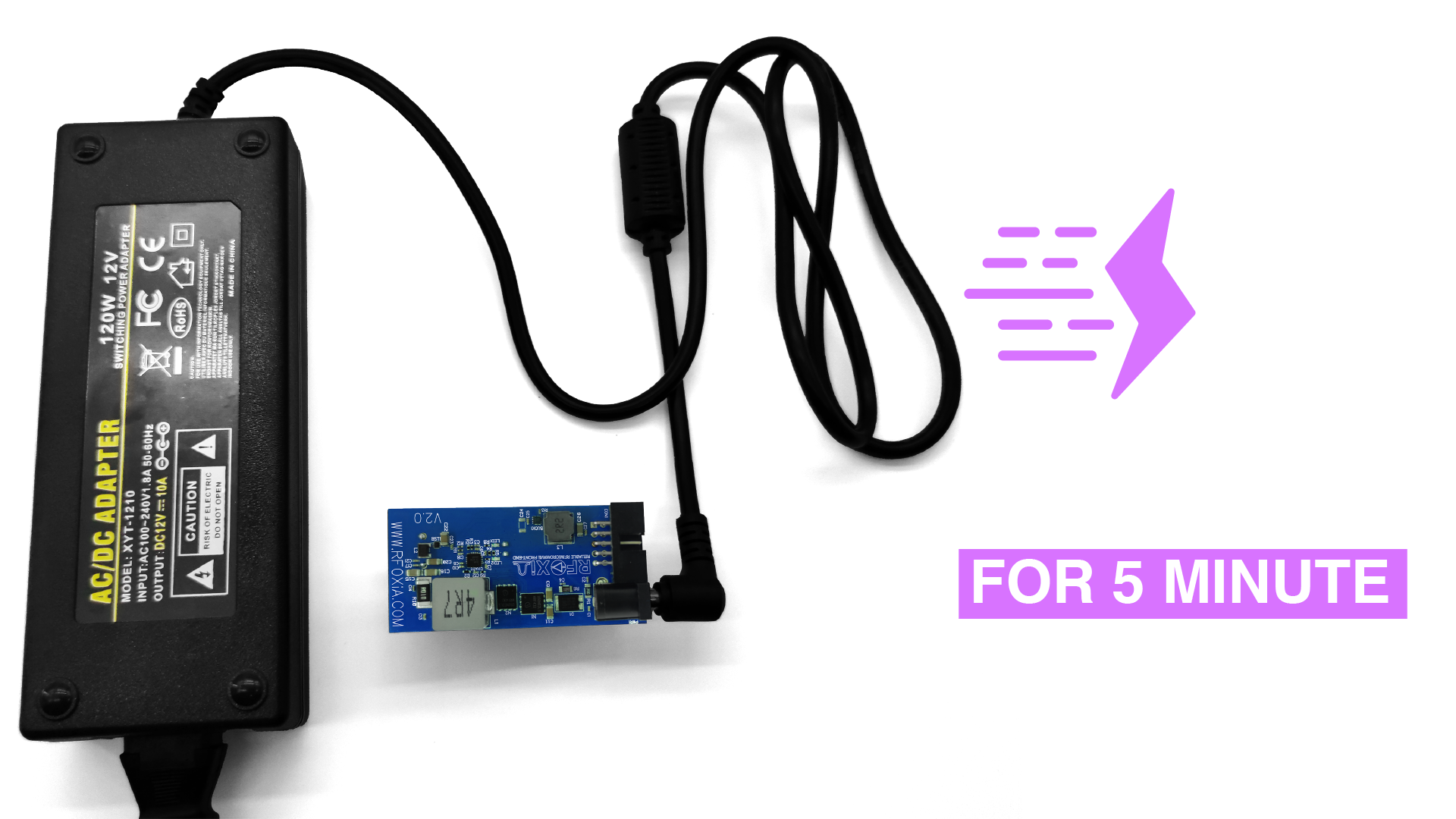
The charging adapter included with the kit is not an afterthought. It is specifically engineered for the supercapacitor bank's charge profile.
Supercapacitors charge differently from lithium cells. They accept current at a rate limited by internal resistance, which for high-capacitance banks means you need a supply that can deliver sustained high current at a controlled voltage. The included 12V 5A adapter drives a charging circuit that delivers 4V at 10A into the supercapacitor bank — matching the bank's charge acceptance curve for maximum speed without stress.
The result is a charge time of under five minutes to full capacity, every single time, with no degradation in charge speed over the lifetime of the kit. Supercapacitors do not develop memory effects. They do not degrade meaningfully over hundreds of thousands of charge cycles. The five-minute charge time you experience on day one will be the same five-minute charge time you experience two years and thousands of cycles later.
For embedded developers who depend on their tools, this kind of reliability is not a feature — it is a requirement.
Full-Day Power for the Entire MultiNav Pro+ Ecosystem
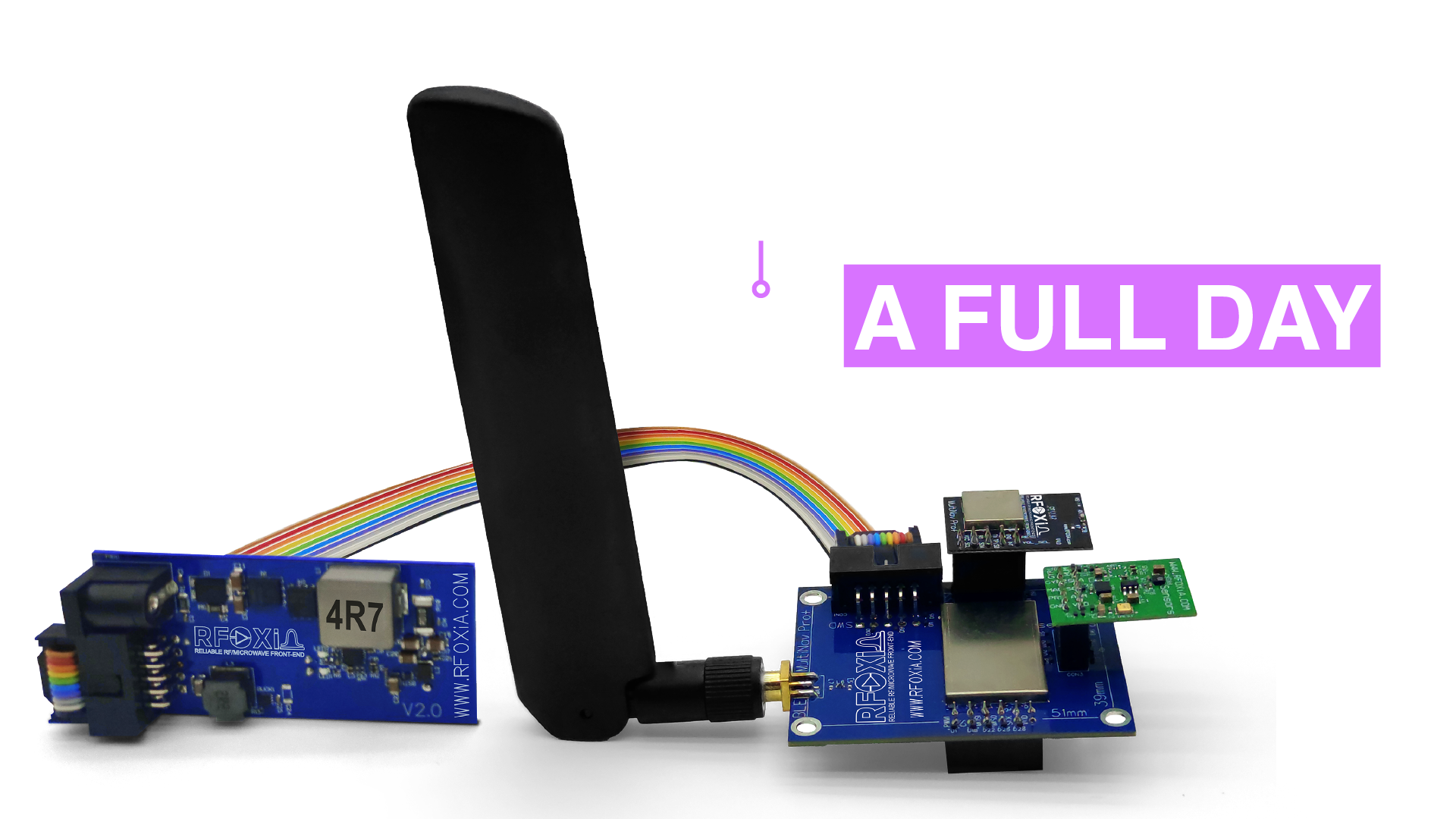
The Power/Program Kit is not designed to power just one module. It is sized to power the entire MultiNav Pro+ stack simultaneously:
- MultiNav Pro+ BLE Module — long-range Bluetooth with external amplifiers, 2Mbps data rate, operating at up to 20km man-to-drone range
- GNSS Module — 18Hz fix rate precision GPS, actively tracking position in real time
- Sensors Module — all seven sensors streaming simultaneously: temperature, humidity, pressure, air quality, accelerometer, gyroscope, magnetometer
Running all of these simultaneously represents a realistic and demanding power load. The 8800J supercapacitor bank sustains this full stack for a complete working day — which means you can take your entire development kit into the field, run continuous tests, stream live data to RFOXiA Club's Command Center dashboard, validate your firmware behavior in real conditions, and return home without ever worrying about power.
This kind of operational continuity is what separates professional power module embedded development from hobbyist tinkering.
Integrated STLink Programmer: Close the Loop on Your Development Cycle

Power management is only half the embedded development workflow. The other half is firmware iteration — and this is where the integrated STLink programmer earns its place in the kit.
The MultiNav Pro+ BLE Module runs on the STM32WB07 microcontroller. Flashing and debugging STM32 devices requires an STLink interface, and sourcing, setting up, and wiring a standalone STLink programmer adds friction to every firmware iteration cycle. Drivers need to be installed. Pinouts need to be confirmed. Connections need to be re-established every time you move between test environments.
The Power/Program Kit eliminates this friction entirely. The STLink programmer is built into the kit and pre-wired for the MultiNav Pro+ BLE Module via the included flat ribbon cables. Plug in once, configure your IDE, and flash firmware as fast as you can compile it.
For developers using RFOXiA's AI Firmware Builder on RFOXiA Club — where you describe your application in plain language and receive production-ready STM32 firmware — this tight integration matters even more. You can generate firmware in the browser, download it, and flash it to your module in minutes. The complete loop from idea to running firmware on hardware becomes extraordinarily fast.
The firmware source repository for the MultiNav Pro+ BLE Module is publicly available at https://github.com/RFOXiA/MultiNav-Pro-Long-Range-BLE-Module-Firmware-STM32WB07, giving developers full access to the production codebase as a starting point for customization.
Complete Connectivity Kit: Everything Wired and Ready
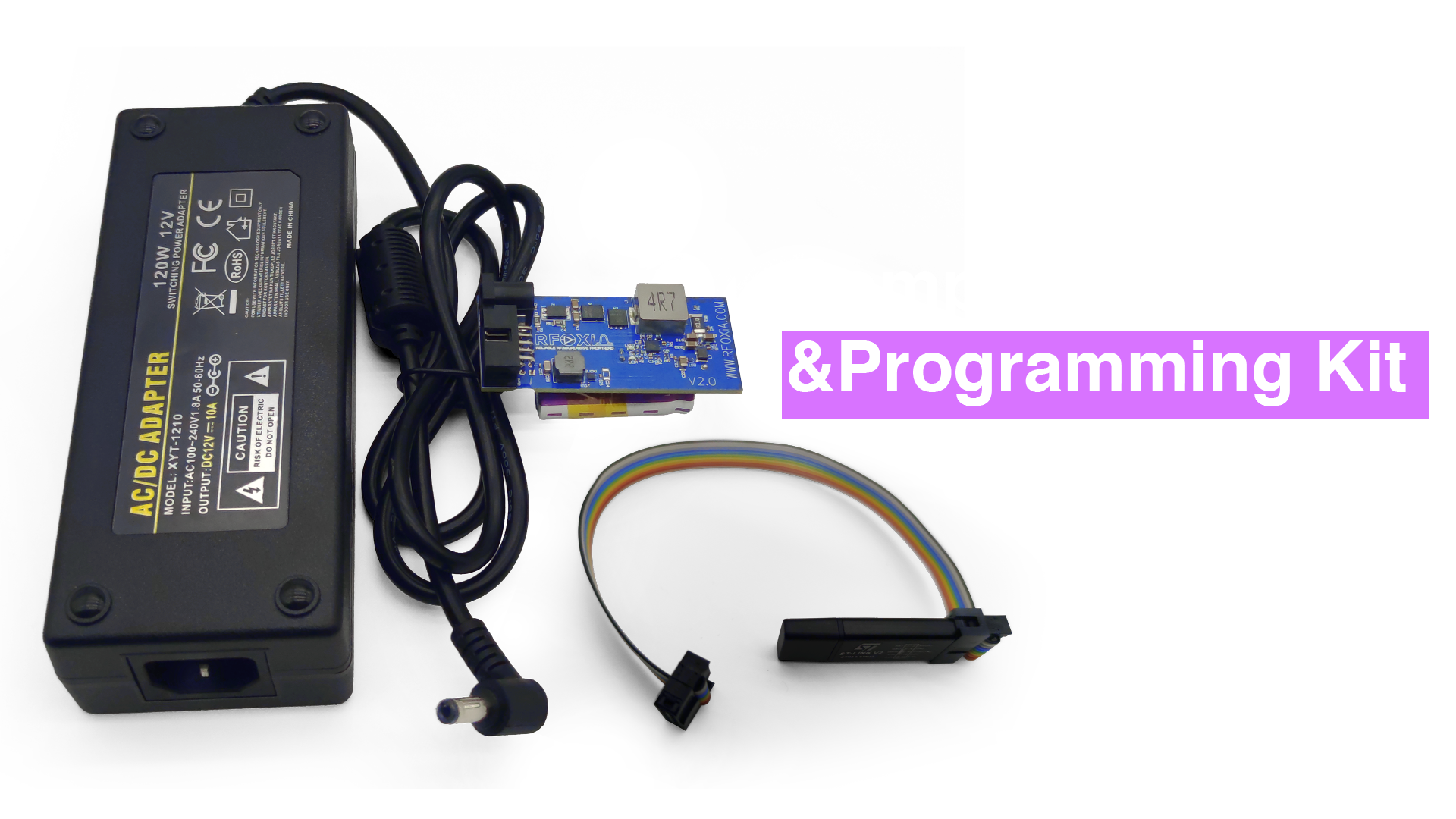
One of the persistent pain points in embedded development is cable management. Modules arrive with one connector standard, your bench supply uses another, your programmer needs a third, and before you have done anything productive you are sourcing adapters and making jumper wires by hand.
The MultiNav Pro+ Power/Program Kit ships with every cable you need:
- Flat ribbon cables connecting the BLE Module to the power module
- Flat ribbon cables connecting the STLink programmer to the BLE Module
- Charging cable for the supercapacitor system
Everything is keyed and labeled. There is no ambiguity about what connects where. Open the kit, connect the cables as shown, and your power module embedded development environment is operational.
This attention to the out-of-box experience reflects RFOXiA's broader philosophy: the hardware should work the moment you receive it. The MultiNav Pro+ modules are FCC certified and pre-validated. The firmware repository is live and documented. The AI Firmware Builder is available immediately on RFOXiA Club. The Power/Program Kit arrives ready to go.
Who Is This Kit For?
The MultiNav Pro+ Power/Program Kit is purpose-built for a specific kind of developer — one who takes their work seriously and needs tools that match that seriousness.
Drone builders and FPV pilots deploying MultiNav Pro+ BLE modules for long-range telemetry and control need power solutions that work in the field, charge fast between test flights, and do not introduce voltage instability into their RF systems. The supercapacitor bank's stable output under variable load makes it particularly well-suited to RF applications.
IoT developers building data-gathering nodes for the RFOXiA data network need devices that run continuously without maintenance overhead. A node that charges in five minutes and runs for 24 hours can be deployed, checked weekly, and forgotten about — exactly the behavior a passive data income model requires.
Embedded firmware engineers who are iterating rapidly on STM32-based wireless firmware need both stable power and fast flash cycles. The integrated STLink programmer and supercapacitor power system together eliminate the two biggest sources of friction in the iteration loop.
Researchers and field scientists deploying MultiNav Pro+ sensor stacks in remote or challenging environments need power systems that perform predictably across temperature ranges and do not require battery replacement logistics. Supercapacitors operate effectively across a wider temperature range than lithium cells and do not require careful storage or transport protocols.
Power Module Embedded Development Without Compromise
The embedded hardware industry has tolerated mediocre power solutions for too long because the alternatives were expensive, custom, or unavailable at maker-accessible price points. Military and industrial field equipment uses supercapacitor-based power systems because the performance advantages are real and well-understood — but until now, those systems were not available to the developers building the next generation of wireless hardware.
At $119, the MultiNav Pro+ Power/Program Kit puts professional-grade supercapacitor power management and integrated STLink programming within reach of every serious embedded developer. Combined with the MultiNav Pro+ BLE Module's unprecedented 5-20km range at $59 for two units, and the complete Developer Bundle at $199, RFOXiA is systematically eliminating every bottleneck that has historically kept professional wireless development tools out of the hands of independent engineers and small teams.
If you are serious about power module embedded development — if you are tired of battery-related project failures, slow recharge cycles, and voltage instability ruining your RF work — this kit was built for you.
Explore the RFOXiA SuperCapacitor Battery and Programmer Kit and see the full MultiNav Pro+ ecosystem at rfoxia.com.
Technical Specifications Summary
| Feature | Specification |
|---|---|
| Supercapacitor Capacity | 1100F |
| Energy Storage | 8800 Joules |
| Charge Time | < 5 minutes |
| Runtime (full module stack) | 24 hours |
| Charging Adapter Input | 12V 5A |
| Charging Adapter Output | 4V 10A to supercapacitor bank |
| Programmer Interface | STLink (STM32 compatible) |
| Target Module | MultiNav Pro+ BLE Module (STM32WB07) |
| Certifications | FCC Certified |
| Price | $119 |
Frequently Asked Questions
Can the Power/Program Kit power modules other than the MultiNav Pro+? The kit is optimized and designed for the MultiNav Pro+ ecosystem — BLE Module, GNSS Module, and Sensors Module. While the electrical output may technically power other low-power embedded hardware, RFOXiA validates and supports it specifically for the MultiNav Pro+ stack.
How does a supercapacitor compare to a LiPo battery for RF applications? Supercapacitors deliver more stable voltage under variable pulse loads — exactly the load profile of an RF module transmitting at high power. LiPo cells show voltage sag during TX bursts. Supercapacitors maintain output voltage more consistently, resulting in cleaner RF behavior and more reliable link performance.
Is the STLink programmer compatible with standard IDEs? Yes. The STLink interface is the industry standard for STM32 development and is supported by STM32CubeIDE, Keil MDK, IAR Embedded Workbench, and most ARM toolchain environments. Full firmware source and documentation is available at the MultiNav Pro+ GitHub repository.
What happens to charge capacity over time? Supercapacitors degrade far more slowly than lithium batteries over charge cycles. Where a lithium cell might show meaningful capacity loss after 500-1000 cycles, supercapacitors maintain their rated capacity over hundreds of thousands of cycles. For high-use development environments, this is a significant lifetime advantage.
Does the kit work with the RFOXiA Connect app? Yes. The Power/Program Kit powers the BLE Module, which pairs with the RFOXiA Connect app on Android and iOS for live telemetry, GPS tracking, and remote control. The complete ecosystem is designed to work together out of the box.
Ready to eliminate power problems from your embedded development workflow? The RFOXiA SuperCapacitor Battery and Programmer Kit ships with everything you need to build without limits.
Written by: Moamen Mohamed LinkedIn