
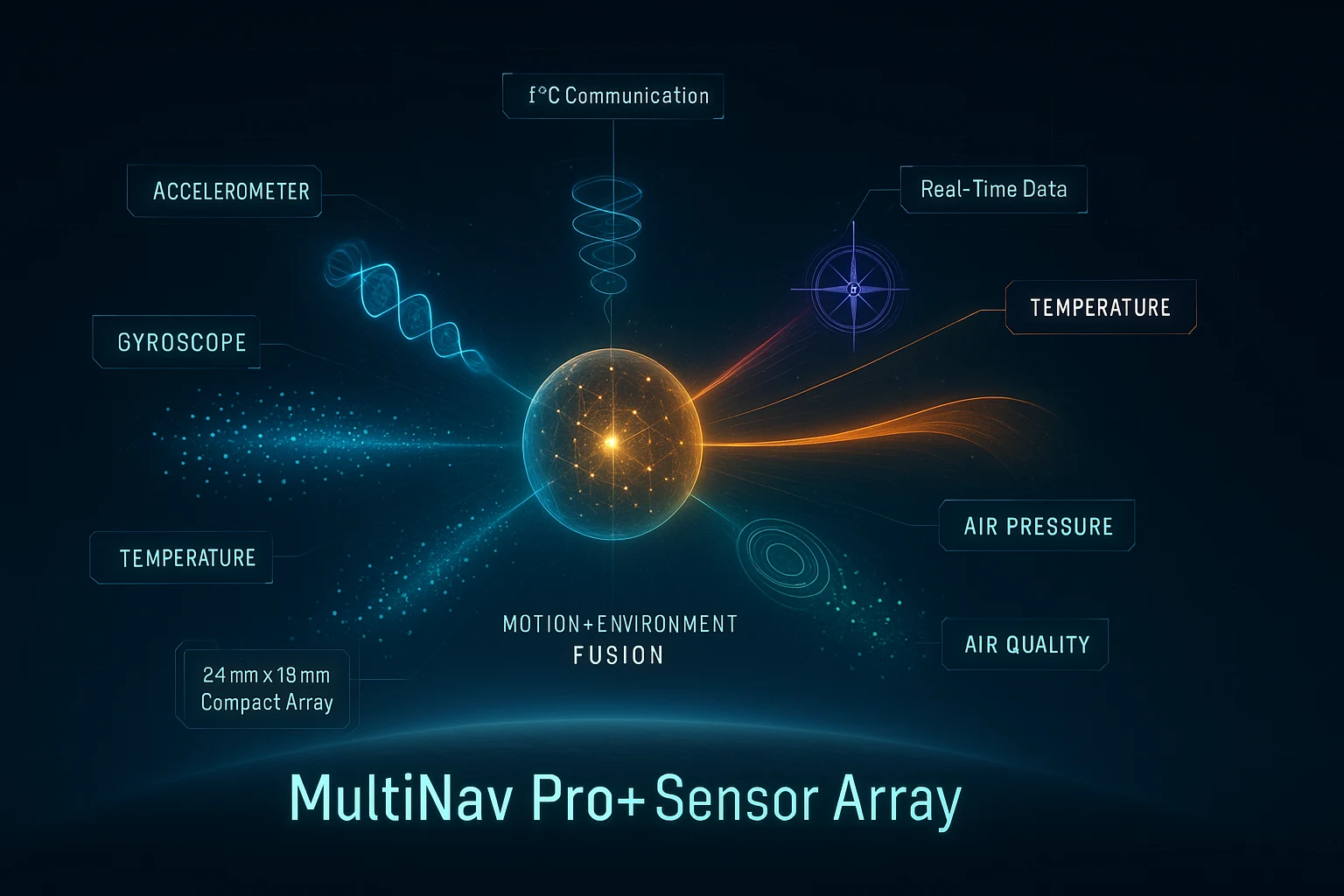
RFOXiA Sensor Module: The All-in-One Solution for Precision Environmental and Motion Sensing
RFOXiA Integrated Sensors Module
Why the RFOXiA Sensor Module Changes What Developers Expect from a Single Board
If you have spent any meaningful time building drones, robotics platforms, or IoT deployments, you know the frustration of sensor integration. One module for motion. Another for pressure. A third for air quality. Different I2C addresses that conflict. Different voltage requirements. Different form factors that refuse to cooperate with your PCB layout. The cable spaghetti grows, the debugging sessions multiply, and your compact project stops being compact before it ever flies.
The MultiNav Pro+™ RFOXiA sensor module is built to solve exactly that problem — and it does it without compromise.
Packed into a 24mm × 18mm board, this module integrates seven professional-grade sensors from some of the most respected names in MEMS and semiconductor engineering: Bosch Sensortec, Texas Instruments, STMicroelectronics, MEMSVision, and RENESAS. Every sensor shares a single I2C line with dedicated addressing. One connection. No conflicts. Complete environmental and motion intelligence in a form factor small enough to fly on a racing quad.
This is not a hobbyist breakout board. This is a professionally engineered sensor platform designed for builders who need real data, not ballpark readings.
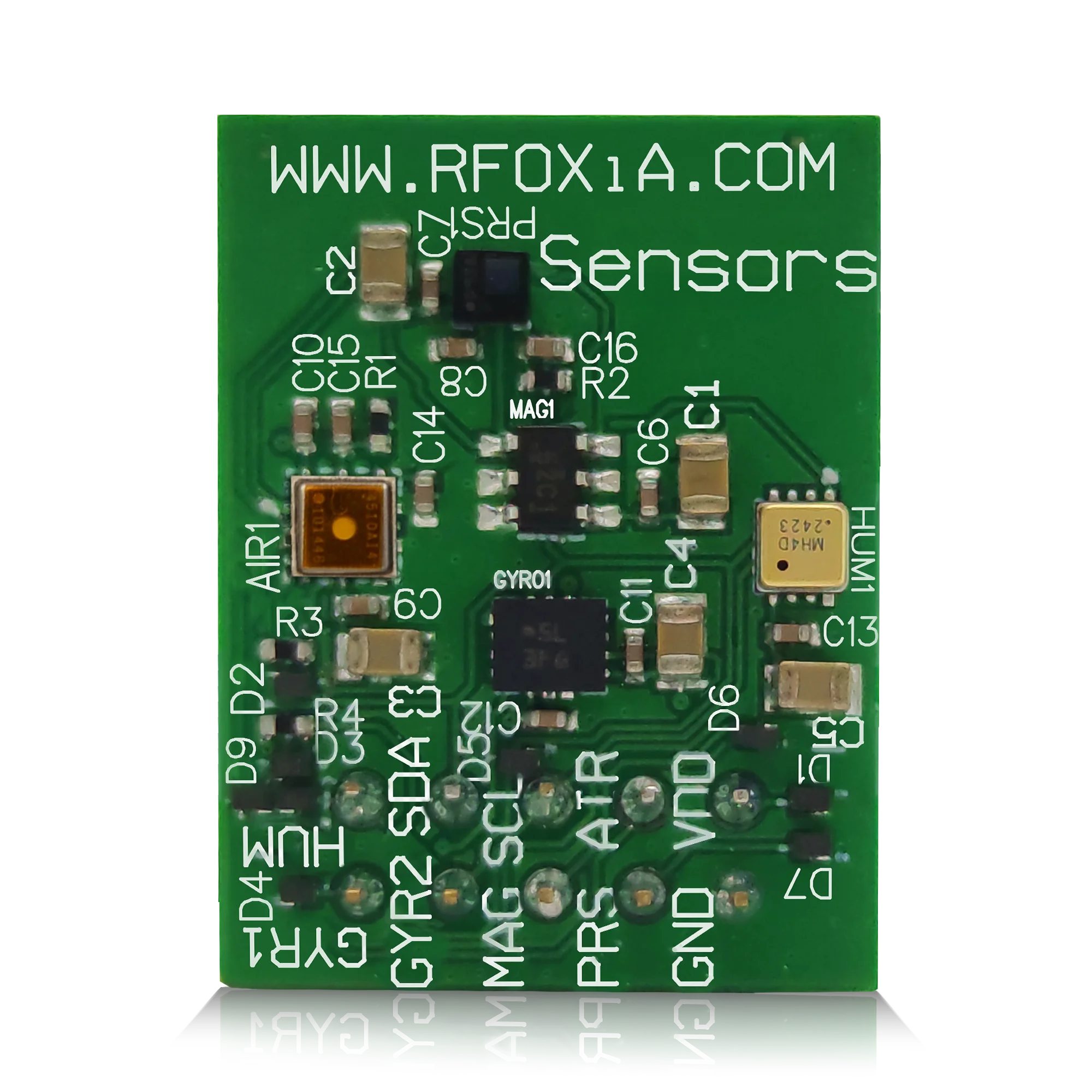
What Seven Sensors Actually Means for Your Project
Seven sensors sounds like a marketing number until you start listing what they cover. The MultiNav Pro+ RFOXiA sensor module monitors:
- Motion state — accelerometer and gyroscope tracking linear acceleration and rotational velocity across all three axes
- Heading and orientation — magnetometer providing absolute directional reference
- Atmospheric pressure — barometric sensor enabling altitude estimation and weather trend detection
- Ambient temperature — precision thermal sensing for environmental logging and system compensation
- Relative humidity — critical for agricultural, HVAC, and climate monitoring applications
- Air quality — electrochemical sensing detecting ozone and nitrogen dioxide concentrations outdoors
Collectively, these seven data streams give your project a complete picture of both its own motion state and the environment it is operating in. A drone can know simultaneously that it is climbing at 3 m/s, pitched 12 degrees nose-up, heading magnetic north, and flying through air with above-average particulate quality at 28°C and 62% relative humidity.
That combination of data — motion plus environment — is what separates intelligent autonomous systems from simple remote-controlled hardware.
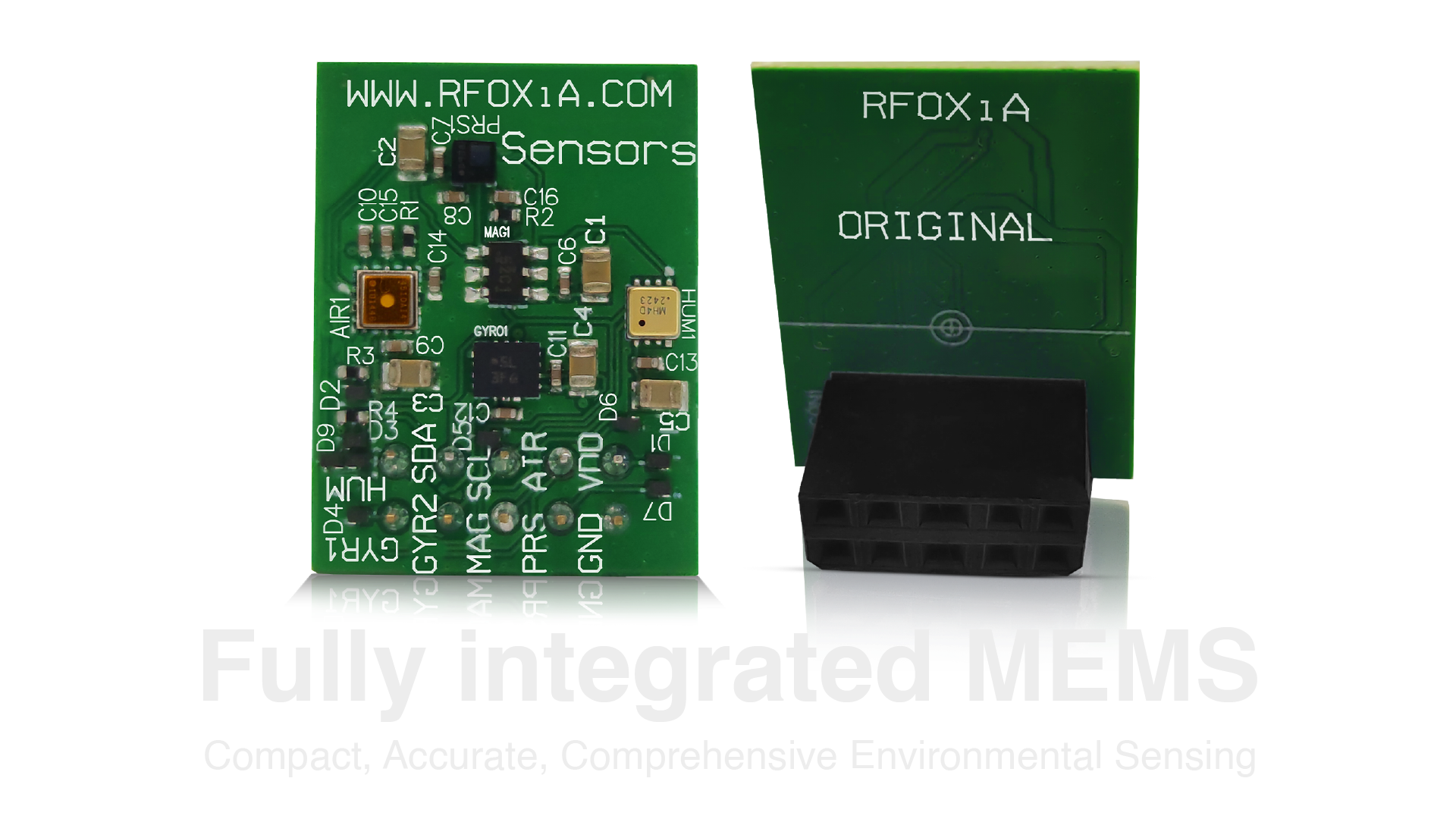
The Sensor Stack: Engineering Choices That Matter
Not all sensors are created equal. The components selected for the RFOXiA sensor module represent deliberate choices toward performance, reliability, and long-term supply chain stability. Here is what is actually on the board.
BMI270 — Accelerometer and Gyroscope (Bosch Sensortec)
The BMI270 is not an entry-level IMU. It is the same sensor family used in high-performance consumer electronics and professional drone autopilots. It delivers low-noise, high-bandwidth motion data with built-in hardware filtering, making it appropriate for applications where vibration rejection matters — which is everywhere if you are flying a brushless motor platform.
Key characteristics: ultra-low power consumption, dedicated FIFO buffer for burst reading without processor polling, and configurable ODR (output data rate) up to 1600 Hz for the gyroscope and 1600 Hz for the accelerometer.
TMAG5273C1QDBVR — Magnetometer (Texas Instruments)
Texas Instruments' TMAG5273 brings 3-axis magnetic sensing with exceptional sensitivity and offset compensation. For drone and robotics applications, an accurate magnetometer is the difference between a heading hold that holds and one that drifts. The TMAG5273 series is designed for industrial-grade applications, which means it performs predictably across temperature ranges that would push consumer-grade magnets into saturation.
LPS22HHTR — Barometric Pressure (STMicroelectronics)
ST's LPS22HH is a high-resolution MEMS pressure sensor with a measurement range of 260 to 1260 hPa and absolute accuracy of ±0.5 hPa. In drone applications, this translates directly to barometric altitude holding. In weather and climate monitoring applications, it enables you to detect frontal passages and pressure trend analysis. The LPS22HH is already widely used in commercial autopilots — having it integrated directly into the RFOXiA sensor module eliminates the need for a separate altimeter breakout.
MVH4003D — Humidity and Temperature (MEMSVision)
MEMSVision's MVH4003D delivers calibrated relative humidity readings alongside co-located temperature sensing. Co-location matters: when your temperature and humidity sensors are physically on the same die, the humidity reading is always corrected against the actual local temperature rather than an estimated one. This distinction becomes significant in applications where dew point accuracy or psychrometric calculations drive decisions.
ZMOD4510AI4R — Air Quality (RENESAS)
RENESAS's ZMOD4510 is purpose-built for outdoor air quality monitoring. Unlike general VOC sensors that report a vague "TVOC" estimate indoors, the ZMOD4510 is specifically calibrated for ozone (O₃) and nitrogen dioxide (NO₂) detection in outdoor ambient air. This is the sensor that makes the RFOXiA sensor module genuinely useful for environmental research, smart city deployments, and the RFOXiA data monetization network — where verified outdoor air quality data has real commercial value to enterprise buyers.
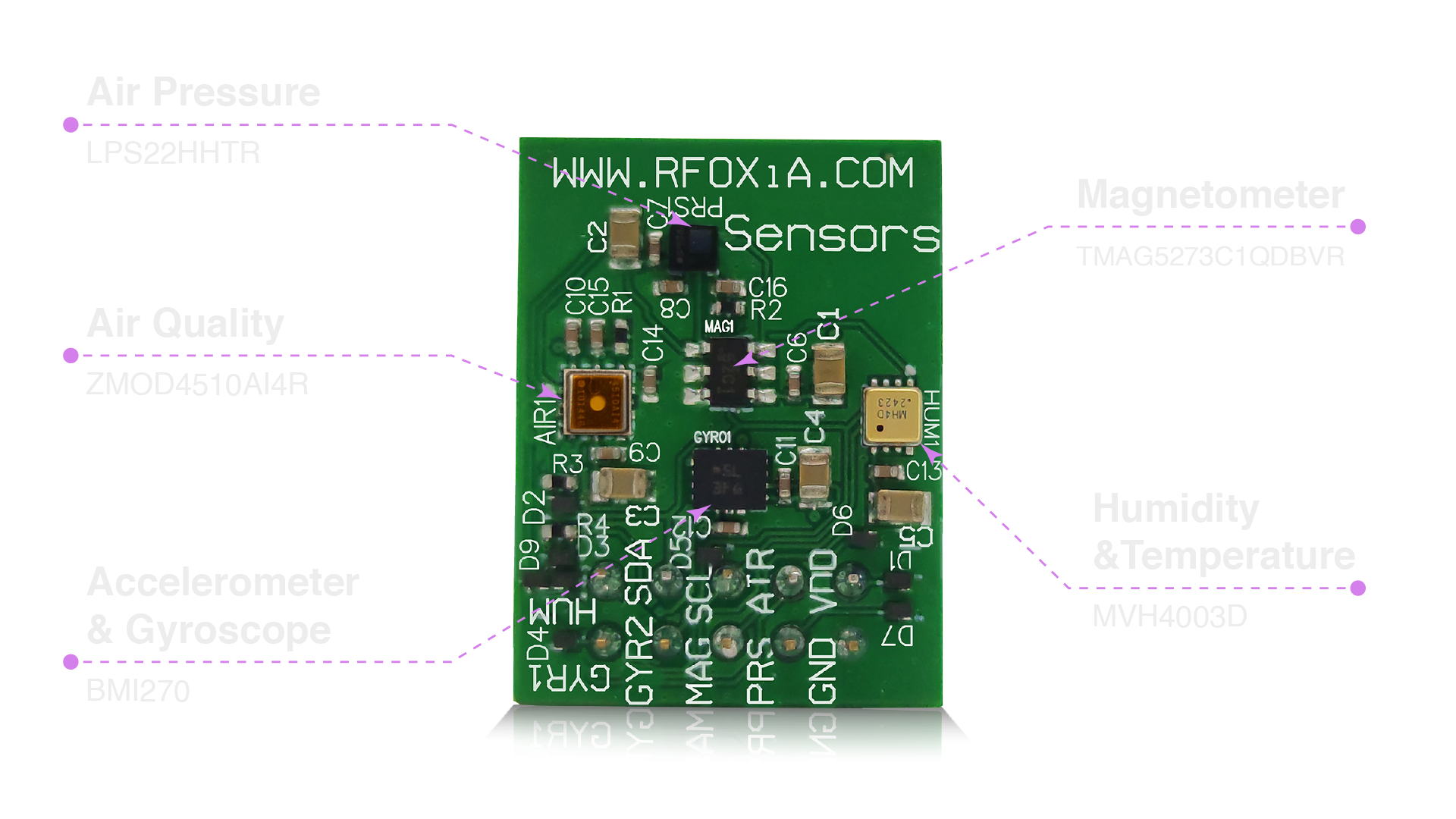
Precision Motion and Environmental Sensing: Two Capabilities in One Package
Most sensor modules specialize. Motion modules skip environmental sensing. Environmental loggers ignore IMU data. The MultiNav Pro+ breaks that convention by delivering professional-grade performance in both domains simultaneously.
For drone builders, this means your flight controller can pull attitude data and barometric altitude from the same module while your companion computer reads temperature, humidity, and air quality over the same I2C bus. For robotics engineers, it means your platform knows its own orientation and the ambient conditions it is operating in without a rats' nest of discrete modules.
For researchers deploying sensor nodes in the field, it means a single compact board captures the complete dataset you need without multiple power rails, multiple libraries, and multiple potential failure points.
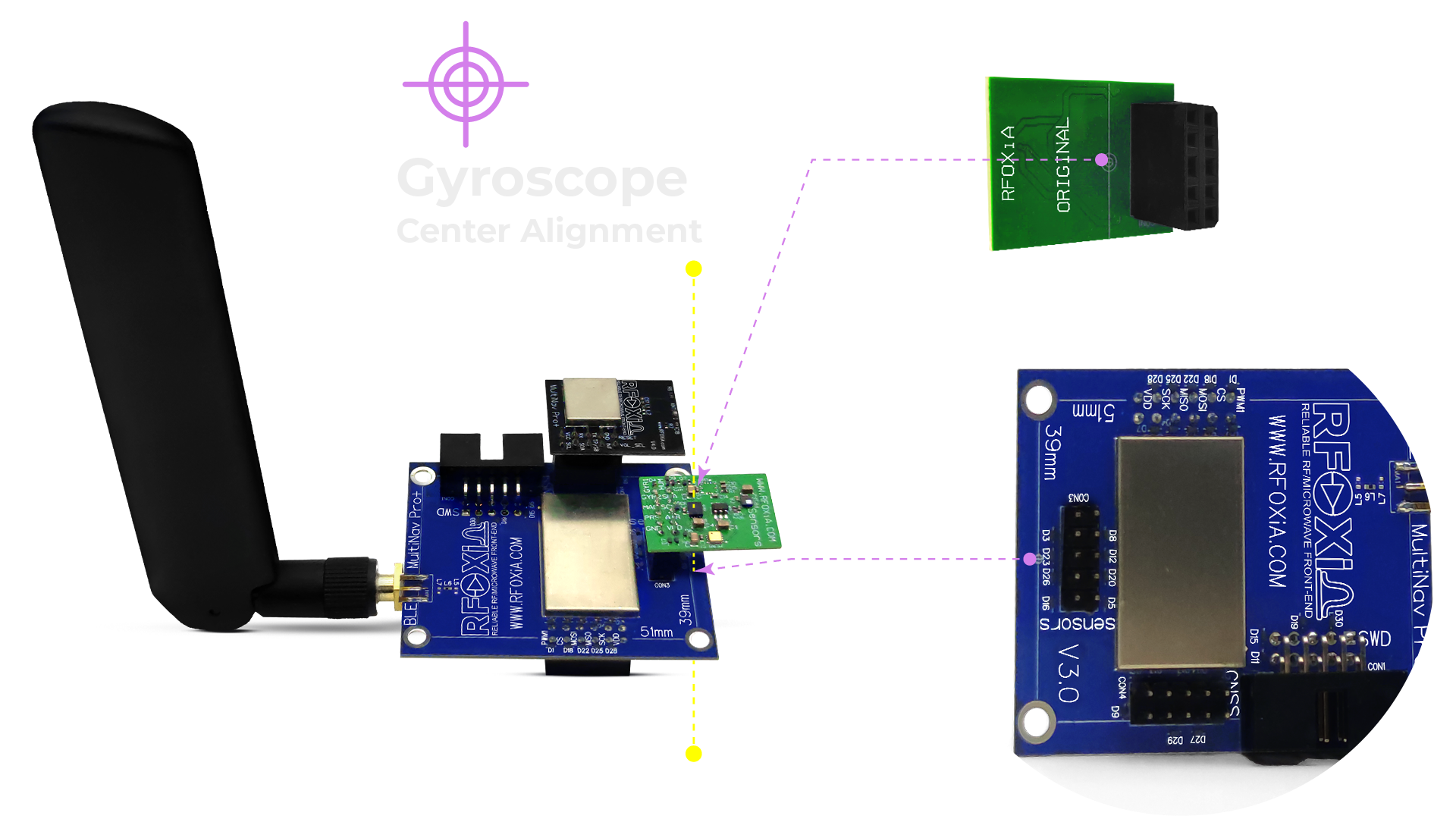
I2C Architecture: One Bus, Seven Sensors, Zero Headaches
One of the most underappreciated engineering decisions in this module is the I2C implementation. Every sensor on the board is assigned a dedicated, non-conflicting I2C address. They all share a single SDA/SCL pair to your host controller.
This matters for several practical reasons:
Wiring simplicity. A two-wire I2C bus to your microcontroller or single-board computer versus seven separate sensor connections. If you have ever tried to route seven sensor headers on a compact PCB, you understand what this saves.
Software simplicity. Standard I2C libraries. Standard register maps. No proprietary bus protocols, no SPI chip selects to manage, no DMA configuration nightmares.
Power simplicity. One module, one decoupling network, one power domain to regulate.
No address conflicts. The pre-assigned unique addresses mean you can plug this module into a system that already has other I2C devices without hunting through datasheets trying to find a free address or resoldering address jumpers.
For rapid prototyping, this means you go from opening the box to reading live sensor data in minutes. For production designs, it means cleaner PCB layouts and simpler firmware abstraction layers.
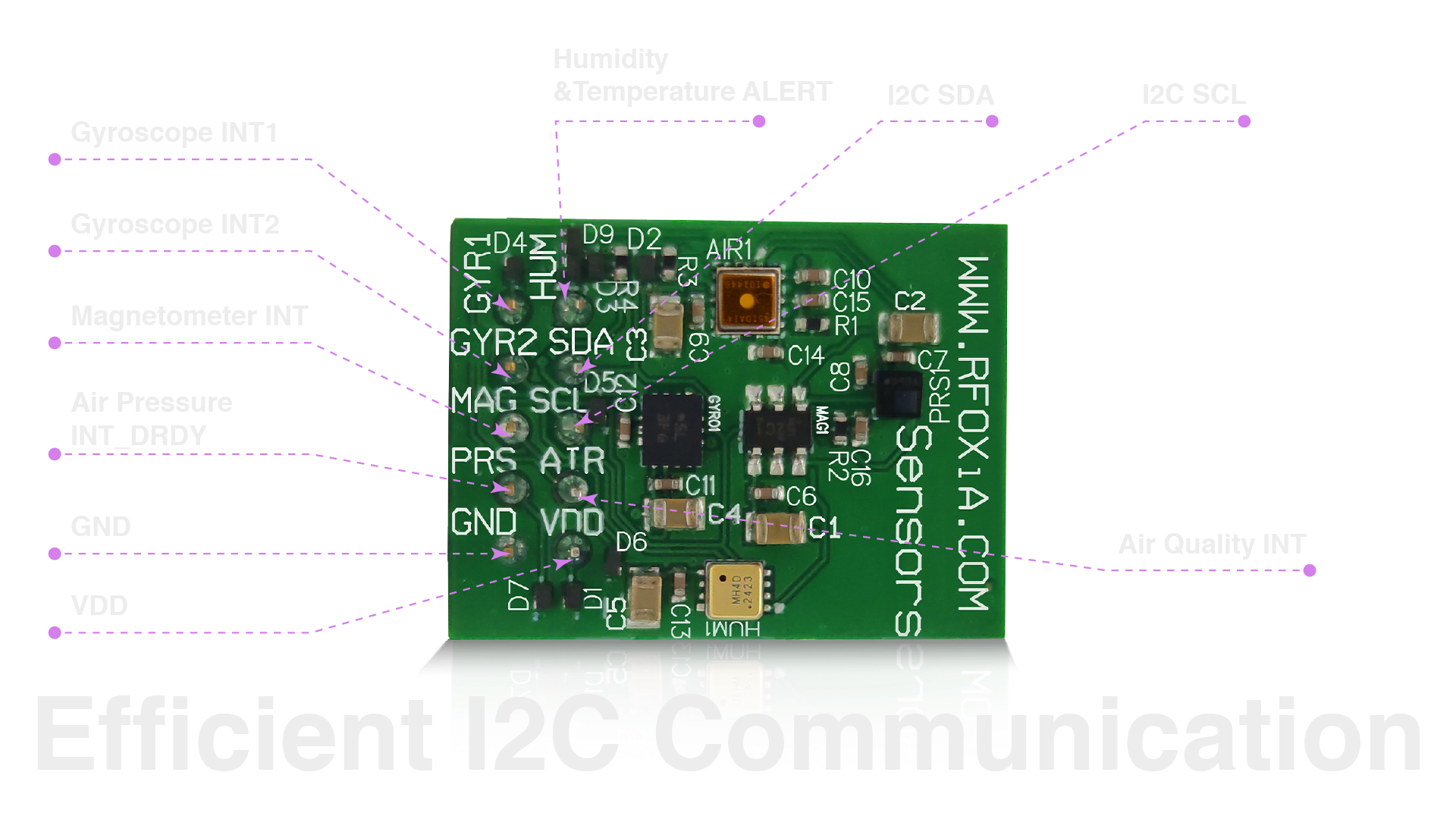
24mm × 18mm: What Compact Actually Means
The MultiNav Pro+ RFOXiA sensor module measures 24mm × 18mm. To put that in context: it is smaller than a standard postage stamp, lighter than a coin, and small enough to mount cleanly on virtually any drone frame, inside any enclosure, or on any wearable platform without consuming meaningful payload capacity.
For FPV racing quad builders, payload weight is everything. Every gram off the sensor stack is a gram back in battery. A module this size and weight allows you to add complete environmental and motion awareness to builds where you previously would have carried only a bare IMU.
For wearable and portable device developers, the footprint opens up form factor possibilities that discrete sensor arrays simply cannot match. Embedded in a weather monitoring badge, a field research instrument, or a compact agricultural sensor node, this module disappears into the design without dictating it.
For industrial IoT enclosures where DIN rail space or panel depth is constrained, a 24mm × 18mm sensor board fits where nothing else does.
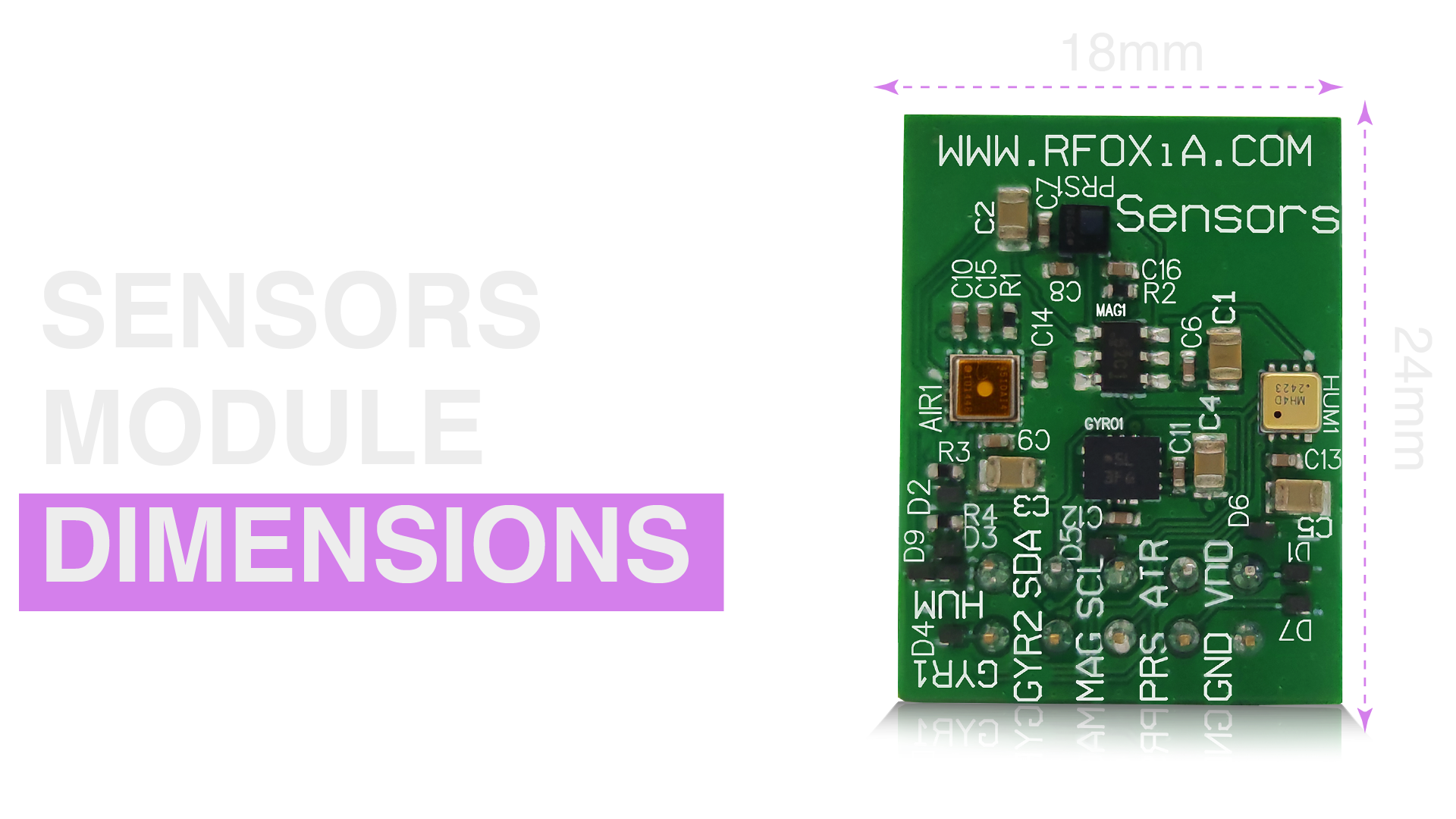
Real-Time Environmental Data: What You Can Actually Do With It
The phrase "real-time environmental data" is common. What it means in practice with this module is worth unpacking.
The ZMOD4510 air quality sensor, the LPS22HH pressure sensor, the MVH4003D humidity and temperature sensor, and the BMI270 IMU all update continuously. Your application receives fresh readings on every polling cycle — not buffered five-second averages, not HTTP API responses with rate limiting, not simulated values. Actual sensor readings from the physical environment, updated as fast as your I2C clock allows.
For drone autopilots, real-time pressure data means barometric hold loops that respond quickly enough to matter. For environmental research, real-time air quality data means catching transient pollution events that ten-minute averaged API data would completely smooth over. For agricultural monitoring, real-time humidity and temperature data means irrigation decisions based on actual field microclimate rather than the nearest weather station five kilometers away.
This is also the data that powers RFOXiA's data monetization network. When you deploy the Sensors Module with GNSS validation outdoors, your node contributes verified hyper-local environmental data to a network that aggregates and sells that information to enterprise buyers — agricultural technology companies, smart city operators, insurance firms, and climate researchers who need street-level resolution that public weather APIs cannot provide. Pioneers on the network earn daily rewards for every verified complete data session.
Explore the RFOXiA Integrated Sensors Module and start deploying your own node.
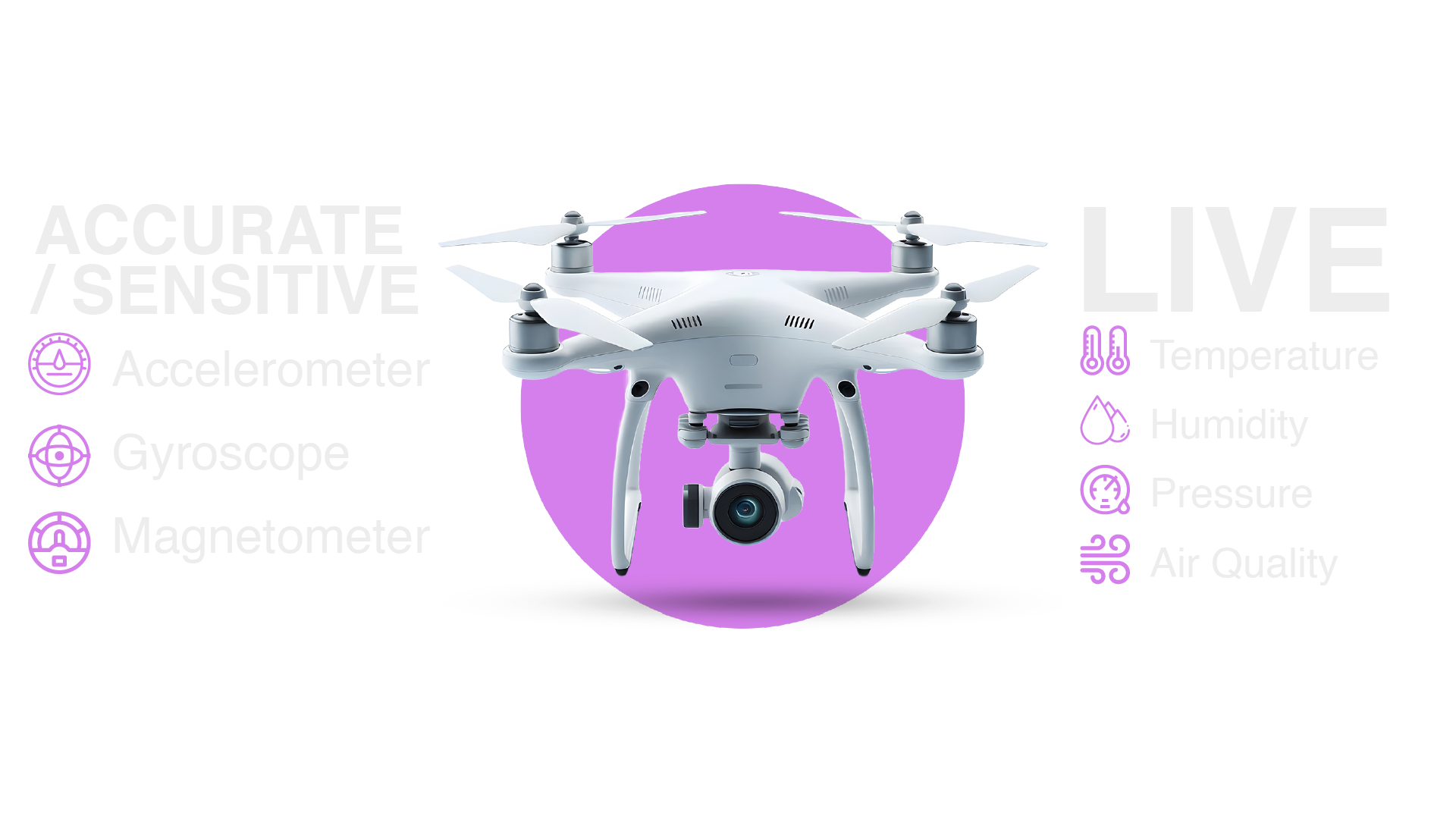
Application Domains: Where This Module Belongs
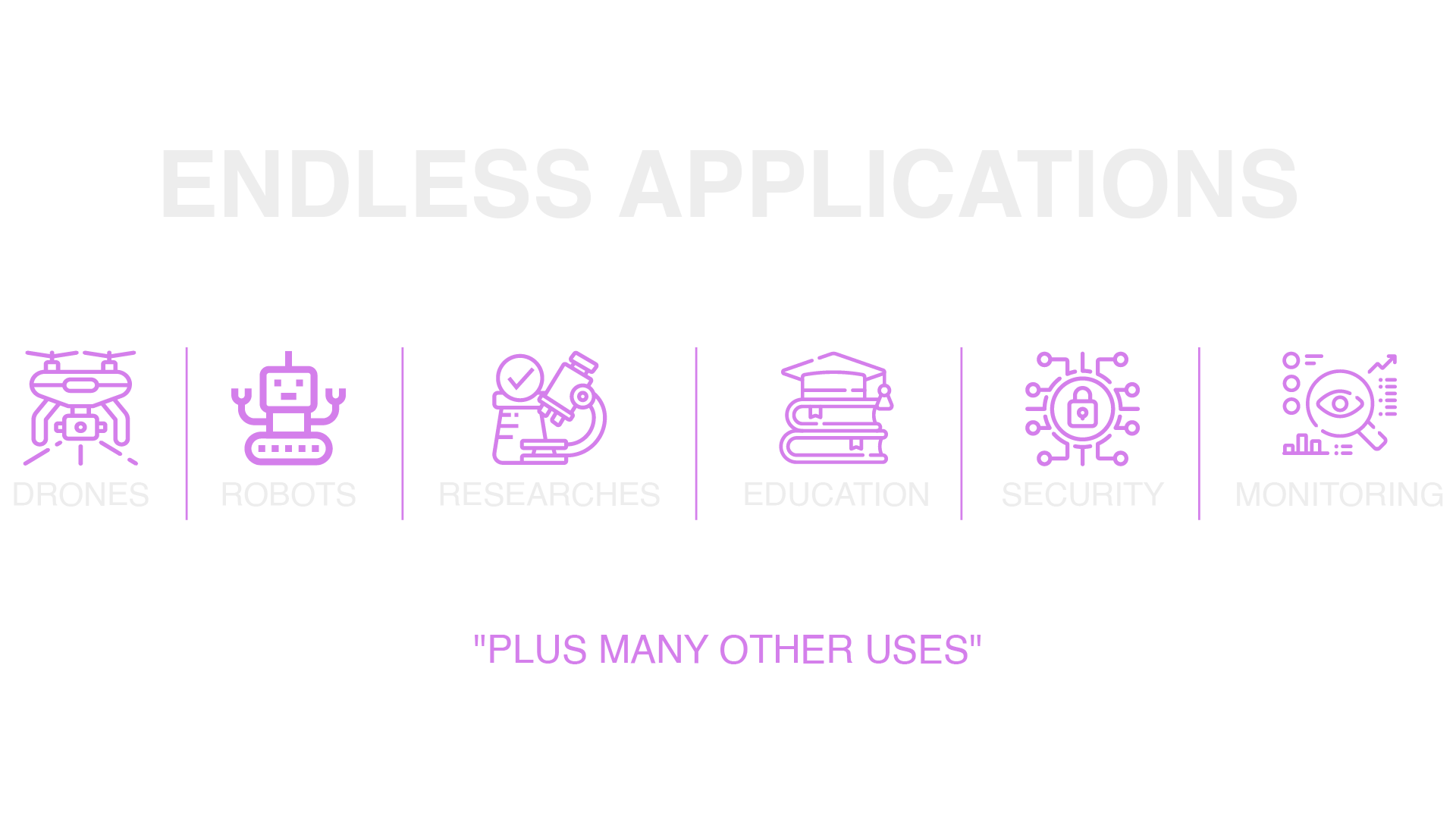
The versatility of seven integrated sensors across motion and environmental domains means this module appears in projects that look nothing alike. Here is where builders are actually deploying it.
Professional Drones and UAV Platforms
Barometric altitude hold, attitude estimation via IMU, heading reference via magnetometer, and ambient condition logging for mission reports. The RFOXiA sensor module gives drone builders a complete sensor foundation that previously required sourcing and integrating multiple discrete components. Pair it with the MultiNav Pro+ BLE Module and GNSS Module from the RFOXiA ecosystem and your drone gains long-range control, precision positioning, and full environmental awareness in one unified stack.
Robotics and Ground Vehicles
Ground robots navigating dynamic environments benefit from knowing their orientation (IMU + magnetometer), the terrain-induced vibration patterns (accelerometer), and ambient conditions that might affect electronics or payload performance (temperature, humidity). Indoor mobile robots can use pressure-based floor detection. Outdoor autonomous vehicles can log environmental conditions alongside position for post-mission analysis.
Environmental Research and Field Science
Researchers deploying distributed sensor networks need nodes that capture complete environmental context without requiring a dissertation-level integration effort. The Sensors Module gives field scientists temperature, humidity, pressure, and outdoor air quality from a single board that connects to any microcontroller over I2C. Combined with the RFOXiA GNSS Module for location tagging, each node becomes a fully georeferenced environmental observation point.
Agricultural IoT
Precision agriculture depends on hyperlocal climate data. Field microclimate varies enormously across even a small farm — temperature and humidity differences between rows, air quality near livestock operations, pressure-derived altitude differences across sloped terrain. A distributed network of RFOXiA sensor modules gives agricultural operators the spatial resolution that regional weather services cannot approach.
Smart City Infrastructure
Urban air quality monitoring, environmental equity assessment, traffic pollution correlation — these are active research and policy areas where the bottleneck is always data density. The ZMOD4510's outdoor-calibrated air quality sensing, combined with the pressure and climate sensors, makes the MultiNav Pro+ a capable smart city environmental node at a price point that enables genuine network density.
Wearable and Personal Environmental Monitors
The 24mm × 18mm footprint fits in wearable enclosures. Researchers building personal environmental exposure monitors, athletes tracking conditions during outdoor training, and developers creating environmental health tools can all build around this module without the space penalty of assembling multiple breakout boards.
Integration with the RFOXiA Ecosystem
The RFOXiA sensor module is not designed to exist in isolation. It is one component of a vertically integrated wireless development ecosystem that includes:
MultiNav Pro+ BLE Module — Long-range Bluetooth reaching 5km ground-to-ground and up to 20km man-to-drone. FCC certified. Pairs with the RFOXiA Connect app for live sensor data display over the air.
GNSS Module — 1.5-meter accuracy at 18Hz fix rate. GPS validates outdoor sensor deployment for the data monetization network and provides geolocation for any logged environmental dataset.
Power/Program Kit — Supercapacitor-based power management delivering 5-minute charge for 24-hour runtime. Keeps your sensor node running through field deployments without lithium battery constraints.
RFOXiA Connect App — iOS and Android application with live sensor data display, GPS map view, and long-range mesh communication. See your Sensors Module data live on your phone screen from up to 20km away.
RFOXiA Club Platform — Web platform with AI Firmware Builder that generates production-ready firmware for the Sensors Module from plain language descriptions. Describe your application, receive complete source code.
The Developer Bundle combines all of these components into one package at $199 after credits — the most cost-effective path to a complete long-range, sensor-rich, location-aware wireless development stack available anywhere at this price.
For developers who want to start with just the sensor capability, the MultiNav Pro+ Sensors Module is available standalone at $39. For those ready to build out the complete ecosystem, the Developer Bundle is the right starting point.
Get your RFOXiA Integrated Sensors Module for $39 and start building.
FCC Certified and Ready to Deploy
The MultiNav Pro+ Sensors Module carries FCC certification. For developers building products rather than one-off prototypes, this is not a footnote — it is a prerequisite for distribution, retail listing, and commercial deployment in the United States.
FCC certification means the module has been tested and confirmed to meet emissions and immunity standards. It means you can design it into a product you intend to sell without triggering a separate device-level certification process for the sensor subsystem. It means distributors like DigiKey, Mouser, and Digi-Key Marketplace will consider it. It means your commercial IoT deployment is not running on uncertified hardware.
RFOXiA has FCC certification across its entire product line. This is part of what separates the RFOXiA sensor module from DIY assemblies and grey-market breakout boards that carry no such validation.
Specifications at a Glance
| Parameter | Specification |
|---|---|
| Dimensions | 24mm × 18mm |
| Communication | I2C (single bus, dedicated addresses) |
| Accelerometer / Gyroscope | BMI270 (Bosch Sensortec) |
| Magnetometer | TMAG5273C1QDBVR (Texas Instruments) |
| Barometric Pressure | LPS22HHTR (STMicroelectronics) |
| Humidity / Temperature | MVH4003D (MEMSVision) |
| Air Quality | ZMOD4510AI4R (RENESAS) |
| Certification | FCC Certified |
| Price | $39 |
| Ecosystem Compatibility | Full RFOXiA ecosystem |
Getting Started: From Unboxing to Live Data
The I2C interface and the quality of available Arduino, MicroPython, and embedded C libraries for every sensor on this board means integration time is measured in hours, not weeks. The BMI270, LPS22HH, and TMAG5273 all have mature open-source driver ecosystems. The ZMOD4510 ships with RENESAS's application library for algorithmic output.
For developers who want AI-assisted firmware development, RFOXiA Club's AI Firmware Builder generates complete, production-ready firmware for the Sensors Module from a plain-language description of your application. Describe what you are building, specify your host microcontroller, and receive working code with full source access.
For those contributing to the RFOXiA data network, the activation flow guides you through connecting the module outdoors, verifying your first live data point with GPS confirmation, and enrolling in the daily reward program. Pioneers in data-sparse locations earn the highest contribution rates — early network participants lock in elevated reward tiers that later contributors will not access.
Whether you are building a drone, a field research instrument, a smart city node, or just exploring what seven sensors on 24mm × 18mm can reveal about the world around you — this module is ready.
Order the RFOXiA Integrated Sensors Module now and add it to your next build.
Final Thoughts
The MultiNav Pro+ RFOXiA sensor module represents a straightforward proposition: seven professionally selected sensors, from five reputable semiconductor manufacturers, integrated on a single FCC-certified board smaller than a postage stamp, communicating over a single I2C bus, at $39.
For builders who have priced out the alternative — seven discrete modules, seven different footprints, seven different power requirements, seven I2C address negotiation problems — the value is immediate. For researchers who need verified outdoor environmental data with motion context. For drone engineers who need a complete sensor foundation. For IoT developers who need environmental intelligence without a wiring project.
The RFOXiA sensor module does not ask you to compromise between capability and convenience. It delivers both, in a form factor that fits anywhere your ambition takes it.
Written by: Moamen Mohamed LinkedIn