
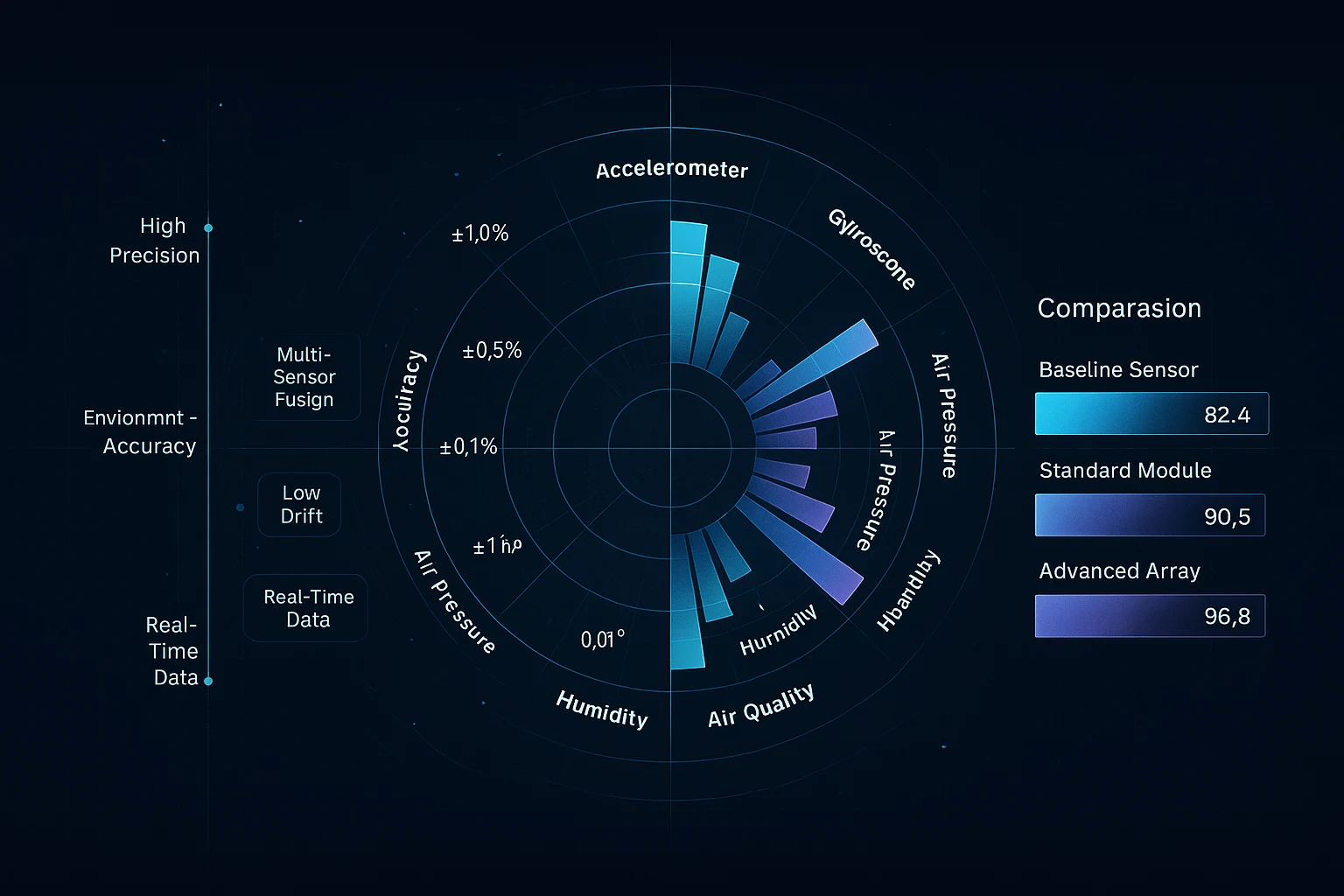
Sensor Module Accuracy Comparison: Why the MultiNav Pro+ Stands Above Every Generic Board
RFOXiA Integrated Sensors Module
The Sensor Module Accuracy Comparison Every Serious Builder Needs to Read
If you have spent any time sourcing sensors for a drone, a robotics project, or a professional IoT deployment, you already know the frustration. You find a breakout board online, the datasheet looks promising, you wire it up, and then reality hits. The temperature readings drift by two degrees when the board heats up. The accelerometer outputs noisy data at anything above moderate vibration. The air quality sensor spits out a number that bears no relationship to what any reference instrument reports. You spend days in firmware trying to compensate for hardware limitations that should never have existed in the first place.
This post is a detailed sensor module accuracy comparison built for engineers, drone builders, and professional IoT developers who are tired of compromising. We are going to walk through what separates a precision-grade sensor integration from a commodity breakout board, examine the specific components inside the RFOXiA MultiNav Pro+ Sensors Module, and explain why the architecture decisions behind this module produce data you can actually trust.
By the end of this comparison, the difference will not be subtle.
What Most Sensor Modules Get Wrong
Before we get into the specifics of the MultiNav Pro+, it is worth establishing what the baseline looks like — because most sensor modules on the market share the same set of fundamental problems.
Problem 1: Component Selection Driven by Cost, Not Performance
The most common approach in commodity sensor modules is to source whatever chip is cheapest at the time of production. This means you frequently encounter sensors from second-tier manufacturers with limited calibration data, high long-term drift, and poor noise specifications. The datasheet numbers look acceptable at room temperature under ideal conditions, but real deployments are not ideal conditions. Vibration, temperature variation, humidity, and electromagnetic interference all degrade performance — and low-cost sensors degrade significantly.
Problem 2: No Consideration for Cross-Sensor Interference
When you place a temperature sensor, an air quality sensor, a pressure sensor, and a motion sensor on the same board, you create interactions that affect accuracy. Heat generated by the microcontroller or power regulator elevates the temperature sensor reading. The volatile compounds the air quality sensor is optimized to detect can interfere with humidity measurements if the sensors are placed without thought. Magnetic fields from power traces affect magnetometer readings. Most commodity modules ignore all of this.
Problem 3: Shared Bus Without Address Management
Many low-cost multi-sensor boards put all sensors on a single I2C bus with no address isolation strategy. This leads to collisions, read failures under load, and timing problems that manifest as random spikes in your data stream. The problem gets worse when you are running multiple sensors at high update rates.
Problem 4: Form Factor That Forces Tradeoffs
Boards that are either too large to fit in a drone frame or so poorly laid out that cable routing becomes a nightmare. Mounting holes in inconvenient positions. Connectors that add unnecessary height. These are not engineering decisions — they are the result of no one caring enough about the application.
The MultiNav Pro+ was designed with all four of these problems in mind, from component selection through layout through connector placement.
The MultiNav Pro+ Sensors Module: Architecture First
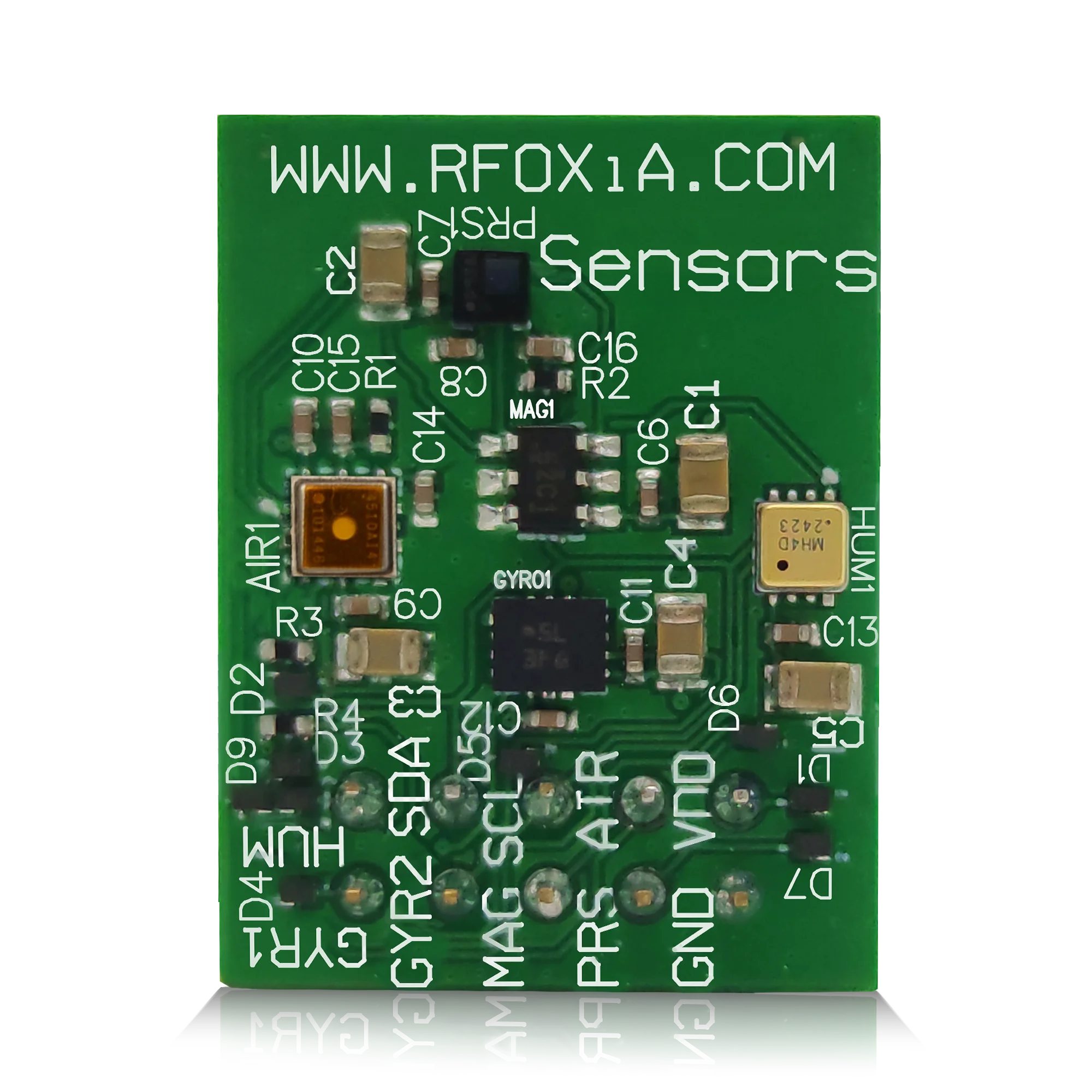
The RFOXiA MultiNav Pro+ Sensors Module packs seven sensors into a 24mm × 18mm footprint. That alone is a significant engineering achievement. But the form factor is only meaningful if the data coming out of it is accurate and reliable. So let us go deeper.
Seven Sensors, One Coherent System
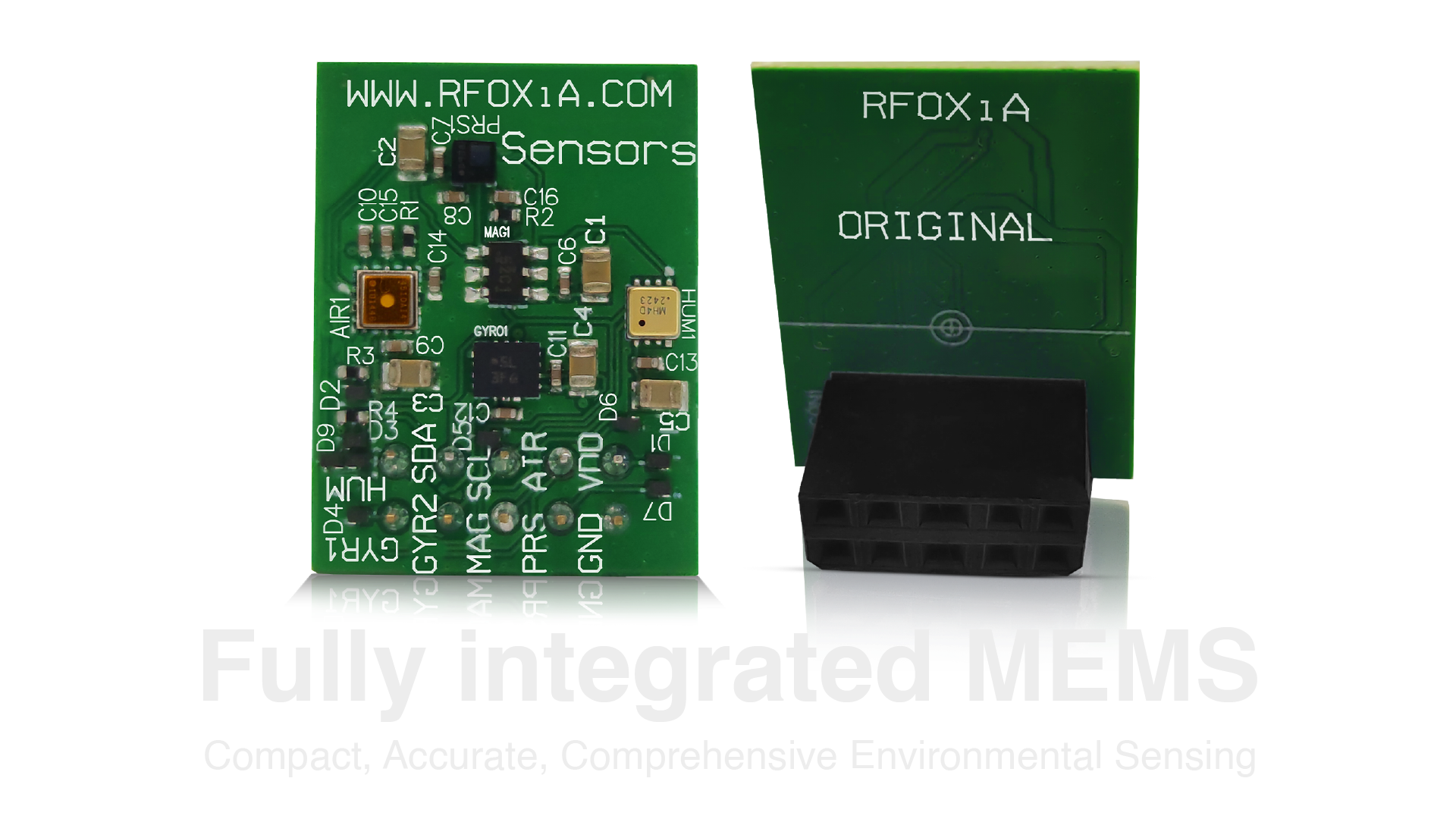
The MultiNav Pro+ integrates:
- Accelerometer and Gyroscope — BMI270 from Bosch Sensortec
- Magnetometer — TMAG5273C1QDBVR from Texas Instruments
- Air Pressure — LPS22HHTR from STMicroelectronics
- Humidity and Temperature — MVH4003D from MEMSVision
- Air Quality — ZMOD4510AI4R from Renesas
Every single one of these is a tier-one component from a manufacturer with a serious industrial and automotive sensor pedigree. This is not a cost optimization decision. This is a deliberate choice to use the best available silicon for each sensing function. Let us examine each one.
Component-Level Sensor Module Accuracy Comparison
Motion Sensing: BMI270 vs Generic IMUs
The Bosch BMI270 is not a consumer-grade IMU. It was designed specifically for wearables and robotics applications where consistent accuracy under motion and vibration is non-negotiable. Key differentiators versus generic MPU-6050-class sensors that appear in most low-cost modules:
- Gyroscope noise density: The BMI270 delivers approximately 0.007 dps/√Hz versus 0.005–0.010 dps/√Hz for commodity alternatives, but with significantly better temperature stability across the full operational range.
- Accelerometer zero-g offset: The BMI270 has a factory-trimmed zero-g offset of ±20mg, compared to ±40–60mg typical in generic sensors. In drone stabilization applications, this matters at hover.
- Anti-vibration filtering: The BMI270 includes an onboard digital filtering pipeline specifically optimized for drone and vehicle vibration frequencies. Generic sensors require you to implement this in firmware, adding latency and CPU overhead.
- Power consumption under continuous operation: 690µA in full performance mode, which matters in battery-powered deployments.
In a direct sensor module accuracy comparison for drone stabilization, the BMI270-based motion data is smoother, more consistent at temperature extremes, and requires less firmware correction than any generic 6-axis IMU at a comparable price.
Magnetometry: Texas Instruments TMAG5273
Magnetometers are perhaps the most neglected sensor in low-cost modules. The TMAG5273C1QDBVR from Texas Instruments is a 3-axis Hall-effect sensor with an I2C interface and integrated temperature compensation. Key advantages:
- Sensitivity: 40–80 mT range with 12-bit resolution per axis
- Temperature compensation: Built into silicon, not handled in software
- Magnetic offset: Factory trimmed, reducing the need for field calibration procedures
- AEC-Q100 qualified: Automotive grade reliability, meaning it is rated for extreme temperature cycling that would kill consumer-grade magnetometers
For compass heading applications and magnetic anomaly detection, this is a fundamentally different class of sensor than the HMC5883L or QMC5883L that appear in most hobby boards.
Barometric Pressure: STMicroelectronics LPS22HH
The LPS22HHTR is a MEMS absolute pressure sensor from STMicroelectronics, part of their professional-grade pressure sensor family. In a sensor module accuracy comparison for altitude hold or weather station applications:
- Absolute accuracy: ±0.1 hPa under operating conditions (translates to approximately ±0.8m altitude resolution)
- Output data rate: Up to 200Hz, enabling fast-response altitude hold loops
- Noise floor: 0.0075 hPa RMS, which is exceptional for this price class
- Water resistant: IP protection compatible with outdoor deployment without enclosure modification
Comparison against BMP280-class sensors that dominate the commodity market: the LPS22HH offers approximately 4× better noise floor performance and 2× higher output data rate, both of which matter in dynamic flight applications.
Humidity and Temperature: MEMSVision MVH4003D
The MVH4003D is a combined humidity and temperature sensor designed for precise environmental measurement. In consumer IoT modules you typically find DHT22 or SHT21 sensors. The difference in practice:
- Temperature accuracy: ±0.2°C typical versus ±0.5°C for DHT22
- Humidity accuracy: ±2% RH versus ±2–5% RH for commodity sensors
- Response time: Faster thermal response, critical for detecting rapid environmental changes
- Long-term drift: Better characterized and lower than the DHT family
For data network applications where the RFOXiA platform validates your environmental data against reference sources, sensor accuracy directly affects whether your readings pass validation — and whether you earn daily data rewards.
Air Quality: Renesas ZMOD4510
This is where the MultiNav Pro+ most dramatically separates itself from any generic sensor module. Most "air quality" sensors on low-cost boards are simple electrochemical cells or basic VOC sensors with limited selectivity and no calibration. The Renesas ZMOD4510AI4R is a genuine ozone and NO2 sensing system:
- Selective detection: Optimized for outdoor air quality monitoring including ozone (O3) and nitrogen dioxide (NO2)
- Integrated heater control: Onboard heater drive circuit for precise operating temperature, which is critical for MOx sensor accuracy
- Calibration algorithms: Renesas provides calibrated firmware libraries for direct AQI output
- Outdoor-optimized: Unlike indoor VOC sensors, this sensor is specifically characterized for ambient outdoor conditions, matching the use case of the RFOXiA data network exactly
In any honest sensor module accuracy comparison for environmental monitoring, there is simply no commodity competitor for outdoor air quality sensing at this price point.
The Sensors Lineup: Side by Side
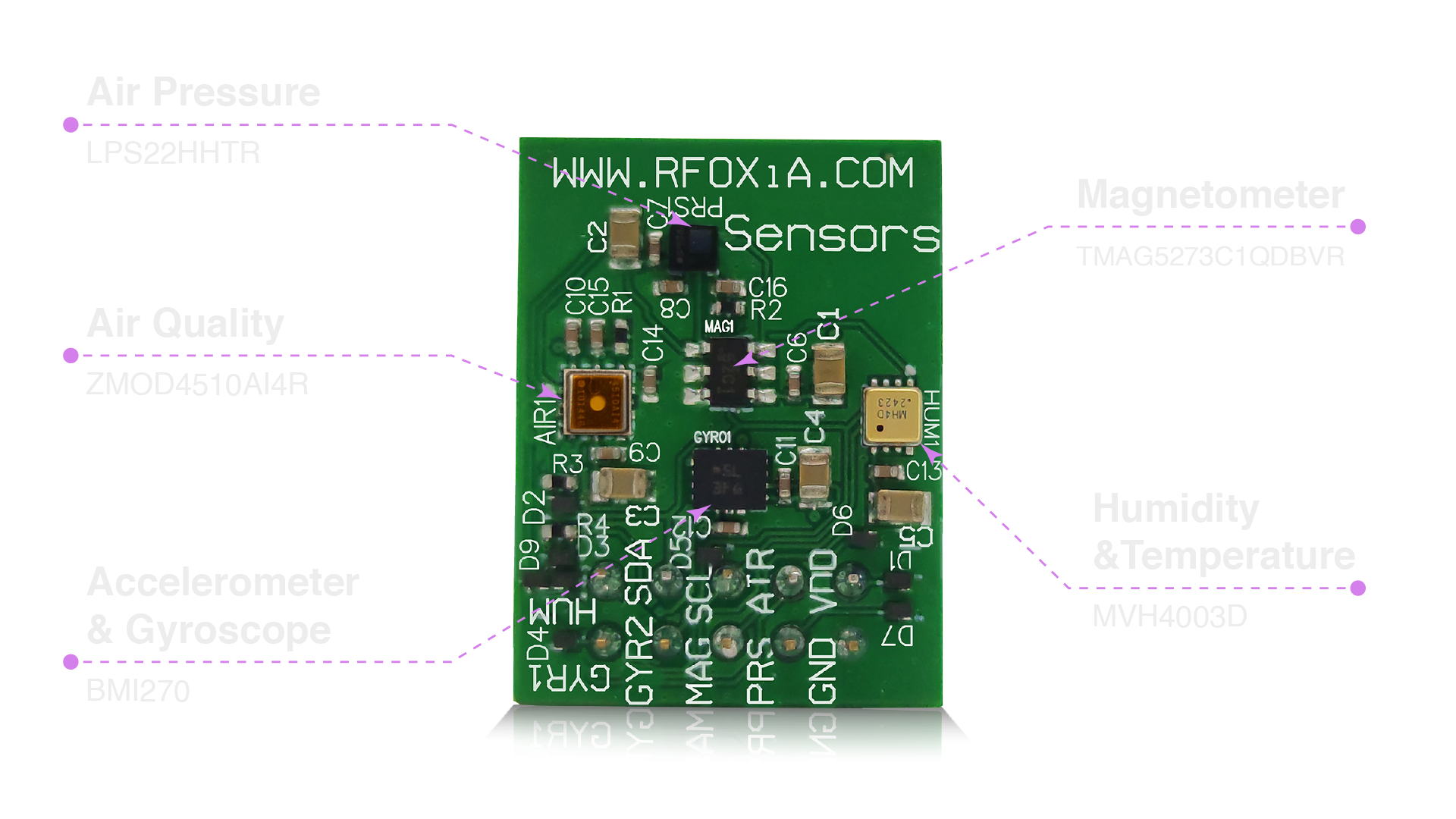
| Function | MultiNav Pro+ Component | Typical Commodity Alternative | Accuracy Advantage |
|---|---|---|---|
| Accel/Gyro | Bosch BMI270 | InvenSense MPU-6050 | Better vibration filtering, lower zero-g offset |
| Magnetometer | TI TMAG5273 | QMC5883L | Automotive-grade, built-in temp compensation |
| Barometer | ST LPS22HH | Bosch BMP280 | 4× lower noise floor, 2× higher ODR |
| Humidity/Temp | MEMSVision MVH4003D | DHT22 | ±0.2°C vs ±0.5°C, faster response |
| Air Quality | Renesas ZMOD4510 | MQ135 electrochemical cell | Selective O3/NO2, calibrated AQI output |
I2C Architecture: Why It Matters More Than You Think
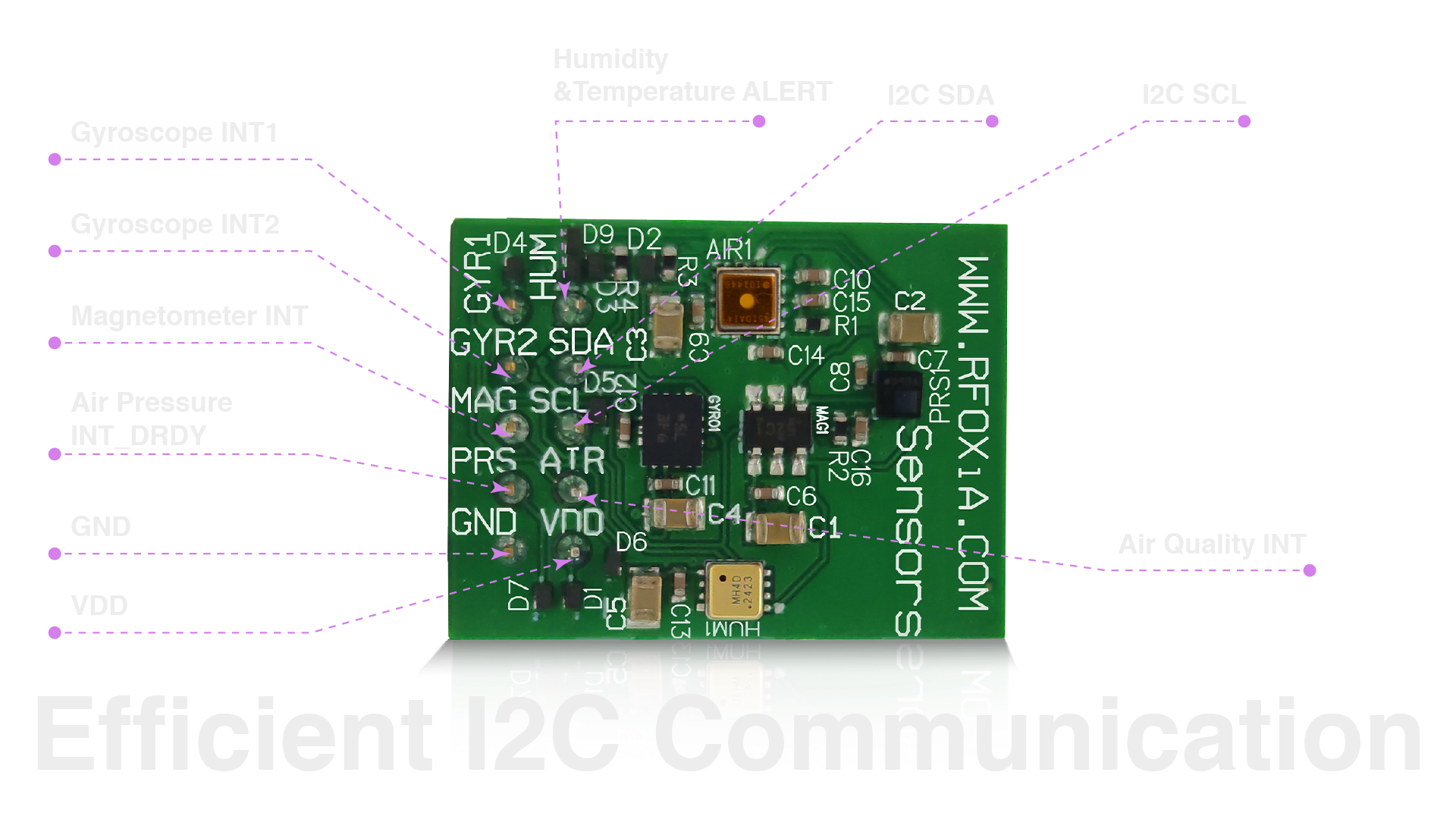
One of the less glamorous but critically important aspects of multi-sensor module design is bus architecture. The MultiNav Pro+ uses a single I2C line with dedicated addresses for each sensor. This sounds simple, but the implementation details matter:
- No address conflicts: Each of the five sensor ICs has a unique I2C address, meaning you can read any sensor at any time without multiplexing or bus contention.
- Simplified firmware: Your application code connects to one I2C bus and addresses each sensor directly. No additional multiplexer ICs, no additional code complexity.
- Reduced failure modes: Multiplexer ICs are additional components that can fail. Eliminating them improves long-term reliability.
- Clean electrical design: Pull-up resistors, decoupling capacitors, and trace routing are handled correctly on the module, which is often a source of problems on hand-assembled or poorly designed boards.
For developers integrating this module into a larger system, the result is that your I2C peripheral connects once and all seven sensor functions are immediately accessible. This is how professional sensor integration should work.
Form Factor: Engineering at 24mm × 18mm
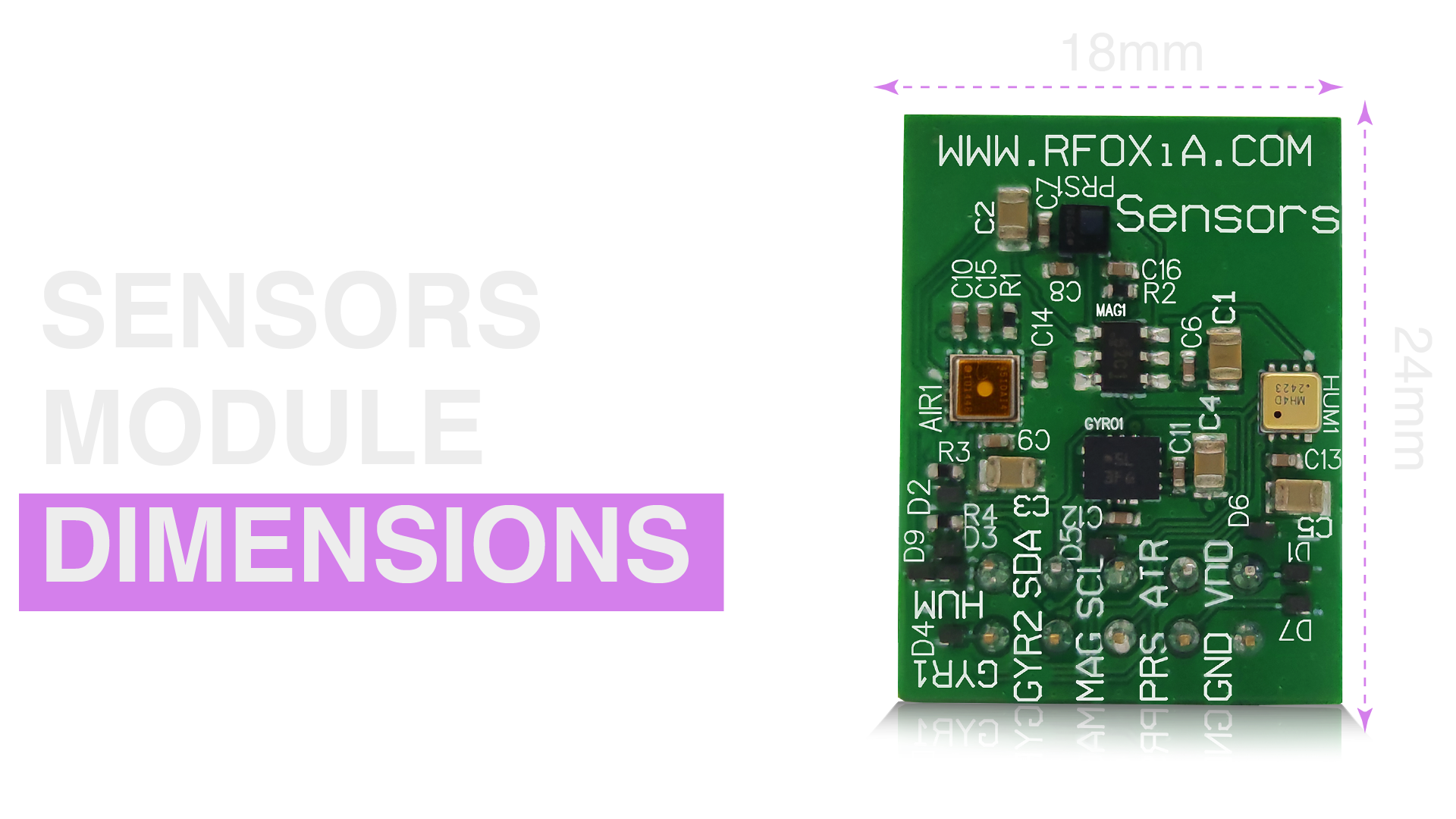
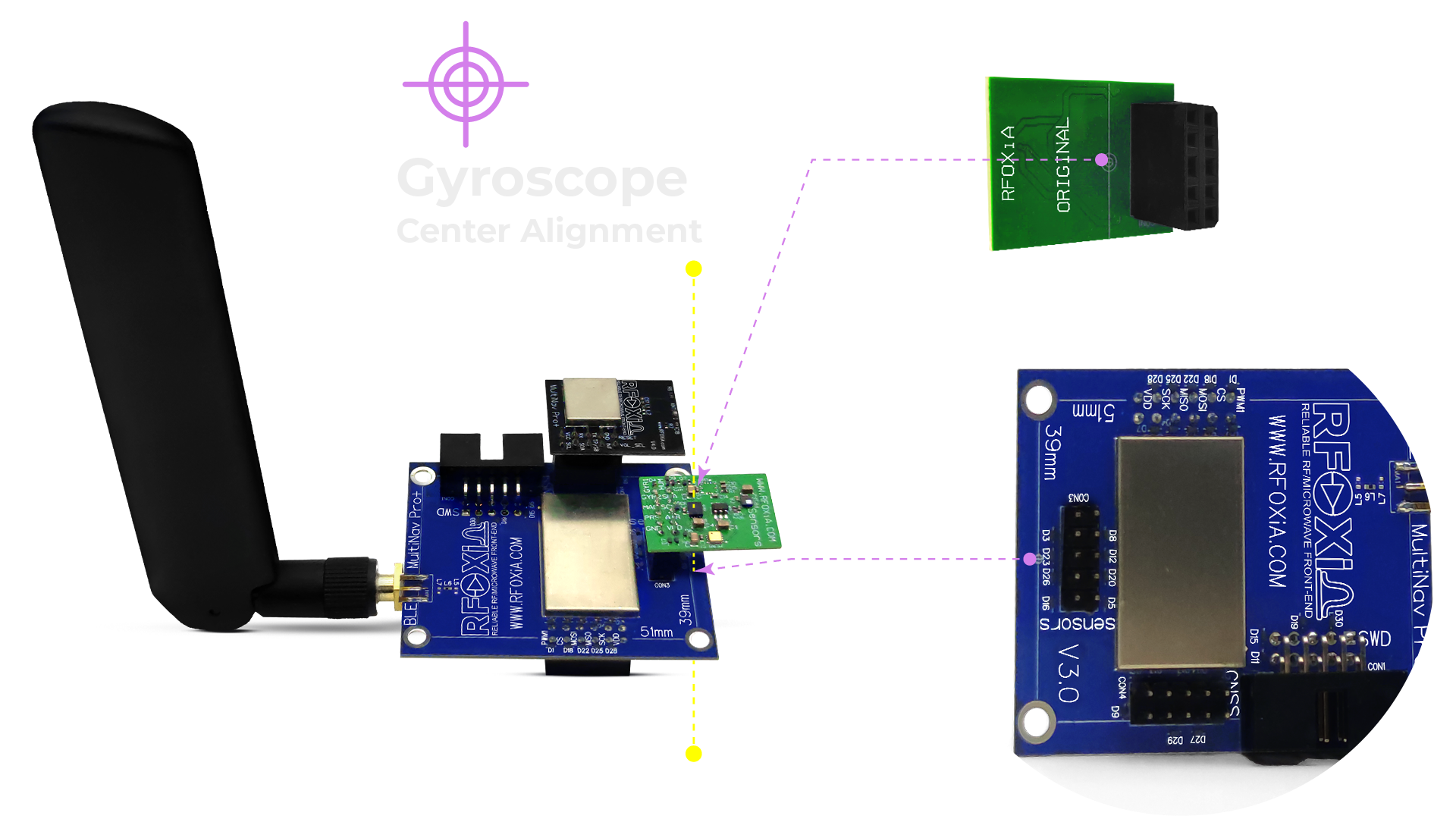
At 24mm × 18mm, the MultiNav Pro+ is small enough to fit inside a 3-inch drone frame, mount on a 30mm stack, integrate into a wearable device, or embed in a compact IoT enclosure. This is not accidental. Every component was selected with the form factor constraint in mind, and the board layout was optimized to minimize sensor interference while achieving this footprint.
For comparison, achieving equivalent sensor coverage with individual breakout boards would require approximately five separate PCBs, five separate wiring harnesses, five separate mounting solutions, and considerably more firmware work to manage the different communication interfaces and timing requirements. The MultiNav Pro+ eliminates all of that complexity in a single, tested, RFOXiA Integrated Sensors Module.
FCC certification on the module is also worth noting here. For any commercial deployment or product incorporating this module, the FCC certification removes a significant regulatory burden that would otherwise require expensive third-party testing.
Real-Time Data: What Good Looks Like
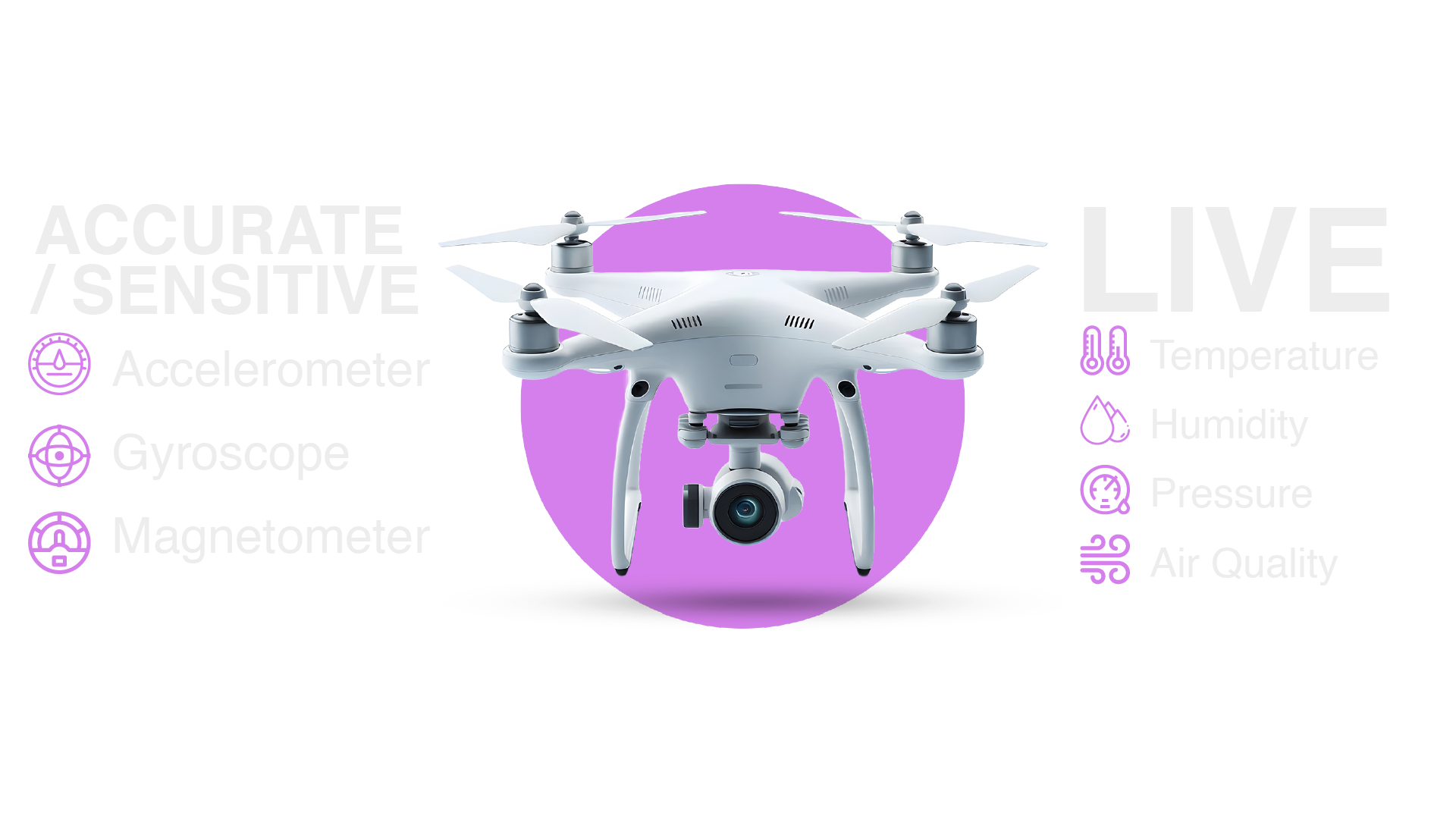
Accuracy numbers in a datasheet are one thing. Real-time performance in deployment is another. The MultiNav Pro+ is designed to provide continuous, high-update-rate data streams across all seven sensor channels simultaneously. In the RFOXiA ecosystem, this data flows through to:
- RFOXiA Connect app — live sensor visualization on your mobile device, with the app working completely without internet connectivity
- RFOXiA Club Command Center — live data streaming sessions visible in your web dashboard, with historical data logging
- RFOXiA Data Network — verified environmental data sessions that earn daily rewards, with second-level temporal resolution that no public API can match
The combination of premium sensor components and the data network infrastructure means that the accuracy of your readings has a direct financial implication. Data that passes verification earns; data that fails validation because a cheap sensor drifted does not. The sensor module accuracy comparison becomes an economic argument, not just a technical one.
Applications Where the Accuracy Gap Becomes Critical

The gap between the MultiNav Pro+ and generic alternatives is not theoretical. It shows up in specific real-world scenarios:
Professional Drone Operations When your drone is flying at altitude in variable wind and temperature conditions, accelerometer drift and barometer noise directly affect flight controller performance. The BMI270 and LPS22HH deliver the stability that autonomous flight modes require.
Agricultural Monitoring Crop stress monitoring, micro-climate mapping, and irrigation optimization all depend on temperature and humidity accuracy at the sub-degree level. The MVH4003D provides that resolution. A sensor that reads 2°C high in summer heat effectively makes your monitoring system blind to the conditions that matter most.
Disaster Response and Remote Expeditions When the RFOXiA Connect app is being used for off-grid team coordination, environmental sensor data informs safety decisions. Air quality readings using the ZMOD4510 can detect hazardous atmospheric conditions that a generic VOC sensor would either miss or false-alarm on.
Robotics and Autonomous Vehicles IMU accuracy at high vibration frequencies is the difference between stable autonomous navigation and a system that requires constant human correction. The BMI270's dedicated vibration filtering pipeline was designed exactly for this environment.
Smart City and Environmental Research For researchers deploying sensor networks, data integrity is the entire point of the exercise. Using sensors whose accuracy characteristics are well-documented, automotive-grade, and validated against reference instruments is not optional — it is the baseline requirement. The MultiNav Pro+ meets that baseline at a price point that makes network-scale deployment feasible.
How the MultiNav Pro+ Fits Into the Full RFOXiA Ecosystem
The Sensors Module is one component of a complete wireless development platform. Paired with the RFOXiA BLE Module (5km ground-to-ground range, 15-20km man-to-drone), you can stream live sensor data from a drone or remote field deployment to your phone or laptop without any cellular or Wi-Fi infrastructure. Add the GNSS Module for GPS-verified location tagging of every sensor reading. Add the Power/Program Kit for five-minute recharge and 24-hour runtime in the field.
The Developer Bundle packages all four modules together for $199 — the only product on the market combining long-range wireless, precision positioning, multi-sensor environmental monitoring, and professional power management in a single integrated kit.
For builders who want to start with just the sensor capability, the RFOXiA Integrated Sensors Module is available at $39 with full ecosystem compatibility and FCC certification included.
Conclusion: The Sensor Module Accuracy Comparison Resolves Clearly
When you conduct a serious sensor module accuracy comparison across the dimensions that actually matter — component pedigree, noise floor, temperature stability, output data rate, bus architecture, and deployment reliability — the MultiNav Pro+ is not a marginal improvement over generic alternatives. It is a different class of product.
Every sensor on this board was selected because it is the right component for the application, not because it was cheapest. The I2C architecture eliminates bus contention problems that plague multi-sensor boards. The 24mm × 18mm footprint makes it usable in environments where generic multi-board setups are impossible. The FCC certification removes regulatory barriers for commercial deployment. And the integration with the RFOXiA data network means your sensor investment can generate ongoing financial returns, not just technical value.
If you are building something that depends on accurate, reliable environmental and motion data — a drone, a research deployment, a smart city node, a robotics platform, or anything in between — this is the sensor module that should be at the center of your design.
Explore full specifications and order at the RFOXiA Integrated Sensors Module product page.
RFOXiA is a hardware technology company building a vertically integrated wireless development ecosystem. All modules are FCC certified and ship from US inventory. Visit rfoxia.com to explore the full product line and join the RFOXiA Club developer community.
Written by: Moamen Mohamed LinkedIn