
Sensor Module Comparison for Makers: Why the MultiNav Pro+ Sensors Module Stands Alone
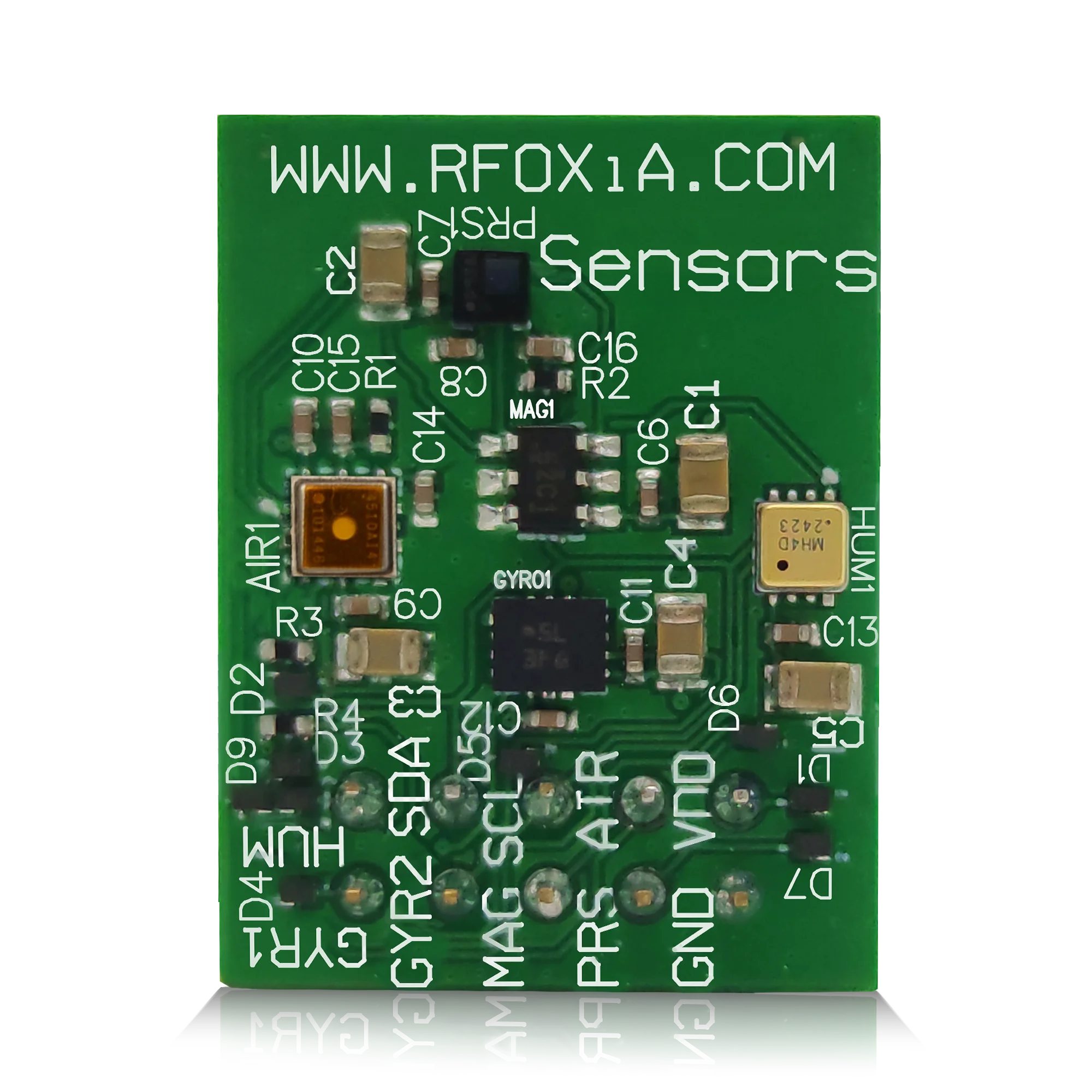
RFOXiA Integrated Sensors Module
The Sensor Module Comparison Every Maker Needs to Read Before Buying
If you have spent any time sourcing sensors for a drone, robotics platform, environmental monitor, or IoT deployment, you already know the frustration. You find a great accelerometer breakout. Then you need a separate humidity board. Then another for air quality. Then another for magnetometer calibration. Before long you have five modules fighting for I2C addresses, a rats nest of wiring, and a bill of materials that has quietly climbed past $120 — and you still do not have a compact, integrated solution.
This guide is the sensor module comparison for makers that cuts through that chaos. We are going to look at what the market typically offers, where those solutions fall short for serious builders, and why the RFOXiA MultiNav Pro+ Sensors Module is the most compelling single-board sensor solution available today at its price point.
Let us get into it.
The Problem With Piecemeal Sensor Setups
The maker ecosystem is full of individual breakout boards. SparkFun, Adafruit, and Seeed Studio all produce excellent single-sensor modules. For prototyping on a breadboard, they are fine. But when you are building something real — a drone that needs to stay stable, an environmental monitor that needs to log accurate data, a wearable that needs to track motion and ambient conditions simultaneously — individual breakouts introduce serious problems.
Address conflicts. Many popular sensor ICs share default I2C addresses. The moment you put two sensors with the same address on the same bus, you have a problem that requires address remapping, multiplexers, or separate buses.
Power management complexity. Each breakout board draws power differently. Managing voltage regulators, decoupling capacitors, and current budgets across five separate boards adds engineering time and failure points.
Physical size and weight. On a drone or compact wearable, five separate boards connected by jumper wires is not a viable end solution. It is a prototype. Moving to production requires either a custom PCB or accepting a physically large and mechanically fragile assembly.
Firmware fragmentation. Different sensors from different manufacturers mean different libraries, different initialization sequences, different data formats. Integration time multiplies with every additional breakout board.
This is the problem that the MultiNav Pro+ Sensors Module was designed to solve from the ground up.
What the MultiNav Pro+ Sensors Module Includes
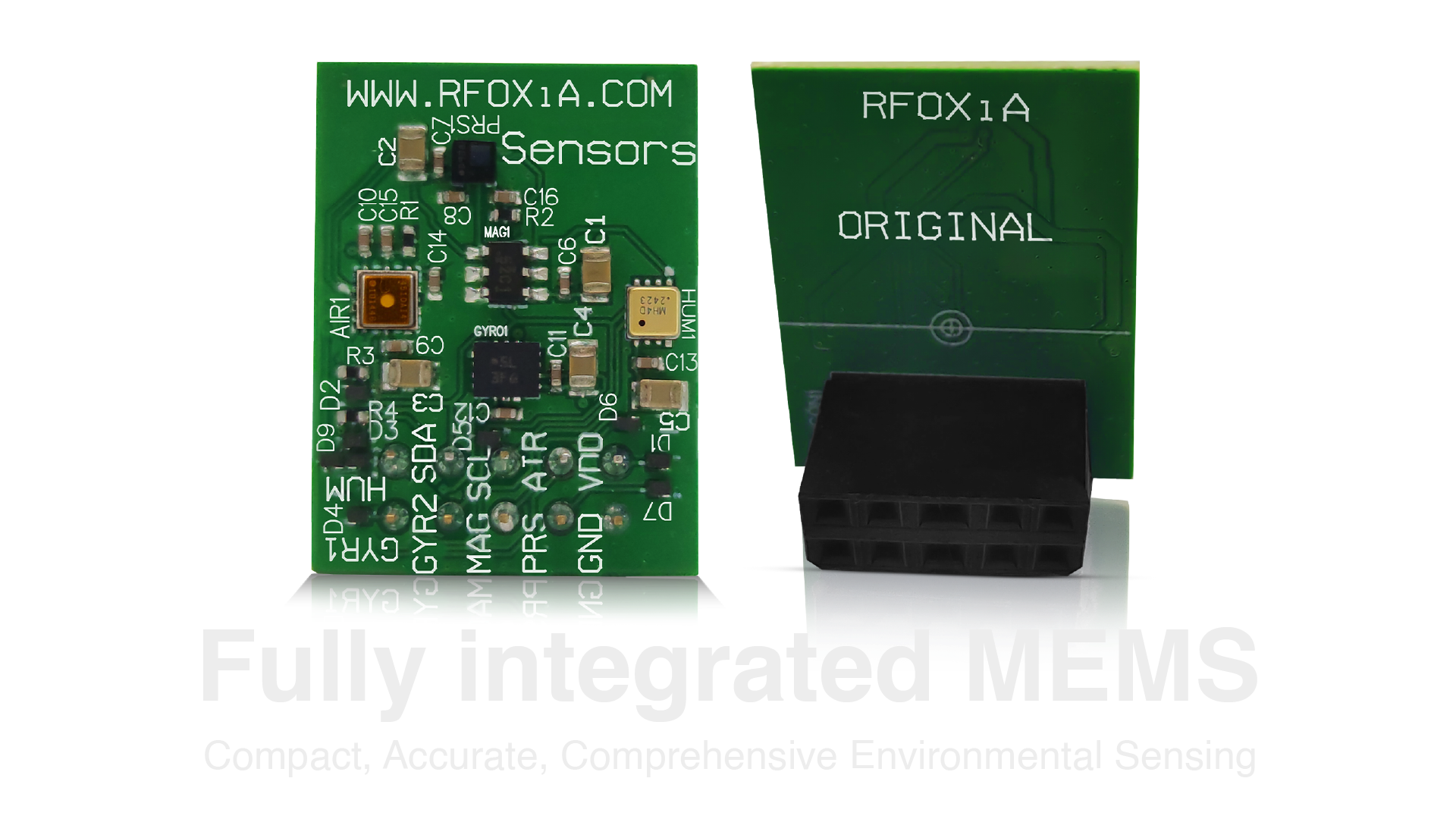
The MultiNav Pro+ Sensors Module integrates seven distinct sensors on a single 24mm × 18mm PCB. That is a complete environmental and motion sensing package smaller than a postage stamp. Here is exactly what is on board:
- Accelerometer — 3-axis linear acceleration
- Gyroscope — 3-axis angular velocity
- Magnetometer — 3-axis magnetic field for heading and compass applications
- Barometric Air Pressure — altitude estimation and weather monitoring
- Humidity — relative humidity for environmental and agricultural applications
- Temperature — ambient temperature with high accuracy
- Air Quality — outdoor air quality index for environmental monitoring and data network contributions
Seven sensors. One board. One I2C connection. $39.
When you stack that against the alternative — sourcing, wiring, and integrating seven separate breakout boards — the value proposition becomes immediately obvious.
Sensor-by-Sensor Breakdown: The Components Inside
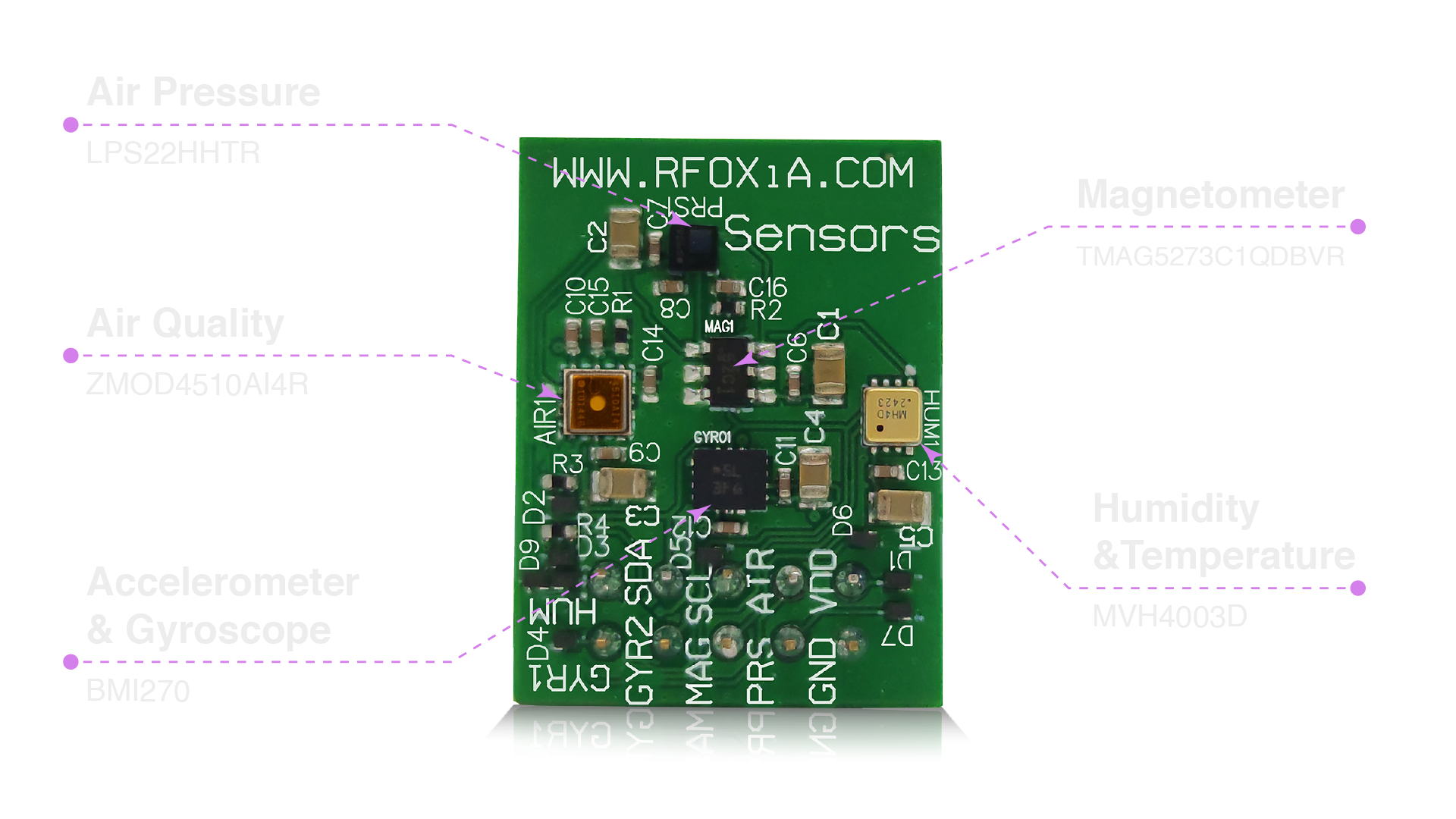
RFOXiA did not populate this board with generic, lowest-cost ICs. Each sensor is a professional-grade component from a tier-one manufacturer. Here is what is under the hood.
Accelerometer and Gyroscope: Bosch Sensortec BMI270
The BMI270 is Bosch's flagship IMU for performance-critical applications. It is the same family of sensors used in professional drone flight controllers and advanced robotics platforms. It delivers low-noise, high-dynamic-range motion data with integrated noise filtering — critical for applications where vibration from motors or mechanical systems would otherwise corrupt your readings.
For FPV pilots and drone builders, an IMU of this caliber is not optional. Cheap sensors drift. They introduce lag. The BMI270 does not.
Magnetometer: Texas Instruments TMAG5273C1QDBVR
Texas Instruments' TMAG5273 is a high-precision 3-axis hall-effect sensor designed for reliable heading and compass data even in electrically noisy environments. When your platform is surrounded by motor drivers, ESCs, and power cables — all of which generate magnetic interference — you need a magnetometer with the robustness to filter signal from noise. The TMAG5273 delivers that.
Air Pressure: STMicroelectronics LPS22HHTR
The LPS22HH from ST is a water-resistant, low-power barometric pressure sensor capable of detecting altitude changes as small as a few centimeters. For drones operating in variable atmospheric conditions, and for environmental monitors that need to correlate air quality data with altitude, this is the right component.
Humidity and Temperature: MEMSVision MVH4003D
MEMSVision's MVH4003D delivers accurate relative humidity and temperature readings in a tiny footprint. For environmental monitoring applications — agriculture, weather stations, smart building systems — accurate humidity and temperature are the foundational data points. This sensor provides both from a single IC.
Air Quality: Renesas ZMOD4510AI4R
The ZMOD4510 from Renesas is specifically designed for outdoor air quality monitoring. It detects ozone and nitrogen dioxide — the primary pollutants in outdoor urban environments — and outputs a calibrated air quality index. This is the sensor that enables participation in RFOXiA's data network, where verified outdoor environmental data earns daily rewards.
Precision Motion and Environmental Sensing in One Package
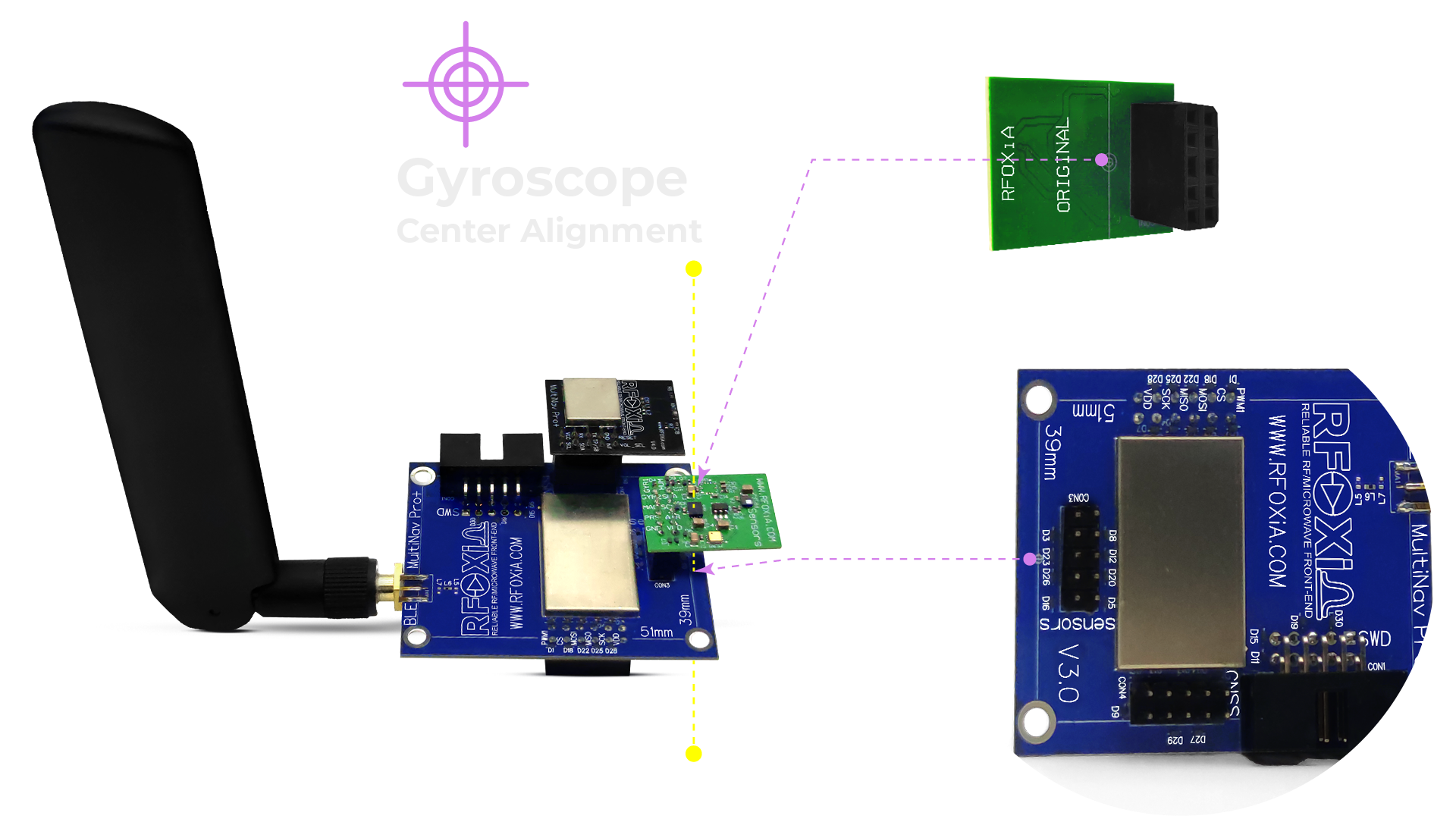
The combination of motion sensing and environmental sensing in a single module is genuinely unusual. Most products in this space specialize in one or the other. Environmental monitor breakouts give you temperature and humidity but nothing for orientation. IMU modules give you motion data but no environmental context.
The MultiNav Pro+ Sensors Module gives you both simultaneously, which opens up application categories that neither category could serve alone:
- A drone that logs GPS position, orientation, altitude, and air quality simultaneously — creating a georeferenced environmental dataset during every flight
- A weather balloon payload that tracks its own motion, orientation, and atmospheric conditions without multiple separate boards
- An autonomous vehicle that uses barometric pressure for altitude hold and air quality data for environmental reporting as a secondary function
- A wearable field instrument for researchers that tracks both the researcher's movement and the surrounding environmental conditions
This is what an integrated platform approach enables that piecemeal sourcing cannot.
I2C Architecture: Elegant Engineering, Practical Benefits
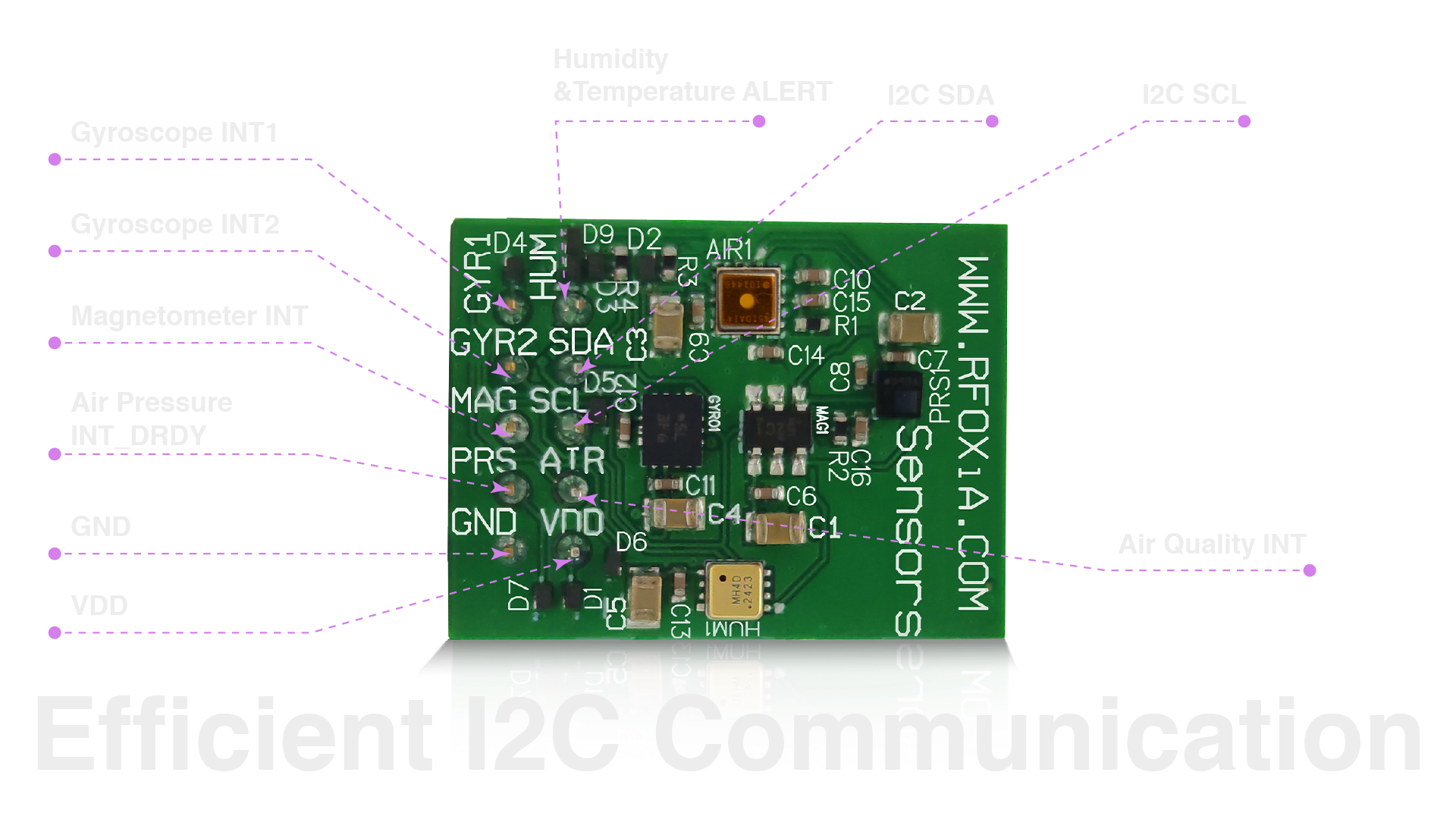
One of the most important engineering decisions on the MultiNav Pro+ Sensors Module is the I2C implementation. All seven sensors share a single I2C bus. Each sensor has a dedicated, unique address. There are no address conflicts, no multiplexer required, no custom address remapping in firmware.
This matters for several reasons.
Simplified wiring. Your MCU connects to the module with four wires: VCC, GND, SDA, SCL. That is it. All seven sensors are accessible through that single connection.
Firmware simplicity. When sensors share a bus with dedicated addresses, you initialize the bus once and address each sensor individually. There is no switching logic, no timing gymnastics, no bus contention to manage.
Reliability. Fewer connections mean fewer failure points. In field deployments where vibration, temperature cycling, and mechanical stress are real concerns, simplicity is reliability.
For any maker who has wrestled with I2C multiplexers to resolve address conflicts across a multi-sensor build, this alone is worth the price of the module.
The Size Advantage: 24mm × 18mm
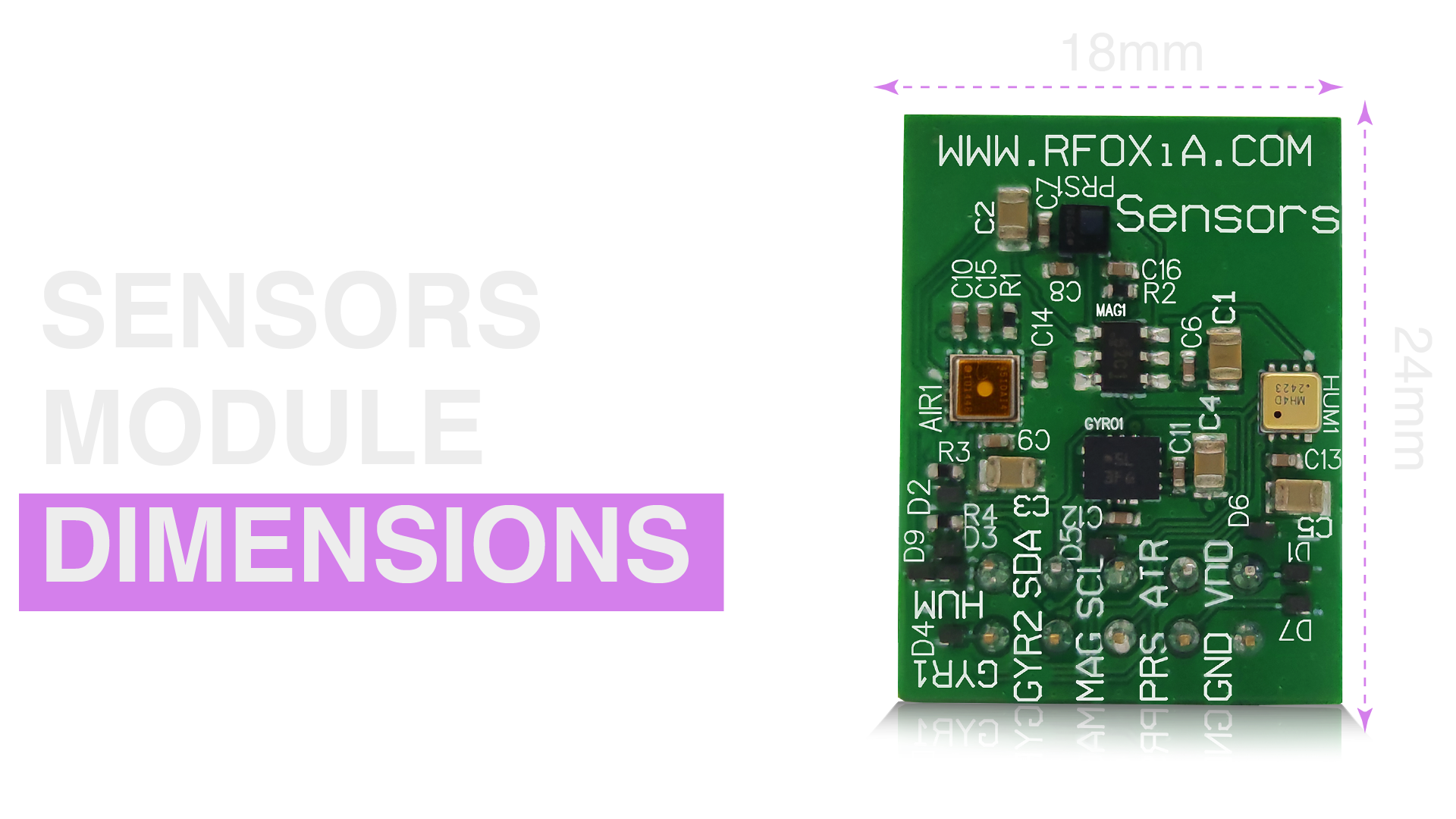
At 24mm × 18mm, the MultiNav Pro+ Sensors Module is genuinely compact. To put that in context, a standard business card is 85mm × 55mm. This module fits on a business card with room to spare — and it contains seven sensors.
For drone builders, every gram and every cubic centimeter of volume is a budget. Replacing five or six individual breakout boards with a single 24mm × 18mm module is not just convenient — it is the difference between a build that is feasible and one that is not.
For wearable applications, compact form factor is similarly non-negotiable. A sensor assembly that needs to be worn on the body, integrated into a garment, or embedded in a helmet cannot be a cluster of breakout boards.
For sealed IoT enclosures — weather stations, remote environmental monitors, agricultural sensors — a compact, single-board solution simplifies enclosure design and reduces the risk of mechanical failure from vibration or thermal cycling.
Real-Time Environmental Data: What It Enables
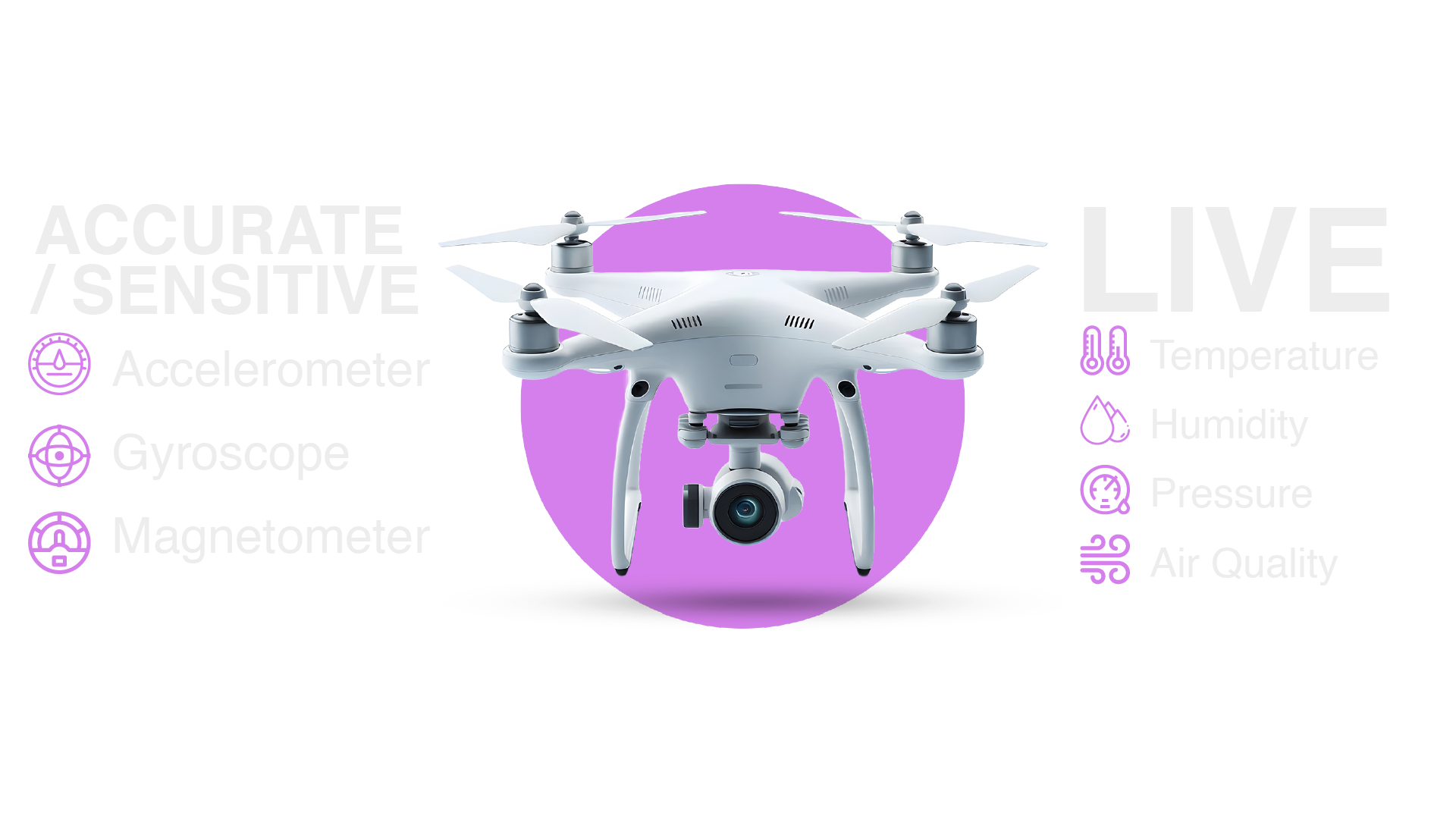
Environmental data at real-time update rates unlocks reactive systems that static or low-frequency data cannot support. With the MultiNav Pro+ Sensors Module streaming live readings, your platform can:
- Adjust flight behavior in response to real-time barometric pressure changes
- Trigger alerts when air quality index crosses a threshold
- Log correlated motion and environmental data for post-flight analysis
- Feed live sensor data into the RFOXiA Connect app for visualization on a live map dashboard
- Contribute to the RFOXiA data network and earn daily rewards for verified environmental data
That last point deserves emphasis. When you pair the Sensors Module with the RFOXiA GNSS Module and deploy your node outdoors, you can contribute GPS-verified environmental data to RFOXiA's commercial data network. Verified nodes earn between $0.08 and $0.40 per day, depending on location scarcity, data completeness, and network tier. Your hardware works for you while you are not using it.
Sensor Module Comparison for Makers: MultiNav Pro+ vs. the Alternatives
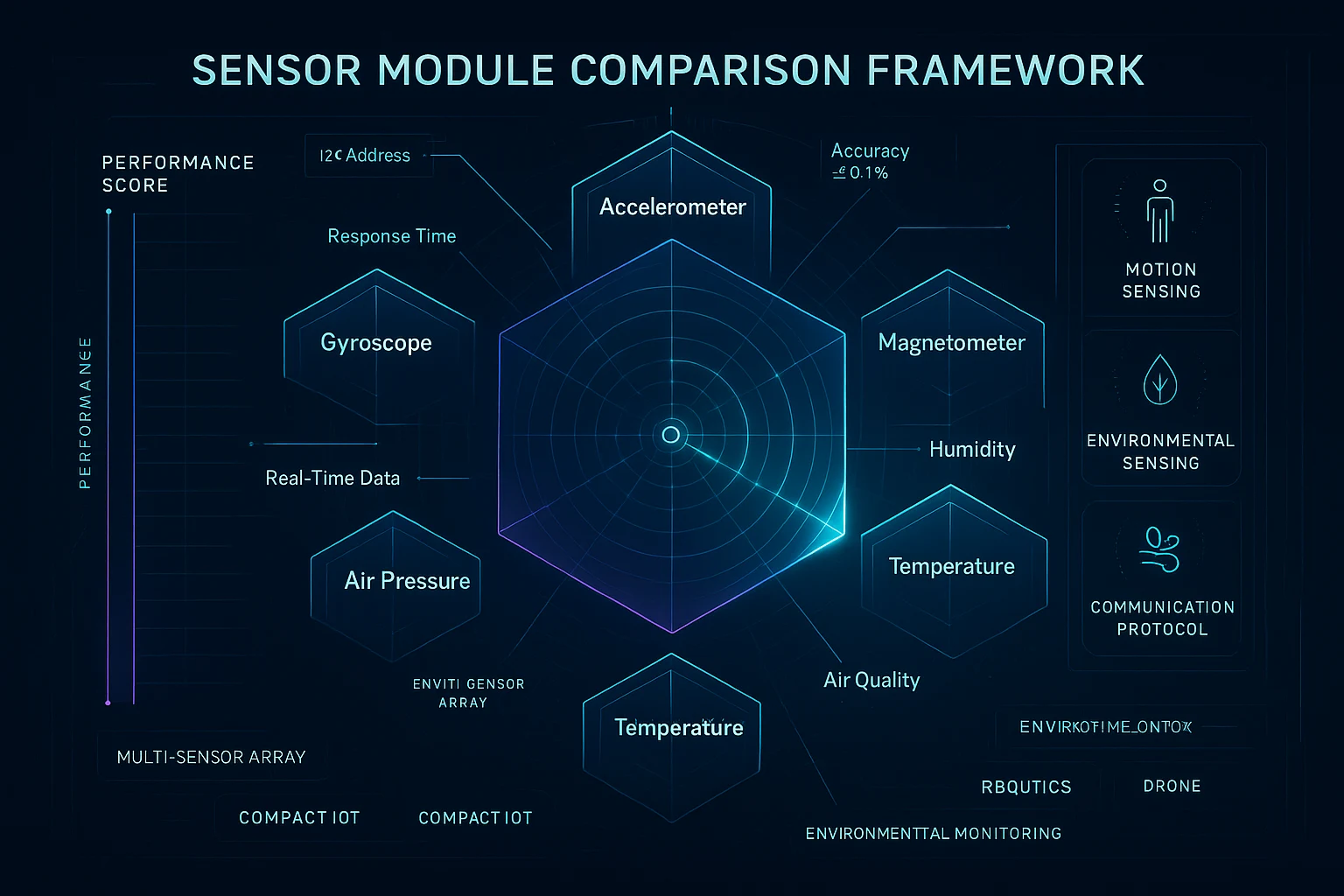
When you do a genuine sensor module comparison for makers, the MultiNav Pro+ Sensors Module sits in a category of its own. Let us look at the comparison honestly.
| Criteria | Individual Breakouts | Generic All-in-One Boards | MultiNav Pro+ Sensors Module |
|---|---|---|---|
| Sensor count | 1 per board | 3-4 typically | 7 |
| Component quality | Varies | Low-to-mid tier | Tier-1 (Bosch, TI, ST, Renesas) |
| I2C conflicts | Common | Common | None — pre-resolved |
| Form factor | Large (multiple boards) | Medium | 24mm × 18mm |
| FCC certification | No | No | Yes |
| Ecosystem integration | None | None | Full RFOXiA platform |
| Data network access | No | No | Yes |
| Price for equivalent coverage | $80-150+ | $25-40 | $39 |
The FCC certification point deserves special attention. If you are building a product that you intend to sell, deploy commercially, or operate in environments where compliance matters, FCC certification on your sensor module is not optional — it is mandatory. The MultiNav Pro+ Sensors Module is FCC certified. Most breakout boards and generic all-in-one boards are not.
Applications: Where the MultiNav Pro+ Sensors Module Excels

The range of applications where this module is the right answer is broad. Here are the categories where it consistently outperforms any alternative approach.
Professional Drone Builds
Motion sensing for stabilization. Barometric altitude hold. Real-time air quality logging during survey flights. All from a single module that weighs almost nothing and does not compete for mounting space.
Robotics and Autonomous Vehicles
Orientation and heading for navigation. Environmental data for situational awareness. Compact enough to integrate into tight chassis designs without compromising structural integrity.
Environmental Research and Field Instruments
Researchers deploying field instruments need compact, multi-parameter sensors that can be left in the field without complex maintenance. The MultiNav Pro+ Sensors Module provides seven research-grade data streams from a single sealed-enclosure-friendly board.
Smart Agriculture
Micro-climate monitoring at field scale. Temperature, humidity, air pressure, and air quality data at the crop level — not from a weather station kilometers away. When combined with the RFOXiA GNSS Module, every data point is GPS-tagged.
Smart City and Industrial IoT
Air quality networks, weather monitoring grids, HVAC optimization systems. Any application that needs dense, hyper-local environmental data at reasonable cost benefits from the economics and integration of the MultiNav Pro+.
Wearable Technology
Health monitoring, athletic performance tracking, occupational safety monitoring. Small enough to integrate into wearables, capable enough to deliver research-grade data.
RFOXiA Data Network Nodes
Deploy a MultiNav Pro+ Sensors Module with a GNSS Module outdoors, connect to the RFOXiA platform, and start earning daily rewards for verified environmental data. Passive income from hardware you already own.
The Ecosystem Advantage
The MultiNav Pro+ Sensors Module does not exist in isolation. It is one component of a vertically integrated ecosystem that includes:
- RFOXiA BLE Module — 5km ground-to-ground, 20km man-to-drone, 50km drone-to-drone long-range wireless connectivity
- RFOXiA GNSS Module — 1.5-meter accuracy, 18Hz fix rate precision location
- RFOXiA Power/Program Kit — supercapacitor-based power for 24-hour runtime from a 5-minute charge
- RFOXiA Connect App — live sensor data visualization, GPS map, drone and robot control interface
- RFOXiA Club — developer platform with AI firmware builder, Dev Hub community, and data network dashboard
When you choose the MultiNav Pro+ Sensors Module, you are not just buying a sensor board. You are entering an ecosystem where every component works together, where AI-generated firmware removes the integration burden, and where your deployed hardware can generate ongoing returns through the data network.
For makers who want to take one step further, the full RFOXiA Integrated Sensors Module is available as part of the Developer Bundle — combined with the BLE Module, GNSS Module, and Power/Program Kit at $199. If you are building anything serious in the wireless IoT space, that bundle represents extraordinary value.
Pricing and Availability
The MultiNav Pro+ Sensors Module is priced at $39 — a number that becomes even more striking when you calculate what you would spend sourcing equivalent sensors individually.
- BMI270 breakout (accelerometer/gyroscope): $15-20
- Magnetometer breakout: $10-15
- Barometric pressure breakout: $8-12
- Humidity/temperature breakout: $8-12
- Air quality sensor module: $25-40
Total for equivalent piecemeal coverage: approximately $66-99, before you account for the time cost of integration, firmware development, and the physical engineering challenge of mounting and wiring five separate boards.
The MultiNav Pro+ Sensors Module delivers all of that — with tier-1 components, FCC certification, and full ecosystem integration — for $39.
Inventory is currently available. Units are in stock and ship quickly.
Final Verdict: The Right Choice in Any Sensor Module Comparison for Makers
For any maker doing a real sensor module comparison, the conclusion is straightforward. If you need a single sensor for a specific, isolated task, individual breakouts are fine. But if you are building anything that requires environmental monitoring, motion sensing, or both — and especially if you are building something that needs to be compact, reliable, and potentially commercialized — the MultiNav Pro+ Sensors Module is the right choice.
Seven sensors. Tier-1 components. FCC certified. 24mm × 18mm. Full ecosystem integration. Data network access. $39.
There is no comparable product at this price that offers this combination.
Ready to stop piecing together sensor builds and start deploying something real? Explore the RFOXiA MultiNav Pro+ Sensors Module and join the RFOXiA Club for free — with $10 in welcome credits waiting for you.
RFOXiA is a Delaware-based hardware technology company building a vertically integrated wireless development ecosystem. All RFOXiA modules are FCC certified and available for immediate shipment.
Written by: Moamen Mohamed LinkedIn