
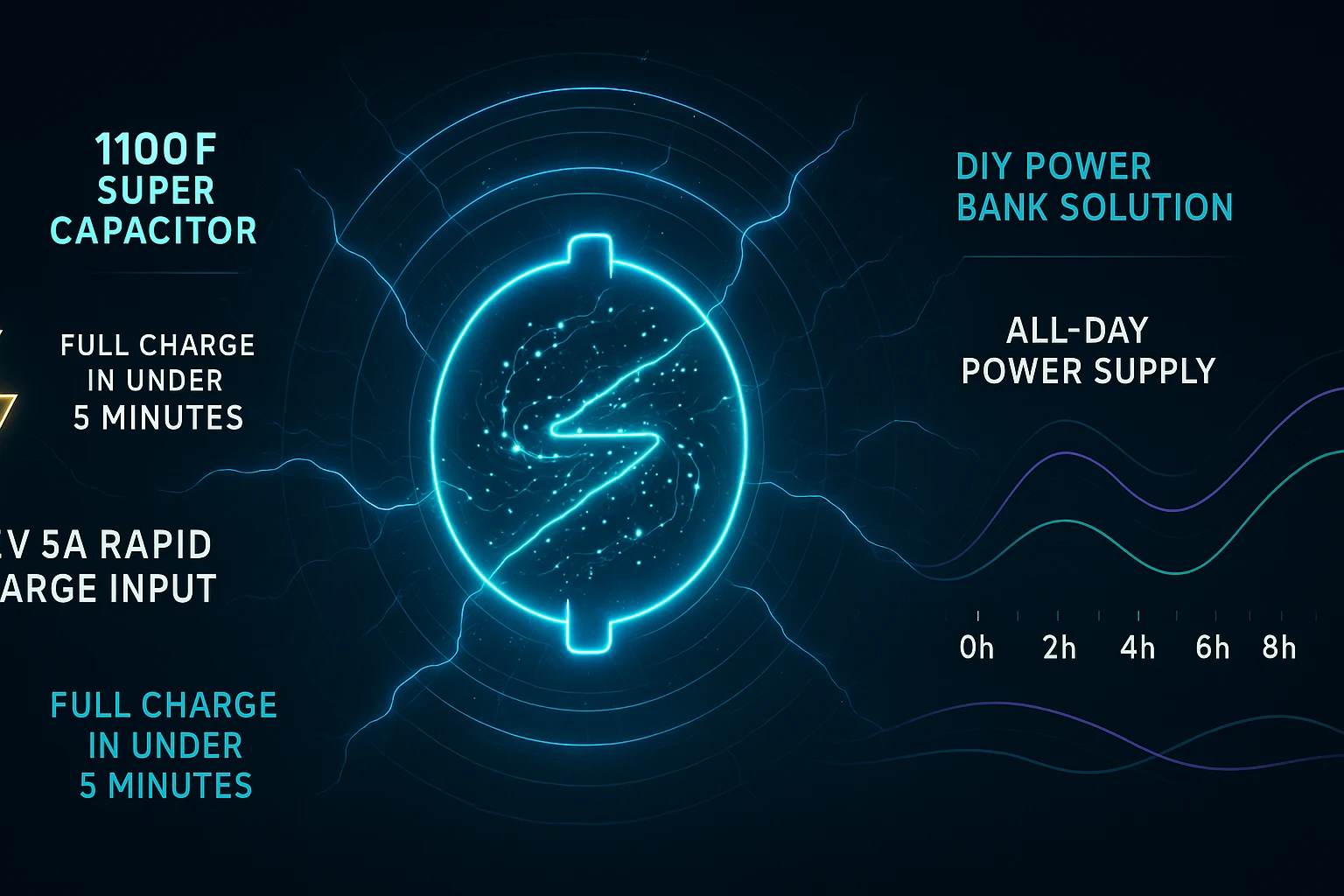
Supercap Power Bank DIY: The Professional Power Solution Every IoT Builder Needs
RFOXiA SuperCapacitor Battery and Programmer Kit
Why a Supercap Power Bank DIY Approach Changes Everything for Field Developers
If you've ever deployed a wireless sensor node in a remote location, run a drone control rig during a long field session, or spent hours debugging firmware only to watch your module die mid-session, you understand the single most underrated problem in hardware development: power management.
Batteries discharge unevenly. Lithium cells degrade over hundreds of cycles. Charge times eat into your working day. And most off-the-shelf power banks are built for smartphones — not for the precise, sustained, high-current demands of wireless IoT modules, GPS systems, and multi-sensor stacks.
This is exactly why the supercap power bank DIY concept has been gaining serious traction among embedded developers, drone builders, and field researchers. Supercapacitors — ultracapacitors capable of storing and releasing energy at rates no lithium cell can match — offer something fundamentally different: near-instant charging, virtually unlimited charge cycles, and consistent voltage delivery throughout the discharge curve.
The RFOXiA MultiNav Pro+ Power/Program Kit is the first commercially available, FCC-certified solution built around this principle — engineered specifically for the MultiNav Pro+ wireless ecosystem. It combines a massive 1100F supercapacitor energy storage system with an integrated STLink programmer, making it the only power solution on the market that also doubles as a professional firmware development tool.
Let's break down exactly what makes this kit the definitive supercap power bank DIY solution for serious hardware developers.
What Is a Supercapacitor Power Bank — And Why Should Developers Care?
A traditional lithium battery stores energy through an electrochemical reaction. That process introduces latency, heat, cycle degradation, and a discharge curve that droops as the battery empties. For smartphones, this is acceptable. For precision IoT hardware drawing regulated current across multiple active modules, it's a liability.
A supercapacitor stores energy electrostatically — in an electric field rather than through chemistry. The implications are significant:
- Charge rate is orders of magnitude faster — a supercapacitor can accept charge at the full rated current without damage
- No cycle degradation — supercapacitors tolerate hundreds of thousands of charge/discharge cycles
- Flat discharge curve — voltage stays consistent longer before dropping, which matters for sensitive RF and GNSS circuitry
- No thermal runaway — eliminates the fire risk associated with lithium cells in embedded applications
For the DIY developer building a supercap power bank, the challenge has historically been the engineering complexity: balancing cells, managing inrush current, designing appropriate charge circuitry, and ensuring consistent output regulation. The RFOXiA Power/Program Kit solves all of this in a single, ready-to-deploy package.
Inside the MultiNav Pro+ Power/Program Kit
The 1100F Supercapacitor Energy Storage System
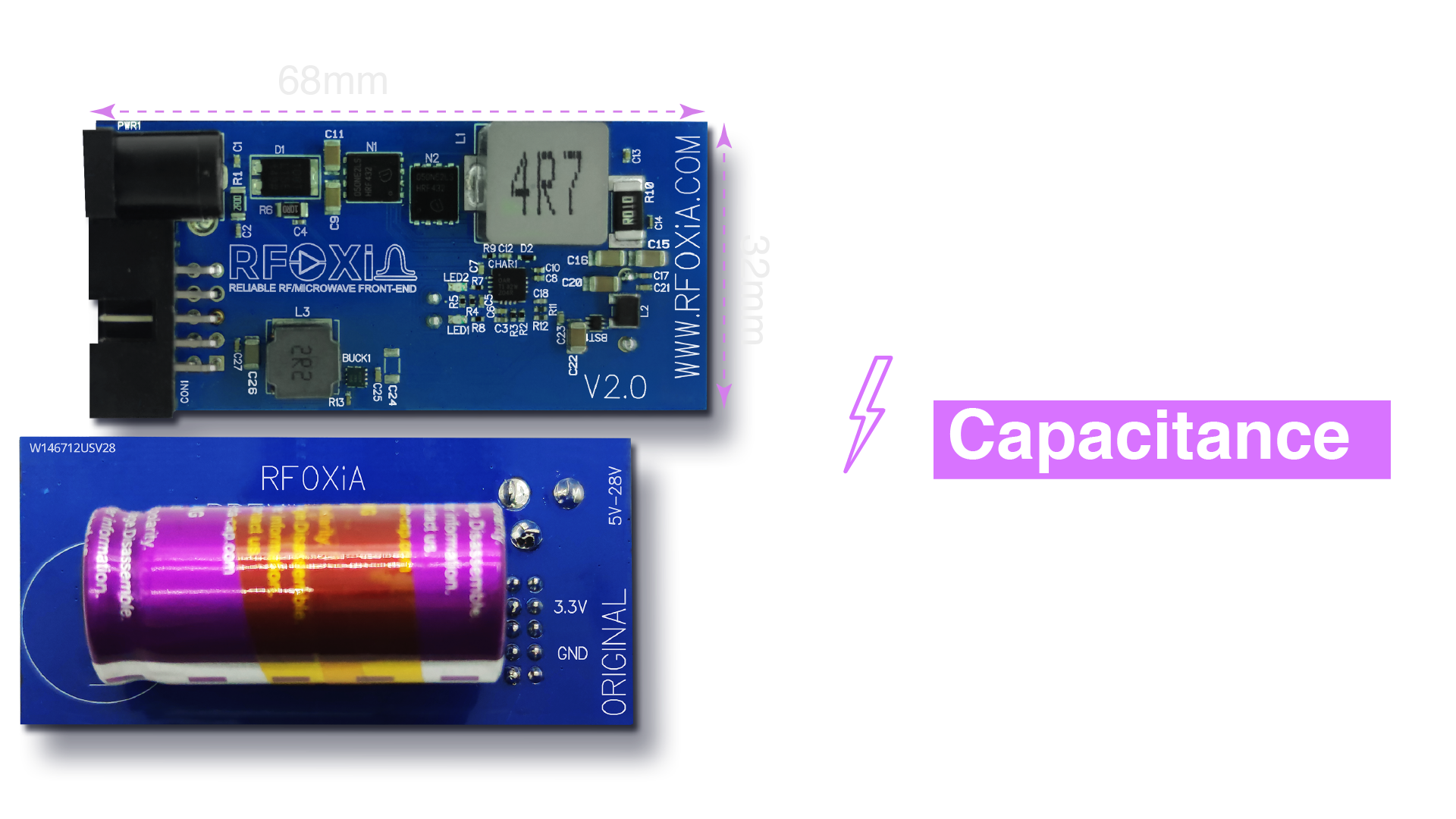
The heart of this kit is an 1100F supercapacitor system storing 8,800 Joules of energy. To put that into context: that is enough to power the complete MultiNav Pro+ module stack — BLE module, GNSS module, and Sensors module running simultaneously — for a full working day.
The numbers that matter most for field deployment:
- Capacity: 1100F
- Energy stored: 8,800 Joules
- Runtime: Full 24 hours powering the complete module stack
- Charge time: Under 5 minutes to full capacity
That last figure is worth pausing on. Five minutes. Not 45 minutes. Not 2 hours. Five minutes from dead to full charge. For field researchers, drone operators, and anyone running back-to-back test sessions, this is transformative. You are never waiting on your power supply.
This is the core value proposition of the supercap power bank DIY approach made real: eliminate battery downtime entirely. Charge between sessions during a coffee break. Swap contexts without swapping hardware. Keep your focus on your firmware and your field data — not on your power indicator.
High-Power Charging Adapter
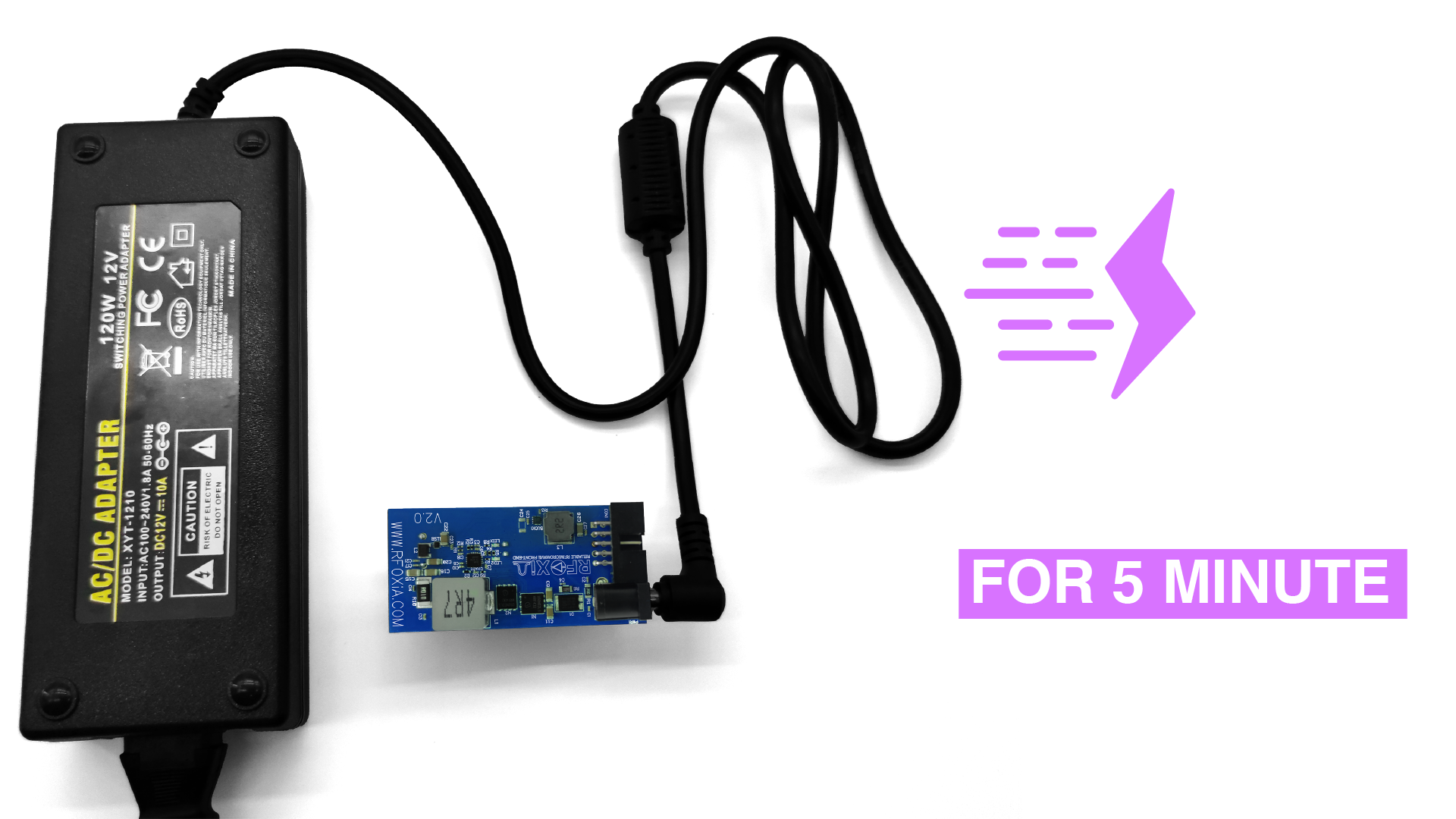
To charge an 1100F supercapacitor bank in under five minutes, you need serious charging current. The included 12V 5A high-power charging adapter delivers exactly that — charging the supercapacitor system at 4V 10A to achieve that sub-5-minute full charge.
This adapter is included in the kit because standard USB chargers and generic power adapters simply cannot move energy fast enough. Using an undersized charger would stretch charge times to 30-60 minutes — defeating the core advantage of supercapacitor technology.
The 12V 5A adapter is built to handle sustained high-current output without overheating, and the charging circuitry in the kit manages inrush current and cell balancing automatically. You plug in, and five minutes later you are fully charged. No configuration required.
Powers the Complete MultiNav Pro+ Module Stack for a Full Day
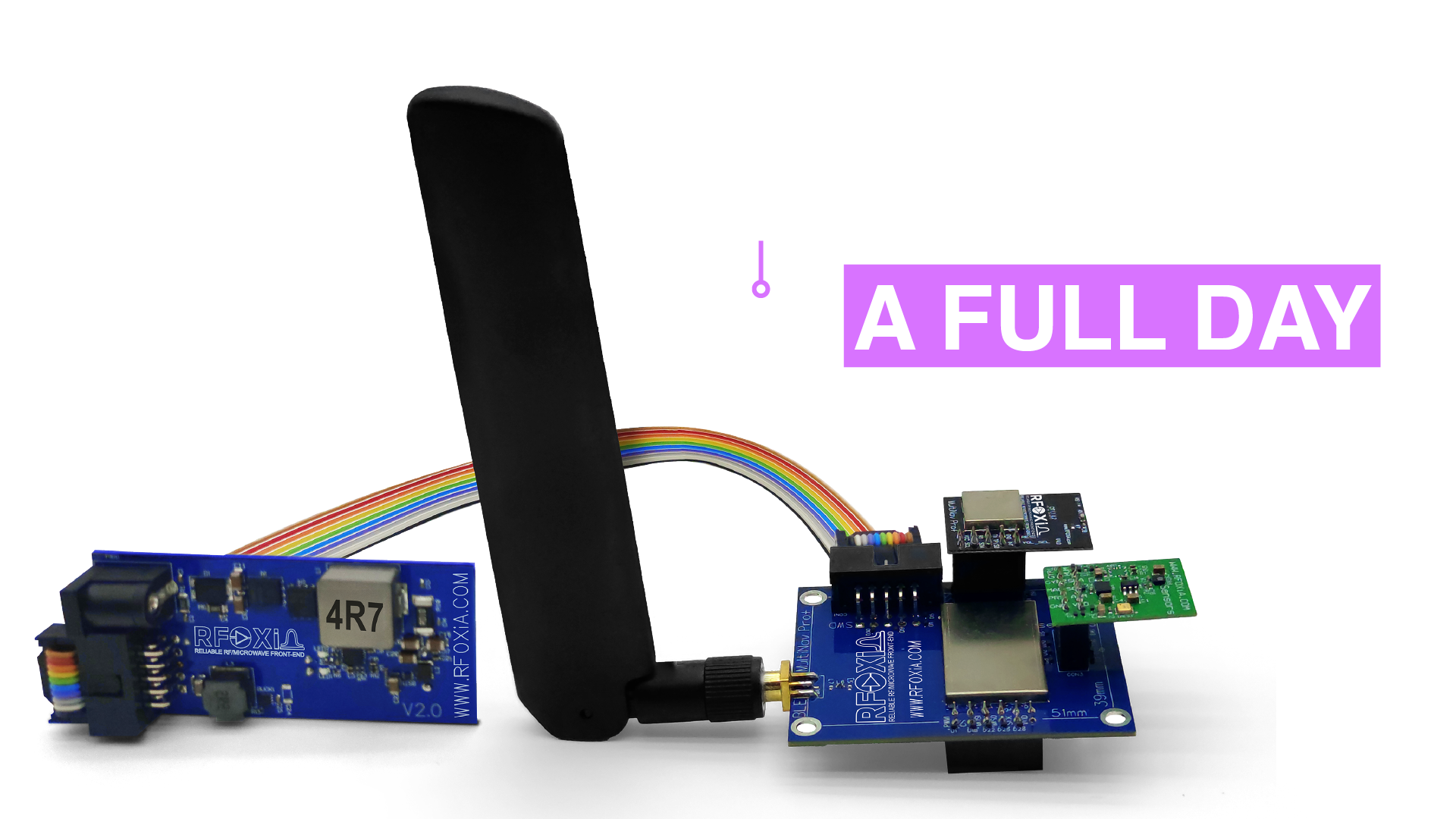
One of the most common misconceptions about supercapacitors is that their high power density comes at the expense of energy density — that they charge fast but discharge fast. For small-cell supercapacitors, that concern is valid. At the 1100F scale with 8,800 Joules of stored energy, the calculus changes entirely.
The RFOXiA Power/Program Kit is sized to power all four MultiNav Pro+ modules simultaneously for a complete working day:
- MultiNav Pro+ BLE Module (long-range Bluetooth, up to 20km man-to-drone)
- MultiNav Pro+ GNSS Module (18Hz precision GPS, 1.5m accuracy)
- MultiNav Pro+ Sensors Module (7 environmental sensors streaming live data)
Running all three modules together — a full wireless sensor node with long-range communication, precision positioning, and environmental monitoring — and the Power/Program Kit keeps it alive for 24 hours. This is not a lab specification. This is field-tested runtime for real-world deployment scenarios.
For developers contributing to the RFOXiA SuperCapacitor Battery and Programmer Kit ecosystem and running the Sensors Module as a data network node, this 24-hour runtime means your node streams verified environmental data continuously through an entire field deployment without intervention.
Integrated STLink Programmer
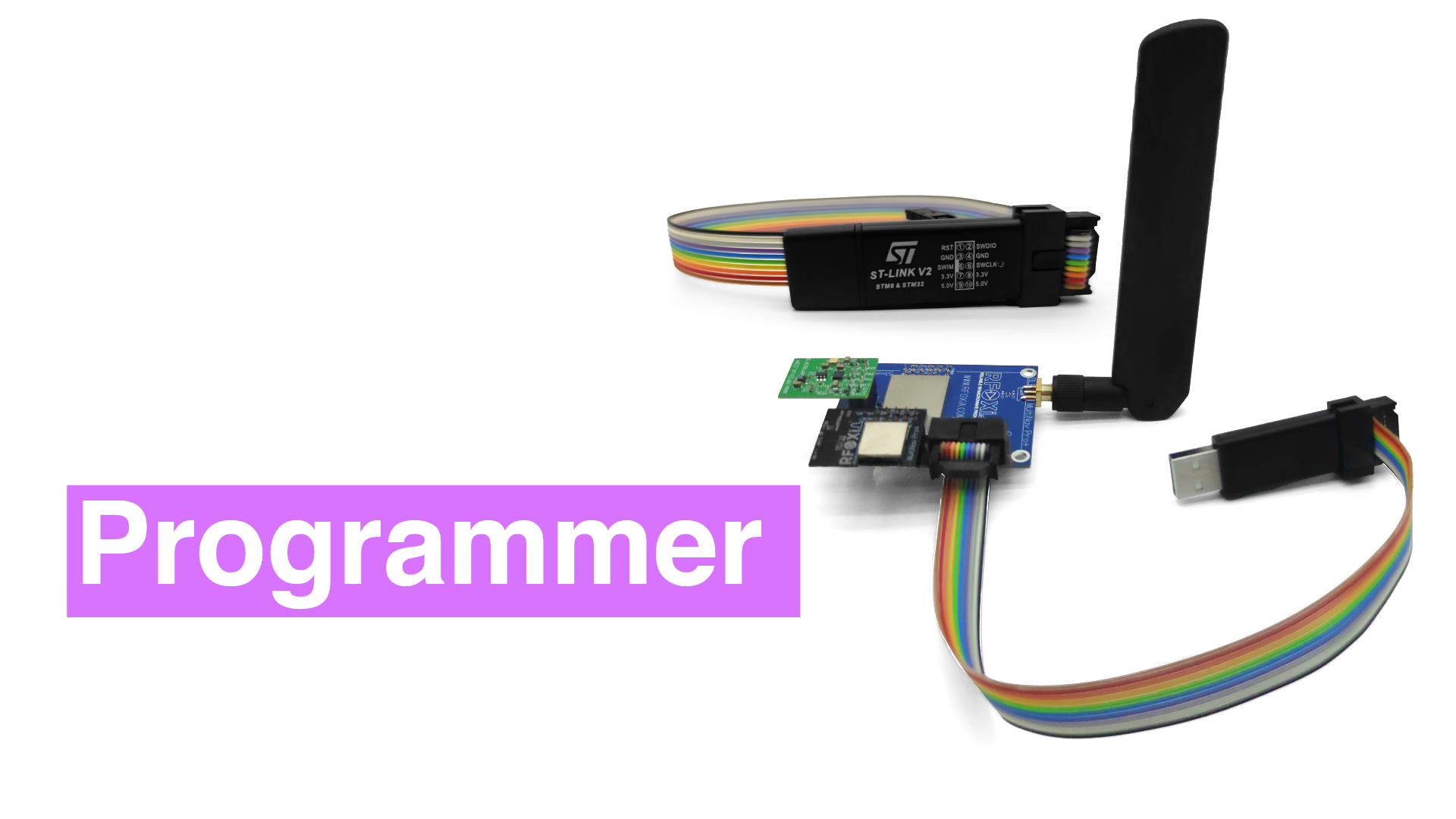
Here is where the Power/Program Kit separates itself from any other supercap power bank DIY solution on the market: it is not just a power supply. It is a complete development workstation for your MultiNav Pro+ BLE Module.
The integrated STLink programmer gives you:
- Direct firmware flashing — load new firmware onto the BLE module without removing it from your build
- Real-time debugging — step through code, inspect registers, set breakpoints
- Reliable firmware updates — production-grade programmer interface, not a USB-serial adapter workaround
- One-cable setup — flat ribbon cable connects programmer to BLE module directly
For developers using the RFOXiA Club AI Firmware Builder — the platform feature that generates complete, production-ready firmware from plain-language descriptions — the STLink programmer is the deployment bridge. You describe your application, the AI generates the firmware, and the STLink programmer flashes it directly to your BLE module. The entire loop from idea to running hardware takes hours, not weeks.
This integration matters because it removes a common friction point in embedded development: keeping your programmer, your power supply, and your target hardware synchronized during development sessions. The Power/Program Kit puts all three in one unit.
Complete Connectivity Kit
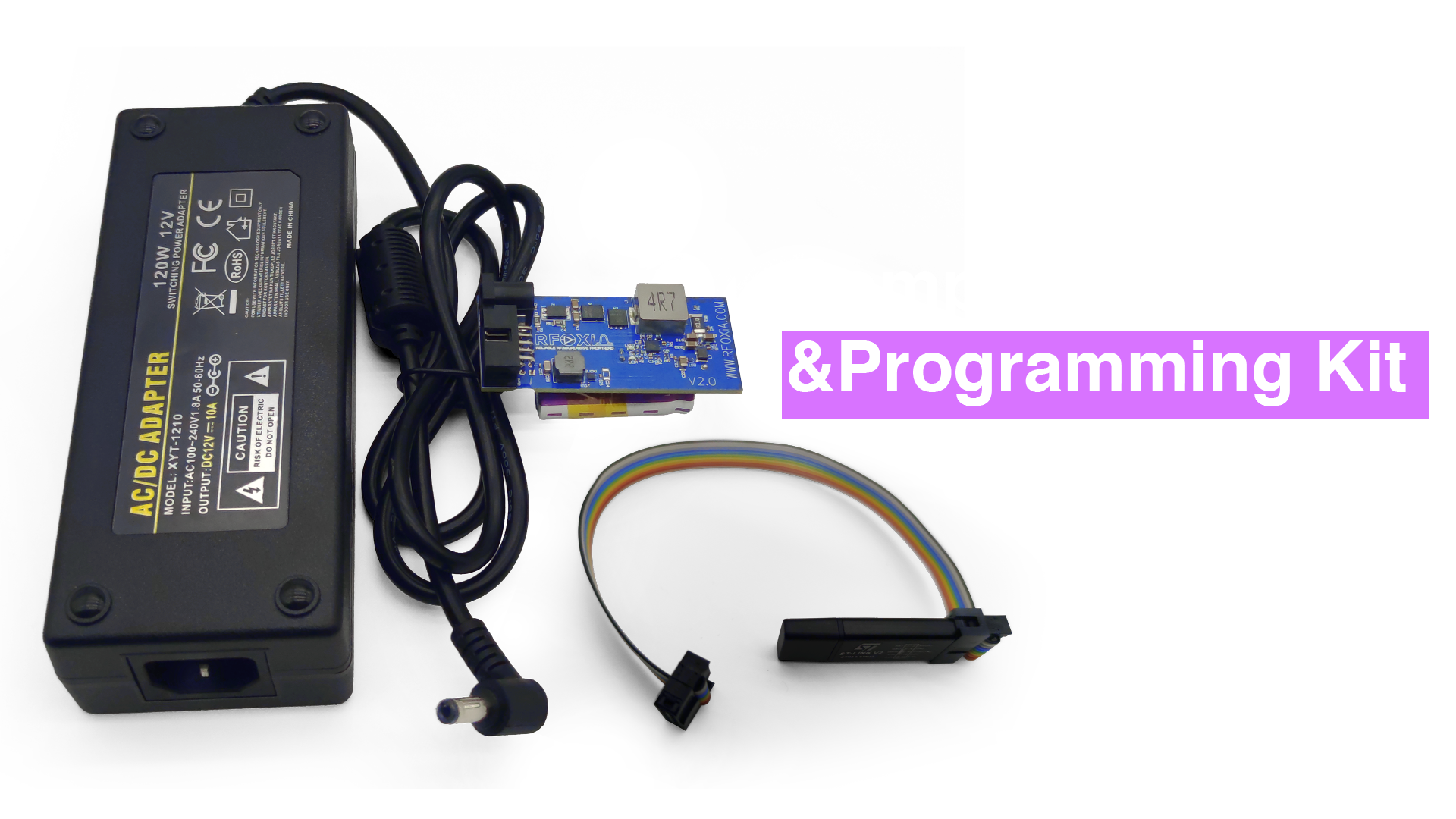
Every cable you need is in the box. The kit ships with:
- Flat ribbon cable for BLE module to power module connection
- Flat ribbon cable for STLink programmer to BLE module connection
- High-power charging cable for the 12V 5A adapter
No hunting for the right connector. No breadboard wire rats-nest holding your module to your programmer. Everything plugs together in a clean, organized configuration that keeps your development workspace — or your field deployment — looking like a professional build.
Why This Is the Right Supercap Power Bank DIY Solution for Serious Builders
There are ways to build a supercap power bank from scratch. You can source bare supercapacitor cells, design balancing circuitry, spec a charge controller, build a regulated output stage, and integrate a programmer separately. Many embedded engineers have done this. It takes weeks of design time, requires PCB fabrication, and the result is a one-off prototype that may or may not perform reliably in the field.
The MultiNav Pro+ Power/Program Kit delivers all of that engineering work, tested and certified, in a package that ships to your door at $119.
For context on what you are getting:
| What you'd need to DIY | Time required | Cost estimate |
|---|---|---|
| Supercapacitor cell sourcing and selection | 4-8 hours research | $30-60 for cells |
| Cell balancing circuit design | 8-16 hours | PCB fabrication costs |
| Charge controller circuit design | 8-12 hours | Components + PCB |
| Regulated output stage | 4-8 hours | Components |
| STLink programmer (separate) | Ready-made only | $20-40 |
| Cable harness fabrication | 2-4 hours | Materials |
| Testing and validation | 10-20 hours | — |
| Total | 36-68 hours | $150-300+ materials only |
The Power/Program Kit compresses that entire development cycle into a product you can unbox, connect, and deploy in under 15 minutes — with FCC certification already on the label.
Who Needs This Kit
Drone Builders and FPV Pilots
Running ground station equipment, telemetry modules, and RC control hardware through a long field session demands reliable power that doesn't introduce voltage sag as the supply depletes. The supercapacitor's flat discharge curve means your RF hardware sees consistent supply voltage from 100% to near-empty — no performance degradation mid-flight.
Field Researchers and Environmental Monitors
Deploying a remote sensor node for a 24-hour data collection session is only viable if the power system matches the deployment window. With 8,800 Joules and a 24-hour rated runtime, the Power/Program Kit is sized specifically for single-day field deployments. Charge it at camp in the morning, deploy, return at end of day, charge again in five minutes.
IoT Developers Building Wireless Infrastructure
For anyone building nodes that feed the RFOXiA data network — streaming GPS-verified environmental data and earning daily rewards — the Power/Program Kit is the professional-grade power solution that keeps your node online for the full reward window.
Embedded Firmware Developers
The STLink programmer integration makes this the only power supply on the market that is also a firmware development tool. If you are iterating on firmware with the AI Firmware Builder in RFOXiA Club, having your programmer and power supply in one unit eliminates the context-switching overhead of managing separate tools.
Technical Specifications Summary
| Specification | Value |
|---|---|
| Supercapacitor Capacity | 1100F |
| Stored Energy | 8,800 Joules |
| Charge Time | < 5 minutes |
| Runtime (full module stack) | 24 hours |
| Charging Adapter | 12V 5A |
| Charging Current to Supercap | 4V 10A |
| Programmer Interface | STLink |
| Compatible Modules | All MultiNav Pro+ Modules |
| Certification | FCC Certified |
| Price | $119 |
How the Power/Program Kit Fits Into the Full RFOXiA Ecosystem
The Power/Program Kit is included in the Developer Bundle — RFOXiA's complete ecosystem package combining the BLE Module, GNSS Module, Sensors Module, and Power/Program Kit in one integrated kit at $199.
For developers who want the full stack — long-range wireless communication up to 20km man-to-drone, precision GPS positioning at 18Hz, seven-sensor environmental monitoring, complete power management, and a firmware programmer — the Developer Bundle is the starting point. The Power/Program Kit is the component that makes all four modules field-deployable as a single professional unit.
If you already own the MultiNav Pro+ BLE Module and want to add professional power management and firmware programming capability to your existing setup, the RFOXiA SuperCapacitor Battery and Programmer Kit is available as a standalone purchase.
Get Started: Your Supercap Power Bank DIY Solution Is Ready to Ship
The MultiNav Pro+ Power/Program Kit is in stock, FCC certified, and ready to ship. With 140 units available and demand growing from drone builders, IoT developers, and field researchers discovering that supercapacitor power technology is no longer exclusive to high-budget military and industrial applications, inventory moves.
This is what the supercap power bank DIY concept looks like when it ships as a finished, tested, certified product: five-minute charge times, 24-hour field runtime, integrated firmware programmer, every cable included, $119.
Visit the RFOXiA SuperCapacitor Battery and Programmer Kit product page to order or to explore bundle options with the complete MultiNav Pro+ module ecosystem.
If you are not yet a member of RFOXiA Club, signing up is free and comes with a $10 welcome credit toward your first order. The Club gives you access to the AI Firmware Builder, the developer community, live data streaming sessions, and the full RFOXiA ecosystem — no hardware required to start.
Stop waiting for your power supply to charge. Five minutes is all it takes.
Written by: Moamen Mohamed LinkedIn