
Supercapacitor Balancing Circuit: The Engineering Behind 5-Minute Charging and 24-Hour Runtime
RFOXiA SuperCapacitor Battery and Programmer Kit
Why the Supercapacitor Balancing Circuit Changes Everything for Hardware Developers
If you have ever been deep in a field deployment — drone in the air, sensor array streaming, data flowing — and watched your power system fail, you know exactly what is at stake. Battery downtime is not just an inconvenience. It is a project killer. And for engineers building serious wireless systems, the power layer is just as critical as the RF layer.
That is the problem RFOXiA set out to solve with the MultiNav Pro+ Power/Program Kit. At its core is a carefully engineered supercapacitor balancing circuit that enables something previously unavailable at this price point: a full charge in under 5 minutes and a verified 24-hour runtime powering the entire MultiNav Pro+ module stack.
This post breaks down what a supercapacitor balancing circuit actually is, why it matters for your builds, how RFOXiA implemented it in the Power/Program Kit, and why this approach is fundamentally superior to lithium battery systems for high-demand wireless development work.
What Is a Supercapacitor Balancing Circuit?
Before diving into the product, it is worth understanding the underlying technology — because supercapacitors behave very differently from the lithium cells most developers are used to.
Supercapacitors vs. Batteries: The Core Difference
A standard lithium battery stores energy through electrochemical reactions. Charge and discharge cycles physically stress the chemistry of the cell. This is why lithium batteries degrade over hundreds of cycles, why they can be dangerous when overcharged, and why fast charging generates significant heat and long-term damage.
A supercapacitor — also called an ultracapacitor or electric double-layer capacitor (EDLC) — stores energy electrostatically, not chemically. There is no reaction happening. Ions accumulate on the surface of activated carbon electrodes separated by an electrolyte. Because there is no chemical transformation, supercapacitors can:
- Accept charge at extremely high rates without degradation
- Deliver charge at high burst currents without damage
- Operate for hundreds of thousands of cycles with minimal capacity loss
- Function across a much wider temperature range than lithium cells
The trade-off is energy density. Per unit volume, a supercapacitor stores less energy than a lithium cell. This is why supercapacitors have historically been used as buffer elements rather than primary storage — absorbing regenerative braking energy in EVs, handling startup current spikes in industrial equipment, and providing backup power for memory retention.
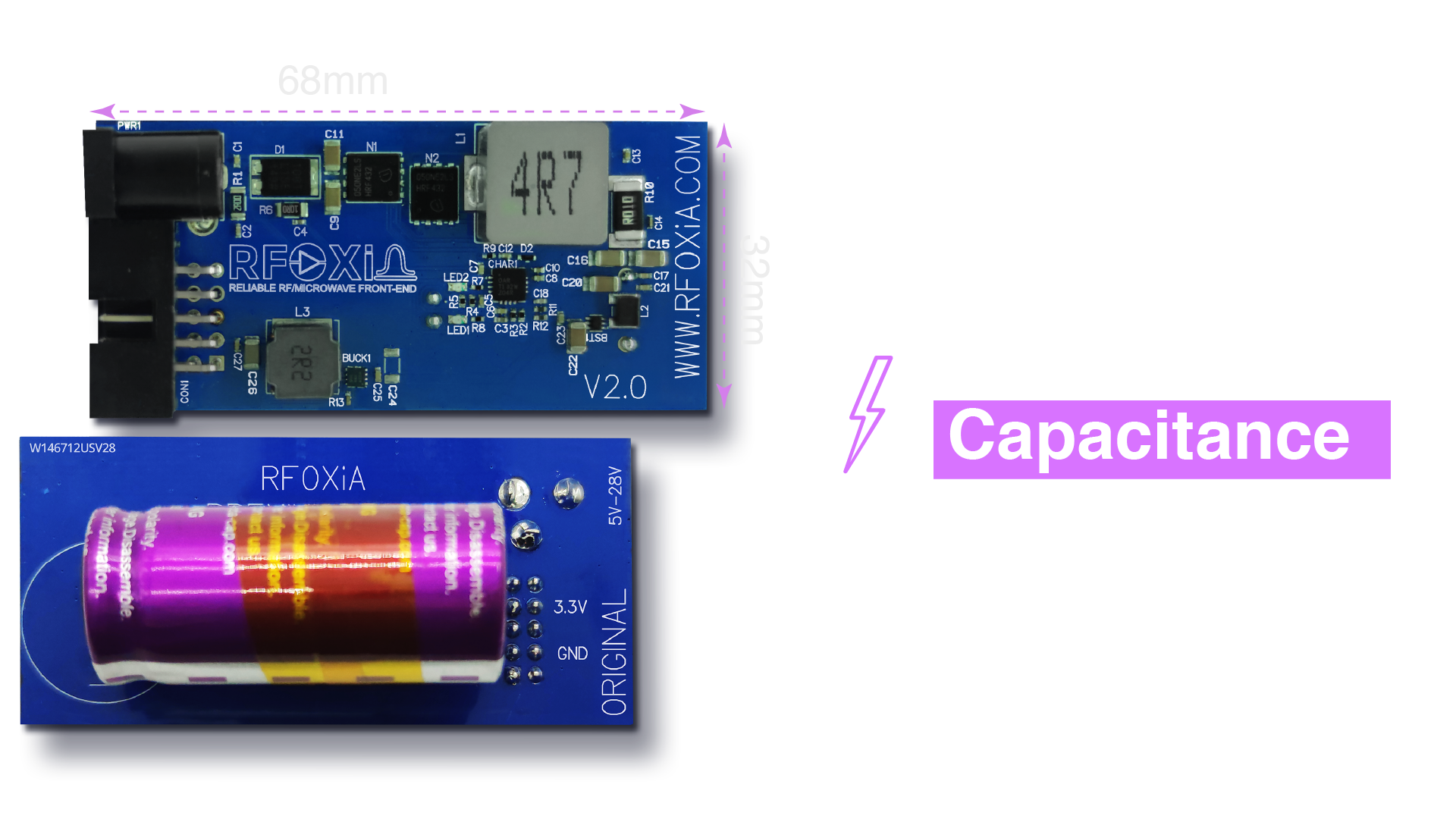
But with sufficiently large capacitance values, supercapacitors can serve as primary storage for low-to-medium power electronics. The RFOXiA Power/Program Kit uses an 1100F supercapacitor system that stores 8,800 Joules — enough energy to run the complete MultiNav Pro+ module ecosystem for a full working day.
Why Balancing Matters
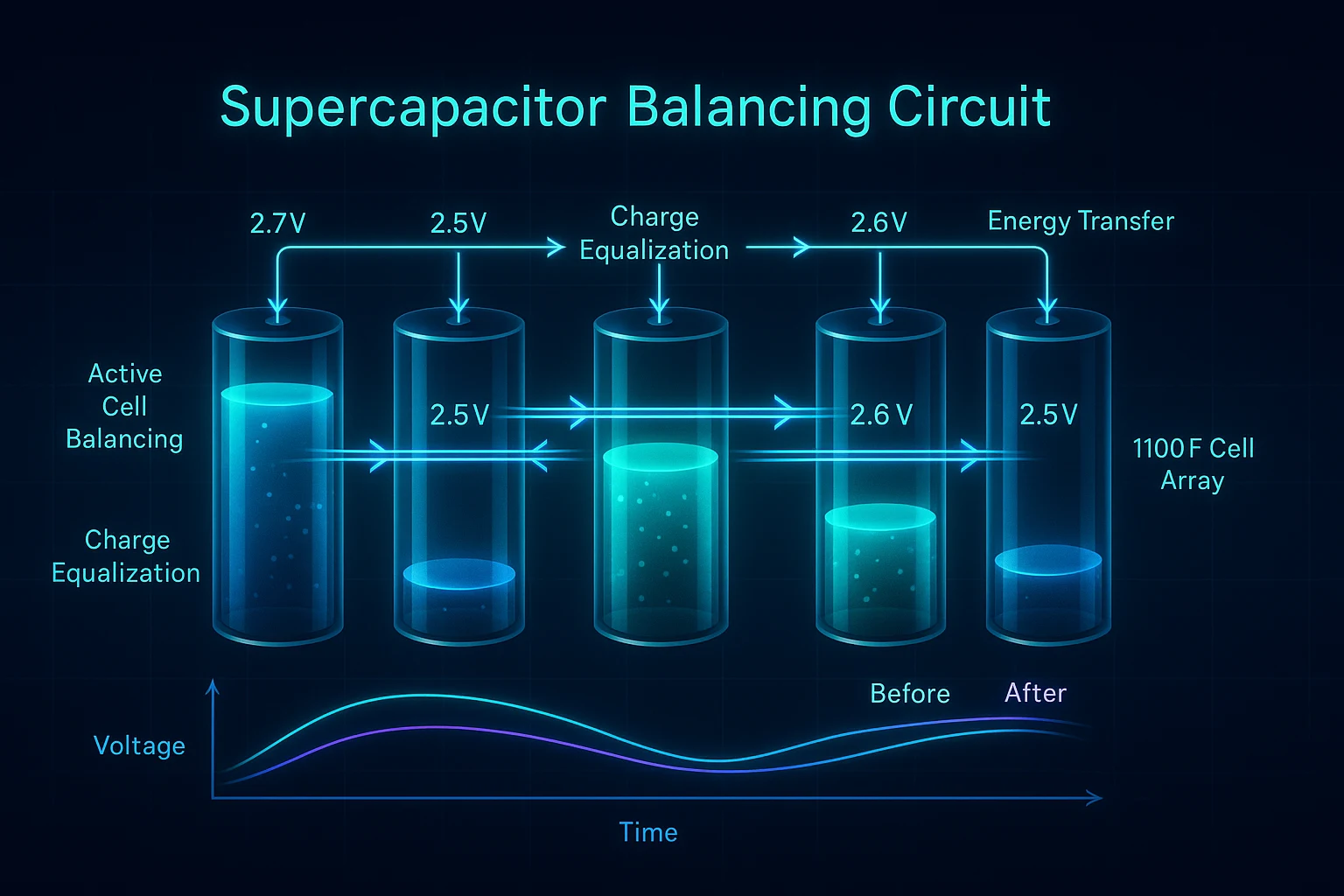
Here is where the engineering becomes non-trivial. Supercapacitors in series — which is required to reach usable voltage levels, since individual cells typically max out at 2.7V — do not balance themselves. Due to manufacturing tolerances, temperature variations, and self-discharge differences, individual cells in a series stack will develop different voltage levels over time.
If one cell charges faster than its neighbors, it will exceed its rated voltage while others remain undercharged. Overvoltage on a supercapacitor accelerates electrolyte degradation and can cause catastrophic failure. Undercharged cells mean the system never reaches full capacity.
A supercapacitor balancing circuit solves this by actively or passively redistributing charge across series-connected cells to keep each one within its rated voltage window. This is not optional engineering — it is the difference between a supercapacitor system that performs reliably for years and one that degrades rapidly or fails dangerously.
There are two primary approaches:
Passive balancing uses resistors in parallel with each cell to bleed excess voltage. Simple and low-cost, but inefficient — energy is wasted as heat.
Active balancing uses switched-capacitor or inductor-based circuits to transfer charge between cells rather than dissipating it. More complex and more expensive, but dramatically more efficient — critical for a system where charge time is a key specification.
The RFOXiA implementation achieves sub-5-minute full charge at 4V / 10A input, which requires an active balancing approach. Passive balancing at that charge rate would generate unacceptable heat and waste significant energy.
The MultiNav Pro+ Power/Program Kit: Full Technical Breakdown
The 1100F Supercapacitor System
The headline specification is 1100 farads of total capacitance storing 8,800 joules of energy. To put that in context: a standard 18650 lithium cell at 3,000mAh and 3.7V stores approximately 40,000 joules — but it takes 1-2 hours to charge and degrades measurably over 500 cycles. The supercapacitor system stores less absolute energy, but it charges in under 5 minutes and will outlast the hardware it powers by orders of magnitude in cycle count.
For field hardware developers, this trade-off is overwhelmingly positive. You are not looking to power a laptop for eight hours. You are powering a wireless embedded system — the MultiNav Pro+ BLE Module, GNSS module, and sensors module — at a combined current draw that the 8,800J system handles comfortably for a full working day.
The supercapacitor balancing circuit integrated into the power module ensures each cell in the stack charges uniformly and stays within its rated voltage window throughout the charge and discharge cycle. This is what makes the 5-minute charge rate safe and repeatable, not just a one-time demonstration.
The High-Power Charging Adapter
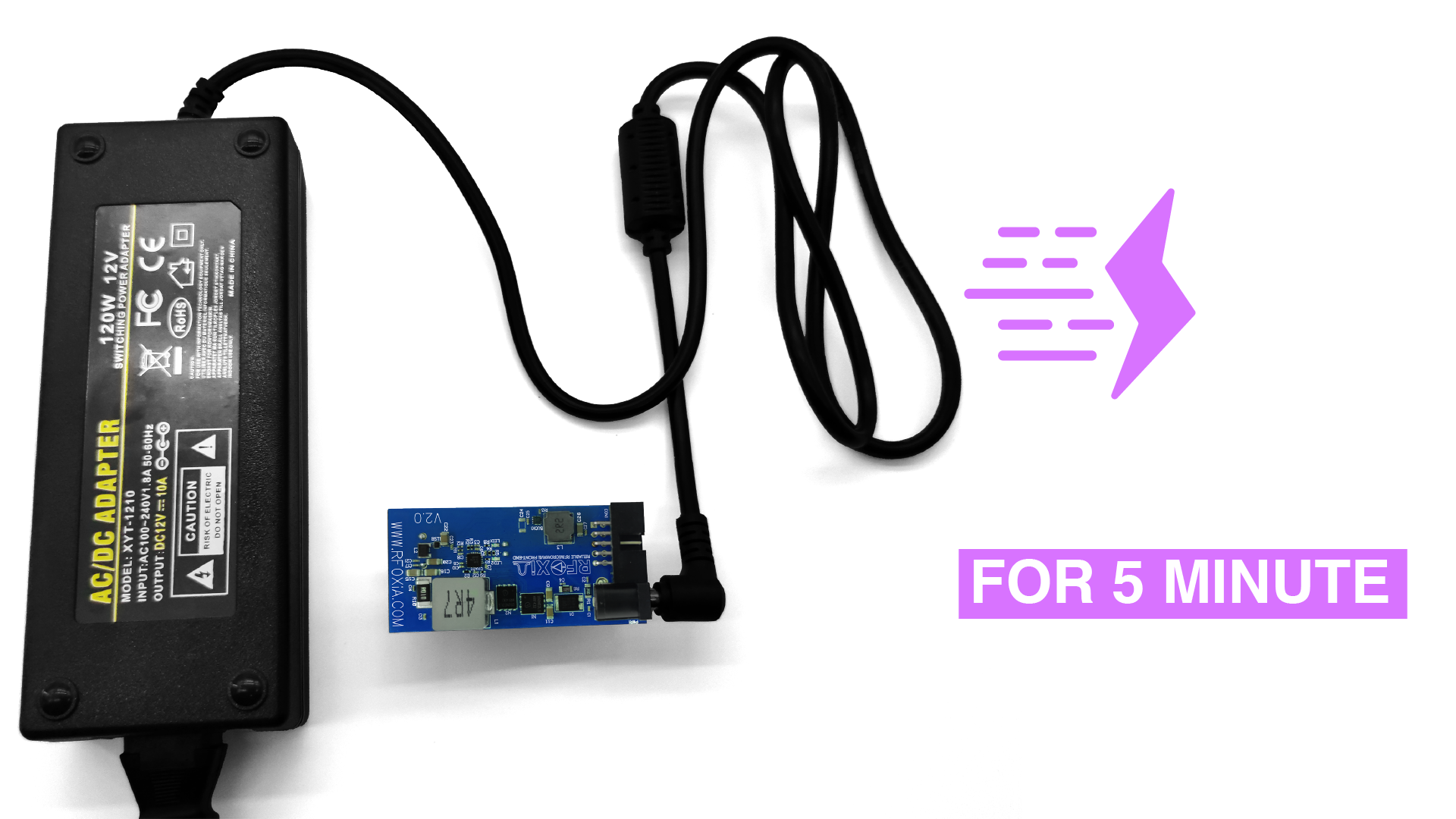
The included 12V 5A adapter provides the input power to the charging circuit, which steps down and regulates the current to the supercapacitor stack at 4V / 10A. This high-current charging profile is what enables the sub-5-minute charge time.
For comparison: most USB-C fast chargers deliver 5V at 3A maximum to the device. The RFOXiA charging circuit delivers more than three times that current directly into the supercapacitor stack. This is possible because supercapacitors, unlike lithium cells, do not experience thermal runaway or accelerated degradation under high charge currents when the balancing circuit is operating correctly.
The practical implication for your workflow is significant. If you are running a field survey, a drone test flight, or a multi-hour data collection session, a depleted power module is a 5-minute break — not a 90-minute wait. This fundamentally changes how you plan field operations.
Powering the Full Module Stack
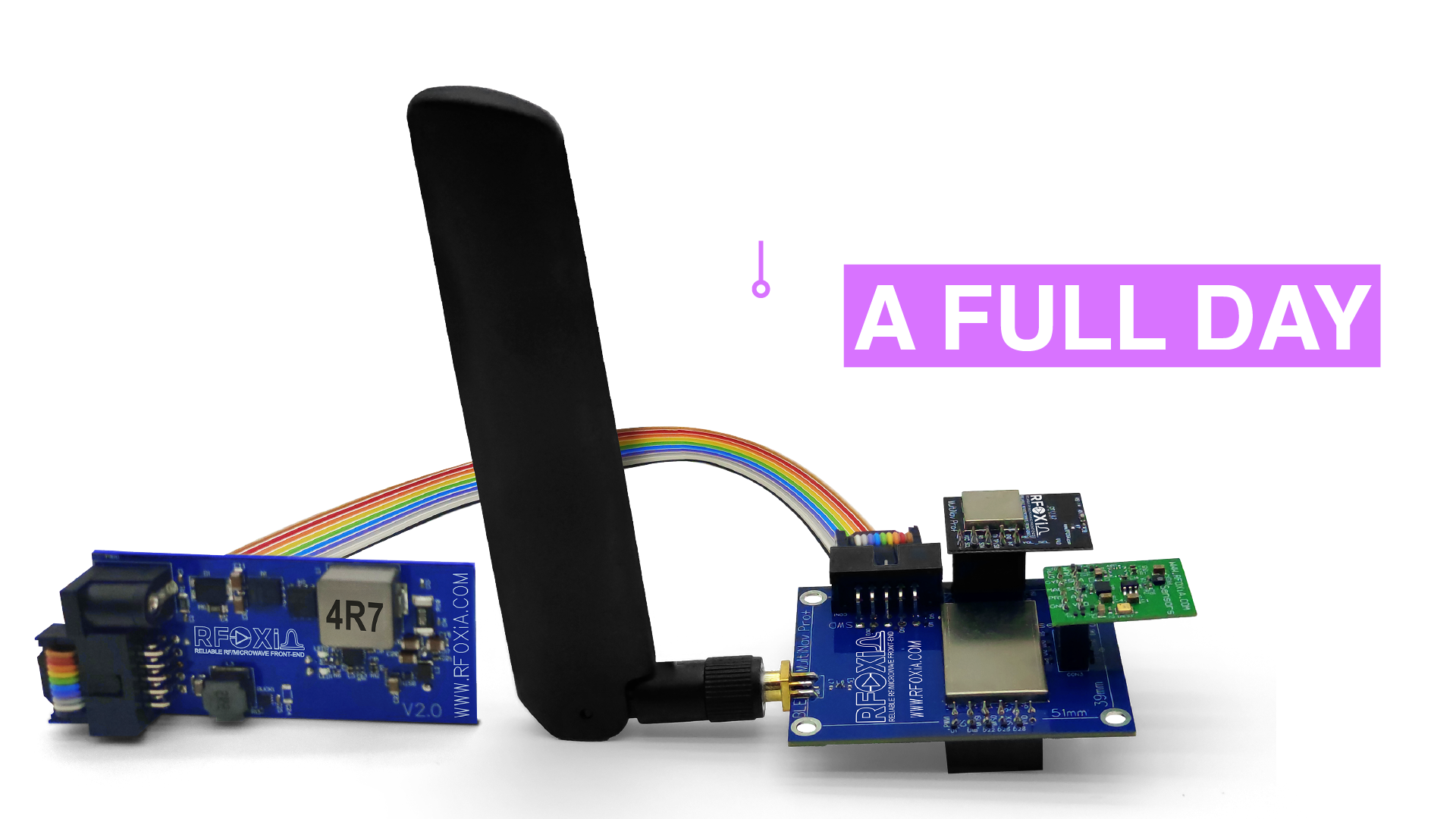
The Power/Program Kit is not designed to power just the BLE module in isolation. It is sized and rated to power the complete MultiNav Pro+ ecosystem — BLE module, GNSS module, and sensors module simultaneously — for a full working day.
This matters because the full ecosystem represents a realistic deployment scenario. A field node doing something useful — streaming GPS-verified environmental data, maintaining a long-range BLE link, logging sensor readings — runs all three modules in parallel. The power budget has to account for all of them.
The 8,800J energy reserve handles this load profile comfortably. And because the supercapacitor balancing circuit maintains stable output voltage throughout the discharge curve — unlike a lithium cell whose voltage sags significantly as it depletes — your modules receive consistent, clean power from full charge to the end of the day.
Voltage sag is a real problem in battery-powered embedded systems. RF modules are particularly sensitive to supply voltage variation because it affects transmission power, receiver sensitivity, and oscillator stability. The flat discharge curve of a properly managed supercapacitor bank keeps your RF performance consistent from minute one to hour eight.
The Integrated STLink Programmer
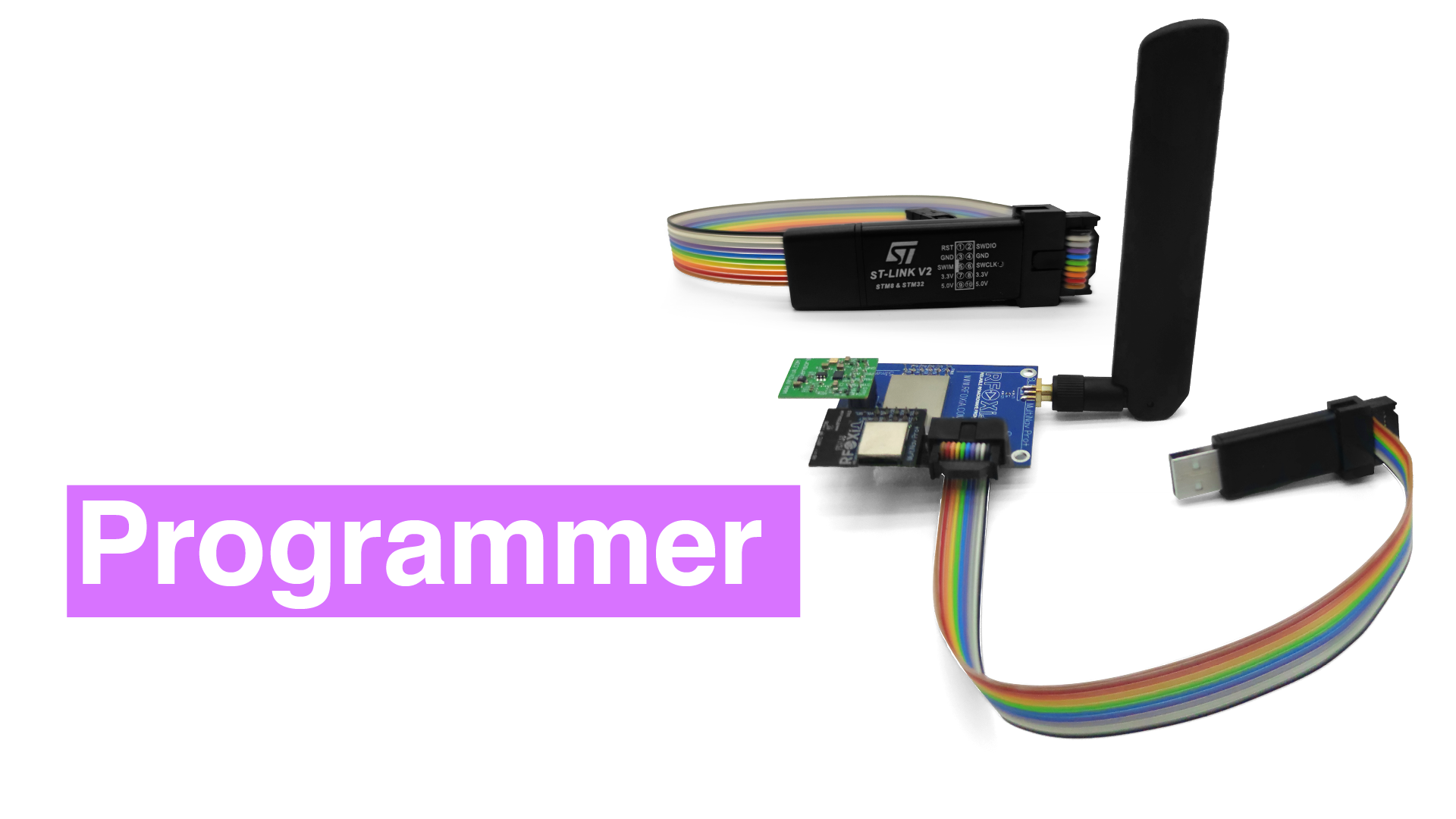
The Power/Program Kit is not just a power supply. It doubles as a complete programming interface for the MultiNav Pro+ BLE Module.
The integrated STLink programmer connects directly to the BLE module and provides full debug and programming access. This means you can:
- Flash new firmware directly from your development environment
- Step through code in real-time debug sessions
- Monitor hardware registers and peripheral state
- Update firmware in the field without returning to a bench setup
For developers using RFOXiA's AI Firmware Builder — which generates production-ready STM32WB07 firmware from plain-language descriptions — having the programmer integrated into the power module means the development cycle is completely self-contained. Write your firmware description, generate the code, flash it, test it in the field, all with one kit.
This integration is deliberate. RFOXiA's philosophy is that hardware development tools should be as friction-free as the hardware itself. A separate programmer is another cable, another power source, another thing to forget. Integrating it into the power module you are already carrying makes the entire development workflow cleaner.
Complete Connectivity Kit
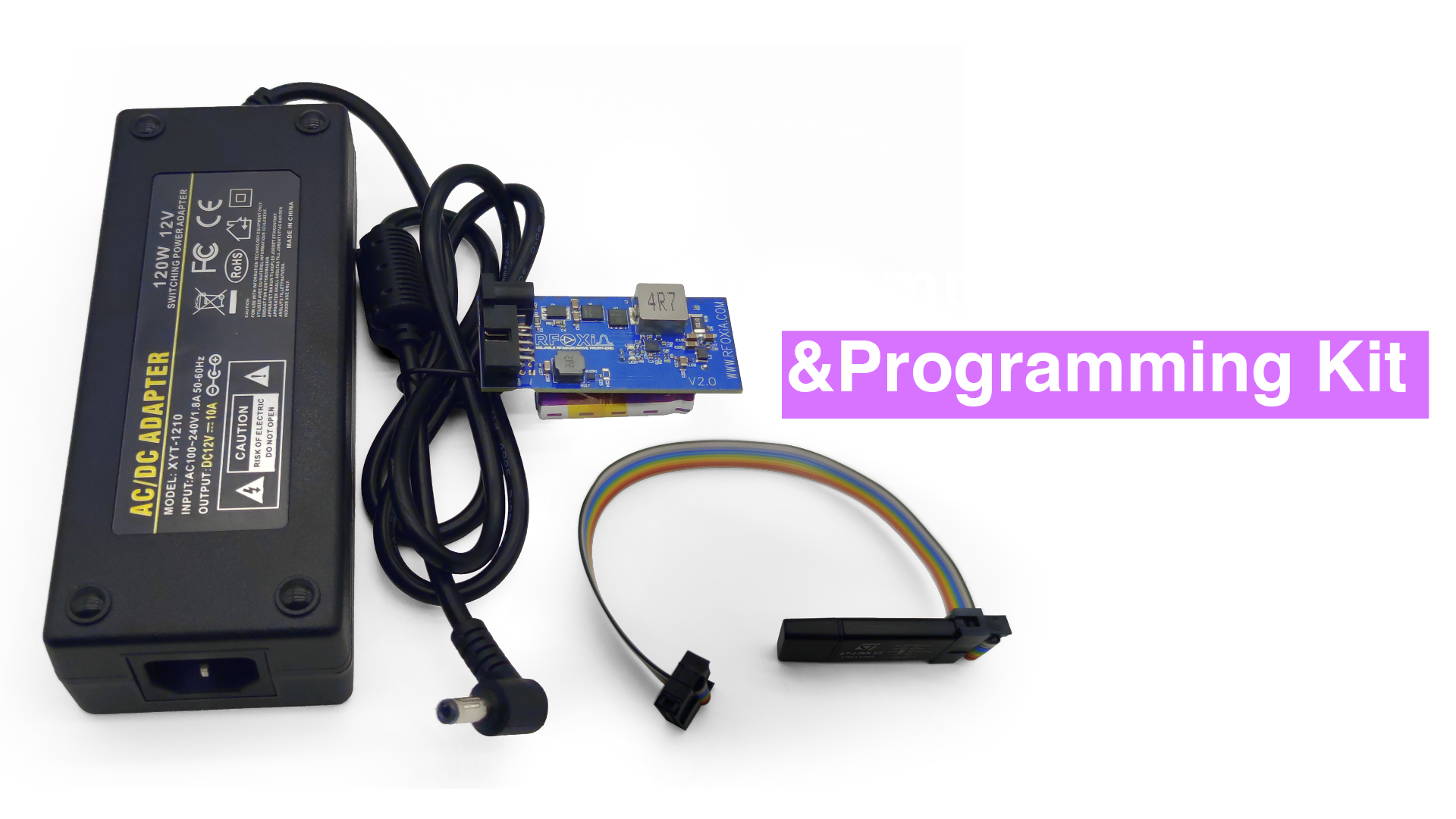
The kit ships with all required cables included. Flat ribbon cables handle the BLE module to power module connection and the programmer to BLE module connection. There is nothing to source separately. You open the kit, connect the cables, and you are operational.
This is a small thing that matters a lot in practice. Hardware developers know the frustration of receiving a kit that requires three additional cable orders before you can actually use it. The RFOXiA Power/Program Kit ships complete.
Why Supercapacitor Technology Is the Right Choice for Wireless Hardware Development
Let us be direct about the trade-offs, because they are real.
A supercapacitor system at equivalent energy storage is physically larger and heavier than a lithium cell. For applications where size and weight are the primary constraints — a miniature drone, a wearable — lithium is still the right answer.
But for development kits, field testing equipment, and deployed sensor nodes where the developer controls the form factor, the advantages of the supercapacitor approach are substantial:
Safety. No thermal runaway risk. No fire hazard. No dangerous failure modes. Supercapacitors fail gracefully — they lose capacitance gradually rather than failing catastrophically.
Longevity. 500,000+ charge cycles versus 500-1,000 for lithium. The power module you buy today will outlast every other component in your development workflow.
Field readiness. A 5-minute charge means a dead module is a minor interruption, not a project stoppage. You can carry the charger in the field and be back online faster than it takes to swap a battery pack.
Consistent performance. The flat discharge curve maintained by a proper supercapacitor balancing circuit means your RF hardware performs consistently throughout the discharge cycle — critical for repeatable test results.
Wide temperature operation. Supercapacitors perform reliably at temperatures where lithium cells struggle. For outdoor deployments in cold environments, this is a meaningful advantage.
The engineering decision to build the Power/Program Kit around supercapacitor technology rather than lithium cells reflects a clear-eyed assessment of what hardware developers actually need in the field.
Integration With the RFOXiA Ecosystem
The Power/Program Kit does not exist in isolation. It is one component of the MultiNav Pro+ ecosystem, and it is designed to work seamlessly with every other component in that ecosystem.
When you deploy the complete Developer Bundle — BLE Module, GNSS Module, Sensors Module, and Power/Program Kit — you have a self-contained wireless development platform capable of:
- Long-range BLE communication up to 20km man-to-drone
- Sub-2-meter GPS positioning at 18Hz update rate
- Seven-sensor environmental monitoring (temperature, humidity, pressure, air quality, accelerometer, gyroscope, magnetometer)
- Full-day operation on a 5-minute charge
- In-field firmware updates via integrated STLink
The RFOXiA Connect app, available on Android now and iOS pending approval, pairs with the BLE module to provide a PS5-style controller interface with live GPS tracking and sensor visualization — completely offline, no internet required.
For developers contributing to the RFOXiA Data Network, the Power/Program Kit enables continuous sensor node operation. A node that charges in 5 minutes and runs for 24 hours can maintain near-continuous data streaming, maximizing daily data rewards. The network pays verified contributors based on uptime and data completeness — consistent power directly translates to higher earnings.
If you are ready to eliminate power limitations from your hardware development workflow, the RFOXiA SuperCapacitor Battery and Programmer Kit is available now at $119, with 140 units in stock.
Technical Specifications Summary
| Specification | Value |
|---|---|
| Capacitance | 1100F |
| Energy Storage | 8,800 Joules |
| Charge Time | Under 5 minutes |
| Runtime (full module stack) | 24 hours |
| Input Adapter | 12V 5A |
| Charge Current to Stack | 4V 10A |
| Programmer Interface | STLink (SWD) |
| Target Module | MultiNav Pro+ BLE (STM32WB07) |
| Included Cables | Flat ribbon — power and programmer connections |
| Certification | FCC certified |
| Price | $119 |
Who Should Use the Power/Program Kit
Drone builders and FPV pilots who need reliable power for embedded wireless systems without the weight and risk penalties of large lithium packs for bench and field testing.
Field researchers deploying sensor arrays in locations where recharging infrastructure is limited or inconvenient. A 5-minute charge at a vehicle outlet beats an overnight lithium charge every time.
IoT developers building and iterating on firmware who want the programmer and power supply integrated into one device rather than juggling separate tools.
Data network contributors who want to maximize uptime and earnings by running their sensor nodes with the most reliable power solution available.
Anyone building with the MultiNav Pro+ ecosystem who wants a complete, professional power and programming solution designed specifically for these modules.
Conclusion: The Supercapacitor Balancing Circuit as a Foundation for Serious Hardware Work
The supercapacitor balancing circuit is not a marketing detail. It is the engineering foundation that makes the 5-minute charge time safe, the 24-hour runtime consistent, and the long-term reliability of the power module a genuine specification rather than a hope.
RFOXiA built the Power/Program Kit because the company has experienced, firsthand, every power problem that hardware developers face in the field. The solution was not to ship a lithium pack with a USB-C port and call it done. The solution was to engineer a supercapacitor system with proper balancing, integrate a professional-grade programmer, and package everything with the cables required to be immediately operational.
At $119, the Power/Program Kit is priced for the maker and developer community — not for the industrial integrator with a $50,000 equipment budget. FCC certified. Ready to ship. 140 units in stock.
Explore the complete RFOXiA SuperCapacitor Battery and Programmer Kit and add it to your Developer Bundle order to unlock the full MultiNav Pro+ ecosystem with professional power management included.
For developers building their first serious wireless system or scaling up an existing project, this is the power layer your build deserves.
Written by: Moamen Mohamed LinkedIn