
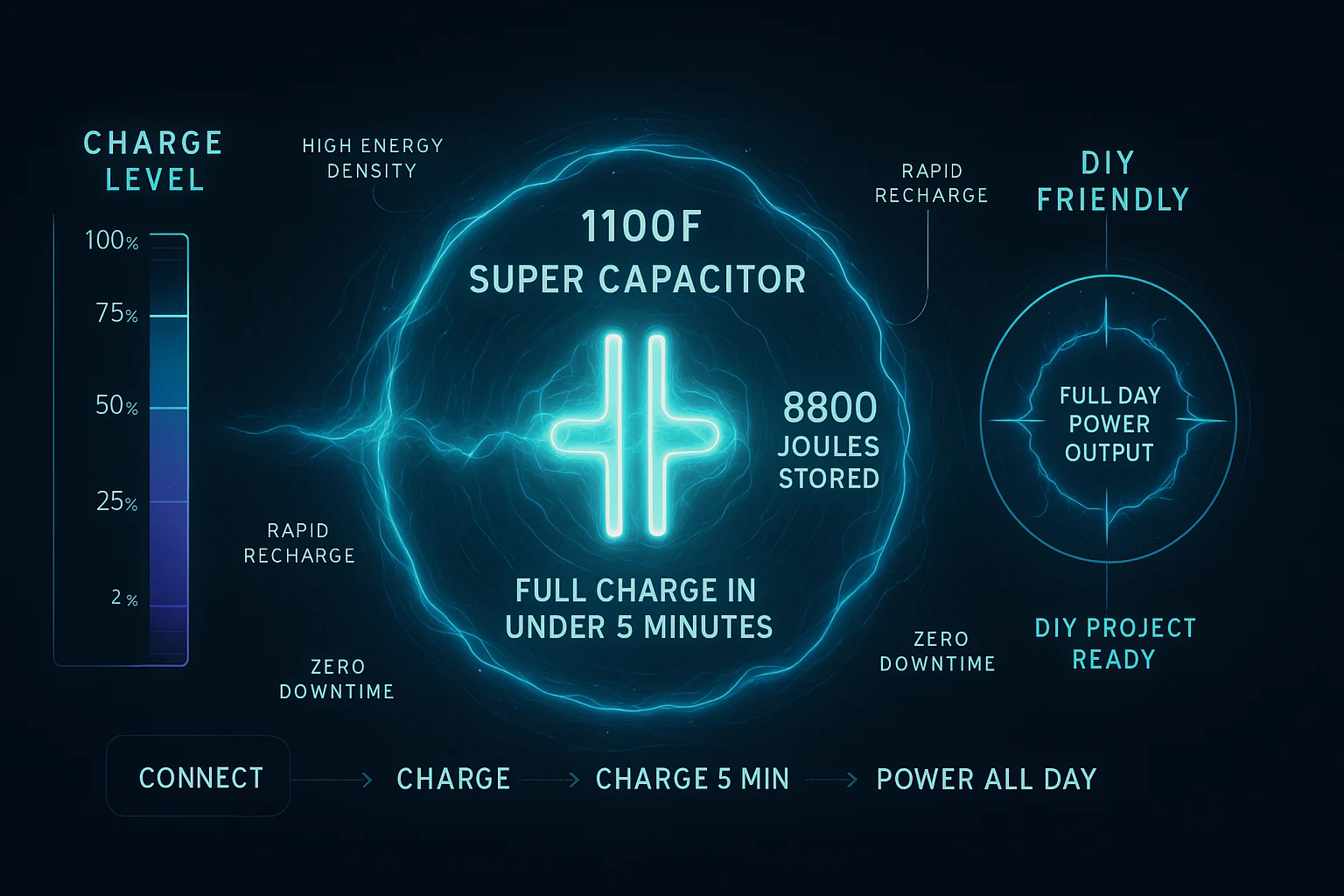
Supercapacitor Battery Pack DIY: Power Your Wireless Projects for a Full Day on a 5-Minute Charge
RFOXiA SuperCapacitor Battery and Programmer Kit
The Best Supercapacitor Battery Pack DIY Solution for Serious Hardware Developers
If you've ever been mid-session on a drone test, a field robotics deployment, or a remote IoT installation — and watched your power source die at exactly the wrong moment — you already understand the problem this article solves.
Battery technology has always been the hidden bottleneck of hardware development. Lithium cells take hours to recharge. They degrade over hundreds of cycles. In cold field conditions, they fail unpredictably. And for developers who need to flash firmware, test configurations, and iterate rapidly, the constant interruption of waiting for a battery is a genuine productivity killer.
The supercapacitor battery pack DIY approach flips this entire equation. Instead of chemical energy storage with its slow charge curves and degradation cycles, supercapacitors store energy electrostatically — charging in minutes, delivering consistent power, and lasting for tens of thousands of cycles without meaningful capacity loss.
The RFOXiA SuperCapacitor Battery and Programmer Kit is one of the most capable implementations of this technology available to makers, developers, and field engineers today. In this post, we'll break down exactly how it works, what makes it technically exceptional, and why it belongs in every serious hardware developer's toolkit.
Why Traditional Batteries Fail Hardware Developers
Before diving into supercapacitor technology, it's worth understanding exactly why standard lithium batteries are the wrong tool for serious embedded development work.
Charge times are brutal. A standard 3000mAh LiPo pack takes 1.5 to 3 hours to fully charge at standard rates. If you're iterating on firmware, running field tests, or deploying in waves, that downtime adds up to hours of lost productivity every week.
Capacity degrades with every cycle. Lithium chemistry loses roughly 20% capacity after 300-500 full charge cycles. For a developer running daily tests, that's less than two years before the pack is meaningfully degraded.
Cold temperature performance drops sharply. LiPo batteries lose 20-30% capacity at 0°C and can fail entirely below -20°C. For field researchers and drone operators working in winter conditions or high-altitude environments, this is a real operational constraint.
They're not designed for rapid recharge. Fast-charging lithium batteries at high C-rates damages the cells and accelerates degradation. You can't safely slam energy back in within minutes the way you can with a supercapacitor system.
The supercapacitor battery pack DIY approach eliminates all of these constraints simultaneously.
What Is a Supercapacitor and Why Does It Matter for Makers?
A supercapacitor (also called an ultracapacitor or EDLC — electric double-layer capacitor) stores energy in an electrostatic field between two electrodes rather than through a chemical reaction. This fundamental difference in storage mechanism creates radically different performance characteristics.
Key advantages of supercapacitor energy storage:
- Charge time: Seconds to minutes vs. hours for lithium chemistry
- Cycle life: 100,000+ charge/discharge cycles vs. 300-500 for LiPo
- Temperature performance: Consistent output from -40°C to +65°C
- Charge rate: Can accept extremely high charge currents without degradation
- Power density: Delivers high peak currents without voltage sag
- Safety: No thermal runaway risk, no fire hazard from overcharge
The tradeoff historically has been energy density — supercapacitors store less energy per kilogram than lithium batteries. But for applications where runtime is measured in hours rather than days, and where rapid recharging in the field is operationally critical, this tradeoff is entirely acceptable.
For embedded developers, drone operators, and field IoT engineers, the supercapacitor model is genuinely superior.
Introducing the MultiNav Pro+ Power/Program Kit
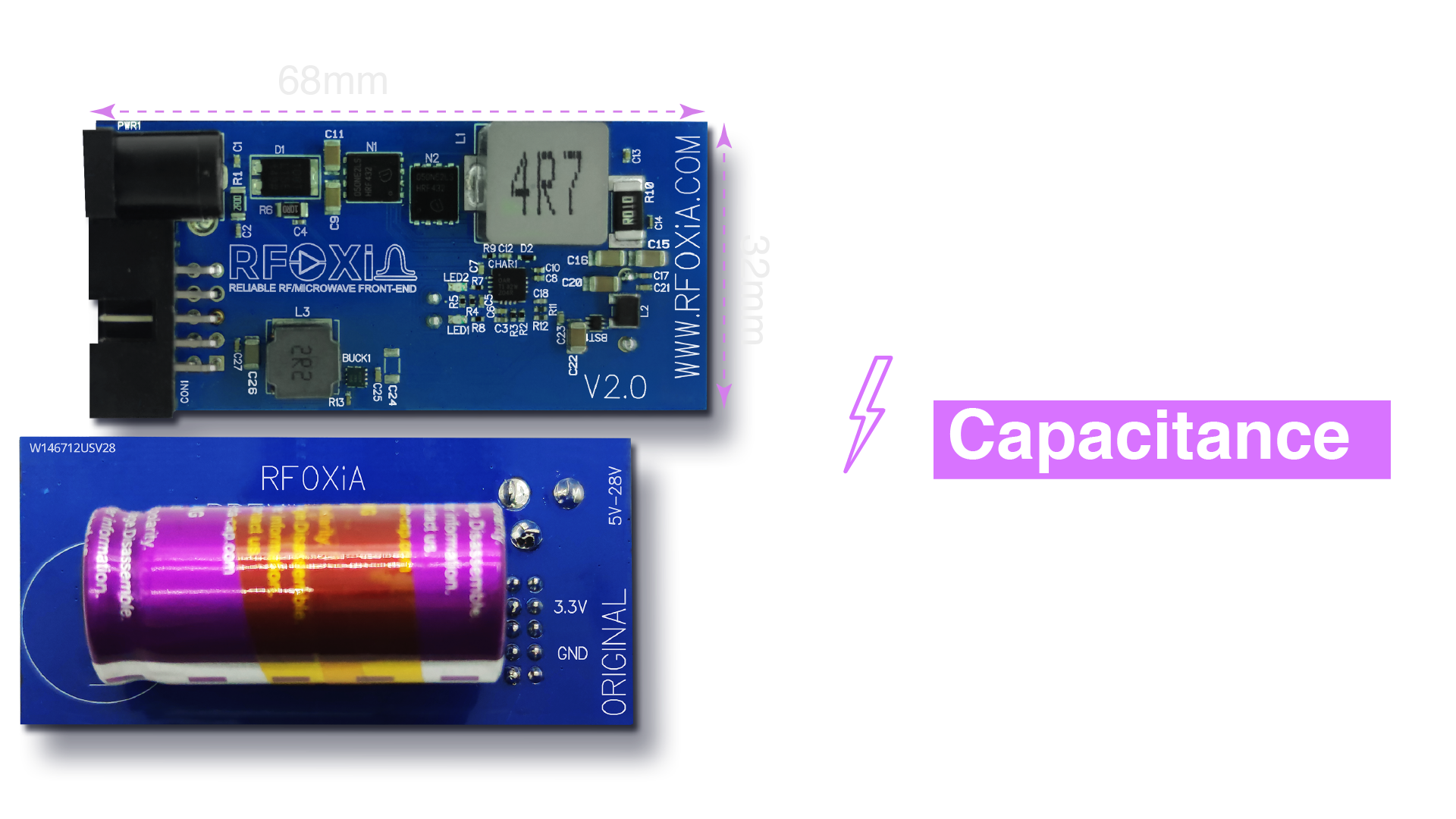
The MultiNav Pro+ Power/Program Kit from RFOXiA is a complete power and programming solution built around a professional 1100F supercapacitor system. It was designed specifically to power the MultiNav Pro+ module ecosystem — but its value extends to any developer who needs reliable, fast-recharging power for embedded hardware work.
Here's what's in the kit and why each component matters.
Component Deep Dive: The 1100F Supercapacitor System
The heart of this kit is an 1100 Farad supercapacitor bank storing 8,800 Joules of energy. To put that number in context:
- 8,800 Joules is enough to run the complete MultiNav Pro+ module stack — BLE module, GNSS module, and sensors module — for a full 24-hour working day
- The bank charges fully in under 5 minutes from the included high-power adapter
- The system delivers consistent regulated voltage throughout the discharge curve, unlike lithium cells that sag as they deplete
For a developer iterating on firmware at their bench, this means you can drain the pack completely, plug in for five minutes while reviewing your code, and be back to full capacity before you're ready to test again. The concept of "waiting for the battery" essentially disappears from your workflow.
For field deployment — drone testing, remote sensor installation, environmental monitoring stations — this changes what's operationally possible. A single high-power charging adapter in your field kit means you can recharge anywhere with a 12V source (vehicle battery, portable generator, solar system) and be back to full capacity in minutes.
The High-Power Charging Adapter
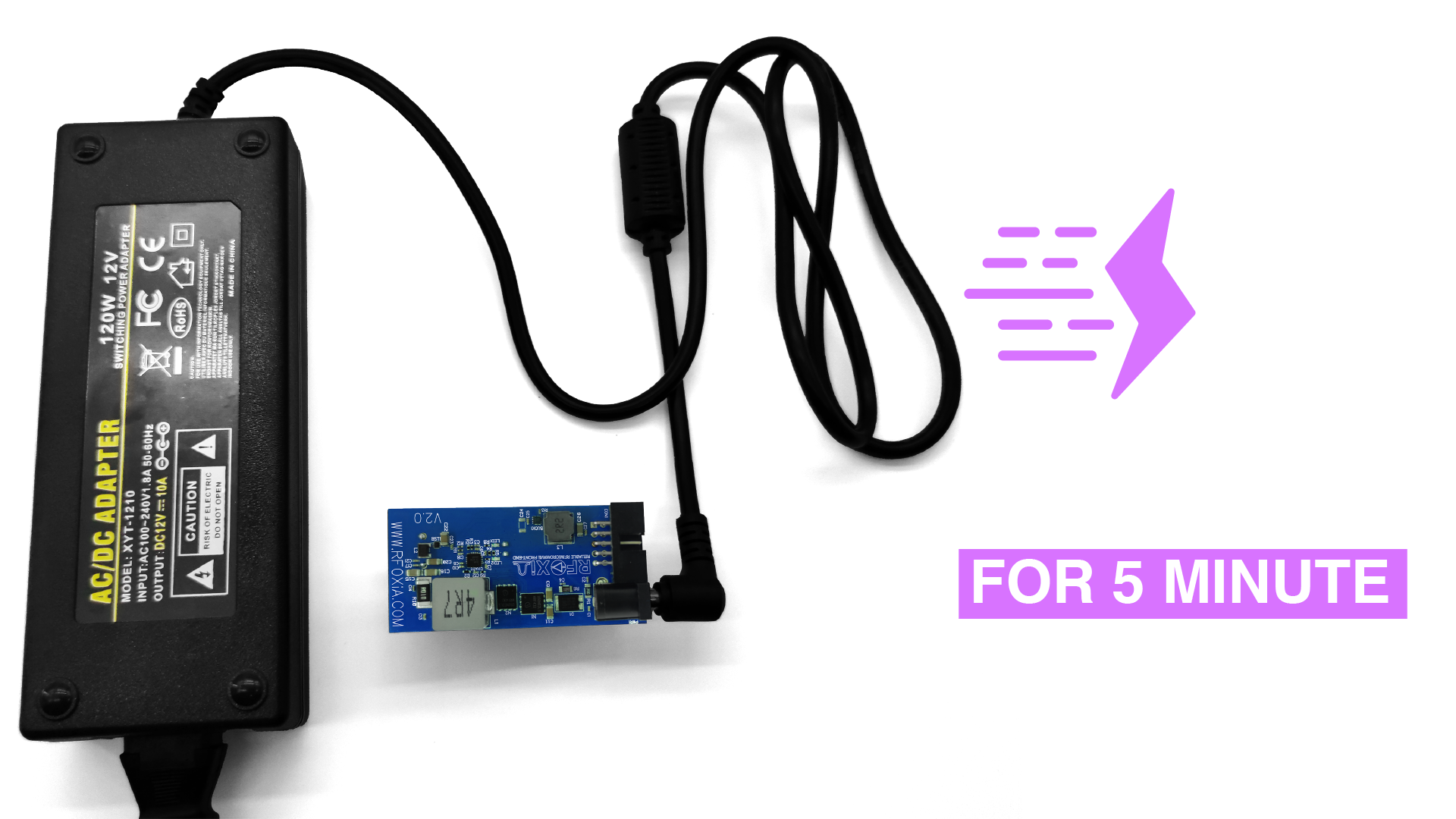
Charging a 1100F supercapacitor bank at a meaningful rate requires a purpose-built charging solution. The included 12V 5A high-power adapter drives the supercapacitor system at 4V / 10A — an aggressive charge rate that's completely safe for the ultracapacitor chemistry while being catastrophically damaging to any lithium pack.
This is one of the most important practical advantages of the supercapacitor approach: you can pour energy in at high rates without any damage, degradation, or safety risk. The 5-minute charge time isn't a marketing approximation — it's a direct consequence of supercapacitor physics.
The adapter is included in the kit, so there's nothing additional to source or configure. Plug in, wait five minutes, unplug, deploy.
All-Day Power for the Complete MultiNav Pro+ Stack
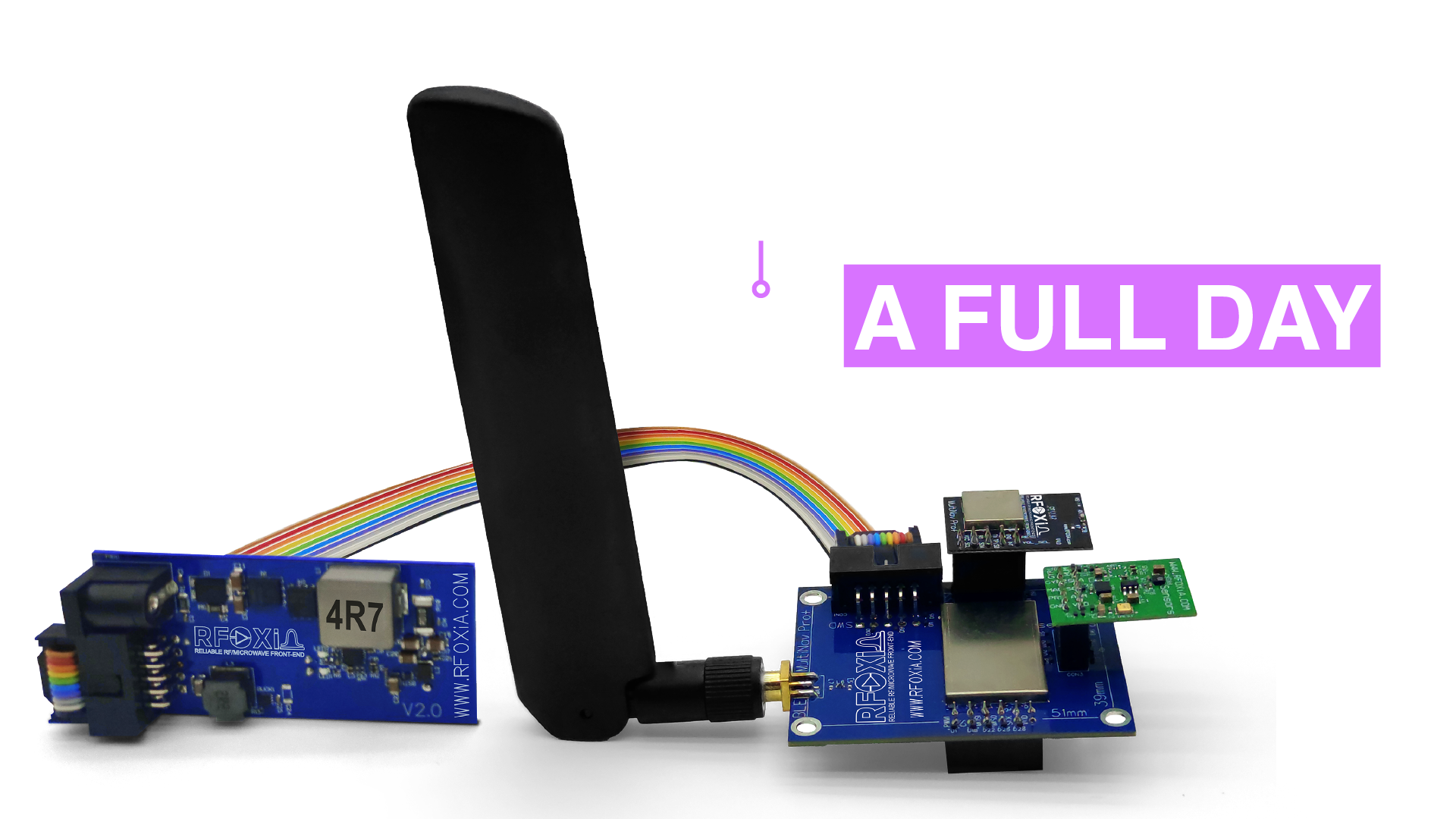
The Power/Program Kit isn't just designed to run the BLE module in isolation. The 8,800 Joule capacity is sufficient to power the complete MultiNav Pro+ module ecosystem simultaneously for a full day:
- MultiNav Pro+ BLE Module — the long-range 5-50km wireless communication module
- GNSS Module — the 18Hz precision GPS module
- Sensors Module — the 7-sensor environmental monitoring board (temperature, humidity, pressure, air quality, accelerometer, gyroscope, magnetometer)
For developers working with the full Developer Bundle stack, this means a single Power/Program Kit keeps everything running through a complete field session without any need to manage individual module batteries or worry about partial power loss causing sensor data corruption or communication drops.
For data network contributors deploying sensor nodes — users who stream verified environmental data through the RFOXiA platform to earn daily rewards — this means a complete deployment solution that runs from morning setup through end-of-day retrieval with a single 5-minute morning charge.
The STLink Programmer: Professional Firmware Development Built In
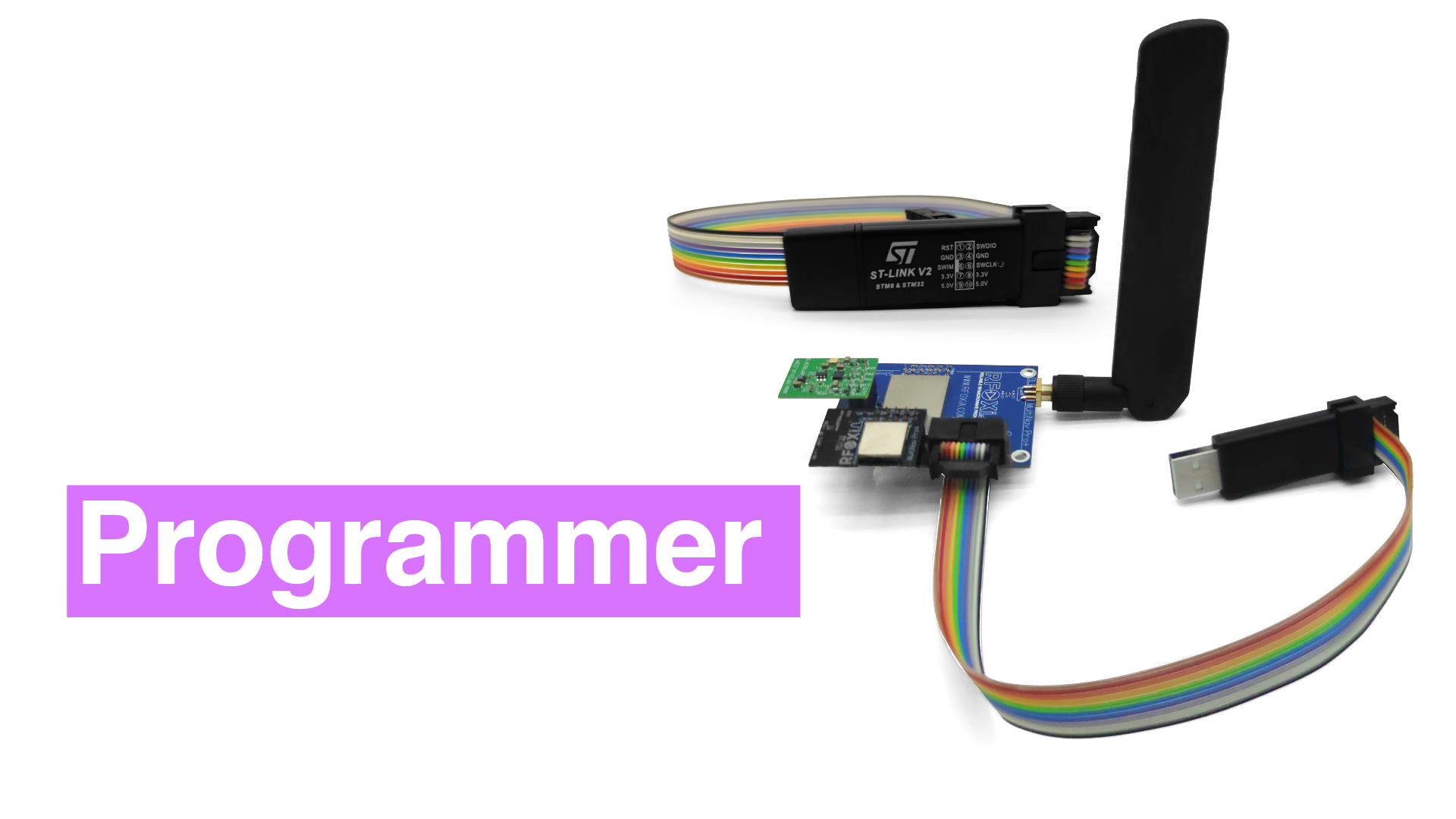
This is what separates the Power/Program Kit from a simple supercapacitor power bank — and what makes it uniquely valuable as a supercapacitor battery pack DIY platform for embedded developers.
The integrated STLink programmer is the industry-standard interface for programming and debugging STM32 microcontrollers, which power the MultiNav Pro+ BLE Module. Having this directly integrated into the power kit means:
No separate programmer to source. The STLink interface is already included, already wired, already tested with the BLE module. You don't need to purchase a standalone ST-LINK/V2 programmer or source third-party adapters.
Firmware updates in the field. If you're running a long-duration field deployment and need to push a firmware update to your BLE module — whether to fix a bug, add a feature, or reconfigure communication parameters — you can do it directly from the Power/Program Kit without returning to a lab bench.
Debugging during live operation. The STLink interface supports live debugging, not just programming. You can set breakpoints, inspect register states, and trace execution while the module is running on supercapacitor power — a genuinely professional development capability.
Seamless integration with RFOXiA's AI Firmware Builder. RFOXiA Club's AI Firmware development platform generates production-ready firmware from plain-language descriptions. Once generated, that firmware needs to be flashed to the hardware. The integrated STLink programmer makes this a one-step process — generate firmware in Club, flash via the kit, test immediately.
Complete Connectivity: All Cables Included
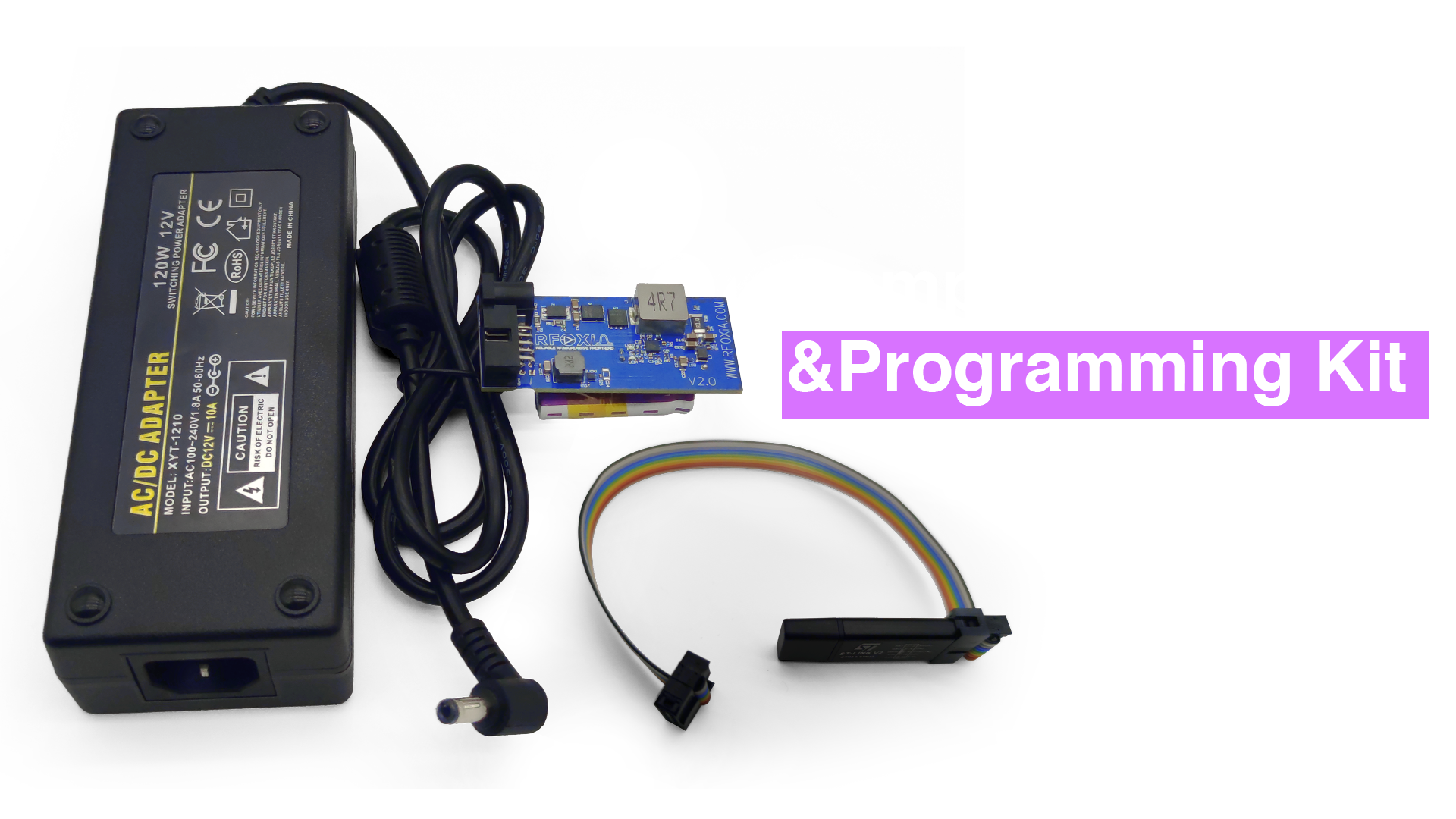
One of the most frustrating experiences in hardware development is receiving a new piece of equipment and discovering it requires specific cables you don't have. The MultiNav Pro+ Power/Program Kit includes the complete connectivity package:
- Flat ribbon cables for connecting the BLE module to the power module
- Programmer ribbon cables for connecting the STLink interface to the BLE module programming port
- All connectors are pre-terminated and tested
Out of the box, you have everything needed for complete setup. No cable sourcing, no custom crimping, no compatibility hunting. This is an intentional design decision — the kit is built to be immediately usable, not to require a secondary procurement process.
Real-World Use Cases
Drone Development and FPV Building
Drone builders using the MultiNav Pro+ BLE Module for telemetry and control need power solutions that match their iteration pace. A build session involves repeated firmware flashes, range tests, and configuration changes. A 5-minute charge cycle between tests means your power source never slows your development cadence.
Field IoT Deployment
Environmental monitoring nodes, precision agriculture sensors, and smart city installations are often deployed in locations without reliable power infrastructure. A supercapacitor battery pack with 24-hour runtime and a 5-minute recharge from any 12V source makes logistics dramatically simpler than managing lithium packs with overnight charge requirements.
Research and Data Collection
Researchers using the MultiNav Pro+ module stack for environmental data collection need power that lasts a full field day and recharges fast enough for back-to-back sessions. The 8,800 Joule capacity and 5-minute recharge make this viable in ways that lithium systems simply aren't.
Embedded Firmware Development at the Bench
For developers working on BLE firmware — whether using RFOXiA's AI Firmware Builder or writing custom code — having a stable, regulated power source with integrated programming capability eliminates USB power variability and separate programmer management from the development environment.
Technical Specifications Summary
| Parameter | Specification |
|---|---|
| Supercapacitor Capacitance | 1100 Farads |
| Energy Storage | 8,800 Joules |
| Charge Time | Under 5 minutes |
| Runtime (full module stack) | 24 hours |
| Input Adapter | 12V 5A |
| Charge Rate | 4V / 10A |
| Programmer Interface | STLink (STM32 compatible) |
| Certification | FCC Certified |
| Cables Included | Flat ribbon (power + programming) |
| Compatible Modules | MultiNav Pro+ BLE, GNSS, Sensors |
Why This Is the Best Supercapacitor Battery Pack DIY Platform Available
Let's be direct about the competitive landscape. There are several ways a hardware developer can approach building a supercapacitor battery pack DIY solution:
Option 1: Source and build from scratch. Purchase supercapacitor cells, balance boards, voltage regulators, enclosures, and connectors separately. Spend 10-20 hours engineering, testing, and validating a custom solution. This is viable for experienced engineers with time to spend, but it's a significant project in itself.
Option 2: Purchase a generic USB power bank. These use lithium chemistry, charge in hours, and provide no programming interface. They solve the portability problem but not the charge-time problem or the development-workflow problem.
Option 3: The MultiNav Pro+ Power/Program Kit. FCC certified, professionally engineered, immediately compatible with the MultiNav Pro+ ecosystem, includes the STLink programmer and all cables, charges in 5 minutes, runs for 24 hours. It's the complete solution without the build effort.
For developers who want the supercapacitor advantage without the engineering overhead of a scratch build, this kit is the direct path.
If you're ready to eliminate power downtime from your development workflow, the RFOXiA SuperCapacitor Battery and Programmer Kit is available now at $119.
The RFOXiA Ecosystem: More Than Just Power
The Power/Program Kit is designed as part of a complete wireless development ecosystem. When paired with the MultiNav Pro+ BLE Module, GNSS Module, and Sensors Module — all available individually or as the Developer Bundle — it enables capabilities that don't exist anywhere else at this price point:
- 5km ground-to-ground wireless range via the BLE module
- 15-20km man-to-drone range for unmanned systems control
- 1.5-meter precision GPS at 18Hz update rate
- 7-sensor environmental monitoring in one compact board
- AI-generated firmware via RFOXiA Club's Dev Hub
- Live device control from the RFOXiA Connect mobile app
- Data monetization — deploy your sensor node and earn daily rewards for contributing verified environmental data to the RFOXiA network
The Power/Program Kit is what keeps all of this running — in the field, at the bench, and everywhere in between.
Getting Started
The MultiNav Pro+ Power/Program Kit is FCC certified, in stock, and ready to ship. Setup involves no complex configuration — connect the modules via the included ribbon cables, charge for 5 minutes, and you're running.
For developers new to the RFOXiA ecosystem, signing up for RFOXiA Club is free and comes with a $10 welcome credit toward your first purchase. The Club platform includes full documentation, firmware examples, the AI Firmware Builder, and access to a growing community of drone builders, IoT engineers, and hardware developers.
Stop managing battery logistics. Stop waiting hours for a recharge. Stop sourcing separate programmers and cables.
Get the complete solution: RFOXiA SuperCapacitor Battery and Programmer Kit — $119, ships now.
Conclusion
The supercapacitor battery pack DIY concept is one of the most impactful upgrades available to working hardware developers — but building a custom solution from components takes time and expertise that most developers would rather spend on their actual projects.
The MultiNav Pro+ Power/Program Kit delivers the core supercapacitor advantage — 5-minute recharge, 24-hour runtime, consistent regulated power — in a professionally engineered, FCC-certified package that also includes a complete STLink programming interface and all necessary cables.
For drone builders, IoT engineers, field researchers, and embedded developers who want to eliminate power as a constraint in their work, this kit is the purpose-built answer. It's not a compromise. It's the right tool for the job.
Written by: Moamen Mohamed LinkedIn