
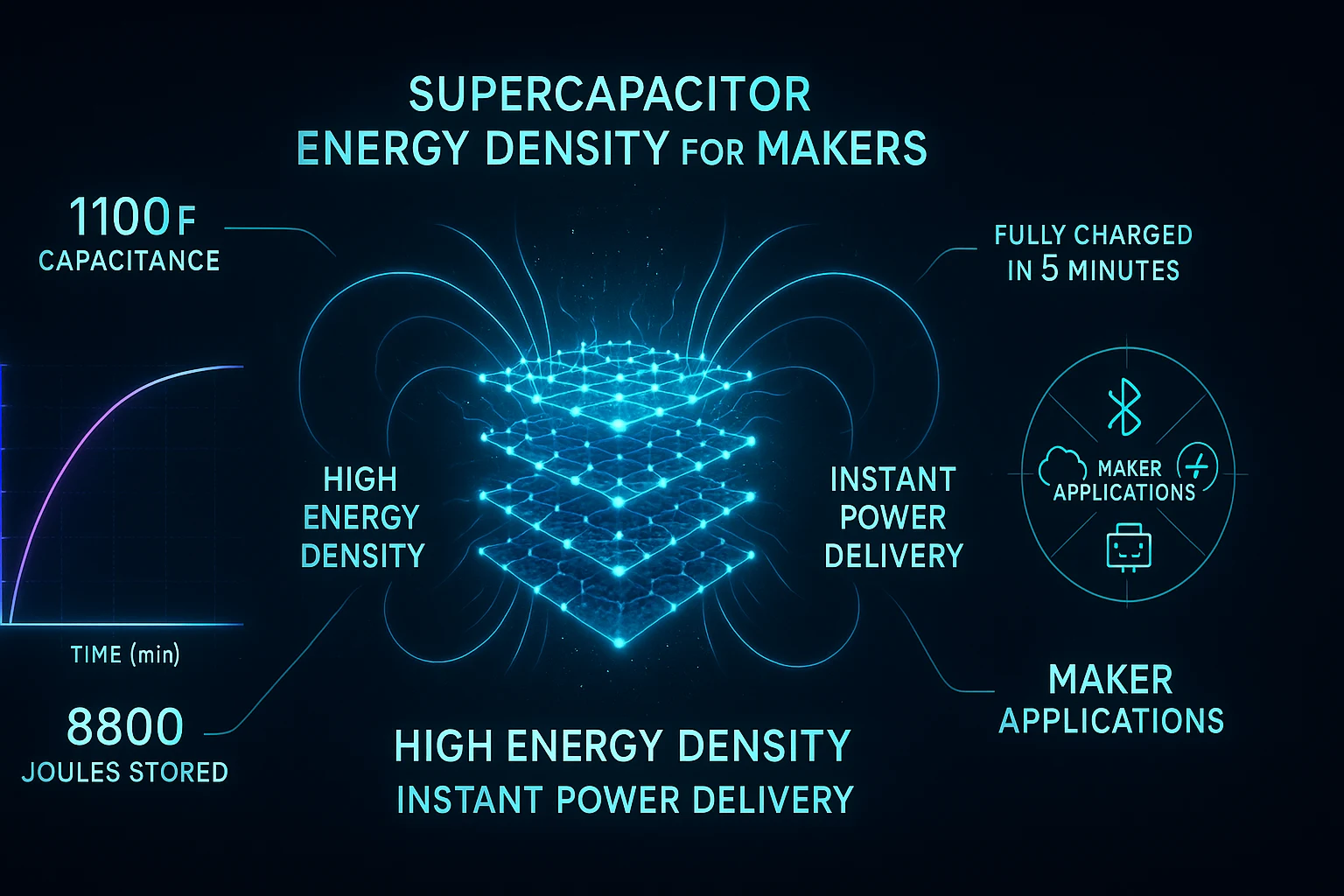
Supercapacitor Energy Density for Makers: Why It Changes Everything
RFOXiA SuperCapacitor Battery and Programmer Kit
Supercapacitor Energy Density Maker Revolution — Never Run Out of Power Again
If you have spent any time building wireless systems, drones, field robotics, or IoT deployments, you already know the feeling. You are deep in a test session, the data is flowing, your firmware is behaving exactly as it should — and then the battery dies. You scramble for a charger, wait thirty minutes or an hour, and by the time you are back online you have lost your momentum, your data continuity, and sometimes your patience.
This is not a small inconvenience. For serious makers, researchers, and drone engineers, power interruption is a project killer. It is the hidden tax on every outdoor deployment, every field test, every long development session.
The solution is not a bigger battery. The solution is fundamentally different power architecture — and that is exactly what supercapacitor energy density technology delivers to the maker community. For the first time, you do not have to choose between fast charging and long runtime. You can have both.
The RFOXiA SuperCapacitor Battery and Programmer Kit was built to solve this problem completely. This post breaks down how supercapacitor technology works, why its energy density characteristics make it uniquely suited for maker applications, and exactly how the MultiNav Pro+ Power/Program Kit puts this technology into your hands at a price that respects your budget.
What Is Supercapacitor Energy Density and Why Should Makers Care?
To understand why supercapacitor energy density matters for makers, it helps to understand what separates a supercapacitor from a conventional lithium battery.
A standard lithium-ion battery stores energy through electrochemical reactions. Ions move through the electrolyte, intercalate into electrode materials, and the chemical reaction releases energy over time. This is efficient for long-duration storage, but those chemical reactions take time — which is why even fast-charging lithium batteries still require 20 to 60 minutes to reach capacity.
A supercapacitor — also called an ultracapacitor or electric double-layer capacitor — stores energy electrostatically. There are no chemical reactions. Charge accumulates on the surface of extremely high-surface-area carbon electrodes. This means charging is limited only by how fast you can move electrons, not by how fast a chemical reaction can proceed.
The tradeoff historically has been energy density. Conventional capacitors store very little energy per unit volume compared to batteries. But modern supercapacitor technology, using activated carbon electrodes with enormous effective surface areas, has dramatically closed this gap — to the point where a supercapacitor system can store enough energy to run professional electronics hardware for an entire working day.
For the maker and developer community, this shift in supercapacitor energy density has created a genuine breakthrough: a power source that charges in minutes and runs for hours.
The MultiNav Pro+ Power/Program Kit: Supercapacitor Energy Density in Practice
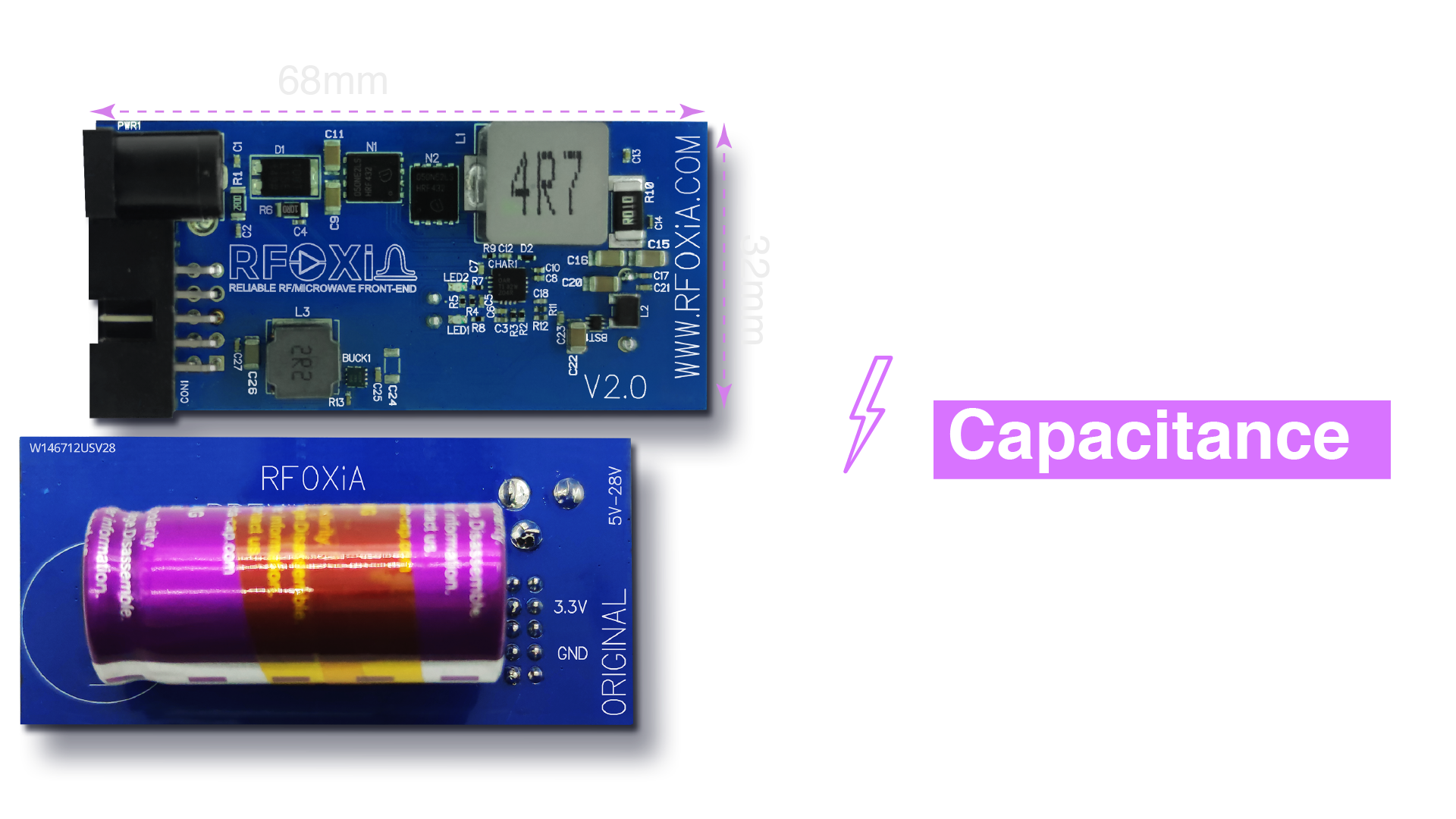
The RFOXiA MultiNav Pro+ Power/Program Kit centers on a 1100F supercapacitor system. That is not a typo — 1100 Farads of capacitance, storing 8800 Joules of usable energy.
To put that in perspective: 8800 Joules is enough to power your complete MultiNav Pro+ module stack — BLE Module, GNSS Module, Sensors Module — for a full working day of continuous operation. You are not getting a couple of hours between charges. You are getting a full professional deployment window.
And when that window closes and you need to recharge, the entire 1100F system charges in under five minutes using the included 12V 5A adapter delivering 4V at 10A to the supercapacitor bank.
This is what supercapacitor energy density looks like in a real maker product: not a laboratory spec sheet, but a functional field tool that eliminates one of the most frustrating constraints in hardware development and deployment.
Breaking Down the Kit: Every Component Matters
The Power/Program Kit is not just a power supply. It is a complete companion system for the MultiNav Pro+ ecosystem. Here is what is inside and why each piece matters.
The Supercapacitor Battery System
The core of the kit is the 1100F supercapacitor bank. At 8800 Joules of stored energy, this system was sized specifically to power all MultiNav Pro+ modules simultaneously for a full eight-hour deployment. Whether you are running a drone test session, a field data collection run, or a long firmware development day at your bench, the power will outlast your session.
The five-minute full charge time is not a marketing approximation. The system charges at 4V and 10A, which means the math works out to roughly 4-5 minutes for a complete charge cycle. You can recharge between test flights. You can top off at lunch. You never have to plan your work schedule around a charging curve.
High-Power Charging Adapter
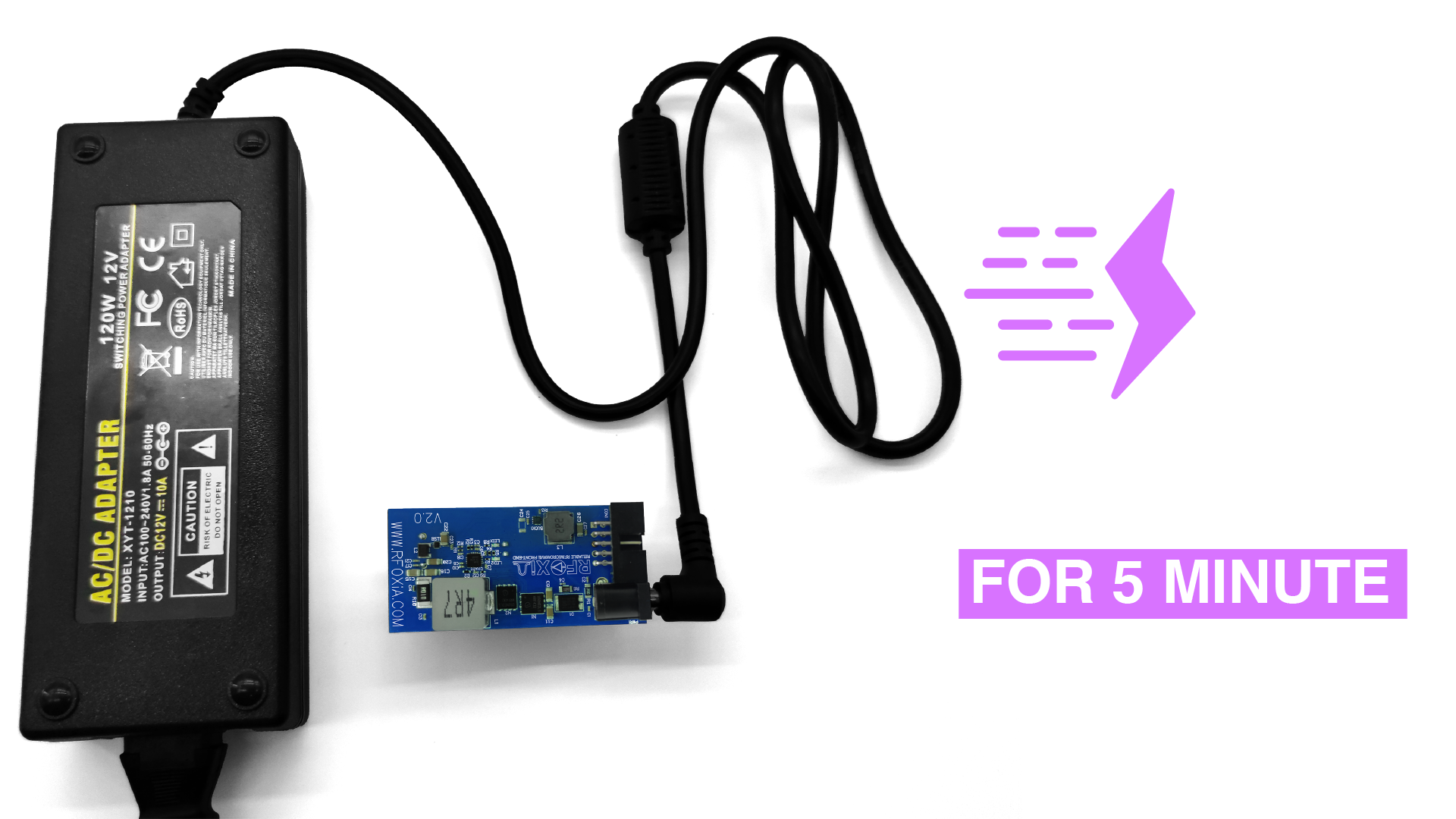
The included 12V 5A adapter is matched specifically to the supercapacitor charging circuit. Generic adapters will not deliver the current profile needed for the five-minute charge — the kit ships with the right hardware already included. You do not need to source a compatible charger separately or worry about compatibility. Plug in, wait five minutes, and you are ready.
This is a detail that matters more than it sounds. Professional tools ship with everything you need. The Power/Program Kit follows that philosophy completely.
Full-Day Power for All MultiNav Pro+ Modules
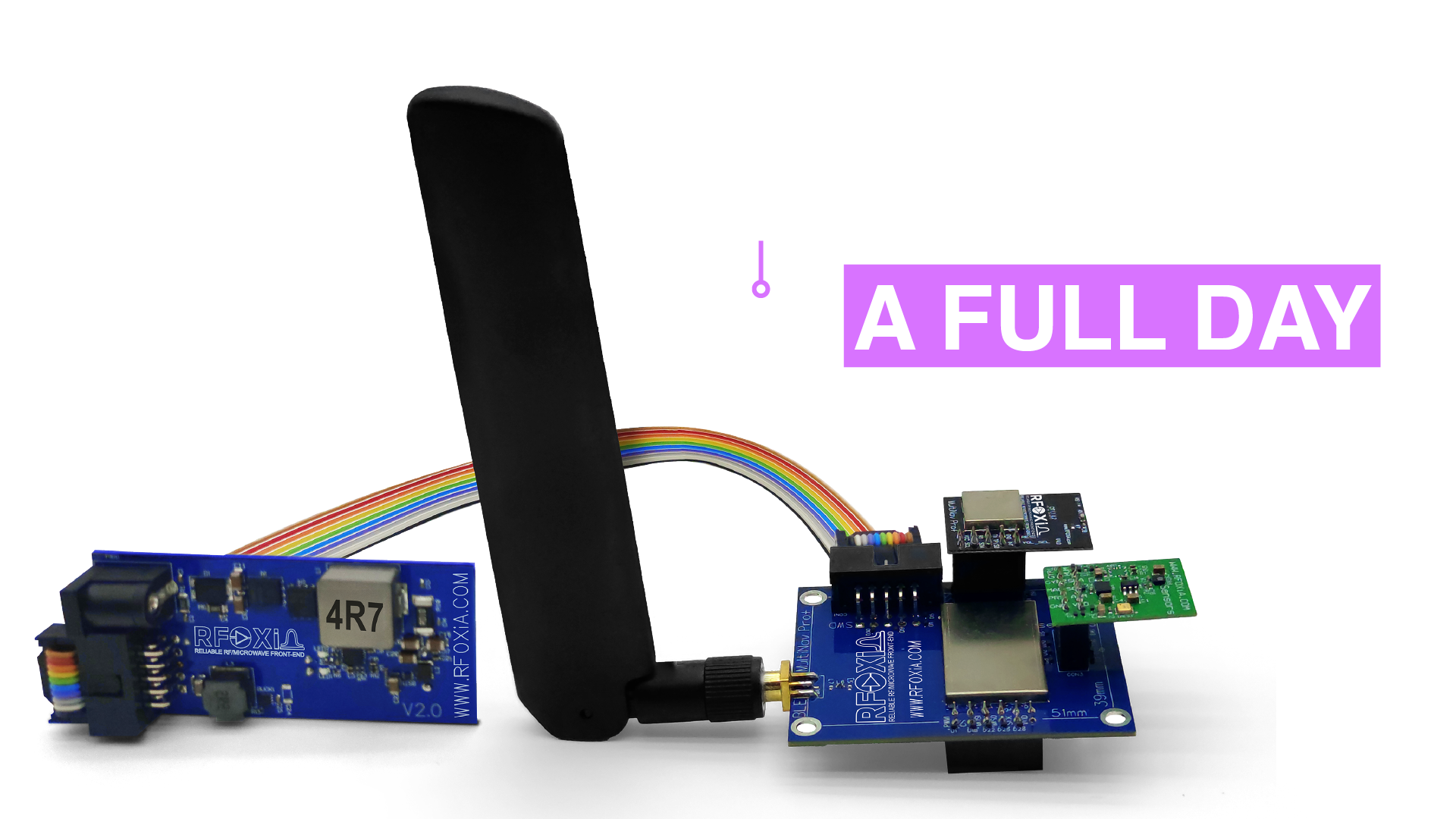
The power system is not spec'd just for the BLE Module in isolation. It is designed to power the complete MultiNav Pro+ stack: the long-range BLE Module with its RF amplifiers and advanced receiver circuitry, the 18Hz GNSS Module tracking fast-moving platforms, and the Sensors Module streaming temperature, humidity, pressure, air quality, accelerometer, gyroscope, and magnetometer data simultaneously.
Running all of that hardware in parallel for a full day from a supercapacitor system that charges in five minutes is not something you will find anywhere else in the maker market. The supercapacitor energy density achievements built into this kit are what make it possible.
For researchers doing long field deployments, for drone engineers running extended test programs, for IoT developers stress-testing their builds — this single specification eliminates an entire category of project constraint.
STLink Programmer
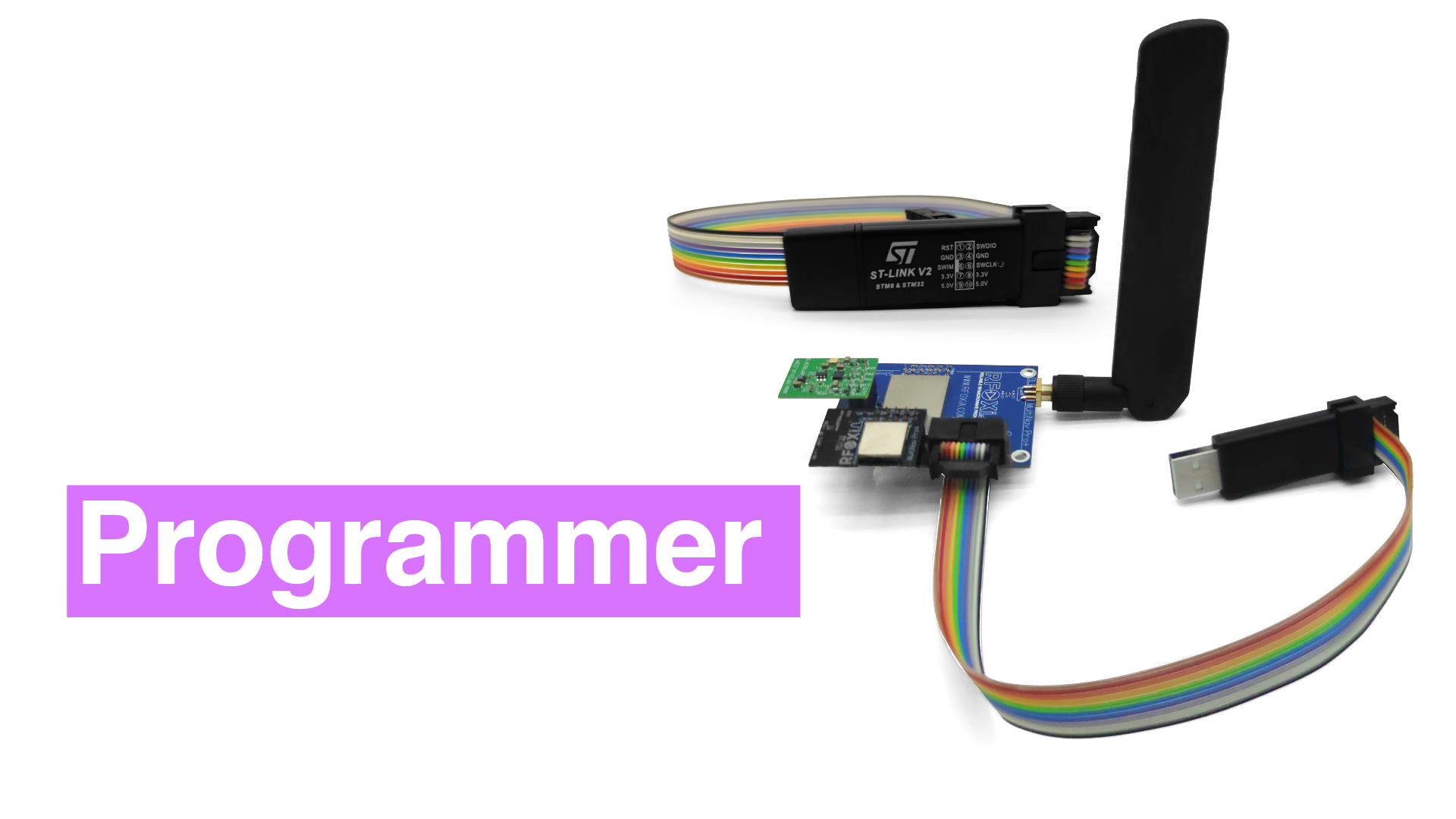
Beyond power, the kit integrates a full STLink programmer for the MultiNav Pro+ BLE Module. This is not an afterthought — it is a recognition that power and programming belong together in a professional developer kit.
With the STLink programmer, you can push firmware updates, debug live sessions, and iterate on your codebase directly from the kit. Combined with the RFOXiA Club AI Firmware Builder — which generates production-ready firmware from plain language descriptions — the programming workflow becomes dramatically faster.
Describe what you want your BLE module to do. The AI generates the firmware. The STLink programmer flashes it in seconds. You test on hardware that is always powered and ready. This is what a complete developer kit should look like.
Complete Connectivity Kit
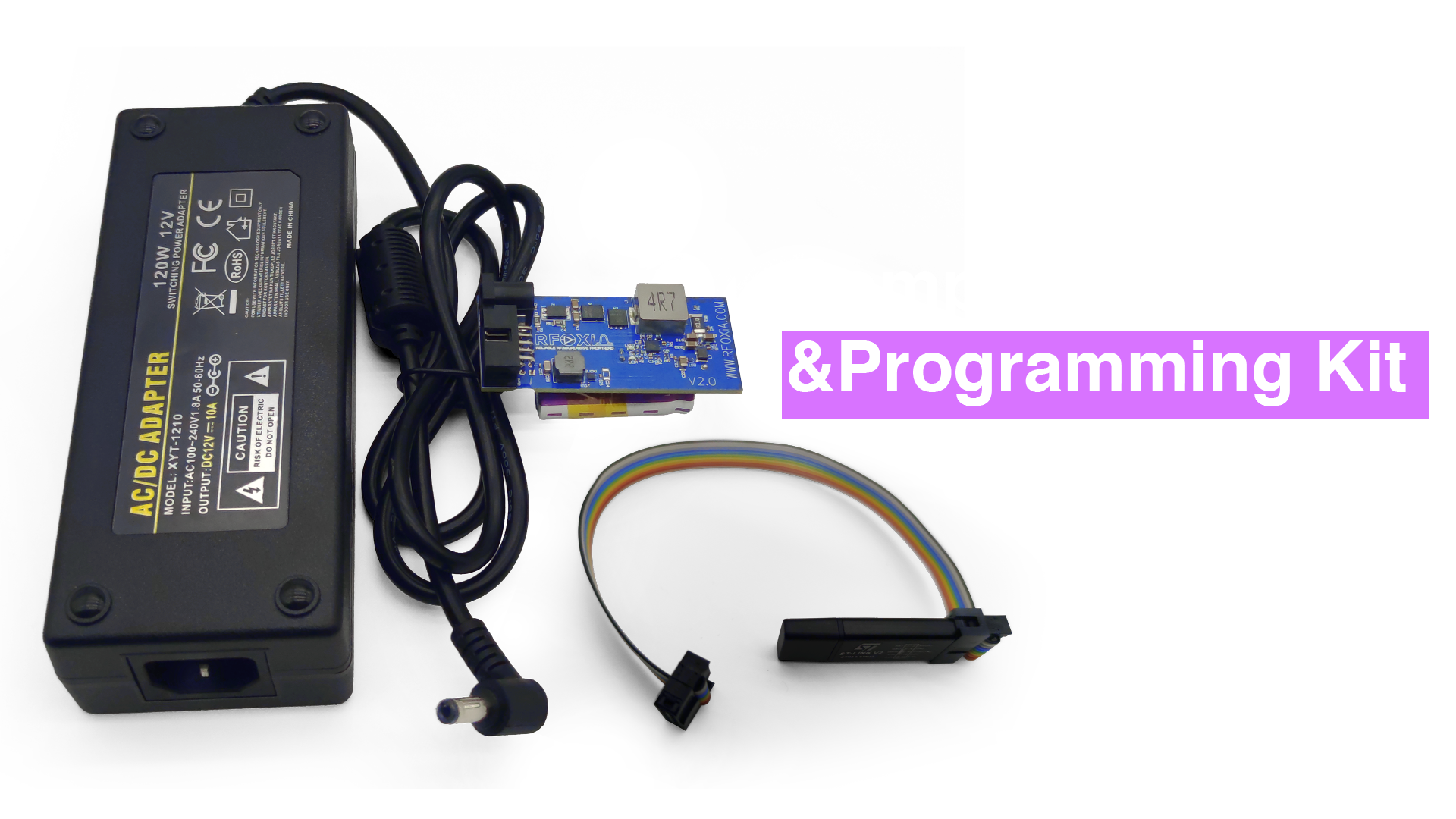
The kit ships with all necessary flat ribbon cables for connecting the BLE Module to the power system and the programmer to the BLE Module. Clean, reliable connections that integrate with the MultiNav Pro+ form factor without adapter hunting or improvised wiring.
For field deployments, this matters. Loose wiring and improvised connections are failure points. The flat ribbon cable system keeps your stack together, organized, and reliable whether you are at a bench or mounting hardware on a drone frame.
Why Supercapacitor Technology Outperforms Lithium for Maker Use Cases
The maker and developer community has historically defaulted to lithium batteries because they are available, cheap, and familiar. But for professional maker applications — especially those involving frequent charge cycles, variable temperatures, and long deployment windows — supercapacitors have significant advantages that go beyond the headline five-minute charge time.
Cycle Life
Lithium-ion batteries degrade with every charge cycle. After 300-500 cycles, most lithium batteries are operating at 80% of their original capacity or less. After 1000 cycles, degradation can be severe. For a developer who charges their kit daily, that means meaningful capacity loss within two to three years.
Supercapacitors are rated for hundreds of thousands of cycles with negligible capacity degradation. The kit you buy today will perform the same in five years of daily use as it does on day one. For professional tools, this longevity fundamentally changes the total cost of ownership calculation.
Temperature Performance
Lithium batteries lose significant capacity at low temperatures. Field deployments in cold environments — winter drone testing, outdoor sensor networks in northern climates, high-altitude research — are where lithium chemistry struggles most visibly.
Supercapacitors maintain their performance characteristics across a much wider temperature range. Cold weather deployments that would leave a lithium-powered kit operating at reduced capacity are not a concern with supercapacitor energy storage.
Safety
Lithium batteries carry fire and explosion risk under abuse conditions — overcharge, physical damage, short circuit, and extreme heat can all lead to thermal runaway. For drone applications especially, a battery fire is a catastrophic failure mode.
Supercapacitors do not experience thermal runaway. They are electrochemical rather than chemical energy storage, which means failure modes are dramatically less dangerous. For a kit that will be mounted on or near flight hardware, this is not a trivial consideration.
Charge Acceptance
Lithium batteries cannot accept unlimited charge current — the chemical processes that allow intercalation have speed limits, and exceeding them causes damage. This is why fast charging lithium systems still require 20+ minutes and aggressive thermal management.
Supercapacitors accept charge as fast as you can deliver current, up to their impedance limits. The 4V 10A charge profile that fills the 1100F system in five minutes is not stressing the storage medium. It is simply how supercapacitors work.
Real-World Applications: Where This Kit Makes the Difference
Drone Development and Field Testing
Drone builders running MultiNav Pro+ BLE Modules for long-range control and telemetry need their ground station powered and ready at all times. Between flights, between firmware iterations, between test windows — the five-minute recharge means your ground hardware is never the bottleneck. Power up, fly, land, recharge in five minutes, fly again.
Remote Field Data Collection
Researchers and IoT developers deploying sensor networks in the field face a fundamental problem: power. Solar and battery solutions are heavy, expensive, and slow to recover from cloudy days. A supercapacitor kit that charges in five minutes from any 12V source — a vehicle, a portable generator, a solar panel with a DC-DC converter — and then runs all day changes the field deployment calculus entirely.
Intensive Development Sessions
At the bench, the combination of the supercapacitor power system and the integrated STLink programmer creates a development environment where you are never waiting for hardware to be ready. Flash new firmware, test, iterate, reflash — the power system is always charged, the programmer is always connected, and the only bottleneck in your workflow is your own thinking.
Data Network Deployment
RFOXiA's live data network rewards users for streaming verified environmental sensor data. Nodes that run continuously earn higher rewards. A supercapacitor power system that supports all-day operation and recharges in minutes is ideal for serious data network contributors who want maximum uptime and maximum earning potential.
The RFOXiA Ecosystem: Power Is Just the Foundation
The Power/Program Kit makes the most sense when you understand what it is powering. The MultiNav Pro+ ecosystem includes:
- BLE Module — 5km ground-to-ground, 15-20km man-to-drone, 50km drone-to-drone range at 2Mbps. FCC certified. $59 for two units.
- GNSS Module — 1.5-meter accuracy at 18Hz fix rate. Designed for fast-moving platforms. FCC certified.
- Sensors Module — Seven sensors in one board: temperature, humidity, pressure, air quality, accelerometer, gyroscope, magnetometer. FCC certified.
- RFOXiA Connect App — PS5-style controller interface with live GPS map and sensor data. Works completely offline. Android live, iOS pending.
- AI Firmware Builder — Describe your application, get production-ready firmware. Integrated into RFOXiA Club.
- Data Network — Deploy your Sensors Module, earn daily rewards for contributing verified environmental data.
The RFOXiA SuperCapacitor Battery and Programmer Kit is what keeps all of this running — in the field, on a drone, at your bench, or in a remote deployment location where reliable power is everything.
Technical Specifications Summary
| Specification | Value |
|---|---|
| Supercapacitor Capacitance | 1100F |
| Stored Energy | 8800 Joules |
| Charge Time | < 5 minutes |
| Charging Input | 12V 5A adapter |
| Charging Profile | 4V at 10A to supercapacitor |
| Runtime | Full day powering complete MultiNav Pro+ stack |
| Programmer | STLink — supports firmware flash and debug |
| Cables Included | Flat ribbon cables for module and programmer connections |
| FCC Certification | Yes |
| Price | $119 |
Who Should Buy the Power/Program Kit?
This kit is for makers and developers who treat their hardware seriously. If you are a casual hobbyist running short bench tests with a USB power bank, you may not need this level of power infrastructure. But if any of the following describes you, the Power/Program Kit is a direct answer to a real problem you have already faced:
- You develop drone or robotics firmware and need reliable power and programming access in one kit
- You deploy IoT or sensor networks in the field and power management is a constant constraint
- You want to contribute to the RFOXiA data network and need all-day uptime from your Sensors Module
- You run long development sessions where waiting for a battery to charge interrupts your workflow
- You operate in temperature-variable environments where lithium performance is unpredictable
- You want your developer tools to last years without capacity degradation
If you are building a Developer Bundle — combining the BLE Module, GNSS Module, Sensors Module, and Power/Program Kit — the power kit is what makes the entire stack deployable as a professional system rather than a bench prototype.
The Supercapacitor Energy Density Advantage: Final Thoughts
The maker community has been constrained by battery technology for decades. Lithium batteries are an improvement over what came before, but they are still a compromise — slow to charge, subject to degradation, temperature sensitive, and carrying safety risks in high-impact applications.
Modern supercapacitor energy density achievements have changed the equation. What was once a laboratory curiosity or a specialized industrial component has matured into a practical, affordable power solution that delivers genuine advantages for exactly the kind of applications that makers and hardware developers actually build.
The MultiNav Pro+ Power/Program Kit puts this technology into a complete, professional package — supercapacitor storage, matched high-power charging, STLink programming, and a full cable kit — at $119. That price includes every component you need to power and program a complete MultiNav Pro+ module stack with no additional sourcing required.
For drone builders, field researchers, IoT developers, and anyone who has watched a dead battery interrupt a promising test session, this is the kit that solves the problem completely.
Explore the full specifications and get yours at the RFOXiA SuperCapacitor Battery and Programmer Kit product page. Join RFOXiA Club for free and claim your $10 welcome credit toward your first order — link in the navigation above.
The MultiNav Pro+ Power/Program Kit is FCC certified and ships from RFOXiA's existing inventory. Compatible with the complete MultiNav Pro+ module ecosystem including BLE Module, GNSS Module, and Sensors Module.
Written by: Moamen Mohamed LinkedIn