
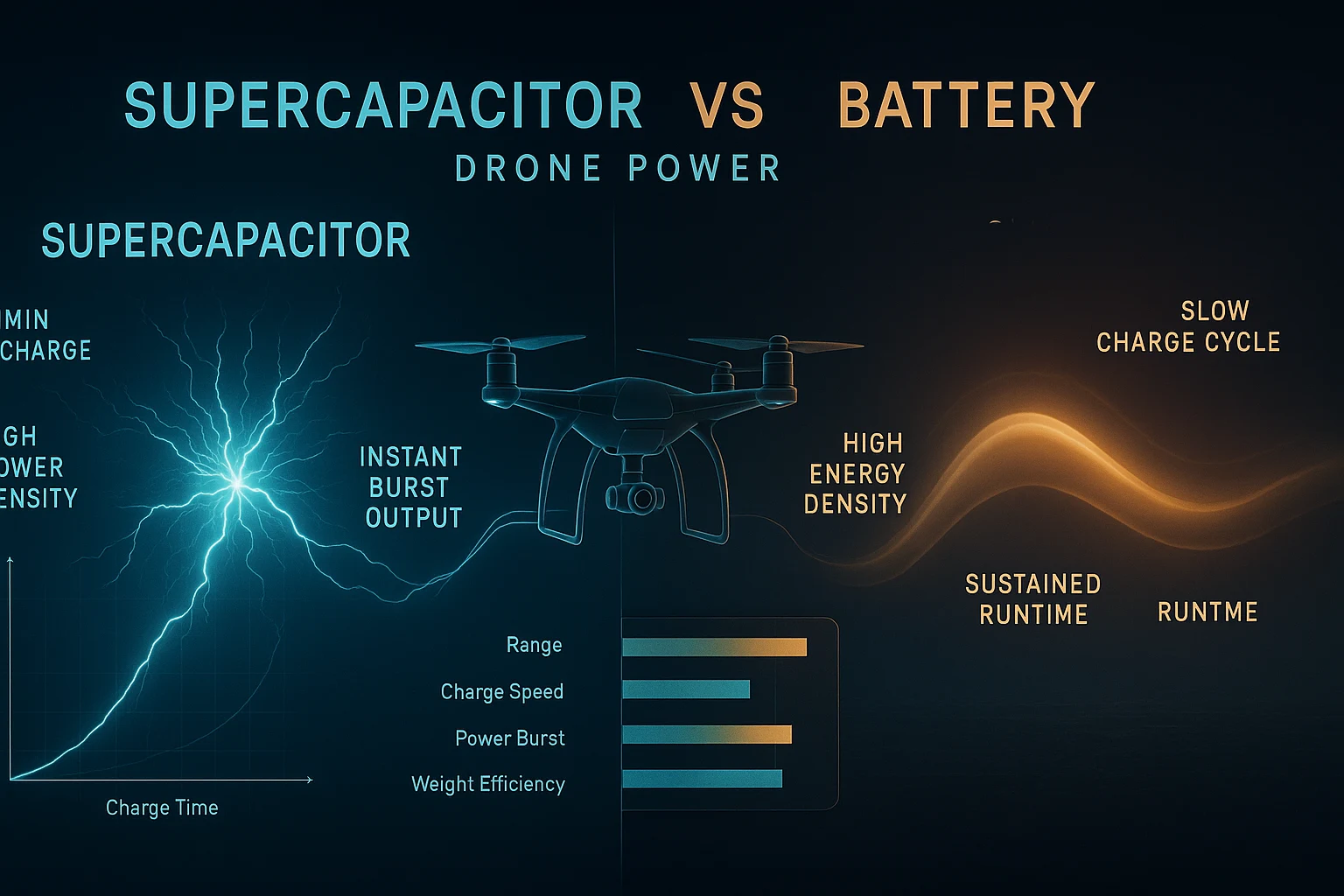
Supercapacitor vs Battery Drone Power: Why Builders Are Switching
RFOXiA SuperCapacitor Battery and Programmer Kit
Supercapacitor vs Battery Drone Power — The Question Every Serious Builder Should Ask
If you've ever had a drone mission cut short by a dead battery, waited 45 minutes for a LiPo to charge before you could run another test, or lost critical field data because your onboard electronics ran out of juice at the worst possible moment — you already understand the core problem this guide addresses.
The debate over supercapacitor vs battery drone power has been heating up in the hardware and robotics community for good reason. Supercapacitors are no longer exotic lab components reserved for automotive energy recovery systems or military applications. They've arrived in the maker ecosystem, and the implications for drone builders, IoT developers, field researchers, and embedded engineers are significant.
In this guide, we break down exactly how supercapacitors and conventional batteries compare for drone and wireless hardware applications, where each technology excels, where each falls short, and why a growing number of professional builders are choosing supercapacitor-based power systems for their field deployments.
We'll also show you a real-world implementation — the RFOXiA SuperCapacitor Battery and Programmer Kit — that packages supercapacitor power with integrated programming capability into a single professional-grade solution for the MultiNav Pro+ ecosystem.
What Is a Supercapacitor? (And How Is It Different From a Battery?)
A supercapacitor — also called an ultracapacitor or electric double-layer capacitor (EDLC) — stores energy electrostatically rather than chemically. This single distinction drives nearly every performance difference between supercapacitors and conventional batteries.
Conventional batteries store energy through chemical reactions. Charging a battery means driving a chemical change. Discharging it means reversing that change. These reactions are inherently slow, generate heat, degrade the electrode materials over time, and impose hard limits on how fast you can safely push energy in or out.
Supercapacitors store energy in an electric field between two electrodes separated by an electrolyte. There are no chemical reactions involved. Energy goes in and comes out as fast as the physical structure allows — which is extremely fast. This is why supercapacitors can be charged in seconds to minutes rather than hours, and why they can deliver massive peak currents without the voltage sag that plagues batteries under load.
Key Technical Differences
| Property | Lithium Battery | Supercapacitor |
|---|---|---|
| Charge time | 45–120 minutes | 30 seconds – 5 minutes |
| Cycle life | 300–1,000 cycles | 500,000–1,000,000 cycles |
| Peak current | Limited by chemistry | Extremely high |
| Energy density | High | Lower (but improving) |
| Temperature range | Narrow (degrades in cold) | Wide (-40°C to +65°C) |
| Self-discharge | Low | Moderate |
| Degradation | Significant over time | Minimal |
| Safety | Fire risk if overcharged | No thermal runaway risk |
For drone power systems and IoT field deployments, the charge time and cycle life columns tell most of the story.
The Supercapacitor vs Battery Drone Power Debate: Where Each Technology Wins
Where Batteries Win
Batteries still dominate one dimension: raw energy density. A LiPo pack stores significantly more energy per kilogram than any commercially available supercapacitor system. For applications where flight time is the primary constraint — consumer photography drones, agricultural spray drones, long-endurance survey platforms — batteries remain the right choice for the main propulsion power system.
If your application needs to run for hours on a single charge and weight is critical, a battery is still your primary energy storage solution.
Where Supercapacitors Win
Once you move beyond raw flight time and into the broader picture of operational efficiency, development workflow, reliability, and total cost of ownership, the supercapacitor vs battery drone power calculation starts to shift — often dramatically.
1. Development and Testing Workflow
Every hardware developer knows the frustration of waiting for a battery to charge between test iterations. A 5-minute charge cycle versus a 90-minute charge cycle doesn't sound dramatic until you're running 12 test iterations in a day. With a battery, those 12 tests might require 18 hours of charging. With a supercapacitor, the charging overhead essentially disappears.
For drone builders, robotics engineers, and IoT developers who are actively iterating on firmware and hardware, this matters enormously.
2. Cycle Life and Long-Term Cost
A quality LiPo battery rated for 500 cycles will need replacement after moderate use. A supercapacitor rated for 500,000 cycles is, for practical purposes, permanent. For field-deployed sensor nodes, research equipment, or any system that runs continuously, the maintenance cost of battery replacement is a real and recurring expense that supercapacitor systems eliminate.
3. Temperature Reliability
LiPo batteries lose capacity rapidly in cold temperatures and can behave unpredictably at temperature extremes. Supercapacitors maintain their performance characteristics across a much wider temperature range — critical for outdoor field deployments, high-altitude drone operations, and any application where ambient temperature is outside the comfortable 15–25°C range where batteries perform best.
4. Safety
LiPo thermal runaway is a real and well-documented risk. Overcharging, physical damage, or manufacturing defects can cause lithium batteries to ignite — a serious concern for indoor testing environments, shared workspaces, and drone operations over populated areas. Supercapacitors have no thermal runaway mechanism. They are intrinsically safer power storage elements.
5. Onboard Electronics Power — The Overlooked Use Case
Here's where the supercapacitor vs battery drone power discussion gets more nuanced than most articles acknowledge: for the onboard electronics systems of a drone or wireless platform — the flight controller, communication modules, GPS receiver, sensor array — you don't necessarily need the energy density of a LiPo. You need reliability, clean power delivery, and the ability to keep systems operational for extended periods without the complexity and risk of lithium chemistry.
This is exactly the use case that purpose-built supercapacitor power systems address.
Real-World Application: Powering the MultiNav Pro+ Ecosystem
The MultiNav Pro+ is RFOXiA's flagship long-range BLE module — an FCC-certified wireless development platform capable of 5km ground-to-ground range, 15–20km man-to-drone range, and 50km drone-to-drone range at 2Mbps data rate. It's the kind of hardware that gets deployed in demanding field environments: drone operations, remote sensor networks, long-range robotics, and off-grid IoT installations.
For hardware this capable, operating in environments this demanding, power reliability isn't optional. It's the difference between a successful deployment and a failed mission.
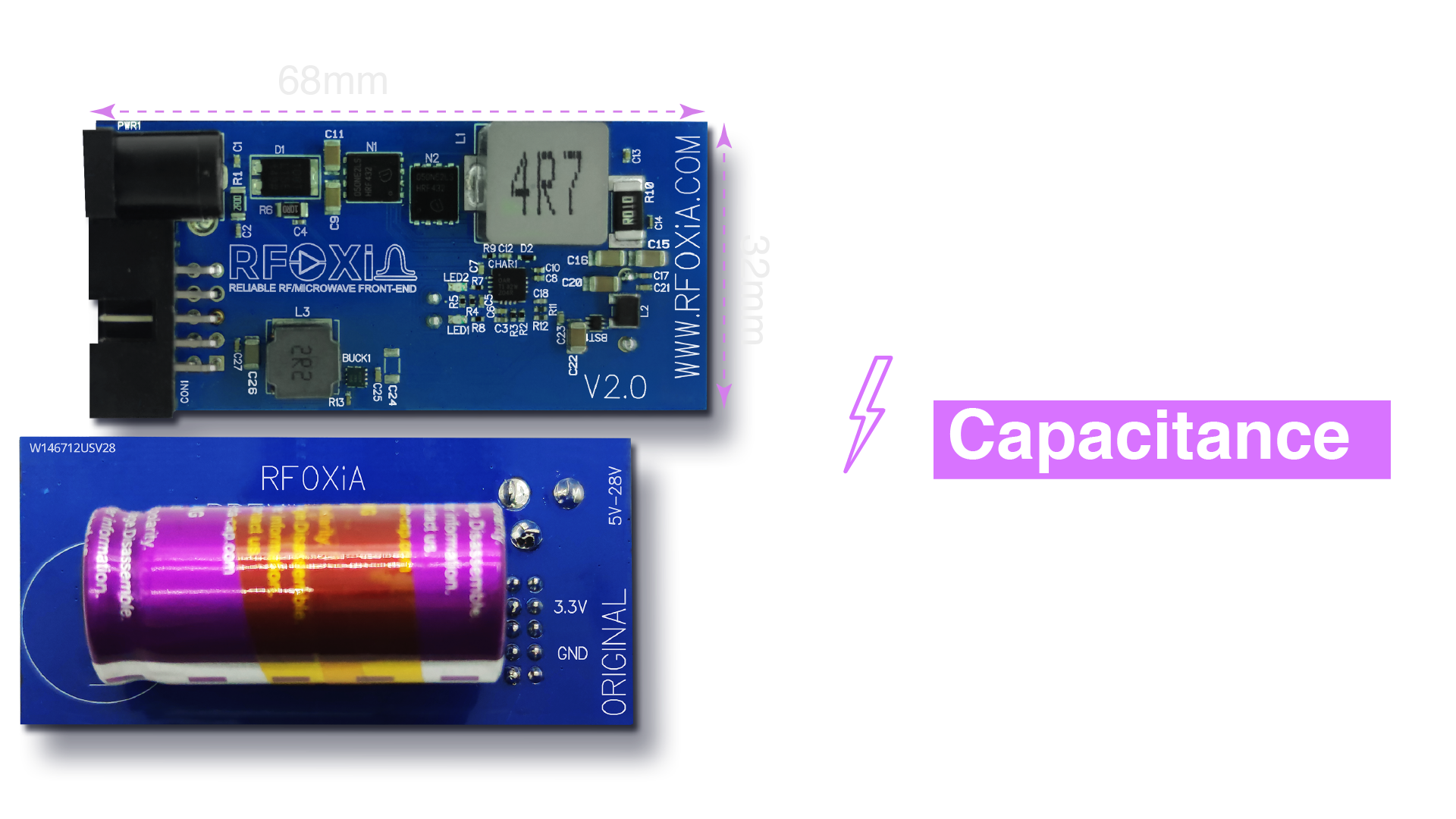
The RFOXiA Power/Program Kit was designed specifically around this reality. At its core is an 1100F supercapacitor system — storing 8,800 Joules of energy. That's enough to power the complete MultiNav Pro+ module stack for a full working day. And it charges to full capacity in under 5 minutes.
Let's put that in practical terms:
- You arrive at a field test location. Your power kit is discharged from yesterday's session.
- You plug in the charging adapter. You unpack your equipment, check your laptop, review your test plan.
- Five minutes later, your power system is fully charged and ready for a full day of operation.
Compare that workflow to managing a bank of LiPo batteries — charging overnight, monitoring charge levels, rotating packs, dealing with reduced capacity in cold weather — and the operational advantage becomes obvious.
The MultiNav Pro+ Power/Program Kit: Complete Feature Breakdown
1100F Super-Capacitance Battery System
The heart of the kit is a professional-grade supercapacitor bank. 1100 Farads of capacitance stores 8,800 Joules — sufficient energy to power the full MultiNav Pro+ module stack (BLE Module, GNSS Module, and Sensors Module simultaneously) for an entire working day.
The charge rate is equally impressive: the system accepts charge at 4V / 10A, enabling that industry-leading sub-5-minute full charge time. This isn't a marketing approximation — it's the physics of supercapacitor charging, which is limited only by how fast you can safely push current into the system rather than by slow chemical reaction kinetics.
High-Power Charging Adapter
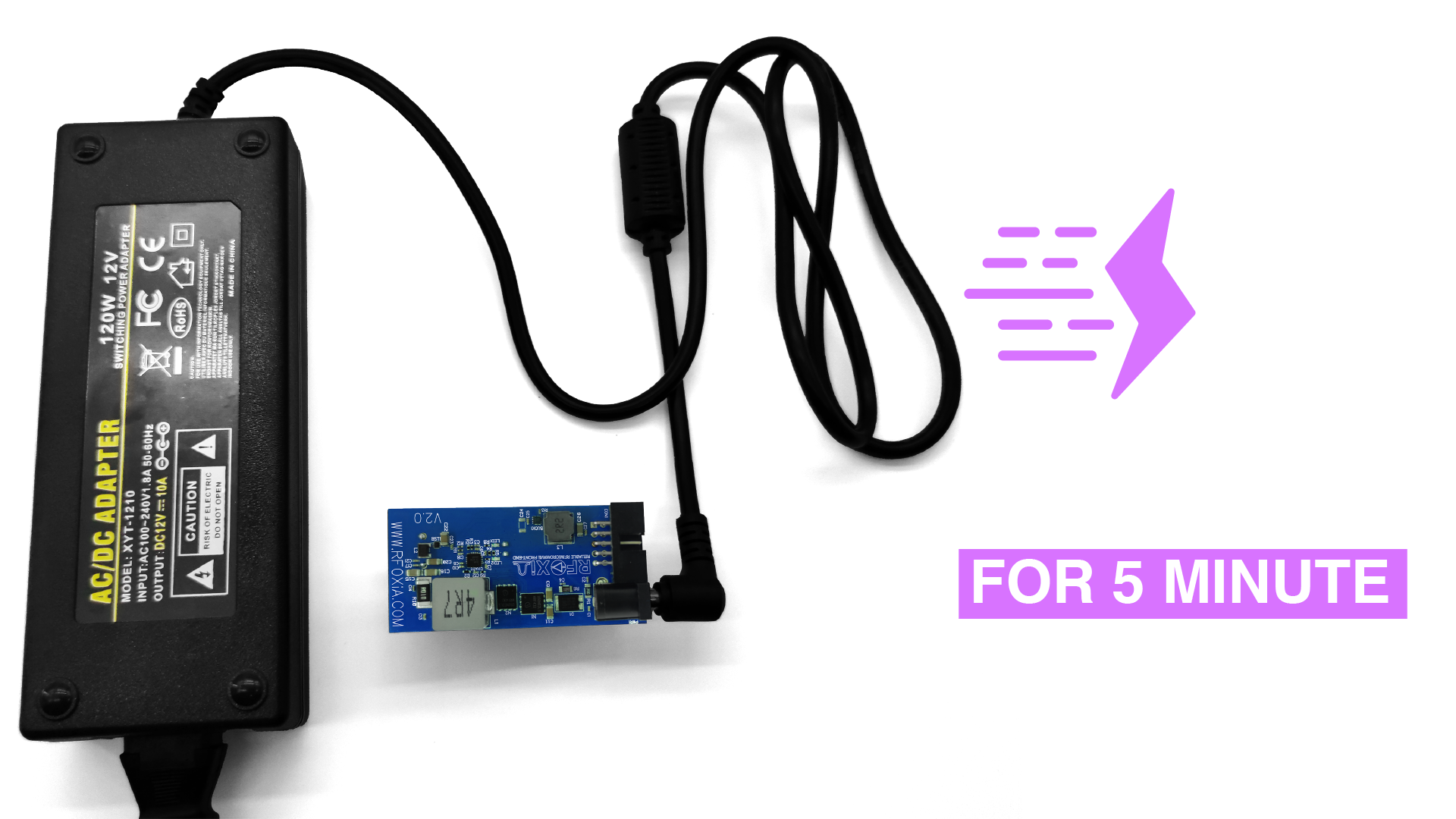
The included 12V / 5A adapter is matched to the supercapacitor system's charging requirements. This isn't a generic wall adapter thrown in as an afterthought — it's the power delivery component that enables the sub-5-minute charge time. The adapter delivers the right voltage and current profile to charge the supercapacitor bank quickly, safely, and repeatedly without degradation.
Unlike lithium battery chargers, which require sophisticated charge management algorithms (CC/CV, cell balancing, temperature monitoring) to avoid damaging the cells, supercapacitor charging is fundamentally simpler and more robust. The adapter charges the system; the system is ready; you go to work.
Full-Day Module Power
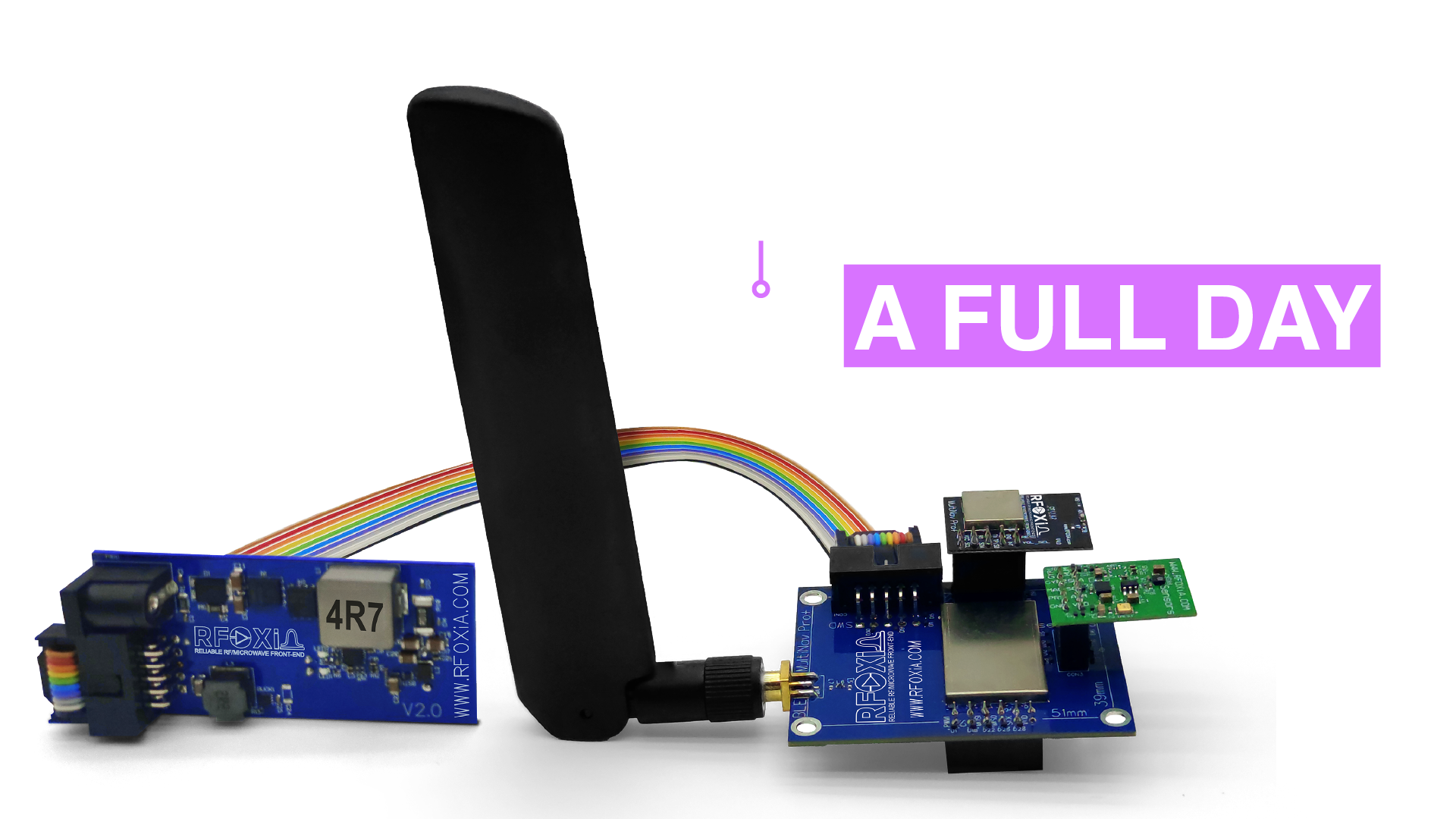
The 8,800 Joule storage capacity is calculated to power the entire MultiNav Pro+ module ecosystem — BLE Module, GNSS Module, and Sensors Module — simultaneously for a full working day. Whether you're running a stationary sensor network, operating a mobile research platform, or powering onboard drone electronics for extended field operations, the power kit keeps your system running without interruption.
This addresses one of the most common pain points in field IoT deployment: the complexity of power management. With a supercapacitor system of this capacity, you charge once in the morning and work all day. The power system disappears from your operational concerns and you focus on your actual application.
Integrated STLink Programmer
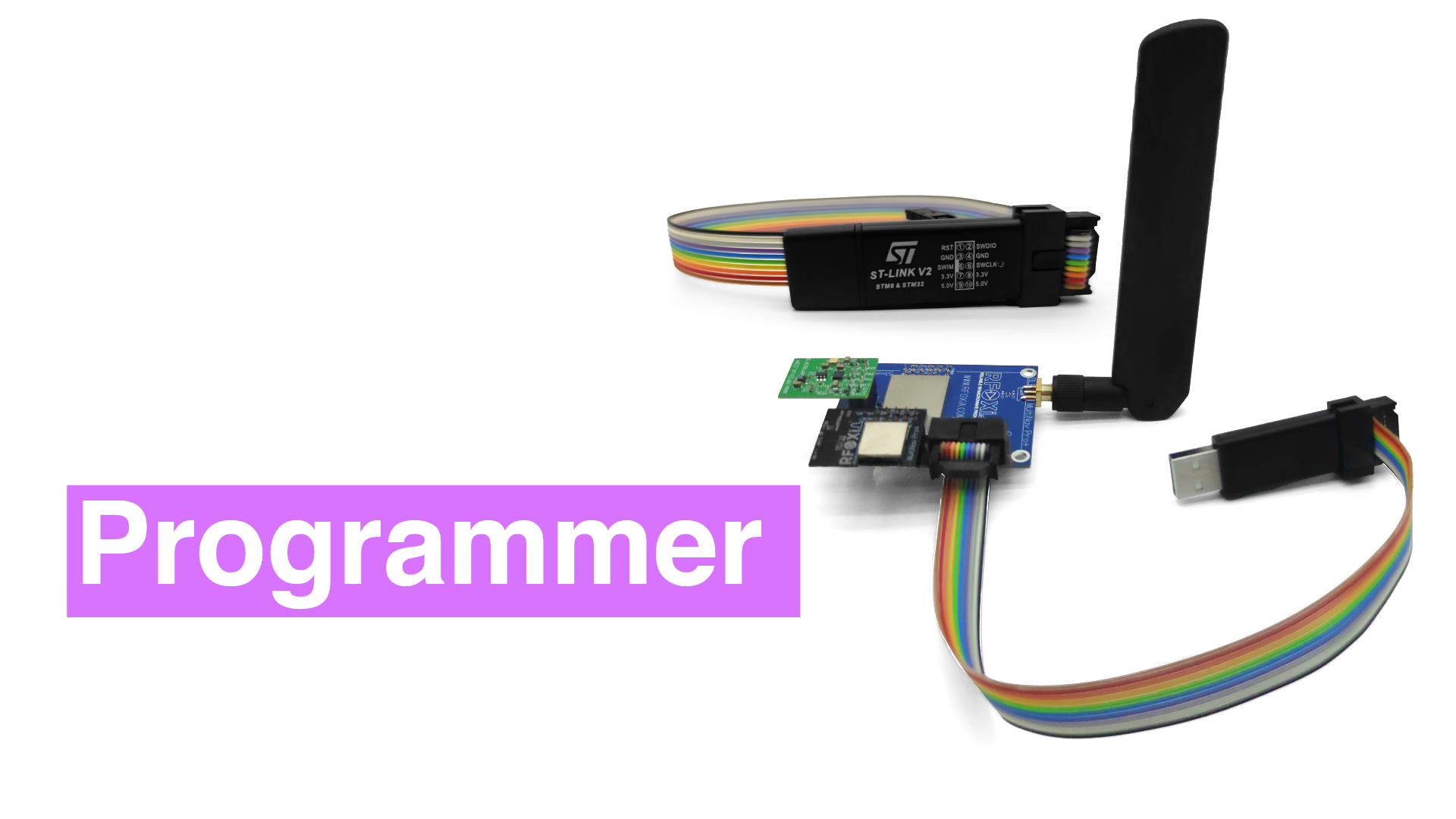
Here's where the Power/Program Kit goes beyond being a power solution and becomes an essential development tool. The integrated STLink programmer provides direct hardware-level access to the MultiNav Pro+ BLE Module for firmware flashing, debugging, and development.
For hardware developers, this matters. The STLink interface gives you:
- Firmware flashing — push new firmware to your BLE module directly from your development environment
- Hardware debugging — step through code execution at the hardware level, inspect registers, set breakpoints
- Development iteration speed — the combination of fast charging (power is always available) and integrated programming (no separate programmer to manage) dramatically accelerates the development cycle
This is particularly powerful when combined with RFOXiA's AI Firmware Builder — the Club platform feature that generates production-ready firmware from plain-language descriptions. You describe your application, the AI generates the firmware, and the STLink programmer in the Power/Program Kit flashes it to your hardware. The full cycle from concept to running firmware can happen in minutes.
Complete Connectivity Kit
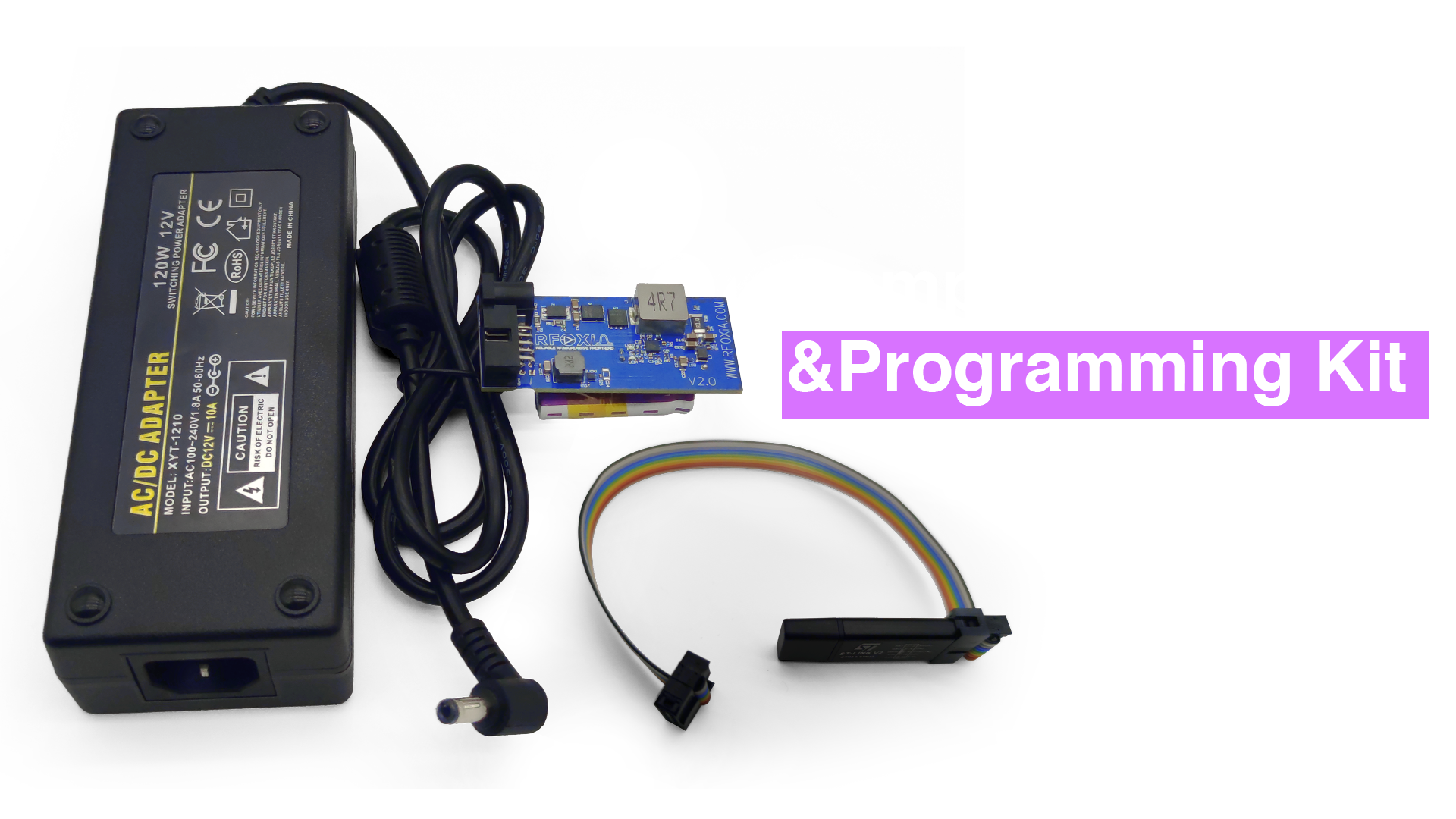
Every necessary cable is included. Flat ribbon cables connect the BLE module to the power module and the STLink programmer to the BLE module. This isn't a trivial detail — in a professional development kit, having the right cables ready means you spend zero time hunting for compatible connectors or improvising connections before you can get to work.
The flat ribbon cable design also matters for physical integration. Whether you're integrating the power kit into a compact drone enclosure, mounting it on a research platform, or deploying it in a weatherproof field enclosure, flat ribbon cables offer routing flexibility that bulkier round cables don't.
Who Should Use a Supercapacitor Power System?
The supercapacitor vs battery drone power question doesn't have a single universal answer — it depends on your specific application and priorities. Here's a practical guide:
Choose a supercapacitor system if:
- You're powering onboard electronics (flight controller, communication modules, sensors) rather than main propulsion motors
- You're running development and testing workflows where charge time directly impacts iteration speed
- You're deploying permanent or semi-permanent field installations where battery replacement is operationally costly
- You're operating in temperature-extreme environments where lithium chemistry becomes unreliable
- You're working in safety-sensitive environments where lithium thermal runaway risk is unacceptable
- You want a power system that genuinely lasts the life of your hardware
Maintain lithium batteries for:
- Main drone propulsion where energy density per kilogram is the primary constraint
- Applications requiring multi-hour continuous operation from a compact, lightweight source
- Cost-sensitive disposable or single-use deployments
For most serious hardware builders working with wireless development platforms like the MultiNav Pro+, the answer is both: lithium chemistry for main flight power, supercapacitor systems for onboard electronics, sensors, and communication modules. The RFOXiA SuperCapacitor Battery and Programmer Kit is designed exactly for this complementary role.
The Development Workflow Advantage
Let's be concrete about what a 5-minute charge time actually changes in a hardware development workflow.
A typical firmware development and testing cycle for a wireless module might look like this:
- Write or modify firmware (15–30 minutes)
- Flash firmware to hardware (2–5 minutes with STLink)
- Power up and test (10–30 minutes)
- Document results, plan next iteration (10–15 minutes)
- Repeat
With a battery-powered system, step 4 often includes "charge battery" — which adds 45–90 minutes of dead time per cycle. A developer running 6 test iterations in a day adds 4.5–9 hours of charging overhead. That's not a minor inconvenience. That's a productivity constraint that directly determines how fast you can ship.
With the supercapacitor Power/Program Kit, charging overhead drops to under 5 minutes per cycle. Six test iterations add 30 minutes of charging time instead of 9 hours. For active hardware development, this change is transformative.
And because the STLink programmer is integrated into the same kit as the power system, the physical setup of your development environment becomes simpler. One device handles both power delivery and firmware programming. Fewer cables, fewer components on your bench, fewer things to manage.
Supercapacitor Technology: What's Changed and Why It Matters Now
Supercapacitors have existed for decades, but early commercial versions were limited in energy density and voltage rating to the point where they were useful mainly as backup power for volatile memory — not as primary power sources for real hardware systems.
The past decade has seen significant advances in supercapacitor technology:
- Energy density has improved substantially through better electrode materials (activated carbon, graphene-based composites)
- Voltage ratings per cell have increased, and series stacking enables higher-voltage system designs
- Cost per Farad has dropped dramatically as manufacturing scale has increased
- Module-level products (pre-engineered supercapacitor banks with integrated protection and management circuits) have made supercapacitor power systems accessible without deep power electronics expertise
The result is that in 2025, a professionally engineered supercapacitor power system capable of powering a full wireless electronics stack for 24 hours — with sub-5-minute recharge — is a real, commercially available product at an accessible price point. This wasn't true five years ago.
Integrating with the Full RFOXiA Ecosystem
The Power/Program Kit isn't a standalone product — it's one component of the RFOXiA vertically integrated wireless development ecosystem. Understanding how it fits into the complete picture reveals the full value proposition.
MultiNav Pro+ BLE Module ($59 for 2 units) — the long-range wireless backbone, 5km ground range, 20km drone range, FCC certified.
GNSS Module ($49) — 18Hz, 1.5-meter precision GPS for fast-moving platforms.
Sensors Module ($39) — temperature, humidity, pressure, air quality, accelerometer, gyroscope, magnetometer in one compact board.
Power/Program Kit ($119) — supercapacitor power system plus STLink programmer.
Developer Bundle ($199 with credits) — all four modules in one integrated kit.
The Power/Program Kit sits at the foundation of this ecosystem: it powers the hardware and programs it. Combined with the AI Firmware Builder in RFOXiA Club (which generates production-ready firmware from plain-language descriptions) and the RFOXiA Connect mobile app (which provides PS5-style drone control, live GPS tracking, and off-grid mesh communication), the complete stack enables serious hardware development at a price point that was simply not available before.
For builders interested in the data monetization layer — deploying Sensors Modules as verified environmental data nodes and earning daily rewards — the Power/Program Kit's all-day runtime and rapid recharge make continuous, uninterrupted data streaming operationally practical.
Specifications Summary
Supercapacitor Bank
- Capacitance: 1100F
- Energy storage: 8,800 Joules
- Charge time: Under 5 minutes to full
- Runtime: Full working day powering complete MultiNav Pro+ module stack
Charging Adapter
- Input: Standard AC
- Output: 12V / 5A
- Supercapacitor charge rate: 4V / 10A
STLink Programmer
- Interface: SWD (Serial Wire Debug)
- Compatible with: MultiNav Pro+ BLE Module
- Capabilities: Firmware flashing, hardware debugging
Included Cables
- Flat ribbon cable (power module to BLE module)
- Flat ribbon cable (STLink programmer to BLE module)
- All necessary connection hardware
Certification: FCC certified
Price: $119
Final Verdict: Supercapacitor vs Battery Drone Power for Electronics Systems
The supercapacitor vs battery drone power debate resolves differently depending on what you're powering. For main propulsion, batteries still win on energy density. For onboard electronics — communication modules, GPS receivers, environmental sensors, flight controllers — supercapacitor systems offer a compelling combination of rapid recharge, extreme cycle life, temperature resilience, and safety that batteries simply cannot match.
For hardware developers actively building and testing wireless systems, the 5-minute charge time alone represents a workflow transformation that is difficult to overstate. When your power system stops being a bottleneck, your development velocity increases — and in hardware development, velocity is everything.
The RFOXiA SuperCapacitor Battery and Programmer Kit delivers professional-grade supercapacitor power, an integrated STLink programmer, and all necessary connectivity hardware in a single purpose-built solution for the MultiNav Pro+ ecosystem. At $119, it's the professional power infrastructure your wireless hardware deserves.
Ready to eliminate charging delays from your workflow? Explore the complete MultiNav Pro+ Power/Program Kit and the full RFOXiA developer ecosystem at rfoxia.com.
RFOXiA is a Delaware-based hardware technology company building a vertically integrated wireless development ecosystem. All RFOXiA hardware modules are FCC certified and available for immediate shipment.
Written by: Moamen Mohamed LinkedIn