
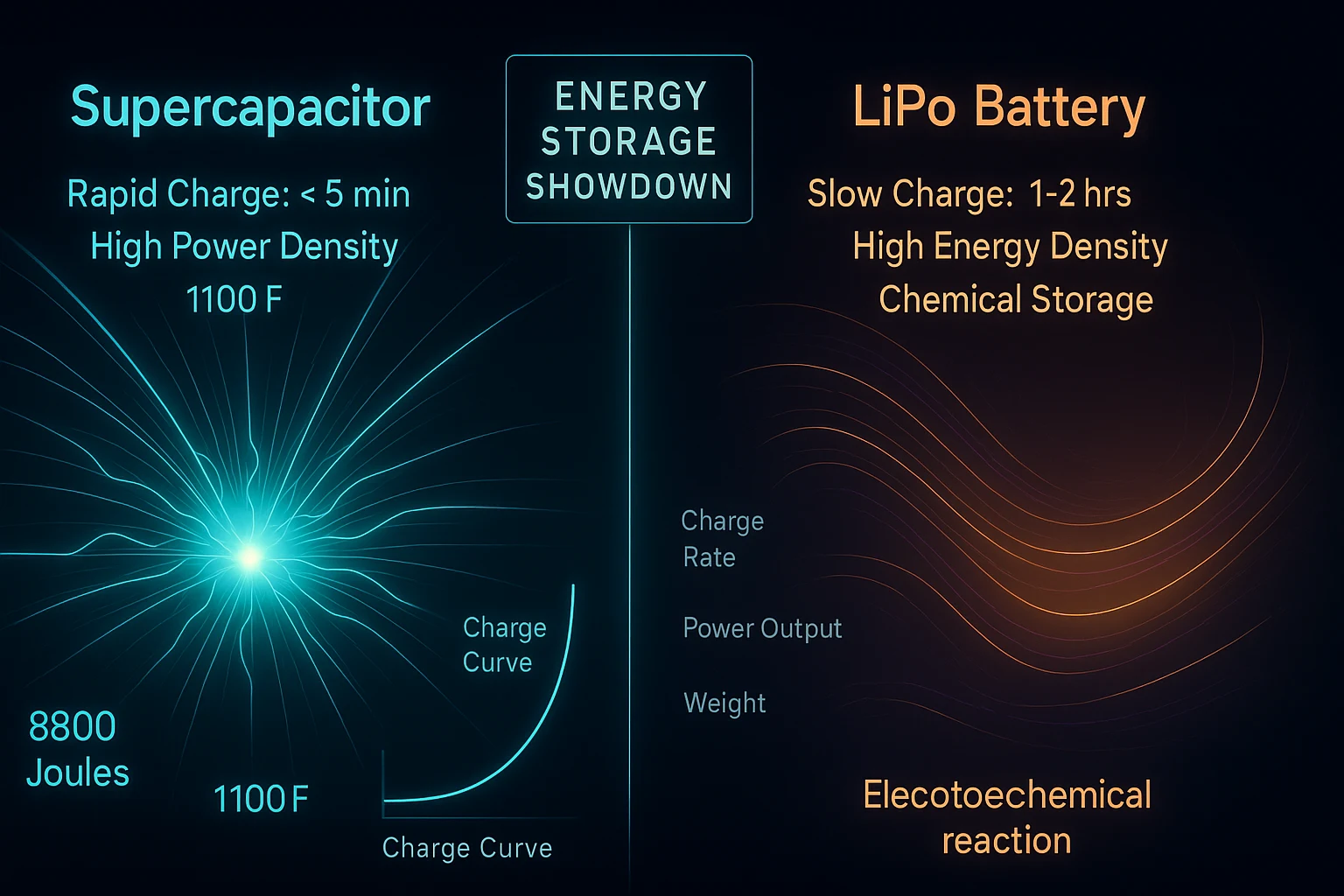
Supercapacitor vs LiPo Battery Maker: The Power Decision That Defines Your Build
RFOXiA SuperCapacitor Battery and Programmer Kit
Why Your Power Source Is the Most Underrated Design Decision in Hardware Development
Every hardware developer obsesses over the right microcontroller, the right radio module, the right sensor array. But the power source? That usually gets picked last, almost as an afterthought. A LiPo from the parts drawer. A USB power bank. Whatever fits the enclosure.
That approach costs you in the field. Dead batteries mid-test. Hour-long charge cycles between sessions. Thermal runaway risks in tight enclosures. Degraded capacity after a few hundred cycles. If you've been building wireless systems, drones, field sensors, or IoT nodes for any length of time, you've felt every one of these pain points firsthand.
The debate of supercapacitor vs LiPo battery for makers is not just academic. It is a practical engineering decision that determines whether your project runs reliably in the real world or fails you at the worst possible moment. This article breaks down both technologies with honest numbers, explains exactly where each excels and where each falls short, and shows you why the RFOXiA SuperCapacitor Battery and Programmer Kit was engineered specifically to solve the power problems that field developers face every single day.
Understanding the Fundamentals: How LiPo and Supercapacitors Actually Store Energy
How LiPo Batteries Work
Lithium Polymer batteries store energy electrochemically. Ions move between anode and cathode through an electrolyte during charge and discharge cycles. This gives LiPo batteries an excellent energy density — typically 100 to 265 Wh/kg — which means a small, lightweight cell can store a substantial amount of energy relative to its mass.
That energy density is the reason LiPo batteries dominate in consumer electronics, FPV racing drones, RC vehicles, and portable devices. When you need maximum runtime in minimum weight and volume, LiPo chemistry is hard to beat on a pure joule-per-gram basis.
But that electrochemical process comes with real limitations:
- Charge time: A healthy LiPo charge cycle using a standard 1C rate takes approximately the same number of hours as the capacity in amp-hours. A 2Ah pack takes roughly 2 hours. Even with fast charging, you're looking at 45 minutes to an hour for a full charge on most maker-grade cells.
- Cycle life: Most LiPo batteries are rated for 300 to 500 full charge/discharge cycles before capacity degrades meaningfully. High-quality cells may reach 800 to 1000 cycles with careful management.
- Temperature sensitivity: LiPo performance degrades significantly in cold temperatures. Capacity can drop 20 to 40 percent at 0°C. Charging a LiPo below freezing can cause permanent damage or lithium plating.
- Safety: LiPo cells can swell, vent, or in worst cases enter thermal runaway if punctured, overcharged, or subjected to high ambient temperatures. Field deployments in uncontrolled environments require careful management.
- Self-discharge: LiPo cells self-discharge at roughly 1 to 5 percent per month, which matters for nodes that sit idle between deployments.
How Supercapacitors Work
Supercapacitors — also called ultracapacitors or electrochemical double-layer capacitors — store energy electrostatically rather than electrochemically. Charge accumulates in an electrical double layer at the interface between the electrode and the electrolyte. There is no chemical reaction involved in normal operation.
This physical storage mechanism is what gives supercapacitors their defining characteristics:
- Charge time: Because no chemical reaction needs to occur, supercapacitors can accept charge as fast as you can deliver current safely. Charge times measured in seconds to minutes, not hours.
- Cycle life: Without the chemical degradation that limits battery cycle life, supercapacitors are rated for 500,000 to 1,000,000 cycles or more. Effectively unlimited for any practical application.
- Temperature performance: Supercapacitors maintain performance across a much wider temperature range than LiPo cells, typically -40°C to +65°C or beyond depending on the specific cell chemistry.
- Safety: No flammable electrolyte in most designs. No thermal runaway risk. Safer for deployment in enclosed spaces, high-temperature environments, and unmanned field installations.
- Power density: Supercapacitors can deliver very high instantaneous current — much higher than LiPo cells of comparable size — making them excellent for applications with high peak current demands.
The traditional limitation of supercapacitors has been energy density. A supercapacitor stores far fewer joules per kilogram than a LiPo cell. That limitation has historically made supercapacitors suitable only for short-duration burst applications — power backup for RAM, regenerative braking in vehicles, hold-up power for industrial equipment.
But that limitation changes dramatically when you scale the supercapacitor system appropriately for the load.
The Real Comparison: Supercapacitor vs LiPo Battery for Makers in Field Applications
When makers and hardware developers weigh supercapacitor vs LiPo battery options, the comparison usually gets oversimplified. "Supercaps are for bursts, batteries are for runtime" is the conventional wisdom — and it was accurate when supercapacitor cells were small and expensive.
Large-format supercapacitor systems change this equation completely.
| Characteristic | LiPo Battery | Supercapacitor System |
|---|---|---|
| Charge time (full) | 45 min – 3 hours | Under 5 minutes |
| Cycle life | 300 – 1000 cycles | 500,000+ cycles |
| Energy density | High | Moderate |
| Peak current delivery | Moderate | Very high |
| Cold temperature performance | Degrades significantly | Stable |
| Safety | Thermal runaway risk | No thermal runaway |
| Long-term cost | Replace every 1-2 years | Effectively permanent |
| Field recharge convenience | Poor | Excellent |
For makers deploying wireless sensor nodes, GNSS trackers, or long-range BLE systems in field conditions, the supercapacitor advantages in charge time, cycle life, temperature stability, and safety are not marginal improvements. They are fundamental operational differences.
The developer doing a full day of flight testing cannot afford 90 minutes of charging downtime between sessions. The researcher deploying environmental nodes in a remote location cannot swap battery packs easily. The drone builder running iterative firmware tests needs power available immediately, not after a charge cycle.
Introducing the RFOXiA MultiNav Pro+ Power/Program Kit
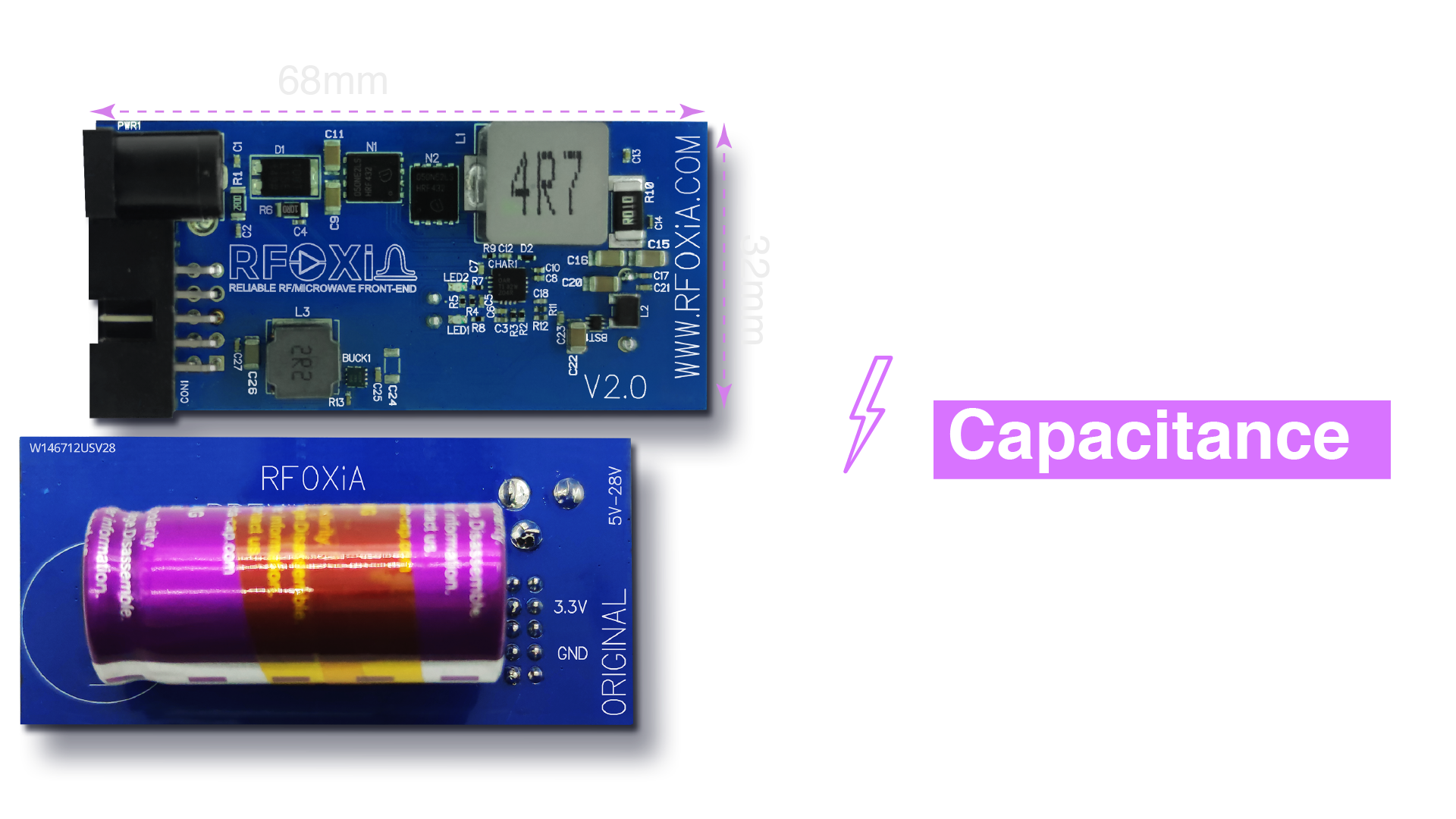
The MultiNav Pro+ Power/Program Kit is RFOXiA's direct answer to the power problem that every serious hardware developer faces. It was designed specifically for developers working with the MultiNav Pro+ BLE Module and the full MultiNav Pro+ module ecosystem, but the engineering decisions behind it reflect a broader philosophy: field hardware should work when you need it, charge when you have a moment, and never slow down your development process.
The Supercapacitor System: 1100F, 8800 Joules, 5-Minute Charge
At the core of the Power/Program Kit is a 1100F supercapacitor system storing 8800 joules of energy. To put that in practical terms: 8800 joules is enough to power the complete MultiNav Pro+ module stack — BLE Module, GNSS Module, and Sensors Module running simultaneously — for a full working day.
The charge time for this entire 8800-joule system is under 5 minutes using the included high-power charging adapter. That is not a peak or ideal-conditions figure. That is the operational charge time in practice.
Compare that to a LiPo system of equivalent runtime capability. You would be looking at a pack with 2 to 3 Ah of capacity at 3.7V, giving you approximately 7 to 11 Wh. Charging that at a standard 1C rate takes 2 to 3 hours. Even with fast charging at 2C or 3C — which accelerates degradation and requires careful thermal management — you are still looking at 45 minutes minimum.
The 5-minute charge of the supercapacitor system versus the 45-minute to 3-hour charge of a comparable LiPo system is not an incremental improvement. It is a complete elimination of charging as a workflow bottleneck.
The High-Power Charging Adapter
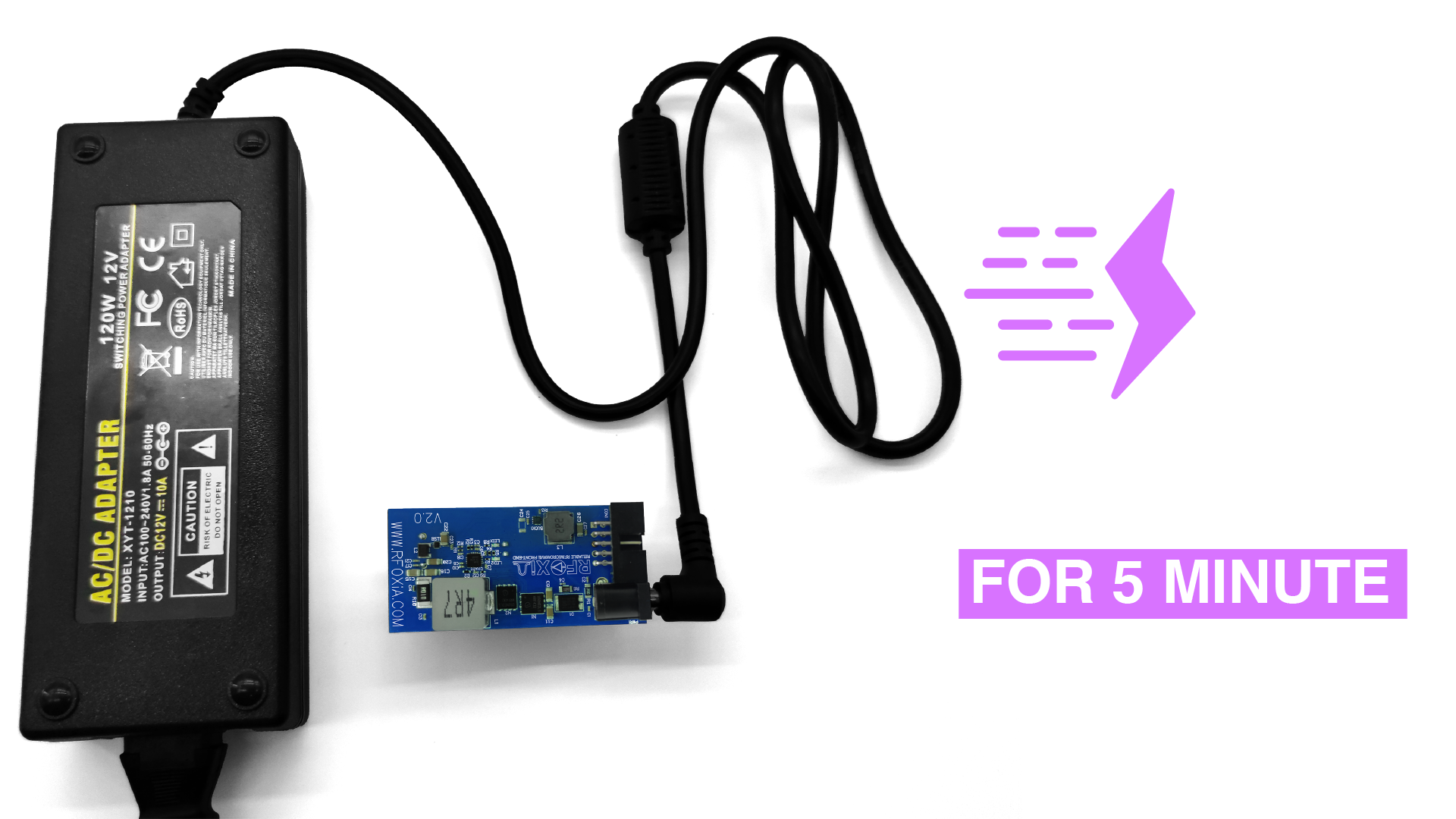
The included 12V 5A adapter delivers power at 4V 10A to the supercapacitor system — the high current rate that enables the sub-5-minute charge time. This is not a standard USB charger. It is a purpose-built high-power charging solution matched to the supercapacitor system's ability to accept charge at rates that would destroy a LiPo cell.
This matters in the field. You arrive at the test site. You run a session. You plug in for five minutes while you review data. You run another session. The power system is no longer the rate-limiting factor in your development cycle.
Full-Day Power for the Complete Module Stack
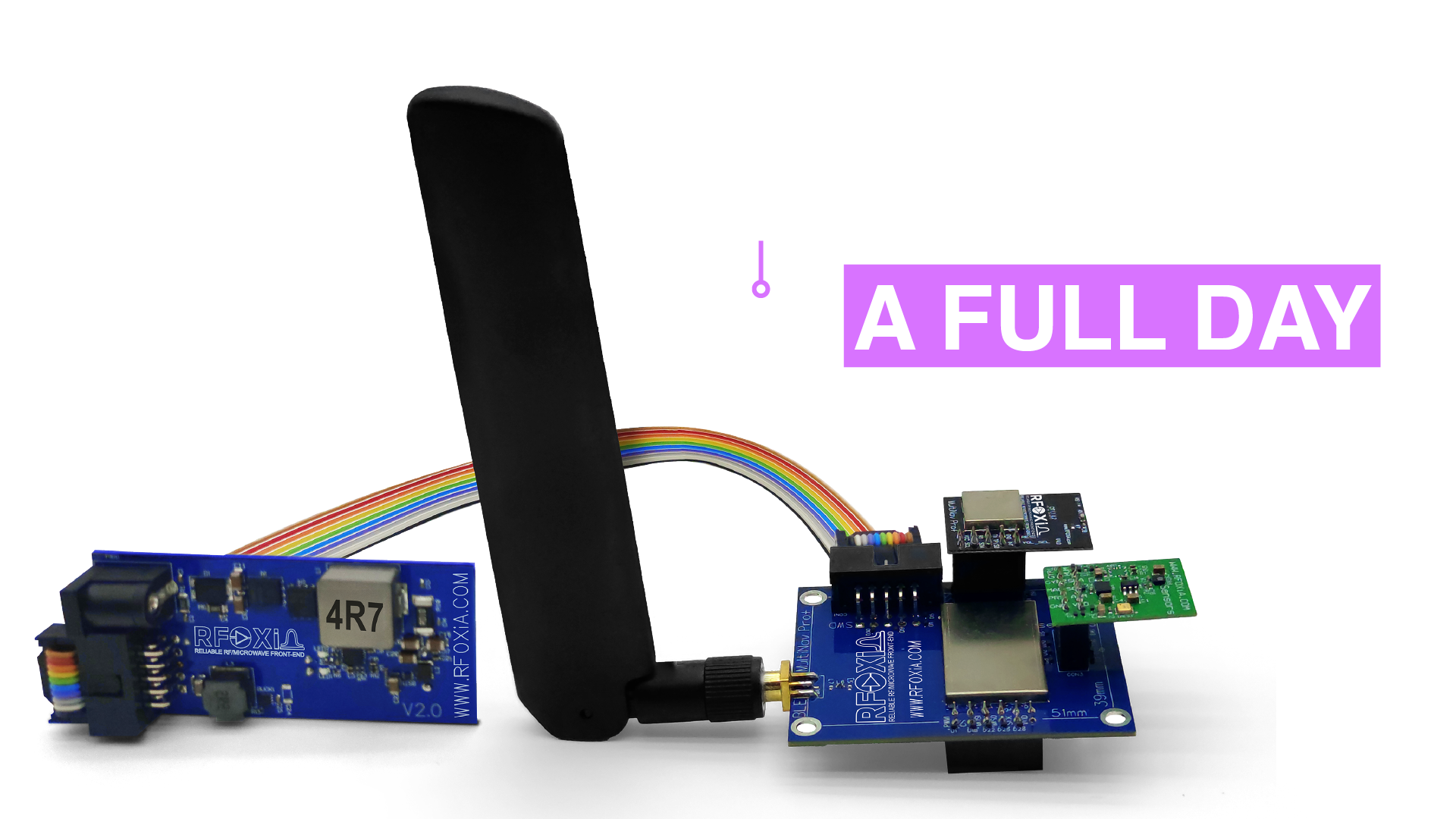
The Power/Program Kit is capable of powering the entire MultiNav Pro+ module ecosystem for a full working day on a single charge. That means the BLE Module, GNSS Module, and Sensors Module running together, streaming data, maintaining long-range BLE connections, and logging GPS fixes at 18Hz — all powered from a single 5-minute charge.
For IoT developers deploying sensor nodes, this changes the economics of field deployment significantly. A node powered by a supercapacitor system that charges in 5 minutes and lasts 24 hours requires almost no operational overhead. Maintenance visits become brief. Downtime is measured in minutes, not hours.
The STLink Programmer: Firmware Development Without Friction
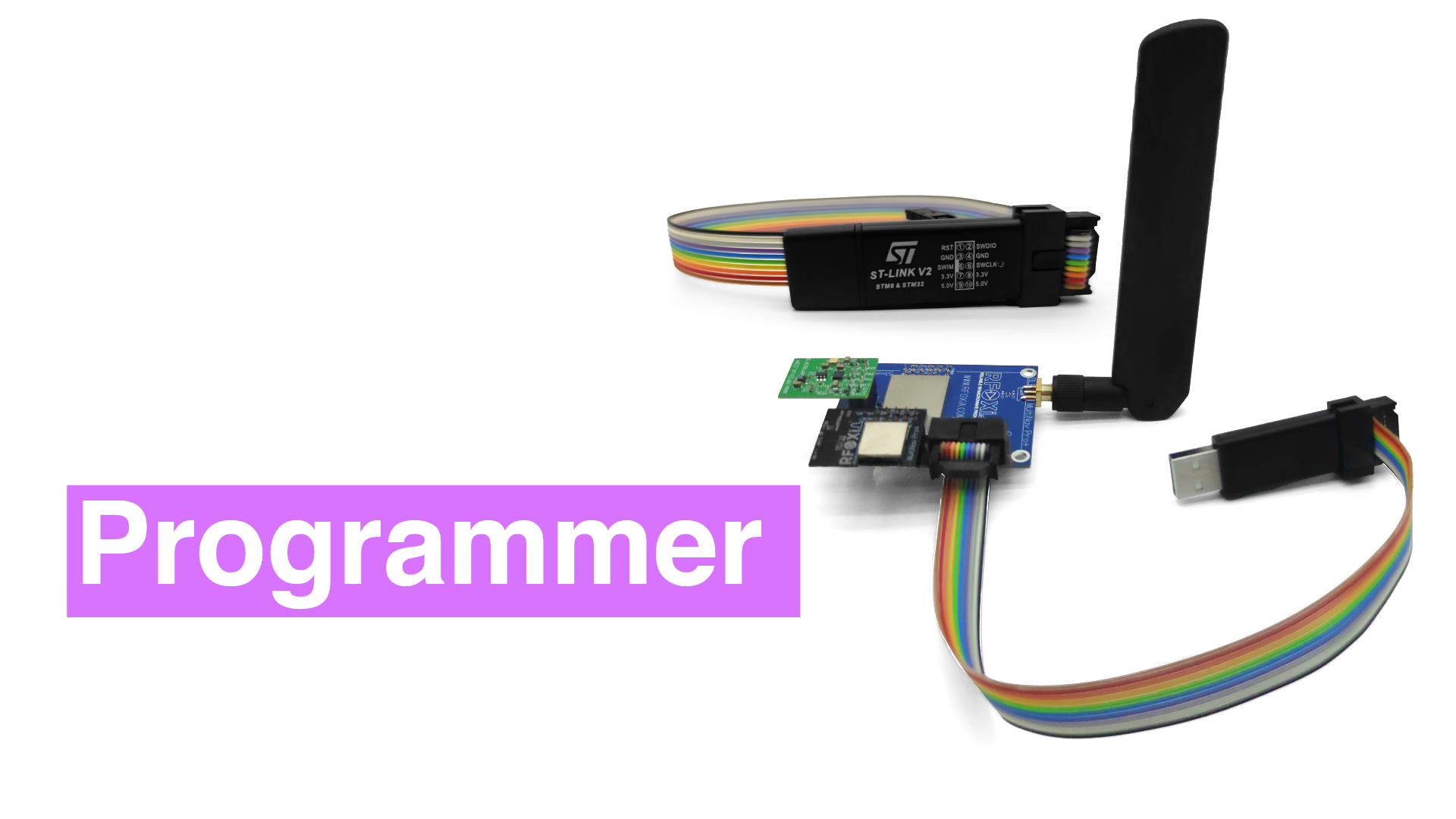
The Power/Program Kit includes an integrated STLink programmer interface for the MultiNav Pro+ BLE Module. This is a meaningful inclusion that removes a significant friction point from the firmware development workflow.
Programming the MultiNav Pro+ BLE Module — which is built around the STM32WB07 — requires an STLink programmer. Without the included programmer, developers need to source one separately, manage a separate USB connection, and deal with the cable management overhead of an additional device on their bench.
The integrated STLink programmer in the Power/Program Kit connects directly to the BLE Module via the included flat ribbon cables. Power and programming are handled by the same kit. The development workflow becomes:
- Connect the Power/Program Kit
- Write firmware in your IDE (or use RFOXiA's AI Firmware Builder to generate it)
- Flash directly through the STLink interface
- Test with full-day battery runtime
- Iterate
For developers using RFOXiA's AI Firmware Builder — which generates production-ready STM32WB07 firmware from plain-language descriptions — the ability to flash immediately from the same kit that powers the module makes the full development cycle seamless. You describe your application, get firmware, flash it, and test it, all without touching a separate programmer.
The firmware repository for the MultiNav Pro+ BLE Module is available on GitHub at https://github.com/RFOXiA/MultiNav-Pro-Long-Range-BLE-Module-Firmware-STM32WB07, giving developers a full starting point for custom firmware development.
Complete Connectivity: Everything Included
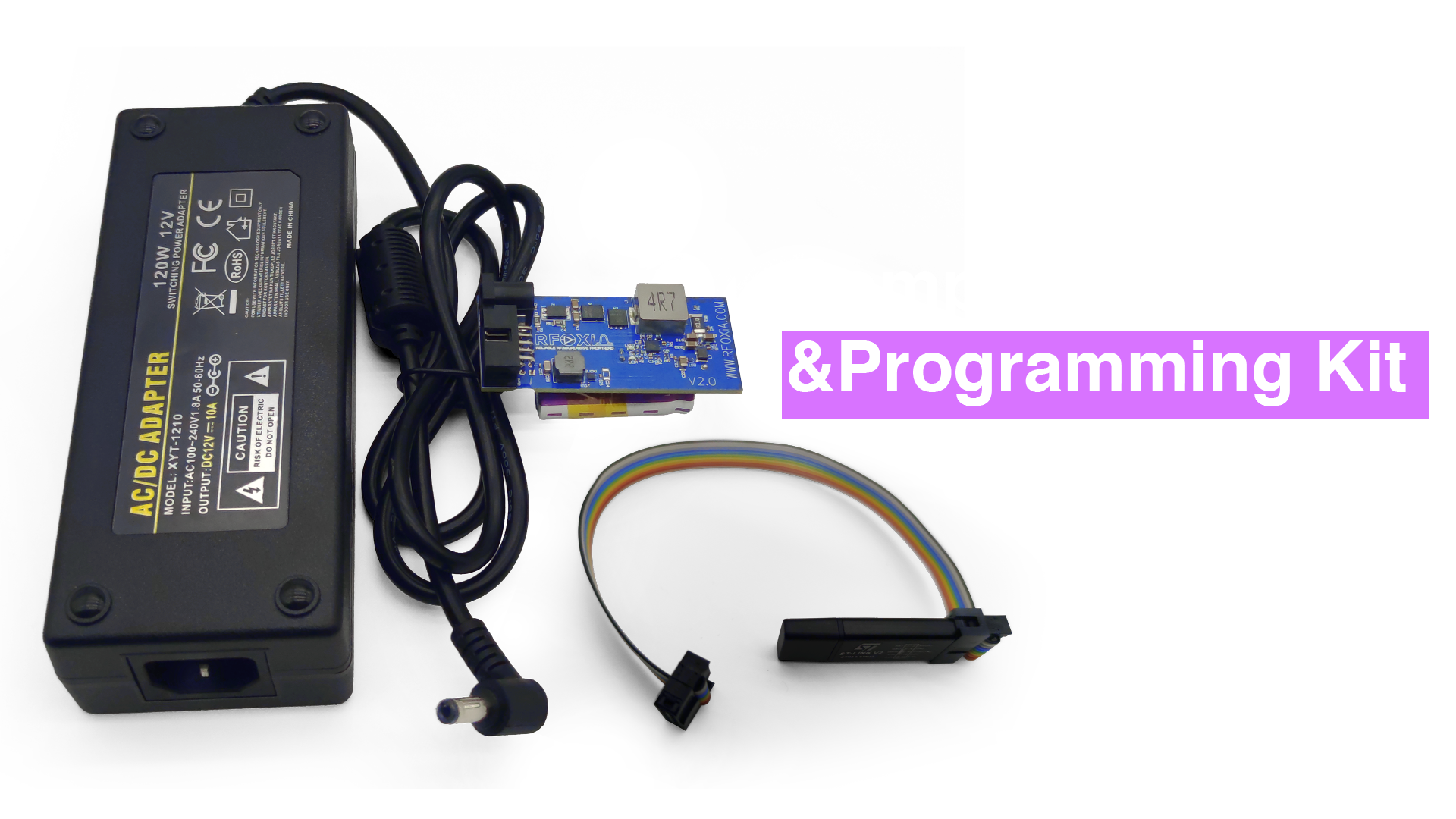
The Power/Program Kit ships with all cables required for immediate operation. The flat ribbon cables connect the BLE Module to the power module and the STLink programmer to the BLE Module. No additional cables to source. No connectors to crimp. No compatibility research required.
This completeness matters more than it might seem. Hardware developers lose real time sourcing cables, discovering compatibility issues, and waiting for shipping. The Power/Program Kit is designed to be operational within minutes of unboxing, not after a secondary order from a components supplier.
Where the Supercapacitor Advantage Is Most Pronounced
The supercapacitor vs LiPo battery for maker comparison resolves most clearly in favor of supercapacitors in specific use cases. The MultiNav Pro+ Power/Program Kit is engineered for exactly these scenarios:
Iterative Firmware Development
Repeat flash-test-revise cycles demand immediate power availability. A 5-minute recharge between sessions eliminates the dead time that characterizes LiPo-powered development rigs.
Field Testing of Long-Range Systems
Testing a 5km ground-to-ground or 15-20km man-to-drone link requires moving between locations, running multiple sessions, and maintaining consistent power throughout. The supercapacitor system charges from a vehicle's 12V outlet in 5 minutes and powers the module stack for the rest of the day.
Remote Sensor Node Deployment
Nodes deployed in locations with limited access benefit enormously from the cycle life advantage. Where a LiPo system might require battery replacement after 300 to 500 cycles — perhaps 1 to 2 years of daily operation — the supercapacitor system operates indefinitely without capacity degradation.
Cold-Weather Operation
Drone operators and field researchers working in winter conditions know how dramatically LiPo performance drops below freezing. The supercapacitor system maintains its rated performance across the full operating temperature range, making it reliable in environments where LiPo-powered systems become unpredictable.
High-Reliability Unattended Operation
The absence of thermal runaway risk makes supercapacitor-powered nodes safer for unattended installation in enclosures, attics, equipment bays, and other locations where a lithium fire would be catastrophic.
Pricing and Value: $119 for Professional-Grade Power Management
The MultiNav Pro+ Power/Program Kit is priced at $119. That price includes:
- 1100F supercapacitor system (8800 joules, 24-hour runtime)
- 12V 5A high-power charging adapter
- Integrated STLink programmer
- All flat ribbon cables for BLE Module, GNSS Module, and Sensors Module connectivity
For context: a standalone STLink programmer costs $20 to $30. A professional-grade supercapacitor energy storage module of comparable capacity costs $50 to $100 from industrial suppliers, without the power management circuitry, without the charging adapter, and without the integration into the MultiNav Pro+ ecosystem.
The Power/Program Kit bundles all of this into a single, immediately operational product at a price point that makes professional-grade field power management accessible to individual developers and small teams, not just enterprise engineering departments.
For developers building out the full RFOXiA ecosystem, the Power/Program Kit is included in the Developer Bundle, which combines the BLE Module, GNSS Module, Sensors Module, and Power/Program Kit at a bundled price that represents significant savings over individual module purchases.
You can order the RFOXiA SuperCapacitor Battery and Programmer Kit directly from the RFOXiA store, with FCC-certified hardware shipping from current inventory.
The Long-Term Cost Argument: Supercapacitor vs LiPo Battery for Makers Who Build Seriously
When you account for the full lifecycle cost, the supercapacitor vs LiPo battery maker comparison shifts even more strongly toward supercapacitors for serious builders.
A LiPo battery suitable for powering a full module stack for a day costs approximately $15 to $25. At 500 cycles, you replace it after roughly 1.5 years of daily use. Over 5 years, you replace it 3 times. Total battery cost over 5 years: $45 to $75, plus the time and friction of sourcing, receiving, and replacing the battery each time.
A supercapacitor system rated for 500,000 cycles does not degrade meaningfully over any timeframe a maker project is likely to operate. The upfront cost is higher. The total cost of ownership over the life of the project is dramatically lower — and more importantly, the operational reliability is dramatically higher.
For developers running data network nodes through RFOXiA's sensor data monetization program — where consistent uptime directly translates to daily earnings — that reliability is not just a convenience. It is revenue. A node that goes offline because a LiPo failed is a node that is not earning. A supercapacitor-powered node that charges in 5 minutes and runs for 24 hours is a node that stays in service.
Summary: Why the Power/Program Kit Exists and Who It's Built For
The MultiNav Pro+ Power/Program Kit was designed for a specific kind of developer: someone building real wireless systems for real applications, working in the field or at the bench, who cannot afford power system failures, cannot afford hours of charge time, and cannot afford the friction of sourcing separate programming hardware.
The choice between supercapacitor vs LiPo battery for makers working at this level is not close. The supercapacitor system wins on charge time, cycle life, temperature range, safety, and long-term cost. The Power/Program Kit delivers all of that in a single integrated package with a professional STLink programmer included, priced at $119 with all cables and adapters in the box.
If you're building with the MultiNav Pro+ ecosystem — or if you're evaluating it — the Power/Program Kit is not optional equipment. It is the foundation that makes serious field development possible.
Get the RFOXiA SuperCapacitor Battery and Programmer Kit and eliminate power as the variable that limits your builds.
RFOXiA builds professional-grade wireless hardware for developers who build things that matter. All MultiNav Pro+ modules are FCC certified and ship from current inventory. New to RFOXiA? Create a free account at rfoxia.com and claim your $10 welcome credit.
Written by: Moamen Mohamed LinkedIn