
u-blox vs RFOXiA GNSS Module: The Precision Navigation Showdown Every Builder Needs to See
u-blox vs RFOXiA GNSS Module — Why the Right Choice Depends on More Than Just a Chip
If you have spent any time sourcing GNSS hardware for a drone, a robotics project, a precision agriculture sensor, or any IoT application that demands real location accuracy, you have almost certainly encountered the name u-blox. They are the gold standard chip manufacturer in the GNSS world — and for good reason. Their silicon powers everything from consumer wearables to industrial survey equipment.
But here is the question that too many developers fail to ask: Are you buying a chip, or are you buying a complete, deployable module?
That distinction matters more than almost anything else when you are trying to get a project into the field quickly, reliably, and at a price that does not blow your entire component budget on a single board.
This post breaks down the u-blox vs RFOXiA GNSS module decision in full detail — covering accuracy, fix rate, constellation support, integration effort, software ecosystem, and real-world use cases. By the end, you will know exactly which option fits your build, your timeline, and your budget.
What u-blox Actually Is (And What It Is Not)
u-blox is a Swiss semiconductor company that designs GNSS receiver chips, cellular modules, and positioning ICs. Their GNSS chips — including the widely used series of M8, M9, and now M10 cores — are genuinely excellent silicon. They appear inside products made by Garmin, DJI, Trimble, and hundreds of other hardware companies.
When developers refer to "using u-blox" in their projects, they typically mean one of two things:
- Purchasing a raw u-blox chip (like the UBX-M10050 or MIA-M10Q) and designing their own PCB around it — requiring RF layout expertise, antenna design, power regulation, filtering, and firmware integration.
- Purchasing a third-party breakout or module built around a u-blox chip, which abstracts away most of the hardware complexity.
Option 1 is realistic only for experienced RF hardware engineers. Option 2 is what most makers and developers actually end up doing — and that is exactly where the u-blox vs RFOXiA GNSS module comparison becomes most relevant.
Because when you are comparing ready-to-use modules, you are no longer comparing chips. You are comparing the entire integration package: antenna performance, filtering, power design, software library quality, documentation, and ecosystem support.
Introducing the RFOXiA MultiNav Pro+ GNSS Module
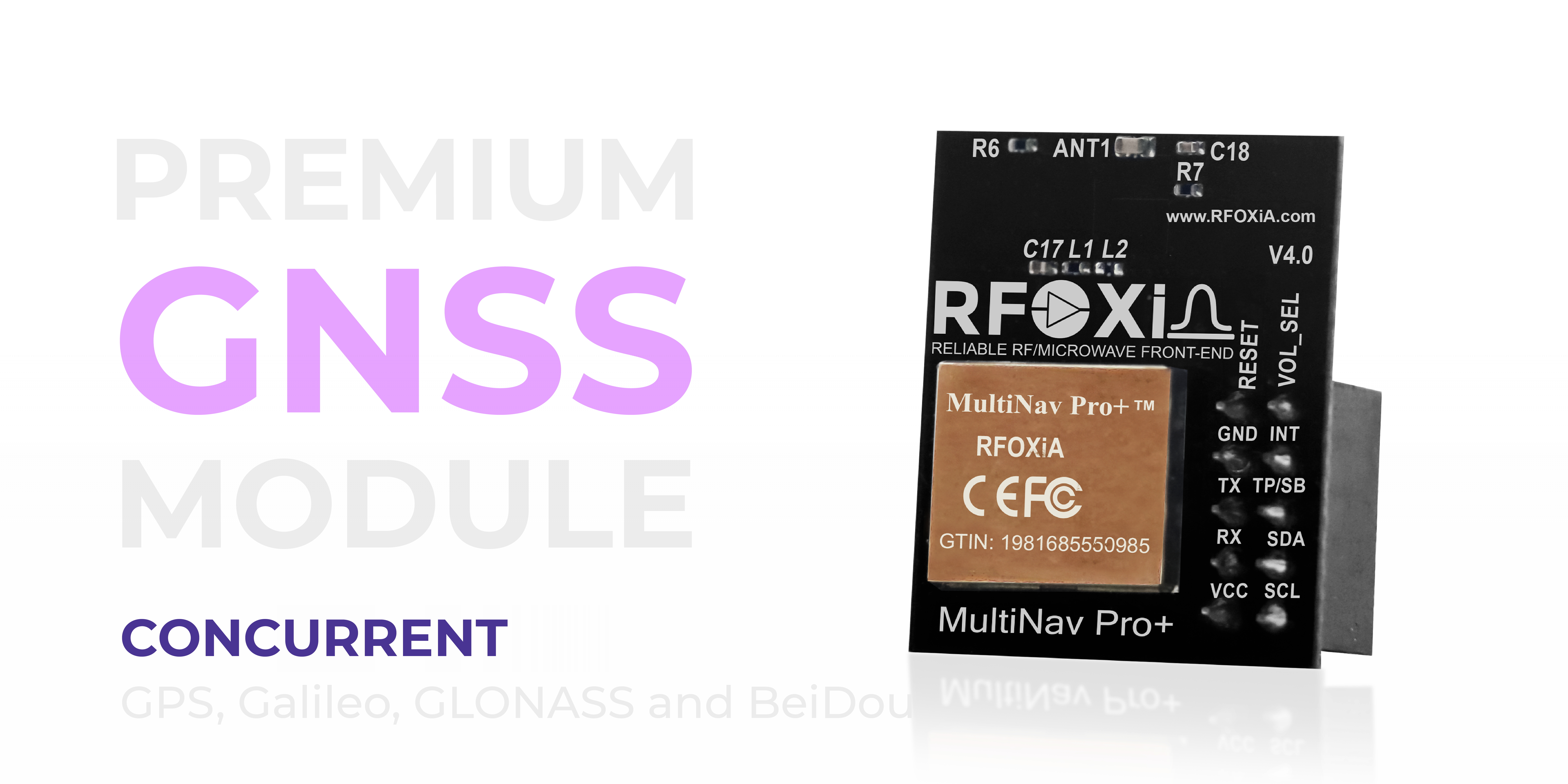
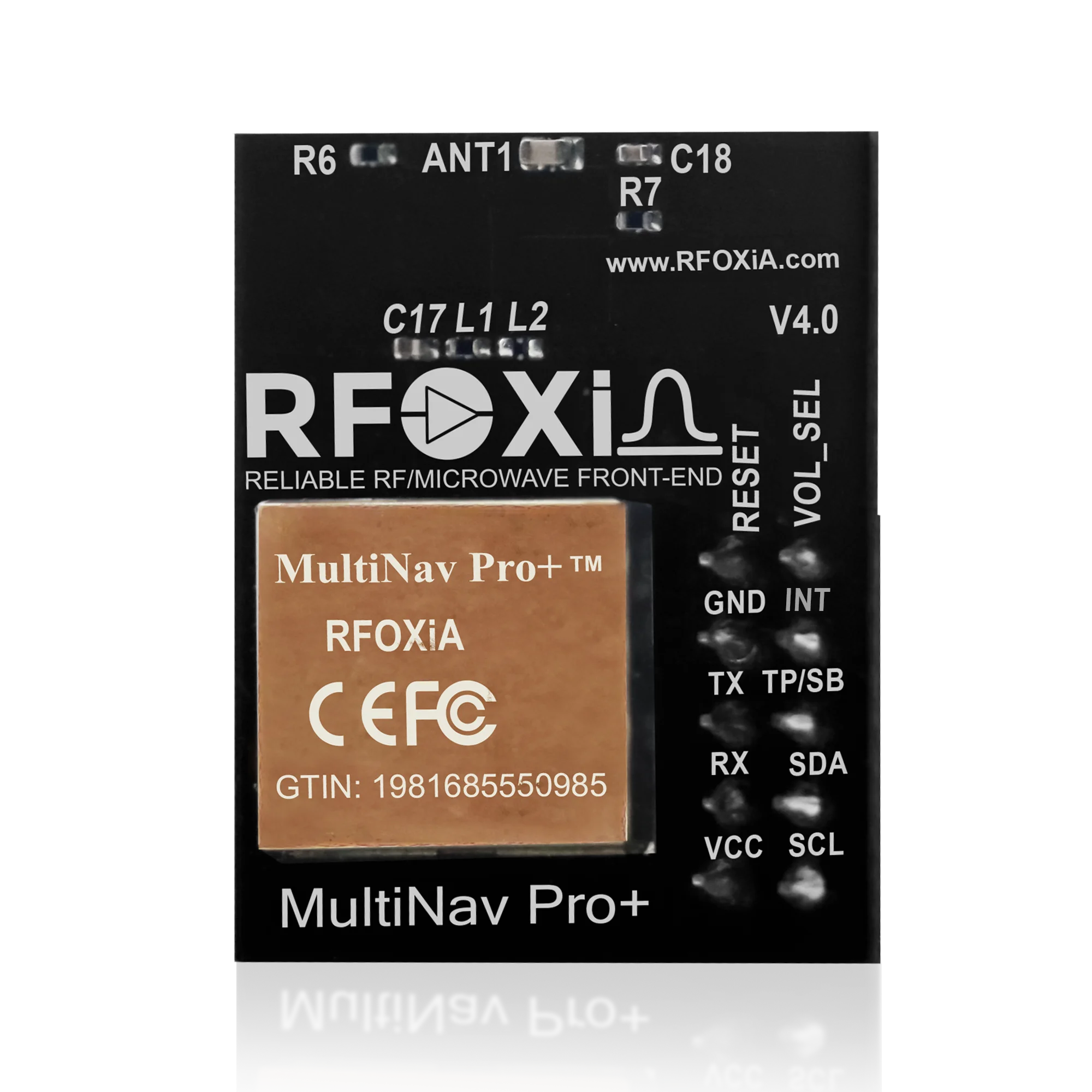
The RFOXiA MultiNav Pro+ is a complete, FCC-certified GNSS module built around the u-blox MIA-M10Q — one of the most capable GNSS cores available in 2024-2025. But RFOXiA did not simply solder a chip to a breakout board and call it a day. They engineered a full module with proprietary RF/microwave microstrip filter technology, an integrated high-gain chip antenna, dual-interface support, and a fully open-source C driver library — all in a 26mm x 22mm footprint priced at $49.
The result is a module that gives you u-blox's world-class GNSS silicon wrapped in RFOXiA's hardware engineering and ecosystem — without requiring you to design a single trace of RF layout yourself.
Core Specifications at a Glance
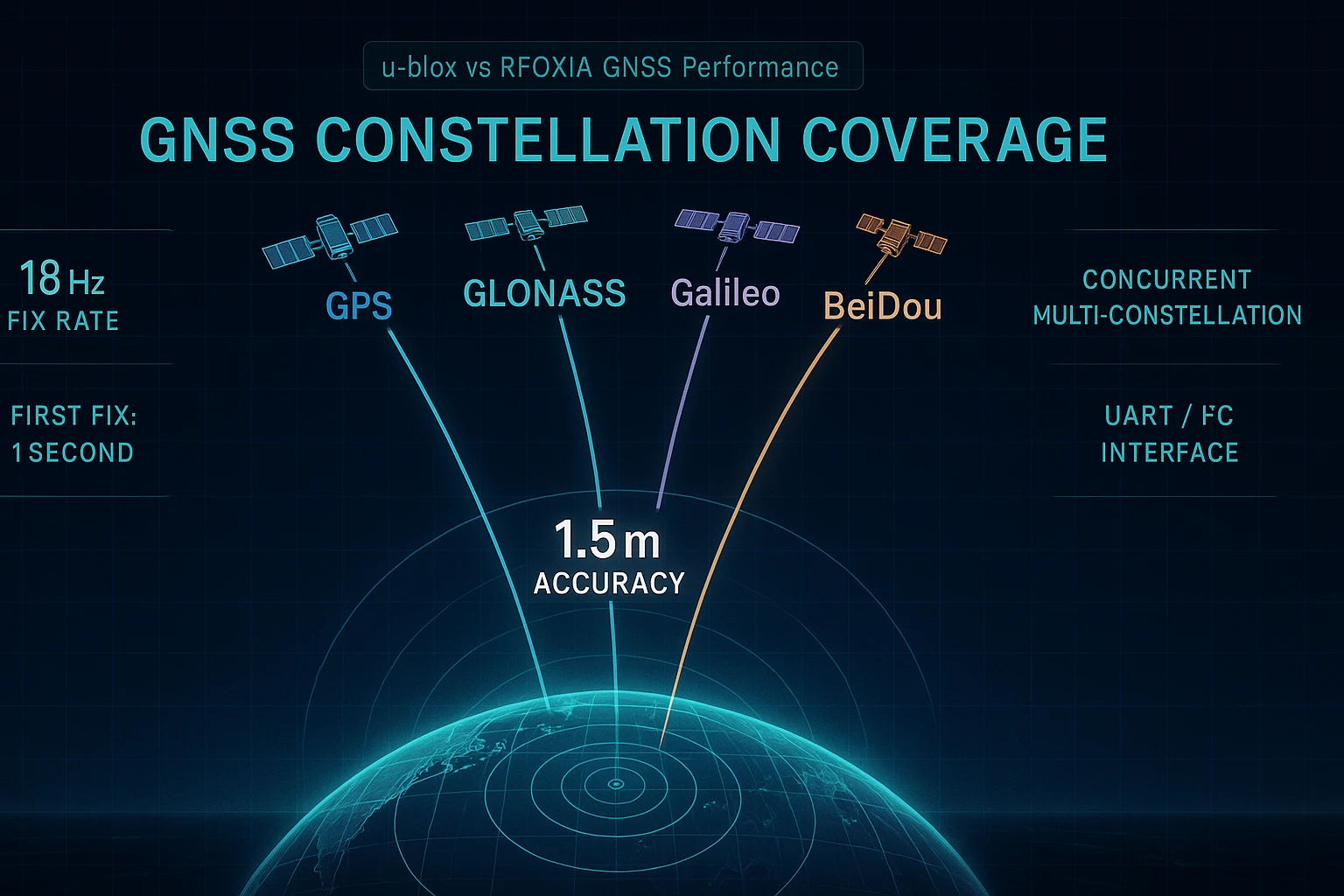
- Accuracy: Less than 1.5 meters
- Fix Rate: Up to 18Hz
- First Fix: As fast as 1 second
- Constellation Support: GPS, Galileo, GLONASS, BeiDou (concurrent)
- GNSS Core: u-blox MIA-M10Q
- Antenna: Integrated high-gain chip antenna
- Interface: UART (TX/RX) and I2C (SCL/SDA)
- Operating Voltage: 1.8V and 3.3V
- Current Draw: 25-30mA
- Dimensions: 26mm x 22mm
- Certifications: FCC certified
- Price: $49
Accuracy: 1.5 Meters Is Not a Marketing Number
Let us talk about what 1.5-meter CEP accuracy actually means in practice.
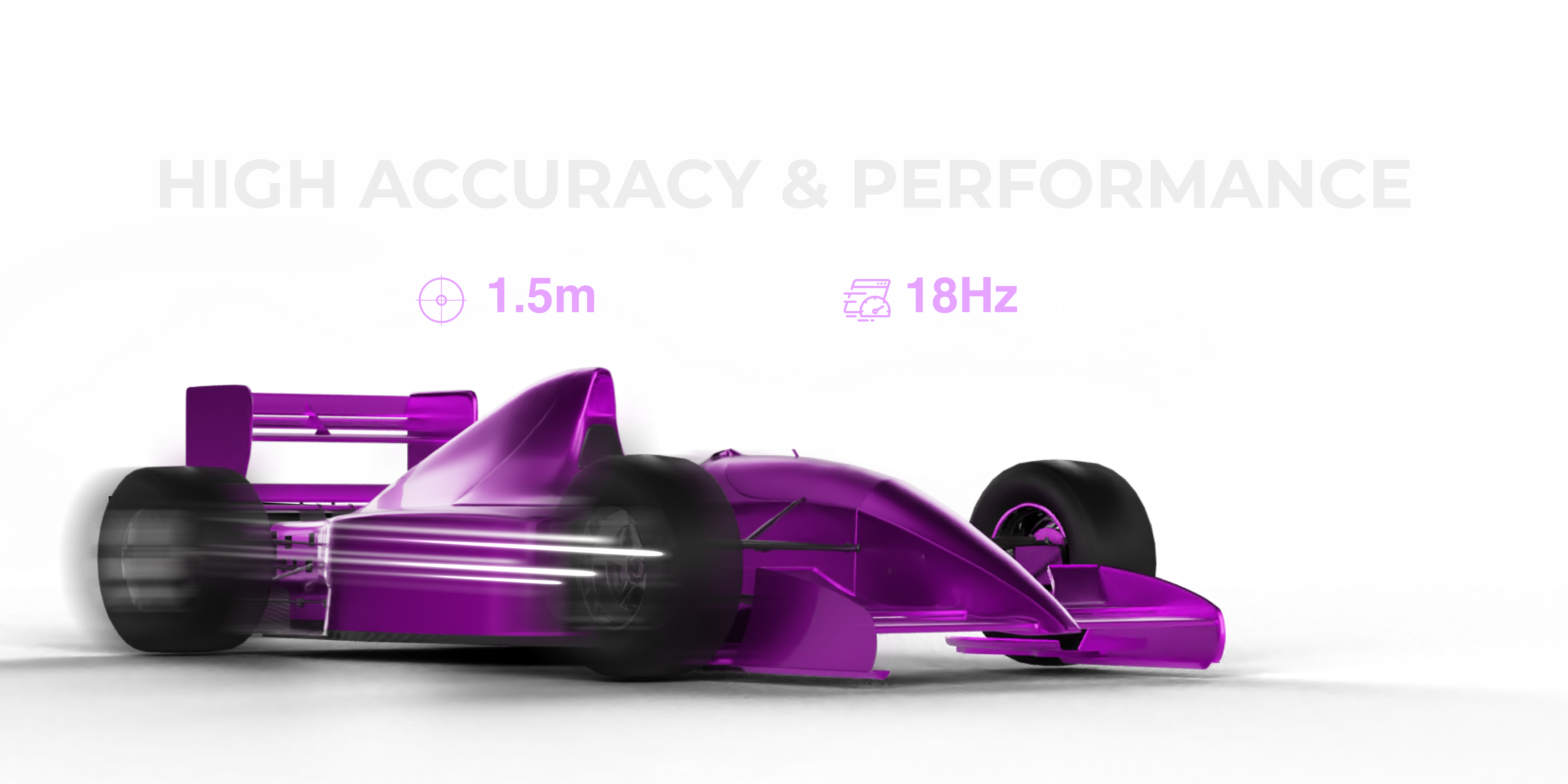
CEP (Circular Error Probable) accuracy of 1.5 meters means that 50% of position fixes will fall within 1.5 meters of the true position. For most maker-grade GPS modules — the kind you find on common Arduino breakout boards — accuracy sits at 2.5 to 5 meters under good sky conditions. That gap matters enormously when you are:
- Flying a drone on a pre-programmed waypoint mission where obstacle clearance is measured in meters
- Deploying a precision agriculture sensor where field coordinates must correlate with soil samples
- Tracking a fast-moving vehicle where position error compounds with latency
- Building a search-and-rescue device where 3 extra meters could mean missing a target entirely
The MIA-M10Q core inside the MultiNav Pro+ delivers this 1.5-meter accuracy through a combination of concurrent multi-constellation reception (more satellites tracked simultaneously means better geometric dilution of precision) and RFOXiA's proprietary microstrip filter technology that actively suppresses RF interference before it can corrupt the signal path.
Many breakout modules using older u-blox cores skip this filtering entirely to save board space and cost. The MultiNav Pro+ does not cut that corner.
18Hz Fix Rate: Why Update Speed Is as Important as Accuracy
An 18Hz fix rate means the module outputs a new position solution 18 times per second. Most consumer GPS modules run at 1Hz. Higher-end hobby modules reach 5Hz or 10Hz. 18Hz puts the MultiNav Pro+ in a category typically reserved for survey-grade and aerospace-grade receivers.
Why does this matter?
For drones: A quadcopter flying at 60 km/h covers 16.7 meters per second. At 1Hz update rate, your flight controller is making attitude and position corrections based on position data that is already a full second old — which means 16+ meters of potential position error before the next fix arrives. At 18Hz, that window shrinks to under one meter. The difference in flight stability and waypoint accuracy is dramatic.
For robotics: Fast-moving ground robots benefit from the same math. High update rates allow control loops to run tighter without relying as heavily on dead reckoning from IMU data.
For tracking applications: Whether you are logging a vehicle route, tracking an athlete, or monitoring wildlife, 18Hz gives you a smooth, high-resolution position trace rather than a coarse point-to-point approximation.
In the u-blox vs RFOXiA GNSS module comparison, this is one area where the MultiNav Pro+ distinguishes itself not just from generic alternatives but from many ready-made modules that artificially cap the update rate to reduce processing overhead.
Size, Power, and Integration Reality
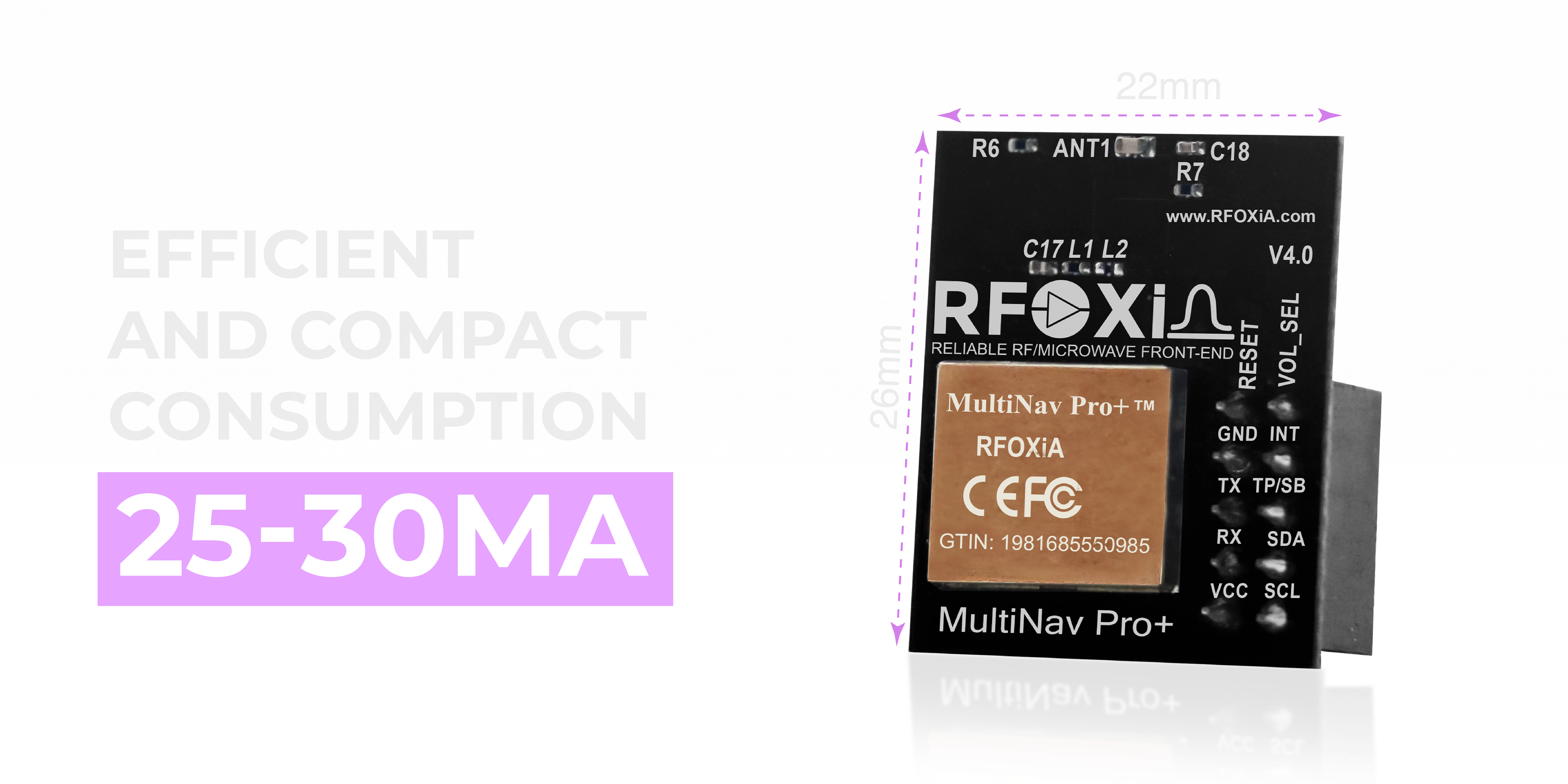
At 26mm x 22mm, the MultiNav Pro+ is genuinely compact. That is smaller than a US quarter in both dimensions, which means it integrates cleanly into:
- Drone flight decks with limited board real estate
- Wearable devices where PCB area is a hard constraint
- Compact IoT enclosures designed for weatherproof outdoor deployment
- Embedded systems where the GNSS module is one of many components sharing a chassis
At 25-30mA operating current, it is also power-efficient enough for battery-operated deployments. Paired with RFOXiA's Power/Program Kit (supercapacitor-based, 24-hour runtime from a 5-minute charge), the MultiNav Pro+ can run continuously in the field without any battery management anxiety.
Support for both 1.8V and 3.3V operating voltage eliminates the need for additional level shifters when integrating with modern microcontrollers and SoCs that have moved to lower voltage rails.
Interface Flexibility: UART and I2C Without Compromise
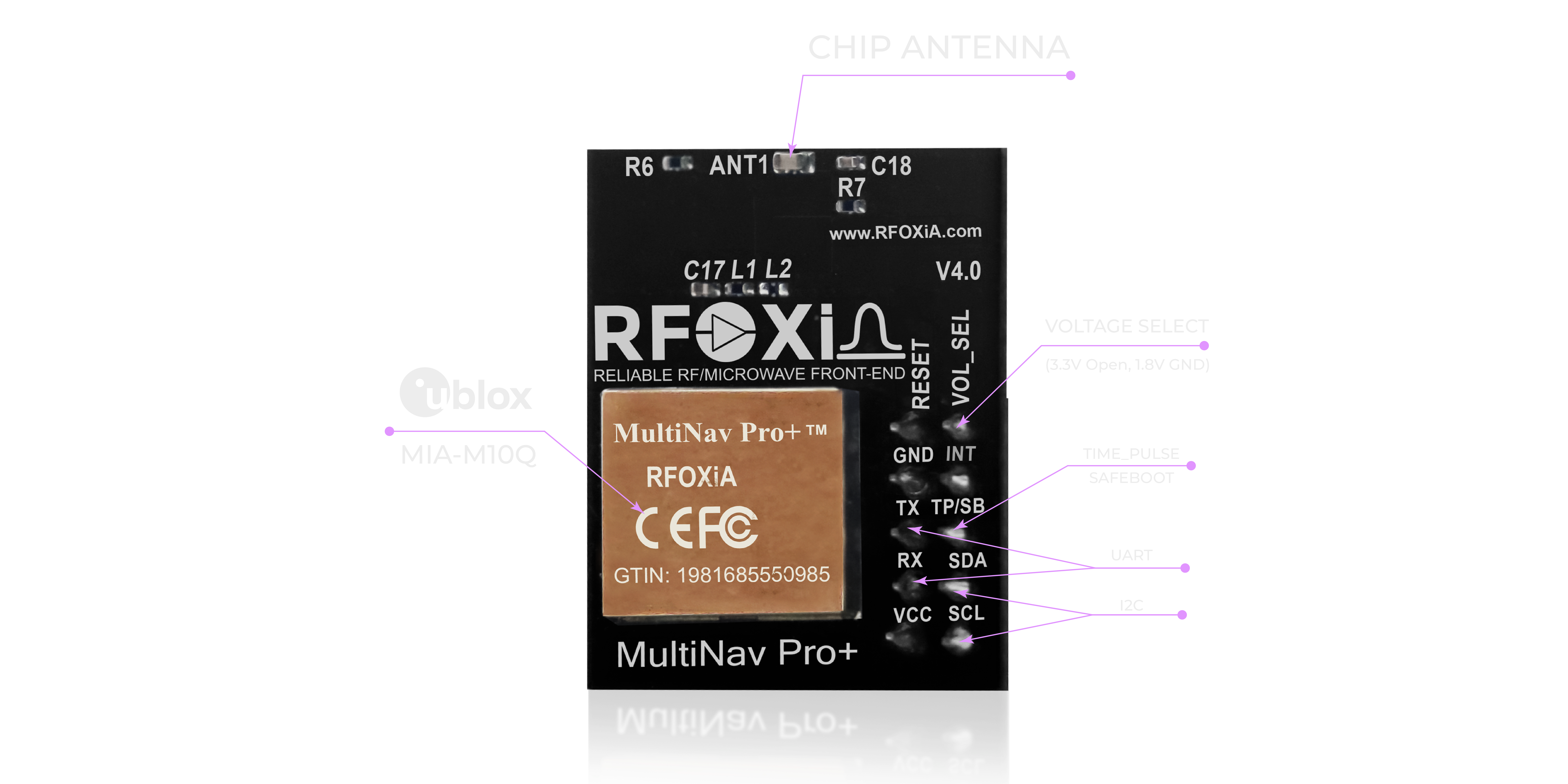
One of the friction points with many GNSS modules is interface rigidity. You get UART, or you get I2C, and if your microcontroller's pinout makes one of those options inconvenient, you work around it.
The MultiNav Pro+ supports both UART (TX/RX) and I2C (SCL/SDA) natively, giving you the flexibility to wire it however your application demands. UART is the traditional choice for GNSS modules — it is simple, reliable, and handles the NMEA sentence stream elegantly. I2C is useful when you are already using that bus for other sensors and want to consolidate communication lines.
This dual-interface support is particularly valuable when the MultiNav Pro+ is deployed alongside RFOXiA's Sensors Module (which integrates temperature, humidity, pressure, air quality, accelerometer, gyroscope, and magnetometer) — allowing both modules to share a bus without additional hardware.
Open Source Driver: No Proprietary Lock-In
One of the legitimate frustrations with some GNSS module vendors is proprietary firmware or closed-source drivers that limit what you can actually do with the hardware once you have it. The MultiNav Pro+ takes the opposite approach entirely.
RFOXiA ships a fully open-source C language driver library that implements the NMEA standard protocol command set. This library:
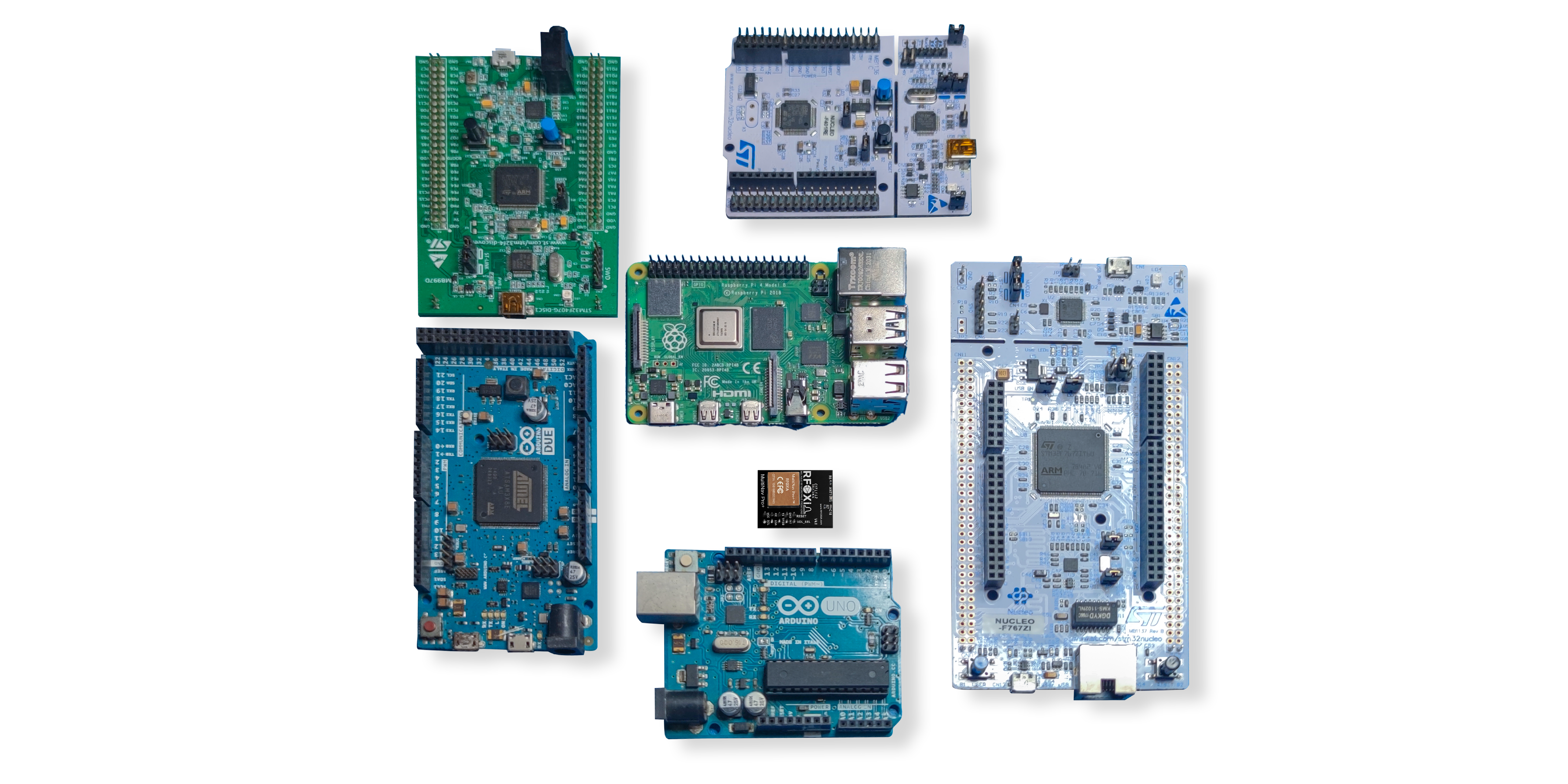
- Imports directly into Arduino IDE with minimal setup
- Works with any toolchain that supports standard C — STM32CubeIDE, PlatformIO, ESP-IDF, Zephyr RTOS, and others
- Gives you full access to the raw NMEA sentence stream for custom parsing if you prefer to handle data yourself
- Is hosted publicly so you can read it, fork it, and modify it without any licensing restrictions
For developers integrating this module into a commercial product, the open-source driver also means you are not dependent on a vendor maintaining a proprietary SDK — your firmware is yours.
This open-source commitment extends to the broader RFOXiA ecosystem. The BLE module firmware is publicly available on GitHub, and the platform philosophy across all products is builder-first transparency rather than vendor lock-in.
U-Center Software: Professional Visualization Without Extra Cost
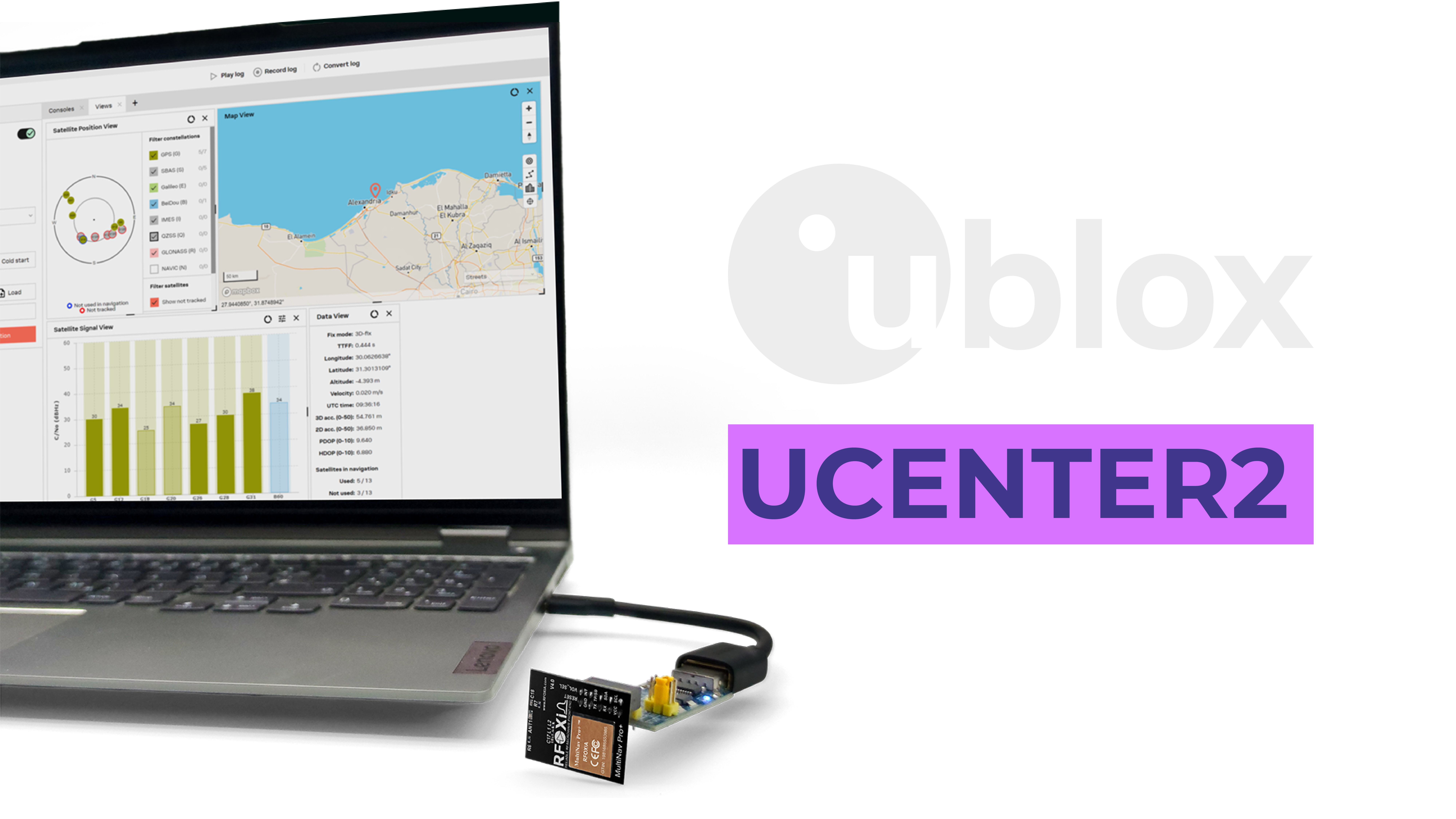
Because the MultiNav Pro+ is built on genuine u-blox silicon, it is fully compatible with u-blox's U-Center software — a professional-grade desktop GUI for GNSS evaluation and configuration.
U-Center provides:
- Real-time satellite visualization — see exactly which satellites are being tracked, their signal strength, and their sky position
- Live position plotting — watch your position trace in real time on a map interface
- Configuration management — adjust update rates, constellation selection, power modes, and NMEA output settings through a graphical interface rather than raw commands
- Data logging — capture raw GNSS data streams for post-processing and analysis
- Performance evaluation — assess fix quality, HDOP, satellite count, and accuracy metrics over time
For development and debugging, U-Center is invaluable. The fact that the MultiNav Pro+ provides access to this professional toolset at a $49 price point — the same software used by engineers working on survey-grade and automotive GNSS systems — is a significant advantage that often goes unappreciated until you actually need to diagnose a tricky multipath issue or tune constellation priority for your deployment environment.
u-blox vs RFOXiA GNSS Module: The Honest Side-by-Side
Let us put the comparison in plain terms.
| Factor | Raw u-blox Chip (DIY) | Generic u-blox Breakout | RFOXiA MultiNav Pro+ |
|---|---|---|---|
| Accuracy | 1.5m (chip spec) | 2-5m (varies by PCB design) | <1.5m (optimized design) |
| Fix Rate | Up to 18Hz | Often capped at 5-10Hz | 18Hz |
| RF Filtering | Requires custom design | Minimal or absent | Proprietary microstrip filter |
| Antenna | Requires external design | Chip or patch (quality varies) | Integrated high-gain chip antenna |
| FCC Certification | None (chip only) | Often absent | Yes — FCC certified |
| Interface | Chip-level (raw traces) | Usually UART only | UART + I2C |
| Open Source Driver | None | Varies | Full C library, Arduino compatible |
| U-Center Compatible | Yes | Yes | Yes |
| Price | $8-15 (chip only, MOQ) | $15-35 | $49 |
| Time to Working Prototype | Weeks to months | Days | Hours |
The raw chip comparison is almost unfair — u-blox sells silicon to engineers who design boards, not complete solutions. The more honest comparison is against generic breakout modules, and there the MultiNav Pro+ wins on filtering quality, certified accuracy, update rate, and dual-interface support.
The $49 price is higher than a barebones breakout. But when you factor in the engineering time you are not spending on antenna tuning, RF layout iteration, driver development, and regulatory certification — the math changes quickly.
Who Should Choose the MultiNav Pro+

The MultiNav Pro+ is built for builders who need real performance without the overhead of designing their own RF hardware from scratch. Specifically:
Drone builders and FPV pilots who need high-update-rate GNSS for autonomous flight, return-to-home accuracy, and GPS-hold stability. The 18Hz fix rate and 1.5m accuracy make this module directly relevant to flight controller integration.
Robotics engineers building autonomous ground vehicles where tight position control loops demand sub-second update rates and consistent accuracy.
IoT developers deploying outdoor sensor networks where GPS verification of node location is required — especially relevant for RFOXiA's own data network, where GNSS validation confirms outdoor deployment and unlocks data monetization rewards.
Precision agriculture operators who need reliable geo-tagging of sensor readings, soil sample locations, or equipment position with accuracy that surveyors would recognize as useful.
Researchers and educators who need a legitimate GNSS module with professional tooling access (U-Center), open-source driver code, and documented performance specs for academic projects.
Hardware product developers who need an FCC-certified GNSS component they can incorporate into a commercial product without adding their own certification burden.
For all of these users, the RFOXiA MultiNav Pro+ represents the fastest path from "I need GNSS" to "I have a working, accurate, deployable system."
The RFOXiA Ecosystem Advantage
No product exists in isolation, and the MultiNav Pro+ is no exception. One of the strongest arguments for choosing the RFOXiA module over a generic u-blox breakout is the ecosystem it plugs into.
When you combine the MultiNav Pro+ with RFOXiA's other modules:
- BLE Module (MultiNav Pro+ BLE) — adds 5km ground-to-ground, 15-20km man-to-drone wireless range for transmitting GNSS data over long distances without infrastructure
- Sensors Module — adds temperature, humidity, pressure, air quality, accelerometer, gyroscope, and magnetometer alongside the GNSS feed
- Power/Program Kit — powers the complete stack for 24 hours from a 5-minute supercapacitor charge
- RFOXiA Connect App — displays live GPS position on a map in real time, paired wirelessly via BLE, completely without internet
- RFOXiA Club Data Network — with GNSS validation confirming your outdoor node location, your Sensors Module becomes a paying contributor to RFOXiA's environmental data network, earning daily rewards
The Developer Bundle brings all of these pieces together for $199. But the MultiNav Pro+ at $49 is also a fully capable standalone module for anyone who just needs precise, fast GNSS without building out the full stack.
You can explore the full module and order directly at the RFOXiA Accurate GNSS Module page.
Final Verdict: u-blox vs RFOXiA GNSS Module
The u-blox vs RFOXiA GNSS module question has a clear answer once you understand what you are actually comparing.
u-blox makes exceptional chips. RFOXiA builds exceptional modules on top of those chips. They are not competitors — they are collaborators in a supply chain, and RFOXiA's engineering value-add is what transforms silicon potential into field-deployable precision.
If you are a chip designer with an RF lab, a clean room, and six months to spare on PCB iteration, buy the raw u-blox chip and design your own module. You will squeeze out every last nanometer of performance.
If you are a builder, a drone engineer, a robotics developer, an IoT architect, or a researcher who needs 1.5-meter accuracy and 18Hz updates working in your project by next week — the MultiNav Pro+ is the right tool.
FCC certified. Open-source driver. U-Center compatible. Dual interface. 26mm x 22mm. $49.
That is not a compromise. That is professional-grade GNSS designed for the people who actually build things.
Ready to add precision navigation to your next project? The MultiNav Pro+ ships now. Get your RFOXiA GNSS Module here and join thousands of builders who have already chosen performance over compromise.
Written by: Moamen Mohamed LinkedIn