
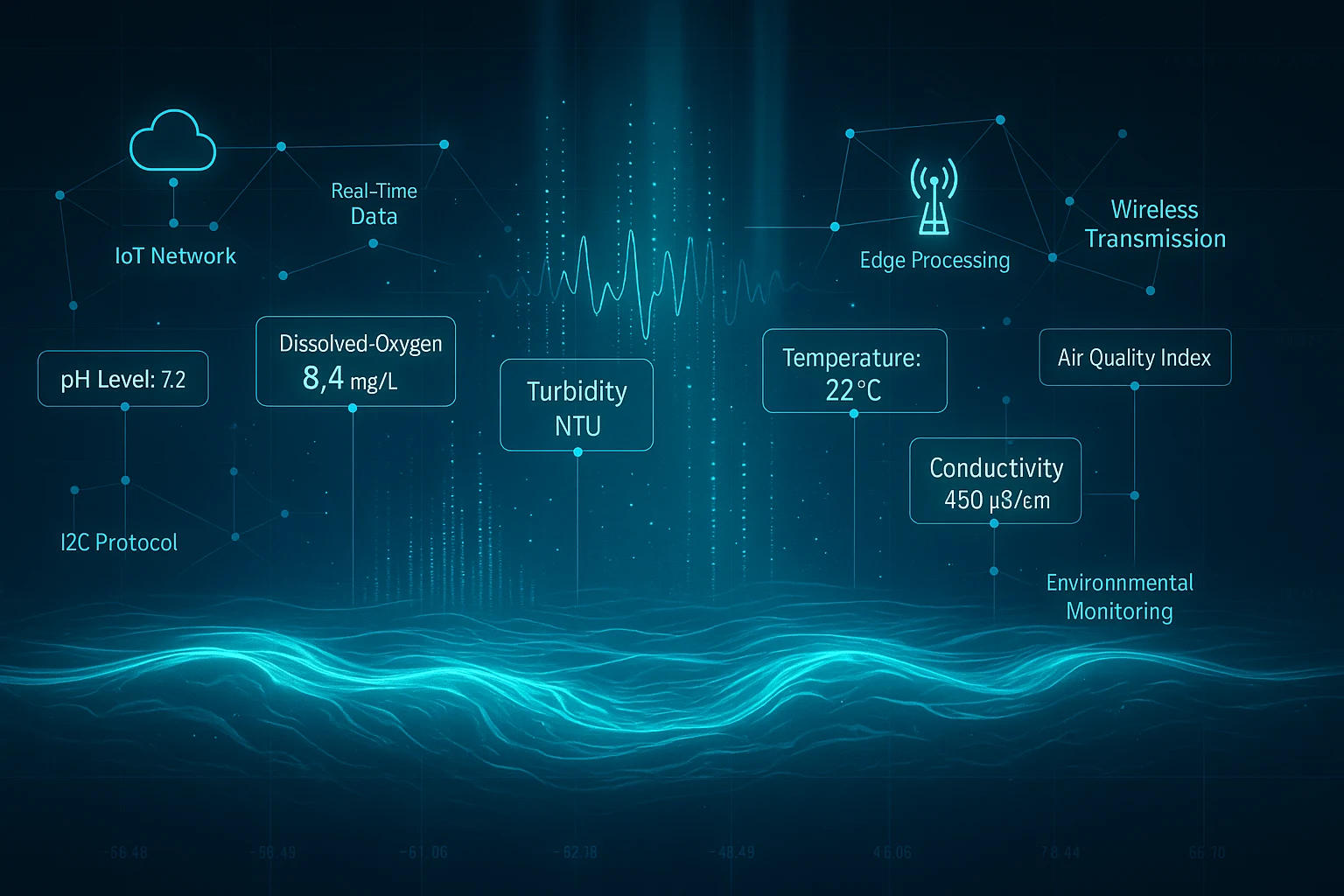
Water Quality Sensor Module IoT: The Complete Builder's Guide
RFOXiA Integrated Sensors Module
Why Every Serious IoT Developer Needs a Water Quality Sensor Module IoT Solution That Actually Delivers
If you have been searching for a reliable water quality sensor module IoT solution that goes beyond surface-level monitoring, you already know the problem. Most modules on the market offer one or two environmental sensors bolted onto a breakout board, leaving you to wire up five separate components, fight I2C address conflicts, debug power rail noise, and pray everything fits inside your enclosure. The result is weeks of integration work before you have even written a line of application logic.
The environmental IoT space is exploding. According to industry analysts, the global environmental monitoring market is expected to surpass $22 billion by 2030, driven by demand from precision agriculture, smart cities, industrial compliance, and climate research. At the heart of every one of those deployments is a sensor module — and the quality of that module determines the quality of every decision made downstream.
This guide covers everything you need to know about building with environmental and water quality sensor modules in IoT applications: what specifications actually matter, which sensor ICs are worth trusting, how to architect a system that streams verified data at scale, and why the RFOXiA Integrated Sensors Module is the most complete solution available to hardware developers today at any price point near $39.
What Makes a Great Water Quality Sensor Module IoT Platform?
Before diving into the MultiNav Pro+ Sensors Module specifically, it is worth establishing what separates a professional-grade environmental sensing platform from a hobbyist breakout board.
1. Sensor Coverage
Water quality and environmental monitoring is not a single-variable problem. Temperature, pressure, humidity, and air quality are deeply interdependent. A temperature reading without pressure context is incomplete. An air quality reading without humidity compensation can be wildly inaccurate. Any serious water quality sensor module IoT deployment needs multi-parameter capability baked in at the hardware level — not assembled from individual modules in the field.
2. Sensor IC Pedigree
Not all sensor ICs are created equal. There is a massive difference between a $0.30 no-name NTC thermistor and a calibrated MEMS sensor from STMicroelectronics. In professional IoT applications, the sensor IC determines your data quality ceiling. If the IC is poorly specified, no amount of software filtering will recover the signal.
3. Communication Architecture
Multi-sensor modules live or die by their bus architecture. A clean I2C implementation with properly assigned addresses and pull-up resistors eliminates a class of bugs that plagues DIY multi-sensor builds. The ability to share one bus across seven sensors without collisions is an engineering achievement that saves days of debugging.
4. Physical Footprint
Drones, wearables, compact IoT nodes — space is always at a premium. A module that delivers seven sensors in a 24mm × 18mm footprint is not just convenient. It is a genuine engineering accomplishment.
5. Ecosystem Integration
A sensor module that works in isolation is useful. A sensor module that plugs into a complete wireless ecosystem — with long-range communication, GPS verification, AI firmware generation, mobile app visualization, and a data monetization network — is transformative.
With those criteria established, let us look at how the MultiNav Pro+ Sensors Module performs against each one.
Introducing the MultiNav Pro+ Sensors Module
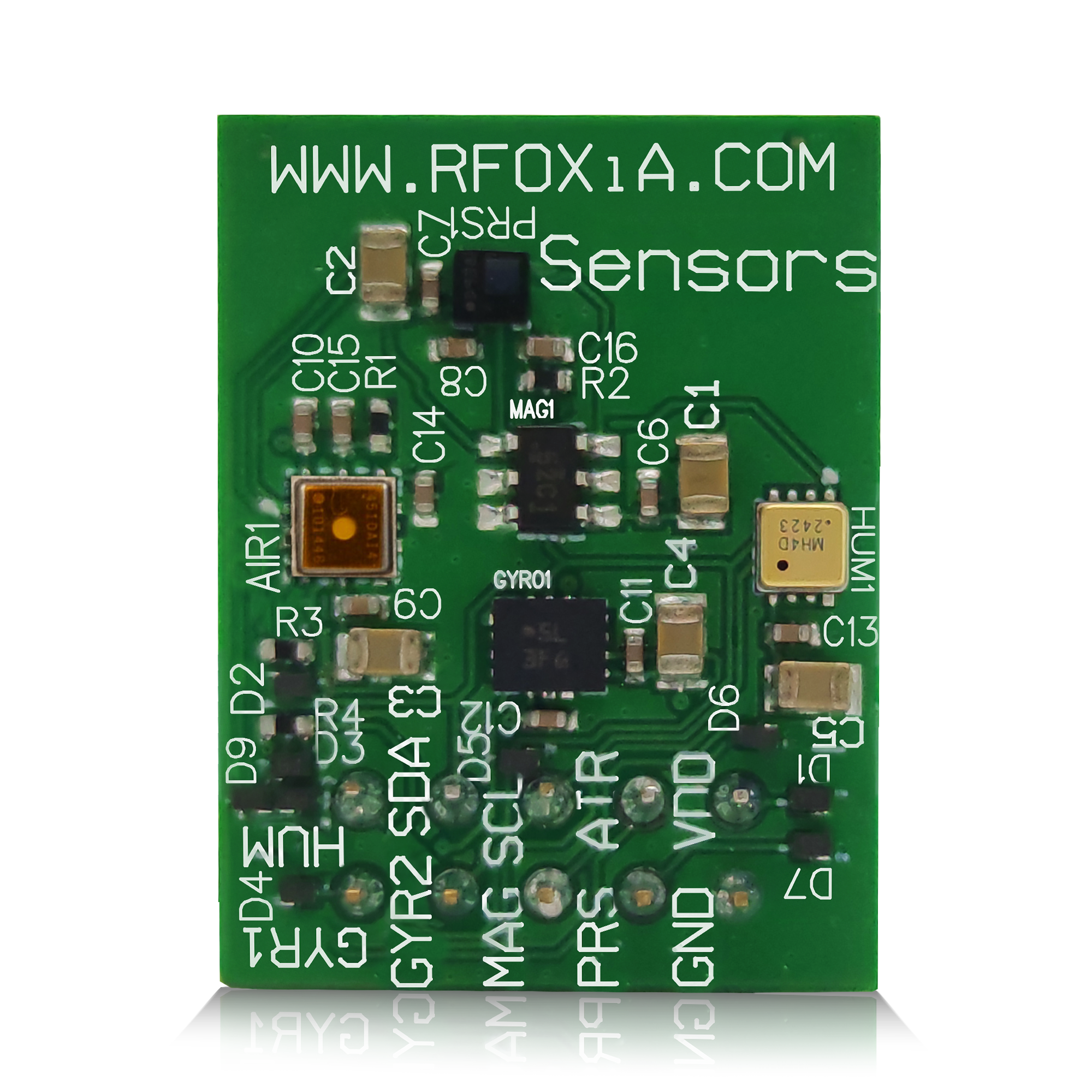
The MultiNav Pro+ Sensors Module from RFOXiA is a single compact board that integrates seven professional-grade sensors into one unified, I2C-addressable platform. At $39 and FCC certified, it is designed for developers who need production-quality environmental data without the complexity and cost of assembling a custom sensor array from scratch.
This is not a breakout board collection. Every sensor IC was selected for its performance in demanding field applications, every I2C address was assigned without conflict, and the entire assembly was engineered to fit platforms where space, weight, and power consumption are real constraints.
The Seven Sensors: A Technical Deep Dive
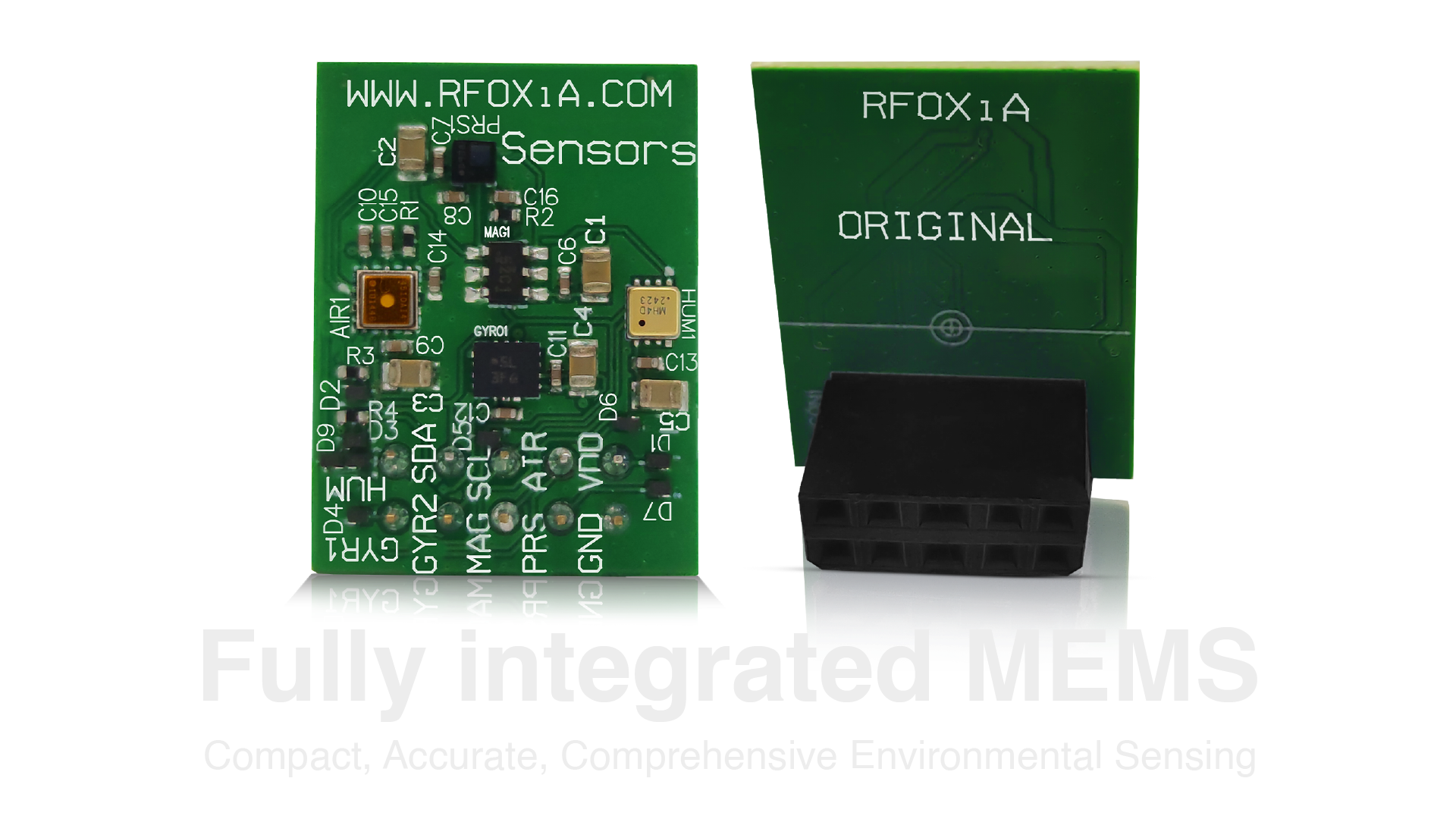
Let us examine each sensor on the module, the IC behind it, and why it matters for real-world IoT deployments.
Accelerometer and Gyroscope — BMI270 (Bosch Sensortec)
The BMI270 is one of Bosch Sensortec's flagship inertial measurement units. It combines a 16-bit triaxial accelerometer and a 16-bit triaxial gyroscope in a single 2.5mm × 3mm package. This IC is used in professional drone flight controllers, sports wearables, and industrial robotics — not because it is the cheapest option, but because it delivers.
For IoT applications specifically, the BMI270's integrated step detection, orientation recognition, and activity classification features offload computational work from the main MCU. In water and environmental monitoring buoys, the accelerometer data can detect platform tilt, wave motion, and even vibration anomalies that indicate sensor fouling or physical damage.
Magnetometer — TMAG5273C1QDBVR (Texas Instruments)
The TMAG5273 from Texas Instruments is a low-power 3D Hall-effect sensor with I2C interface and 12-bit resolution. It delivers accurate heading data for applications that require compass functionality, including autonomous vehicles, UAVs, and any platform that needs to know its absolute orientation relative to magnetic north.
In outdoor environmental monitoring deployments, magnetometer data is used alongside GPS for heading-corrected position tracking. Combined with the accelerometer and gyroscope, the TMAG5273 completes a full 9-DOF IMU solution on a single board.
Air Pressure — LPS22HHTR (STMicroelectronics)
The LPS22HH is STMicroelectronics' high-accuracy MEMS pressure sensor, offering absolute pressure measurement from 260 to 1260 hPa with a resolution of 1/4096 hPa. At 24-bit output and a current consumption of 3 µA in low-power mode, it is optimized for battery-powered field deployments.
Pressure data is essential for altitude calculation in drone applications, weather station accuracy, and — critically for any water quality sensor module IoT system — barometric compensation of other environmental readings. Temperature and humidity readings that are not pressure-compensated are systematically biased in ways that corrupt long-term datasets.
Humidity and Temperature — MVH4003D (MEMSVision)
MEMSVision's MVH4003D is a capacitive MEMS humidity and temperature sensor offering ±2% RH accuracy and ±0.3°C temperature accuracy. Its fast response time makes it suitable for applications where environmental conditions change rapidly — outdoor air quality stations, drone-mounted sensors flying through thermal gradients, and precision agriculture deployments tracking micro-climate variations.
For water quality monitoring applications, ambient temperature and humidity data provides the environmental context needed to interpret dissolved oxygen readings, evaporation rates, and biological activity in water bodies.
Air Quality — ZMOD4510AI4R (Renesas)
The ZMOD4510 from Renesas is a gas sensor module specifically designed for outdoor air quality monitoring. It detects nitrogen dioxide (NO2) and ozone (O3) — two primary indicators of urban air pollution — using metal oxide sensing technology with on-chip signal conditioning.
For IoT developers building environmental monitoring networks, the ZMOD4510 provides the data needed to contribute to air quality indices, track pollution sources, and generate the kind of hyper-local environmental datasets that government agencies, agricultural operators, and insurance companies pay significant amounts for access to.
Precision Motion and Environmental Sensing in One Package
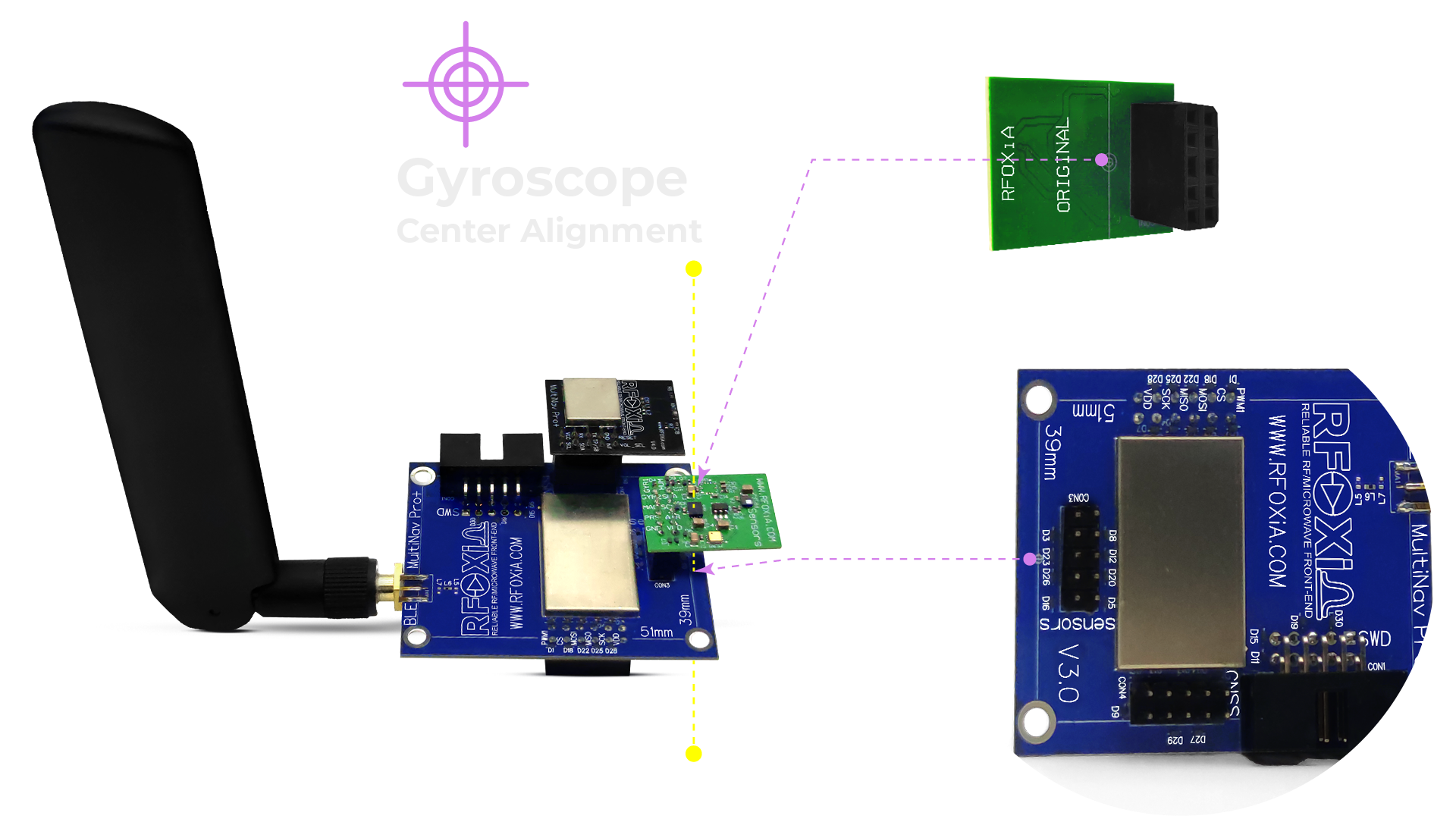
What makes the MultiNav Pro+ Sensors Module genuinely unusual is that it does not force you to choose between motion sensing and environmental sensing. Most modules specialize in one or the other. This module delivers both, on a single I2C bus, in a package smaller than a postage stamp.
For drone applications, this means attitude data (roll, pitch, yaw from the IMU) and environmental data (temperature, pressure, humidity, air quality) are available simultaneously, without additional hardware. For autonomous ground vehicles, the magnetometer provides heading reference while the pressure sensor tracks elevation changes. For water quality monitoring buoys, the accelerometer detects platform stability while the environmental sensors continuously log the atmospheric conditions surrounding the measurement site.
Professional Sensor ICs: The Components Behind the Performance
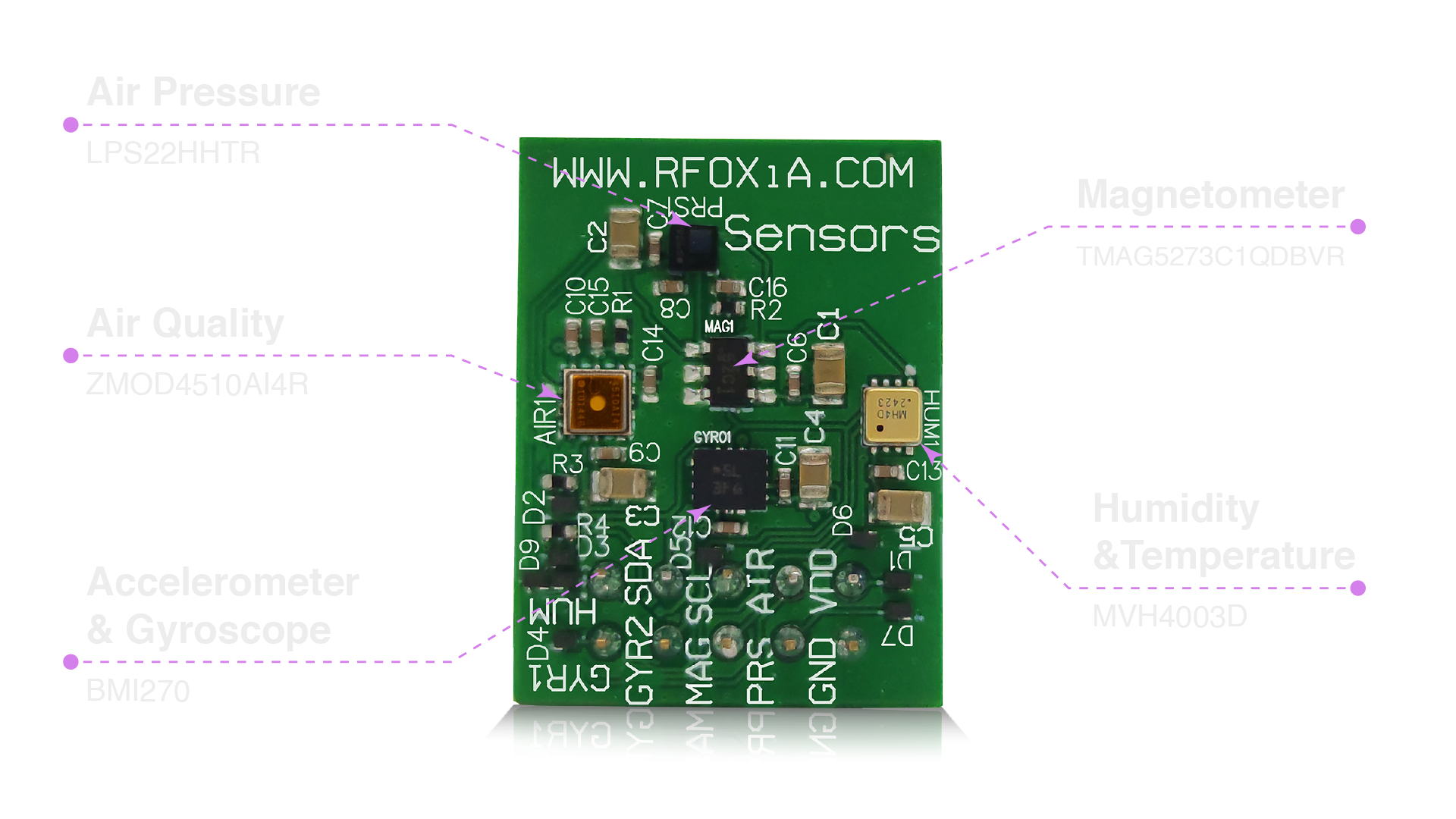
Every sensor IC on the MultiNav Pro+ was selected from Tier 1 semiconductor manufacturers with documented performance in professional applications:
- BMI270 — Bosch Sensortec, the same company whose sensors are found in professional DJI drone flight controllers and Samsung Galaxy devices
- TMAG5273 — Texas Instruments, one of the most trusted names in precision analog and mixed-signal ICs
- LPS22HH — STMicroelectronics, whose MEMS pressure sensors are used in aerospace, automotive, and industrial applications worldwide
- MVH4003D — MEMSVision, specialists in MEMS humidity sensing with rigorous accuracy specifications
- ZMOD4510 — Renesas, a leading supplier of gas sensing solutions for environmental monitoring
This is not a parts list assembled for minimum cost. These are the components a hardware engineer would specify for a commercial product, available in a $39 development module.
Efficient I2C Communication Architecture
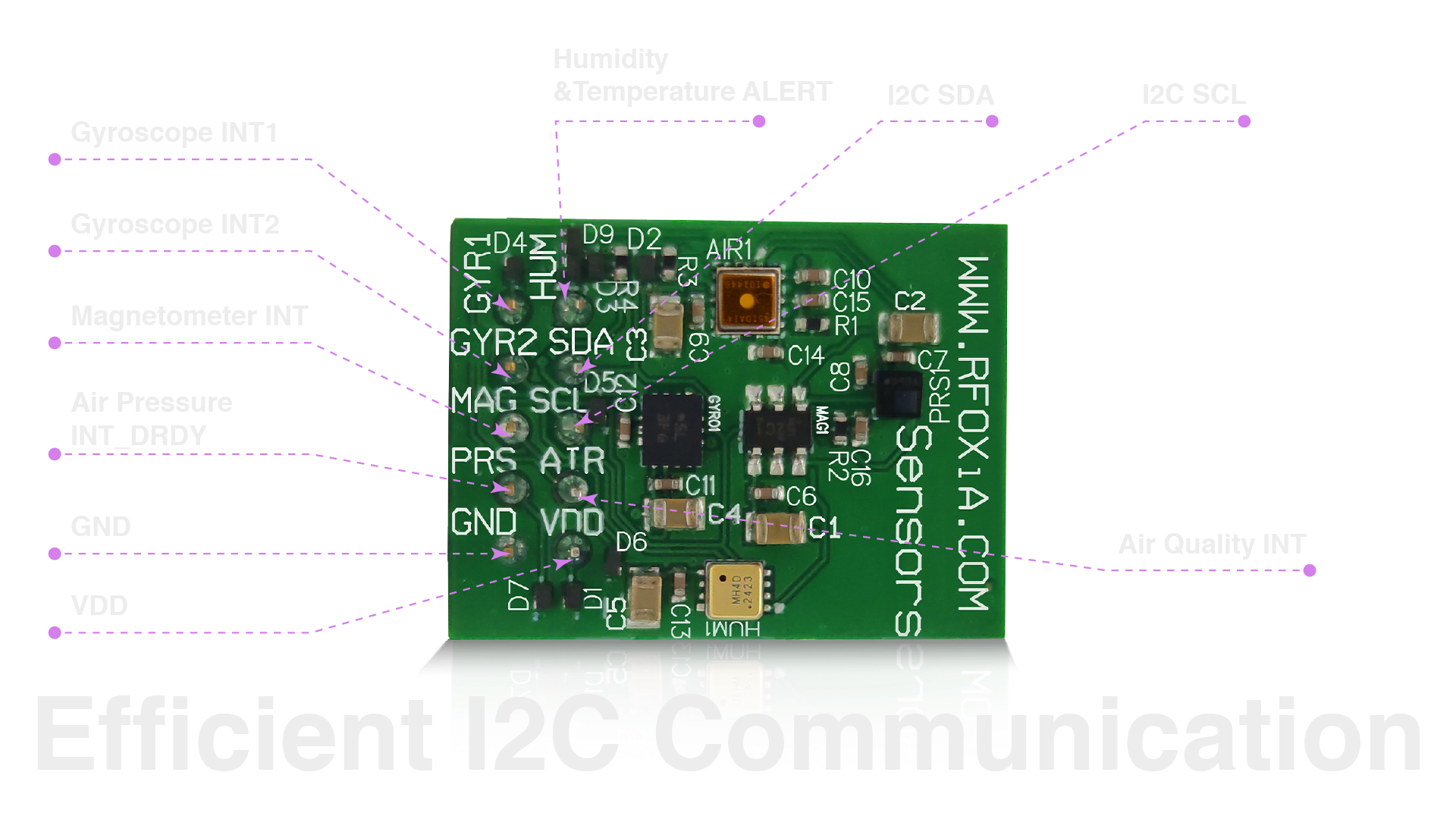
One of the most underappreciated aspects of the MultiNav Pro+ Sensors Module is its I2C implementation. All seven sensors share a single I2C bus, each assigned a unique address, with no conflicts and no jumper configuration required.
For developers who have manually assembled multi-sensor systems, the significance of this is immediately apparent. I2C address conflicts are one of the most common and frustrating integration problems in embedded development. When two sensors share the same default address and neither supports address remapping, you are forced into multiplexer ICs, separate buses, or creative workarounds that add hardware complexity and firmware overhead.
The MultiNav Pro+ solves this at the hardware design level. Connect SDA, SCL, VCC, and GND, and you have access to all seven sensors immediately. In conjunction with the RFOXiA AI Firmware Builder — which generates production-ready I2C initialization and polling code from a plain-language description of your application — the time from unboxing to streaming live sensor data can be measured in minutes rather than hours.
Compact Design: 24mm × 18mm for Seven Sensors
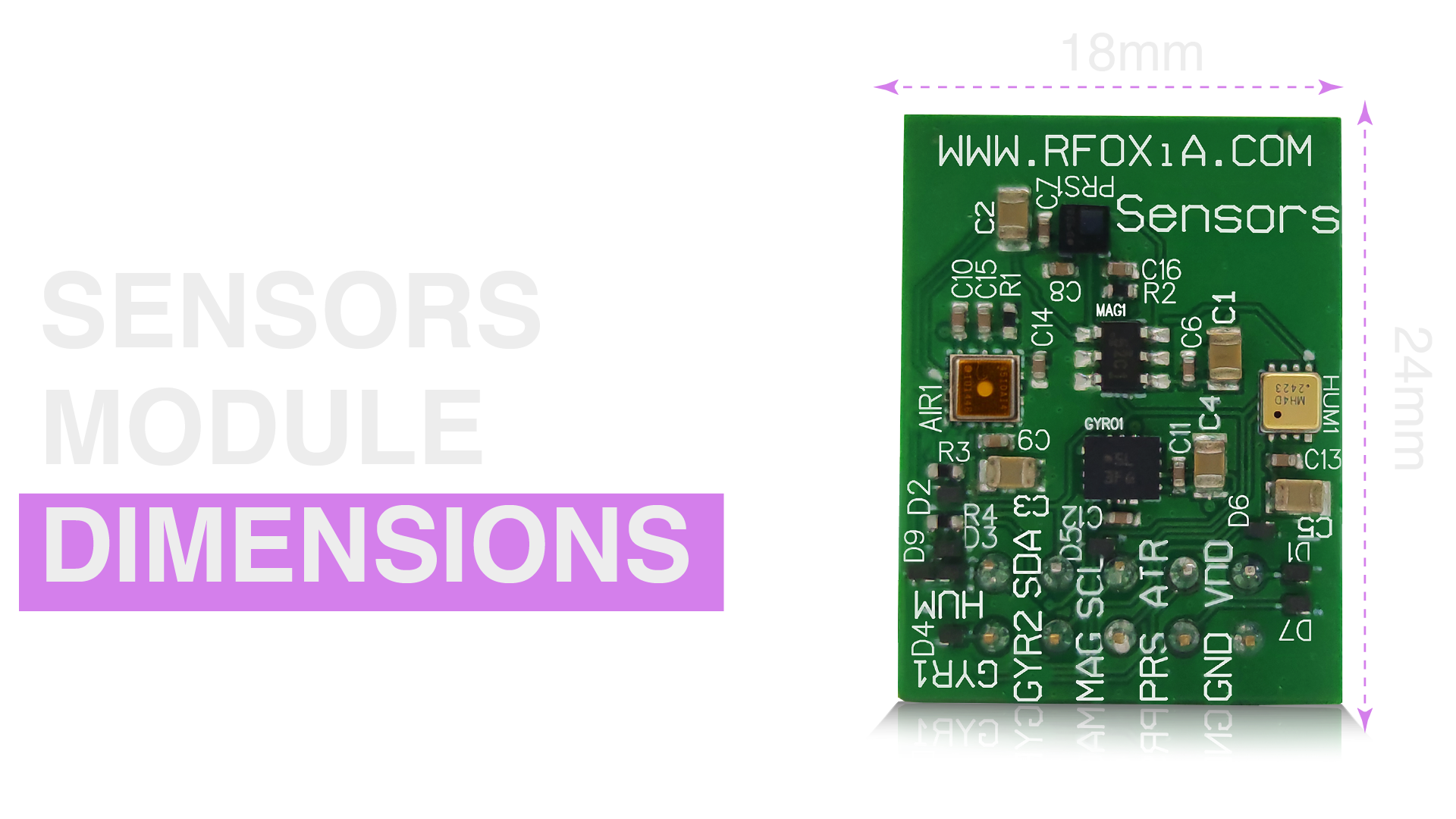
At 24mm × 18mm, the MultiNav Pro+ Sensors Module fits in places where most multi-sensor assemblies cannot. This footprint enables deployment in:
- Nano and micro drones where payload weight and volume are strictly limited
- Wearable monitoring devices where ergonomics demand minimal PCB size
- Compact IoT enclosures intended for outdoor deployment in protected housings
- Water quality monitoring buoys and floats where submersible enclosure volume is constrained
- Agricultural sensor nodes that must survive in-field deployment seasons
The compact design is not achieved by sacrificing capability. It is achieved by careful component selection, tight PCB layout, and a design philosophy that treats physical size as a first-class specification rather than an afterthought.
Real-Time Environmental Data for IoT Applications
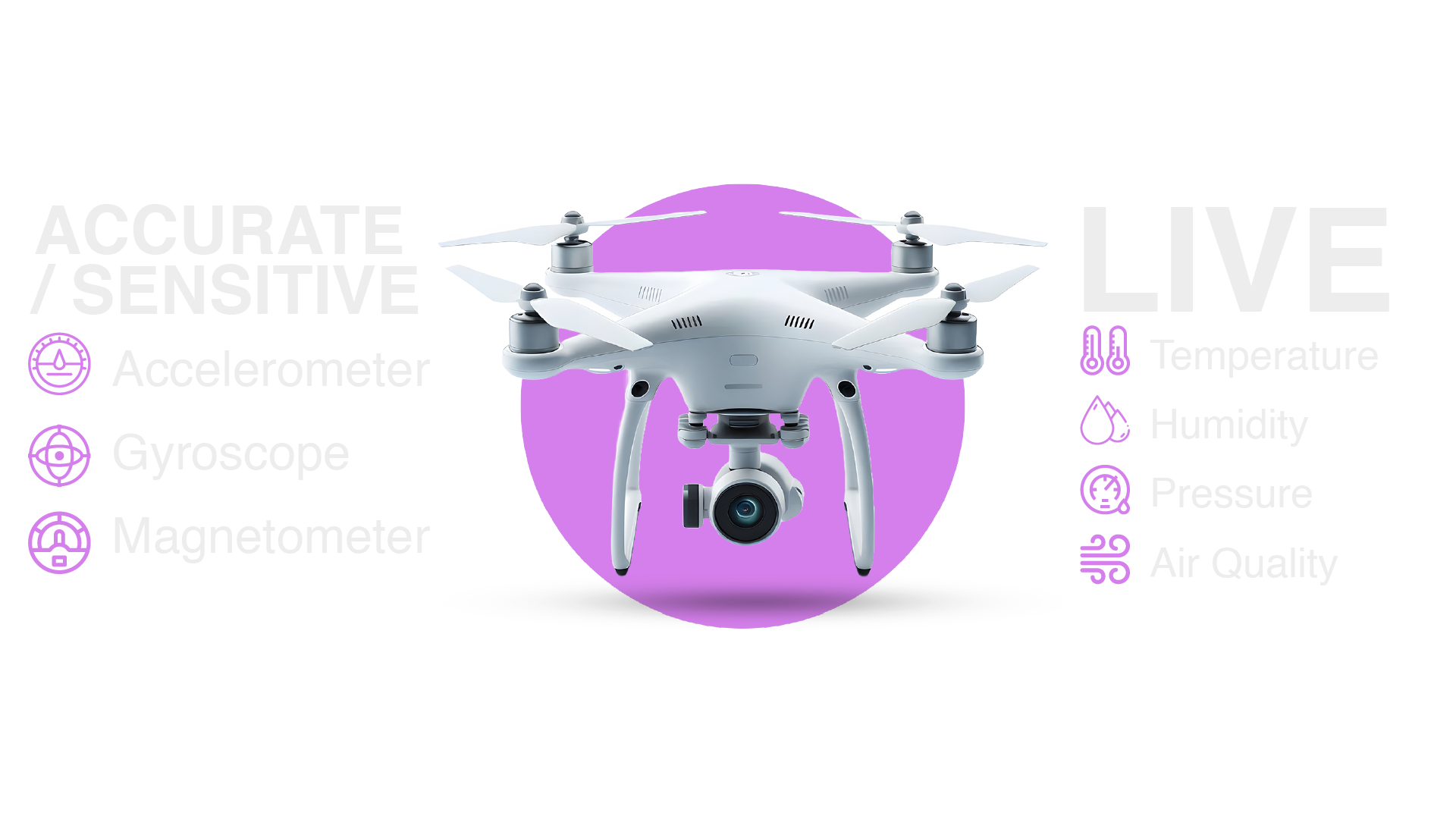
The MultiNav Pro+ streams real-time environmental data across all seven sensor channels simultaneously. When integrated with the RFOXiA ecosystem — specifically the BLE Module for wireless transmission and the RFOXiA Connect app for live visualization — this data becomes immediately actionable on a mobile device, without internet connectivity, at ranges up to 20km man-to-drone.
For water quality sensor module IoT applications, real-time data means:
- Instant alerts when air quality thresholds are exceeded at a water treatment facility
- Continuous pressure monitoring on underwater sensor platforms to detect depth changes
- Live temperature and humidity logging at agricultural water reservoirs
- Motion-triggered data logging that activates when a buoy platform detects wave anomalies
The RFOXiA data streaming server accepts verified sensor streams and makes them available through the RFOXiA Club Command Center dashboard, where historical data can be reviewed, exported, and analyzed. For developers building data products or contributing to the RFOXiA data network, this infrastructure is already built and waiting.
The RFOXiA Data Network: Earn While Your Sensors Sense
One of the most unusual aspects of the RFOXiA ecosystem is the integrated data monetization network. When you deploy the MultiNav Pro+ Sensors Module outdoors with GNSS location verification, you can contribute your verified environmental data stream to the RFOXiA network and earn daily rewards — currently ranging from $0.08 to $0.40 per day depending on location scarcity, data completeness, and network tier.
RFOXiA aggregates this contributor data and sells it to enterprise buyers: agricultural technology companies, smart city operators, insurance companies modeling environmental risk, logistics providers, and university research institutions. These organizations need hyper-local, high-resolution environmental data that public weather APIs simply cannot provide.
Your water quality and environmental sensor node becomes a passive income asset. The sensor module you deploy for your IoT project contributes to a growing dataset that has real commercial value — and you are compensated for it.
Applications: Where the MultiNav Pro+ Sensors Module Deploys
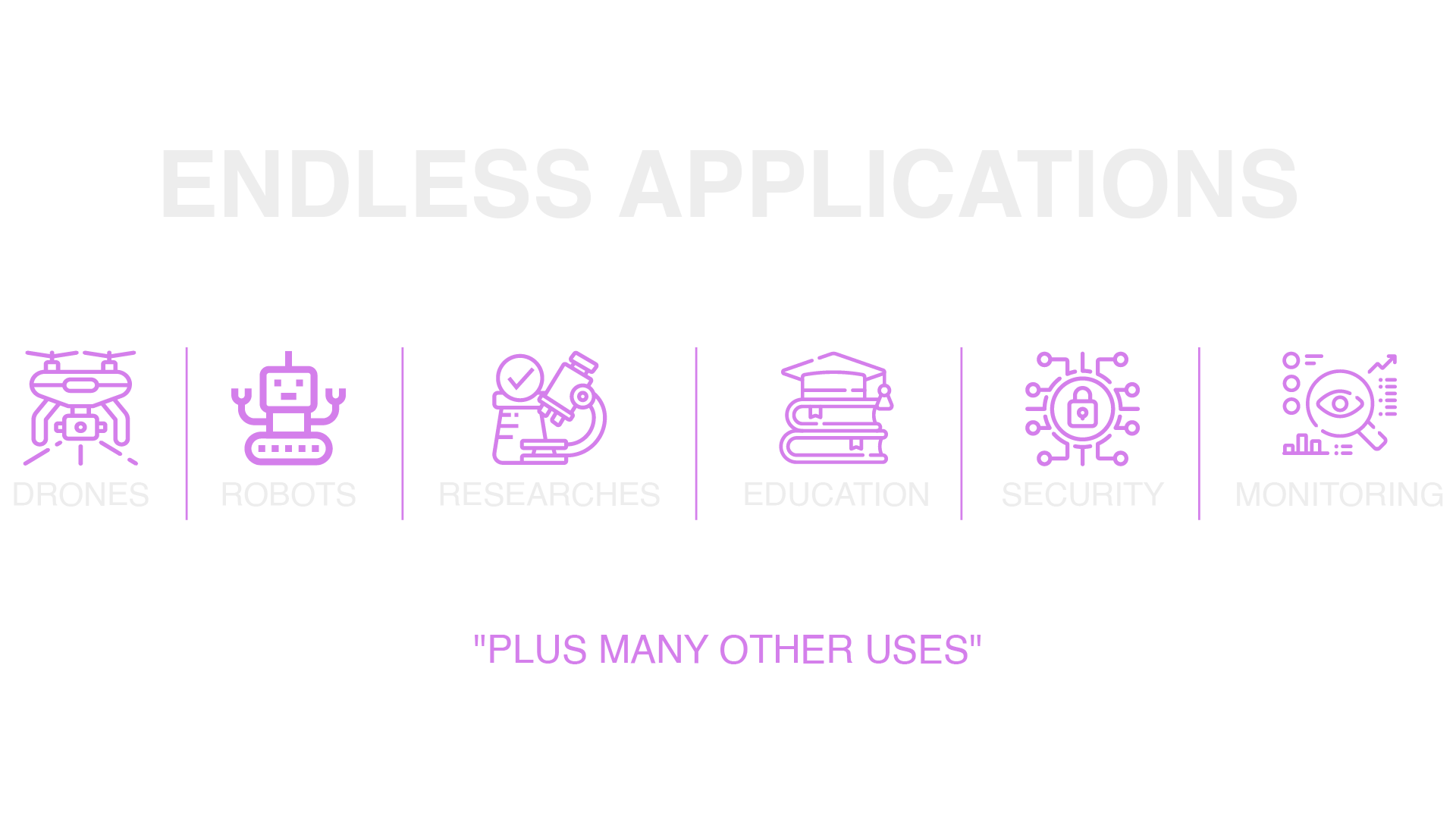
The range of applications for a seven-sensor environmental and motion platform is genuinely broad. Here are the primary deployment categories where the MultiNav Pro+ Sensors Module delivers measurable value:
Water Quality and Environmental Monitoring
For the developer specifically searching for a water quality sensor module IoT solution, the MultiNav Pro+ provides the environmental context layer that surrounds water monitoring applications. Temperature, pressure, humidity, and air quality data from the immediate vicinity of a water monitoring station provides the baseline needed for accurate interpretation of dissolved oxygen, turbidity, and biological oxygen demand readings from downstream sensors.
Deployments typically combine the MultiNav Pro+ with a water-contact sensor (pH, conductivity, or optical turbidity) connected via the same I2C bus or a secondary UART interface on the host MCU.
Precision Agriculture
Agricultural IoT is one of the fastest-growing segments of the environmental monitoring market. Crop health, irrigation optimization, frost prediction, and pesticide efficacy all depend on micro-climate data at the field level — exactly what the MultiNav Pro+ is designed to provide. The air quality sensor's NO2 and ozone detection is valuable for monitoring the effectiveness of field pest management operations.
Drone Telemetry
Professional drone operators need environmental telemetry for flight planning, payload performance modeling, and regulatory compliance. The BMI270 IMU combined with the LPS22HH pressure sensor provides altitude-referenced attitude data. The air quality and temperature data is increasingly required for commercial drone operations in urban airspace.
Robotics and Autonomous Vehicles
For ground robotics, the 9-DOF IMU (accelerometer + gyroscope + magnetometer) provides the sensor fusion inputs needed for dead reckoning navigation, slope detection, and obstacle avoidance. Environmental sensors add awareness of operating conditions that can affect battery performance, motor cooling, and electronics longevity.
Smart City Infrastructure
Municipal IoT deployments for air quality networks, traffic noise correlation, and urban heat island mapping require exactly the sensor capabilities the MultiNav Pro+ provides. At $39 per node, the cost of deploying a dense sensor network across an urban area is dramatically lower than with traditional environmental monitoring equipment.
Industrial IoT and Compliance Monitoring
Manufacturing facilities, chemical plants, and water treatment operations face environmental compliance requirements that demand continuous monitoring. The ZMOD4510's NO2 and O3 detection, combined with temperature and pressure logging, provides the data backbone for regulatory reporting systems.
Integrating the MultiNav Pro+ Into Your IoT Stack
The MultiNav Pro+ Sensors Module is designed to integrate cleanly with any microcontroller that supports I2C: STM32 series, ESP32, Arduino, Raspberry Pi, and any other platform with a standard I2C implementation.
For developers using the full RFOXiA ecosystem, the module pairs directly with the MultiNav Pro+ BLE Module (which provides wireless transmission at up to 5km ground-to-ground), the GNSS Module (which adds GPS location tagging to every sensor reading), and the Power/Program Kit (which provides up to 24 hours of runtime from a 5-minute charge cycle using supercapacitor technology).
The complete Developer Bundle — BLE Module, GNSS Module, Sensors Module, and Power/Program Kit — is available for $199 through the RFOXiA Integrated Sensors Module product page.
Firmware development is accelerated through the RFOXiA AI Firmware Builder, available inside RFOXiA Club. Describe your application in plain language — "I want to read temperature, humidity, and air quality every 30 seconds and transmit the data over BLE to a mobile device" — and the AI generates complete, production-ready firmware for the STM32WB07 at the heart of the RFOXiA module stack.
Technical Specifications Summary
| Feature | Specification |
|---|---|
| Sensors | 7 (Accelerometer, Gyroscope, Magnetometer, Temperature, Humidity, Air Pressure, Air Quality) |
| IMU IC | BMI270 (Bosch Sensortec) |
| Magnetometer IC | TMAG5273C1QDBVR (Texas Instruments) |
| Pressure IC | LPS22HHTR (STMicroelectronics) |
| Humidity/Temp IC | MVH4003D (MEMSVision) |
| Air Quality IC | ZMOD4510AI4R (Renesas) |
| Communication | I2C (single bus, unique addresses) |
| Module Size | 24mm × 18mm |
| Certification | FCC Certified |
| Price | $39 |
| Ecosystem | RFOXiA Club, BLE Module, GNSS Module, Power Kit, AI Firmware Builder |
Why the MultiNav Pro+ Is the Right Choice for Your Next IoT Project
The market for environmental and water quality sensor module IoT hardware is crowded with options that look similar on paper but fall short in practice. Generic breakout boards use unspecified or underspecified sensor ICs. Multi-sensor assemblies require complex wiring and address conflict resolution. Commercial environmental monitoring systems cost ten to fifty times more and are not designed for developer integration.
The MultiNav Pro+ Sensors Module occupies a unique position: professional-grade sensor ICs, clean I2C architecture, minimal footprint, FCC certification, and an ecosystem designed by engineers who build real hardware for real applications.
At $39, with all seven sensors integrated, I2C conflicts solved at the hardware level, and direct compatibility with the full RFOXiA wireless and data ecosystem, it is the most complete environmental sensing platform available to hardware developers at this price point.
Whether you are building a water quality monitoring network, a precision agriculture sensor array, a drone telemetry system, or an urban air quality station, the MultiNav Pro+ gives you the sensor foundation you need without the integration overhead that typically consumes your development time.
Get Started Today
The MultiNav Pro+ Sensors Module is in stock and ships immediately. FCC certified and ready for commercial deployment.
Join RFOXiA Club for free and receive a $10 welcome credit toward your first order. Explore the AI Firmware Builder, the Dev Hub community, and the data network reward program — all inside a single platform built for serious hardware developers.
Order the RFOXiA Integrated Sensors Module directly and start building the environmental sensing system your project deserves.
Your sensor node is waiting. Your data is worth something. Build it right the first time.
Written by: Moamen Mohamed LinkedIn