
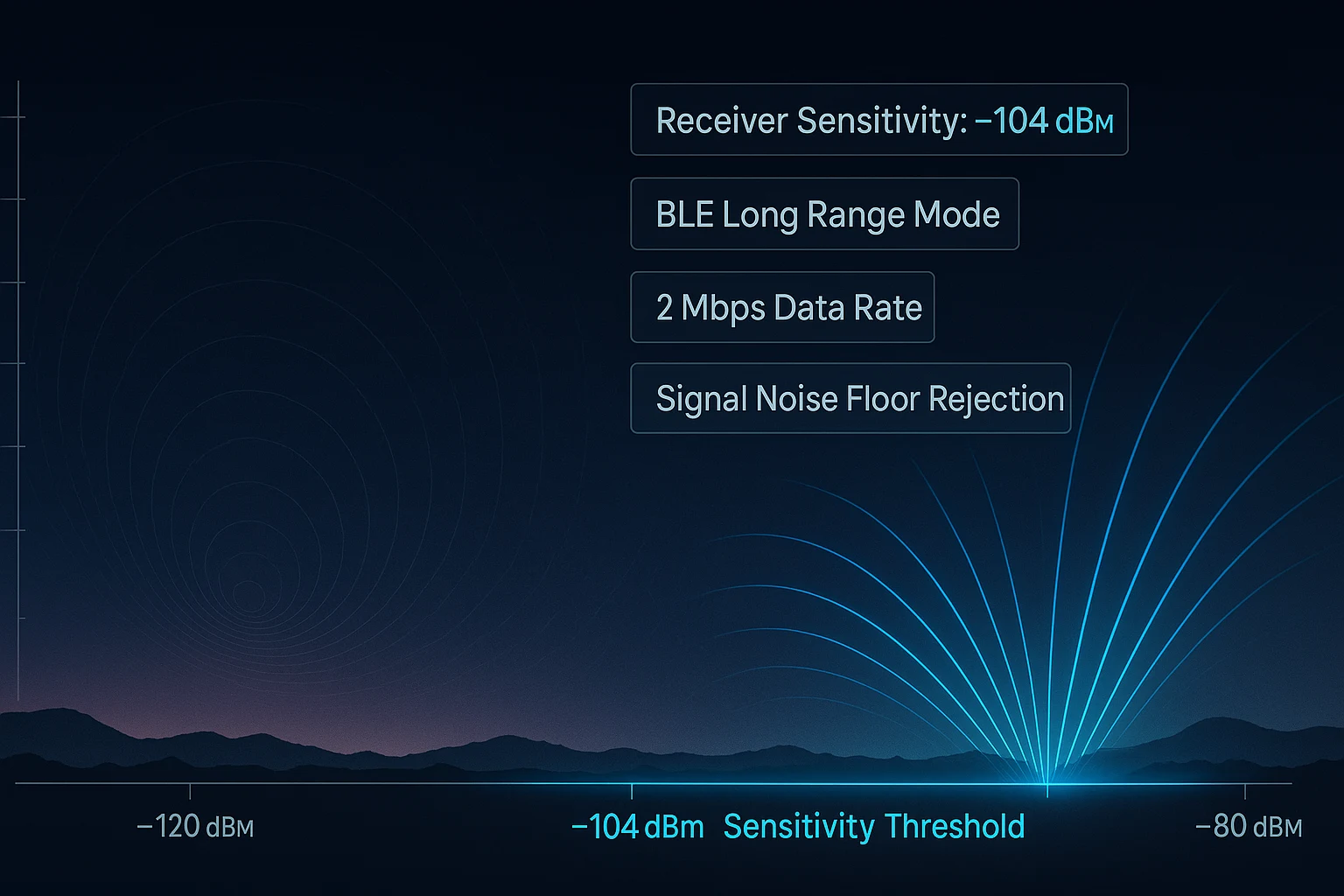
-104 dBm Receiver Sensitivity Module: How MultiNav Pro+ BLE Breaks the 50KM Barrier
RFOXiA Long Range Bluetooth Module
The -104 dBm Receiver Sensitivity Module That Changes Everything About Long-Range Bluetooth
Most engineers accept a brutal tradeoff when designing wireless systems: pay commodity prices and live with 80–100 meters of range, or spend $5,000+ on military-grade hardware to reach meaningful distances. The MultiNav Pro+ BLE module from RFOXiA exists to destroy that tradeoff entirely.
At the heart of this module is a -104 dBm receiver sensitivity rating — a specification that puts it in a class almost entirely occupied by industrial and defense-grade hardware. Combined with an optimized RF front-end and external amplifiers, this single figure explains how a $59 device achieves something the wireless industry has never made accessible at this price point: over 50KM of Bluetooth range between two airborne units.
This post breaks down exactly how receiver sensitivity translates into real-world range, what makes the MultiNav Pro+ BLE architecture unique, and why this module has become the go-to choice for drone builders, IoT developers, and field researchers who need reliable long-range wireless without institutional budgets.
What Is Receiver Sensitivity and Why Does -104 dBm Matter?
Receiver sensitivity is the minimum signal power level a radio receiver can detect and successfully decode. It is measured in dBm — decibels relative to one milliwatt — and expressed as a negative number. The more negative the number, the weaker the signal the receiver can still process.
This matters enormously for range. As a radio signal propagates through free space, its power decreases following the inverse square law. Every time you double the distance between transmitter and receiver, the received signal power drops by approximately 6 dB. A receiver that can detect signals at -104 dBm will therefore maintain a reliable link across distances that would completely lose a receiver operating at -80 dBm or -70 dBm — which describes most commodity Bluetooth modules on the market.
To put specific numbers on it:
- A standard BLE module with -70 dBm sensitivity: reliable to roughly 80–100 meters in open space
- A mid-range module with -85 dBm sensitivity: pushes to a few hundred meters under ideal conditions
- The MultiNav Pro+ BLE -104 dBm receiver sensitivity module: 5KM ground-to-ground when paired with a smartphone, 15–20KM man-to-drone, and 50KM drone-to-drone where ground reflections are eliminated
The difference between -70 dBm and -104 dBm is not incremental. It is 34 dB — a factor of roughly 2,500 in received power threshold. Combined with the module's RF front-end amplification stage, this is why the range figures look physically impossible to anyone accustomed to commodity BLE hardware. They are not impossible. They are the direct, predictable result of serious RF engineering applied to a consumer-accessible platform.
The Architecture Behind the -104 dBm Receiver Sensitivity Module
STM32WB07CCV6 Processing Core
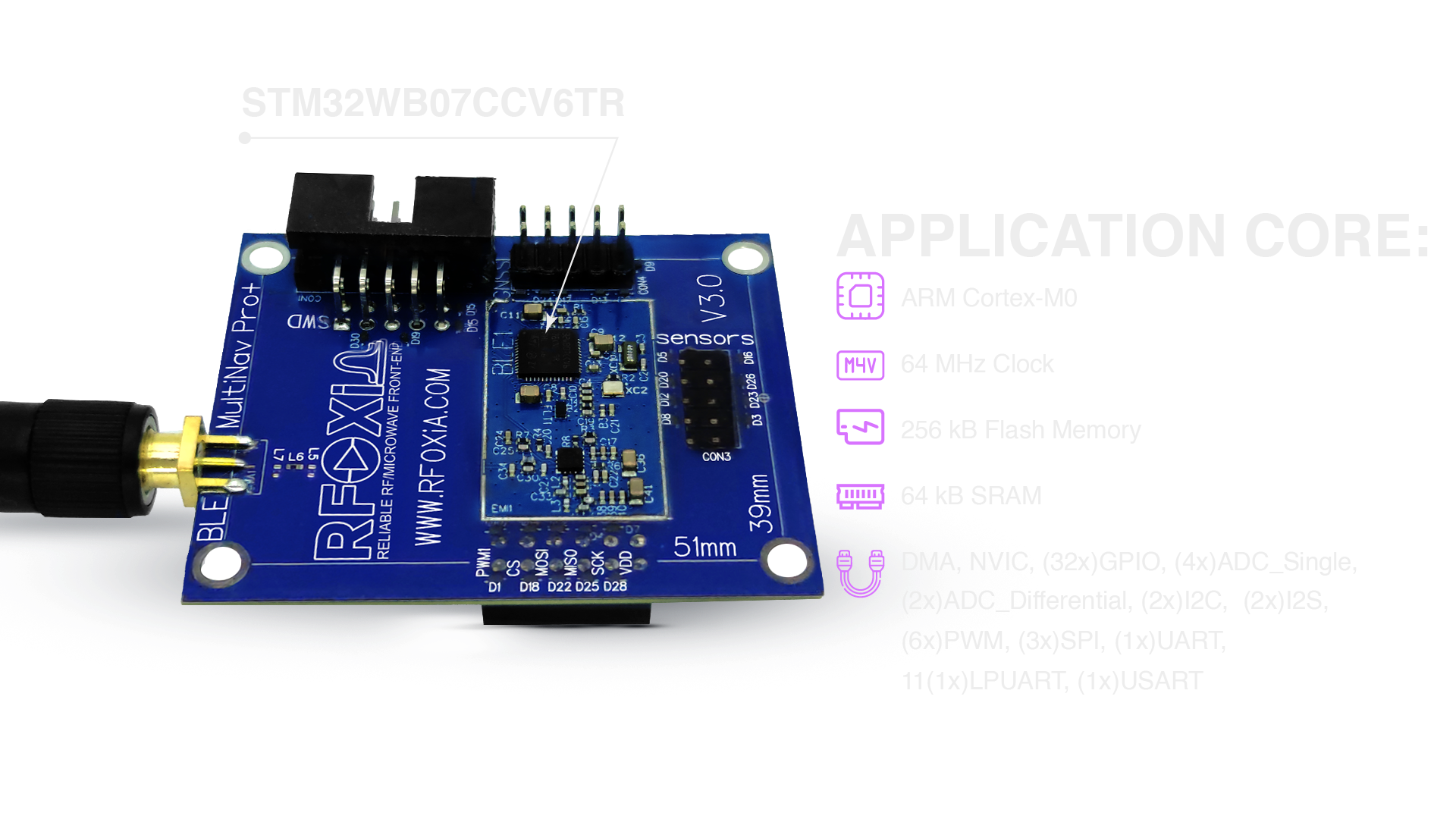
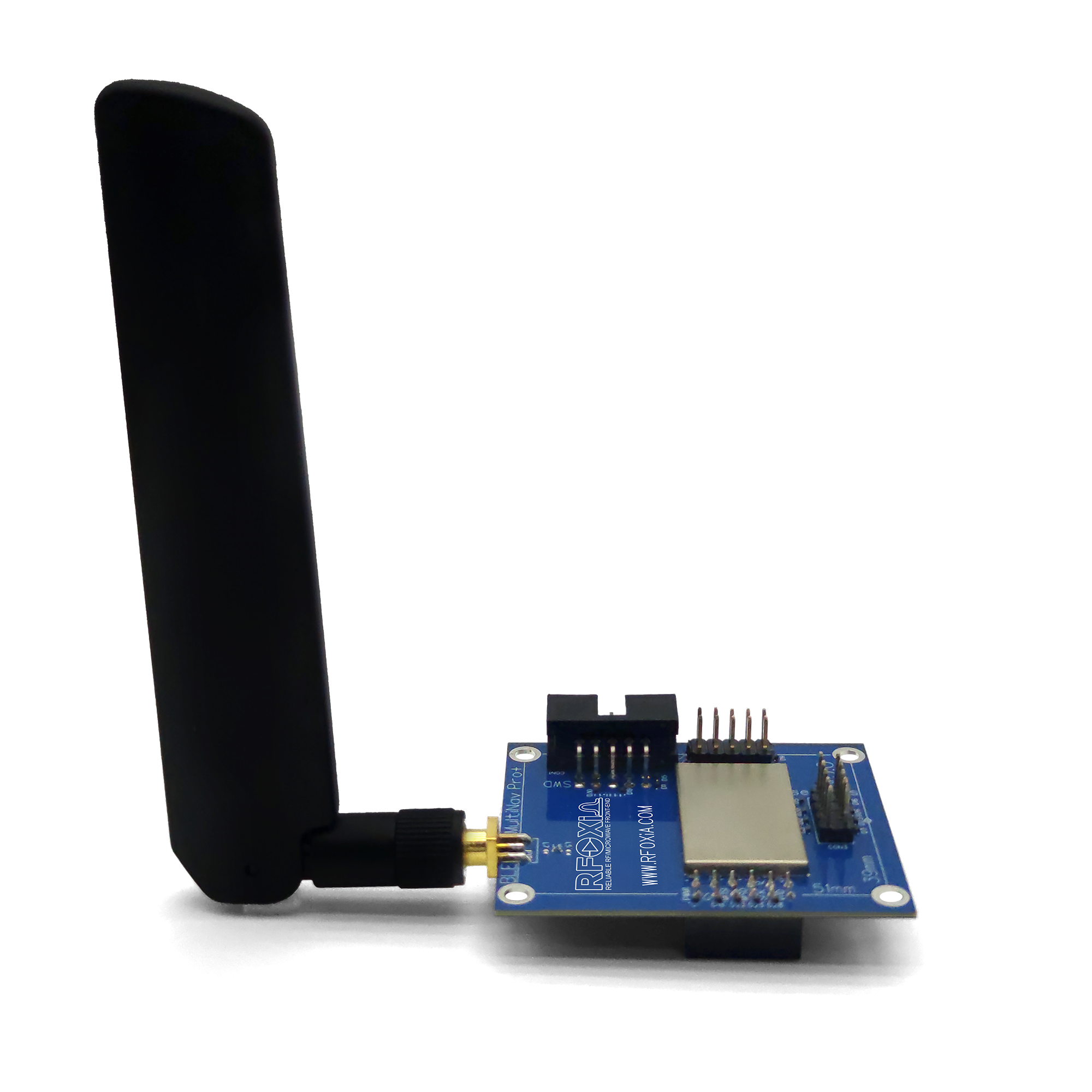
The MultiNav Pro+ BLE is built around STMicroelectronics' STM32WB07CCV6 — a dual-core wireless microcontroller that dedicates one core exclusively to managing the BLE stack while leaving the second core fully available for user applications. This separation is critical. On commodity modules, the application firmware competes with the radio stack for processor time, introducing latency and instability at the edges of range. The STM32WB07CCV6 eliminates this competition entirely.
The result is a module that maintains reliable 2 Mbps data throughput even at the outer limits of its operational range — not just a module that technically connects at long distances while delivering degraded, stuttering data.
External RF Front-End and Amplification
The -104 dBm receiver sensitivity does not come from the SoC alone. RFOXiA's hardware design adds an external RF front-end with dedicated amplification stages that boost both transmit power and receive sensitivity beyond what any integrated-only solution can achieve. This is custom PCB-level RF engineering — not a firmware configuration change — and it is the primary reason the MultiNav Pro+ BLE occupies a market position that no commodity module can replicate simply by updating its settings.
High-Gain Chip Antenna
The integrated high-gain chip antenna maintains strong signal directionality and efficiency without requiring the user to design or source an external antenna. This simplifies integration dramatically while preserving the performance characteristics that make the -104 dBm receiver sensitivity module deliver on its range specifications in real deployments.
Real-World Range: Three Scenarios
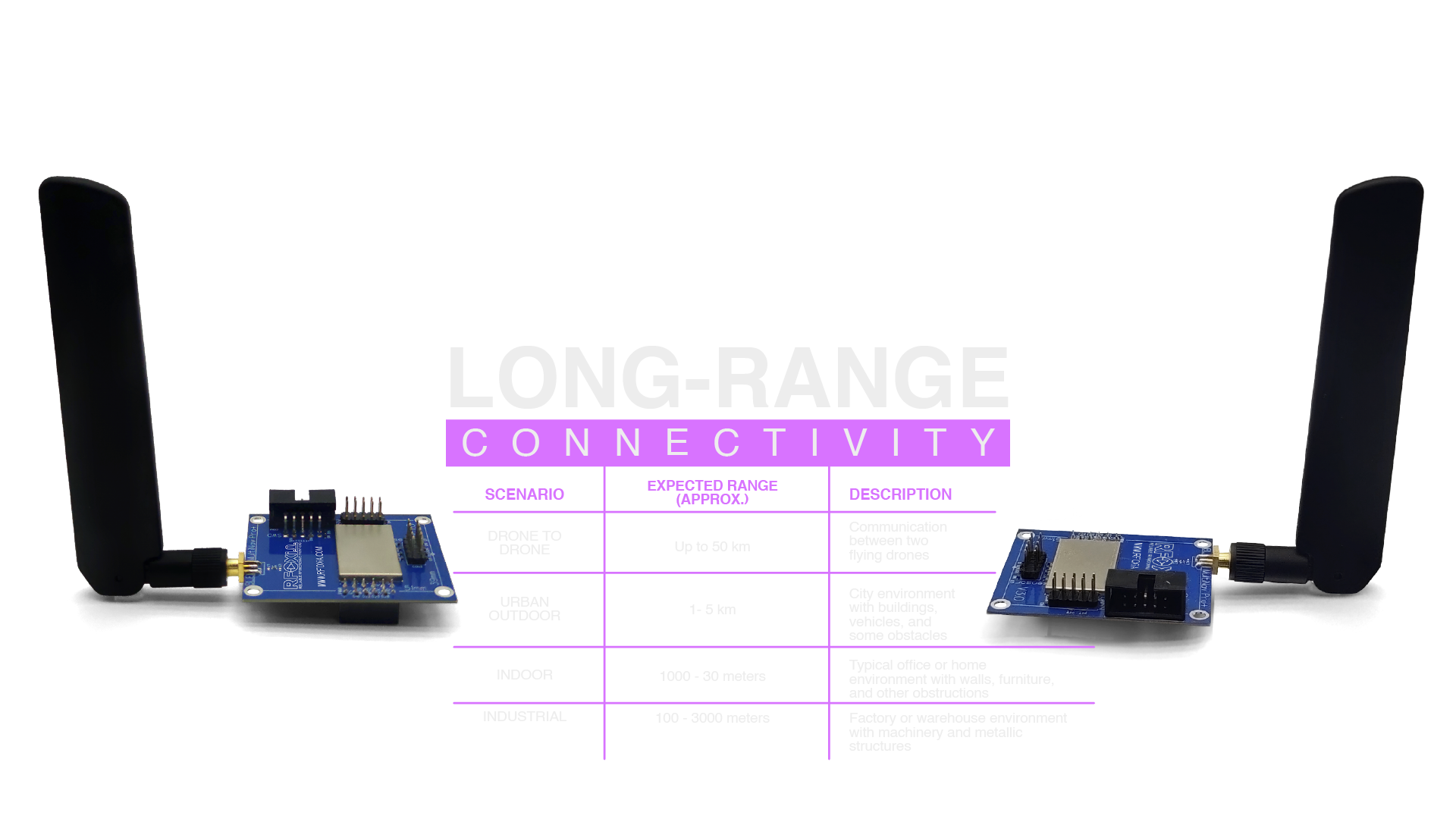
Understanding the MultiNav Pro+ BLE range requires understanding the three deployment scenarios that define its performance envelope:
Ground-to-Ground (5KM): One BLE module paired with a smartphone, the second module also paired with a smartphone. Both users at ground level. Ground reflections, obstacles, and multipath interference reduce effective range — yet this configuration still achieves 5KM, a figure that exceeds most "long-range" BLE products marketed specifically for range extension.
Man-to-Drone (15–20KM): One module at ground level paired with a smartphone, one module on an airborne platform (drone, balloon, UAV). Elevation of the airborne unit eliminates a significant portion of ground-level multipath and obstruction, extending range to 15–20KM. This is the primary operating scenario for FPV pilots and UAV developers using the module for telemetry and control.
Drone-to-Drone (50KM): Both modules are airborne. Ground reflections are effectively eliminated. With both units operating in clean free-space RF conditions and the -104 dBm receiver sensitivity module working as designed, the link extends beyond 50KM. This opens mesh networking, relay node architectures, and swarm coordination use cases that have never been accessible outside government and defense programs.
2 Mbps Data Rate: Why Speed Matters at Long Range
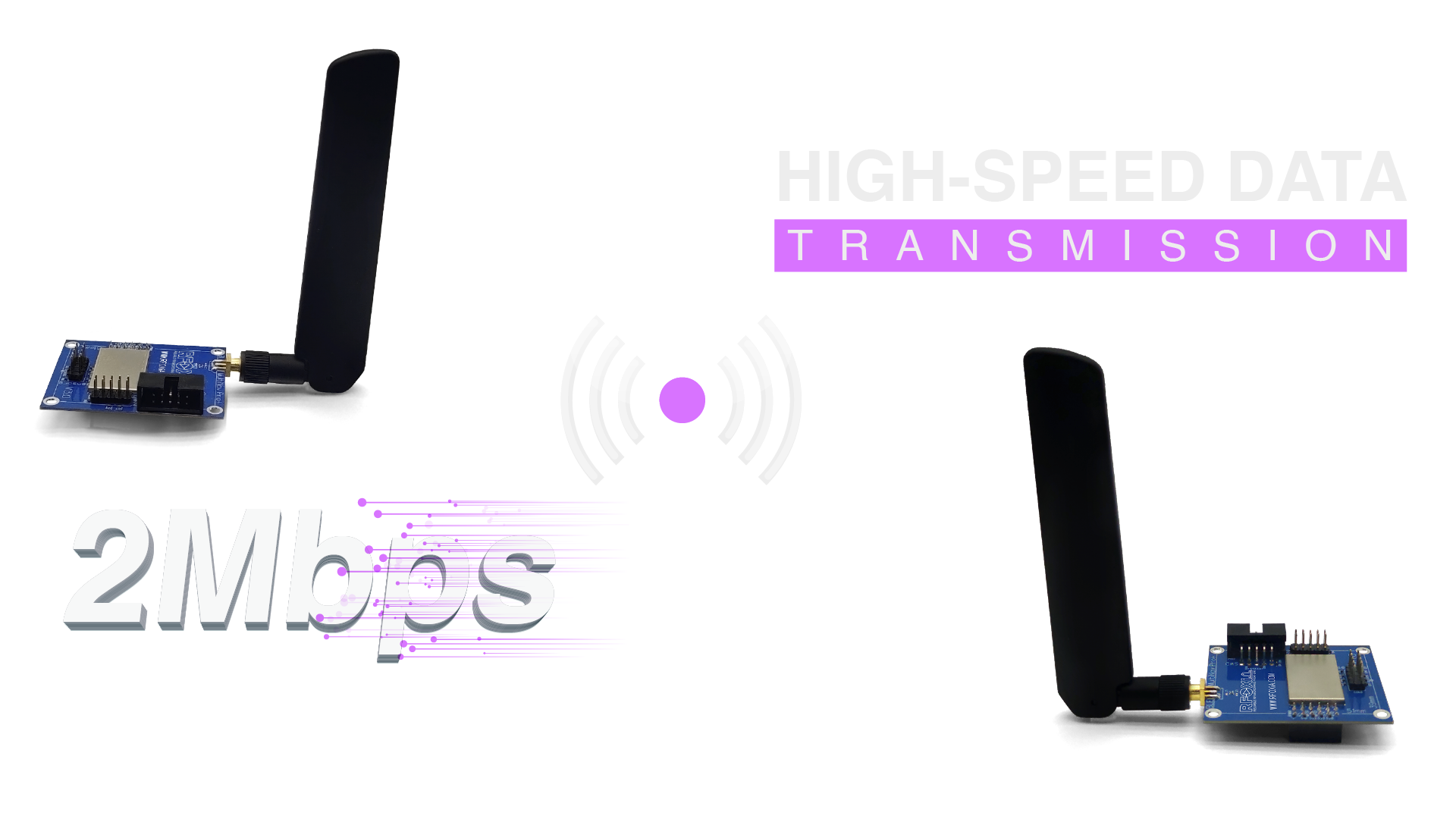
Most long-range radio systems achieve range by reducing data rate. Slowing transmission down allows more signal averaging and improves link margin — but it also means you cannot stream sensor data, transmit GPS coordinates at useful update rates, or maintain low-latency control links. The MultiNav Pro+ BLE maintains 2 Mbps data rate across its operational range, enabling:
- Real-time GPS coordinate streaming from drone to ground station
- Live sensor data telemetry (temperature, humidity, pressure, air quality) at full update rates
- Drone and robot control with latency low enough for responsive manual piloting
- BLE Chat voice and text communication between field operators without any internet infrastructure
The combination of -104 dBm receiver sensitivity and 2 Mbps throughput in a single module is what separates professional-grade wireless hardware from both commodity BLE modules (which sacrifice range) and narrowband long-range protocols like LoRa (which sacrifice data rate).
Ecosystem Integration: More Than a Standalone Module
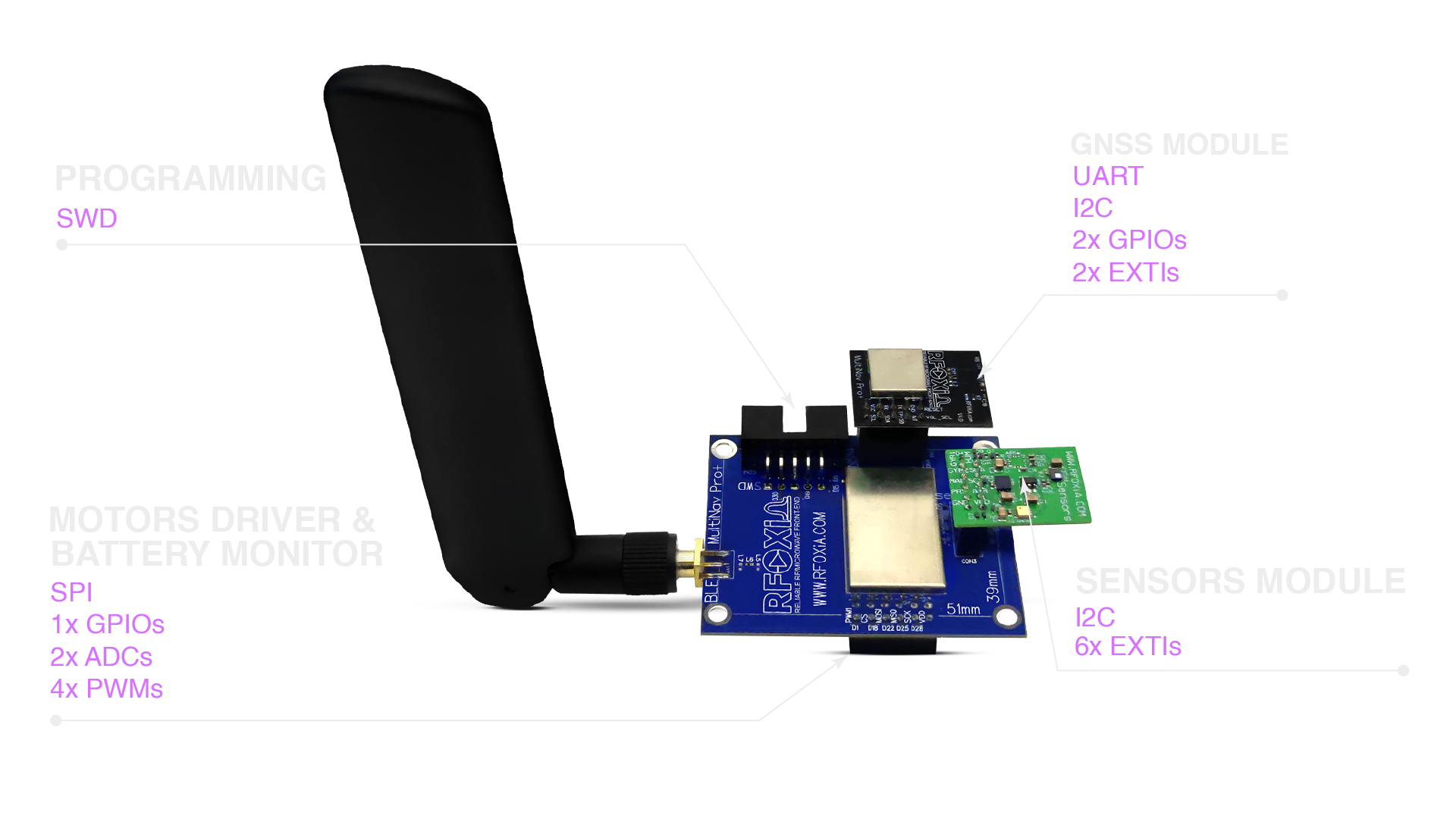
The MultiNav Pro+ BLE module is designed with four distinct interface connectors: GNSS, Sensors, Motors and Battery Management, and Programming. These interfaces exist so the BLE module can serve as the communication backbone of a complete autonomous system without requiring custom adapter boards or firmware modifications.
Connecting the MultiNav Pro+ GNSS module adds 1.5-meter precision location at 18Hz fix rate — fast enough to track rapidly maneuvering drone platforms. Connecting the Sensors module adds seven environmental sensors: temperature, humidity, air pressure, air quality, accelerometer, gyroscope, and magnetometer. The Motor and Battery Management interface enables direct drive integration for robotics and drone builds.
This modular stack approach means a developer can build a fully instrumented autonomous drone with precise location tracking, environmental monitoring, long-range telemetry, and motor control — using a coherent, documented ecosystem rather than combining incompatible modules from multiple vendors.
For developers ready to explore the full capability of the RFOXiA Long Range Bluetooth Module, the Developer Bundle packages all four modules together at a price point that makes the complete system accessible for serious makers and professional engineers alike.
RFOXiA Connect App: The Control Layer
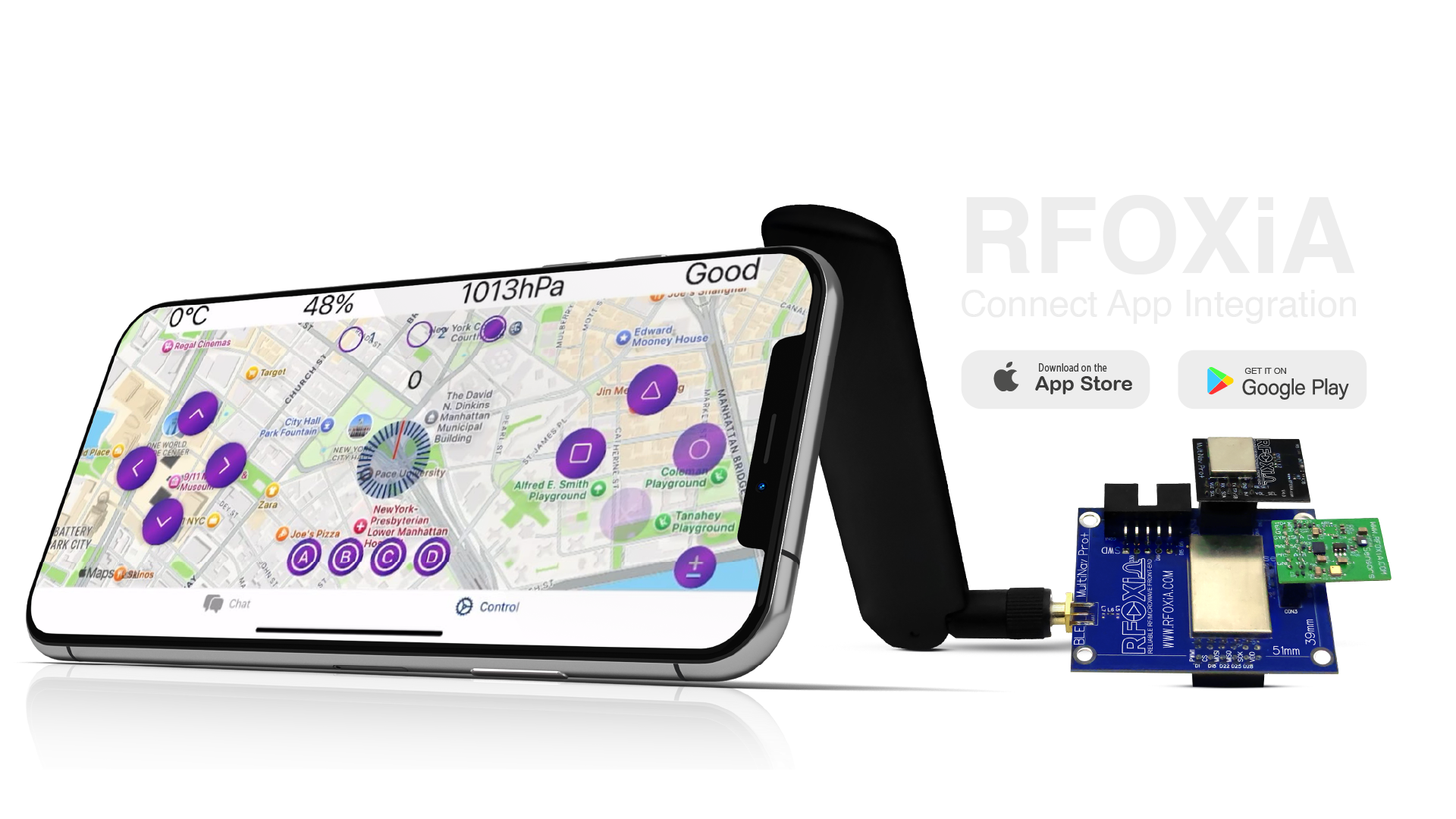
The module ships with full support for the RFOXiA Connect application on iOS and Android. The app provides two primary operating screens:
Control Screen: A PS5-style controller interface for drone and robot operation, with a live map showing real-time GPS position and a live sensor data panel. The control link operates entirely without internet — the app communicates directly with the module via Bluetooth, and the module communicates with the remote platform via its long-range RF link. At 15–20KM man-to-drone range, this means full telemetry and control from a smartphone with zero dependency on cellular coverage or WiFi infrastructure.
Chat Screen: Long-range mesh communication between multiple RFOXiA Connect users. Each BLE module acts as a network node. Text, data, and voice communication propagate through the mesh without any internet infrastructure. Applications include disaster response coordination, remote expedition communications, field research teams, and off-grid operations where cellular networks are unavailable or compromised.
BLE Chat: Internet-Independent Communication
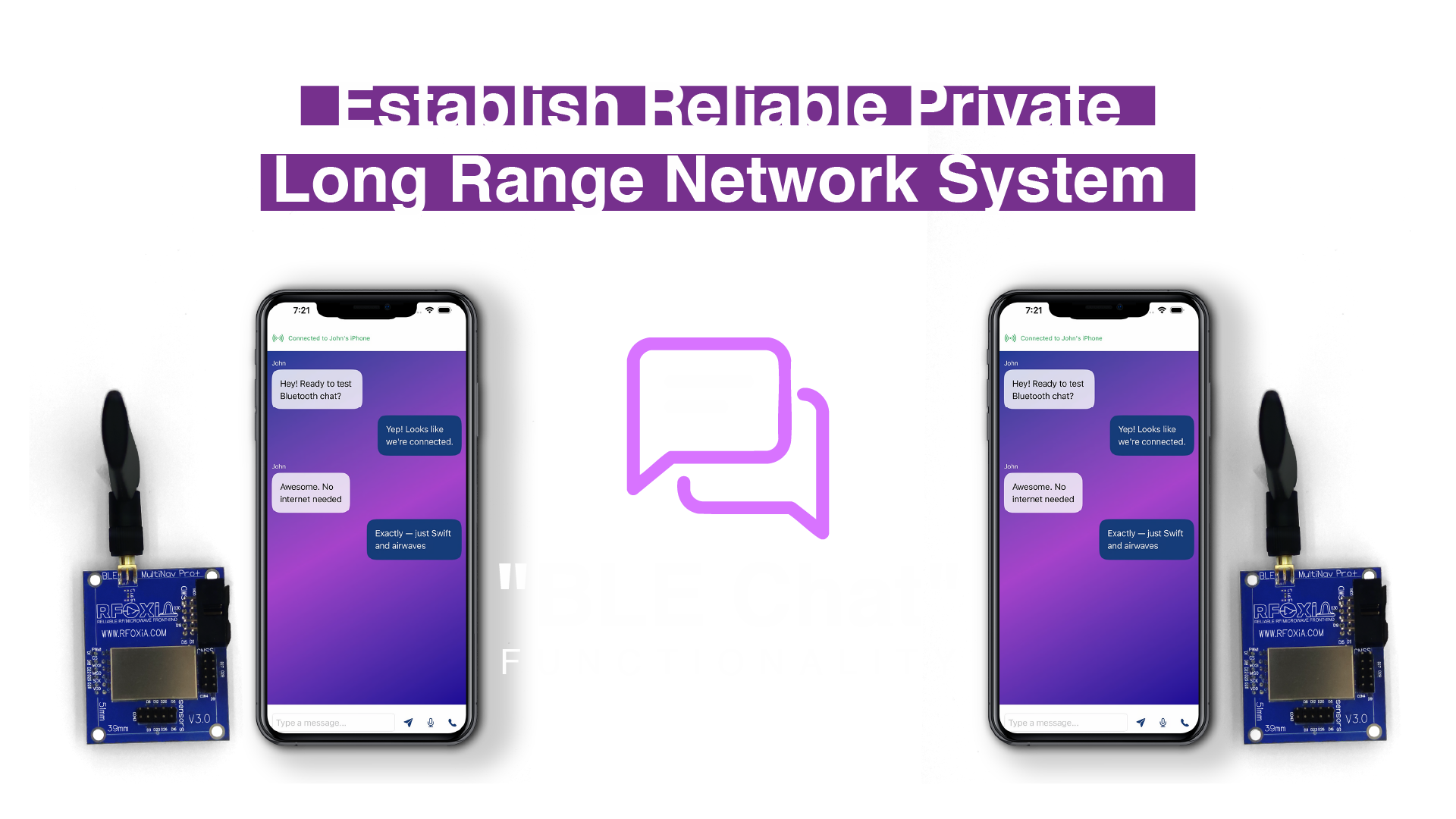
The BLE Chat functionality embedded in the module firmware and RFOXiA Connect app enables direct peer-to-peer and mesh communication between MultiNav Pro+ BLE users at distances up to 5KM ground-to-ground per hop. In mesh configurations with multiple nodes, coverage extends further. All communication is encrypted, direct, and completely independent of any network infrastructure.
This capability has immediate practical value for:
- Search and rescue operations where cellular networks may be overloaded or destroyed
- Remote field research where teams operate across distances that exceed radio walkie-talkie range
- FPV race events where team coordination needs to happen at the flight line without cellular dependency
- Disaster preparedness scenarios where maintaining communication capability independent of infrastructure is essential
No other consumer BLE module at any price offers this combination of 5KM ground-range mesh communication, voice capability, and integration with a full drone/robotics control ecosystem.
Physical Specifications: Compact Without Compromise
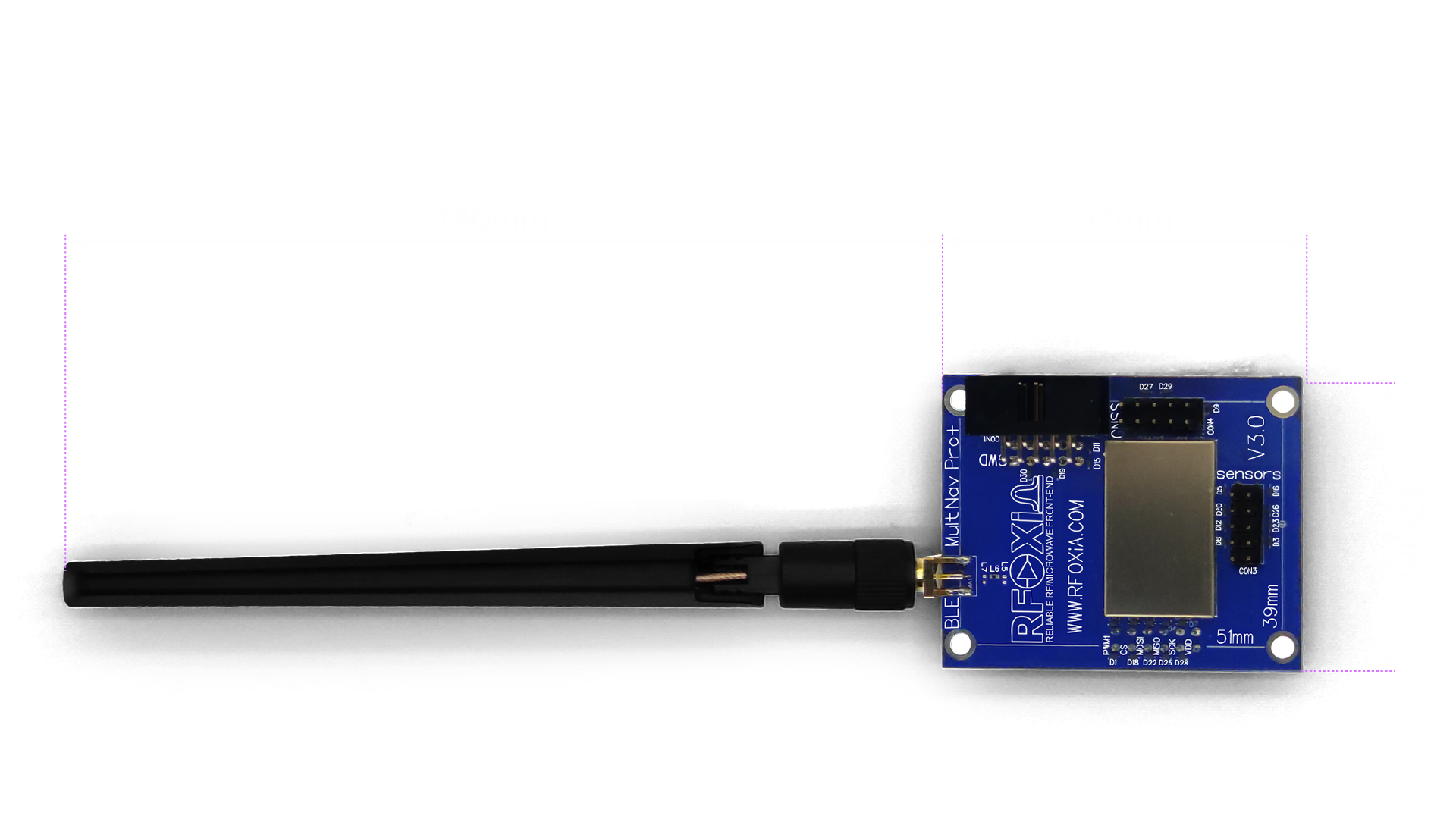
The MultiNav Pro+ BLE measures 57mm × 47mm with a fixing frame footprint of 54mm × 34mm and corner mounting holes at 51mm × 39mm spacing. The external antenna adds 140mm of length when deployed but folds or routes cleanly in most airframe and enclosure designs.
This size is a deliberate engineering choice. Achieving -104 dBm receiver sensitivity requires physical RF components — filtering stages, amplifier circuitry, and antenna matching networks that cannot be miniaturized without performance penalty. The module is sized to house this circuitry properly rather than to meet an arbitrary size target at the cost of the specifications that make it useful.
For drone builders accustomed to fitting everything into tight frames, the module integrates cleanly into standard 5-inch to 10-inch frame designs. The corner mounting holes align with standard M3 standoff patterns used throughout the FPV community.
Open Source and Fully Programmable
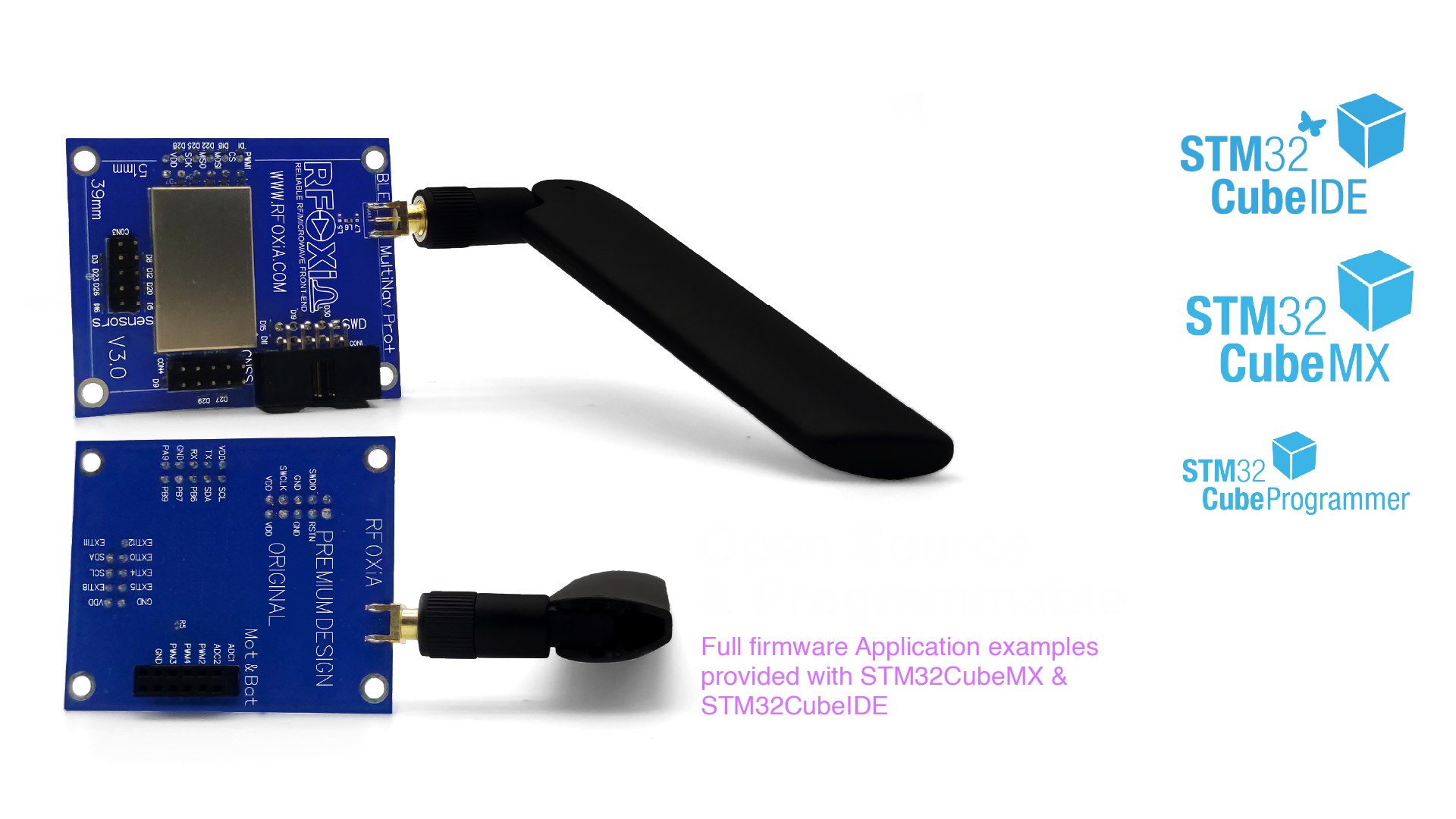
The MultiNav Pro+ BLE is fully programmable via SWD (Serial Wire Debug) interface. Complete source code access is provided through RFOXiA Club. For developers who need to customize the radio stack behavior, implement proprietary protocols, or integrate the module into existing firmware architectures, full source access means the module adapts to your application rather than constraining it.
RFOXiA Club also includes an AI Firmware Builder tool that generates production-ready firmware from plain-language descriptions of your application. Developers who do not want to write from scratch can describe their use case — "stream GPS coordinates and sensor data to ground station every 100ms" — and receive complete, documented, compilable firmware. This dramatically reduces integration time from weeks to hours for common application patterns.
The -104 dBm receiver sensitivity module is not just hardware you use — it is hardware you own, understand, and extend.
Integrated Real-Time Clock
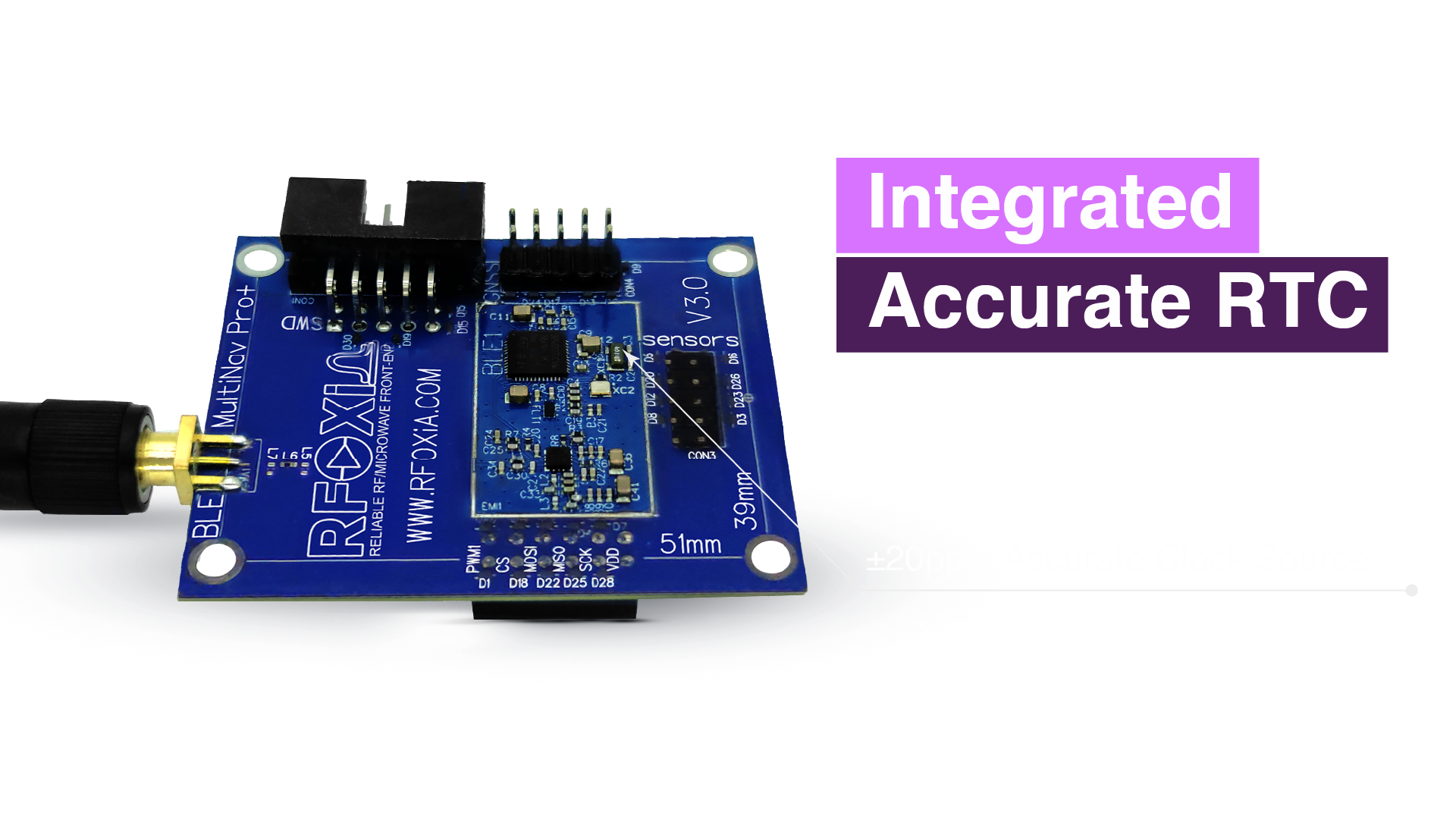
An integrated RTC crystal provides timestamp accuracy for all data logged or transmitted by the module. In multi-node deployments where data from several modules needs to be correlated — environmental sensor networks, multi-drone coordination, distributed monitoring systems — precise shared timing is not optional. The onboard RTC ensures that data from every node in a network carries a consistent, reliable timestamp without requiring GPS lock or network time synchronization on every node.
FCC Certification and Regulatory Compliance
The MultiNav Pro+ BLE is FCC certified — a qualification that matters for two distinct reasons.
First, it is a legal requirement for any intentional radio device sold or deployed in the United States. Operating uncertified radio equipment is a regulatory violation regardless of the frequency band or power level.
Second, FCC certification is a meaningful technical credential. The certification process requires the device to demonstrate emissions compliance across its full operational range, not just at nominal power levels. A module that passes FCC testing at its actual operating power and sensitivity is a module that has been tested by an accredited third-party laboratory — not merely claimed by its manufacturer.
For professional deployments, institutional customers, and developers integrating the module into products intended for distribution, FCC certification is non-negotiable. The MultiNav Pro+ BLE ships certified and ready to deploy.
Pricing and Availability
The MultiNav Pro+ BLE ships as a pair — two modules for $59. This pricing makes the -104 dBm receiver sensitivity module accessible at a price point that sits entirely between commodity BLE hardware (which cannot approach its specifications) and the professional long-range systems it performs alongside (which cost 80 to 800 times as much).
For developers building complete systems, the Developer Bundle combines the BLE module pair, GNSS module, Sensors module, and Power/Program Kit into a single integrated package. New members of RFOXiA Club receive $10 in welcome credits, with additional credits earned through the platform's onboarding funnel that can reduce the effective bundle price to $150.
Explore the full specification sheet and order the RFOXiA Long Range Bluetooth Module directly from the RFOXiA store with current inventory and shipping options.
Who Builds With the MultiNav Pro+ BLE
The module's user base reflects the breadth of applications that long-range, high-speed Bluetooth connectivity unlocks:
FPV and UAV Pilots use the module as a primary telemetry and control link, replacing proprietary RC systems with an open, programmable platform that also provides real-time GPS tracking and sensor data streaming.
Robotics Engineers integrate the module into ground and aerial platforms that need reliable command links beyond the range of standard wireless protocols, with the 2 Mbps data rate enabling high-frequency sensor fusion and control loops.
IoT Developers and Researchers deploy the Sensors module stack to build distributed environmental monitoring networks, using the BLE module's range to collect data from nodes deployed across hectares without requiring cellular or WiFi infrastructure at each node.
Field Research Teams rely on the BLE Chat functionality to maintain communications in locations where cellular coverage is absent and satellite comms are cost-prohibitive for general team coordination.
Hardware Makers and Embedded Developers use the module as the RF backbone for custom projects, leveraging the open-source firmware access and AI firmware builder to prototype new applications quickly.
The Market Position No Other Module Occupies
There is a gap in the wireless hardware market that has existed for years. Commodity BLE modules — Nordic nRF52 series, Silicon Labs EFR32, countless Chinese variants — are cheap, well-documented, and limited to roughly 100 meters of practical range. Professional long-range systems from defense and industrial suppliers are capable of 50–150KM links but priced for government procurement budgets, not engineering projects.
Between these two categories sits almost nothing. The MultiNav Pro+ BLE -104 dBm receiver sensitivity module exists precisely in this gap. It brings -104 dBm sensitivity, external RF amplification, 2 Mbps throughput, and 50KM drone-to-drone range to a $59 product that ships certified and ready to integrate.
For developers who have been forced to choose between affordable and capable in their wireless hardware, that choice no longer exists. The -104 dBm receiver sensitivity module from RFOXiA makes professional-grade long-range Bluetooth accessible to every builder with a project worth connecting.
Get Started With the MultiNav Pro+ BLE
The MultiNav Pro+ BLE is available now, FCC certified and in stock. Two modules ship for $59 with full documentation, firmware source access, and RFOXiA Connect app support included.
Join RFOXiA Club free to access the AI Firmware Builder, complete developer documentation, and community project library. New members receive $10 in welcome credits toward their first hardware order.
Ready to build beyond 100 meters? Explore the full RFOXiA Long Range Bluetooth Module and order today.
Written by: Moamen Mohamed LinkedIn