
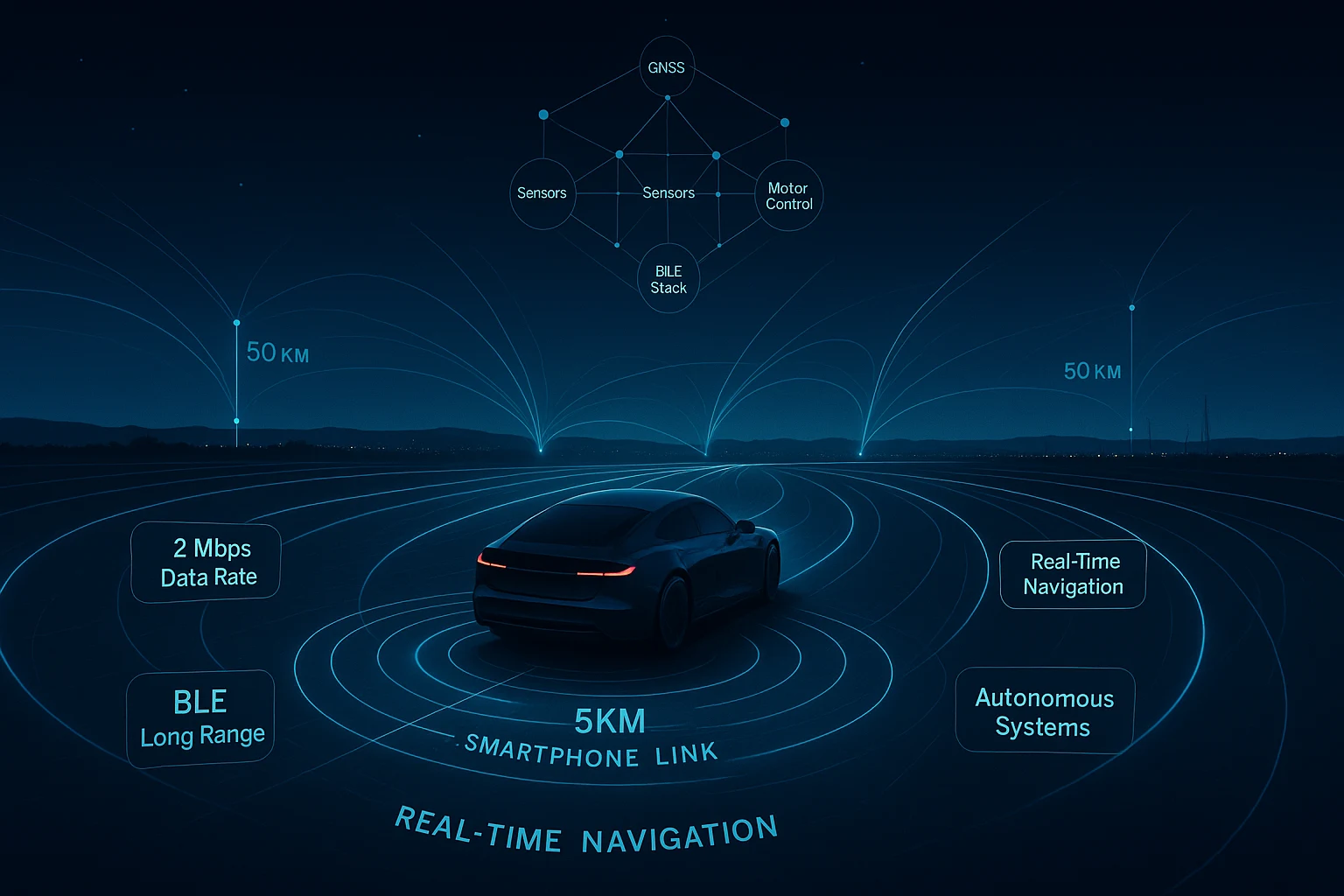
Autonomous Vehicle Communication Module: How the MultiNav Pro+ Achieves 50KM Bluetooth Range
RFOXiA Long Range Bluetooth Module
The Autonomous Vehicle Communication Module That Changes Everything
For engineers building drones, ground rovers, autonomous robots, or any remotely operated platform, the wireless communication link is the most critical — and most often compromised — component in the system. Standard Bluetooth modules reach 80 to 100 meters on a good day. Industrial radio modems capable of real range cost thousands of dollars and require licensing. The gap between "hobbyist-grade" and "military-grade" has historically been enormous, leaving developers to either accept severe range limitations or write enormous checks.
The MultiNav Pro+ BLE Module by RFOXiA is engineered specifically to close that gap. It is a professional-grade autonomous vehicle communication module that achieves over 50KM of Bluetooth range between two modules, over 5KM when paired with a smartphone at ground level, and 15 to 20KM in man-to-drone configurations — all at a price point of $59 for two units.
This is not a firmware trick or a marketing claim. The range is achieved through a purpose-built RF front-end, external amplifiers, advanced receiver sensitivity engineering, and a high-gain chip antenna system — the same fundamental architecture used in professional-grade radio systems, miniaturized and optimized for modern embedded development.
Why Autonomous Vehicles Demand a Better Communication Module
Autonomous and semi-autonomous vehicles — whether aerial drones, ground-based rovers, underwater ROVs, or agricultural robots — share a common dependency: they require a reliable, low-latency, high-bandwidth communication link that can operate across meaningful distances without infrastructure.
Consider what is actually being transmitted in a real autonomous vehicle deployment:
- Control commands — throttle, steering, actuator states — that must arrive within milliseconds
- Telemetry data — GPS position, battery voltage, motor temperatures, attitude data
- Sensor streams — environmental readings, camera metadata, object detection flags
- Status and alert packets — system health, error codes, threshold notifications
A standard BLE module cannot sustain any of this at operational distance. Wi-Fi requires access points. LoRa handles the range but sacrifices data throughput to the point of being unsuitable for real-time control. Cellular requires coverage and introduces cloud latency. The MultiNav Pro+ was designed from the ground up to serve as the dedicated autonomous vehicle communication module that handles all of these requirements simultaneously.
Technical Architecture: How 50KM BLE Range Is Actually Achieved
The MultiNav Pro+ does not rely on a single component to deliver its range. The performance is the result of a system-level approach to RF design that stacks multiple advantages.
RF Front-End with External Amplifiers
At the core of the module is the STM32WB07CCV6 wireless SoC from STMicroelectronics, which handles the BLE stack and user application simultaneously. But the SoC's native output power is dramatically extended by an external RF amplifier stage that increases transmit power well beyond what any off-the-shelf BLE module delivers. On the receive side, a low-noise amplifier (LNA) stage pushes receiver sensitivity to levels that allow detection of extremely weak signals — the key to long-range performance in any radio system.
High-Gain Chip Antenna
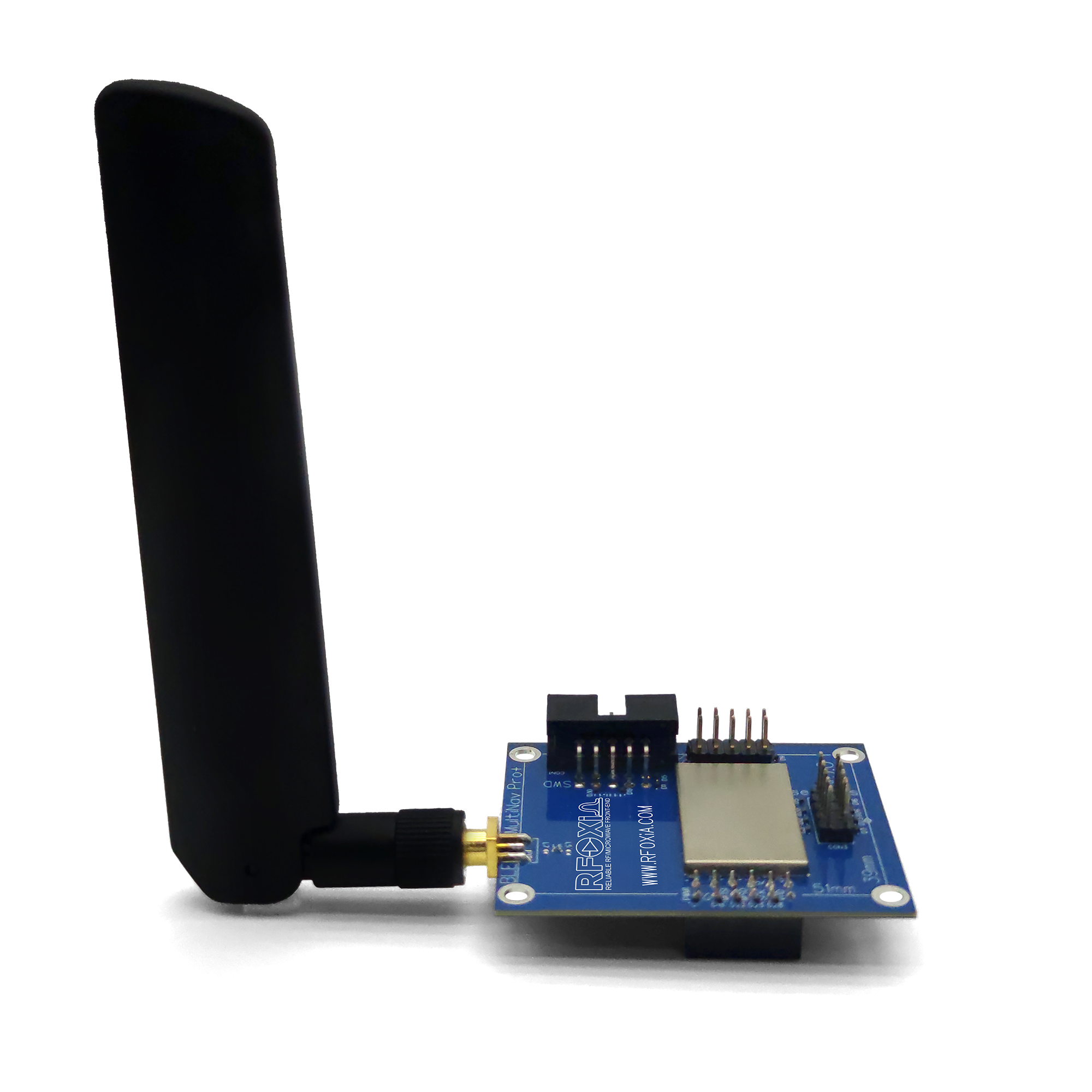
The integrated high-gain chip antenna with a 140mm antenna length is tuned specifically for the 2.4GHz band used by Bluetooth. This eliminates the need for external antenna connections while maintaining signal directivity and gain that commodity modules simply do not achieve.
Line-of-Sight Geometry
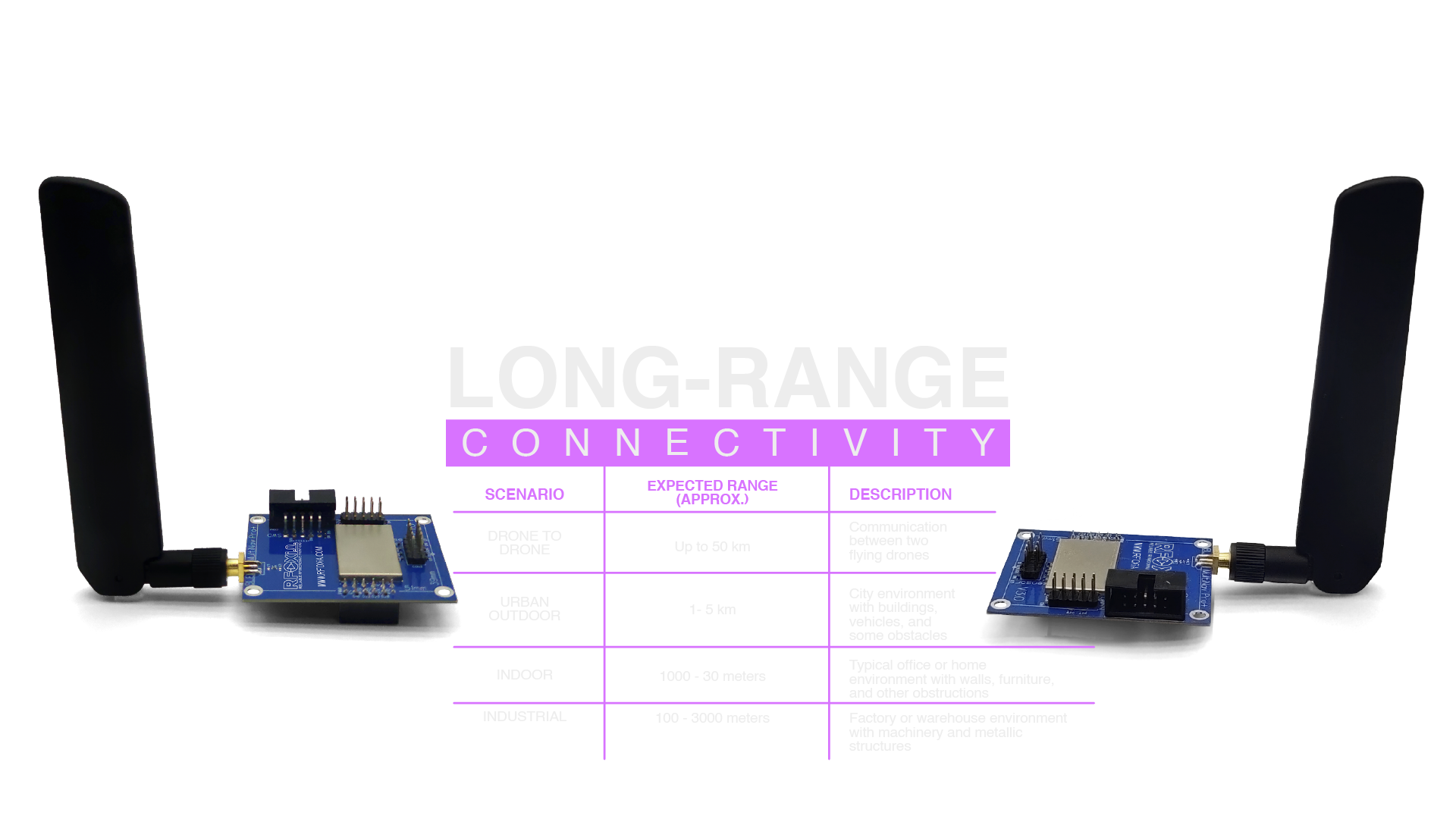
The range figures scale with deployment geometry, which follows the physics of radio propagation:
- Ground-to-ground: 5KM — multipath reflections and terrain introduce losses
- Man-to-drone: 15–20KM — one elevated node eliminates much of the ground reflection problem
- Drone-to-drone: 50KM+ — both nodes elevated, ground reflections eliminated entirely, Fresnel zone clearance maximized
This is why the MultiNav Pro+ is the definitive autonomous vehicle communication module for aerial platforms specifically — the architecture is optimized for exactly the deployment geometry that drones and aerial systems create.
2Mbps Data Rate: Why Speed Matters in Autonomous Control
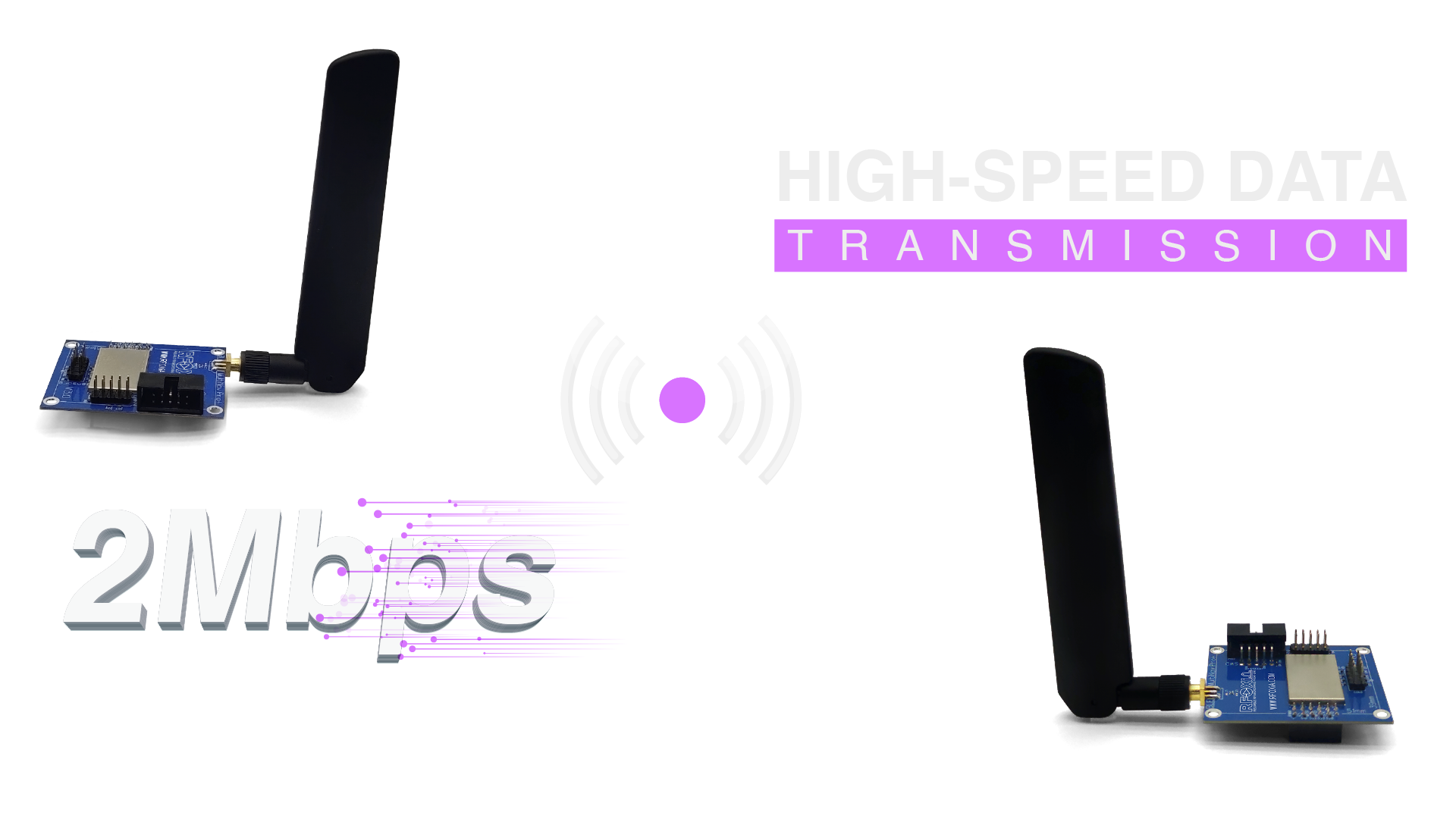
Range without bandwidth is useless for autonomous vehicle applications. The MultiNav Pro+ supports 2Mbps Bluetooth data rates — the maximum achievable under Bluetooth 5.x specifications. This matters for several reasons:
Real-time control loops require commands to arrive and be acknowledged within the control cycle time of the vehicle. At 2Mbps, latency is minimized even when transmitting dense telemetry alongside control packets.
Sensor data throughput — particularly when integrating with GNSS at 18Hz fix rates and multi-axis IMU data — demands a data pipe capable of sustaining concurrent streams without packet drops or queuing delays.
Firmware update capability — over-the-air firmware updates for autonomous vehicle systems are only practical when the transport link can move meaningful data volumes in acceptable time windows.
No other Bluetooth module on the market at this price point combines 50KM operational range with 2Mbps throughput and a $59 price tag for two units. The value proposition for developers building autonomous systems is straightforward: this is the autonomous vehicle communication module that was previously unavailable to anyone without a large budget.
Seamless Ecosystem Integration
The MultiNav Pro+ BLE Module is not a standalone component. It is the communication backbone of the complete RFOXiA MultiNav Pro+ ecosystem — a modular hardware platform designed so that each component connects directly to the others.
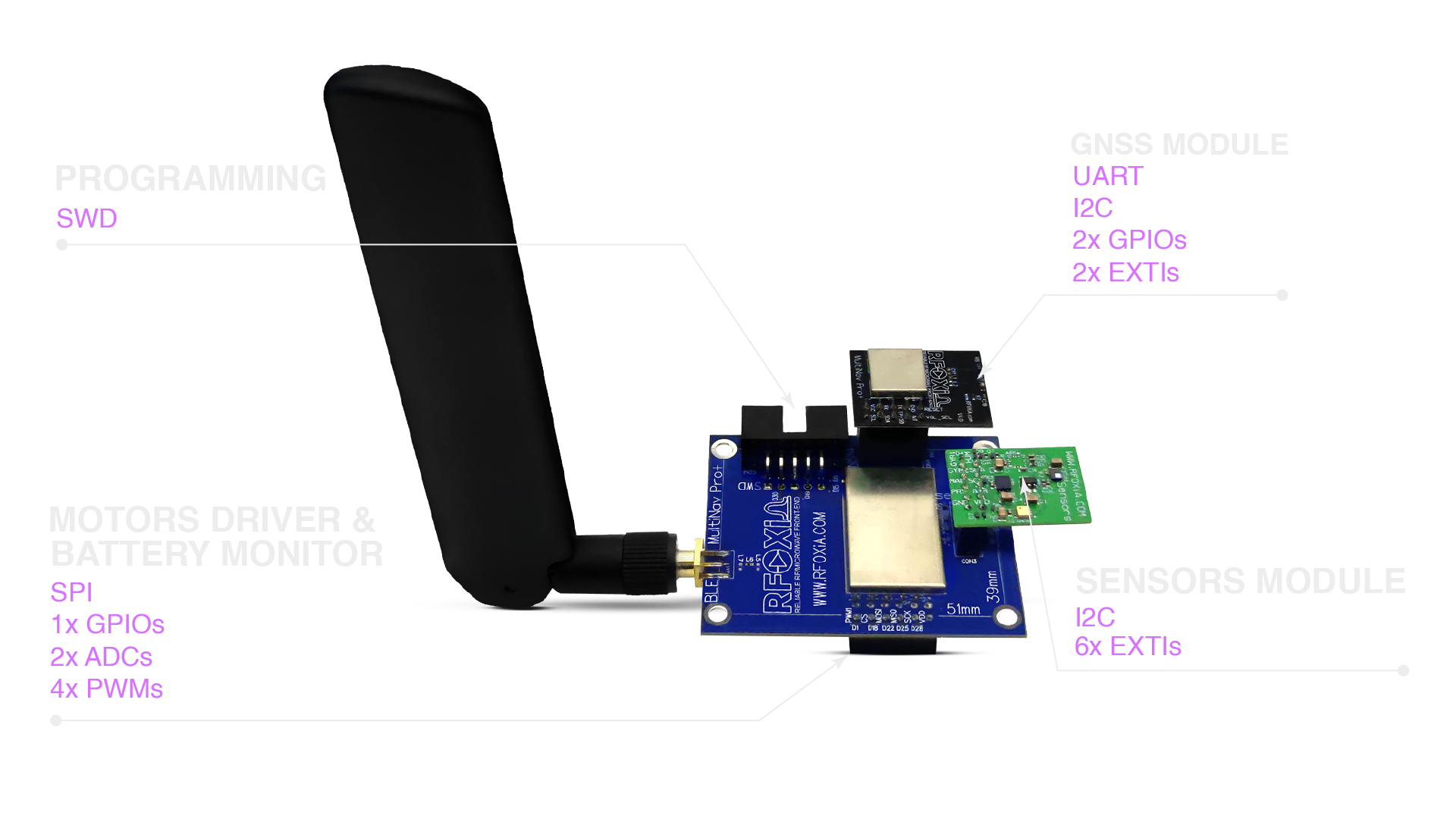
The four interfaces on the BLE module are not generic GPIO headers. They are purpose-designed connection points:
- GNSS Interface — direct connection to the MultiNav Pro+ GNSS Module (1.5m accuracy, 18Hz fix rate) for precise position data
- Sensors Interface — connection to the 7-in-1 Sensors Module for environmental telemetry (temperature, humidity, pressure, air quality, accelerometer, gyroscope, magnetometer)
- Motors and Battery Management Interface — enables direct actuator control and power monitoring for autonomous vehicle drive systems
- Programming Interface — SWD-based programming and debug access for custom firmware development
This modular architecture means a developer can build a complete autonomous vehicle telemetry and control system by connecting standardized modules — no custom PCB work required to achieve professional-grade functionality.
The Processing Core: STM32WB07CCV6
The choice of the STM32WB07CCV6 as the processing core is not incidental. This dual-core wireless SoC separates BLE stack management from application processing, meaning the radio protocol never competes with user application code for processor cycles.
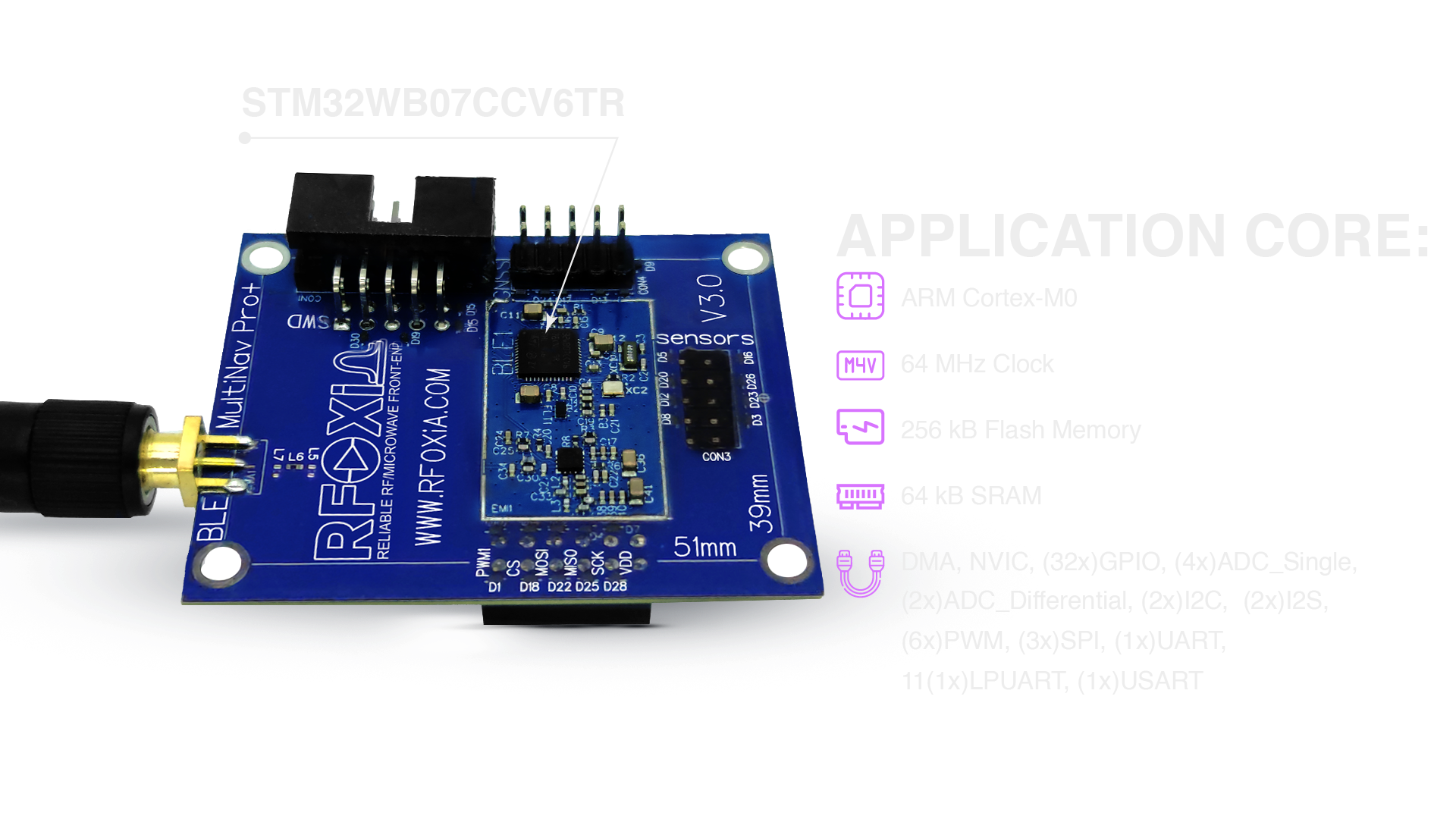
For autonomous vehicle communication module applications, this architectural separation is critical. A control loop running at 100Hz cannot tolerate priority inversions from BLE stack maintenance routines. With the STM32WB07CCV6, the application developer gets dedicated compute for their vehicle logic while the wireless subsystem operates independently.
The SoC also provides the foundation for the full open-source firmware stack that RFOXiA publishes on GitHub, enabling developers to modify, extend, and optimize the firmware for their specific autonomous platform requirements.
RFOXiA Connect App: Control Interface for Autonomous Platforms
The MultiNav Pro+ BLE Module pairs with the RFOXiA Connect mobile application — available on both iOS and Android — to provide an immediate, professional-grade ground control interface for autonomous vehicles.
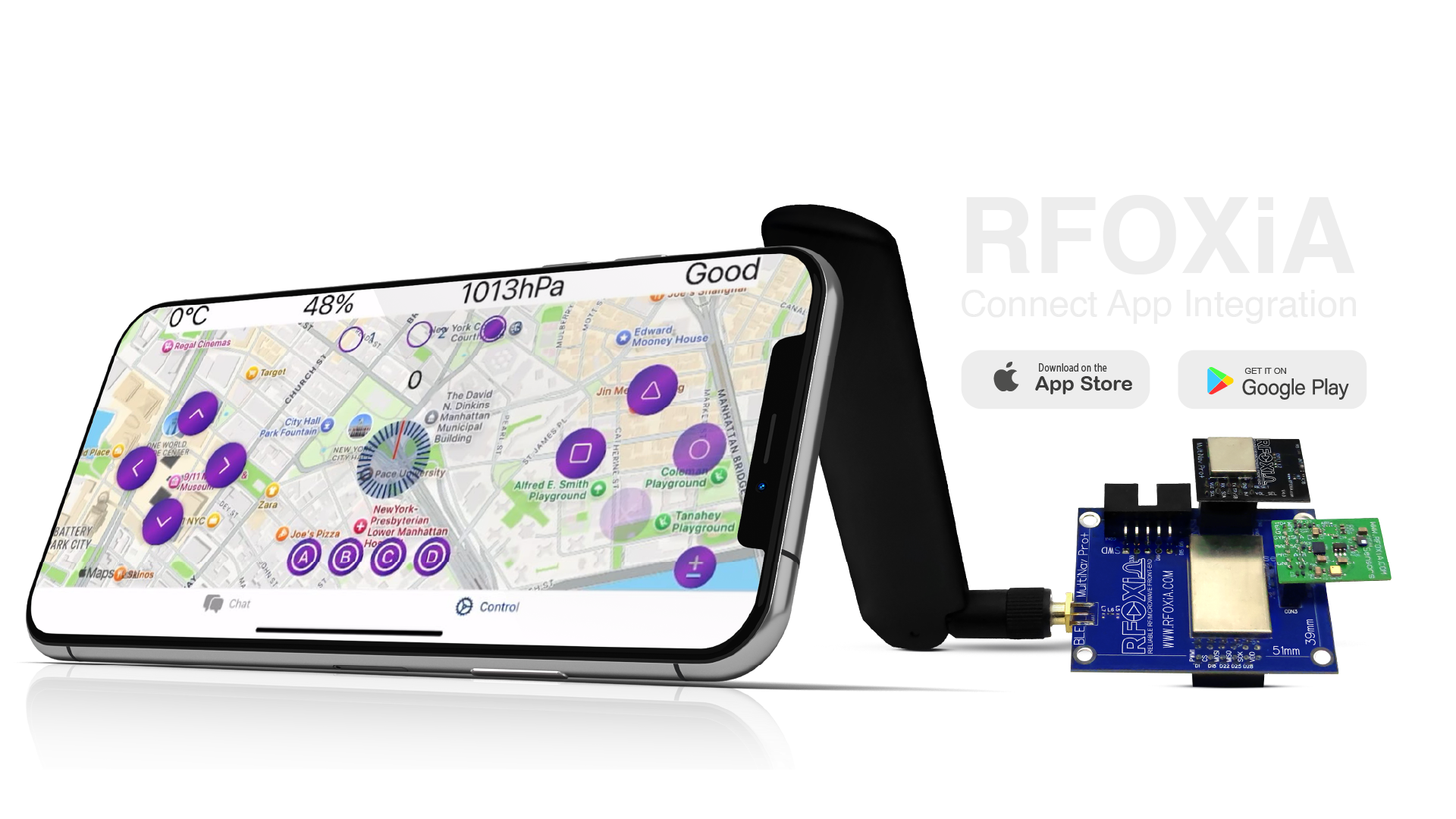
The app provides:
PS5-Style Controller Interface — familiar joystick-based control for drone and ground vehicle operation, with configurable axis mapping and sensitivity curves.
Live Map with Real-Time GPS Tracking — your autonomous vehicle's position plotted on a live map at up to 18Hz update rate when the GNSS module is in the stack. No external ground control station software required.
Live Sensor Data Display — all telemetry from the Sensors Module displayed in real time on the operator's phone screen. Environmental conditions, attitude data, and system health in a single view.
Automation Center — configure automated behaviors, geofencing triggers, and conditional logic directly from the app interface.
Critically, the entire app operates without internet connectivity. The BLE link between the phone and the module is the only connection required. This is the correct architecture for autonomous vehicle operations in remote areas, emergency response scenarios, or any environment where cellular infrastructure is absent or unreliable.
If you're building or operating autonomous vehicles and need a communication solution that works at real distances without infrastructure dependencies, explore the RFOXiA Long Range Bluetooth Module to see full specifications and ordering information.
BLE Chat: Infrastructure-Free Communication for Field Operations
Autonomous vehicle deployments rarely involve a single operator at a desk. Field teams, survey crews, emergency responders, and research groups operating multiple autonomous platforms need team communication that works in the same environment as their vehicles — which often means no cell coverage.
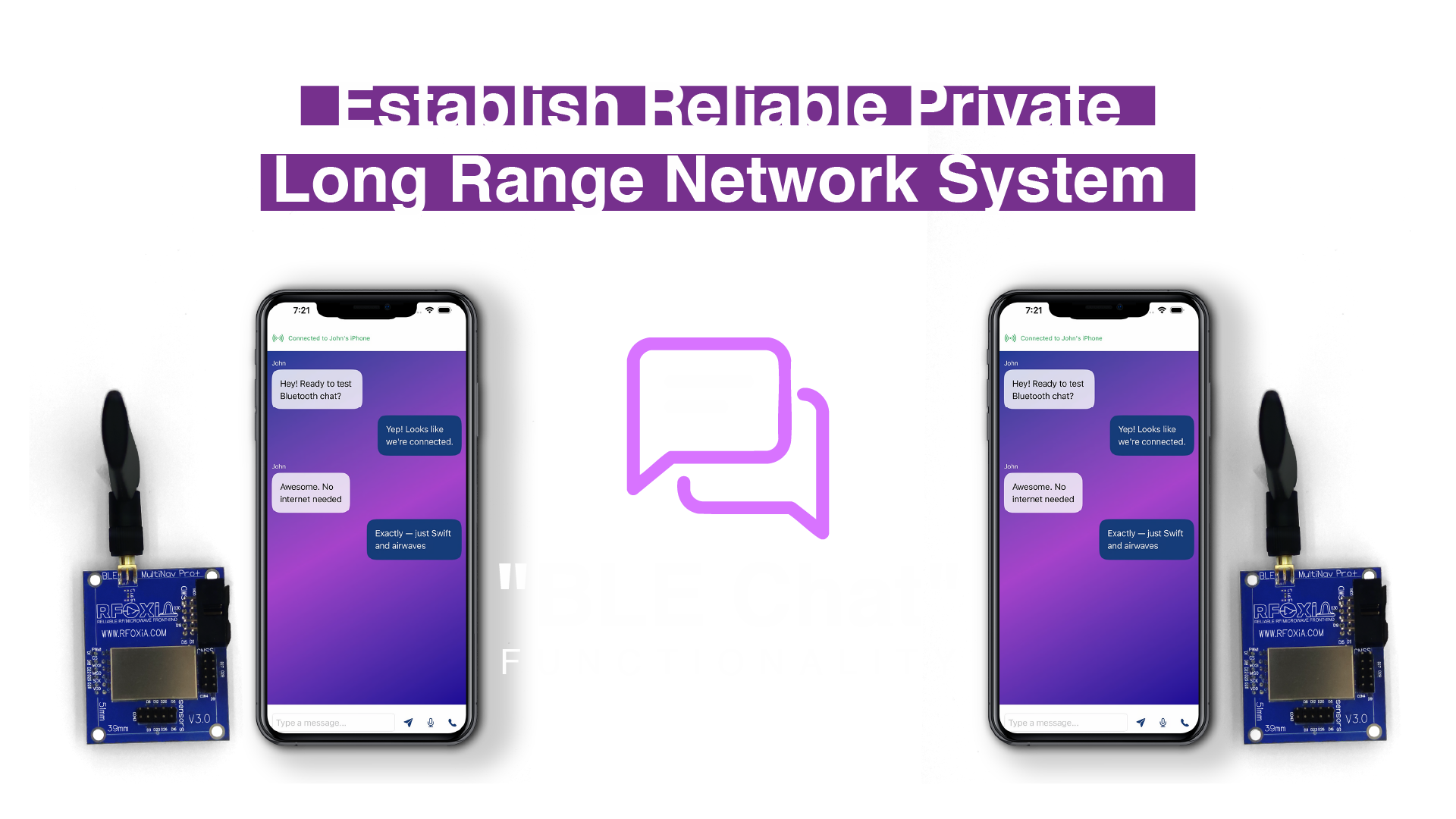
The BLE Chat functionality built into the MultiNav Pro+ ecosystem enables direct, internet-independent communication between multiple users carrying BLE modules. Text messages, data packets, and voice communications travel over the same BLE link used for vehicle control — creating a unified communication layer for both vehicle telemetry and team coordination.
This is not a feature commonly found in any autonomous vehicle communication module at any price point. It reflects the broader vision behind the MultiNav Pro+ design: build a system that is complete enough to support real operational deployments, not just laboratory demonstrations.
Compact Form Factor Built for Integration
Autonomous vehicle platforms are constrained by weight, volume, and mounting geometry. The MultiNav Pro+ BLE Module was designed with these constraints as primary requirements.
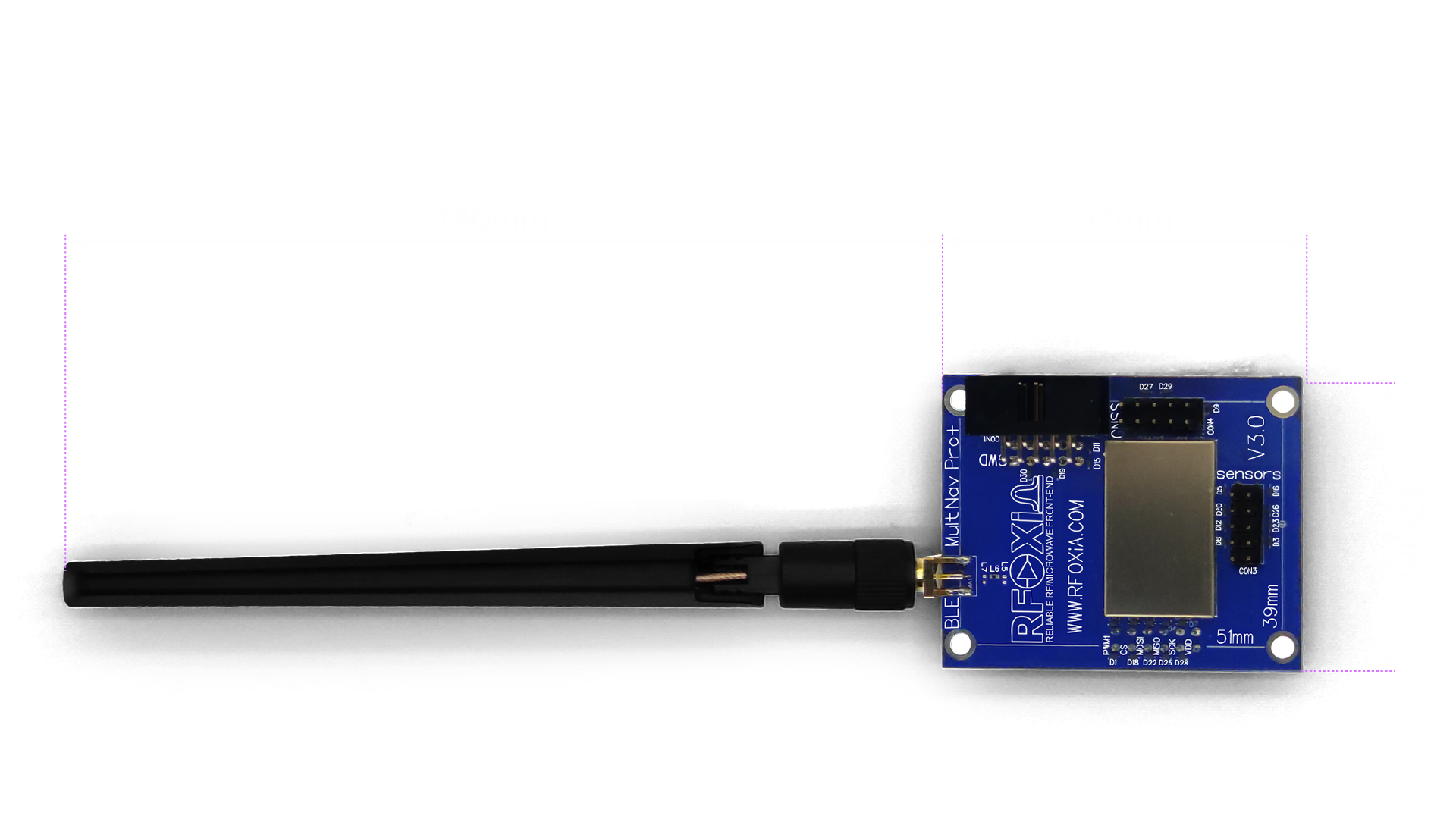
Module dimensions: 57mm × 47mm — small enough to mount on any drone frame, rover chassis, or embedded enclosure without structural compromise.
Fixing frame: 54mm × 34mm with corner mounting holes, compatible with M2 and M3 fastener standards commonly used in drone and robotics manufacturing.
Antenna: 140mm integrated high-gain chip antenna — no external connector, no pigtail, no coaxial routing required. Clean, reliable, vibration-resistant.
The compact design does not require any tradeoff in RF performance. The antenna and RF front-end are optimized for the form factor — the 50KM range figure is achieved at these dimensions.
Open Source and Fully Programmable
Proprietary black-box modules are incompatible with serious autonomous vehicle development. Engineers building production autonomous systems need to understand and control every layer of their communication stack.
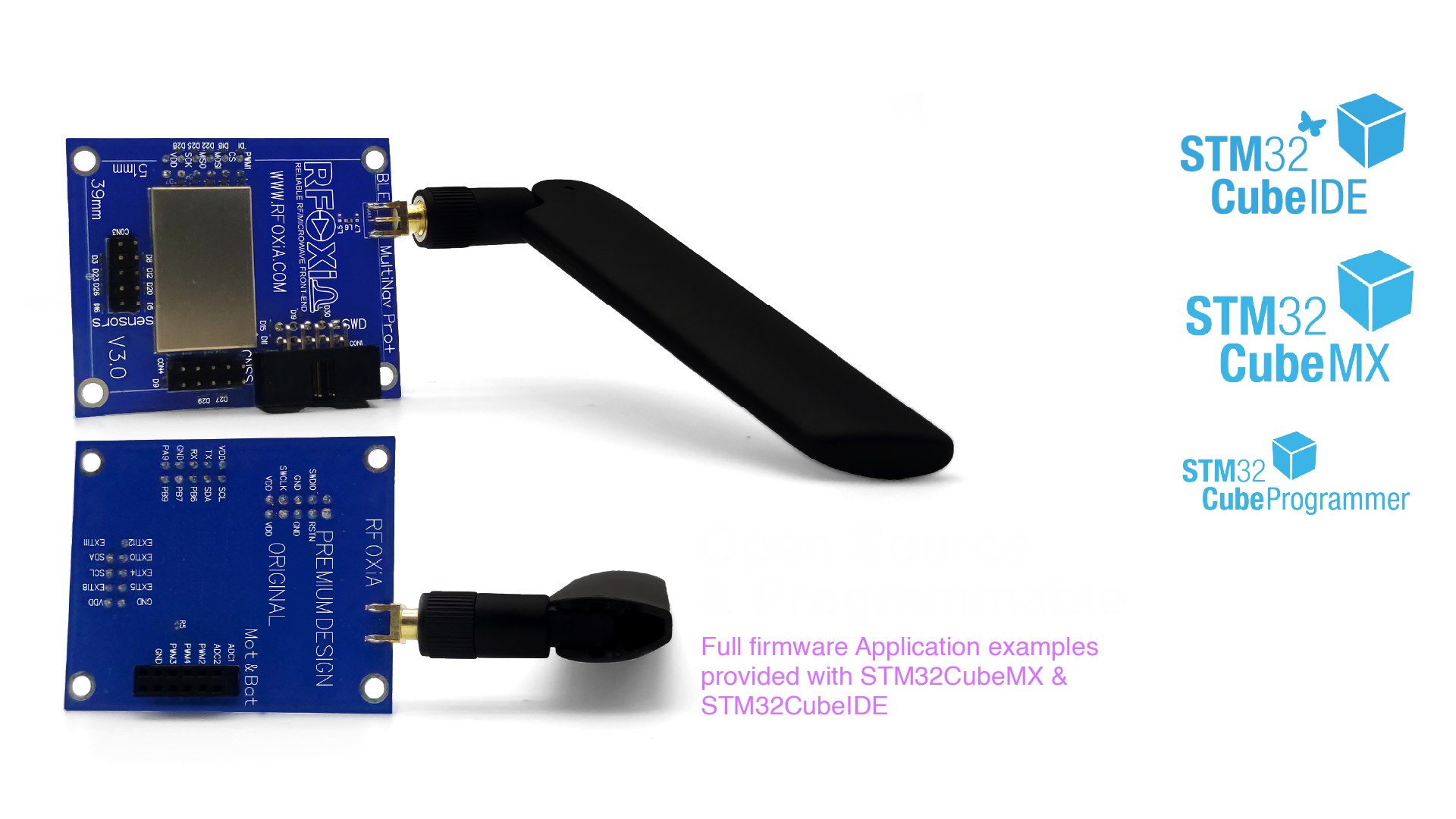
The MultiNav Pro+ BLE Module is fully open source. The complete firmware is published at github.com/RFOXiA/MultiNav-Pro-Long-Range-BLE-Module-Firmware-STM32WB07 and can be modified, extended, and compiled for custom deployment scenarios.
Programming access is via SWD (Serial Wire Debug) — the standard ARM Cortex debug interface — using the integrated STLink programmer included in the Power/Program Kit. This means standard development tools (STM32CubeIDE, OpenOCD, J-Link) work without any proprietary adapter or licensing requirement.
For developers who want to get to production firmware faster, RFOXiA Club includes an AI Firmware Builder that generates complete, production-ready firmware from plain-language descriptions of the target application. Describe your autonomous vehicle's communication requirements and receive compilable source code in minutes.
Integrated RTC for Time-Synchronized Autonomous Systems
Precision timing is a non-negotiable requirement in autonomous vehicle systems where multiple sensors, actuators, and communication nodes must operate in coordinated time domains.
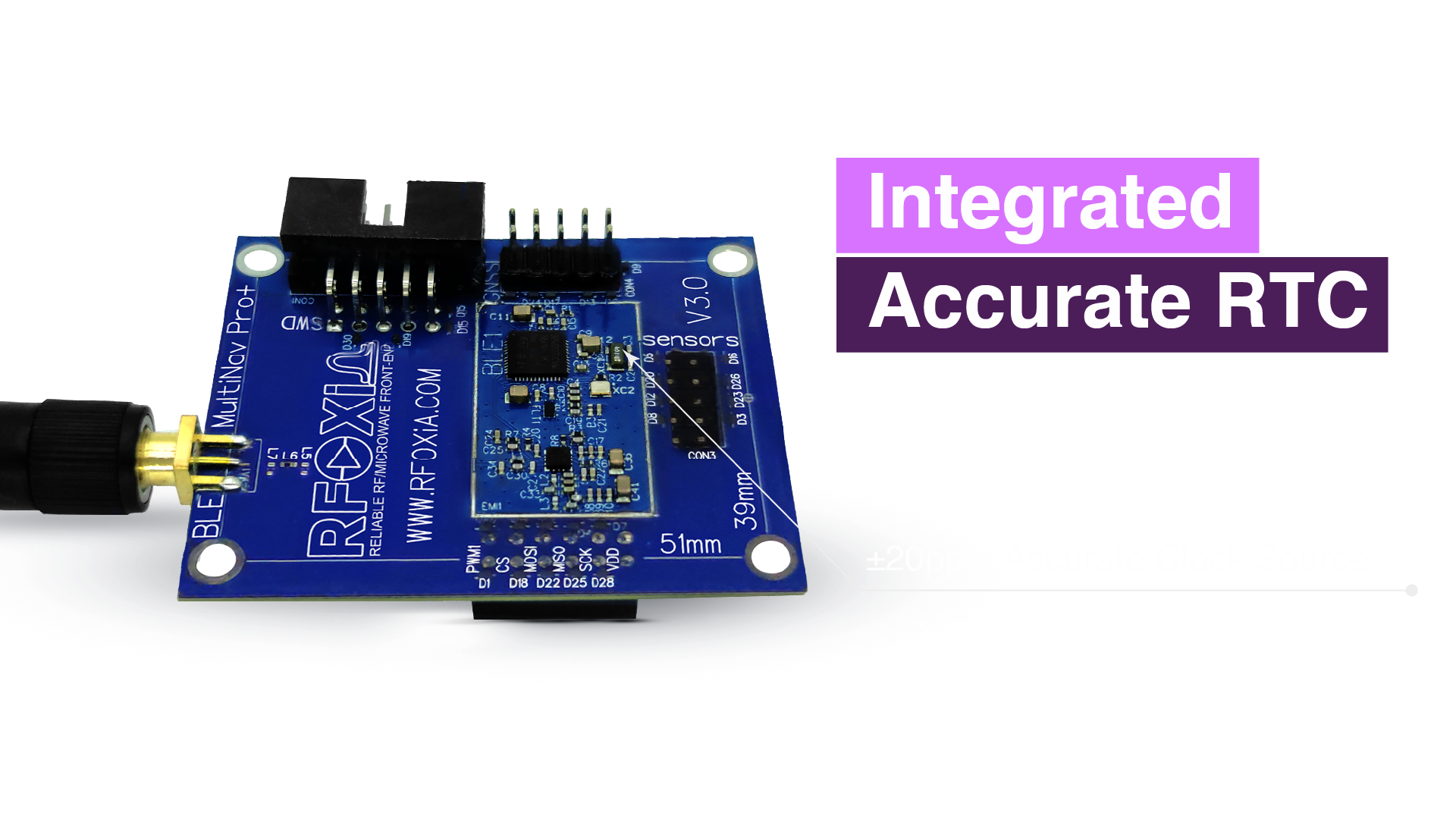
The MultiNav Pro+ BLE Module includes an integrated RTC crystal that provides accurate real-time clock functionality independent of the main processor clock domain. This enables:
- Timestamped telemetry packets — every sensor reading and GPS fix can be tagged with an accurate timestamp for post-processing and log analysis
- Synchronized multi-node deployments — multiple vehicles or sensor nodes can operate on coordinated time bases without GPS-disciplined clocks
- Scheduled operation modes — autonomous vehicle missions can be triggered or terminated based on real-time clock events
- Power management schedules — the module can enter low-power modes and wake on RTC alarm for energy-efficient deployments
This is a detail that distinguishes a professional autonomous vehicle communication module from a simple radio link — timing infrastructure built in at the hardware level.
FCC Certification: Deployment-Ready Out of the Box
One of the most significant practical advantages of the MultiNav Pro+ BLE Module is its FCC certification. Every RFOXiA module carries FCC approval — which means:
- Legal operation in the United States without additional RF compliance work
- Accepted by distributors including DigiKey, Mouser, and other professional electronics channels
- Integration into commercial products without triggering a full device-level FCC re-certification in most use cases
- Credibility for enterprise procurement and research institution purchasing departments
For developers building autonomous vehicle systems intended for commercial deployment or institutional research use, FCC certification is not optional. The MultiNav Pro+ delivers it at the $59 price point.
Competitive Landscape: Why Nothing Else Compares
The honest competitive analysis for the MultiNav Pro+ as an autonomous vehicle communication module looks like this:
Commodity BLE modules (Silicon Labs, Nordic, Chinese manufacturers): $5–15, 80–100m range, no ecosystem, no amplifier stage, no app. Adequate for in-room IoT, completely unsuitable for autonomous vehicle applications.
LoRa modules: Long range, but data rates of 250bps to 50kbps. Cannot support real-time control loops, video metadata, or dense sensor streams. Wrong technology for this application.
ExpressLRS / RC radio systems: Drone-focused, open source, excellent for RC control, but no sensor integration, no data monetization network, no general-purpose SDK.
Military / Industrial long-range radio: DTC BluSDR, Taisync, Harris systems. Ranges of 150KM+, but prices of $5,000 to $50,000+. Not accessible to the development community.
The MultiNav Pro+ sits in a position that was genuinely unoccupied before its existence: professional-grade autonomous vehicle communication performance at maker-accessible pricing, with a complete software and ecosystem stack included.
For engineers ready to move beyond 100-meter range limitations and build autonomous vehicles that actually operate at field distances, the RFOXiA Long Range Bluetooth Module is the direct path to getting there.
Complete Developer Ecosystem
Beyond the module itself, RFOXiA has built a complete support infrastructure for autonomous vehicle developers:
RFOXiA Club — the developer platform featuring the AI Firmware Builder, Dev Hub community, live device command center, documentation library, and firmware examples specifically for autonomous system applications.
Developer Bundle — the complete ecosystem kit combining the BLE Module, GNSS Module, 7-sensor Sensors Module, and Power/Program Kit (supercapacitor-based, 5-minute charge for 24-hour runtime) for $199. Everything required to build a complete autonomous vehicle telemetry and control stack.
Data Network — once a Sensors Module is deployed outdoors with GNSS validation, it contributes verified environmental data to the RFOXiA network and earns daily rewards of $0.08 to $0.40. Your autonomous vehicle deployment can become a revenue-generating data node when not in active use.
Specifications Summary
| Parameter | Specification |
|---|---|
| Ground-to-ground range | 5KM |
| Man-to-drone range | 15–20KM |
| Drone-to-drone range | 50KM+ |
| Data rate | 2Mbps |
| Processor | STM32WB07CCV6 |
| Module dimensions | 57mm × 47mm |
| Antenna length | 140mm |
| Fixing frame | 54mm × 34mm |
| Certification | FCC |
| Programming interface | SWD |
| App compatibility | iOS and Android |
| Firmware | Open source (GitHub) |
| Price (2 units) | $59 |
Conclusion: The Autonomous Vehicle Communication Module the Industry Has Been Waiting For
The MultiNav Pro+ BLE Module solves a problem that has constrained autonomous vehicle developers for years: the absence of a professional-grade, long-range, high-bandwidth communication module at a price point accessible to independent developers, university research labs, startup teams, and small-scale commercial operators.
50KM Bluetooth range. 2Mbps data throughput. FCC certified. Open source. Complete mobile app. Modular ecosystem integration. AI-assisted firmware development. Infrastructure-free operation. All of this at $59 for two units.
This is what it means to democratize autonomous vehicle communication technology. The capability that was previously locked inside military procurement budgets is now available to every developer who has a platform to build and a problem to solve.
If you are building an autonomous vehicle, drone, ground rover, research platform, or any wireless-controlled system that needs to operate beyond line-of-sight distances, there is no longer a reason to compromise on your communication link.
Explore full specifications, documentation, and ordering at RFOXiA Long Range Bluetooth Module and join the RFOXiA Club to access the AI Firmware Builder, developer community, and complete ecosystem support.
Written by: Moamen Mohamed LinkedIn